Thursday, November 14, 2013

#4

The Center for a Public Anthropology (based at the University of Hawaii and run by Dr. Robert Borofsky) recently released a study of social science faculty media impact at public universities. The aim, as Borofsky stated, was to permit the public to assess “the degree to which those who draw on public funding participate in public conversations in return.”

The project involved using the Google News archive from 2006 to 2011 to find how many times  faculty members were cited in any of 6,000 news sources, and then dividing the average number of citations for a school by the percentage of National Science Foundation funding the institution received. Schools then were ranked and, within schools, the political science, anthropology, psychology, economics and sociology departments were also ranked using the same system.

As reported in the University of Arkansas Newswire on October 11, 2013, the University of Arkansas social scientists ranked 5th in the country, out of 94 research universities, behind Rice University, Southern Methodist University, the Massachusetts Institute of Technology, and the University of Texas, San Antonio.

As is typical in such cases, the top three faculty at the University of Arkansas were named in the Newswire: Janine Parry and Andrew Dowdle from political science and my colleague Peter Ungar from anthropology. Among departments at the University of Arkansas, political science ranked #1. Anthropology ranked #2.

Curious, I decided to dig a little deeper, and discovered this:


Yep, I was number 4. I didn't make the headlines. Of course, I did have a lot fewer cites than the top 3, but 50% more than the numbers 5 and 6.

It's not that I really care about such things (well, that's not entirely true, if this ranking helped me get a larger merit raise that would be great). The point for calling attention to it is (1) because who else will, since I missed the top three cut-off (the tyranny of trinitological thinking!) and (2) my citations are in all likelihood due to this blog; the fact that I display here my obsession with kufiyas; and that during 2007-2008 there was a "kufiya craze" and a fair amount of media attention to the phenomenon. I was interviewed by various media reporters about the kufiya, most notably in the New York Times.

There is no lesson here, or at least, there is no "model" for anyone who wants a similar amount of media attention so they can impress their college dean. The media attention was really quite random. Moreover, the NSF funding that also factors into the equation has nothing to do with me. Most of it, when it comes to my university, is probably from my anthropology colleagues, especially those in Biological Science. There is no direct line between NSF funding and media impact with an impact on the public.

Monday, November 11, 2013

"I'm Stoned" by MC Sadat and Figo (Mahragan)


I'm stoned, I'm drunk...Stoned, drunk...Dear Mr. weed dealer/Give me two bags/Cuz I invited my friends/For a beer and two joints.

heaven knows I'm miserable now

I found this in tumblr but can't find the site now. 
Probably it was ordered to take all its riffs on The Smiths down. 
Grab this fast if you like it.

Friday, November 08, 2013

Leila Mourad's brother Mounir: another Egyptian Jewish artist

I recently learned that the great Egyptian singer and actress Leila Mourad's brother Mounir Mourad was also a prominent showbiz figure in Egypt, a singer, actor, and composer.


Son of the great Egyptian Jewish singer and composer Ibrahim Zaki Mordechai (known as Zaki Mourad), Mounir was known for, among other things, his efforts to incorporate jazz music into Egyptian popular music.

He wrote the music for one of Shadia's big hits, "Wahed, Etneen" (One, Two), which you should check out. The Hawaiian guitar at the end of the song is just perfect.


Like his sister Leila, Mounir converted to Islam after he married. His wife was the actress Soheir El Bably.

But unlike Leila, it seems that Mounir was not accused of relations with Israel, and so he remained active as an artist at least into the 1960's. His film appearances are quite delightful, and I've found several on youtube. They show him doing fare that is somewhat more "modern" (not sure how else to put it) than that done by his sister, and would seem to put him on the avant-garde side in the Egyptian popular music scene.

Check out this jazzy number, "Ayna Tadhhab Hadha al-Masa'" (Where are you going this evening?) from the 1955 film Appointment with Satan (موعد مع ابليس), which features Mounir on vocals (and he co-wrote the music with Mahmoud El-Sherif).


This is another delightful one, "Isti‘rad al-Batta" (Duck Review -- not really sure how to translate this), from the film Bint al-Hitta (Local Girl, 1964), with Mounir on vocals (and he composed the music). It's also notable for the dancing of the divine, inimitable Samia Gamal.


This long number is really a scream. It's called "Skatch al-Kura (Ya Hadarat al-Mustama‘in)" or Football Sketch (O Distinguished Listeners), sung by Mounir, and again, his composition, and one showing his equal facility with modern show tunes and traditional Egyptian mawwal. It's from the film Naharak Sa‘id (1955), and it's a marvelous musical production, beautifully filmed, by director Fatin Abdel Wahab, who later married Mounir's sister Leila (I'm not sure which year, but definitely after this film was made.


According to the wikipedia article about Mounir Mourad, he wrote the music hits not just for Shadia, but several for Abdel Halim Hafez (including the great "Dahk wa La‘b") as well as hits for the likes of Warda, Muhammad Qandil, Hani Shaker and others.

Finally, download a zany instrumental with insane Farfisa, called "The Factory Theme," here.

Wednesday, November 06, 2013

Satanism, West and East

Dangerous Minds has recently been reporting on US hysteria over Satanism (I guess it's a Halloween season theme)? One of them is on a 1970 film, in the pseudo-documentary/ethnographic Mondo Cane vein, called Witchcraft '70. The other is about an evangelical preacher, Dr. Jerry Johnston, and a video he is in that dates from the late 1980s.

In both cases it is all moral panic: Satanism and animal sacrifice, human sacrifice, ritualistic sex, drug use and abuse, desecration of Christian symbols, and so on. In Witchcraft '70, it's hippies who are the focus, and we see nude hippy Satanists doing hallucinogenic drugs and a ritual that involves the violation of nubile young women. In the Johnston vid it is heavy metal music that is associated with the evils of Satanism. In both instances, Satanism is presented as a danger that threatens young people, and urges more sober adults to be on the look-out for the warning signs.

I presented a paper at the American Anthropological Association meetings in 2000 on the 1997 crackdown on Satanic heavy-metal fans in Egypt. I've never published the paper, but you can read an account of it here.

Below is a photo of one of several popular exposés of Satanism that I found in Cairo in summer 2000. This one is entitled: Satan Worship: Rituals of Sex and Blood.


As I am considering reworking the paper for eventual publication, I find it interesting to what degree the 1997 panic over heavy metal Satanism in Egypt (and another, much less hysterical one in 2012), Morocco in 2003, Lebanon in 1996-98 and 2002, and 2012, among others, have their ideological origins in the various panics over Satanism (probably dating from the late sixties) in the US. The discourse, East and West, is remarkably similar, as are the themes and motifs.

The big difference, of course, is that in the case of the US, the danger is internal, whereas in the Arab World, the danger is presented as external: Satanism is an alien, Western, sometimes Zionist, threat.

(Some of these issues are also discussed, of course, in Mark Levine's Heavy Metal Islam.)

More, inshallah, later.

P.S. added 11/11/13: I just came across this source on Egypt's heavy metal, which I've not yet read (but I just ordered the book on Interlibrary Loan): Benjamin J. Harbert, "Noise and its Formless Shadows: Egypt's Extreme Metal as Avant-Garde Nafas Dawsha," in Thomas Burkhalter et al, eds.,  The Arab Avant-Garde: Music, Politics, Modernity, Wesleyan University Press. (The book comes out this Wednesday!)

Saturday, November 02, 2013

Line Monty, friend of Farid al-Atrash

I was poking around on ebay earlier today and found this photo, from the back cover of a Line Monty album that was for sale (for more than I wanted to pay, alas).


Line Monty (d. 2003) was one of those many terrific Algerian-Jewish singers of the twentieth century. According to wikipedia (French), she was a friend of the great singer and oud player Farid al-Atrash (a Syrian, but whose career was almost entirely in Egypt). The wikipedia article states: 'En Égypte, son ami Farid El Atrache lui fait répéter une de ses compositions et les Égyptiens, ignorant qu'elle possède aussi cette culture écoutent "la Française qui chante si bien l'arabe."'

This is the album in question. (The title track is the only French song on the album; the rest are Arabic.)


I highly recommend getting anything by Monty. I've been unable to track down much about her biography at the moment, but in future, inshallah. I do know that she was frequently backed by Maurice El Medioni on piano.

Meanwhile, here is one of her great songs:


As for Farid, he had a secret love affair with Moroccan Jewish singer Maya Casabianca (who grew up in Israel as Margalit Azran), who was a big star in France in the sixties. But that's another story. 

(F.N.: Umm Kalthoum met Salim Halali once.)

Thursday, October 31, 2013

hip capitalism: kale from jail

A report on Soprafinna's and Cicchetti, restaurants in Chicago.

Isn't it so cool and hip and botique-y when restaurants promote local and natural food production? and use recyclable and biodegradable products? and produce tapas with a 'Venetian twist'? and use eco-friendly design?

And then there is, as Doug Henwood has quipped, kale from jail: 'Both new eateries will tap local sources for produce, including a new partnership with the Cook County Department of Corrections that's already underway with Mr. Rosenthal's other restaurants for naturally grown tomatoes, kale, squash, beets and more.'

(Thanks to Adolph for this one.)

Sunday, October 27, 2013

Bahram Hajou's kufiya art

I know very little about Syrian-Kurdish neo-expressionist painter Bahram Hajou, but I like this painting, called "Menschen," featuring kufiyas.


Here's Bahram's website. And if you read German (he is based in Münster), check this out.

Saturday, October 26, 2013

Omar Souleyman's new release "Wenu Wenu" (and the question of politics)


 Syrian dabke singer Omar Souleyman has a new album out, Wenu Wenu, his first album produced specifically with a Western audience in mind. And he has been getting lots and lots of publicity.

In The Guardian. Where he says: "My music has no influences," and "I'm not into politics, I don't know any solution."

In Rolling Stone. Where Souleyman says "he's never felt pressure to join any political parties, or lend support to the government." And we learn that Syria dabke expert Shayna Silverstein  

once went to a Souleyman show where a couple of concertgoers from Beirut, the cosmopolitan capital of Lebanon, crinkled their nose at the singer.

"They said, 'Oh, I don't understand why he is representing our culture. They should really invite Marcel Khalife'"...

In Spin, two articles.

The first calls Souleyman "[o]ne of the hottest stars of indie music," a quite remarkable designation, and one, the article underscores, which is quite unlikely. It goes on to say that, "Without a doubt, Omar Souleyman is the most popular Syrian wedding singer in the Western world. Beyond President Bashar al-Assad, he may be the next Syrian who an American music fan could name."

Souleyman calls attention to Syria's drastic water crisis, which played a major role in turning him into a musician: 'If the region hadn't fallen into a crippling drought, Souleyman might have remained a farmer. "It's a problem in the region," he says. "Even the wells have dried up and there are many issues with bringing water to people."'

On the paradox of Souleyman's success in the West: 'Zayid Al-Baghdadi, a criminal defense lawyer from Baghdad, says that neither he nor any of his Syrian friends had ever heard of Souleyman until he moved to Montreal. "When I first saw Omar perform here, I was just amazed by the cultural clash between him and the audience," he wrote via e-mail. "Here you have a middle-aged Arab man dressed in traditional bedouin clothing and a crowd of intoxicated, pot-smoking hipsters dancing frantically to his music. I think what has added to Omar's appeal in the West is the fact that his music has been slightly tweaked to better suit modern Western dance-music tastes."'

The other publicizes the release of the album and the video "Warni Warni," which really does kick ass.

Check out the two videos from the new release, "Warni Warni":


And "Wenu Wenu": 


Both are great, but it may be that, as some observers claim, the sounds of the keyboards (which imitate the mijwiz, used in traditional dabke, may have been softened up to suit the Western ear.

Of course, Souleyman's arrival on the "indie" scene isn't brand new -- for instance, he played Glastonbury in 2011:


And Bonaroo the same year:


It also seems to be the case that Souleyman is not as apolitical as it seems. Check out this song he did in tribute to Syrian dictator, Bashar al-Asad. 


Since it took me about 5 seconds to find this, you would imagine that at least one of the music journalists writing about Souleyman could have asked him about this song. I in no way want to trash Souleyman here for this recording, given that so many artists were forced to make such compromises (or felt they had to) in order to maintain their careers under Bashar's rule, but I do wonder why none of the journalists who have interviewed Souleyman bothered to do the research to find this, and ask the question.

The kind of "electronic dabke" produced by Souleyman is not unique to him alone, for there are a number of Syrians recording and performing in a similar vein. One who I particularly like is Saria al-Sawas, who I believe is better known in Syria and is more urbane than Souleyman.


Check out this video of her performing "Hajar" for a wedding (the bread and butter for such musicians):


If you like this one, go look for some more vids. There are lots out there. And also lots more of Omar Souleyman.

Wednesday, October 23, 2013

Algerian twist


Check out this youtube video from apollon1965 (who is no doubt Algerian), where he plays one side of an e.p. by an Algerian singer named Karoudji. The first track, "Brigitte Bardot Bardot," is very Cuban in its feel, especially when you get to the piano interlude starting at about 1:15, and it's not really a twist. Karoudji sings it in that distinctive francarabe style developed by Algerian popular musicians beginning in at least the 1930s.

I am unable to make out the title of second track (starting at 2:55) from the record jacket. It opens with a kind of flamenco guitar intro, but then shifts into a cover of Chubby Checker's 1961 hit "Let's Twist Again," which hit #8 on the US charts, and charted throughout Europe as well. "Let's Twist Again" in Algerian Arabic! It's a pretty decent cover too, rockin' sax solo.

According to apollon1965, Karoudj was a singer originally from Oran, who sang rock'n'roll and twist in the early 1960s. I'm not sure whether this was recorded prior to Algerian independence (July 1962) or after.

I've been able to find out nothing else about Karoudj thus far other than the fact that he also recorded a cover of Johnny Hallyday's 1961 single "24,000 Baisers." (It must have been a hit in France, as it was covered by several other artists, among them Dalida and Bob Azzam.) Here's the cover of Karoudji's EP.


According to the writeup by the amourdurocknroll.fr website, Karoudji recorded "24,000 Baisers" in French. The other tracks, "Si Tu Voulais," "Twist à B.B.," "Zinek," "Yasmina," and "Rock's Twist," seem to have been recorded in Arabic. The EP was released in 1963 (after independence) on the La Voix du Globe label, in Oran and Paris.

There is also a film about the twist in Algeria, director Mahmoud Zemmouri's Les Folles Années du twist (The Golden Years of the Twist), released in 1986. I've only seen some clips of it, but it is about two young Algerian men who are obsessed with rock'n'roll and dressing like hip rocksters and are disinterested in either working or the war of liberation. The only information I have about the music in the soundtrack is that it features at least one song by French pop star Richard Anthony, known for covering US rock'n'roll songs in French (as was Johnny Hallyday). Anthony even did a version of "Let's Twist Again," which he recorded in English.

Anthony was born Ricardo Anthony Btesh, in 1938 in Cairo. Son of a textile manufacturer originally from Syria, he lived the privileged life of the Levantine in pre-revolutionary Egypt, and was of course a polyglot, schooled in the UK and France. He launched his music career by recording covers of US rock songs in French, and had his first major hit as a rocker in France in 1958. 


There's another late-fifties early-sixties Algerian rock'n'roller -- Mahieddine Bentir, who put out "Optimiste Twist" in 1964. The song won the prize of the 5th festival de la chanson méditerraneéne (about which I've not been able to find anything). He sings it in French, but it has just a bit of Eastern flavor, and he even calls it a "twist Orientale." Music and lyrics were composed by Bentir himself. Perhaps the optimism he expresses is that of his newly independent country. It's recorded with a French group, Jean Claudric et son orchestre, who appeared on numerous French recordings (including some by the Algerian Jew and French pop star Enrico Macias, born Gaston Ghenassia), and it was put out on the El Frida label (which I assume is Algerian). (The song also seems also to have been issued under the name "Manach Dalam (Twist Oriental)" on the Spanish label Vergara.)

There is an even more remarkable rock'n'roll song from Bentir, very jazzy, called "Scooter," which I really love. This one is sung in Arabic. It's not clear when it was released, some sources say late fifties, others early sixties. It really rocks.


The only other track I've been able to find from Bentir is the rock song, "Prête-moi mille balles" (Lend me a thousand bullets), which apparently evokes the Algerian revolution. 

Bentir was by all accounts an important figure in this period, but I've not been able to find out much about him, and some of what I've found seems unreliable. For instance, the claim that he placed second in the 1966 Eurovision contest, and although his song was clearly superior, he was denied a victory because he was an Arab. But in fact he was not an entrant in Eurovision, that year or any year. (Algeria does not compete in Eurovision, in any case.)


But we do know for certain that Bentir was prominent enough to have been one of those Arab artists who appeared on Algerian television during the colonial period (between 1958 and 1962). Here's a photo of a Bentir appearance from 1959, which I took from the very fine documentary Alger Oran Paris: Les années music-hall.


Last note: I love this EP cover, put out by Philips in France, which was once for sale on-line, but alas, no more.


Tuesday, October 22, 2013

Love amid the ruins

I learned about this amazing and appalling vid from Edo Konrad, writing for the great +972 blog.


The vid features the Nahal Band (Lahakat HaNahal), a well-known music and theater group attached to the Nahal Group, combat units in which military service was combined with agricultural work on new agricultural settlements and kibbutzim. That is, we're talking about an music group sponsored by the Israeli military.

The video shows members of the group singing a love song and driving their jeep around over rugged, first on land where prickly pear cactus (sabr in Arabic, sabra in Hebrew) is growing. Palestinians would of course immediately recognize the cactus as the sign that this was the site of a Palestinian village, as Palestinian peasants typically planted sabr as a kind of fencing around their communities. (And the prickly pear is a delicious fruit.) Then we see the Nahal Band singing on the site of a ruined Palestinian village, one of the some 418 Palestinian villages and towns destroyed in the wake of the 1948-49 war.

I have no idea which of the many destroyed villages it is (I saw several when I did my fieldwork in 1984-85). According to Konrad, the film was probably shot in the mid-60s. The ruins, characteristically, are made to look quite old, so as not to give any impression that the inhabitants would in fact have been evacuated (in an act of ethnic cleansing) less than 20 years prior to the shoot.

The love song is “He Didn’t Know Her Name” by the celebrated songwriter and poet Haim Hefer, who died just a year ago. He was a canonical composer associated with the "heroic" years of the Zionist movement, who wrote for the Palmach, for the Nahal Band, and for classic Israeli films, including famous ones that date with Israel's Mizrahi (Jewish Arab) population, Salah Shabbati and Kazablan. (I've blogged about the latter and how it manages to simultaneously evoke and erase the Arabness of Jaffa, where it is set, and the "Eastern" character of its protagonists, who are Moroccan Jews. Hefer's compositions for the film, which are very far from the kind of music that Moroccan Jews in Israel were actually singing and performing at the time, play a role in this erasure/evocation.) Hefer was also the composer of another canonical Zionist song, "The Red Rock," a song about Petra, the famous Nabataean city in southern Jordan. According to Rebecca Stein, "Petra was a place long immortalized in Israeli myth, the subject of collective longing, popular song [most notably Hefer's], and children’s stories. Beginning in the 1950s, clandestine travel to this Nabatean city had been a virtual rite of passage for young Israeli men who risked their lives in enemy Jordanian territory for a glimpse of the city’s celebrated red sandstone cliff."

Fitting, then, that, given who Hefer was, that he be buried in Ein Hod Artists’ Village, in accordance with his wishes.

Ein Hod, as anyone who has read Susan Slyomovics' book The Object of Memory or seen Rachel Leah Jones' documentary 500 Dunam on the Moon knows, was founded in 1953, on the ruins of the Palestinian village of Ayn Hawd, whose residents had been expelled. The charm and beauty of the artists' colony is largely a product of the original Palestinian village architecture, which was restored and remodeled according to the new residents' preferences. Imagine that the ruins we see in the video above were transformed into a quaint, bohemian artists' abode. That's what Ein Hod is, and this has been the fate of many Palestinian "ruins" throughout Israel, in West Jerusalem (for instance Ein Karem), Safad, Jaffa...

The video is a potentially a great teaching tool, particularly if you are using texts like Slyomovics or Rochelle Davis' Palestinian Village Histories: Geographies of the Displaced or chapter two ("Scenes of Erasure") of my book, Memories of Revolt.

I wish someone who reads this would identify the village in the Nahal Band video.

Sunday, October 20, 2013

Tunisian rappers form union; Klay BBJ acquitted

Tunisia's rappers, of all Arab hip-hop artists, continue to be the most politicized. At least it would so appear.

BBC News reported on October 15 that Tunisian rappers are forming a union to defend their interests. According to the Italian news agency ANSA, "Born under the guidance of a minor trade federation called the CGL, the rappers union has little to do with work contracts and a lot to do with sending a signal to the powers that be. These appear unable to take any criticism, no matter where they come from, and especially if they call for social change."

Klay BBJ

 Meanwhile, AhramOnline reported on October 19 that rapper Klay BBJ (named after boxer Cassius Clay/Muhammad Ali), had been acquitted on appeal, after serving six months of his jail sentence of 21 months. He had been convicted of insulting government officials, undermining public morals, and defamation, based on a performance he did together with rapper Weld El 15 during a concert at a sea resort south of Tunis. Weld El 15, notorious for his song "Boulicia Kleb" (Cops Are Dogs), was also convicted, but remains at large. (I wrote a brief post on Weld El 15 in April, here.)

 Aymen El-Fikih (l), Mustapha Fakhfakh (r) photo: AFP

Tunisian rappers Mustapha Fakhfakh and Aymen El-Fikih for their part are about to go to trial for "insulting public officials" and "affronting morals" in the course of protests surrounding the trial of Weld El 15.

Wednesday, October 09, 2013

Ziad al Rahbani's "Yellah Keshour Bara" and Sabreen's "Maz'ooj"


 I remember how blown away I was by Sabreen's album Maz'ooj, released in 2002. I particularly liked the songs which featured actor Mohammad Bakri's deep-bass spoken vocals (he is pictured on the bottom right on the album cover). And I also liked how the group incorporated, on a number of songs, a kind of hip-hop vibe. Listen, for instance, to the song "Wala‘" (Set Alight).

I had always thought that the album was so completely unique, that there was nothing like it.

And then I was listening again to Ziad al Rahbani's 1985 album Houdou Nisbi (which I picked up in Beirut in March), and noticed that Ziad's vocals on the song "Yellah Keshou Barra" are spoken as well, and Ziad's very clever, disco-ish, arrangement, as well as his deep, spoken vocals...remind me of Bakri on Maz'ooj. Listen to it here.


Could Ziad have been an influence on Sabreen when they recorded Maz'ooj?

more R'n'B turbans

Thanks to Nabeel for informing me about this gallery of African-American entertainers turbans, posted by Freddie Patterson for India Music Week.

If you've followed this blog, you will know that I don't just post about kufiyas, and sometimes do post on turbans on occasion. And I've posted some of the same photos as found in the gallery, and about most of the same artists. You can see my turban postings here -- there are quite a few.

But there were some revelations nonetheless. I just love this photo of R'n'B giant Louis Jordan.


And Aretha Franklin in a turban:


I had posted a photo of singer The Mighty Hannibal in a turban previously, but I found this vid, of him singing "Jerkin' the Dog," on a TV show, I guess, to be quite fun.


Wednesday, October 02, 2013

Kufiyaspotting: Paula Deen

This is a weird one, eh? Paula Deen, the celebrity chef lately accused of uttering racial epithets, was the Grand Marshal for the 2011 Rose Bowl Parade. She appeared in publicity photos wearing a red kufiya. Red, I guess, because it was the Rose Bowl, and she is from a "red state." But the kufiya???


Sunday, September 29, 2013

drone life 5: Chicago alderman proposes using drones for students' safe passage to school

Yes, seriously, Chicago Alderman George Cardenas proposed this.

And the Association for Unmanned Vehicle Systems International chimed in, saying that 'drones can be a boon to law enforcement agencies by keeping officers out of dangerous situations, helping with search and rescue missions, responding to natural disasters and saving on the bottom line. The group claims drones can operate for as little as $25 to $75 per hour, which is far less than the $400-per-hour cost of using a manned helicopter.' And -- “The technology could certainly be used to help keep children safe. Importantly, however, it is up to local leaders to determine whether this is an appropriate use in their community," according to AUVSI spokeswoman Melanie Hinton.

One wonders whether Mayor Rahm Emmanuel might not be in favor, since all the school closings that his administration mean that many school children who going to new schools will have to cross gang boundaries and to be "in the line of fire."

Friday, September 27, 2013

drone life 4: Seymour Hersh

"Like killing people, how does [Obama] get away with the drone programme, why aren't we [journalists] doing more? How does he justify it? What's the intelligence? Why don't we find out how good or bad this policy is? Why do newspapers constantly cite the two or three groups that monitor drone killings. Why don't we do our own work?"

Seymour Hersh, to The Guardian, September 27, 2013.

Thursday, September 26, 2013

drone life 3: Lynn Hill on "Capacity" (Vijay Iyer and Mike Ladd's Holding It Down: The Veterans' Dreams Project)

I learned of this thanks to a tweet of Teju Cole.

As you no doubt know, the great jazz pianist Vijay Iyer just received a prestigious MacArthur Award.

You will find him even more deserving when you learn, as I just have, of his recent release, with Mike Ladd, of Holding It Down: The Veterans' Dreams Project. I've only listened to a few tracks (it came out on September 24) but what I've heard is great. The publicity from Pi Recordings describes the album as follows: "a thought-provoking, sometimes frightening, and ultimately exhilarating combination of music, poetry and song, created from the actual dreams of young veterans of the Iraq and Afghanistan wars." And check out the vid below that introduces the project.


But because I sometimes blog here (not very profoundly) about drones, I was particularly interested in the track "Capacity" (which you can listen to here), featuring the poetry and recollections of Lynn Hill, who worked as a drone operator, firing missiles remotely into Iraq from her base in Las Vegas. "Soft kill," she calls it. It's very powerful stuff.


Here's a section of her poem:

I have a capacity for war. I have a capacity for hate. I have a capacity for insanity. For anger. For lies. 525,600 minutes times 2, before I break into an explosion of thoughts, of insurgents and soft kills, and career moves. Capacity for destruction. Capacity for loss. Capacity for death, violence, nothingness. 24 months of pain and disgust. Actions of my hands accuse me. Guilty, charge. Unclear clear details and shaky intell, but still I pull the trigger. There’s a limit to madness. Gague clocks out at two years, but they serve up poison like entrees at Blueberry Hill. Crazy with a side of numb. It took 63,720,000 seconds to go from me to somebody else. 

And check out the NEA interview with Lynn Hill, where she reflects more on her poetry and her work as a Predator Drone operator.

I have a capacity for war. I have a capacity for hate. I have a capacity for insanity. For anger. For lies. 525,600 minutes times 2, before I break into an explosion of thoughts, of insurgents and soft kills, and career moves. Capacity for destruction. Capacity for loss. Capacity for death, violence, nothingness. 24 months of pain and disgust. Actions of my hands accuse me. Guilty, charge. Unclear clear details and shaky intell, but still I pull the trigger. There’s a limit to madness. Gague clocks out at two years, but they serve up poison like entrees at Blueberry Hill. Crazy with a side of numb. It took 63,720,000 seconds to go from me to somebody else. To change. - See more at: http://arts.gov/audio/lynn-hill#file_audio_default_group_audio_transcript
PS: Vijay Iyer's 2003 collaboration with Mike Ladd, In What Language?, is also terrific.

Tuesday, September 24, 2013

Orient-Institut Studies 2 (2013) - Inverted Worlds: Cultural Motion in the Arab Region

Volume 2 of Orient-Institut Studies (put out by the Orient-Institut Beirut and the Orient-Institut Istanbul) recently came out (the journal is published only online). It's the Proceedings of the Conference, "Inverted Worlds: Cultural Motion in the Arab Region," Beirut, October 4–8 2012. I've not had time to do more than skim some of the articles, but they are all about the Arab uprisings and culture. Since my main area of interest is music, I thought these essays seemed particularly interesting:

Yves Gonzalez-Quijano: Rap, an Art of Revolution or a Revolution in Art?

Nader Srage: The Protest Discourse: The Example of “Irhal” (Go/Get Out/Leave)

And there are more articles on graffiti, poetry, jokes and more. All the articles are online. Please check it out.

Monday, September 23, 2013

more kufiyaspotting: Main Attrakionz


Main Attrakionz are a rap duo from Oakland, California, 
well known players in the "cloud rap" rap subgenre.


And they seem to really like kufiyas. In all the colors.


Sunday, September 22, 2013

drone life 2: NYPD drones


In December 2012 the NYPD arrested the artist Essam Attia for posting 100 posters around the city suggesting that New York's finest were using drones to control crime. In particular, given the image, it intimates a targeting of the undocumented. (The image of the fleeing family is lifted from a warning sign developed by the California Department of Transportation to warn drivers, on I-5 north of San Diego, that illegal immigrants might be crossing.)

The posters also are riffing on a current iPod add seen around town:


Just a month after Attia was arrested, CBS News reported that the NYPD might be considering using drones in its crimefighting efforts.

A year earlier, anti-war activists in the city, led by a US army vet who had worked with drones during two tours in Iraq, were posting signs saying: “Attention, authorized drone strike zone.”


Stay tuned...

Saturday, September 21, 2013

Esther Ofarim does Scott Walker

I posted previously about Esther (born Esther Zaied, in Safad) and Abi Ofarim, their 1968 #1 hit "Cinderella Rockafella," and the fact that Esther's parents were Syrian Jews.

This is just a footnote. But a beautiful one.

It's Esther who performs Scott Walker's "Long About Now" on his 1970 album, 'Til the Band Comes In. As Dangerous Minds (where I learned about the recording) tells us, she really kills it.

Why did an Israeli singer, best known for a novelty song, do a guest vocalist on a Scott Walker album?! According to Dangerous Minds, the lyrics were just too much for him to sing. And -- his manager at the time was the Israeli Ady Semel, who also managed Esther and Abi. Strange convergence. And yet, what a result. Here's Esther doing the song live on the Rolf Harris Show in 1970. (Yeah, that Rolf Harris, who recorded "Tie Me Kangaroo Down Sport" 1959, and in 2013 was charged with child sexual assault. His show ran on BBC1 from 1967-74.)


The album, 'Til the Band Comes, was a commercial and critical flop. But as you know, Scott Walker's reputation has been growing and growing since the mid-eighties, and he is now considered an important experimental and avant-garde artist. A far cry from his pop days as part of the Walker Brothers, and this 1966 hit (the one I remember the best, as it was #1 in England -- and I lived in Lebanon and therefore it was the UK charts that we had best access to.) (Scott is on the right.)


Friday, September 20, 2013

Rai rebels redux: Khaled flees homosexual-friendly France for the warm embrace of the Moroccan monarchy

Back in June, it was announced that the King of Rai, Khaled, rai's legendary "bad boy" would be decamping France for Morocco. He and his wife Samia (a Moroccan citizen) had decided do so after France legalized gay marriage, and for the sake of the proper moral education of his children.

In August, a royal decree granted Khaled Moroccan citizenship, and King Mohammed IV (towards whom the rai singer has expressed his friendship and admiration) went so far as to give Khaled a villa on the Saâdia coast.


 Rebel, indeed. (See my 2010 post on Khaled here.)

Thursday, September 19, 2013

Andalusian music responsible for the fall of Arab Spain, says the Imam of Zeitouna mosque (Tunisia)

In fact, Cheikh Houcine Laabidi put it this way, according to Tuniscope (14 September, 2013): reckoning that the Arabs were too preoccupied by their music, he argued that malouf (the brand of Andalusian music played in Tunisia) had contributed to the fall of the Islamic state of Andalusia. It seems he was exercised by the fact that Tunisian national television had broadcast concerts by the Tunisian malouf artist Zied Gharsa.

Malouf is the 'classical' Andalusian tradition as it is done in both Tunisia and in the city of Constantine in Algeria, and it is said to originate from Seville. Cheikh Raymond Leyris was a famous Jewish Algerian malouf practitioner from Constantine.

Here is Zied Gharsa:


PS (added September 25): This post got tweeted and a gentleman from Constantine commented that malouf is played throughout the Maghreb, not just Constantine. So I should clarify: Andalusian music is played throughout the Maghreb and malouf is the name for the Tunisian and Constantine variant. Elsewhere it's known variously as hawzi, gharnati, andalusi...

Arabic Elements in Palestinian Yiddish


Don't you really, really want to read this book? I'm about too, soon. Amazingly, it is in the University of Arkansas library (it's part of the Kenneth L. Brown collection), and I just reserved it. If I find time, I will report back.

Saturday, September 14, 2013

Tehran Street Style

This is a lovely photo album of 'street style' in Tehran. Mostly women. If it's "street," however, it's definitely uptown and not downtown. Here's a sample.


Get this: Mutamassik's newly remastered "That Which Death Cannot Destroy." Free!

photo: Morgan Craft


In case you don't already know how cool Mutamassik is, The Wire is promoting this. That enough for ya?

About the recording, Mutamassik sez: "It still 'cannot be bought or sold' and I'm playing all the instruments, again, as opposed to sampling ghosts of my ancestors whose names I did not even know."

Here's the link to The Wire, which will link you to the downloads.

I don't, alas, have time to review the release, but I did review her album, Masri Mokkassar: Definitive Works here.

Sunday, September 08, 2013

Battle of Algiers Mambo

If you've seen The Battle of Algiers, you of course remember the famous scenes when the two young Algerian women, dressed up to look like évoluées, plant bombs in a milk bar and a bar. The scene is based on historical fact. On September 30, 1956, the FLN militant Zohra Drif planted a bomb at the Milk Bar, which, according to Raphaël Draï (Le pays d'avant, 2008, Paris, p. 228), was one of the most popular hang-outs for young Europeans, as well as young bourgeois Arab women. Samia Lakhdari planted her bomb at L'Otomatic, the most popular student bar of Algiers.

The song playing on the jukebox, according to Draï (at L'Otomatic, I think he means, but it's not clear) was a mambo that was all the rage, from the 1954 film starring Sophia Loren, La Donna Del Fiume (known as La Fille du fleuve in French, Woman of the River in English). Draï doesn't tell us what his source is for this fact.

Perhaps it was this one, from a scene in the film which features the sultry dancing of Loren. I have not been able to identify the title or the artists.


The video identifies the song as "Mambo Bacan," but clearly that's not what it is. This is "Mambo Bacan," sung by Sophia Loren, and also from the movie soundtrack.

I've blogged previously about the song playing in the milk bar in The Battle of Algiers, when the bomb goes off. If you read the comments for the post, you will find that the song is identified as "Rebecca," and that it's by The Chakachas. You can listen here. It's a cha-cha-cha.

Saturday, August 10, 2013

On Bob Azzam's "Mustapha" (a.k.a. "Ya Mustapha")


From Michel Launay's great book, Paysans Algériens: La Terre, La Vigne et Les Homme (Paris: Éditions du Seuil, 1963). He is describing what he considers the negative effects of what he calls "double culture" (French, Algerian) on the small group of educated in the arrondissement of Aïn Témouchent, in the late fifties and early sixties. He writes, on p. 381:
J'ai écouté, pendant l'été 1962, de navrantes conversations, où des titulaires du B.E.P.C. [Brevet d'Études du Premier Cycle], instructeurs scolaires ou autres petits fonctionnaires des villages, trahissaient inconsciemment leur egoïsme et leur futilité. L'exemple de leurs dirigeants qui s'entre-déchiraient n'était qu'une excuse: s'ils critiquaient alors l'A.L.N. [Armée de Libération Nationale], c'était non pas parce qu'elle avait déçu le peuple, ce qui était le cas, mais parce qu'elle interdisait les surprise-parties et les boissons alcoolisées. Pour d'autres «intellectuels» du même type, mais amoureux du Caire, la culture arabe es symbolisée par les disques et les films de cet «Hollywood d'Orient». La chanson Mustapha en synthétise l'ineptie.
To summarize, these "intellectuals" were characterized by egoism and shallowness, they were critical of the Algerian liberation movement because it forbade "surprise parties" and alcohol, they were enamored of the music and cinema of Cairo, and, what summed up their absurd position was: "Mustapha."

Here is Bob Azzam's famous and much beloved song (also known as "Ya Mustapha"). Notice how it modulates between Western and Oriental modes (more than 30 years before Khaled's "Didi," which does the same thing).


And here's an article on the song, and Azzam, from Time magazine. Note all the punning. (Such punning was revived in media coverage of the world music phenomenon in the 1980s, and it continues til today.)

Most Happy Fellah
Time, Monday, May 30, 1960

"It has a wiggly-hipped, exotic beat that sounds part Latino, part Arab. When the song is played at Geneva's tonier-than-thou Chez Maxim's, aging bankers and their young girl friends go into curious convulsions on the dance floor; at least one U.N. functionary has been known to snatch up a tablecloth, wrap it around his waist and do a belly dance. In Paris the tune tumbles endlessly from Left Bank students' rooms; chefs abandon soufflés to hear it. From Stockholm to Sorrento, Bandleader Bob Azzam's Mustapha has spread like a rampaging fungus, is the biggest European juke and nightclub tune since Volare.

Tomato Sauce. Like 37-year-old Azzam himself—who was born in Cairo, lives in Geneva, drives a Chevrolet station wagon and speaks five languages—the song is a hybrid, Eurafrican polyglot. Written in French, Italian and Arabic, its lyrics may have been found in a Babel café:

Chérie, je t'aime, Chérie, je t'adore,
Como la salsa del pommodore.
Ya Mustapha, ya Mustapha
Ya baheback, ya Mustapha.
Sabaa senine fel Attarine,
Delwati guina Chez Maxim's . . .

All this is, more or less, the story of a fellah who once lived in the Cairo slum of Attarine
[sic: Attarine is in Alexandria, not Cairo, and is more middle class than slum], is now at Chez Maxim's (where Bandleader Azzam himself hit the big time), and adores his girl "like tomato sauce" (salsa del pommodore in Azzam's pidgin Italian). But the words do not matter. They merely complement the international melody, which tinkles like goat bells near the White Nile and clicks like the heels of an Andalusian gypsy. Scored by Azzam for bongos, flute, tambourine, echo chamber and his own voice, Mustapha is adapted from an Egyptian student song, but owes much of its popularity to electricity. When he plays the song at nightclub engagements or recording sessions, onetime Electrician Azzam surrounds himself on the bandstand with an impressive bank of hi-fi equipment, places a microphone before each member of his five-man combo, whirls dials feverishly to doctor their output as it blends in the echo chamber, before a final electric impulse sends it shivering through the audience.

Fox-Oriental. Bob Azzam learned his electronics in the British Royal Navy, set up his own business after World War II, may have been discouraged by the outcome of his biggest contract, the complete wiring job for a pair of 200-room palaces belonging to Saudi Arabia's Premier Feisal. Azzam worked for a year, putting in everything from air conditioning to electric-eye doors, but had trouble collecting bills and ended up without a profit. Turning to music, he organized a combo and began picking up engagements around the Levant, hit it biggest in Lebanon with his "slow rocks," "fox rocks" and boleros.

The band caught the last ship when the Lebanese civil war broke in 1958. In less than two years, Azzam & Co. had driven the Continent wild on Mustapha's "fox-oriental" mixture. From then on, every thing was pure tomato sauce."


Bob Azzam was a Christian, born in Egypt to Lebanese parents in 1925, died in Monaco in 2004. He enjoyed a long career in Europe and the Mediterranean more broadly. He's a kind of Egyptian version of Charles Aznavour or Tino Rossi, or maybe the best analogy is Dalida. Here's an account of the song, which seems not to have originated with Azzam, although he did copyright it and make it huge. And the wikipedia take. Here is a post on Azzam by a Swede, Matts Werner, who was friends with Azzam. (Use google translate, if you don't know Swedish. Azzam was a hit in Sweden too.)

Some claim that this guy, the Turkish-Jewish singer Dario Moreno, did the original, but who knows. In any case, this version is a great deal of fun. I love it when it shifts into big-band gear.


Azzam did two other well-known songs with a strong Middle East flavor, "Ali Baba Twist," and "Fais Moi Le Couscous." ("Habibi Rock" and "Shish Kebab" are great fun too.)


At the time of nationalist struggles, the kind of cosmopolitan culture that "Mustapha" represented was very much frowned upon by nationalist militants, with whom Launay is in sympathy. Now we tend to look upon it with more favor, and sympathy.

Wednesday, July 31, 2013

Cheikha Rimitti record jacket

This is from toukadime's instagram account, which is fabulous.


This of course is not a photo of the Cheikha. It was common for recording companies in Algeria to put photos of European-looking models on the jacket when it came to marketing female singers, and it became even more common to market female artists this way when cassettes replaced vinyl.

This one might actually depict Cheikha Rimitti. But I'm not sure.


And you can hear that song, "Ya Nafrah L'kssida" here, again, courtesy toukadime. (He doesn't give us the date of release.)


Tuesday, June 18, 2013

Cheikha Rimitti, Charrak Gataa‘

I previously posted on this song (usually translated as "Tear, Cut" or "Tear, Lacerate,") recorded in 1954, arguing that the claim that the song was an unambiguous call on young Algerian women to abandon their virginity.

I've been searching for (a) a good transcription of the lyrics and (b) a translation. I went back to the task today and discovered that there are (at least) two versions of the song.

First, there is this version, released on Pathé in 1954, which is 6:07 long.


And, there is this version, which is 3:42 long.

The shorter version is one found on this CD, released by L'Institut du Monde Arabe in Paris, from a series of concerts Rimitti gave at the IMA in February 1994.


I found this translation here, which I've fixed just a bit, but it still doesn't make sense in a lot of places. It's a bit of a mess in fact. I will come back to it shortly, I hope, but in the meantime inshallah someone will see this and help me out!


Lacère, déchire 
lacère, déchire 
lacère, déchire  
la figure Rimitti revient
lacère, déchire 
j'ai déchirer droit sur le coté
la la la la la la
la route de Blida est loin
et nous prenons une taxi
route de Blida route de Blida
regardez moi ils m'ont demander de payer
lacère, déchire 
la figure de Rimitti est de retour
fais comme ci comme ça comme hier a l'hotel
comme hier sur le lit (bis) 

Ya ya ya
l'amour dans nos yeux chez les faikine
l'amour ya l'amour l'amour
retournade retournade retournade
retournade retournade fait le fort a celui qui le desir
l'amour ya l'amour l'amour
dix bagards est compagnon me devore
faiseur d'histoire nous envoyer des belle colombe
lacère, déchire lacère, déchire lacère, déchire 
lacère, déchire l'ombre de Rimitti reapparait

More later...

Wednesday, May 29, 2013

Dalida in kufiya


The great French singing star, born in Shubra, Cairo, Egypt. I have no idea what the source of this photo is, or when or where it was taken. But I love it.

And just for good luck, here's Dalida as Iolanda, singing "Desiderio di un'ora" in the 1954 Egyptian film Sigara wa ka's (A cigarette and a glass). She is making Hoda (Samia Gamal) jealous as hell.


Saturday, May 18, 2013

Mahragan in Beirut (Sadat and DJ Amr 7a7a)

 (The Daily Star/Hasan Shaaban)

Sadat and Amr 7a7a made a "surprise" appearance at the Home Works 6 forum on May 15 in Beirut. "Unassailably cool," writes Jim Quilty in The Daily Star.

Read more about Home Works and mahragan here.

Saturday, May 11, 2013

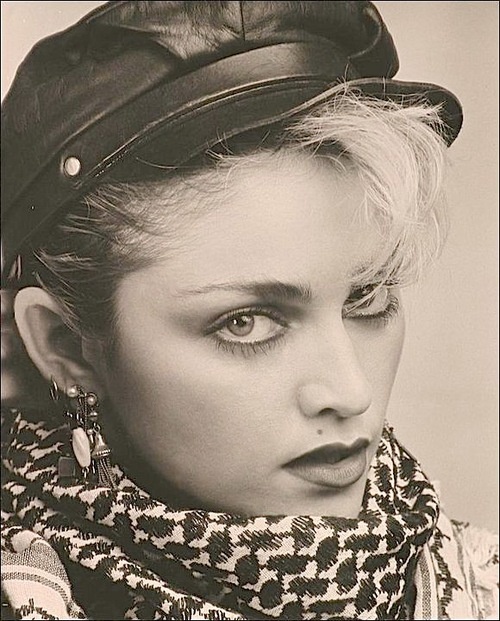
Madonna in kufiya

I posted a photo of Madonna in a kufiya back in 2010, along with a note on the scene in early 80's New York City that might have produced her accessory choice. It wasn't a very good photo. Now, at last, I've located a much, much better one, via pinterest. Check it out.