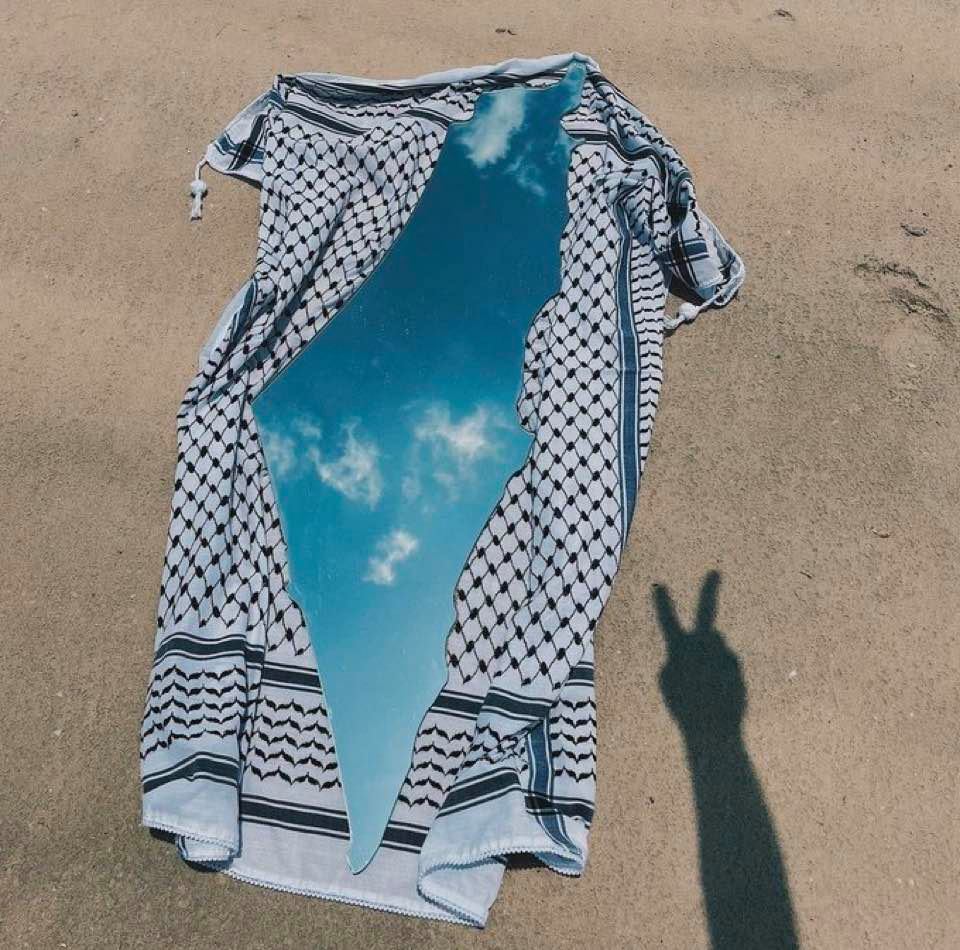
From artist Laura Harling:
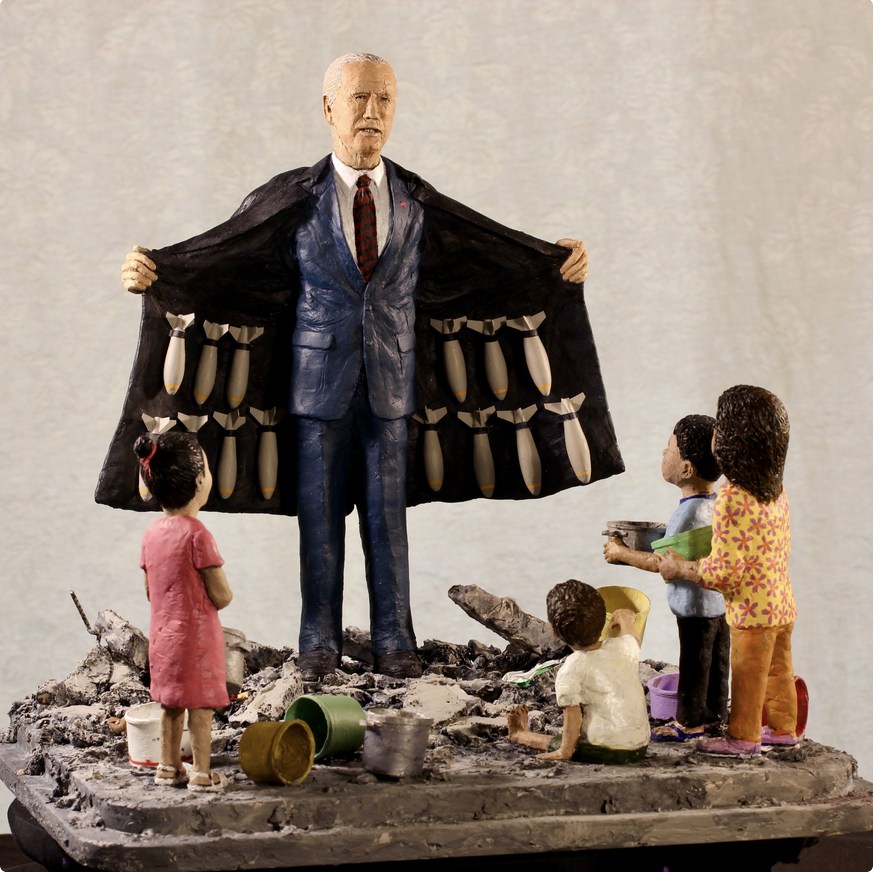
From artist Laura Harling:
Since October 7 there has been a steady stream of reports about the kufiya: their growing use and visibility, and, in response, efforts to squelch or silence or even arrest people for wearing them. I'm too overwhelmed to keep a full accounting, but occasionally I will try to post about the phenomenon. Here's one incident. Layla is a grad student in Social Work at Columbia, very active on Twitter/X and elsewhere.

Interesting film, "Palestine Red Crescent Society" (1979, dir. Monica Maurer and Samir Nimer). Filmed in 1978 in Lebanon, it examines the development and the work of the PRCS. Its work encompasses not just pre-natal health and "normal" medical functions, but also the treatment of the wounded and the rehabilitation clinics that handle those mutilated or left handicap by periodic Israeli attacks and the Lebanese Civil War. Attacks on Palestinian health infrastructure did not start in Gaza in 2023....

At the Grammys last night, jazz bassist and singer Esperanza Spalding (double nominee)
showed her support for the Palestinians by donning a kufiya.

Also: poet Aja Monet, up for Best Spoken Word Poetry Album, carried a watermelon clutch.

and...boygenius wore arists4ceasefire pins.

And finally, Annie Lennox gave a shoutout for #ceasefire

My book chapter, "The Kufiya," published in Asef Bayat and Linda Herrera, Global Middle East: Into the Twenty-First Century, University of California Press, 2021, is now available here, as a pdf.
Note that there is even a kufiya on the cover of the book! (On the shoulders of Edward Said, from a mural.)
Note too that if you search this blog there is lots of kufiya/kaffiyeh/keffiyeh content.

My 1992 article, “Seeing Double: Palestinian-American Histories of the Kufiya,” published in Michigan Quarterly Review 31(4): 557-577, can now be found here, as a pdf. It also appeared in the Michigan Quarterly Review's 60th anniversary issue--60(1): 341-362 in 2021.

I've written rather extensively about the push by the Palestinian rebels to impose kufiyas on Palestinian males at the height of the 1936-39 revolt, in fall 1938. And I just came across another story about those events, courtesy Zeina Ghandour's A Discourse on Domination in Mandate Palestine: Imperialism, Property and Insurgency (Routledge 2010). This is from her interview with Said Hassan Me'ary, originally from the village of Sha'b, in the Acre district, found on page 113.

In Berlin the popo are keeping a close watch on kufiya wearers.
The kufiya, they seem to have determined, is a sign of anti-Semitism.
(posted May 20, 2022)


His archive of photos, from his time in Palestine between 1921 and 1923, is quite remarkable. I particularly like this one, as it shows a kufiya pattern unlike anything I've ever seen before.
For more on Scholten:
Simon Peres, former Israeli PM, former president of Israel, former Defense Minister of Israel, and oh so respected in US official circles, on what he thought of Palestinians wearing kufiyas and tarbushes, when he landed up in Palestine in 1934. From his 1995 book, Battling for Peace.


I have a piece in this new book, about to be released from Pluto Press, edited by Diana Allan.
The book is already a winner of an English PEN Award 2021.
And here is a description:
During the 1948 war more than 750,000 Palestinian Arabs fled or were violently expelled from their homes by Zionist militias. The legacy of the Nakba - which translates to ‘disaster’ or ‘catastrophe’ - lays bare the violence of the ongoing Palestinian plight.
Voices of the Nakba collects the stories of first-generation Palestinian refugees in Lebanon, documenting a watershed moment in the history of the modern Middle East through the voices of the people who lived through it.
The interviews, with commentary from leading scholars of Palestine and the Middle East, offer a vivid journey into the history, politics and culture of Palestine, defining Palestinian popular memory on its own terms in all its plurality and complexity.

Very honored to have been interviewed by Anna Tsykov of Insaniyyat about my work on Palestine, and in particular, my book about the 1936-39 Revolt. Listen here.
Here's what they say about it:
Ted Swedenburg is Professor of Anthropology at the University of Arkansas. His first book, Memories of Revolt: The 1936-39 Rebellion and the Palestinian National Past, is a study of popular memory based on oral interviews with elderly peasants living in Palestinian villages in the Galilee and the West Bank. Since his first book, Dr. Swedenburg’s research has focused on popular music in the Middle East and North Africa. He has also taught at the American University in Cairo from 1992 to 1996. In this episode, Anna Tyshkov spoke with Dr. Swedenburg about his first book, questions and methods of oral history and its relationship to power and the peasant class. They also discuss current politics, and the unified Palestinian resistances surrounding events in May 2021. Dr. Swedenburg shares his personal reflections on the debts of solidarity, and his experience of fieldwork in Palestine.
This is from the anthropologist Sharif Kanaana's article, "Survival Strategies of Arabs in Israel," published in Merip Reports #41 (October 1975). It is based on research he conducted in Israel in 1969-70 for his dissertation. Kanaana received his PhD in Anthropology from the University of Hawaii. Kanaana began his teaching career at Birzeit University in 1975; he has since retired, I'm not sure what year.
The quote is from his discussion of what he calls the "middle peasant" survival strategy of the Arabs in Israel. (Interestingly, he does not use the term, "Palestinian," which has more recently become the preferred nomenclature: rather than "Arabs in Israel" (state language), "Palestinian-Israelis" or, "Palestinian citizens of Israel."
I'd love to find some photographs of Israel's Palestinian Communists garbed in kufiyas, from the 1950s, 60s, and 70s. If you've got a clue as to where I might find some, please let me know.