Showing posts with label poetry. Show all posts

Thursday, September 26, 2013

drone life 3: Lynn Hill on "Capacity" (Vijay Iyer and Mike Ladd's Holding It Down: The Veterans' Dreams Project)

I learned of this thanks to a tweet of Teju Cole.

As you no doubt know, the great jazz pianist Vijay Iyer just received a prestigious MacArthur Award.

You will find him even more deserving when you learn, as I just have, of his recent release, with Mike Ladd, of Holding It Down: The Veterans' Dreams Project. I've only listened to a few tracks (it came out on September 24) but what I've heard is great. The publicity from Pi Recordings describes the album as follows: "a thought-provoking, sometimes frightening, and ultimately exhilarating combination of music, poetry and song, created from the actual dreams of young veterans of the Iraq and Afghanistan wars." And check out the vid below that introduces the project.


But because I sometimes blog here (not very profoundly) about drones, I was particularly interested in the track "Capacity" (which you can listen to here), featuring the poetry and recollections of Lynn Hill, who worked as a drone operator, firing missiles remotely into Iraq from her base in Las Vegas. "Soft kill," she calls it. It's very powerful stuff.


Here's a section of her poem:

I have a capacity for war. I have a capacity for hate. I have a capacity for insanity. For anger. For lies. 525,600 minutes times 2, before I break into an explosion of thoughts, of insurgents and soft kills, and career moves. Capacity for destruction. Capacity for loss. Capacity for death, violence, nothingness. 24 months of pain and disgust. Actions of my hands accuse me. Guilty, charge. Unclear clear details and shaky intell, but still I pull the trigger. There’s a limit to madness. Gague clocks out at two years, but they serve up poison like entrees at Blueberry Hill. Crazy with a side of numb. It took 63,720,000 seconds to go from me to somebody else. 

And check out the NEA interview with Lynn Hill, where she reflects more on her poetry and her work as a Predator Drone operator.

I have a capacity for war. I have a capacity for hate. I have a capacity for insanity. For anger. For lies. 525,600 minutes times 2, before I break into an explosion of thoughts, of insurgents and soft kills, and career moves. Capacity for destruction. Capacity for loss. Capacity for death, violence, nothingness. 24 months of pain and disgust. Actions of my hands accuse me. Guilty, charge. Unclear clear details and shaky intell, but still I pull the trigger. There’s a limit to madness. Gague clocks out at two years, but they serve up poison like entrees at Blueberry Hill. Crazy with a side of numb. It took 63,720,000 seconds to go from me to somebody else. To change. - See more at: http://arts.gov/audio/lynn-hill#file_audio_default_group_audio_transcript
PS: Vijay Iyer's 2003 collaboration with Mike Ladd, In What Language?, is also terrific.

Friday, April 13, 2012

Famous Alexandrians: Cavafy (and the Denshawai Affair)


It is often, in fact one should say, nearly always, claimed that the celebrated Greek Alexandrian poet Constantine Cavafy (1863-1933), lived his life in almost complete isolation from Egyptian Arabs. Hala Halim, in her unpublished dissertation, The Alexandria Archive: An Archaeology of Alexandrian Cosmopolitanism (UCLA, 2004), suggests that the reality is somewhat more complicated. She suggests that his work is in some ways Orientalist, but that his Orientalism "both could be qualified and undercut by a disaporic affiliation that goes beyond binaries and makes for a more cosmoplitan attunement to otherness and other textualities" (107-108).

One of the pieces of writing that she cites in evidence is this poem, written in response to the notorious Denshawai affair.

27 June 1906, 2 P.M.

When the Christians brought him to be hanged,
the innocent boy of seventeen,
his mother, who there beside the scaffold
had dragged herself and lay beaten on the ground
beneath the midday sun, the savage sun,
now would moan, and howl like a wolf, a beast,
and then the martyr, overcome, would keen
“Seventeen years only you lived with me, my child.”
And when they took him up the scaffold’s steps
and passed the rope around him and strangled him,
the innocent boy, seventeen years old,
and piteously it hung inside the void,
with the spasms of black agony–
The youthful body, beautifully wrought–
His mother, martyr, wallowed on the ground
and now she keened no more about his years:
“Seventeen days only,” she keened,
“seventeen days only I had joy of you, my child.”

You can read the full story of Denshawai here, which involved a dispute that broke out when British soldiers shot some pigeons owned by Denshawai villagers. Villagers were angered, attacked the soldiers, the British opened fire on villagers, wounding five, one of the villagers hit an officer with the stick. An officer who escaped died of heatstroke.

The British responded by rounding up 52 villagers, conducted a summary trial, and sentenced five to hanging and 27 others to various terms of hard labor and flogging. The hangings were carried out quickly, only two weeks after the "incident." The effect was to inflame nationalist sentiment in Egypt.

My source for the poem is here.

A couple other remarks:

The family name of Cavafy is of Turkish origin; it comes from the word ayakkabici or "shoe seller."

Philip Mansel, the source for the above (Levant: Splendour and Catastrophe on the Mediterranean, Yale UP, 2010), also notes that it is highly unlikely that Cavafy's poems could have been published in any city other than Alexandria (with the exception of Paris). His erotic poems, Mansel observes, would have doubtless raised moral hackles and caused the author and publisher to be sentenced to jail. Cavafy's poems were published in Alexandrian literary magazines after 1919, and a book of a complete edition of his poems was published in Alexandrian two years after his death, in 1935 (144). Published in Greek, of course.

More evidence of the tolerant character of Alexandrian cosmopolitanism.

Monday, January 09, 2012

Elliott Colla on "The Poetry of Revolt" in the New Egypt

This was broadcast back on February 15, 2011, just 4 days after the toppling of Mubarak. Although so much has happened since then, this is still a very valuable document, since it is based on a deep historical knowledge of the literature and social movements that fed into the Egyptian revolt. Please listen.

Sunday, November 20, 2011

Sheikh Imam, The Ballad of Beans and Meat (lyrics, Ahmad Fu'ad Nigm, 1970s)

Sheikh Imam (1918-1995) was a leftist Egyptian singer, whose songs galvanized the progressive movement in Egypt, especially in the late 60s and the 70s, and particularly during the reign of President Anwar Sadat. He formed a duo with the great colloquial poet Ahmad Fu'ad Nigm (also written Ahmad Fouad Negm), who composed his lyrics. Sheikh Imam's songs (and Nigm's lyrics) were great favorites among the crowds at Tahrir during the insurrectionary days of January and February of this year. One of the songs that Ramy Essam was well-known for singing was "The Donkey and the Foal," with lyrics by Nigm. (I blogged about it here.)

One of his famous songs is "The ballad of beans [ful] and meat" (sometimes translated as, on the subject of beans and meat). It is in response to Sadat's economic policies, which involved an "opening" to the West and an attack on government supports for the poor, which had been a mainstay of Gamal 'Abd al-Nasser's policies. Today we would call Sadat's policies neo-liberalism. Sadat's officials urged the poor and working working classes to tighten their belts. Apparently at one time this involved arguing that they didn't need to eat so much meat, and that the staple diet of the poor, ful (fava beans) was perfectly adequate. (It reminds one of the efforts by the Reagan administration to classify ketchup as a vegetable -- to economize on school lunches -- and recent efforts by the Republicans in Congress to similarly classify pizza as a vegetable.) Sheikh Imam and Nigm saw this for what it was, and pushed back.

This video, usefully, comes with an English translation. A couple weeks ago I attended a talk on Arabic colloquial poetry by Prof. Clive Holes of Oxford, and one of the three poems he discussed was this one, by Ahmad Fu'ad Nigm. So below the vid, I've included his translation. (I hope he doesn't mind.)


Some big-wig in the government
Declared the other day
(Some "Dr. Muhsin" backed him up
In what he had to say.)
That scientists have proved it true,
Broad beans will do you good -
"Eat beans," they say, "and yet more beans,
For your health's sake you should!
Egyptian beans, especially,
Are bursting with protein,
No beans can touch these beans of ours,
There's fat in them, and lean!
Eat beans and beans! You'll feel as if
You've scoffed a joint of meat!
Beans make you sound in wind and limb
They'll fatten you a treat!
They're kind of, sort of, "vege-meat"
(Kebabs are so passé!)
So eat your beans, dear citizens,
Get high on beans today!"

"And add to that," said Dr. M
The medical concerns -
It's proven meat's a poison that
Brings on dyspeptic turns.
And even worse, research has shown
Meat eating causes crime,
Creates light-fingered layabouts
Who don't clock-in on time!
So summing up, Id have to say:
Meat eaters, one and all,
You're heading for a sticky end
In Satan's fiery thrall!"

But wait a mo', dear Dr. M
You well-fed hypocrite,
Your statements made 'officially'
Are just official shit!
They say the world needs brains like yours --
Well, give us your best shot -
If some madman like me blurts out
"Eat meat and die!" - then what?
You lot can eat your beans and live,
That's fair, don't you agree?
Don't try to pull the wool my friend.
Shove off and let us be!

Saturday, March 05, 2011

More on Ramy Essam and Ahmad Fouad Negm

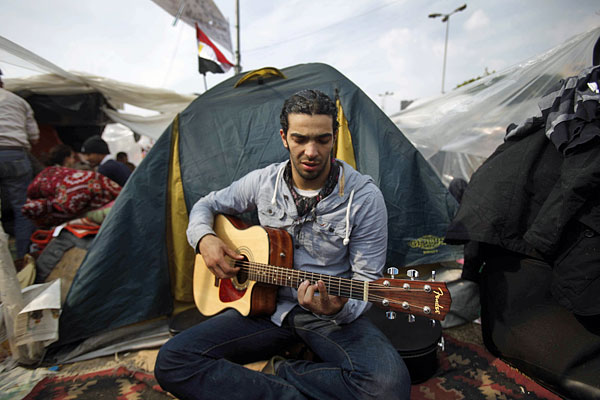
(Michael Robinson Chavez / Los Angeles Times)

On February 9, which now seems so long ago, I wrote a post called "Music of the Egyptian Revolution." Included in it was the now famous youtube vid of Ramy Essam singing "Irhal" (Leave, or, Go Away). I also included a vid of a song about a donkey refusing to step down for a younger one, but I was unable at the time to identify either the lyrics or the singer.

Since then many have written about the music of Egypt's revolution, and I'm able to identify the song and the lyrics. It's Ramy Essam (again), and the lyrics are by the celebrated revolutionary poet Ahmad Fouad Negm, the lyricist for Egypt's beloved revolutionary singer Shaykh Imam.

An article in The Los Angeles Times about Essam gives the story of his performance of the song on Tahrir:

One song that he relished, and that late at night the crowd would want to hear again and again, was an ode written by well-known poet Ahmed Fouad Negm: "The Donkey and the Foal," which everyone knew to be a commentary on Mubarak and his son Gamal.

Essam had written the music and played it for himself alone at home before the revolution. And now everyone shouted for the scathing lyrics of the aging poet, who had been jailed under Mubarak's predecessor. He felt honored when the poet stood with him and recited the words.

The foal said to the donkey, "Father, hand me the cart. Father, you have aged and now it is my turn."

The donkey coughed too strongly and the passengers panicked.

"It isn't about health, son," the donkey said. " Even the bridle is too big for you, son. Think and don't be greedy, or the passengers will rise up."

Since Hosny Mubarak's resignation, Ramy Essam has received a great deal of media attention, and has become something of a celebrity. Featured in the article in The Los Angeles Times, mentioned above, celebrated by Mark Levine in The Huffington Post (Levine produced a remix of "Irhal" as well--I respectfully prefer the original), an featured in an article in The Guardian by respected Middle East music commentator Andy Morgan, who calls Essam the Billy Bragg of Tahrir Square.

Before you imagine that Ramy Essam has gone all rock star, check out this video. It shows Essam performing his song "Irhal" on Tahrir Square to a big crowd. Later that night, the crowd at Tahrir is attacked by Mubarak's thugs. The pro-democracy forces keep them at bay. The video then shows Ramy Essam on the following morning. He stayed the night, and was wounded on the head by the rocks hurled by the counter-revolutionary goons. As far as I can tell, this occurred on the night of February 4-5, 2011. I don't know many "rock stars" who have the street fighting cred and the courage of Ramy Essam. I don't know if I know of anyone, in fact. Below is a screen grab of Ramy with his head bandage, and then, the full video.


This video shows Essam singing "The Donkey and the Foal" before a small group, on Tahrir, and also performing "Irhal," on another occasion, before a large crowd at the square.

This vid is a full version of "The Donkey and the Foal."

Here's Negm's poem in Arabic:

الجحش قال للحمار *** يابا اديني الحنطور

يابا انت سنك كبر*** و وجب عليا الدور

كح الحمار كحة *** فزعت لها الركاب

مش يابني بالصحة *** ده كل شئ بحساب

وسواقة الحنطور *** محتاجة حد حكيم

وانت عينيك فارغة *** همك علي البرسيم

قوللي تسوق ازاي *** والتبن مالي عينيك

ده حتي حبل اللجام *** واسع يا ابني عليك

اعقل وبطل طمع *** لاتسخن الركاب

ما تجيش يا واد جنبهم *** لاتبقي ليلة هباب

دول صنف ناس جبار *** قادر مالوهش امان

يبان عليهم وهن *** لكنهم فرسان

يابا دا نومهم تقل *** وبقاله يابا سنين

كل البشر صحصحوا *** ولسه دول نايمين

يا جحش بطل هبل *** وبلاش تعيش مغرور

ركابنا مش اغبيا *** ولا عضمهم مكسور

بكرة حيصحولك *** ويزلزلوا الحنطور

وتلاقي في قفاك *** تمانين خازوق محشور


And you can find out more about Ramy Essam, and download some of his music (although not the songs discussed above) from his Facebook page.

Sunday, August 24, 2008

More Darwish


Here's a great source for more on the recently departed Palestinian poet, Mahmoud Darwish, from Banipal: Magazine of Modern Arab Literature, published in London.

And I was pleased to receive my copy of the latest New Yorker (August 25) and to find that they had published this poem by Mahmoud Darwish.

Sunday, August 10, 2008

RIP Mahmoud Darwish

The great Palestinian poet Mahmoud Darwish passed away yesterday, in Houston, Texas, of all places. Read about him here and here. (Will the US media cover this story at all?!)

The fact that this man never received a Nobel Prize is a cultural crime. (Arab artists can only receive Nobels if they have come out publicly and uncritically for "peace" with Israel. If they are in any way critical of Israeli policies, no chance.)