Showing posts with label cha-cha-cha. Show all posts

Monday, November 12, 2018

Franco-Arab music: Bob Azzam, Bruno Mory (Dalida's Brother), "Ya Mustapha," "Fattouma"


I first heard Bob Azzam's "Ya Mustapha" when I moved to Beirut in 1964, it was one of the very few songs in Arabic that any American kid would have been familiar with. It was a hit all over the Mediterranean, and I've posted about it previously. If you're not familiar with it, here it is:


I've since discovered a bit more about the song. First, it shows up in the Egyptian film "El Hob Kedda" (1961) which stars, among others, Salah Zo El Faqqar, Sabah and Abdelmonem Ibrahim. I'm not sure who is shown performing the song here, but it's the Bob Azzam's version. 


There is also another version, overshadowed by Bob Azzam's version, recorded by Dalida's younger brother Bruno Gigliotti, known in Egypt as Bruno Mory, and better known in France as "Orlando." Bruno had a brief career as an actor and a recording artist but then went on to become Dalida's artistic director and producer. It sounds much more "Egyptian" and less campy then Bob Azzam's version. 


It was released on record by the Egyptian label Sawt al-Qahira, and who knows, maybe it came out before Bob Azzam's version. Note that the lyrics are credited to Sa'id al-Masri, and the music to Muhammad Fawzi. According to an article from Rotana on "Franco-Arab" music, Bruno's version did precede Bob Azzam's.


Bruno's "Ya Mustapha" can also be found on a cassette, issued in 1978, called Al-Aghani al-Raqisa (Franco-Arab), or Dance Songs (Franco-Arab). I'd love to get my hands on this cassette.


The second song from Bruno on the cassette, "Fattouma," can be heard on YouTube (below). It's very very cool, more "Franco Arab" than his version of Mustapha.


"Fattouma" was released, according to discogs.com, in 1960, from the Egyptian label Misrphone. This song too was by Muhammad Fawzy and Sa'id al-Masri.


Finally, please check out the amazing scene of Bruno Mory, doing "Fattouma" while dancing the cha-cha-cha with the divine Egyptian actress Hind Rustom, from an online article from Rotana. Sorry, the article is in Arabic, it's the second video embedded here. Really, you must watch it. 

 
Bruno Mory and Hind Rustom in Fattouma, 1961

The scene is from the film of the same name, Fattouma, released in 1961. Here's a poster for the film. I've not seen it and don't know much about it.
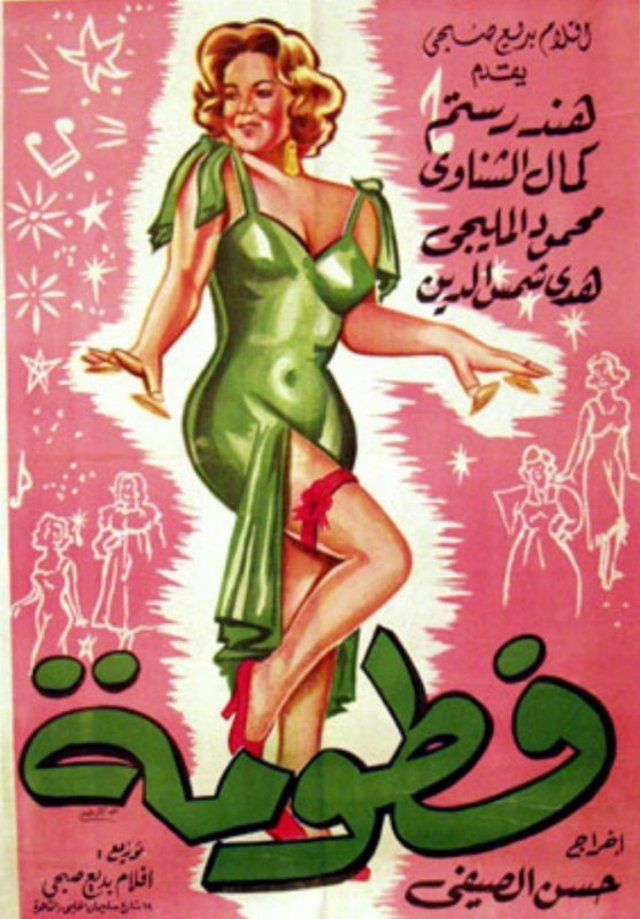


And here is another poster for Fattouma, and note that it announces the participation of "Orlando" (on the right of the photo) in the film. (I cannot make out what it says above Orlando, sorry.)


That Franco-Arab cassette also has some songs from Karim Shukry, including "Take Me Back to Cairo," released on Sono Cairo, with lyrics in England. Not as interesting as Bob Azzam and Bruno's material, I don't think, but have a listen, you decide.

Sunday, November 04, 2018

A little more on Mahieddine Bentir

I looked a bit more at the short Algerian TV documentary on Mahieddine Bentir that I linked to in my previous post. (I realize that it's a problem that I can't make too much of Algerian dialect. But I can't control my obsessions.) 

Two things: First, there is a reference to a film that Bentir starred in, called Fous de musique or غرام الموسيقي

screenshot from the documentary

It's from the early sixties, filmed prior to independence, a musical, no doubt with some of the rock'n'roll that Bentir became famous for in the late fifties and early sixties. 

Second, please check out Bentir doing rock'n'roll, in 1959, on Algerian television, in the documentary, starting at 4:00. It's very lively, Bentir's dancing -- he does a couple of flips at around 5:00 -- strong backing by a couple sax players, trumpeter, piano and drums. Quite amazing.


Finally, I found, courtesy the blog of the great Algerian music scholar Hadj Miliani, an article about Bentir, from the magazine Femmes Nouvelles, published in Algeria (April 10, 1961). 


There is a lot of information about Bentir's life (born in 1934, in the commune of Ménnerville, grew up in Algiers, worked for the PTT (Postes, télégraphes et téléphones). When he played guitar and sang for some of his friends at the PTT and one of them helped get him in touch with the RTF (Radiodiffusion Télévision Française) and he appeared on the show "Rendez-vous à 13 heures" of Françoise Espel and Jacque Bados. He performed with a band called Orchestre Chenouf, composed of musicians with full-time jobs (station master, anesthesiologist, cabinet maker), who must be the ones who appear in the documentary (and in the clip on my previous blog). 

According to the article, Bentir composed in a variety of genres: "Negro" spirituals, waltzes, jazz, chansons réalistes. And it claims he was the first to launch rock'n'roll in "Oriental" music. His records sold in Alexandria, Rabat, and throughout Algeria. 

As of the date of the article, he had recorded four songs: "Youp! Ya Aoud" (rock), "Sinbad et Amira Cha-Cha" ("cha cha cha oriental"), "Ya mama chérie" (cha cha cha bolero) and "Anaya Bouhali" (style not specified. 


He was also translating some French popular songs into Arabic (I don't know whether these were ever recorded other than "Ana bouhali") and was preparing songs for a singer named Samira -- cha cha cha, waltz, and jazz. 

A more recent account of Bentir, from January 2018 (Reporters: Quotidien national d'information -- Algiers) reports on an hommage to Bentir, and states that Bentir's rock'n'roll song "Scooter" dates from 1955 (there is no mention of the song in the 1961 article) and that the songs Bentir performed on television (see the documentary were "Cha Cha Cha Chechia" and "Anaya Bouhali," a remake of Darío Moreno's 1959 recording, "Le marchand de bonheur" -- this is the clip on my previous blog post. (Moreno was a Turkish singer who made his career in France in the fifties and sixties.)

This article also claims that Bentir made some banners attacking colonialism and because he was sought after by the security forces, he took refuge in Tunisia with the liberation army. Perhaps, although it seems somewhat unlikely, given that the article cited above was published in April 1961. It states that the musical Bentir was to appear in (certainly Fous de musique) was to be filmed in May and June, and we can see from the movie poster reproduced in the Bentir documentary, that the film was in fact released. Algeria gained its independence in March 1962, so the timing does not seem right. But even if Bentir did not flee to Tunisia for anti-colonial activity, he nonetheless continued to enjoy a musical career in Algeria after indpendence.

Wednesday, October 31, 2018

Dalida in Algiers, 1965, on the same bill as Mahieddine Bentir

Oh, to have seen this show in November, 1965 in Algiers, just three years after Algeria gained its independence! On the 11th anniversary of the launching of the Algerian revolution, organized by Algeria's national tourism office (ONAT). The divine Dalida, born in Shobra, Cairo, and a star throughout the Mediterranean.


One guesses of course that Dalida played her greatest hits, including those that hit the charts in France in 1965: 

"Viva la papa" (#10)


"La danse de Zorba" (#8)


"Bonsoir mon amour" (#5)


And my favorite from that year, "Amore scusami" (#13)


I find it quite amazing that Dalida was welcomed to Algeria in 1965, given that according to wikipedia, and other sources, Dalida had performed for the French colonial troops in Algiers in summer 1958. It's rather amazing how forgiving the Algerians were, given that hundreds of thousands of Algerians (the figure is not agreed upon, but perhaps Horne's number, 700,000, is a plausible number) were killed in the war of liberation (1954-62). Here's a photo of Dalida with one of the colonial soldiers, snapped by a fan.


In thinking about Dalida in Algeria, I came across an article by Barbara Lebrun, "Daughter of the Mediterranean, docile European: Dalida in the 1950s" (Journal of European Popular Culture 4(1), 2013). It argues that the Egyptian-born singer's Mediterranean identity was carefully crafted, as her career was launched in France in 1956, to occlude her origins: "Because Dalida’s early success in France coincided with the Algerian War, the singer’s oriental provenance was strictly ignored, and her ‘Mediterranean’ identity instead remapped onto the northern shores of the Mediterranean Sea." (Note: I've only read the abstract, and am waiting to receive the full article.) 

Apparently by 1965 her handlers thought it was okay for her to be seen as associated with Algeria. But note that she did not record in Arabic until 1977, with "Salma ya salama."

What really excited me about this concert was the fact that she was on the bill with Mohieddine Bentir. I've blogged about him previously, but let me both recap and add some more details. Born in 1930, Bentir recorded a terrific rock'n'roll song, "Scooter," apparently in 1955.  

In 1959, there was "Ana Bouhali," a cha-cha cha, done Cuban style, very, very hot. Check this out, from Algerian television, broadcast during the colonial era. (Added November 4: It's a remake, in Arabic, of a song recorded that same year by Dario Moreno, "Le marchand de bonheur," the Turkish singer who made his career in France during the fifties and sixties.


Later, he was doing twists, most famously, "Optimiste Twist," from 1964. I mention some other tracks on my earlier blog.

If you check these three tracks, you could get an idea about what a terrific performer Bentir was, and, wow, I just can't imagine (again) how cool it would have been to see him opening for Dalida in Algeria. 

If your Algerian Arabic is good (and mine is minimal), check out this report on Bentir from Algerian television, broadcast in 1994. I wish I could track down more.


Addendum (11/3/18): Kareem tweeted this at me: Bentir talks about his show with Dalida in the video (at 15:00). When they went to dinner she asked him to ask if there were fava beans. A real Egyptian I guess :-).

Sunday, September 08, 2013

Battle of Algiers Mambo

If you've seen The Battle of Algiers, you of course remember the famous scenes when the two young Algerian women, dressed up to look like évoluées, plant bombs in a milk bar and a bar. The scene is based on historical fact. On September 30, 1956, the FLN militant Zohra Drif planted a bomb at the Milk Bar, which, according to Raphaël Draï (Le pays d'avant, 2008, Paris, p. 228), was one of the most popular hang-outs for young Europeans, as well as young bourgeois Arab women. Samia Lakhdari planted her bomb at L'Otomatic, the most popular student bar of Algiers.

The song playing on the jukebox, according to Draï (at L'Otomatic, I think he means, but it's not clear) was a mambo that was all the rage, from the 1954 film starring Sophia Loren, La Donna Del Fiume (known as La Fille du fleuve in French, Woman of the River in English). Draï doesn't tell us what his source is for this fact.

Perhaps it was this one, from a scene in the film which features the sultry dancing of Loren. I have not been able to identify the title or the artists.


The video identifies the song as "Mambo Bacan," but clearly that's not what it is. This is "Mambo Bacan," sung by Sophia Loren, and also from the movie soundtrack.

I've blogged previously about the song playing in the milk bar in The Battle of Algiers, when the bomb goes off. If you read the comments for the post, you will find that the song is identified as "Rebecca," and that it's by The Chakachas. You can listen here. It's a cha-cha-cha.