Famed Viennese painter Gustav Klimt, at an artists' party hosted by Otto Primavesi at his house in Winkelsdorf (Moravia), 1916. Otto and his wife Eugenia were among the most important patrons of Klimt in his last years. Otto was owner and director of the Primavesi Bank, based in Olmütz (now Olomouc, Czech Republic). Klimt designed the Primavesis' country house at Winkelsdorf.
Orientalist parties like the one depicted above were a common feature of bourgeois life in the US and Europe in the first three decades of the twentieth century, as I've blogged about previously: here and here.
I came across these images of Mike Love from a post on the super super music blog Aquarium Drunkard. It presents and discusses a video of The Beach Boys singing with the Alexander Hamilton Double Rock Baptist Choir. The song, "That Same Song," is, well, vintage Beach Boys + gospel. It was released on their album 15 Big Ones in 1976.
One of the things that struck me was Mike Love in turban (the second photo shows him with Al Jardine.)
Mike had gone to Rishikesh, India, as part of a group of sixty, organized by The Beatles and including also Donovan and Paul Horn, in February. There they studied Transcendental Meditation with Maharishi Mahesh Yogi. I guess this is evidence that Mike was still fully in to TM in the mid-seventies.
While they were all there, The Beatles wrote and recorded a lot of music, that would show up on the White Album and Abbey Road.
And they recorded this, which never appeared on record: the very very BeachBoysesque "Spiritual Regeneration/Happy Birthday Mike Love," on the occasion of Mike's birthday.
I guess the most Beach Boys-sounding Beatles song ever recorded is "Back in the USSR," penned by Paul McCartney. Mike Love has stated that he encouraged McCartney to "talk about the girls
all around Russia, the Ukraine and Georgia" to make the song sound more Beach Boys.
I've reported on occasion about the bohemian hipness of turbans in the US. Notable why? Because it seems to fly in the face of endemic Islamophobia.
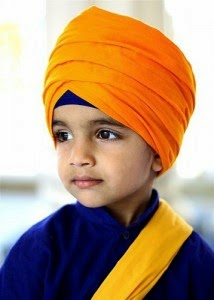
So maybe we on the progressive front should be doing more to promote turban wearing, in solidarity with Sikh children, who, it turns out, are the massive target of bullying in US schools. (Wearing a turban would be much more radical than sporting a kufiya scarf, eh?)
"A recent survey by the Sikh Coalition has found that half of Sikh
children and two-thirds of Sikh children who wear their hair in turbans
report being bullied at school" (emphasis added).
Where is the anti-bullying lobby on this issue?!
The report goes on to argue that this is a wider phenomenon, due largely to the post 9/11 terror hyper-hysteria:
"The period since 9/11 has been particularly difficult for Sikh Americans
and their children. While Sikh children experience bullying in the
classrooms, their Sikh American parents endure astoundingly high rates
of hate crimes, employment discrimination, and scrutiny at the nation's
airports. Brown skin and turbans have popularly become associated with
terror. Crude popular culture stereotypes of terrorists and damaging
media images outside the class room have made their way into the
classroom to the detriment of young Sikhs."
And, whenever instances of mass shootings are discussed in the context of the need for control, why in the hell is Oak Creek, Wisconsin almost never mentioned? It was here, on August 5, 2012, that a white supremacist killed six Sikhs and wounded four others, at a Sikh Temple.
Oak Creek, Oak Creek, Oak Creek. We remember Columbine, Aurora, Newton...Why not Oak Creek?
Oh, I guess the Sikh Coalition report begins to suggest why. Many of us do not believe turban wearers are "innocent" or even "American."
Thanks to Nabeel for informing me about this gallery of African-American entertainers turbans, posted by Freddie Patterson for India Music Week.
If you've followed this blog, you will know that I don't just post about kufiyas, and sometimes do post on turbans on occasion. And I've posted some of the same photos as found in the gallery, and about most of the same artists. You can see my turban postings here -- there are quite a few.
But there were some revelations nonetheless. I just love this photo of R'n'B giant Louis Jordan.
And Aretha Franklin in a turban:
I had posted a photo of singer The Mighty Hannibal in a turban previously, but I found this vid, of him singing "Jerkin' the Dog," on a TV show, I guess, to be quite fun.
Thanks to Jerry Zolten, the author of "'I Ain't Lyin'!: The Unexpurgated Truth about Rudy Ray Moore" (Living Blues, May-June 2001), who I quoted in an earlier post about turbans and Rudy Ray Moore. Zolten told me about the 'fifties doo-wop group from Philadelhia, The Turbans.
The Turbans had a national hit in 1955 with "When You Dance." You may have heard the song, as I had, but I didn't know, or remember, the name of the group associated with the tune.
Another great song from The Turbans, released in late 1955 in the hopes of following up the success of "When You Dance," is "Sister Sookey." Alas for The Turbans, it didn't chart. But it does have a great line: "and that girl she's gone to Egypt." That may be the only "Orientalist" theme in any of The Turbans songs. The group eventually split up, in around 1962.
I clipped this article from the New York Times last fall, but it got misplaced in some pile or other, and I've just recovered it. I think it's still of interest.
It focuses on the claim of June Ambrose (pictured above) who, it says, wore a turban every day during New York Fashion Week. And it traces the current trend to a Prada show in 2006, which wasn't picked up, but then began to catch on by 2009. Kate Moss wore one at the Met gala in May 2009. And it started showing up on the street, on young women.
The new fashion connected them to "sophistication linked with Hollywood glamour of the 1920s and ’30s, when women like Garbo, Gloria Swanson and Joan Crawford wore them. “From way back, turbans signified a woman who was very educated and worldly,” said Caroline Rennolds Milbank, the fashion historian."
The article goes on to say that, 'Because turbans have historically been associated with Arab dress, it is tempting to connect them with the conflict in the Middle East. “They make a strong political statement, like wearing harem pants,” Ms. [June] Ambrose said. “We take an element of other cultures and internalize it”'
For his part, the curator of the Costume Institute at the Met, Harold Koda, 'isn’t convinced that they have anything to do with politics: “It’s not a part of a Kumbaya fashion movement. I think it’s more of Poiret’s view of Orientalism than women watching the news and referencing what’s going on in Afghanistan. It’s an exoticism, a sense of the other that is visually compelling.”'
Fashion historian Caroline Rennolds Milbank meanwhile 'noted that in the past, Western culture looked at the Middle East for its exotic form of dress, which was seen as sexually liberating. “If you look back at the portrayal of women in films like ‘1,001 Nights,’ ‘Lawrence of Arabia’ or even the television show ‘I Dream of Jeannie,’ the West depicted those women very sexually with sheer fabrics and an exposed midriff,” she said. “Going back to the turban is a return to the allure and sexiness of a foreign culture.”'
My opinion is not that it's a question of either/or. Probably the trend has something to do with Middle East politics--in some displaced fashion. And no doubt it's also rooted in the history of popular Orientalism in the US. Check out the slideshow that goes along with the article for more turbans. I particularly liked the photo of Nina Simone wearing one.
(credit: Associated Press)
I've posted a few times on turbans, as well as related Orientalist fashions. Re Maria Montez and Lana Turner, here. Rudy Ray Moore and more here. Beyoncé here. Kim Wilson. Chuck Willis. The Fabulous Ottomans and Sam the Sham. Prince and Prada. Ongoing obsession.
"Desi Dance," recorded with Detroit's D12 (Eminem's group), is the first single from her second, forthcoming album (which was announced awhile back but is yet to appear). I am unable to claim that this is a great song. But the vid is interesting, because:
It appears that a "desi dance" requires lots of kufiyas.
There is this, Hard Kaur's quite fabulous head wrap. I'd love to see Amy Winehouse done up in one of these.
And then there are the dancers accompanying Hard Kaur on the "desi dance." Not only do they look like Palestinian guerillas, but the kufiyas are wrapped around their head so as to expose only their eyes. In Palestine they are known as "mulaththamin," "masked men," who confront the Israeli occupiers with their faces wrapped in kufiyas, so as to evade identification by Israeli security. (Wearing the kufiya in this manner is now illegal in France.)
And note that here Hard Kaur not only has a black and white kufiya dangling from her neck, but also a red and white kufiya tucked into her belt, or her front pocket. Desis can't have too many kufiyas...
Here Hard Kaur appears with Bizarre of D12. Is B's shower cap an ironic commentary on Hard Kaur's head wrap?
Still trying to make sense of the circulation of the turban (and fez/tarbush) in African-American popular culture. I just ran across an article that Blake gave me years ago, and that I had never bothered, until today, to read: "'I Ain't Lyin'!: The Unexpurgated Truth about Rudy Ray Moore," by Jerry Zolten, from the May-June 2001 issue of Living Blues. It's a thorough and informed piece, and is especially good about explaining the late Rudy Ray Moore's notorious x-rated humor.
Here's the interesting bit, at least as far as the turbans go. Rudy Ray Moore was born and raised in Ft. Smith, Arkansas (with a bit of time in Paris, AR). Then he moved to Cleveland, in, as far as I can tell the mid-40s or so, where:
Rudy Ray Moore met Billy Nightengale, a dancer who taught him stage moves. Nightengale wore a turban and soon the two of them took to wearing turbans all over town. "We'd put on our turbans and people would follow us around like we were foreign dignitaries." A few years later, the turban became a trademark for Chuck Willis, a singer who built up his fame on a string of hits for Atlantic records, including "C.C. Rider," his R&B version of Ma Rainey's blues classic. Willis got the idea to wear a turban from Rudy Ray who wore his when he emceed R&B stage shows. "He wanted to know where I got it from," says Rudy Ray, "and I carried him by the lady's house that made the turban for me and she made Chuck one...He wore the turban until he died."
Chuck Willis is one of the most celebrated of the R&B turban wearers, and was known as the "Sheik of the Blues." I can't authenticate Moore's claim. Willis was from Atlanta, but perhaps he met up with Moore in Cleveland. Willis had his first hit in 1952; Moore was in the army from 1950-53. When did Willis start wearing the turban? Dunno.
What I do get from this account is that wearing the turban made Moore and his pal Nightengale look and feel like "foreign dignitaries." The effect then was not only that they looked "exotic," but that they also looked distinguished.
In Cleveland, Moore also, teamed up with a woman and the two of them dressed exotically and performed torrid dances to the beat of African drums. [Moore] started singing a little, billing himself as the Harlem Hillbilly...
In time Rudy Ray's first great stage persona would emerge. He became Prince DuMarr, the 'turbanated' dancer in Neil Stepp's traveling revue. He liked the ring to the name "Dumarr" and the association with the Hollywood glamour queen Hedy Lamarr." Moore joined Stepps revue, he says, when he was 17, and this was 1946.Here's a photo of Moore as Prince DuMarr, taken in the late '40s. It's the cover of his Norton Records release,Hully Gully Fever.The article includes a photo of Moore as DuMarr, with the revue, but I've found no copy on the web. I believe it is found in thejacket for the Hully Gully Fever CD. It shows Moore, bare chested and in turban, with female dancers.
Moore barnstormed as Prince DuMarr until 1950, when he was drafted. In the mid-1950s, Moore moved for a time to Seattle, and took up the "Prince DuMarr" role again in a review headlined by sax player Big Jay McNeely. Presumably, again in turban. Perhaps it was in the Seattle period that Chuck Willis saw him in turban.This photo too is of Moore as "Prince DuMarr"--a poor reproduction from the LP cover of Hully Gully Fever.
And here are a few more turban images. It appears that Norton Records is really into the turban aesthetic. Here's the cover of Turban Renewal, a tribute album to Sam the Sham and the Pharaohs record. (Sam is another famous turban wearer.)
And the cover for another Norton release, Hannibalism!, from R&B singer The Mighty Hannibal.
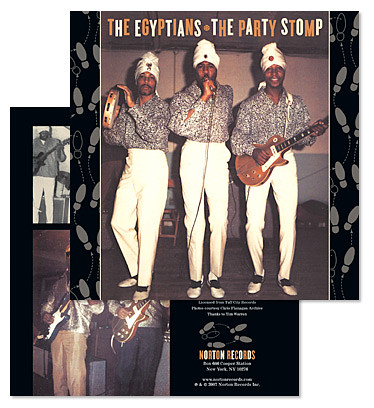
This is the cover of Norton's 2009 catalog. Unfortunately I can't find a better reproduction. Note that it features turbaned artists like Rudy Moore, Sam the Sham, Hannibal, Screamin' Jay Hawkins and The Egyptians, and that it advertises "Turban Contemporary Music."
Still more. Two LP covers from be-turbaned Hammond B3 ace Lonnie Smith: Afrodesia (1975) and Funk Reaction (1977).
Finally, another from King Khan, who is truly keeping "turban contemporary" alive.
The new album of King Khan and the Shrines, Invisible Girl, is terrific. And turbanated.
Ok, one more. This is the last, and from a different turban context and aesthetic. Kate Moss, May 2009.
People keep sending me this stuff. So here goes...
#1. The Akshay Kumar and Snoop Dogg video, "Singh Is Kinng." Kumar can be spotted sporting the kufiya, draped around his neck like a scarf, several times throughout the video. (Thanks, Rachel.)
Why in the world is a Bollywood movie star wearing a kufiya?--particularly when he is also wearing a turban, since he's playing the part of Lakhan Singh, a Sikh, which he plays in the film, Singh is Kinng. Is it because Singh is the king of the gangstas in Australia? Is it just international style? Or, since he's on screen with Snoop Dogg, is Kumar trying to look more hip-hop? Who knows?
"Singh Is Kinng" is a bhangra song, composed by the UK bhangra band RDB, but it's not terribly clever. Such hip-hop/bhangra collaborations seem to be getting more and more common, and there are lots of better ones. Jay-Z's collabo with Punjabi MC on "Beware" seems to have started the trend. Go here for more hip-hop/bhangra downloads.
#2. I found this video on the page of the band, Rainbow Arabia. It's one of their "influences," and it's a video that goes along with the performance of "Palmitos Park" by El Guincho. The kufiya shows up right away, as kind of table cloth, with colored feathers on it. The kufiya and the feathers show up several times, each time looking more psychedelic. It's a very "conceptual" video, by Will Bryant. Who knows why the kufiya is there. El Guincho is a Spanish musician whose music has been described as "space-age exotica."
As for Rainbow Arabia, it is a kind of exoticizing experimental band. Their press packet describes them as combining Middle Eastern flavors with American experimental dance music, according to a review of their first release by Pitchfork. (Thanks to Dave for turning me on to them.)
And catch this, the Pitchfork review actually says that the band has a "keffiyeh-fied aesthetic"!
I've not heard Basta, the EP in question. (It doesn't seem to be available for download on any sites I know.) But if you check out the band's webpage, you can listen to three of their songs. Only one of them, "Tiny Tiny Man," has a hint of "Middle Eastern" influence--the sound of the derbouka.
Not really sure how "keffiyeh-fied" their aesthetic is. It's definitely exotica. I'll let you know if/when I find out.
(Oh, and be sure to check out the 4th video of their "influences"--the completely amazing Syrian singer, Omar Souleyman.)
I finally found a photo of Kim Wilson in a turban. Kim Wilson, the great lead singer and harmonica player of The Fabulous Thunderbirds. The other guy is lead guitarist, Jimmy Vaughan, brother of the late Stevie Ray Vaughn. Jimmy plays in a more restrained style than brother Stevie, but is fully his equal. I used to see these guys play in clubs all the time in the late 70s in Austin, and they kicked ass. Best album from that era is their eponymous The Fabulous Thunderbirds (19779), and this one, What's the Word, is a close second.
Kim used to wear the turban in concert quite often, and he looked slick.
Blues/Rhythm & Blues artist Chuck Willis, routinely wore a turban on stage when he performed (he reportedly owned 54 of them), and so was known as "Sheik of the Blues." (Some claim he was known as the Sheik of Shake and Sheik of the Stroll.) Best known for his 1957 hit, "C.C. Rider." He recorded for Atlantic Records starting in 1956. (Atlantic of course was co-founded by the Turk Ahmet Ertegün--who was secular and of course did not wear a turban.) Willis died of peritonitis, at the age of thirty, in 1958.
A glance at the photo might lead you to think that this group dates from the '50s. But no, The Fabulous Ottomans are a working band, based in Barcelona, Spain, who play the "finest turban headed rhythm & blues." You can download their very fine track, "Shake Shout Soul," on their myspace page. And also here, at Soulful Torino Records, which is where I found it.
For some reason, turbans were very popular among rhythm 'n' blues artists of the '50s and '60s, among them Screamin' Jay Hawkins, Chuck Willis, and Professor Longhair. Here's a photo gallery. Kim Wilson of The Fabulous Thunderbirds (is this where the Ottomans got their 'Fabulous' moniker?) used to wear a turban, back in the day (I first saw him perform in one in 1978). Meanwhile, here's one of my all-time fave turban wearers, Sam the Sham (Domingo Samudio) of Sam the Sham and the Pharaohs, of "Wooly Bully" fame. (And I guess, considering what The Pharaohs are wearing, it's a kufiyaspotting too.)
Professor of Anthropology, University of Arkansas. Author of Memories of Revolt: The 1936-39 Rebellion and the Palestinian National Past. Co-editor of Palestine, Israel and the Politics of Popular Culture and of Displacement, Diaspora, and Geographies of Identity.