Monday, December 25, 2006

Beyoncé vs. Islamism?

This article was published by Slate in August, but still merits reprinting. The argument here is rather silly: that just as Western pop music was opposed by the Communist apparatchik of the Eastern bloc, so it is opposed today by "Muslim leaders" in the Islamic world. And since Western rock and jazz and disco helped topple Communism, therefore the Bush administration should support hip-hop as an agent of "democracy" in the Middle East. As if there were any force in the Middle East comparable to the Stalinist bureaucracy, given the great heterogeneity of Middle Eastern governments, from democracies to monarchies to state-socialist dictatorships. And as if Middle Easterners had not been consuming Western pop music for decades. If Thaddeus Russell thinks Beyoncé's dancing is so liberatory, he should check out some scenes of the great Egyptian belly dancer and movie star Samia Gamal, from the 40's 50's. (He should rent Afrita Hanem or A Cigarette and a Glass from Netflix, or check out this Samia Gamal video. I'd put Samia Gamal up against Beyoncé any day.)

Beyoncé Knowles, freedom fighter

Why "booty popping" will do to Islamic fundamentalism what rock 'n' roll did to Stalinism.

By Thaddeus Russell

Aug. 31, 2006 | Soviet soldiers returning home from the western front after World War II brought the virus with them. Within a few years, it had infected large portions of the Soviet and Soviet bloc populations. By the late 1940s, the Communist Party leadership feared it would destroy the socialist fatherland from within. But it was not a biological disease that threatened communism. Joseph Stalin and his commissars called it an "amoral infection" in the minds of Soviet youth. It was "American primitivism," "capitalist cultural imperialism" and "bourgeois cosmopolitanism." But it was really African-American culture. It was the same infection that today is spreading underneath the police, the laws and the censors of Islamic regimes.


This month, Beyoncé and Jay-Z's "Déjà vu" is No. 1 on the top 40 of the biggest Muslim nation in the world, Indonesia. Nine of the top 10 songs on the United Arab Emirates singles chart are hip-hop or R&B. Earlier this year Egyptian rappers MTM -- whose hit song "Ummi Musafra" ("My Mother's Away") is about a teenager who holds a dance party while his mother is away on holiday -- were voted best modern Arab act at the first Arabian Music Awards. Several journalists have reported on the vast Iranian black market in Western music and movies of all sorts. And everyone seems to agree that youth in Iran are engaged in widespread rebellion against Islamic sharia law. Tattoos, sneakers, platform shoes, belly rings, and public displays of affection are ubiquitous in the most militantly Islamic republic.

Muslim leaders are -- rightly -- up in arms over all this. Even the relatively liberal cable channel Al-Jazeera has run several denunciations of rap in particular and of Western cultural penetration in general. Iranian authorities have removed hundreds of illicit satellite dishes that constantly reappear. Earlier this year, President Mahmoud Ahmadinejad banned Western music and the "social corruption" it caused, but was recently forced to call off his crackdown. Meanwhile, according to a memoir just published by Osama bin Laden's former paramour, the al-Qaida leader might have lusted after Whitney Houston, but he considered her music to be the work of the devil.

It's all very familiar. In 1946, soon after Stalin's chief aide warned that jazz would "poison the consciousness of the masses," the Central Committee of the Communist Party ordered all state orchestras to stop playing the music. Also banned were saxophones, wah-wah trumpet mutes, the plucking of bass strings, the deliberate lowering of tones to create "blue notes," and the playing of drums with too much rhythm. Brigades of music patrols monitored theaters and dance halls to ensure that nothing jazzy was being played. Couples caught dancing anything other than the waltz, the polka, or Russian folk dances were subject to arrest. Members of jazz bands were rounded up and sent to Siberian prisons.

Soviet authorities were right to fear jazz, but they could not stop it. Bootleg recordings were sold by the millions on the black market. Stiliagi, or "style hunters," appeared on the streets of all the major cities in the Soviet bloc, wearing zoot suits and ducktails if they were male or tight dresses and bouffant hairdos if they were female. They refused to work and loved to drink, "hang out" and listen to black music. Swing and boogie-woogie were early favorites, then bebop and rhythm and blues.

Unfortunately for the Communist leadership, the emergence of jazz fans in the Soviet bloc was only the beginning of a process that ended in 1991. The historian Julia Hessler has written that, "in a real sense, the stiliagi heralded the advent of an individualistic, self-expressive approach to consumption characteristic of the consumer societies of the postwar West." Not only did this "vulgar" and "decadent" culture continue to spread, but as the '50s ended it mutated into something even worse -- rock 'n' roll.

The introduction of reel-to-reel tape recorders in the 1960s helped create a vast underground culture of fans of rock, rhythm and blues, and later disco and hip-hop. In 1968 the newspaper Sovetskaia Rossia warned: "The epidemic of bawdy and vulgar songs copied from tape recorders is spreading faster than a flu virus." By far the biggest dance during the Khrushchev era was the twist, which had been introduced in the United States by the black rocker Chubby Checker. In Czechoslovakia alone, there were an estimated 200 "twist ensembles" that performed the dance in underground theaters. Increasingly, however, Soviet bloc youth listened to native musicians who made the music their own.

Though they avoided the explicit racism of their capitalist rivals, Communist authorities clearly understood the source of the corruption. A Bulgarian newspaper called young rockers "arrogant monkeys, dropped into our midst as if from a foreign zoo." Soviet cultural magazines referred to jazz and rock as "mud music" produced by an "ape culture." East German Communists more frankly dismissed it as "Negermusik." But the youth in those countries apparently took the association with African-Americans as a compliment. The first rock band in Poland, formed in 1958, was originally named Rhythm and Blues and subsequently changed its name to the Reds and Blacks.

By the 1970s, desire for music frequently turned to hatred for the USSR. Riots broke out at several rock concerts, where the targets were usually authorities who attempted to stop the performances. Then disco swept the Soviet bloc, soon after it was created in black gay New York City nightclubs. It was particularly popular in the Baltic republics, where dance clubs were the sites of several uprisings against the police. A Latvian newspaper called the country's 300 discos the "incubators of violence."

The Kremlin was forced to acknowledge that popular music could no longer be contained. Instead, as one historian has put it, it became "the soundtrack of glasnost." In the 1980s, performance spaces were opened with official approval from Moscow and Leningrad, the censorship of recordings was eased, giant rock concerts were staged all over Eastern Europe, and by the end of the decade major American and British pop acts were allowed to perform behind the iron curtain. Polls of Soviet youth showed that they had far greater knowledge of rock stars than of Marx, Lenin or Stalin. When the Berlin Wall came down in 1989, East Germans flooded West Berlin record shops.

Something quite similar is happening in the Muslim world, where the proliferation of satellite television and online music has had much the same effect that tape recorders had in the Soviet bloc.

In January of this year, Billboard reported on the enormous popularity of American hip-hop in the "under-the-radar market" of the United Arab Emirates. The Black Eyed Peas, 50 Cent, Mariah Carey, Destiny's Child, Alicia Keys and Sean Paul have all performed there, and a recent concert by Missy Elliott and Busta Rhymes in Dubai drew 10,000 fans. A music promoter in the UAE told Billboard that "the young adult population in Dubai has shown a significant growing appreciation for American R&B and hip-hop music."

Most dangerously, Middle Eastern fans of American music fuse it with their own cultures. Ruby, the biggest pop star in Egypt, sings with traditional Arabic intonations and belly dances, but clearly has taken a page or two from R&B divas. Her music is rooted in a disco-funk beat and in videos she wears tight, hip-riding jeans that were brought back into fashion by black and Latina women in the United States. Soon after her first video aired in 2003, Hamdi Hassan of the Muslim Brotherhood complained to Egypt's parliament that Ruby's performance "went against the morals of Muslim society." She was subsequently banned from an Arab music television channel and from holding concerts in Kuwait. But perhaps the single most important fact about contemporary Middle East politics is that according to a study conducted by the pan-Arab newspaper Al-Hayat, Ruby is more popular than any political or religious figure in Egypt. Even worse for the future of Islamism, a Cairo newspaper survey showed that, by a wide margin, Egyptian youth considered Ruby to be "the most interesting person in Egypt."

Islamism is facing an even graver challenge in Indonesia, with a special assist from Beyoncé Knowles. In 2003, a 24-year-old singer from East Java named Inul Daratista unleashed a sexual revolution simply by rotating her lower body onstage in such a way as to cause millions of men to worship her and millions of women to emulate her. Inul's dance style, which she calls "drilling," is indistinguishable from a move that has been ubiquitous in hip-hop clubs and videos for years, and which Beyoncé recently brought to the mainstream, called "booty popping." Islamic authorities in several Indonesian provinces have banned the dance, Muslim clerics have called for a national boycott of Inul's performances and pray for rain to keep fans away from her shows. She is also frequently cited as a reason to pass the hotly debated national anti-pornography bill. Nonetheless, Inul regularly draws audiences of more than 10,000, and millions of pirated VCDs of her performances have been sold in Indonesia. The singer-dancer, whose name means "the girl with breasts," dresses much like her pop counterparts in the Middle East, but she also has diamonds embedded in her teeth, a fashion statement made famous by American rappers.

And who is the most popular singer in Iraq? "That's easy," said ABC Baghdad correspondent John Berman in a "Nightline" segment. "Lionel Richie." "Grown Iraqi men get misty-eyed by the mere mention of his name. 'I love Lionel Richie,' they say. Iraqis who do not understand a word of English can sing an entire Lionel Richie song." Asked to explain this phenomenon, Richie, who has performed in Morocco, Dubai, Qatar, and Libya, could not: "The answer is, I'm huge, huge in the Arab world. The answer as to why is, I don't have the slightest idea."

Why, then, does black music get so little praise from the would-be evangelists of democracy? If African-American music helped bring down the Soviet Union and is a mortal enemy of Islamic fundamentalism, why has it not been promoted by American political leaders as a beacon of freedom? The answer might be that, by necessity, leaders of all political varieties share a devotion to social order. This may explain why no less a liberal than Franklin Roosevelt banned jazz in concerts sponsored by his Works Progress Administration, or why rock 'n' roll was denounced by both Democrats and Republicans for causing juvenile delinquency in the 1950s. It could help us understand why civil rights leaders such as W.E.B. DuBois, Martin Luther King Jr., and Al Sharpton, who have all sought a share of responsibility for the nation, have collectively attacked every form of black popular music from jazz to rap, or why Tipper Gore and Susan Baker, the wife of Ronald Reagan's treasury secretary James Baker, could find common cause as co-chairs of the Parents Music Resource Center, which called for censoring rap, R&B and rock lyrics.

Of course, the form of black pop music currently ascendant, hip-hop, is attacked by American political figures across the spectrum for promoting sex, consumerism and "irresponsibility." Ironically, these critics sound very much like their enemies in Tehran. Naturally, the Bush administration has nothing good to say about hip-hop, and American liberals are generally "disappointed" when Arabs are more interested in vulgar pop songs than in democracy. But if we are serious about promoting freedom -- here or in the Middle East -- there may be no better way than to promote Beyoncé.

2 sad bits of Xmas news

Not that the rest of the news today is by any means sunny, but these two items particularly struck me:

First, the passing of the Godfather of Soul, Mr. Dynamite, James Brown. Sometime today I'm going to listen to James Brown's great album, Funky Christmas. I particularly like the track, "Santa Claus Go Straight to the Ghetto."

And over the next few days, I'll be listening to other James Brown albums, like Live at the Apollo, The Payback, and The CD of JB.

And then there was the news that Ethiopia has essentially declared war on the Union of Islamic Courts (UIC), one of the two factions struggling for power in Somalia, and has bombed Mogadishu and Balidogle airport. The New York Times today reports that "American officials acknowledged that they tacitly supported Ethiopia’s approach because they felt it was the best way to check the growing power of the Islamists..." This "tacit" support apparently includes backing the presence of a reported 8000 Ethiopian troops in Somalia, training for Ethiopia's military by US advisors, and millions of dollars of US aid ($2.7 million in military aid, $178.3 million in economic aid in 2006). Ethiopia's most recent move, says the Times, constitutes "a major escalation that could turn Somalia’s internal crisis into a violent religious conflict that engulfs the entire Horn of Africa."

Iraq, Palestine/Israel, Lebanon, Afghanistan...and now Somalia? Will the new Democratic-controlled Congress do anything to stop all these disasters that the US is involved in?

Wednesday, December 13, 2006

What about Israel's poisoning of Khaled Mashaal?


Kelley reminded me today that all the media discussion about Russian security forces' probable poisoning of Russian dissident Alexander Litvinenko in London never mentions the Israeli Mossad's poisoning of Hamas leader Khaled Meshaal, in Amman in September 1997. The Israeli Mossad agents were captured in Amman, and King Hussein called President Clinton to tell him that the Israelis would be executed if Israel did not supply the antidote. Clinton called Israeli PM Bib Netanyahu, and a Mossad agent administered the antidote, and Meshaal survived.

Meshaal was eventually expelled from Jordan and now resides in Damascus. He has been the leader of Hamas since the assassination of Sheikh Ahmed Yassin in March 2004. After Hamas' victory in Palestinian elections in January 2006, Meshaal declared that Hamas was ready to negotiate a "just peace" with Israel, but since the abduction of an Israeli soldier in June, he appears to advocate a harder line vis-à-vis Israel than PM Haniyeh.

As usual, the US media is simply not allowed to bring such parallels up.

Tags: ,

Holiday Donations


Instead of purchasing your loved one an iPod or a fancy bottle of wine, consider making a donation in his/her name instead. As mentioned below, we started doing this in my extended family a couple of years back. Last year I sent four different donations (unfortunately, not very large ones) to the Palestine Children's Welfare Fund, a very worthy cause. I quote from the PCWF homepage:
The Palestine Children's Welfare Fund is an enterprise that was established by a group of individuals whose goals are to improve the living standards of the children of Palestine in the refugee camps inside Palestine. The group aims to provide the children of the refugee camps with better educational opportunities, health facilities and a bright future without violence, hatred and discrimination. The organization has branches and volunteers in more than ten countries and is not connected with any militant or political association of any kind.

You can also purchase items, as donations, and I highly, highly recommend the virgin olive oil. Delicious! Last year, the money I sent went to plant olive trees. In return, I got the cool photo. A good way to opt out of Xmas commercialism and to support an extremely important cause.

Tags: ,

Friday, December 08, 2006

Options for reading and listening


I was delighted this morning to hear Deborah Amos, on NPR's Morning Edition, talking to my colleague Mohja Kahf about her new novel, The Girl in the Tangerine Scarf, and also to hear Mohja read an excerpt. Mohja is a rare talent, and she fully deserves the attention. Listen to the segment, then buy the book.


And then, for serious listening, there is Rachid Taha's new album, Diwan 2. The first Diwan (1998) was a tribute to classic songs in the North African repertoire, and produced the global smash hit, "Ya Rayah." On Diwan 2 Rachid also reprises some classics. It's excellent, fully as great a tribute to the voluminous Arab pop repertoire as was the first Diwan. I particularly enjoy Rachid's cover of Abdel Halim Hafez's "Gana al-Hawa" (Garden of Love), from Halim's film, Abi fawq al-Shagara (Father's Up a Tree, 1969). Rachid's cover of Umm Kalthoum's classic song, "Ghanili Shawaya Shawaya," is quite wonderful as well. (This is also the song that Bushra sings in the documentary, Umm Kulthum: A Voice Like Egypt.)


I also highly recommend Jonathan Shannon's new book, Among the Jasmine Trees: Music and Modernity in Contemporary Syria. Based on fieldwork Shannon conducted in Aleppo, it is not only a brilliant ethnographic study of contemporary Syrian music, but it does a fine job of showing how discourses of musical authenticity are at work in constructing essential notions of Syrian modernity and identity. It's one of those rare books that manages to use the cultural artifact, in this case music, to tell you a great deal about the wider culture itself. I'm supposed to review the book for Rootsworld, so I will hopefully have more to say about it later.


Then there's Charles Hirschkind's new book, The Ethical Soundscape: Cassette Sermons And Islamic Counterpublics. I've not yet read it, although I've read a number of Hirschkind's articles, which I believe are incorporated into the book. The subject matter is cassette sermons in Egypt, which circulate very widely in Egypt. I quote from the book description provided by Columbia University Press: "Hirschkind shows how sermon tapes have provided one of the means by which Islamic ethical traditions have been recalibrated to a modern political and technological order-to its noise and forms of pleasure and boredom, but also to its political incitements and call for citizen participation. Contrary to the belief that Islamic cassette sermons are a tool of militant indoctrination, Hirschkind argues that sermon tapes serve as an instrument of ethical self-improvement and as a vehicle for honing the sensibilities and affects of pious living."


Finally, there is Jessica Winegar's Creative Reckonings: The Politics of Art And Culture in Contemporary Egypt. This is a really fabulous book; I reviewed the manuscript for Stanford University Press. I'll quote from my blurb for it: "In a very compelling and lively style, Jessica Winegar examines the world of fine art in Egypt to provide us keen insights into the turmoils and opportunities afforded by today's fast-moving neoliberal openings. Reading this book was a great delight." (And I really meant it.)

If you are into buying Xmas gifts, these would all be great choices. (The tradition we've developed in my family, however, is to donate to worthy causes.)

Thursday, December 07, 2006

Birthdays

Born on December 7:


Noam Chomsky (1928)


Tom Waits (1949)

and me (1949)

I'm in such great company!

Hizbollah Supporter


Presumably, at the ongoing sit-in in downtown Beirut, at Le Grand Serail, against the Fuad Sinyorah government. (And I'm guessing: that this woman is a Maronite, an Aoun backer, who is showing solidarity with Hizbollah by wearing the Hizbollah flag. Or is she a cousin of Haifa?) Courtesy Remarkz.

Addendum: a Lebanese friend of mine adds the important note that this is not an unusual sight in Beirut, as many, many Beiruti young women have tattoos. In addition, the young woman pictured is probably not Haifa's cousin, as the orange belt indicates she is a supporter of Michel Aoun's Free Patriotic Movement. (I'm learning, slowly, to read the semiotics of Lebanese clothing...)

Tags: ,

Monday, December 04, 2006

Measuring the speed of memes...

Scott Kaufmann wants to know how fast and where internet memes go when they go. Help him find out by writing a quick post linking to his page (NOT this one, to HIS post), and let his Technorati magic work. Help the man with his experiment! Get everyone else to do the same...Read about it here.

Robert Vitalis' new book on Saudi Arabia


My friend Bob Vitalis is speaking at the University of Washington (Seattle) on Tuesday December 5th and at the San Francisco World Affairs Council on Wednesday, promoting his new book America's Kingdom: Mythmaking on the Saudi Oil Frontier (Stanford University Press). I've not yet read it, but I've read and heard pieces of it over the last few years, and it is sure to be incisive and witty. If my word isn't good enough, the eminent Tariq Ali recently named it as one of the best books of the year in The Guardian. Ali calls it "a devastating critique of the oil giant Aramco and how strike-breaking and racism cemented the US-Saudi relationship." More info on the book is available from Stanford University Press here.

And check out Qahwa Sada, the Middle East experts' blog-journal, run by Marc Lynch (Abu Aardvark). Tomorrow it will launch a discussion of the book with responses by Lynch, Greg Gause, and Toby Jones.

Tags: , ,

Friday, December 01, 2006

Americans shop, Iraq burns


Bob Herbert's op-ed in Monday's New York Times (Nov. 27) resonated with what I've been thinking about how the US public seems to be dealing with the ongoing Iraq disaster. "Americans are shopping while Iraq burns," is how Herbert opens his piece. He goes on to say, "With no obvious personal stake in the war in Iraq, most Americans are indifferent to its consequences...This indifference is widespread. It enables most Americans to go about their daily lives completely unconcerned about the atrocities resulting from a war being waged in their name."

Yes, most Americans don't support the war, and the issue of Iraq was a major factor in the Democrats' victories in the House and Senate. And there have been a lot of anti-war protests. Nonetheless, I believe Herbert is absolutely correct, most Americans don't feel the impact of the war and its unimaginable horrors. Here's where any purported Vietnam/Iraq parallels don't hold up: there is no widespread, deepseated moral outrage about the Iraq war. We are living in an unreal bubble, unaffected in any palpable way by the unspeakable outrages in which we are implicated in Iraq. What Herbert doesn't mention (this is the New York Times, after all) is that we are implicated in similar outrages in Lebanon (the July-August '06 war and its ongoing after-effects) and in Palestine, and most lately and particularly, Gaza. (And as I stated in my talk at our local anti-war demo on November 5, the anti-war movement has been pretty silent about Lebanon and Gaza. The Dems who are now in the majority are almost unanimous in their support for Israel's most extreme measures. But thank God for Jimmy Carter, who has been making the rounds of talk shows--last night, Charlie Rose--promoting his most recent book, Palestine Peace Not Apartheid.)

Tags: , ,

Wednesday, November 29, 2006

Middle East Report nominated for prestigious award


I just learned that Middle East Report has been nominated for an Utne Independent Press Award in the category of International Coverage. I served on the editorial commmittee of MER from 1997-2002, and recently learned that I'm going back on the editorial committee beginning in 2007. (I can't believe I was away for 4 years!) So congratulations to my comrades. And hawgblawg readers, please read MER and give it your support.

Tuesday, November 28, 2006

“Rockers, Feminists and Homosexuals: Diversionary Scenes in Chahine’s 'Bab al-Hadid'”


I attended the Middle East Studies Association meetings, November 18-21, in Boston, where I presented a paper on Youssef Chahine's classic 1958 film Cairo Station (Bab al-Hadid). The entire panel was devoted to the film, and also featured papers by my UA History Department colleague Joel Gordon and by Elliott Colla (Comp Lit, Brown). It was a great panel, an all-too-rare occasion to focus attention on a single work. I offer below the opening paragraph of the paper; if anyone is interested in the whole thing, they can write me.

I propose today to concentrate our attention away from Bab al-Hadid’s main plotline, the gradual descent of Qinawi into madness and attempted homicide, and toward on three scenes which, according to conventional analyses of the film, serve as entertaining “distractions” from the story’s forward momentum. Film critic Viola Shafik, for instance, describes such scenes, of which there are several, as “inserts” that function as “observations made by Qinawi” and “allow the audience to participate in his voyeurism” (2001: 78). Shafik claims as well that Bab al-Hadid represents a “successful mélange of social criticism and entertainment” (Ibid). Her assertion that these scenes are Qinawi’s observations, however, is problematic because he is not always present, and where he is, the scene is often not shot from his point of view. In addition, Shafik trivializes such scenes by naming them as “inserts” and posing them as “entertainment” in contrast to the ostensibly more serious scenes of “social criticism.” My analysis by contrast foregrounds such scenes and suggests that the film’s pleasures derive as much from the “inserts,” the excesses, as they do from the unfolding tension of the main plot. Rather than viewing them as “mere” entertainment, I want to argue that they both reflect as well as comment on Egypt’s social conditions in significant ways. In addition, attention to such scenes can help us to deepen our appreciation of depicted in Bab al-Hadid as a sight of remarkable social dynamics and interactions, as a crossroads, as the narrator Madbouli states at the film’s opening, where a very heterogeneous variety of social classes and types interact: “northerners and southerners (bahri wa ‘ibli), foreigners and locals, the rich and poor, the employed and those out of work.” These include encounters between travelers of all sorts and the relatively fixed population of workers like Qinawi the newspaper peddler (Youssef Chahine), Hanuma the soda pop vendor (Hind Rustum), and Abu Siri‘ the porter (Farid Shauqi), who provide services to those coming and going, but who are also, in a sense, travelers themselves, as part of Cairo’s burgeoning population of rural-to-urban migrants (Gauthier 1985: 57).

I proceeded to examine three scenes that I call the rock ‘n’ roll, the feminist, and the gay pickup scenes.

The photo shows Hanuma (played by Hind Rustum) on the train with the rock 'n' rollers.

Tags: , ,

Sunday, November 26, 2006

Arab Fiction


I was excited to read a review of The Anchor Book of Modern Arabic Fiction in today's New York Times. Excited because I was pleased to learn about the book, and excited because the review was very favorable. I'm always glad when Arab culture gets its props in high-profile media venues in the US. Although I've not seen the volume, I think the reviewer, Robert W. Worth (who covers Iraq for the Times) gets things right, based on what I know about the writers he covers. He praises Egyptian short story writer Yusuf Idris, Egyptian novelist Sonallah Ibrahim, and Egyptian Nubian writer Haggag Hassan Oddoul's story, "Nights of Musk," from the short story collection of the same name (AUC Press, 2005). I'm particularly pleased to see Oddoul (pictured) getting some credit, both because he's an excellent writer and because it's good for Nubian visibility. Worth also gives high marks to Sudanese novelis Tayeb Salih, and he makes the very accute observation that the stories of Egyptian writer Nawal El Saadawi's "angry rants against Muslim treatment of women...are among the few stories in the book where an author appears to be playing to a Western audience."

Here's what bugs me about the review. Worth states that "One of the best pieces here is an excerpt from 'Men in the Sun'" by Palestinian writer Ghassan Kanafani. I can't quibble, for I think that this novella is Kanafani's best work. Worth goes on to describe Kanafani as a "Palestinian advocate killed by a car bomb in Beirut in 1972." It has of course been very well known for a long time that the car bomb that killed Kanafani (and his niece Lamis) was planted by Israeli intelligence. In fact, Eitan Haber, former spokesperson and speechwriter for the late Israeli PM Yitzhak Rabin admitted Mossad's responsibility, in an article published in Yediot Aharanot last October. (See my blog entry on the subject here.) But even when Israeli terrorism is officially acknowledged and confirmed, the New York Times will not publish the fact. Too "controversial" to say that Israel engaged in targeted assassinations, I guess, even--or maybe especially?--in a review of literature.

Saturday, November 25, 2006

Fun-Da-Mental's "DIY Cookbook" Video


You must see this video! Watch it for free, here. Or better yet, buy it, for 1.99 pounds sterling, here . By purchasing, you support Fun-Da-Mental and get a better quality video to boot. (The image above is the last frame of the video--surprisingly, a quote from JFK.) John Hutnyk, on his invaluable blog Trinketization, analyzes the video here, situating it within the tradition of pantomime.

Here's an excerpt from John's analysis:
In the video for DIY Cookbook, pantomime characters make the argument. There are three verses. The first entails a cross-of-St-George-wearing youth constructing a strap-on bomb from a recipe downloaded from the internet. He is dressed as a rabbit and as a lizard in parts of the verse, playing on childlike toys and fears; the second verse references the Muslim scholar and the figure of the armed guerrilla as the character relates a more cynical employment as a mercenary making a ‘dirty bomb’ with fission materials bought on the black market in Chechnya or some such; the third pantomime figure is the respectable scientist discussed in RamParts by Dave, here the scientist in a lab coat morphs into a member of the Klu Klux Klan and then a suited business man, building a neutron bomb that destroys people ‘but leaves the buildings intact’.

I hope to add something to what Hutnyk says in the future...bil mishmish, as they say. For my earlier posts on Fun-Da-Mental, click on the label below (a new, cool feature).

Tags:

Tha Global Cipha: Hip Hop Culture and Consciousness


I just received a note from James Spady informing me of the publication of Tha Global Cipha: Hip Hop Culture and Consciousness, co-edited by Spady, H. Samy Alim, and Samir Meghelli. It's a collection of interviews with US and international artists with (presumed) connections to hip-hop, including Jay-Z, Sunni rappers Mos Def and Eve, reggaetón star Tego Calderon, dancehall artist Buju Banton, rai singer Khaled, and French rapper Booba. Read more about it here.

I assume that the books resembles the format of Spady's earlier volumes: Nation Conscious Rap: The Hip Hop Vision (co-edited with James D. Eure, 1991), Twisted tales: in the hip hop streets of Philly (co-edited with Stefan Dupres and Charles G. Lee, 1995), and Street Conscious Rap (co-edited with Charles G. Lee, H. Samy Alim, and C. G. Leedham, 1999). These are all massive volumes with invaluable and in-depth interviews with well-known as well as important but not so well-known rap artists. What I find particularly valuable about these volumes is that there is a wealth of material on the Islamic (from Sunni to Nation of Islam to--especially--Nation of Gods and Earths) sympathies and beliefs of many rap artists. Spady has been an indefatigable researcher on such subjects, who is also very attuned to the global dimensions of hip-hop, Afrocentric thought, and Islamic-inflected rap.

H. Samy Alim teaches Anthropology at UCLA and has authored a number of articles on hip-hop. I like what he does, but I have a quibble with him (for an earlier quibble, go here). In his article "A New Research Agenda: Exploring the Transglobal Hip Hop Umma" (in miriam cook and Bruce Lawrence, eds., Muslim Networks from Hajj to Hip Hop, 2005), he tends to assimilate the beliefs of members of the Nation of Gods and Earths (NGE) like Rza to the beliefs of Sunni Muslims like Mos Def. Alim goes so far as to assert that "the belief in Allah and the revelation of the Quran through the Prophet Muhammad is a tenet of all Muslim communities" including the Nation of Gods and Earths (p. 266). This is a misrepresentation of the NGE, who believe, on the contrary, that black men are "Gods" and that monotheistic religions like orthodox Islam mislead the masses by preaching belief in a "mystery god" or "spook." (For more, see my article, "Islam in the Mix: Lessons of the Five Percent" here. And for what I think will be the definitive work, look out for Michael Muhammad Knight's The Five Percenters: Islam, Hip-hop, and the Gods of New York, due out from Oneworld in spring 2007.) But other than the fact that I think that Alim is trying to force Five Percenters into a Hip Hop "umma," I think he's a fine researcher. (And I should add that when he was the editor of Black Arts Quarterly, he generously published one of my articles [vol. 7, issue 1, Spring 2002]. Go here to download the issue.)

I don't know anything about the third editor, Samir Meghelli, so here's what the book's website says: "a Richard Hofstadter Fellow and doctoral candidate in American History at Columbia University, and his work has been published in The Black Arts Quarterly [in Vol. 8, issue 1, Spring 2003--download here], Proud Flesh, and Newsletter of the Institute of African Studies at Columbia University. He has organized several public history programs throughout the New York and Philadelphia areas, as well as served as a consultant to the Museum of the City of New York for their exhibition, “Black Style Now!” Meghelli’s research interests include the history and globalization/glocalization of Hip Hop Culture, and immigration, race, and identity in France."

Be sure to check it out!

Tags: ,

Thursday, November 23, 2006

Bushra at MESA


I attended the Middle East Studies Association meetings in Boston, November 18-21. On the evening of the 20th, MERIP organized a memorial event for Ahmed Abdalla, the celebrated Egyptian student leader of the 70's, who passed away on June 6. I met Ahmed in the early nineties at the house of Joe Stork. When I met him, it didn't click in my head who he was, and so I asked what he did. He responded, "professional troublemaker." Ahmed was the author of Student Movement and National Politics in Egypt, 1923-1973 (Al-Saqi, 1985), which remains the authoritative text on the subject, as well as well as numerous articles, including several in Middle East Report, such as this one.

The event was very moving, and one of the highlights was the presence of Ahmed's daughter Bushra, 25, an up-and-coming Egyptian singer and actress. I got to sit next to her at dinner and photographed her obsessively, as you can see here. Bushra makes an appearance in Michal Goldman's film, Umm Kulthum: A Voice Like Egypt--she's the cute nine-year old girl at the end who sings an Umm K. song.

Thursday, November 09, 2006

Anti-War March in Fayetteville


Sunday November 5, on a rainy and gloomy day, Omni Center for Peace, Justice and Equality organized a demo with the theme: Stop the War! March for Change. I guess about 250 people participated, but I'm not sure--there was little media coverage. In any case, it was spirited, the speakers and performers were good. (I spoke as well, and not so sure about my own performance. I argued that the peace movement needed to take on the issue of US support for Israel, stressing that the ongoing disasters in Lebanon and Gaza should be addressed in addition to that of Iraq.) More photos on my flickr account.

Sunday, October 29, 2006

More on "pro-terrorist" me...

I just sent this letter off to the Arkansas-Democrat Gazette, in response to Ken Thrasher's letter attacking me as a "pro-terrorist" and Nazi symp. Several students and colleagues at the University of Arkansas have also written letters in my defense and, inshallah, at least some of them will be printed. What I learned from this experience is that, in such cases, it is very very difficult to litigate, very difficult (and very expensive) to win cases where one charges slander or defamation of character. Joel Beinin of Stanford, who has been smeared much worse than I have, sued David Horowitz for copyright violation rather than for slander. Several friends suggested that I try to mobilize faculty to urge the UA administration to take up my defense. I consider that a good idea, but for various reasons (some of them sound), that will not happen in this instance. But at least the Democrat-Gazette received quite a few letters of protest. Unfortunately, such attacks on professors who have progressive politics and who are critical of Israel have become almost daily occurrences.

Here's my response to Thrasher:
Ken Thrasher, in his October 20 response to my letter of October 4, charges me with being "pro-terrorist" and suggests that I am a "Nazi." Thrasher seems neither to have read my letter carefully nor to have attended the Middle East forum to which it refers. On both occasions I argued that Israel's indiscriminate attacks on Lebanese civilians last July and August were not in that country's best interests. I also attempted to show that diplomacy is a preferable policy for Israel (and its chief backer, the US) to adopt in the Middle East rather than one of aggression and war. At the forum I presented an analysis of media accounts of the Israel-Hizbollah conflict, and among other things, I criticized the US media for creating the impression that Israeli forces mainly aimed at military targets, while Hizbollah chiefly attacked civilians. The fact is the reverse: Israeli deaths were mostly military (119, plus 44 civilians) and Lebanese deaths were overwhelmingly civilian (nearly 1200). Because of the diproportionate scale of these casualties, Israel's actions in Lebanon have only served to inflame the crisis and incite greater unrest and anger in the region.

I leave it to the Democrat-Gazette's readers to decide whether calling for diplomacy and raising concerns about excessive civilian casualties makes me "pro-terrorist" and a Nazi sympathizer, and whether aggressive defenders of Israel like Mr. Thrasher really promote that country's best interests in either the long or the short run.

Thursday, October 26, 2006

More on Islamic sci-fi/futurism


It turns out I was wrong in my post below when I wondered whether Fun^Da^Mental's song "786 All Is War" might "launch an Islamo-futurism trend?" I learned today of Yusuf Nuruddin's article, Yusuf Nuruddin on "Ancient Black Astronauts and Extraterrestrial Jihads: Islamic Science Fiction as Urban Mythology," published in the latest issue of Socialism and Democracy. It's part of a special issue on "Socialism and Social Critique in Science Fiction," and also includes articles by Steven Shaviro and Carl Freedman, among others. I look forward to checking it out.

Yusuf Nuruddin, by the way, is the author of a very fine, and groundbreaking study of the Nation of Gods and Earths: "The Five Percenters: A Teenage Nation of Gods and Earths," in Muslim communities in North America, Yvonne Yazbeck Haddad and Jane Idleman Smith, eds., Albany: State University of New York Press, 1994.

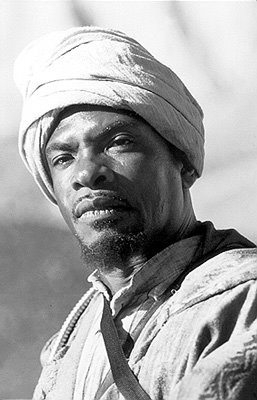
(Photo: Keith David as Abu 'Imam al-Walid in the Vin Diesel sci-fi movie Pitch Black [2000]).

Saturday, October 21, 2006

Sympathetic portrait of the suicide bomber: Battlestar Galactica


Listen to today's Weekend Edition on NPR and hear Elvis Mitchell and Andrea Seabrook discuss the new edition of Battlestar Galactica, now on the SciFi channel. What is remarkable is that suicide bombing is presented in a nuanced, not unsympathetic light, as are veiled critiques of US practices (torture, imprisonment without charge) in Iraq. I've not yet seen the show but I'm going to watch as soon as I have the chance.

I also find it curious that there has been no media outrage about this, at least none that I'm aware of. And yet, when Fun^Da^Mental put out a song ("Cookbook DIY") that compares individual suicide bombers to scientists making weapons of mass destruction for governments, Fun^Da^Mental's frontman, Aki Nawaz, is massively criticized in the media and public figures call for him to be charged for "glorifying terrorism" under Britain's new anti-terrorism laws. As Aki says, artists like Harold Pinter call Tony Blair a war criminal and say he should be tried in a criminal court, and other artists and journalists push the envelope, and no one calls for them to be prosecuted. But just let a Muslim artist get "edgy" and a hysterical, moral panic ensued. According to Aki, it's because of racism against Muslims.