Tuesday, February 26, 2008

Che Spotting


Supporters of Cyprus' president-elect Dimitris Christofias wave Cyprus flags and Che Guevara banners at a victory celebration, Eleftheria Stadium, Nicosia, February 24. Christofias was the candidate of the Cypriot Communist Party, the surprise victor, and the beneficiary of the Greek Cypriot electorate's revulsion toward his predecessor's hardline stance regarding negotiation with Turkish Cypriots. Christofias is the first Communist leader of an EU country.

Monday, February 25, 2008

Kibbespotting: Rewriting the History of the Blues


No doubt almost anyone who reads this blawg heard this amazing story (Jan. 31) on NPR's Morning Edition: "Kibbe at the Crossroads: A Lebanese Kitchen Story." On the face of it, this is just a "food" story, a bit of NPR fluff. But it turns out that a story focusing on the mostly unknown history of Syrian/Lebanese cuisine in the Mississippi Delta opens up a history of Syrian-Lebanese immigrants in the Delta and their ambiguous position on the black-white color line. I love the image of Robert Johnson sitting under a sycamore at the legendary crossroads in Clarksdale, guitar by his side, eating barbecue he had procured from the nearby Abe's Barbecue, a restaurant founded by a Lebanese immigrant (Abraham Davis) from the Lebanese town of Zahle. (Probably he didn't eat kibbe, which seems at the time to have been "home" food cooked up on Sunday and not served in Lebanese-Syrian restaurants.) We learn too that Ike and Tina Turner worked for a Lebanese-owned grocery store in nearby Riverton. And we learn that during the days of the Civil Rights movement, Abe's Barbecue and the Lebanese-owned Chamoun's Rest Haven were among the only in the area that would serve blacks. (Without more evidence, I don't think we should generalize on the basis of this story about the commitment of Arab-Americans in the South to the Civil Rights movement. But I do have it on good authority from a friend who knew Ike Turner quite well that Ike always had kind words for Lebanese, based on his experience working for a Lebanese-American grocer.)

At one point in the story, Pat Davis, owner of Abe's, pulls out a CD and plays a song in Arabic sung by Danny Thomas, who was cited by those interviewed for the story as the preeminent Lebanese-American, and star of the very popular sitcom "The Danny Thomas Show," which ran from 1953 to 1964, and often featured Danny's fictional Lebanese uncle, "Uncle Tonoose" (played by Hans Conried--see photo).

The CD in question is The Music Of Arab-Americans, released by Rounder, and the song is reportedly the only recording in Arabic released by Danny Thomas. I highly recommend it, and Danny's song is one of the best on the CD. (The very informative liner notes were penned by ethnomusicologist Anne Rasmussen.)

And, read to the bottom of the "Kibbe" story for a useful discussion of the song, "Miserlou."

Saturday, February 23, 2008

March 19 Iraq War Blogswarm


Another reminder that March 19th is the 5th anniversary of the Iraq invasion. Please join the effort to end this madness. In Fayetteville, you can participate in Pancakes for Peace on March 1, and the 5 Years Too Many demo on March 8. United for Peace and Justice is organizing events throughout the country on March 19--go here to find an event. And if you blog, please join the March 19 Iraq War Blogswarm. Information available here.

Monday, February 18, 2008

Colin Farrell, Kufiyaspotted Again

Check out this MSN Video, where he's being interviewed about the film, "In Bruges." (Thanks to The Bedouin Project for this info.)

5 Years Too Many!


And 1 trillion dollars too many [WRONG! As of today, Feb. 19, it's $495 billion too many, according to the National Priorities Project], 1 million (or so) Iraqi dead too many, 4000 (nearly) US soldiers too many...I can hardly believe that the 5th anniversary of the beginning of the Iraq War is nearly upon us (March 19). Fayetteville's peace organization, the Omni Center for Peace, Justice and Ecology, is planning to mark the anniversary with a demonstration, strung out along College Ave. from College to Township, on March 8. (Not March 19, because that's during spring break for us.) Join us!

And, to raise money for the event, a Pancakes for Peace breakfast on March 1st. With coffee courtesy of Arsaga's!

Another "Soundtrack for the Next Misadventure": Abjeez


I came across this video, "Eddeaa," by the Iranian group Abjeez, while reading the blog Rough In Here, Rougher Out There. I can't understand Persian, and don't know enough about Iran to really understand the video, but I find it uproariously funny. The scenario seems to evoke early twentieth century, pre-Pahlavi, Qajar Iran. I think. Check it out for yourself.

"Abjee" is Persian slang for sister, and the band is two sisters, Safoura and Melody Safavi, plus backing musicians, and are based in Sweden. More information here.

Also check out Abjeez's very clever video, "DemoKracy," complete with English subtitles. It's a clever, humorous critique of the US neo-con use of the smokescreen of "democratization" to justify military intervention in Iraq and potentially (though now, mercifully, much less likely) Iran. Abjeez describe the video as being a response to "AIPAC is pushing us to war with Iran for Israel." In this regard, I have much more faith in Obama's willingness to talk, as opposed to bomb, Iraq, than in either McCain or Clinton.

Saturday, February 16, 2008

Haifa!


I'm going to Creighton University next week to give a talk about "Contemporary Trends in Middle Eastern Pop Music." (Nice poster, no?) The topic is way too large, so I'll limit the discussion to Haifa Wehbe, "gnawa fusion," and Palestinian rap. Today I'm trying to write up the Haifa bit, which has involved, among other things, scanning the web for useful sources. In the course of my searches I came across the absolutely essential Haifa Wehbe Fashion Blog. Check it out to keep up to date on what Haifa is wearing. We should never forget that Haifa is not just a singer: she's also a fashion model.

What's your favorite Haifa song? I'm quite partial to "Ma Sar." I know, it's pretty much just a techno/dance song with vocals in Arabic, but hey, it's a good dance song, and I like how Haifa's voice sounds on it. Number two for me would be "Ana Haifa." Check out Haifa's most recent videoclip, "Mosh Adra Astana," here.

local kufiyaspotting


I've really slacked off of late when it comes to blogging. There's no real compelling excuse, other than the fact that I was in Portland last week for a meeting of the editorial committee of Middle East Report and to speak (along with Rochelle Davis and Lara Deeb) at Reed College.

There are many things I have wanted to write about, but for now, since it's easy, I wanted to report my latest kufiyaspotting. The photo is of DJ Shortfuze, spinning the wax in Fayetteville on New Year's Eve, for a party at Urban Table. Last night Shortfuze opened for the legendary Mixmaster Mike--a really fabulous show. Turntablism is coming on strong in Fayettenam, as you can read in this article published in the Northwest Arkansas Times. (Shortfuze has an MA in anthropology from the U of A, where he took some classes with me. He acquired his dj-ing skills all on his own, however.) The photo is sampled from the kxua blog.

Friday, January 25, 2008

Sundance: Palestinian Rap and Kufiyaspottings


I forgot to mention it previously, but Jackie Reece Salloum's much anticipated documentary on Palestinian rap, Slingshot Hip Hop, had its premiere at the Sundance Film Festival this week. It is receiving, well, pretty good reviews. Justin Chang had this to say about it in Variety (January 21): "Lively but roughly structured docu could've benefited from more performance footage, focusing instead on the challenges these young talents (hailing from Israel, the West Bank and Gaza) have faced on their rise to prominence, especially the geopolitical barriers that have hindered their mobility. Music-themed fests and Mideast programmers should make room on their playlists." Less positive was Eric D. Snider writing in Cinematical: "What the film lacks, though, is a cohesive theme or story line. An introduction to the Arab rap movement is all well and good, but it's not enough – an introduction is only the first part of a story, after all." In any case, I'm still eagerly looking forward to seeing the film for myself.

Meanwhile, thanks to Linda, who had to pour obsessively through dozens of photos to find it, we have another kufiyaspotting of Colin Farrell, who was photographed several times sporting the "Palestinian scarf" at the Sundance event for his film In Bruges.

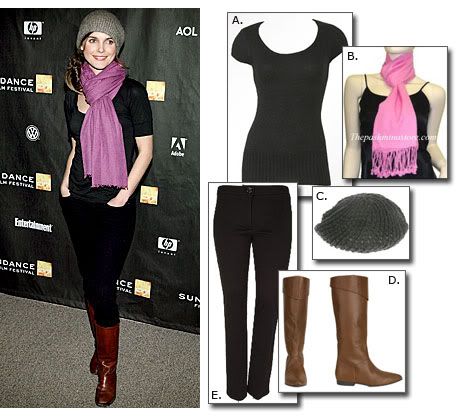
Colin Farrell has been spotted before. But what was also of note was the fact that Mary Kate Olsen showed up at the In Bruges party also sporting a kufiya--one of those fancy purple ones. (If you want to be as obsessive as Linda and I, and see even more photos of Colin and Mary Kate in kufiyas, go here, check out the "events" photos, and then you've got to get to photo 146, and after.)

Celebrity Gossip wrote that she was looking stylish as always, but failed (as the fashion and gossip experts usually do) to identify the kufiya, simply calling it a "purple scarf."

Who next? After Mary Kate Olsen, it really could be almost anyone. According to Celebrity Gossip, "With the writers’ strike raging on, the Hollywood elite are growing bored. But there’s nothing like the Sundance Film Festival to give stars like Mary-Kate Olsen something to do." Get bored and wear kufiyas...


Wednesday, January 23, 2008

the anne frank kufiya virus


Just learned, thanks to a comment on my earlier post that alerted me to a post on Martijn de Koning's invaluable blog CLOSER: Anthropology of Muslims in the Netherlands, who saw my post...(I'm outta breath)...that you can purchase an Anne-Frank-in-kufiya t-shirt from an Amsterdam company called Print Revolutionaries. 27.50 Euros.

Monday, January 21, 2008

Attention kufiya fashionistas! Gaza humanitarian crisis!

I just received this call, regarding the drastic humanitarian crisis in Gaza. Kufiya wearers (and other supporters of human rights): mobilize!

AN ISRAELI CALL FOR URGENT ACTION

We, the Israeli organizations signed below, deplore the decision by the Israeli government to cut off vital supplies of electricity and fuel (and therefore water, since the pumps cannot work), as well as essential foodstuffs, medicines and other humanitarian supplies to the civilian population of Gaza. Such an action constitutes a clear and unequivocal crime against humanity.

Prof. John Dugard, the UN Special Rapporteur for Human Rights in the Palestinian Territories, called the Israeli government’s actions “serious war crimes” for which its political and military officials should be prosecuted and punished. The killing of more than 40 civilians this past week violates, he said, “the strict prohibition on collective punishment contained in the Fourth Geneva Convention. It also violates one of the basic principles of international humanitarian law that military action must distinguish between military targets and civilian targets.” Indeed, the very legal framework invoked by the Israeli government to carry out this illegal and immoral act – declaring Gaza a “hostile entity” within a “conflict short of war” – has absolutely no standing in international law.

We call on the Secretary General of the UN, Mr. Ban Ki-Moon, to lead the Security Council to a decisive decision to end the siege on Gaza when it meets in emergency session on Wednesday.

We call on the governments of the world, and in particular the American government and the European Parliament, to censure Israel’s actions and, in light of recent attempts to revive the diplomatic process, to end all attacks on civilians, including the continuing demolition of Palestinian homes at an alarming rate.

We call upon the Jews of the world in whose name the Israeli government purports to speak, and upon their rabbis and communal leaders in particular, to speak out unequivocally against this offense to the very moral core of Jewish values.

And we call upon the peoples of the world to let their officials and leaders know of their repudiation of this cruel, illegal and immoral act – an act that stands out in its cruelty even in an already oppressive Israeli Occupation.

We condemn attacks on all civilians, and we acknowledge the suffering of the residents of Sderot. Still, those attacks do not justify the massive disproportionality of Israeli sanctions over a million and half civilians of Gaza, in particular in light of Israel’s oppressive 40 year occupation. Such violations of international law by a government are especially egregious and must be denounced and punished if the very system of human rights and international law is to be preserved. The Israeli government’s decision to punish Gaza’s civilian population, with all the human suffering that entails, constitutes State Terrorism against innocent people. Only when Israeli policy-makers are held accountable for their actions and international law upheld will a just peace be possible in the Middle East.

The Alternative Information Center * Bat Tsafon * Gush Shalom * The Israeli Committee Against House Demolitions (ICAHD) * Physicians for Human Rights * Coalition of Women for Peace

Saturday, January 19, 2008

New Statesman articles on kufiya fashion

Continuing in my hysterically-obsessive effort to fully document and understand the kufiya craze, I came across these two articles from the British magazine New Statesman (analogous to The Nation in the US), from 2007 and 2005. The 2007 piece, by Allegra Stratton, discusses how Urban Outfitters, seemingly in response to the controversy over the firm's kufiya marketing in the US, opted to sell it as the "shemagh" in Britain. Ben White, writing back in 2005, worried that the keffiyeh was on its way to becoming an empty symbol of radical politics, just like Che and Martin Luther King. "Rather than its [the keffiyeh's] increased popularity signifying a politicisation of fashion," White concludes, "it simply means more people will be wearing something they know little about and which represents something they do nothing for." Good question: how keffiyeh wearers care at all or even know anything about the suffering of Palestinians in Gaza? The letter in response to white claims that British bikers, and some Goths, have been wearing the keffiyeh/shemagh for decades.

"Bedouin couture," Allegra Stratton (New Statesman, July 19, 2007).

You've just attended Glastonbury in the worst June since records began and could have done with your grandmother's shawl. A pashmina might have helped - but you're not Kate Middleton or Sienna Miller. Besides, you've got some rubber wristbands left over from last year and know that we live in political times. You opt for the shemagh.

The shemagh is the headcloth worn by Arab peasants for centuries, which now features in the autumn collection of the haute couture fashion house Balenciaga. That really is rags to riches. Something Yasser Arafat spent an hour intricately folding around his head each morning so that its tail formed the shape of Palestine, has spent most of 2007 as a fashion accessory.

Readers of Grazia magazine will have seen David Beckham in, variously, an orange and a green shemagh. Sienna and Kate were there at its beginning; one has even been seen round the neck of Jade Goody.

The main purveyor of the reinvented shemagh is the high-street chain Urban Outfitters. Black-and-white in Palestine as a symbol of nationalism, plain white in the Gulf, red and white in the Jordanian army. At Urban Outfitters, you can buy your shemagh in any colour as long as it's nu-rave fluorescent. In pink and purple, with added hearts against the classic checks, it has become the £18 Heart Woven Desert Scarf. "It won't provide you with much camouflage in the desert," says the catalogue, "but it sure is pretty."

Pretty? The Jewish and Palestinian lobbies united in fighting what they saw as trivialisation and the product was pulled from American shelves in January due to what the company acknowledged was its "sensitive nature". An inkling of this may have been why the store chose to name its scarves by the obscure name of the shemagh - something British soldiers called them when posted in North Africa during the Second World War - rather than what Arabs call them, keffiyehs.

In London's Urban Outfitters, the shemagh remains a bestseller. At the Covent Garden branch, a place so glibly political the male mannequin in the forecourt wears a T-shirt slogan, "Drop Acid Not Bombs", I ask one assistant why they're still selling shemaghs. "What, because of the whole Afghan thing?" she asks, making rabbit ear shapes with her fingers. Another assistant wore her shemagh on holiday to America. "Like Iranians, or whatever, would come up to me and say, 'I'm really proud of you for supporting us.'" Close, but not quite.

Centuries ago, shemaghs were a means for Arabs to protect themselves from the wind, sun and storms of the Middle East. Only latterly have they morphed into symbols of Arab nationalism. If the weather continues like this, the bedouin look could spread still further and return to its practical use in northern Europe.

"Fashion claims another symbol: Observations on radical icons," Ben White (New Statesman,
February 14, 2005)

I have seen it several times in Cambridge, and my friends report seeing it in London: the black and white chequered headdress, or keffiyeh. All of a sudden, the instantly recognisable symbol of Palestinian resistance is being adopted by the fashionistas.

As a supporter of the Palestinians ever since I went up to Cambridge in 2002 - I am now president of the university's Palestine Society - I wonder how I should respond. Do I quietly celebrate this adoption of the emblem of Palestinian nationalism, or do I bitterly resent these Johnny-come-latelies and the ignorantly casual way they swing the black and white scarf over their shoulders? As it is safe to assume that those sporting keffiyehs are not new card-carrying members of Fatah, is this phenomenon a "good thing"?

You might say that this anxiety is typical of the miserable left, moaning about the gradual acceptance by the trendsetters and taste-makers of a cherished symbol of resistance. To combine cliches, we never miss an opportunity to snatch defeat from the jaws of victory. But it is not as simple, or uplifting, as that.

In the past few decades, radical icons have been appropriated by market forces and rendered politically impotent. The archetypal commoditisation is Che Guevara or, more accurately, a picture of him. Once confined to posters in student digs, Che's mugshot has since appeared on, well, mugs, along with T-shirts, beer mats and other merchandise. He is now high-street fashion attire, at best worn in a spirit of ironic acknowledgement of his radical politics.

It's not just symbols that undergo a revision; entire moral and intellectual legacies can be transformed. Martin Luther King has become a contemporary saint in the US, complete with a holiday named after him. He has become a marketable meaninglessness, providing suitable quotations for all occasions, and reinforcing self-comforting American ideas of democracy. Meanwhile, his attacks on US foreign policy and the military-industrial complex are forgotten.

The keffiyeh could be heading in the same direction. Rather than its increased popularity signifying a politicisation of fashion, it simply means more people will be wearing something they know little about and which represents something they do nothing for.

Letters - Worn to be wild (New Statesman, February 21, 2005)

Ben White (Observations, 14 February) should know that the black-and-white keffiyeh has been worn by bikers, and the occasional Goth, for decades. It is noted for its warmth and dustproof properties at speed. The bikers buy it from that London purveyor of high fashion, Silvermans, the military clothing supplier, where it is known as a shemagh. [Silverman's still has them, for 6.99 pounds--just search for Shemagh. T.S.]

William Black
Scarborough, North Yorkshire

Friday, January 18, 2008

Anne Frank with Keffiyeh in NYC Street Art

Ever on the lookout for kufiyas (aka keffiyeh, kaffiyeh, shemagh), I found an interesting flickr pool called "Hipster Intifada." It has several interesting kufiya shots, including this one of Anne Fank. Plus check out the "History of the object in question" in the discussion section, from AnomalousNYC.

For more flickr photos, just click on kufiya, keffiyeh, or kaffiyeh on flickr. (Most common spelling on flickr: keffiyeh.)

Friday, January 11, 2008

More kufiyaspottings (#30-32): Israeli Version with Star of David, Bush/Olmert/Peres, Hip Elbow Patch

Three more recent kufiya (كوفية) items.

(1) From a very informative blog, Culture et politique arabes, authored by Yves Gonzalez-Quijano, who teaches Arabic literature at l'université Lyon2. (Warning, francophobes, it's all in French.) He does a very nice job of providing an overview of the history of the kufiya and its recent inroads into the world of fashion. Two observations of particular interest. First, that, in response to the explosion of kufiyas in Western fashion, an Israeli designer has come up with a blue-and-white kufiya, in the colors of the Israeli flag, with the design of the Star of David. (You might have to look at the photo for a minute, like I did, to see the six-pointed star.) I've not been able to determine which designer is doing this.

Gonzalez-Quijano concludes by observing that despite its current fashionability, and much like the image of Che Guevara, "the Palestinian keffieh hasn't totally lost its evocative power," as evidenced by this photo of Hugo Chavez.

If you weren't convinced, how about this poster, plastered around Israel by extreme right-wing activists in anticipation of Bush's visit?

Six activists were arrested on the charge of vandalism, for putting up the posters, as reported by Ynet. The belong to the extreme right Jewish National Front, founded in 2004, which calls for Palestinians (both in Israel and in the West Bank and Gaza Strip) to be "encouraged" to emigrate. They oppose the withdrawal of Israeli civilians and military from any Palestinian territory, and therefore consider Israeli PM Ehud Olmert and Israeli President Shimon Peres (depicted here along with W) to be traitors.

Note that the kufiyas on their heads are arranged in the very distinctive style of late Palestinian president and PLO leader Yasir Arafat, as if to associate them with the ultimate "terrorist." (Note: Bush's niece Lauren has actually been kufiyaspotted.) Thanks to John L. Knight for alerting me to this item.

Finally, kabobfest has spotted another kufiya fashion line, this one from a New York outfit called Kiser. Read about it here. A "Kefia Shawl Collar Sweatshirt." Only $86. Very hip.

Egyptian rock: "Mama Ayez Atgawez" from Wast al-Balad

Don't really know anything about this band. Wast al-Balad means "downtown." I can't make out all the lyrics, but here are some of them (thanks to Robin for help):

Mama ayiz atgawwiz, bass ma fish filus (Mama, I want to get married, but I don't have any money)...

Mama ayiz atgawwiz, ma indish filus ashtari sha'ah (Mama, I want to get married, but I don't have any money to buy an apartment)...

Mama ayiz atgawwiz, ma indish filus ashtari arabiyah (Mama, I want to get married, [but] I don't have money to buy a car).
Habibi sakin fi z-Zamalek, w-ana sakin fi-l-Abbasiyah! (My sweetheart lives in Zamalek, and I live in Abbasiyah.)

The song deals with typical problems facing young people in Cairo, who want to get married and to gain the status of adulthood, but who have difficulty putting together enough funds to do so. Middle class parents will not allow their daughters to marry a young man, if he can't provide an apartment, fully furnished, a car, etc. And what's worse, for the young man singing the song, he and his sweetheart reside in two different, and quite distant, neighborhoods of Cairo.

Great fun!

Monday, January 07, 2008

Prophet Motive: Kahlil Gibran


I highly recommend this amusing and informative account of Kahlil Gibran by Joan Acocella, writing in the New Yorker, on the occasion of a new volume of Gibran's work. The title tells it all: "Prophet Motive." I had not realized that Gibran is said to be the third best-selling poet of all time (after Shakespeare and La-Tzu), based almost entirely on sales of The Prophet. (At least as of 1997, Jalal al-Din Rumi was the best selling poet in the US.)

I could never understand, even as someone who is in some senses a product of "the sixties," why The Prophet was so incredibly popular. Acocella helped me understand. Among other things, it possesses the mysterious allure of "Oriental wisdom" but without being tied to any particular religion, and so prefiguring New Age spirituality. And: its "advice is not bad"; it is “inspirational literature”; it has a "pleasing ambiguity"; it's comforting; and it's short, 96 pages, with, as Acocella writes, "margins you could drive a truck through." Acocella has the good grace not to add that there's no accounting for bad taste--but I think that's a factor.

It's another example of what I'd call "popular Orientalism," rather stupid and banal, but nonetheless pretty harmless. (Although it wasn't really harmless for Gibran, who made lots of money but seems to have felt himself to be a fraud, and so drank himself to death. His adherents seem to prefer the more romantic, but mistaken, idea that tuberculosis did him in.)

What I still don't understand is why Gibran, a Maronite Christian from what is now Lebanon, who emigrated to the US as a child in 1895, spelled his first name Kahlil. The first letter of his name, خ in Arabic, is properly, and normally, transliterated 'kh.'

This bugs me almost as much as the book does...

Prime-time situation comedy in Israel on Palestinians ("Israeli Arabs")

I learned about this show from an informative article in the New York Times. The title of the show, written by Sayed Kashua, a Palestinian citizen of Israel, is "Avoda Aravit," which means Arab work or Arab labor. According to the article, the title is Hebrew slang for second-rate work. The title also riffs off of the slogan, "Avoda 'Ivrit," or Hebrew labor, which was fundamental for the Zionist colonizing movement in Palestine. The Zionist ideology proposed that the Jew of the diaspora would be remade by doing hard physical labor on the land, and by not hiring others (namely Arabs) to do that work. The fact that the iconic "worker," especially when it comes to the most difficult physical labor (in factories, in agriculture, in construction) is done in Israel today by Arabs represents, therefore, a kind of subversion of the Zionist dream.

Two things I love about the video clip (courtesy of Al-Jazeera English): first, the daughter who subverts her parents plan to get through the checkpoint by speaking Arabic: "Sabah al-khayr ya bulees!" (good morning, policeman); and second, the Palestinian-Israeli woman who refers to Edward Said's book Orientalism when she spurns her Jewish-Israeli date. "Since I'm an Arab, I must adore maqluba [a traditional Palestinian dish, made with cauliflower]. That's exactly what Edward Said wrote about in 'Orientalism.'" Interesting because the expectation is that both Jewish and Arab viewers in Israel would be expected to know, or at least know of, Said's book.

Wednesday, January 02, 2008

Gayhane: Gay disco in Berlin for Turks and Arabs

Nicholas Kulish reports, in an NYT article entitled "Gay Muslims Pack a Dance Floor of Their Own," on a monthly event known as "Gayhane" at a Berlin disco. But why give the article the title, "Gay Muslims"? No doubt many of those who participate consider themselves Turks or or Kurds Arabs or Turkish-Germans or Berliners?

The monthly club is organized by the transgendered Fatma Souad (pictured), who started throwing the events in 1997. What's the music? Amr Diab and Cheb Mami are popular. One of the dj's, Ipek Ipekcioglu, "spins everything from Turkish and Arabic music, to Greek, Balkan and Indian, a style she calls Eklektik BerlinIstan."
The article leaves the unfortunate impression, however, that the young men and women who participate in Gayhane ("hane" means home in Turkish) would be "killed" if their families knew, but it also shows that homophobia isn't just a phenomenon peculiar to Middle Eastern communities in Germany. "[H]omophobia is also higher among Russian immigrants and in other, less urban parts of Germany," according to social psychologist Bernd Simon.

Gayhane of course is not a "new" phenomenon. Please check out this article from 2004, from AFP, whose title is "Gay Turks [as opposed to "Muslims"] Tearing Down Walls in Berlin," and which usefully discusses racism within the German gay community.

Monday, December 31, 2007

Kufiyaspotting #29: Karen Hess


Thanks to Bob, who spotted this item on Karen Hess for me in this week's Sunday New York Times Magazine. (I had looked through the magazine but missed the photo.) This issue of the magazine is composed of obits for important people (at least, according to the Times) who passed away in 2007. I had never heard of Karen Hess, who according to Betty Fussell, author of the piece, was a well-known food activist, contrarian, and food historian. She considered Julia Child a "dithering idiot." And she wore a bonnet and a kufiya. You gotta love her.

Happy New Year!

"Arabian Nights": Marc Jacobs

I saw this rather astonishing item yesterday in the Sunday Styles section of the New York Times. The piece, by Bill Cunningham (who also shot the photos), is entitled "Unveiled" and it reads as follows: "The 'Arabian Nights' event given by the designer Marc Jacobs at the Rainbow Room on Dec. 12 was the office party of the year. Many costumes reflected the fantasy drawings of the fashion artist Antonio Lopez in the 1985 book 'Antonio’s Tales From the Thousand and One Nights.' Top left, an image from the book’s cover." Unfortunately, the photos--the best part of the piece--are not reproduced in their full size on the NYT site. But if you click on the photo you can get a fuller view. You can also google "Marc Jacobs" and "Arabian Nights" and find more shots of the event on various blogs. I've reproduced a few here, many of which show more skin than the Times is able to show.These are the entertainers, presumably professional bellydancers.

I've not found out much relevant about fashion illustrator Antonio Lopez (d. 1987), the presumed source for many of the costumes, but I have been able to locate another painting from the book. But I would suggest that the "source" of the Marc Jacobs party fantasy goes back much further than Lopez's 1985. Orientalism was all the rage in the West during the first three decades of the twentieth century, and it was very common for socialites in New York and London to hold parties where the guests dressed up much as Marc Jacobs' guests did in 2007. Such events were quite popular, and considered "liberatory" for women, because adopting Eastern dress meant throwing off the constraining corset. (Some argue that the original "source" for this fashion movement was the appearance of Arab "bellydancers" at the Chicago Worlds Fair in 1893, and particularly the dancer known as "Little Egypt.") The brilliant and visionary filmmaker Jack Smith queerly evokes these traditions in his films Flaming Creatures and Normal Love (which you can view here); freak folksinger Devendra Bernhardt and Hairy Fairy also recall the early twentieth century Orientalist soirées in a NYT fashion spread.

This Orientalism can be found all over the place, and it is quite well documented. One of the best articles I've read about it is by Peter Wollen ("Fashion/Orientalism/The Body," in New Formations 1, 1987), where he discusses the role of Matisse, the Russian Ballet and its costume designer Leon Bakst, and fashion designer Paul Poiret in promoting these trends, in both the domain of "high art" and in popular culture.
A photo of Nijinsky from the Ballet Russe, in a costume designed by Bakst.
This is a photo of Peggy Guggenheim in a Poiret outfit, taken by Man Ray.

And then there is modern dance, whose development is closely related to the image of the Eastern bellydancer. Among the names to mention in this regard are Maude Allen (shown below in her famous Salomé role) Collette, Isadora Duncan and Ruth St. Denis (shown below).
And then of course there is cinema, from the Babylon sequences of D.W. Griffith's Intolerance (1916) to the films starring Theda Bera
,Rudolph Valentino as the Sheik, and so on.

And then there's even art deco, as evidenced in this bit of sculpture.

Back in the early twentieth century, when this sort of Orientalism was all the rage, it was connected to a certain notion of female, involving more freedom for the body from constricting clothing (the corset), and a more libertine orientation to bodily display, rooted in an imagined model of an Orient that was more sensual than the West. Today, clearly, it doesn't mean the same thing to dress up in "Oriental" costume as it did 100 years ago. I've not yet worked out what's going on with the Marc Jacobs party. More later, inshallah.