From Reuters, Monday, July 23
State money will continue to flow to scores of private and religious schools participating in Louisiana's new voucher program even if their students fail basic reading and math tests, according to new guidelines released by the state on Monday.
The voucher program, the most sweeping in the nation, is the linchpin of Louisiana's bold push to reshape public education. The state plans to shift tens of millions of dollars from public schools to pay not only private schools but also private businesses and private tutors to educate children across the state...
Under the new rules, schools will not be penalized for poor scores on state standardized tests if they have fewer than 40 voucher students enrolled in the upper elementary or secondary grades. Those schools can continue to receive state funds even if their voucher students fail to demonstrate basic competency in math, reading, science and social studies...
Some of the schools the state has approved for voucher students use Bible-based science textbooks and other controversial teaching approaches.
Wednesday, July 25, 2012


Achieving excellence through education reform: outsource the failures
"A high-performing Bronx public high school [Bronx Health Sciences HS in Baychester] has been maintaining its 95 percent graduation rate by forcing dozens of students who underperform to transfer to other schools, students, staffers and other sources charge."
Read more here.
Note: the blog of the hog is now receiving lots of info on education "reform." I'm gonna be posting a lot on this in future. Inshallah, as they say.
Read more here.
Note: the blog of the hog is now receiving lots of info on education "reform." I'm gonna be posting a lot on this in future. Inshallah, as they say.
Sunday, July 22, 2012
Heavy Metal (Anti-)Islam

On July 11, The Atlantic published a piece on its website by Kim Kelly, entitled "When Black Metal's Anti-Religious Message Gets Turned on Islam." The article begins by describing a track called "Burn the Pages of Quran" by a female-fronted heavy metal band from Iraq called Janaza. It also describes the metal band Seeds Of Iblis (Iblis = Satan in Arabic), fronted by Anahita, the same woman who fronts Janaza, which has released an EP entitled Jihad Against Islam. Two other bands mentioned in this camp of "blasphemers" are Damaar and Ayat, both from Lebanon.
Kelly concludes by describing Anahita and her projects in quite laudatory terms:
In a scene revered and reviled for its commitment to darkness and blasphemy, it's nevertheless rare to encounter musicians who are, quite literally, willing to die for their art. Anahita's message is controversial, but it also comes with sobering, almost-jarring humanity. As her one-woman war against Islam rages on, her deepest desire seems to be for peace—or at least, for understanding.
"The goals of Janaza and Seeds Of Iblis are to show the world that Islam is dangerous," she said, "and even the people who live in the Middle East get hurt by this religion and seek for freedom of speech, just like the other people from all over the world."
Only two days later Hetal, writing for Metalluminati exposed Janaza as a (probable) hoax. The artists hide behind fake, re-purposed photos. They only communicate with journalists via Facebook. Their stories don't add up.
In fact, the whole notion that there is something called The Arabic Anti-Islamic Legion (The Atlantic for some reason renders "legion" as "league") seems to me highly suspect. On the one hand, the very existence of such a "legion" seems like a wet dream designed to appeal to Westerners (metal fans and non-metal fans alike) on the lookout for local critics of "Islam" with whom to sympathize (cf. Hirsi Ali). Better yet if these Arab or Middle Eastern critics are motivated by their embrace of a Western popular culture form. Isn't it cool and awesome that they are using metal to blast the bejesus out of that awful and threatening doctrine of "Islam." On the other, the whole thing seems like a propaganda gift to local forces who are always on the lookout for immoral, anti-religious behaviors by Arab or Middle Eastern youth who have been corrupted by various forms of Western popular culture (cf. "moral panics" in Egypt [1997], Morocco [2003] and Lebanon [2002-3] against "Satanic" heavy metal). The metal scenes in Egypt, Morocco, and Lebanon have bounced back from the early attacks, but witch hunts keep occurring, as Beth Winegarner writes in an article for PopMatters in June. (And see, of course, Mark Levine's book, Heavy Metal Islam.)
My guess is that the perpetrators of the hoax are Western metal heads, not Arab ones. They may have been successful in creating a ruckus, and the music is pretty decent -- but they have, wittingly or not, probably done more harm to the Arab and Middle Eastern metal scene that they claim to be a part of. Too bad that The Atlantic also, irresponsibly, played along and gave the "Arabic Anti-Islamic Legion" even more publicity.
Director Alison Klayman: Kufiya Dress

Fred R. Conrad/The New York Times
From today's New York Times (July 22, 2012), a review of first-time director Alison Klayman's documentary about Chinese avant-garde artist Ai Weiwei, and showing Klayman wearing: a kufiya dress. (Klayman is a Brown graduate; perhaps she picked up her fashion sense there.)
Thursday, July 19, 2012

Friday, July 06, 2012
Tuesday, June 26, 2012
Cultural Diplomacy

So this announcement seems really appropriate doesn't it? An event organized by the US embassy:
For the First Time in Egypt
American Idol Finalists
in the Cairo Opera House Open Air Theatre
on Friday, July 6 2012
at 8:00 pm.
Ticket Price:10 EGP.
(Courtesy Sarah Carr.)
Are they sending J-Lo to impress the Egyptians that minorities play an important cultural role in the US??
Wouldn't it be better to tell the SCAF to hand over power to civilian rule or the dollars will be cut?
"A Beirut Minute" -- smokin' vid of Beirut, Lebanese rappers
Courtesy DJ Nickodemus, Justin Carty, Jackson Allen, Shortfuse Films: a terrific video with gorgeous scenes of Beirut and raps from Lebanese MCs Ed Abbas, Yaseen I-Voice, Malikah and Ramcess Funk L'Hamorabi.
A BEIRUT MINUTE from Justin Carty on Vimeo.
A BEIRUT MINUTE from Justin Carty on Vimeo.
Friday, June 22, 2012
The People Rose in Cairo (kufiya content)
On The Daily Show last night, Jon Stewart gave a recap of the Egyptian Revolution/Counter-revolution to date, interviewed the host of the popular comedy Egyptian TV show Al-Bernameg, Bassem Youssef, and -- promoted (correctly) a vision of the Egyptian revolutionary as garbed in a kufiya. View it here.


Wednesday, June 20, 2012
SCAF, Council of Bastards
Given the current state of affairs in Egypt, with the Supreme Council announcing its revisions of the constitution, which grant it much more power, and as the Egyptian public awaits the announcement of the victor in the presidential elections...this song, chanted by the Ahlawi Ultras (fanatical fans of the Ahli football/soccer club) at the Parliament sit-in in April 2012, seems only appropriate. This is no "Kumbaya." It's very useful for English speakers, because it comes with subtitles. (I'm looking for the Arabic.)
Oh SCAF you bastards. How much money is a martyr's blood?
PS: for a great analysis of the current disarray of Egypt's political system, please check out this article by Nathan Brown.
Oh SCAF you bastards. How much money is a martyr's blood?
PS: for a great analysis of the current disarray of Egypt's political system, please check out this article by Nathan Brown.
Thursday, June 07, 2012
Music and Torture, Music and War
Very interesting documentary from al-Jazeera, called "Songs of War." It features Christopher Cerf, a composer for Sesame Street, who, after learning that some of his music was used in the torture of US-held prisoners of the "War on Terror," at Guantanamo and in Iraq, tries to make sense of what it all means.
Friday, June 01, 2012
Soraya Morayef on Egypt's Mahragan (Underground Shaabi/Shaabi Techno) Music Scene
Jadaliyya recently published this terrific article on the underground but now bubbling to the surface music scene which outsiders (like myself) have called techno shaabi but which is known locally as "mahragan" (or sometimes, mahraganat, the plural form), which translates as "festival" music.
Morayef tells us that it's the music of the popular quarters, of the microbuses and the ta'amiya stands. It is rooted in Egypt's "shaabi" music, the beats are pure sha'abi, but the sound is provided by DJ's jamming lots of electronica. The singing is shaabi as well but often heavily auto-tuned. The lyrics are full of humor and slang and are often very direct. Exceptionally and unprecedentedly direct, in fact, in their use of curses and vulgar language. Particularly in the case of the amazing Amr Haha (also spelled 7a7a).
Morayef describes Haha's new song, “Aha el shibshib daa’!” or “Fuck, I’ve lost my slippers!” Part of the impact generated by the song is that swearing is something that has long been taboo in Egyptian music. I remember discussions with Egyptian friends when I lived in Cairo ('92-'96) who were interested in rap music and were amazed by all the bad language. It seems that "mahragan" artists like Haha, and in fact perhaps particularly Haha, based on the evidence (all his music available on youtube) is responsible for breaking through that taboo. The song also gets its traction among audiences by its focus on the mundane, the loss of a slipper. Morayef states that mahragan music often, or at least sometimes, has an oppositional edge. Haha and his posse (including Sadat and DJ Figo) mix the popular slogan “yasqut yasqut hokm al-‘askar,” or “down, down with military rule,” in their songs.
Elliott Colla, in his article "The People Want" in the latest Middle East Report (just out), shows how 7a7a, while supportive of the revolution, is also able to poke fun at it slogans. And I quote:
in one particular song, entitled, “The People Want Five Pounds’ Phone Credit,” 7a7a pokes fun at the slogan “the people want” even as he champions it:
The people want something new [to think about]
The people want five pounds’ phone credit
The people want to topple the regime
But the people are so damn tired
It’s hard living hand to mouth
The people have said their word
And Tahrir is their place
While 7a7a uses the same musical pattern of the slogan, he also adds rhyme where none existed before. Moreover, unlike the slogan, this song can only be pronounced in the vernacular. And like the sounds of the words, the lyrics also refer to a very local urban experience of poverty. This song also draws into question the tiredness of the slogan and the term -- “the people.” More precisely, 7a7a points out that “the people” is a rhetorical figure. In other words, 7a7a’s riff on revolutionary rhetoric suggests something very important, namely that the most powerful metaphor employed during the uprising was that of “the people” itself.
For a great account of Amr Haha playing at a wedding in a popular quarter, check out this account by Sarah Carr.
Morayef also discusses the group Tamanya Fil Meya or "Eight Percent," which includes DJ Ortega, Wezza and Oka, from Cairo's popular quarter Matariya. In their song "Ana Aslan Gamed" (I'm Really Hard), she says, they:
sing about their neighborhood, about faith and superstition, envy and the evil eye, and black magic. The lyrics flow like a conversation about an average day in their life as Oka, Ortega, and Wezza take turns in singing verses, while the others echo or call out to their neighborhood. In fact, the structure of their songs and the flow of their singing are very similar to rap music: street culture, roots, pride, ego, and prayer combined with a heavy rhythm and a raw energy.
What is also notable about this video is that it shows Eight Percent performing "Ana Aslan Gamed" not in Cairo but in the southern city of Aswan, and so, the crowd is full of young Nubians. We learn, then, that the group has a sizable fan base outside of Cairo, and as well, that mahragan groups are performing in concerts, not just at neighborhood weddings and parties (which was where they got their start playing).
I am really bowled over by "Ana Aslan Gamed." I find it quite beautiful, and at this moment, it's my favorite of all the mahragan music I've heard. The footage is quite remarkable as well, and it's from a forthcoming (2013) film about mahragan, called “Underground/On the Surface/Raise Your Hand if You Love God,” by director Salma El Tarzi. Please check out the film's blog for more information about the film (and even if you can't read Arabic, it's worth checking out the youtube vids, which feature clips from the film.)
Morayef tells us that mahragan music gaining a growing middle class audience. I was amazed to read her description of Haha and company performing at the Greek Club, one of my favorite establishments in downtown Cairo, but very much a place favored by middle class intellectuals and artists. The fact that shaabi, and in particular, electronic shaabi, is being performed in such a space, is testimony to how far mahragan is moving out of its origins in Egypt's popular quarters.
The more attention I pay to mahragan the more I hope that it blows up internationally, like kudoro or baile funk. It certainly is worthy of the attention. And it is about time for the world to recognize the incredible creativity, humor, tenacity and art of Egypt's lower and working class youth.
Mahragan is also good tonic, for moments when one get depressed about Egypt's ongoing revolution. It will cheer you up, and make you optimistic about the energy of Egypt's youth and its masses.
(I became aware of mahragan -- without knowing what it was called locally -- last fall, and have been struggling to make sense of it. I posted about it here, here, and here. So glad to read Morayef's account.)
Thursday, May 31, 2012
“Taqwacore is dead. Long live Taqwacore”

...whether Taqwacore is dead or has simply mutated, the intersection of Islam, among other brown identities, and music will remain busy and vibrant so long as there are youth around to rebel against the boxes that confine them.
“No one wants to be pigeonholed,” [Omar] Majeed says. “Taqwacore itself was a reaction against being labeled—as Muslim, brown, too religious, not religious enough. Now people are doing new things with the moniker. That’s happening, and that’s good.”
Tuesday, May 29, 2012
Friday, May 25, 2012
Kufiyas and Straub & Huillet's "Moses and Aaron"

New Yorker Films
A review in the New York Times (February 2, 2012) of Straub and Huillet's 1975 film Moses and Aaron reminded me how common it has been for films to depict the biblical Hebrews as Bedouin. This film, however, is anything but what one youtube commenter calls a "sword n' sandals" epic, Hollywood style. The music is by Schoenberg, meaning it is in many ways the antithesis of Hollywood soundtracks.
And the Times reviewer, David Kehr, informs us that the directors "had come to prominence as the creators of a meticulously Marxist-materialist presentation of the music of Johann Sebastian Bach, 'The Chronicle of Anna Magdalena Bach' (1968), and the same systematic refusal of transcendence is at work here." And Kehr concludes, "more than ever 'Moses und Aron' seems like one of the monuments of 20th-century cinematic modernism..."
And yet, those costumes still remind one of Hollywood representations, don't they?
Check out this scene from the film. Love the dancing in front of the golden calf.
Thursday, May 24, 2012
"Maxi Pries wears the Israeli Keffiyeh" --- wha???
Check out this, er, surprising vid, featuring respected British reggae artist Maxi Priest.
The kufiya he is wearing is the record label Shemspeed. It describes its products thus: Israeli Keffiyeh, with its intricate Star of David pattern in the left piece, and words AM ISRAEL CHAI (Jewish People Live) in Hebrew weaved into its fabric in a variety of colors. Check them out here. Colors include blue-and-white, purple, "Army (IDF)" and "Rasta Tiedye."
But there is more to this product than simple appropriation -- though I think it is certainly susceptible to such a claim. Shemspeed also offers the Peace Keffiyeh, which it describes thus:
Peace is something everyone wants, every language in the world has a version of this world in their vocabulary. One of the long standing feuds have been between Jewish & Muslim people, which is the inspiration behind the peace, shalom, salaam Keffiyeh. Though peace talks have been taking place for years now and the divide has grown even wider with harsh actions & rhetoric on both sides, yet it seems there is a consensus that both sides want peace, the problem is that each side wants it on their terms.
We are launching a grass rout campaign to try to focus on the similarities on these Semitic people rather than on our differences. At the end of the day the roots are quite similar in nature since both faiths originate with Abraham and with a shared culture (before the Jews settled around the world) history and now the land. The only sustainable option is coming in terms with a peaceful resolution to this long standing divide. Here is our contribution to this effect.
The peace "kef" comes in both black-and-white and red-and-white.

I do, honestly, appreciate the sentiment. And the fact that the patterns of the "peace kef" include both Stars of David and the traditional kufiya pattern, and that peace is written on the "kef" in both Hebrew and Arabic. This all comes from the orientation of DJ/producer Erez Safar, who is the founder of Shemspeed, also the founder of the Sephardic Music Festival, and is of Yemeni background. This "Israeli keffiyeh" then should not be read simply as an attempt at Zionist colonial appropriation but as an effort on the part of an Israeli Jew of "Oriental" background, i.e., a Mizrahi, to stress the cultural commonalities between Arabs and Jews.
Before passing even cursory judgment on Safar's and Shemspeed's projects, I'd need to become more familiar with the Sephardi Music Festival and with the artists on Shemspeed's label. I am somewhat familiar with Pharaohs Daughter, who I like, though not wildly, and the Hasid reggae artist Matisyahu, whose music I sometimes like but whose politics, when it comes to Israel, I'm suspicious of.
I'm can't imagine that Erez Safar and Shemspeed will be warmly welcomed by many Palestinians or Palestine activists when they call try to reclaim the kufiya as Israeli, or when they infuse it with Star of David patterns. Or when they marked "IDF" kufiyas. Nor are they on very convincing political ground when they act as if both "sides" are equivalent in their "harshness" of their actions and rhetoric. One "side" is an occupying and colonizing force, with enormous military and economic assets. The other is an occupied people resisting. There is no equivalence.
And yet...I welcome Shemspeed's efforts to push the Sephardi, Eastern, Mizrahi side of Jewishness, to challenge Ashkenazi identity. Even at times, to "Arabize" it. Check out, for instance, the Moroccan-Israeli singer Smadar's "Ghali Ya Bouy." Very hot. And she is from Sderot...
Oh, and if you are interested, Shemspeed has other "kef" products (I really don't like this hip abbreviation, sorry), like the Kabbalah Kef and the Kef Shawl and various Kef Skinny Ties.

Kufiya'd vet at NATO protest in Chicago

At least one of the fifty some vets of Afghanistan and Iraq who tossed away their medals on Sunday, May 20, as part of the anti-NATO demonstrations in Chicago, wore a kufiya. Not one of those military-issue khaki ones, but a red one.
The photo above is a screen save from the following report on the event. Please note the vet who tosses his medal, starting at 0:37. That is Jacob George, from my hometown of Fayetteville, Arkansas, who has been riding around the country on his bicycle for two years, organizing against the war and playing banjo. Read about his project, called A Ride Till the End, here.
Forty one years prior to this event, on April 23, 1971, as part of an anti-war action organized by Vietnam Veterans Against the War, over 800 Nam vets tossed their medals, ribbons, discharge papers, and the like, at the US Capitol. The event was widely covered, and part of a major, ongoing mobilization against the Vietnam War. Alas, the anti-war actions in the US these days are, by contrast to those events, are a whimper.
Here's a video of that dramatic event:
dj/rupture - Sufi Plug Ins and Humphrey Davies
1. Via rupture's Mudd Up!, Sufi Plug Ins.
an interdisciplinary project dedicated to exploring non-western & poetic notions of sound in interaction with alternative interfaces...a suite of seven free audio tools for Ableton (Max for Live), including include four distinct synthesizers hardwired to North African & Arabic maqam scales with quartertone tuning built-in, a device called Devotion which lowers your computer’s volume 5 times a day during call to prayer (presets include Agnostic, Fervent, Devout), and a drone machine...as tools, Sufi Plug Ins are what you do with them.
2. On May 16, rupture did a live radio show from Cairo, with guest host Humphrey Davies, one of the preeminent translators of texts from Arabic to English (such as Elias Khoury's Gate of the Sun). The show opens with a divine track from Layla Murad, "Itmakhtari witmayli ya khayl (Strut and prance, Horses!)," from the 1949 film Ghazal al-Banat (which Davies translates as "Candy Floss").
Wayne Marshall (of the blog wayneandwax) tweeted about the show and the opening number: "when the cowbell comes in at 0:07 seconds here, it's so 'take me to the mardi gras' i jump out of my skin." Listen and jump out of your skin too. And be sure to stay tuned for the entire show.
Ghazal al-Banat, btw, is a fantastic, uproarious comedy. Someone has put the entire film up on youtube. (Sorry, no subtitles.) Check out this segment, which features an amazing number from Mohammed Abd-el Wahhab (starting at about 4:30), complete with a huge orchestra and chorus, an army of balalaikas, a division of clarinets, Abdel Wahhab on vocals and banjo...Wow. Ahhh, ya Masr.
And the song continues in this segment.
Friday, May 18, 2012
Facebook and the theory of surplus value

On the occasion of Facebook's IPO, today, May 18, 2012, I want to share something I came across just last night, from an excellent article on the legacy of Karl Marx. ("Marx at 193," John Lanchester, London Review of Books, April 5, 2012). I particularly like statement this because (1) it's a great, teachable illustration of Marx's theory of surplus value and (2) it uses the theory to expose how labor is "hidden" in and by Facebook.
This idea of labour being hidden in things, and the value of things arising from the labour congealed inside them, is an unexpectedly powerful explanatory tool in the digital world. Take Facebook. Part of its success comes from the fact that people feel that they and their children are safe spending time there, that it is a place you go to interact with other people but is not fundamentally risky or sleazy in the way new technologies are often perceived to be – that VHS, for instance, was when it was launched on the market. But the perception that Facebook is, maybe the best word would be ‘hygienic’, is sustained by tens of thousands of hours of badly paid labour on the part of the people in the developing world who work for companies hired to scan for offensive images and who are, according to the one Moroccan man who went on the record to complain about it, paid a dollar an hour for doing so. That’s a perfect example of surplus value: huge amounts of poorly paid menial work creating the hygienic image of a company which, when it launches on the stock market later this year, hopes to be worth $100 billion.
Be sure to read the entire article.
As for the poorly paid Moroccans working for FB, it appears that The Gawker blew the whistle. And The Daily Telegraph did some reporting on this in March.
Thursday, May 17, 2012
Syrian revolutionary culture
From Layla Al-Zubaidi, writing in the London Review of Books:
Since the uprising began, every village has come up with its own dabke, a traditional dance in which the dancers, their hands locked together, move in a circle and stamp their feet to the beat of a drum. Every funeral is turned into a protest procession. Among the most common funeral chants is a song written by Ibrahim Qashoush, a singer from Hama, called ‘Yallah irhal ya Bashar!’ (‘Get out, Bashar!’). When Qashoush was found last summer with his throat slit and vocal cords ripped out, the song became the movement’s soundtrack. It even made its way to Avenue Bourguiba in Tunis, where crowds sang it on the anniversary of their own revolution. It became such a phenomenon that the authorities pirated it. Schoolchildren were given it to sing, but with the lyrics altered: ‘Nahna rijalak ya Bashar!’ (‘We are your people, Bashar!’). Abbas said it was because they are afraid of the song: ‘They use it like a voodoo puppet. They think that if they appropriate the symbols of the revolution, they can tame its spell.’
Since the uprising began, every village has come up with its own dabke, a traditional dance in which the dancers, their hands locked together, move in a circle and stamp their feet to the beat of a drum. Every funeral is turned into a protest procession. Among the most common funeral chants is a song written by Ibrahim Qashoush, a singer from Hama, called ‘Yallah irhal ya Bashar!’ (‘Get out, Bashar!’). When Qashoush was found last summer with his throat slit and vocal cords ripped out, the song became the movement’s soundtrack. It even made its way to Avenue Bourguiba in Tunis, where crowds sang it on the anniversary of their own revolution. It became such a phenomenon that the authorities pirated it. Schoolchildren were given it to sing, but with the lyrics altered: ‘Nahna rijalak ya Bashar!’ (‘We are your people, Bashar!’). Abbas said it was because they are afraid of the song: ‘They use it like a voodoo puppet. They think that if they appropriate the symbols of the revolution, they can tame its spell.’
Wednesday, May 16, 2012
By the rivers of Babylon
Journalist writing Rachel Shabi is an Iraqi Jew, born in Israel to parents who migrated there from Iraq in the early fifties and then moved to England. In her book, We Look Like the Enemy: The Hidden Story of Israel's Jews from Arab Lands (New York, 2008), Shabi writes that her father lampoons the legend of Iraqi Jews weeping beside Babylon as they remembered Zion.
"They weren't crying, " he says. "They were singing and dancing and drinking arak!"
Can someone, someday, write and record a vision of that brilliant reggae song?
"They weren't crying, " he says. "They were singing and dancing and drinking arak!"
Can someone, someday, write and record a vision of that brilliant reggae song?
Tuesday, May 15, 2012
Writers: get up, stand up (for 2 minutes)
Gretchen Reynolds in The New York Times:

In an inspiring study being published next month in Diabetes Care, scientists at the Baker IDI Heart and Diabetes Institute in Melbourne, Australia, had 19 adults sit completely still for seven hours or, on a separate day, rise every 20 minutes and walk leisurely on a treadmill (handily situated next to their chairs) for two minutes. On another day, they had the volunteers jog gently during their two-minute breaks.
When the volunteers remained stationary for the full seven hours, their blood sugar spiked and insulin levels were out of whack. But when they broke up the hours with movement, even that short two-minute stroll, their blood sugar levels remained stable. Interestingly, the jogging didn’t improve blood sugar regulation any more than standing and walking did. What was important, the scientists concluded, was simply breaking up the long, interminable hours of sitting...
So every 20 minutes or so, I now rise. I don’t have a desk treadmill; my office is too small, and my budget too slim. But I prop my papers on a music stand and read standing up. I prowl my office while I talk on the phone...
I run for three or four miles most days, too, and grunt through 20 push-ups most mornings.
Gaza Surfing
This is a gorgeous and moving set of photos of Gaza surfers from Andrew McConnell. There are 23 surfers there who own boards, and other surfers who borrow when possible. Supplies are impossible to get in, so international donors have helped supply boards and wetsuits. But the surfers have no wax, so they improvise. This photos shows them melting candles on their boards before they head out onto the beach.


photo: Andrew McConnell
You wonder whether the Gaza surfers know that surf music was invented by the Lebanese-American guitarist Richard Mansour, who recorded under the name of Dick Dale.
As Dale told George Baramki Azar, "My music comes from the rhythm of Arab songs," he says. "I applied the beat of the darbukkah (fluted drum) to my guitar. This is where a lot of great surf motifs originated."
Probably Dale's most famous song (due to Pulp Fiction) is "Misirlou," which is based on a Greek song (the title, meaning "Egyptian Muslim Girl," comes from the Arabic for Egypt, Misr) that was popular in the Arab-American community since at least the 1930's, and has been recorded in multiple versions. The song emerged from the rebetika tradition, forged in Smyrna, one of the Ottoman Empire's great cosmopolitan cities, which was emptied of its Greek population in the disastrous "population exchange" between Greece and Turkey that occurred after the First World War. Wikipedia has an excellent account of the song, its history, and its multiple versions. This excellent blog posting discusses the song and offers downloads of a number of versions, including one of Dick Dale.
Here's Dick doing the song in the 1963 film, "A Swinging Affair."
Monday, May 14, 2012
Kufiyas galore, courtesy The Palestine Poster Project Archives
Dan Walsh, who runs the amazing Palestine Poster Project Archive, has very helpfully put together all the kufiya posters in the collection, available for viewing online here. As of this writing here are 803(!) images, but more to come for sure, in future.
I especially liked this one, but you may fancy others.

To see it full-sized, and with more details on the artist, etc., go here.
I especially liked this one, but you may fancy others.

To see it full-sized, and with more details on the artist, etc., go here.
More exoticism and humanitarianism: Lauren Bush
Back in 2007, Lauren Bush was spotted wearing a kufiya.
More recently, she has been promoting a designer (feed)bag, the proceeds of the sale of which will help feed starving children. Read about it here, from the blog Africa Is A Country.
The photos promoting the bag are priceless. Both feature Lauren, daughter of Neil, whose married name is Lauren Bush Lauren, who is both a fashion model and a designer. And humanitarian to boot.


Wednesday, May 09, 2012
literature East and West

Pakistani novelist Nadeem Aslam, who now lives in North England:
'After 9/11 happened...many writers in Britain and Aerica said that they felt their work was meaningless because it was so disconnected from the event. I felt that I had been writing about 9/11 all my life.'
From an article about Pakistani writers in the NYRB. Behind a paywall. Subscribe, already.
Sunday, April 22, 2012
Kufiyaspotting: French Socialist Party
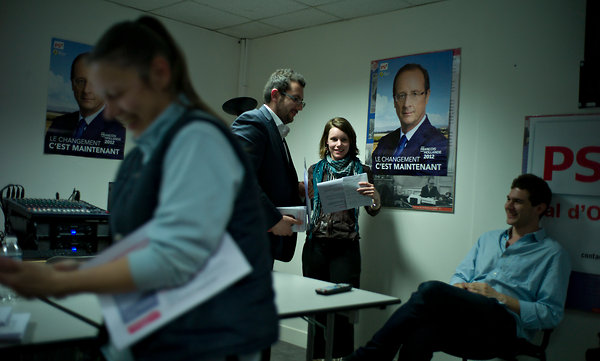
In the office of the French Socialist Party in Cergy, a Paris suburb
(Corentin Fohlen for The New York Times)
(Corentin Fohlen for The New York Times)
The photo is taken in Cergy, a banlieue ("suburb") of France, where there is a high concentration of immigrants and their offspring. According to wikipedia, Cergy-Pontoise, the town in which Cergy is located, has a far higher crime rate than the national average.
The French wikipedia article says that Cergy typically votes on the left side of the spectrum.
I have no idea whether the woman in the photo is wearing the kufiya to appeal to young banlieue potential voters of Maghrebi background, or if it is just a matter of stylishness. Or is it both?
Saturday, April 21, 2012
Sayed Darwish fails this time at Tahrir

Sayed Darwish (picture courtesy of the Friends of Sayyid Darwish Association; found here)
From a report in Egypt Independent on yesterday's massive demonstration at Tahrir.
A lonely island in a sea of Salafis, the National Coalition for Change stage boasts a handful of people, mostly in their early twenties. "We all remember Sayed Darwish and his beautiful lyrics," one youth bleats into the onstage microphone to a scattering of an audience (many of whom are wearing Abu Ismail badges and pins). "Here's one of his most beautiful songs, which we all know and love. It's called 'So It Goes.'" The youth begins to sing, but his voice is easily drowned out by the pro-Hazem stages on both sides. The small crowd disintegrates.
I am guessing that the song in question by Sayed Darwish is "Aho Da Lli Saar." On the run-up to the anniversary of the overthrow of Mubarak, the BBC produced a radio program by Reem Kelani, in which she explores the music of the revolution and in particular, the importance of Egyptian composer and singer Sayed Darwish in it. I posted about the program on the Merip blog, but I did not discuss what was said about "Aho Da Lli Saar." Given what happened yesterday, it is useful to go back to Kilani's program.
She opens by introducing Khaled Abu Naga, who co-produced and starred in the acclaimed 2010 film Microphone, about the underground art scene in Alexandria. Although the film was produced before the outbreak of the revolution, it in many ways seems to anticipate it, in its depiction of a vibrant artistic scene that is frustrated in its efforts to develop and put on its work (particularly the music) in public. Frustrated both by the bureaucratic agencies of the state, backed up by the security forces, and by the Islamist forces. (If you've seen the film, then what occurred yesterday feels like a cruel throwback.) The animators of the scene depicted in the film are the same educated, enthusiastic, creative youth segment of Egypt's urban population who did much of the demonstrating and fighting at Tahrir in late January and early February in 2011. And it is well-known that one of the positive effects of the revolution was both to release all kinds of creative and artistic energies, as well as bring into public view artistic movements and tendencies that had been repressed and marginalized under the Mubarak tenure. No wonder, then, that many, as Reem Kelani observes, regard Microphone as the film of the revolution.
Khaled Abu Naga tells Kelani that it was Said Darwish who the youth in Alexandria went back to, fo find lyrics that depicted the situation they were living in in early 2011, in the days of the revolution. And the song that really depicted how they all felt, he says, was "Aho Da Lli Saar," which Kelani translates as "This Is Where We're At." The song dates from the 1919 Revolution, which erupted in part due to the frustrations of Egyptians who felt that their active participation in the First World War (around a one and a half million Egyptians were conscripted into the Labor Corps) should have earned them independence from Britain.
Kelani provides a translation of some of the lyrics of the song (written, in fact, by Badi' Khayri; Darwish wrote the music):
Egypt, O mother of wonders
Your people are great and your faults are not
Watch out for those who love you
For they are the champions of your cause
In the background, we hear the Darwish song, performed by the Alexandrian group, Massar Egbari ("Compulsory Detour"), who are also appear in the film Microphone.
I happened to see Karim Nagi perform at Georgetown last Wednesday evening, and one of the numbers he did was "Aho Da Lli Saar," which he translated as "This is what happened." Nagi is a fabulous dancer and a multi-talented percussionist and buzuq player. He is the animating force behind Turbo Tabla, whose two albums I highly recommend. He is also a great lecturer -- if you are looking for someone to provide an excellent introduction to Arabic music, be sure to hire Karim.
But I particularly loved Karim's performance of Sayed Darwish's "Salma Ya Salma" and "Aho Da Lli Saar." Before singing them he translated both songs into English -- and I regret not recording these. In his program notes, at least, Nagi provided a translation of a few more lines of "Aho Da Lli Saar":
This is what happened, you cannot blame us
The wealth of our country is beyond our reach
Let us not fight nor envy
Unite our hands, and be strong for the cause
Here are some more versions of the song:
Ali Haggar's -- which predates Massar Egbari's, and on whom Massar Egbari's version seems modelled.
Fairuz does a version too. (I'm pretty sure this is from her Live at Beiteddine 2000 album, the title transliterated as "Ahoua dalli sar.")
An amazing performance of the song, from January 10, 2011 (two weeks before the start of the revolution), done at Al Sawy in Cairo by members of the cast of Microphone, "In solidarity with the victims of terror in Alexandria." In reference, clearly, to the terror bombing of a Coptic church in Alexandria on December 31, 2010, that killed 21 and wounded at least 96. Many blamed the bombing on the regime.
Fairuz's celebrated son Ziad Rahbani also has a version, very similar to his mother's. Apparently recorded in Damascus in 2008.
There are other versions as well, but it would seem that Ali Haggar, Fairuz and Ziad Rahbani in particular have played an important role in keeping the song alive in Arab popular memory.
Unfortunately, I cannot find a version of Darwish's version on youtube -- I assume there are downloads available, probably of dubious legality.
Here are the Arabic lyrics, with a transliteration and a translation into English, which I found here. I've changed a couple things. There are some discrepancies between what is below and the translations I've posted above, so if someone wants to help out and fix these, and provide some more commentary that would be terrific.
اهو دا اللي صار, و ادي اللي كان
aho dalli sar w dalli kan
this is what happened, this is what was!
مالكش حق
malaksh 7a2
you don't have the right
ملكش حق تلوم عليا
malaksh 7a2 tloom 3alayya
you don't have the right to blame me
تلوم عليا ازاي يا سيدنا
tloom 3alayya ezay ya sayedna
how can you blame me sir ?
و خير بلدنا مهوش في ادنا
w 5air beladna mahoosh fe edna
and the wealth of our country is not in our hand
قولي عن اشياء تفدنا
2olli 3an ashya2 tefedna
tell me about things that help us
بعدها بقى لوم عليا
ba3daha ba2a loom 3alayya
then you can blame me
مصر يا ام العجايب
masr ya 2om el 3agayeb
Egypt, the mother of wonders
شعبك اصيل و الخصل عايب
sha3bik aseel wel 5sl 3ayeb
your people are noble, your faults are not
خلي بالك مالحبايب
5alli balik mel 7abayeb
take care of your loved ones
دول انصار القضيه
dool ansar el 2adeya
those are the supporters of the matter
بدال ما يشمت فينا حاسد
bdal ma yeshmat feena 7asid
instead of the gloating of jealous people
ايدك في ايدي نقوم نجاهد
edak fe edi n2oom negahid
let's hold hands and fight
احنا نبقى الكل واحد
e7na neb2ael kol wa7id
we all become one
والايادي تكون قويه
wel 2ayadi tkoon aweya
and hands become strong
(Footnote 1: While working on this post I found this blogpost that accompanies Reem Kelani's BBC piece. It is an invaluable resource about the significance of Sayed Darwish and about the music that was performed on and played on and around Tahrir during the days of the revolution. Please have a look.)
(Footnote 2: on the treatment of Egyptians in the British army: the noted novelist E.M. Forster lived in Alexandria during the First World War. He took up with an Egyptian tram conductor named Muhammad al-Adl, who became the love of Forster's life. In an attempt to improve his position within the government bureaucracy, Forster was able to help Mohammad get a job with the British military on the Suez Canal, where he did low-level intelligence work. Al-Adl described himself as a "spy." Muhammad eventually came down with a fever, received miserable treatment in the badly run hospital and nearly died. Upon his recovery, he used to let Forster know that his British military employers treated him like "dirt," as they treated all Egyptians. Muhammad was arrested and sentenced to six months in hard labor, after an incident in which he and a friend encountered some Australian soldiers in Mansourah, who offered to sell them a revolver. Muhammad considered himself innocent, but he was humiliated, bullied, and badly fed in prison. Muhammad, whose health was impaired by both his time spent in a horribly run British military hospital and in prison, died of consumption in November 1922.
It seems that Forster's knowledge of the evils of colonialism and the bad treatment meted out to Egyptians during the war, mostly via Muhammad, motivated him to write a historical summary for a pamphlet, called The Government of Egypt, put out by the Labour Research Department in summer 1920. Forster did not go so far as to argue for Egyptian independence, but for Egypt to be put under a League of Nations-sponsored mandate. It appears as well that Forster's relations with Muhammad had a great deal to do with the critiques of colonialism that are expressed in his famous novel Passage to India. Forster used to put on Muhammad's ring every day, a ring that Muhammad had willed to him, and when he finished the last lines of Passage to India, Forster put down his pen and picked up a pencil that had belonged to Muhammad and wrote in his diary that he had finished the book.
All this, I learned from Michael Haag's Alexandria: City of Memory, Yale University Press, 2004.)
Tuesday, April 17, 2012
More on Moroccan rapper al-Haqed

Monday, April 16, 2012
Gay Tunisia Kufiya

This is the cover of issue two of a new monthly gay publication out of Tunisia. Check out Gayday's online site. I guess that the kufiya here serves as a sign of cultural legitimacy.
Moroccan rapper al-Haqed charged with "insulting" song
Al-Haqed ("The Vengeful One"), charged on Friday March 30 with insulting the monarchy, for his song, Kilab al-Dawla (Dogs of the State). Read about it here. Read ANHRI's statement about his arrest and imprisonment and an earlier charge here. And watch the video, below. I hope someone produces a translation. In the meantime, here's a translation of his song, "Baraka Men Skate" (No More Silence).
Chinese kufiyas and Hebron (al-Khalil)

Israeli officer assaults peaceful international protester (in kufiya)

On Saturday, April 14, between 100 and 250 demonstrators (depending on which account you credit) took part in a bike protest against the harassment of Palestinian cyclists and drivers on Route 90, the main north-south highway in the Jordan Valley. A senior IDF officer launched an unprovoked attack on a peaceful international protester. Read about it here and be sure to watch the shocking video.
But maybe it wasn't really 'unprovoked'? Maybe the red kufiya drove the officer mad.
Two inventions that have transformed relations between the Mediterranean and northern Europe...
"two inventions, as far apart in technology as could be imagined, have transformed the relationship between the Mediterranean and the north of Europe in the second half of the twentieth century: the aeroplance and the bikini." David Abulafia, "A globalized Mediterranean: 1900-2000," in David Abulafia, ed., The Mediterranean in History (Los Angeles: The J. Paul Getty Museum, 2003), p. 312.
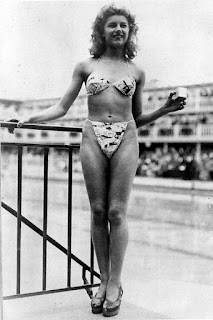

Micheline Bernardini models the first modern bikini, 1946
Saturday, April 14, 2012
Friday, April 13, 2012
The Songs of Tahrir Square: Music at the Heart of the Revolution
Syria's social unrest, climate change, drought
Check out this very important and illuminating article about the role of drought in the Syrian unrest. Here are a few of the scary excerpts.
From 2006-2011, up to 60% of Syria’s land experienced, in the terms of one expert, “the worst long-term drought and most severe set of crop failures since agricultural civilizations began in the Fertile Crescent many millennia ago.”...
In 2009, the UN and IFRC reported that over 800,000 Syrians had lost their entire livelihood as a result of the droughts. By 2011, the aforementioned GAR report estimated that the number of Syrians who were left extremely “food insecure” by the droughts sat at about one million. The number of people driven into extreme poverty is even worse, with a UN report from last year estimating two to three million people affected.
This has led to a massive exodus of farmers, herders and agriculturally-dependent rural families from the countryside to the cities. Last January, it was reported that crop failures (particularly the Halaby pepper) just in the farming villages around the city of Aleppo, had led “200,000 rural villagers to leave for the cities.” In October 2010, the New York Times highlighted a UN estimate that 50,000 families migrated from rural areas just that year, “on top of the hundreds of thousands of people who fled in earlier years.” In context of Syrian cities coping with influxes of Iraqi refugees since the U.S. invasion in 2003, this has placed additional strains and tensions on an already stressed and disenfranchised population.
And be sure to check out the entire article. While the Mediterranean may be under severe threat in the long run, the outlook is not all that great for much of the US as well. In fact, it's disastrous.
Famous Alexandrians: Cavafy (and the Denshawai Affair)

It is often, in fact one should say, nearly always, claimed that the celebrated Greek Alexandrian poet Constantine Cavafy (1863-1933), lived his life in almost complete isolation from Egyptian Arabs. Hala Halim, in her unpublished dissertation, The Alexandria Archive: An Archaeology of Alexandrian Cosmopolitanism (UCLA, 2004), suggests that the reality is somewhat more complicated. She suggests that his work is in some ways Orientalist, but that his Orientalism "both could be qualified and undercut by a disaporic affiliation that goes beyond binaries and makes for a more cosmoplitan attunement to otherness and other textualities" (107-108).
One of the pieces of writing that she cites in evidence is this poem, written in response to the notorious Denshawai affair.
27 June 1906, 2 P.M.
When the Christians brought him to be hanged,
the innocent boy of seventeen,
his mother, who there beside the scaffold
had dragged herself and lay beaten on the ground
beneath the midday sun, the savage sun,
now would moan, and howl like a wolf, a beast,
and then the martyr, overcome, would keen
“Seventeen years only you lived with me, my child.”
And when they took him up the scaffold’s steps
and passed the rope around him and strangled him,
the innocent boy, seventeen years old,
and piteously it hung inside the void,
with the spasms of black agony–
The youthful body, beautifully wrought–
His mother, martyr, wallowed on the ground
and now she keened no more about his years:
“Seventeen days only,” she keened,
“seventeen days only I had joy of you, my child.”
You can read the full story of Denshawai here, which involved a dispute that broke out when British soldiers shot some pigeons owned by Denshawai villagers. Villagers were angered, attacked the soldiers, the British opened fire on villagers, wounding five, one of the villagers hit an officer with the stick. An officer who escaped died of heatstroke.
The British responded by rounding up 52 villagers, conducted a summary trial, and sentenced five to hanging and 27 others to various terms of hard labor and flogging. The hangings were carried out quickly, only two weeks after the "incident." The effect was to inflame nationalist sentiment in Egypt.
My source for the poem is here.
A couple other remarks:
The family name of Cavafy is of Turkish origin; it comes from the word ayakkabici or "shoe seller."
Philip Mansel, the source for the above (Levant: Splendour and Catastrophe on the Mediterranean, Yale UP, 2010), also notes that it is highly unlikely that Cavafy's poems could have been published in any city other than Alexandria (with the exception of Paris). His erotic poems, Mansel observes, would have doubtless raised moral hackles and caused the author and publisher to be sentenced to jail. Cavafy's poems were published in Alexandrian literary magazines after 1919, and a book of a complete edition of his poems was published in Alexandrian two years after his death, in 1935 (144). Published in Greek, of course.
More evidence of the tolerant character of Alexandrian cosmopolitanism.
Wednesday, April 11, 2012
Jewish Morocco
I want to give a shout out to this fabulous blog, Jewish Morocco, and its obsessive search for and commentary on music by Jewish Moroccans. And sometimes Algerians, like Blond Blond:
Well worth following!
Well worth following!
El Menfi (Banishment): Akli Yahiaten & Rachid Taha
Rachid Taha first recorded "Menfi" on his 1998 album Diwân. He reprised it on his Rachid Taha Live album (2001), giving it a real kick-ass rock treatment (listen here), and by he also performs it with Khaled on Faudel on the famous 1-2-3 Soleils album (1999) (you can listen here).
I just came across a version of the original, which you can check out above. The song was written by Algerian Kabyle composer and singer Akli Yahiaten, who migrated to Paris in 1952, was a supporter of the FLN (the Algerian National Liberation Front), and composed "El Menfi (Banishment)" while in prison (for the second time), in 1959, for collecting funds for the FLN.
I located a transliteration of the Arabic lyrics here. And a translation of most of the lyrics here, where there are also some more versions of the song. I've tried to correct some mistakes in both the transliteration and translation, but there's a lot more to be done, and I'm sure I've made mistakes. So this is a work in progress -- and I hope someone will see this who knows Algerian dialect and will help out.
UPDATED, April 16, 2012. I came across this article, which has a better transcription, and translation (in French), of verse three, so I've made some more changes: Hadj Miliani, "Variations linguistiques et formulation thématiques dans la chanson algérienne au cours du XXe siècle: Un parcours," in Jocelyne Dakhlia, ed., Trames de langues: Usages et métissages linguistiques dans l'histoire du Maghreb, Paris: Maisonneuve & Larose, 2004, p. 433.
REFRAIN
Goulou lemmi ma tebkish Ya el menfi (Tell my mother not to cry/O banishment)
Weldak rebbi ma yikhelik Ya el menfi (God will look after your son/O banishment)
Aw ya dakhal fi wast bibaan Ya el menfi
Aw al-saba‘a fih el gadaan Ya el menfi (bis)
Aw galouli kashi al-doukhaan ya el menfi
Wana fi wasthum dehshaan ya el menfi
REFRAIN
Aw ki dawni le tribunal Ya el menfi (When they took me to court)
Aw djadarmiya kbaar wa sghaar Ya el menfi (Gendarmes large and small)
Aw tisensla tewzen qantar Ya el menfi (And the chain weighs a ton [one qintal, 100 kg.)
Aw derbouni b‘aam wa nhaar Ya el menfi (And they beat me for a year and a day)
REFRAIN
‘Ala dekhla haffuli al-ras Ya el menfi (When I entered they shaved my head)
Aw ‘atawni zura wa paillasse Ya el menfi (And gave me a blanket and a straw-filled mattress)
Wel prévôt ‘alaya ‘assaas Ya el menfi (The military police who surveils us)
‘Ala tamenya tesma‘a silence Ya el menfi (At eight you hear: silence)
REFRAIN
Ah ya gelbi wash dak taif Ya el menfi (My heart is revolted)
Aw el-soupa dayman kif-kif Ya el menfi (The share [of food] is always the same)
Aw el gamila ma‘amra bi el ma Ya el menfi (The bowl is filled with [mere] water)
Aw li gralou ionim [?] fiha Ya el menfi (And cockroaches swim in it)
And here is a link to some more vids from Akli Yahiaten.
Monday, April 09, 2012
US mercenaries against Abdelkrim
Very illuminating post about US mercenary pilots who were recruited by the French to fly missions against Abdelkrim's Riffian rebellion in Morocco (1921-1926).
"In the end, US government concerns about violations of neutrality and hostile public opinion brought the chapter of the Escadrille Chérifienne to a close after only six weeks of combat operations."
US public opinion at the time, if you can believe it, was very much on the side of Abdelkrim and against the Spanish and French colonialists.
For instance, there is "The Riff Song," from the Broadway production, The Desert Song, which opened on Broadway in 1925 and was very successful.
"If you're the Red Shadow's foe
The Riffs will strike with a blow
That brings you woe."
To be continued...
As Israeli politics move further to the right, Palestinian gourmet cuisine gets more trendy
At least in Tel Aviv.
"Palestinian tartare"..."Arabic ravioli"..."At Jaffa/Tel Aviv, the new restaurant by chef Haim Cohen, the godfather of Israeli cuisine, knafeh is one of the most popular dishes on the menu."

The acceptance and celebration of Palestinian food in current Israeli cuisine marks the peak of a long and gradual process, just as the identity of Israeli cuisine has started to reveal itself. When we think about what current Israeli cuisine is, a mix comes to mind: Jewish ethnic foods, excellent produce, young chefs with high culinary education and strong Arabic influences. Arguably, as the Israeli scene has become more established, it is able to credit its sources of inspiration.
Another explanation for the rising popularity of this food is strictly political. This trend is limited to the city of Tel Aviv and its surroundings. “In Tel Aviv it’s considered ‘cool’ to be pro-Palestinian,” said Gil Hovav, a leading culinary journalist and television personality. “The culture encourages it.” In the past few years, Tel Aviv has shifted further left on the political map, positioning itself as the liberal refuge and natural habitat for Israel’s young creative community. Raising the banner of pluralism, the residents of Tel Aviv express their discontent with the government agenda not only with social activism, but also in their food culture.
Dalida shares her Arab culture with Enrico Macias and Claude François
Dalida, born in Shobra, Cairo, to Italian parents. Enrico Macias, an Algerian Jew, born Gaston Ghenassia, in Constantine, Algeria. Both huge stars in France. Part of the secret of their successes was that their music sounded a bit exotic, but for them to have used their background in the Arab world as more than frills would have been met with racist hostility. The Arabness therefore manifests itself in small doses. As in this case, in some sort of variety show, where Enrico greets Dalida in Arabic, with "Ahlan wa sahlan Dalida, salamaat salamaat" (welcome Dalida, greetings, greetings). She responds, "Ahlan wa sahlan ya Enrico, ezzayyak? Kuwayyis, ilhamdou lillah?" (Welcome Enrico, how are you? Well, thank God?"(The clip is not dated, but perhaps it's after Dalida recorded her string of hits in Arabic, starting with "Salma ya Salama," and so now it was somewhat more acceptable for stars like her to refer to their Arab roots -- in her case, cultural roots.)
They proceed to do a duet of Dalida's first hit, from 1956, "Bambino." Watch Dalida do the original here, back in the days when she wore her hair dark.
It's worth recalling that Jean Dujardin does a version of "Bambino," in Arabic, in his hilarious spy spoof, OSS 117: Cairo, Nest of Spies. You can check that one out here.
Enrico did not record in Arabic (other than some hints or a few words) until 1999, when he released his terrific Hommage à Cheikh Raymond, his tribute to his teacher and father-in-law, the grand master of malouf, Raymond Leyris.
And then there is this clip, of Dalida with another great French star, Claude François. They open by speaking of the fact that they both were born in Egypt, and that one of Claude François' parents was Italian. They then proceed to sing some duets in Italian.
Claude François (author of "Comme d'habitude," the original of "My Way") was born in Ismailiya, Egypt, in 1939. His father worked as a shipping traffic controller in the Suez Canal. The family left for France in the wake of the Tripartite Aggression (a.k.a. Suez War) of 1956.
Dalida recalled her first meeting with Claude François in 1963, when they became friends, thus: “Nous nous sentions tous les deux déracinés...Ensemble, nous parlions en égyptien” (We both felt uprooted...Together, we used to speak in Egyptian -- i.e., Egyptian Arabic). (Catherine Rihoit, Dalida, 1995, p. 344)
Sunday, April 08, 2012
Ramy Essam: Tribute to Syria
Ramy Essam, singer of the Egyptian revolution, who produced the unforgettable song "Irhal," has put out a song in solidarity with the Syrian revolutionaries. It may be his best song since "Irhal." Helpfully, the video comes with subtitles in English, and the Arabic is written below the vid. Check it out.
Saturday, April 07, 2012
New DAM video for Juliano Mer Khamis
On the first anniversary (April 4) of the unsolved murder of Juliano Mer Khamis, the Palestinian-Israeli rap band DAM put out this very moving video. (Helpfully, with English subtitles.)
Juliano was the son of Palestinian-Israeli Saliba Khamis (who I met in 1985) and Jewish-Israeli Arna Mer-Khamis. His parents were Communists, and such "mixed" marriages were quite common in the Israeli Communist party in the 1950s. Julian was a movie and theater actor, and director of a well-respected documentary, Arna's Children (watch it here) about his mother's work with a children's theater in Jenin, a city in the West Bank. He is best known for founding Freedom Theatre, a community theatre that provided opportunities for children of Jenin Refugee Camp. Juliano was shot by a masked gunman in front of the theater, and the killer is still at large.
Check out Mark Levine's tribute to Juliano and his work here.
Wednesday, April 04, 2012
Cheikh Zouzou
In anticipation of a future post on the film El Gusto, which is out now in France, this video of the Jewish Algerian master of Andalusian music, Cheikh Zouzou (given name Joseph Benganoun), born in Oran (Wahran), Algeria.
Apparently the group accompanying Zouzou is the "Orchestre de la Station d'Oran." On piano is Maurice El Medioni (also Jewish Algerian) and on guitar (in the long-sleeve shirt that looks grey in this B&W video), Blaoui Houari. Houari is mostly obscured and you can barely see the guitar, but he is there. And mostly we see Medioni's back. This would have been broadcast in the late fifties or early sixties, that is, prior to Algerian independence. The French authorities established television in Algeria in 1957, and they broadcast Arab music in part, in an attempt to co-opt the musicians. As a result, a lot of amazing music was produced on colonial Algerian t.v., much of which can be found on youtube.
Apparently the group accompanying Zouzou is the "Orchestre de la Station d'Oran." On piano is Maurice El Medioni (also Jewish Algerian) and on guitar (in the long-sleeve shirt that looks grey in this B&W video), Blaoui Houari. Houari is mostly obscured and you can barely see the guitar, but he is there. And mostly we see Medioni's back. This would have been broadcast in the late fifties or early sixties, that is, prior to Algerian independence. The French authorities established television in Algeria in 1957, and they broadcast Arab music in part, in an attempt to co-opt the musicians. As a result, a lot of amazing music was produced on colonial Algerian t.v., much of which can be found on youtube.
Tuesday, March 27, 2012
How to Be a Christian Hipster (Hint: Kufiya Required)
Check out the easy-to-follow instructional video, which will have you looking like this:

Here's the vid, if you want to self-transform:

Here's the vid, if you want to self-transform:
Wednesday, March 14, 2012
Esquire: Beyoncé vs. Shadia Mansour in The Ladies Tournament for the Hottest Woman of 2012
Huh? really? If you must vote -- but I caution against it -- go here.


And no, I did not put this up because Shadia has a kufiya around her waist.
For those who do not know, Shadia Mansour is a Palestinian rapper. She is probably best known for her song, "The Kufiya is Arab," which I posted about here.
And Beyoncé, for those who do not know, shills for Walmart.
Tuesday, March 06, 2012

Sunday, March 04, 2012
Young kufiya'd fighter in the Free Syrian Army

The photo is by Tyler Hicks of the New York Times, who accompanied Anthony Shadid (RIP) on his final visit to Syria. The photo gallery it is taken from is here. The very interesting article on their trip, to visit the armed opposition in Idlib province, is here.
And from the article, note that Anthony Shadid tried to protect himself from the horse dander by covering his face with a black-and-white kufiya. It didn't work.
Anthony’s health had been good during the week and he prepared himself for the trip down with antihistamines and a supply of inhalers. He had a black and white kaffiyeh covering his face to filter the air, the same one he had worn around his neck throughout the assignment. He told the young men he wouldn’t ride a horse and to walk ahead with them at a distance.
“Should we walk in front of the horses?” I asked Anthony.
“No, they need to guide us,” he said.
Thursday, March 01, 2012
Kufiyaspotting: Jay Electronica

This photo of rapper Jay Electronica accompanied his recent release, via RCRD.LBL, of the free single, "Suckas."
Jay Electronica is probably not wearing the kufiya because it is fashionable. His rap style is in the general universe of the likes of Mos Def, Talib Kweli, J Dilla, and the like. The song "Suckas" blasts shallow and materialistic mainstream rap MC's:
These wack emcees got the game twisted
We don't give a fuck about your rings and your chains
Your four-dot six Range
Or Frankie B jeans
His lyrics are in the "conscious" vein:
The last dragon, carrying weight like Oprah
Redeemer of Abner Louima and Sankofa
And, it is clear from this line, that he is a member of the Nation of Gods and Earths (Five Percenters):
Eighty-five think they free but they really in chains
Talking that big willy looking silly and strange
The "eighty five" in Five Percenter beliefs are the deaf, dumb and blind who are misled and victimized by the elites, the bloodsuckers of the poor, the Ten Percent. (The Five Percenters have "knowledge of self," and struggle to bring consciousness to the 85%.)
These lines allude to Jay's status as a "God":
Jay Elect reign supreme over everything
Meet the heavenly man mics in my hand I rip 'em
I'm somewhat surprised to come across a Five Percenter who is originally from New Orleans, but since leaving NOLA, Electronica has led a somewhat nomadic lifestyle, living variously in Philly, Detroit, NYC and Baltimore. Probably he came across some Gods in those places. Somewhere along the way he hooked up, for a time, with Erykah Badu (who has her own connections to the Gods and Earths; her first son is named 7), and they have a child together, born in 2009.
Electronica is worth following. Here are the complete lyrics to "Suckas" (which get the Abner Louima reference wrong, however.)
Subscribe to:
Posts (Atom)

