Friday, December 01, 2006

Americans shop, Iraq burns


Bob Herbert's op-ed in Monday's New York Times (Nov. 27) resonated with what I've been thinking about how the US public seems to be dealing with the ongoing Iraq disaster. "Americans are shopping while Iraq burns," is how Herbert opens his piece. He goes on to say, "With no obvious personal stake in the war in Iraq, most Americans are indifferent to its consequences...This indifference is widespread. It enables most Americans to go about their daily lives completely unconcerned about the atrocities resulting from a war being waged in their name."

Yes, most Americans don't support the war, and the issue of Iraq was a major factor in the Democrats' victories in the House and Senate. And there have been a lot of anti-war protests. Nonetheless, I believe Herbert is absolutely correct, most Americans don't feel the impact of the war and its unimaginable horrors. Here's where any purported Vietnam/Iraq parallels don't hold up: there is no widespread, deepseated moral outrage about the Iraq war. We are living in an unreal bubble, unaffected in any palpable way by the unspeakable outrages in which we are implicated in Iraq. What Herbert doesn't mention (this is the New York Times, after all) is that we are implicated in similar outrages in Lebanon (the July-August '06 war and its ongoing after-effects) and in Palestine, and most lately and particularly, Gaza. (And as I stated in my talk at our local anti-war demo on November 5, the anti-war movement has been pretty silent about Lebanon and Gaza. The Dems who are now in the majority are almost unanimous in their support for Israel's most extreme measures. But thank God for Jimmy Carter, who has been making the rounds of talk shows--last night, Charlie Rose--promoting his most recent book, Palestine Peace Not Apartheid.)

Tags: , ,

Wednesday, November 29, 2006

Middle East Report nominated for prestigious award


I just learned that Middle East Report has been nominated for an Utne Independent Press Award in the category of International Coverage. I served on the editorial commmittee of MER from 1997-2002, and recently learned that I'm going back on the editorial committee beginning in 2007. (I can't believe I was away for 4 years!) So congratulations to my comrades. And hawgblawg readers, please read MER and give it your support.

Tuesday, November 28, 2006

“Rockers, Feminists and Homosexuals: Diversionary Scenes in Chahine’s 'Bab al-Hadid'”


I attended the Middle East Studies Association meetings, November 18-21, in Boston, where I presented a paper on Youssef Chahine's classic 1958 film Cairo Station (Bab al-Hadid). The entire panel was devoted to the film, and also featured papers by my UA History Department colleague Joel Gordon and by Elliott Colla (Comp Lit, Brown). It was a great panel, an all-too-rare occasion to focus attention on a single work. I offer below the opening paragraph of the paper; if anyone is interested in the whole thing, they can write me.

I propose today to concentrate our attention away from Bab al-Hadid’s main plotline, the gradual descent of Qinawi into madness and attempted homicide, and toward on three scenes which, according to conventional analyses of the film, serve as entertaining “distractions” from the story’s forward momentum. Film critic Viola Shafik, for instance, describes such scenes, of which there are several, as “inserts” that function as “observations made by Qinawi” and “allow the audience to participate in his voyeurism” (2001: 78). Shafik claims as well that Bab al-Hadid represents a “successful mélange of social criticism and entertainment” (Ibid). Her assertion that these scenes are Qinawi’s observations, however, is problematic because he is not always present, and where he is, the scene is often not shot from his point of view. In addition, Shafik trivializes such scenes by naming them as “inserts” and posing them as “entertainment” in contrast to the ostensibly more serious scenes of “social criticism.” My analysis by contrast foregrounds such scenes and suggests that the film’s pleasures derive as much from the “inserts,” the excesses, as they do from the unfolding tension of the main plot. Rather than viewing them as “mere” entertainment, I want to argue that they both reflect as well as comment on Egypt’s social conditions in significant ways. In addition, attention to such scenes can help us to deepen our appreciation of depicted in Bab al-Hadid as a sight of remarkable social dynamics and interactions, as a crossroads, as the narrator Madbouli states at the film’s opening, where a very heterogeneous variety of social classes and types interact: “northerners and southerners (bahri wa ‘ibli), foreigners and locals, the rich and poor, the employed and those out of work.” These include encounters between travelers of all sorts and the relatively fixed population of workers like Qinawi the newspaper peddler (Youssef Chahine), Hanuma the soda pop vendor (Hind Rustum), and Abu Siri‘ the porter (Farid Shauqi), who provide services to those coming and going, but who are also, in a sense, travelers themselves, as part of Cairo’s burgeoning population of rural-to-urban migrants (Gauthier 1985: 57).

I proceeded to examine three scenes that I call the rock ‘n’ roll, the feminist, and the gay pickup scenes.

The photo shows Hanuma (played by Hind Rustum) on the train with the rock 'n' rollers.

Tags: , ,

Sunday, November 26, 2006

Arab Fiction


I was excited to read a review of The Anchor Book of Modern Arabic Fiction in today's New York Times. Excited because I was pleased to learn about the book, and excited because the review was very favorable. I'm always glad when Arab culture gets its props in high-profile media venues in the US. Although I've not seen the volume, I think the reviewer, Robert W. Worth (who covers Iraq for the Times) gets things right, based on what I know about the writers he covers. He praises Egyptian short story writer Yusuf Idris, Egyptian novelist Sonallah Ibrahim, and Egyptian Nubian writer Haggag Hassan Oddoul's story, "Nights of Musk," from the short story collection of the same name (AUC Press, 2005). I'm particularly pleased to see Oddoul (pictured) getting some credit, both because he's an excellent writer and because it's good for Nubian visibility. Worth also gives high marks to Sudanese novelis Tayeb Salih, and he makes the very accute observation that the stories of Egyptian writer Nawal El Saadawi's "angry rants against Muslim treatment of women...are among the few stories in the book where an author appears to be playing to a Western audience."

Here's what bugs me about the review. Worth states that "One of the best pieces here is an excerpt from 'Men in the Sun'" by Palestinian writer Ghassan Kanafani. I can't quibble, for I think that this novella is Kanafani's best work. Worth goes on to describe Kanafani as a "Palestinian advocate killed by a car bomb in Beirut in 1972." It has of course been very well known for a long time that the car bomb that killed Kanafani (and his niece Lamis) was planted by Israeli intelligence. In fact, Eitan Haber, former spokesperson and speechwriter for the late Israeli PM Yitzhak Rabin admitted Mossad's responsibility, in an article published in Yediot Aharanot last October. (See my blog entry on the subject here.) But even when Israeli terrorism is officially acknowledged and confirmed, the New York Times will not publish the fact. Too "controversial" to say that Israel engaged in targeted assassinations, I guess, even--or maybe especially?--in a review of literature.

Saturday, November 25, 2006

Fun-Da-Mental's "DIY Cookbook" Video


You must see this video! Watch it for free, here. Or better yet, buy it, for 1.99 pounds sterling, here . By purchasing, you support Fun-Da-Mental and get a better quality video to boot. (The image above is the last frame of the video--surprisingly, a quote from JFK.) John Hutnyk, on his invaluable blog Trinketization, analyzes the video here, situating it within the tradition of pantomime.

Here's an excerpt from John's analysis:
In the video for DIY Cookbook, pantomime characters make the argument. There are three verses. The first entails a cross-of-St-George-wearing youth constructing a strap-on bomb from a recipe downloaded from the internet. He is dressed as a rabbit and as a lizard in parts of the verse, playing on childlike toys and fears; the second verse references the Muslim scholar and the figure of the armed guerrilla as the character relates a more cynical employment as a mercenary making a ‘dirty bomb’ with fission materials bought on the black market in Chechnya or some such; the third pantomime figure is the respectable scientist discussed in RamParts by Dave, here the scientist in a lab coat morphs into a member of the Klu Klux Klan and then a suited business man, building a neutron bomb that destroys people ‘but leaves the buildings intact’.

I hope to add something to what Hutnyk says in the future...bil mishmish, as they say. For my earlier posts on Fun-Da-Mental, click on the label below (a new, cool feature).

Tags:

Tha Global Cipha: Hip Hop Culture and Consciousness


I just received a note from James Spady informing me of the publication of Tha Global Cipha: Hip Hop Culture and Consciousness, co-edited by Spady, H. Samy Alim, and Samir Meghelli. It's a collection of interviews with US and international artists with (presumed) connections to hip-hop, including Jay-Z, Sunni rappers Mos Def and Eve, reggaetón star Tego Calderon, dancehall artist Buju Banton, rai singer Khaled, and French rapper Booba. Read more about it here.

I assume that the books resembles the format of Spady's earlier volumes: Nation Conscious Rap: The Hip Hop Vision (co-edited with James D. Eure, 1991), Twisted tales: in the hip hop streets of Philly (co-edited with Stefan Dupres and Charles G. Lee, 1995), and Street Conscious Rap (co-edited with Charles G. Lee, H. Samy Alim, and C. G. Leedham, 1999). These are all massive volumes with invaluable and in-depth interviews with well-known as well as important but not so well-known rap artists. What I find particularly valuable about these volumes is that there is a wealth of material on the Islamic (from Sunni to Nation of Islam to--especially--Nation of Gods and Earths) sympathies and beliefs of many rap artists. Spady has been an indefatigable researcher on such subjects, who is also very attuned to the global dimensions of hip-hop, Afrocentric thought, and Islamic-inflected rap.

H. Samy Alim teaches Anthropology at UCLA and has authored a number of articles on hip-hop. I like what he does, but I have a quibble with him (for an earlier quibble, go here). In his article "A New Research Agenda: Exploring the Transglobal Hip Hop Umma" (in miriam cook and Bruce Lawrence, eds., Muslim Networks from Hajj to Hip Hop, 2005), he tends to assimilate the beliefs of members of the Nation of Gods and Earths (NGE) like Rza to the beliefs of Sunni Muslims like Mos Def. Alim goes so far as to assert that "the belief in Allah and the revelation of the Quran through the Prophet Muhammad is a tenet of all Muslim communities" including the Nation of Gods and Earths (p. 266). This is a misrepresentation of the NGE, who believe, on the contrary, that black men are "Gods" and that monotheistic religions like orthodox Islam mislead the masses by preaching belief in a "mystery god" or "spook." (For more, see my article, "Islam in the Mix: Lessons of the Five Percent" here. And for what I think will be the definitive work, look out for Michael Muhammad Knight's The Five Percenters: Islam, Hip-hop, and the Gods of New York, due out from Oneworld in spring 2007.) But other than the fact that I think that Alim is trying to force Five Percenters into a Hip Hop "umma," I think he's a fine researcher. (And I should add that when he was the editor of Black Arts Quarterly, he generously published one of my articles [vol. 7, issue 1, Spring 2002]. Go here to download the issue.)

I don't know anything about the third editor, Samir Meghelli, so here's what the book's website says: "a Richard Hofstadter Fellow and doctoral candidate in American History at Columbia University, and his work has been published in The Black Arts Quarterly [in Vol. 8, issue 1, Spring 2003--download here], Proud Flesh, and Newsletter of the Institute of African Studies at Columbia University. He has organized several public history programs throughout the New York and Philadelphia areas, as well as served as a consultant to the Museum of the City of New York for their exhibition, “Black Style Now!” Meghelli’s research interests include the history and globalization/glocalization of Hip Hop Culture, and immigration, race, and identity in France."

Be sure to check it out!

Tags: ,

Thursday, November 23, 2006

Bushra at MESA


I attended the Middle East Studies Association meetings in Boston, November 18-21. On the evening of the 20th, MERIP organized a memorial event for Ahmed Abdalla, the celebrated Egyptian student leader of the 70's, who passed away on June 6. I met Ahmed in the early nineties at the house of Joe Stork. When I met him, it didn't click in my head who he was, and so I asked what he did. He responded, "professional troublemaker." Ahmed was the author of Student Movement and National Politics in Egypt, 1923-1973 (Al-Saqi, 1985), which remains the authoritative text on the subject, as well as well as numerous articles, including several in Middle East Report, such as this one.

The event was very moving, and one of the highlights was the presence of Ahmed's daughter Bushra, 25, an up-and-coming Egyptian singer and actress. I got to sit next to her at dinner and photographed her obsessively, as you can see here. Bushra makes an appearance in Michal Goldman's film, Umm Kulthum: A Voice Like Egypt--she's the cute nine-year old girl at the end who sings an Umm K. song.

Thursday, November 09, 2006

Anti-War March in Fayetteville


Sunday November 5, on a rainy and gloomy day, Omni Center for Peace, Justice and Equality organized a demo with the theme: Stop the War! March for Change. I guess about 250 people participated, but I'm not sure--there was little media coverage. In any case, it was spirited, the speakers and performers were good. (I spoke as well, and not so sure about my own performance. I argued that the peace movement needed to take on the issue of US support for Israel, stressing that the ongoing disasters in Lebanon and Gaza should be addressed in addition to that of Iraq.) More photos on my flickr account.

Sunday, October 29, 2006

More on "pro-terrorist" me...

I just sent this letter off to the Arkansas-Democrat Gazette, in response to Ken Thrasher's letter attacking me as a "pro-terrorist" and Nazi symp. Several students and colleagues at the University of Arkansas have also written letters in my defense and, inshallah, at least some of them will be printed. What I learned from this experience is that, in such cases, it is very very difficult to litigate, very difficult (and very expensive) to win cases where one charges slander or defamation of character. Joel Beinin of Stanford, who has been smeared much worse than I have, sued David Horowitz for copyright violation rather than for slander. Several friends suggested that I try to mobilize faculty to urge the UA administration to take up my defense. I consider that a good idea, but for various reasons (some of them sound), that will not happen in this instance. But at least the Democrat-Gazette received quite a few letters of protest. Unfortunately, such attacks on professors who have progressive politics and who are critical of Israel have become almost daily occurrences.

Here's my response to Thrasher:
Ken Thrasher, in his October 20 response to my letter of October 4, charges me with being "pro-terrorist" and suggests that I am a "Nazi." Thrasher seems neither to have read my letter carefully nor to have attended the Middle East forum to which it refers. On both occasions I argued that Israel's indiscriminate attacks on Lebanese civilians last July and August were not in that country's best interests. I also attempted to show that diplomacy is a preferable policy for Israel (and its chief backer, the US) to adopt in the Middle East rather than one of aggression and war. At the forum I presented an analysis of media accounts of the Israel-Hizbollah conflict, and among other things, I criticized the US media for creating the impression that Israeli forces mainly aimed at military targets, while Hizbollah chiefly attacked civilians. The fact is the reverse: Israeli deaths were mostly military (119, plus 44 civilians) and Lebanese deaths were overwhelmingly civilian (nearly 1200). Because of the diproportionate scale of these casualties, Israel's actions in Lebanon have only served to inflame the crisis and incite greater unrest and anger in the region.

I leave it to the Democrat-Gazette's readers to decide whether calling for diplomacy and raising concerns about excessive civilian casualties makes me "pro-terrorist" and a Nazi sympathizer, and whether aggressive defenders of Israel like Mr. Thrasher really promote that country's best interests in either the long or the short run.

Thursday, October 26, 2006

More on Islamic sci-fi/futurism


It turns out I was wrong in my post below when I wondered whether Fun^Da^Mental's song "786 All Is War" might "launch an Islamo-futurism trend?" I learned today of Yusuf Nuruddin's article, Yusuf Nuruddin on "Ancient Black Astronauts and Extraterrestrial Jihads: Islamic Science Fiction as Urban Mythology," published in the latest issue of Socialism and Democracy. It's part of a special issue on "Socialism and Social Critique in Science Fiction," and also includes articles by Steven Shaviro and Carl Freedman, among others. I look forward to checking it out.

Yusuf Nuruddin, by the way, is the author of a very fine, and groundbreaking study of the Nation of Gods and Earths: "The Five Percenters: A Teenage Nation of Gods and Earths," in Muslim communities in North America, Yvonne Yazbeck Haddad and Jane Idleman Smith, eds., Albany: State University of New York Press, 1994.

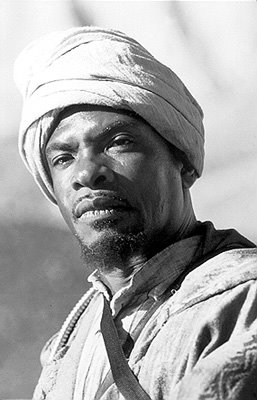
(Photo: Keith David as Abu 'Imam al-Walid in the Vin Diesel sci-fi movie Pitch Black [2000]).

Saturday, October 21, 2006

Sympathetic portrait of the suicide bomber: Battlestar Galactica


Listen to today's Weekend Edition on NPR and hear Elvis Mitchell and Andrea Seabrook discuss the new edition of Battlestar Galactica, now on the SciFi channel. What is remarkable is that suicide bombing is presented in a nuanced, not unsympathetic light, as are veiled critiques of US practices (torture, imprisonment without charge) in Iraq. I've not yet seen the show but I'm going to watch as soon as I have the chance.

I also find it curious that there has been no media outrage about this, at least none that I'm aware of. And yet, when Fun^Da^Mental put out a song ("Cookbook DIY") that compares individual suicide bombers to scientists making weapons of mass destruction for governments, Fun^Da^Mental's frontman, Aki Nawaz, is massively criticized in the media and public figures call for him to be charged for "glorifying terrorism" under Britain's new anti-terrorism laws. As Aki says, artists like Harold Pinter call Tony Blair a war criminal and say he should be tried in a criminal court, and other artists and journalists push the envelope, and no one calls for them to be prosecuted. But just let a Muslim artist get "edgy" and a hysterical, moral panic ensued. According to Aki, it's because of racism against Muslims.

Friday, October 20, 2006

More responses to forum: Swedenburg "pro-terrorist" and perhaps pro-Nazi?

Today's Arkansas-Democrat Gazette contains the following letter to the editor:
Nothing is Israel’s fault

After reading letter writer Ted Swedenburg’s liberal tripe recently, I thought I was going to lose my lunch.

So it’s all the evil Israeli’s fault, huh? Well, I don’t remember any news reports of Israeli terrorists blowing up a busload of Arab women and children. I don’t remember reading about an Israeli suicide bomber blowing himself up in a crowded Gaza Strip cafe. I didn’t see Israelis dancing and cheering in the streets when they got the news about 9/11. I must have missed the reports of Israeli terrorists blowing up an Arab airliner full of innocent people. Haven’t seen any Israeli nut case on TV shouting for all the world to hear that Iran and Syria need to be wiped off the map. Didn’t see anything about Israel lobbing Iranian missiles on Hezbollah.

Swedenburg is not pro-Israel by any means, but pro-terrorist. When he finishes speaking at his forums, does he raise his arm and shout, “Heil Hitler”? He’s proof of the well-known medical fact that there is no cure for stupid.

KEN THRASHER
Little Rock

This is in response to a letter of mine published in the Democrat-Gazette, responding to a letter by Darla Newman. (Newman got the same letter published in the Northwest Arkansas Times; my response was also published. Read the letters here. I sent a shortened version to the Democrat-Gazette.)

This is of course a typical McCarthyite smear. My concern is that the paper prints such nonsense without a shred of evidence. I spoke to the responsible person at the paper, who said that Mr. Thrasher was just expressing his "opinion." I said, so it would have also been okay, just his "opinion," if he had called me a rapist or a child molester? She said, that's a stretch. I said, so it's worse to be a rapist or child molester than a Nazi? She changed the subject...

I'll respond briefly here to just one point made by Mr. Thrasher: "Haven’t seen any Israeli nut case on TV shouting for all the world to hear that Iran and Syria need to be wiped off the map." No, but Israeli policy makers are working over-time for regime change in Iran, with their neo-con sidekicks in the White House. And then there is Avigdor Liberman, leader of the Israel Beytenu (Israel Our Home) party, who favors a "peace" plan with the Palestinians that involves not only the "transfer" (read: ethnic cleansing) of Palestinians from areas of the Gaza Strip and the West Bank that are to (according to the plan) remain in Israel hands, but also the "transfer" of Arab-Palestinians who are Israeli citizens into the Palestinian territories. This proponent of ethnic cleansing may now be invited to join the Israeli government by PM Olmert.

Tuesday, October 17, 2006

Bush vs. Magna Carta

Articles 38 and 39 of the Magna Carta state, regarding "habeas corpus":

"38 In future no official shall place a man on trial upon his own unsupported statement, without producing credible witnesses to the truth of it.

"39 No free man shall be seized or imprisoned, or stripped of his rights or possessions, or outlawed or exiled, or deprived of his standing in any other way, nor will we proceed with force against him, or send others to do so, except by the lawful judgment of his equals or by the law of the land."

Our President has just, today, signed these rights away, by signing the Terror Interrogation Law. But we shouldn't just blame Bush & the Republicans for this; 12 "Democratic" Senators (including my own Arkansas "Democratic" Senator Marc Pryor) voted for the legislation.

A day that will live in infamy.

Tags: , , ,

Tuesday, October 10, 2006

Demo against Rove


Demo against Rove
Originally uploaded by tsweden.

Bush's brain, Karl Rove, visited Fayetteville today, Oct. 10, for a fundraiser. The Omni Center for Peace, Justice & Ecology organized a welcoming party. About 20-25 showed up, and there was good media coverage.


Tags: , , ,

Tuesday, October 03, 2006

Haifa: Hizbullah Supporter


And I quote from The Angry Arab:
You know that sectarian polarization in Lebanon has reached a high point when Arab super star, Haifa Wahbi (a Shi`ite from the village Mahrunah in South Lebanon) declares her support for Hizbullah. She said on New TV that her heart beats for Hasan Nasrallah when she sees him. My mother tells me that her family in South Lebanon are all Hizbullah supporters. The sectarian system of Lebanon forces every Lebanese to identify with her/his sect. The system gives no secular alternatives, and secular parties have done a lousy job of making their case in recent years.

Monday, October 02, 2006

Fun^Da^Mental's "786 All Is War": "Sufi surfing on boards of steel"


Fun^Da^Mental's All Is War has been out since July 31, and it now appears that, despite all the controversy, the group's leader, Aki Nawaz, will probably not prosecuted under Britain's glorification of terrorism laws, passed earlier this year. I've been listening to it a lot, and playing songs that are appropriate on my "Interzone Radio" world music show. One of the songs I play is "786 All Is War." The controversy about All Is War mostly centers on the songs "DIY Cookbook" and "Che Bin" parts 1 and 2. "DIY Cookbook" gets into the heads of bomb-makers: the lowrent suicide bomber who makes his own bomb at a cheap cost, the maker of a dirty bomb who holds a PhD, and a "legitimate" bomb-maker, government employee, at work on a neutron bomb. Part one of Che Bin features a speech by Che, explaining the difference between sabotage ("revolutionary") and terrorism ("ineffective and indiscriminate"), although terrorism is sometimes useful when it involves the killing of an oppressive leader. Part two of Che Bin features a speech by Bin Laden in which he justifies the killing of Western civilians in a kind of exchange for the Muslim children killed by the West.

Less attention has been paid to the track, "786 All Is War." I consider it just as disturbing as "DIY Cookbook," and perhaps even more so. (I'm much more creeped out, however, by "Che Bin Pt. 2," the Bin Laden speech.)

Here's what Fun^Da^Mental say about the song on their website:
The United States is a country built on theft and mass murder yet it propagates the idea it is a civilized nation. Since 9/11 it has displayed all the evidence necessary to find it guilty of genocide and mass murder. Thus we will see its demise in the future, even if this seems like a dream, eventually its own citizens will turn their backs and beg to be liberated by those which it is currently attempting to destroy...Muslims. Islam will come back to haunt it. No Hollywood movie mogul would dare to imagine such a scenario...but here is the theme to the future. The emancipation of the United States will come from within but with the help of those forces that it attempted to destroy. Even the Statue of Liberty will prostrate to its liberation, until that fictional idea becomes reality let's watch Hollywood continue to push through its fantasy of a free nation, democratic and just, as its foundation is overflowing with the blood of others.

That is, this is meant to be a futuristic song about how the US is liberated by Muslim invader/liberators, in alliance with its own citizens. A look at the lyrics, however, suggests that the focus is mostly on the invader-liberators. Check it out:
Attack at dawn with sonic horns
Quranic forms and phonic guns
Sufi surfing on boards of steel
Laser scimitars coded zikr
Love and hate approach the state
The Statue of Liberty falls prostrate
On the way to slay the riba
The money lenders the bank elite

786

Takbirs from cyborg mujahids
AI imams electro du'a
Robotic maidens of paradise
Mechanoid martyrdom sacrifice
Chrome steeds galloping out to war
Future fedayeen shariah law
Truth cannons firing tomes
Beaming khutbas to their homes

786

Send forth the Sunnah troopers
Anti gravity plasma scooters
Crescent starship shabab clones
Powered by the power of the blackstone
Form ranks Ibrahim tanks
IC ballistic archers flank
Built from the holy Meccan soil
Engines running on blackseed oil

786

East west bring the law deliver
Jihadi jetskis Hudson River
Mechanical Moorish tour of duty
Deen machines replicant Sufis
Activate the Saracens
Annihilate the Pharaoh's sons
Embraced by the citizens
Appointed by the denizens

786 - congregate - 786 - dominate - 786 - propagate - 786 - emancipate

All is war this is what you fought for

Dream team Salahuddin

The citizens they build they build a mosque on Ground Zero

The musical track for the song is hard slamming, consisting of a very basic electronic riff, repeated over and over, backed by an insistent, driving beat from the dhol. A sample of a chorus singing one or two notes in harmony (and no lyric) is also used frequently, especially at the end of verses, and lends the track a kind of celestial feeling. The lyrics are rapped, by someone with a BrAsian accent.

"786" is the numerical total of the Qur'an's opening words, "Bismillah al-rahman al-rahim" (In the name of God, the Compassionate and Merciful) in the abjad numeral system. Abjadi numerals were used by the Arabs prior to the development of Hindu-Arabic numbers, in which the 28 letters of the Arabic alphabet were assigned numerical values. In South Asia, 786 is an important Islamic symbol (Fun^Da^Mental's Aki Nawaz is the son of Pakistanis who settled in England.)

"All Is War" and "All is war this is what you fought for": I read these lines as references to the war on terror declared by President Bush, a war without end, and to the song's prediction that what is being fought for will ultimately end in the Muslim liberation of the US. This end is symbolized powerfully, and transgressively, in the image of the Statue of Liberty falling prostrate, to Allah, and the citizens building a mosque on the site of Ground Zero. In-your-face images, designed to provoke and enrage, and entirely within the punk tradition. (Aki was the drummer for Southern Death Cult, which later turned into The Cult, and he has consistently stated that punk philosophy was for him, foundational.) Ponder the images: the Statue of Liberty, on a prayer rug, in the act of Islamic prayers; a towering minaret at the site of Ground Zero, the sacred location of the martyrs of 9/11. Whether one is an American who thinks of the US as quintessentially secular or as quintessentially Judaeo-Christian, these are images of symbolic defilement. But they are not, ultimately, images of destruction or death or mayhem.

The song mobilizes all kinds of images of "Islamic warriors" and Islamic invasion dressed up in futuristic, sci-fi garb. The overall effect reminds me of the futuristic writings of William Burroughs, particularly his Nova trilogy, minus of course the homoerotic currents. It's important to recall that in his writings Burroughs repeatedly mobilizes the image of Hassan al-Sabbah, the 12th century leader of the "Assassins" (the original fedayeen), an Isma'ili Nizari shaykh. In some respects Hassan al-Sabbah could be considered as the original Islamic "terrorist," in the view of the West. "786 All Is War" is a kind of revenge fantasy, of the sort often found in hip-hop. It's useful to recall that Fun^Da^Mental's first album, Seize the Time (1995), was very much in the "conscious hip-hop" vein, and that the group was frequently compared at the time to Public Enemy. What distinguishes "786 All Is War" from other revenge fantasies, however, is that it's written from the perspective of the Islamic warrior, mostly describing the character of the warriors and their actions, and the anger is not aimed at the listener, but at the oppressor, the "riba" (meaning usury but implying the usurer), the bank elite, the moneylenders (also a Biblical image), and the Pharaoh's sons. Unlike much hip-hop, and also unlike the novels of Black writers like Chester Himes, the listener is not made to feel implicated in the crimes of the oppressors.

The song is full of fabulous, crazy images and of clever internal rhyme schemes and alliteration. Among the images I particularly like:

"Sufi surfing on boards of steel." This calls to mind the Silver Surfer of Marvel Comics fame; presumably, like the Silver Surfer, the Sufi surfers are flying around on airborn boards. It also confounds the liberal-hippy Orientalist depictions of Sufism as only about peace and love, for these are Sufi warriors.

"Jihadi jetskis Hudson River." The picture of jihadis on jetskis makes me chuckle (and reminds of the "fun" in Fun^Da^Mental). These are NOT the Wahhabist jihadis of Al-Qaeda or Islamic Jihad in Egypt. They are engaged in "holy war," jihad for liberation.

"Deen machines replicant Sufis." I like the internal rhyme of "deen machine"; deen means religion, in Arabic and Urdu. "Replicant Sufis": the term replicant (biorobotic being) was invented by Ridley Scott for his film Blade Runner (and replacing the term, android, used by novelist Philip K. Dick, whose book, Do Androids Dream of Electric Sheep?, was the inspiration for the film). Are replicant Sufis, Sufis who look as fully human as Nusrat Fateh Ali Khan? When Aki Nawaz thinks of Sufism, one of the things he has in mind is qawwali, the very vibrant devotional music of the Pakistani Sufis. Fun^Da^Mental have performed and recorded in the past with qawwali maestro Nawazish Ali Khan and with the Rizwan-Muazzam Qawwali group (led by two of Nusrat's nephews).

Here's a glossary of some of the other terms used:

"coded zikr": zikr (Urdu) or dhikr (Arabic) is the remembrance of God. Chief among the ways in which God is remembered is through the use of dhikr beads (sometimes known as "worry beads"), which are fingered as the 99 names of God are recited. Sufi orders revolve around rituals of dhikr, or remembrance. "Coded zikr" could refer to the beads and/or to the Sufi rituals.

"takbir": the Arabic name for the phrase, "Allahu akbar," or God is the greatest.

"mujahid": in Arabic, literally a "struggler," but usually implying someone engaged in jihad. Also can be used in the sense of militant or insurgent.

"AI imams": an imam is a leader, often in the sense of the leader of prayer. AI: artificial intelligence.

"du'a": prayer, calling out to God.

"fedayeen": in Arabic, "those willing to sacrifice their lives." In the Arab world, the term often refers to the Palestinian guerillas during the years when the PLO was focused on armed struggle.

"khutba": a sermon, typically delivered in the mosque before Friday prayers.

"Sunnah": in Arabic, the "way of the Prophet." The deeds of the Prophet Muhammad, agreed upon by the Prophet's companions, and considered to have established Orthodox religious practice by Sunni Muslims.

"shabab": in Urdu, "youthfulness," in Arabic, youths. "Shabab clones" seems to refer to the Arabic meaning, youths.

"blackstone": a reference to the Ka'aba, a structure built of black granite, located inside the Masjid (mosque) al-Haram in Mecca, the holiest site in Islam. When Muslims pray, they pray in the direction of the Ka'aba.

"Ibrahim": Arabic for Abraham, the same Abraham of the Judeo-Christian tradition. In Islam, Ibrahim is one of the most important prophets.

"blackseed oil": blackseed is sometimes referred to as black cumin in English. The prophet Muhammad is said to have recommended the black seed as a "cure for all diseases except death." A popular "folk" remedy in South Asia and the Middle East.

"Pharaoh's sons": The Pharaoh is used as a symbol of the apostate tyrant by jihadi Islamists; the source of this notion is Sayyid Qutb. But the symbol is also widely used in the Judeo-Christian tradition, for instance, in the expressive culture of US slaves.

"Salahuddin": known in English as Saladin, renowned for vanquishing the Crusaders in the 12th century.

Will "786 All Is War" launch an Islamo-futurism trend?

Tags: , , ,

Sunday, September 24, 2006

Natacha Atlas in Chicago, September 16 & 18


Natacha at the Jay Pritzker Auditorium

I managed to make it to Chicago for the World Music Festival, a really fantastic annual event. My main purpose was to see Natacha Atlas, one of the most important world music artists doing Middle Eastern music today, and one of only a handful who have made some real inroads into the Western cultural scene, along with Rachid Taha, Khaled and Chab Mami. I first heard Natacha's voice on those great, and historic, world dance music collections issued by Nation Records, Fuse Vol. 1 (1988) & Fuse Vol. 2 (1990). On Vol. 2 Natacha sings in Spanish with a band called ¡Loca!, on a track called "Encantador". I next heard her when I lived in Cairo (1992-96). I was listening one day to the John Peel show, and heard some of her amazing vocals with Transglobal Underground, and I've been following her ever since. Natacha started releasing solo albums in 1997, with Diaspora; her latest, Mish Maoul, is her sixth. In July 2003 I got saw her perform in Detroit at the Festival of Colors, and also managed to talk with her for a bit backstage. Then she was touring in support of her 2003 album Something Dangerous, which, she told me, was very influenced by Missy Elliott. In Detroit her show was very dance oriented, with elements of funk, r & b, dancehall, hip-hop and Egyptian bellydance--the usual mix of elements Natacha has done on her albums.

Mish Maoul is much more lowkey and laidback than Something Dangerous, although it does have its hard moments. The album opens with a slow number, "Oully" or "Tell me" (incidentally, the way the Arabic titles are transcribed on this album are really confusing, as is often the case in world music releases). This song sets the tone, leading you expect a different sort of Natacha album than you are used to. Of course there are hard moments as well, most notably on "Hayati Inta," which has a very Moroccan feel, with its Gnawa-propelled bass line (played on ginbri), Gnawa-style chorus, and a mizmar (a reed wind instrument). "Ghinwa Bossanova" (Bossanova song), which as the title suggests, takes Natacha into Brazilian territory. I don't have time to give a full review, but the album is definitely worth checking out.

The first Natacha show was at the Old Town School of Folk Music, on the 16th, a real nice and intimate venue. Opening for Natacha were La Mar Enfortuna, a side project of Oren Bloedow and Jennifer Charles of Elysian Fields. The self-titled album came out in 2001 on John Zorn's Tzadik, and is an updating of traditional Sephardic songs--in line with Zorn's Tzadik project of promoting "new" Jewish music. The album is very accessible, tasteful and nice, if not terribly challenging. Essentially it's a studio album. So I was a bit surprised to see the new La Mar Enfortuna ensemble, which has now turned into a real group that's been together a little over a year, and has played mostly in Europe or in New York City. I was really blown away by their performance. The group features Bloedow on bass and guitar and occasional vocals, Charles on vocals, Brahim Fribgane on 'ud and guitar, Robert DiPietro on percussion, and Doug Wieselman and Ted Reichman. The last two play piano & accordion and sax & clarinet, and I'm not sure who plays what. The group did Sephardic songs in Ladino (the Spanish of the Jews of Spain), Hebrew and Arabic, and on each one several musical trends seemed to be productively clashing. On some songs the sax/clarinet player contributed klezmer sounds, on others what he played was more in the vein of avant-garde jazz. On one cut, Bloedow's Spanish guitar and Fribgane's 'ud played riffs in unison, demonstrating the close cultural links between Spain and the Arab world, while the beat was that of a dramatic paso doble. One of my favorite numbers featured Fribgane singing in Arabic and playing simple, bluesy lines on the 'ud, while the sax player picked up a guitar and played slide backing. On two songs where Charles sang in Hebrew, the Moroccan Fribgane joined the others in singing the chorus in Hebrew. On a song that I think is called "Ya Qalbi Khali" (My heart is empty), Fribgane sang lead (in Arabic) with Charles singing backing in Arabic. All in all, every song was somewhat startling for its inventiveness, and for the multiple musical/cultural strands that were brought into conversation, and confrontation, with each other.

I chatted with Fribgane for a bit after the set. I had seen him perform with Hassan Hakmoun at the Gnawa Festival in Essaouira in June 1999. I was a bit ambivalent about Hakmoun's set at Essaouira, but Fribgane is an excellent guitarist. I had not known that he is also an 'ud player and a very fine vocalist. He still plays with Hakmoun, but seems quite excited about being in La Mar Enfortuna. Fribgane is originally from Casablanca, and has lived in the US since 1989, in New York City I believe. He told me the band had recently performed in Grenada, at the house of Garcia Lorca.

After intermission, Natacha Atlas and her group. Her current ensemble is an acoustic one (except for electric bass), and represents a big change from her previous outfits which were all about playing dance music. Harvey Brough, the group's musical director, plays piano and acoustic guitar. Brough is a composer, arranger, and performer, probably best known for his production work with Jocelyn Pook. He and Pook collaborated on the soundtrack for Stanley Kubrick's Eyes Wide Shut. He's been working with Natacha for just a few months. She handed him some scratchy cassettes of Fairuz and Abdel Halim Hafez and he produced arrangements for the songs. 'Ali Minyawi is on derbouka. Natacha introduces 'Ali as "her cousin," but as he explains to me, they're not really first cousins, but are related. 'Ali's family, as the name indicates, is from Minya in Egypt, but he was born in England and is working on a degree in tourism from North London University. On bass is Steve Leake, who was also part of her ensemble when I saw her play in Detroit in 2003. There are also three string players (violin, viola, cello), who Natacha hired on in New York. They played her New York City gig the previous night, after only one rehearsal, and they are really great. Finally, on accordion is Gamil 'Awad (Natacha Atlas introduces him as Gamal Kurdi, so I guess he goes by both names). Gamil is in his late fifties, an ordinary-looking, bespectacled middle aged Egyptian. Nothing hip looking about him. He too was part of Natacha's group in Detroit in 2003. It was astonishing to see someone like him, playing crazy lines on the electronic keyboards to accompany Natacha's dance numbers. What was more amazing was to meet him backstage and learn that he played accordion with the great Abdel Halim Hafez. It's comparable to meeting someone in the US who played with Elvis. If memory serves me, Gamil was recruited to play accordion with Abdel Halim in 1962, when he was 14 years old, and continued to play with him until 1977, when he moved to England. (Abdel Halim passed away the same year.)

Natacha began her set with a song by Lebanon's great female singer Fairuz, whose title I believe is "Insani Ya Habibi" (composed by the Rahbani brothers in the sixties). Natacha is very well-suited to sing Fairuz material, both because her voice is so pretty, and because her singing style is in the vein of Fairuz's light and open-throated vocals--which are marked in contrast to the typically Egyptian style of Umm Kalthum, which is more nasally and close-throated. The second number was Egyptian crooner 'Abdel Halim Hafez's "Al-Aseel." The song is from the '50s, and is not a well-known Abdel Halim number. The lyrics go something like, "the early sunset kissing the palm trees." At the close of the song, Natacha said was doing Fairuz songs in memory of what has been happening in Lebanon. And she said she chose Abdel Halim's "Al-Aseel" because the original recording had a jazz feel. (I cannot confirm this, as I've not tracked it down yet.) Natacha had decided to perform songs by Fairuz and Abdel Halim because, she said, these artists were fusing Eastern and Western sources in their music long before she started doing it. People make a big deal about the "East/West fusions" I'm doing, she said, so I wanted to pay tribute to the fact that musicians in the Arab world have in fact been doing this sort of thing for at least 50 years. Next up was "Ghinwa Bossanova" (Bossanova Song) from Mish Maoul, featuring some fine bossanova guitar from Harvey Brough. Fourth, another Fairuz number, "Laysh al-Haki" (Why the talk?), another Fairuz song I wasn't familiar with. As on all the Fairuz and Abdel Halim numbers, Harvey Brough's piano playing was very fine, as was the string section, which often played in harmony rather than unison. The songs written and produced for Fairuz by the Rahbani brothers frequently explored harmony, which was (but no longer is) somewhat novel and avant-garde for Arabic music in the mid-twentieth century. The piano and the strings elements really make these old numbers sound authentic; Brough's piano is particularly good on the Fairuz numbers. The song is "very romantic, like all Arabic songs," says Natacha. Number five is a number called "Adam's Lullaby" that Natacha co-authored with Jocelyn Pook. The lyrics are quite simple, "'Ayish ya ibni Adam, 'ayish" (Live, oh human [son of Adam], live); i.e., choose life, not death. Next is another Abdel Halim number, "Bayni wa Baynak," one of his better known songs. Gamil 'Awad always shines on accordion, but especially so on the Abdel Halim cuts. Number seven, Natacha announces, is an anti-war song. People in the audience clap. She talks about how upset she is with what is going on in Lebanon and Iraq, how much she dislikes the policies of Bush and Blair in the Middle East. The song, "He Hesitated," she says, is about a soldier who wonders whether or not to shoot. The lyrics are pretty simple and go something like this:
Ana shuftu hinna wa'if la wahdu
(I see him here, standing by himself)
Kan yfakkar, yis'al nafsu, aywa walla la', yibda' darb al-nar
(He was thinking, asking himself, yes or no, [to] start shooting)

Number 8 is "Mon Amie La Rose," a song originally recorded by Françoise Hardy in the mid-60s, and which appears on Natacha's third album, Diaspora (1999). She says, it's a very heavy song, about life and death, and dedicates it to her English mother, who is dying of cancer. Natacha had wanted not to tour and to stay home with her mother, but her mum wanted her to sing in the US and spread the message that the East and West can live together. (Her husband, Natacha's father, is Egyptian.) Natacha lends this French chanson some Eastern touches, trilling in Arabic style, and Gamil's accordion frills are very Arabic sounding. Next up is a song whose name I don't catch. It's sung in Arabic, and one of the lines is "Georgie Clooney," which is quite amusing, but it fits with the song. Natacha explains that she usually writes songs together with her cousin 'Ali, but when she was writing this one, 'Ali wasn't around to help. She was trying to find a line that would rhyme with typical Arabic phrases like "'ayouni" (my eye) and "hayati" (my life) and she provisionally threw in "Clooney." The people she was recording with liked it, so she kept "Georgie" in. Song number 10 was the final Fairuz number of the night, whose title is something like "The moon made me late." The lyrics, I think, go "la ghadab 'alayi, ghadab 'al 'amr" (don't get mad at me, get mad at the moon.) I am struck again by how gorgeous Natacha's voice is when she sings Fairuz. Some of the single notes she hits are events of sheer beauty, real gems. Next up is "Black is the Color of My True Love's Hair," which Brough says is Appalachian in origin, but here inspired by Nina Simone's famous version. I'm not much of a fan of the few songs Natacha has sung in English, and this one doesn't go over well with me either. When she talks between songs, it's clear that she speaks unaccented Brit English (she was raised in Belgium and England), so I don't know why she sings in accented (European?) English. Next is "Hayati Inta" (You are my life), from Mish Maoul. With her acoustic band the song as not as hard-rocking as it is on the album (see above), but it's still very effective. The last song of the evening is "Moustahil" (Impossible) from Halim (1997), Natacha's second solo album. This is a real belly dance number, and eventually Natacha, who has been singing the entire night perched on a stool, gets up and bellydances. Then 'Ali does quite a long percussion solo on his derbouka, and then the band gets back to the song. I think that "Moustahil" segues at some point into another song, whose name I don't know.

All in all, it was a very fine show, very much appreciated by the crowd, which was clapping and cheering for an encore, but an encore there was not to be.

Natacha played again in Chicago on the 18th (she was in Milwaukee on the 17th), at the Jay Pritzker Auditorium in Millenium Park, downtown, close to the lake. This is really a great venue, designed by Frank Gehry, but what's truly remarkable about it are the acoustics, fully the equal of any indoor arena. I managed to get front-row, VIP seating, which made the experience even better. Perhaps because the sound was so good, this show was even more enjoyable than the first one. The playlist was as follows: (1) Insani Ya Habibi, (2) Al-Aseel, (3) Ghanwa Bossanova, (4) Laysh al-Haki, (5) Bayni wa Baynak, (6) He Hesitated, (7) Mon Amie La Rose, (8) Black Is the Color of My True Love's Hair, (9) The Moon Made Me Late, (10) Hayati Inta, and (11) Moustahil. Two songs less than they played at Old Town, and despite the ovation, no encore. (Natacha was clearly working within a time limit, and the stage hands were signaling for her to get off so that the Zanzibar Culture Club could go on next.) The only thing I would add to my observations of the earlier concert are that (1) Natacha was wearing a wild costume that I couldn't make sense of, it reminded me of something Fairuz might have put on for one of her folkloric shows (see photo); (2) "Black Is the Color of My True Love's Hair" sounded much better than the first time around; (3) Gamil played a great accordion solo on "Hayati Inta," and (4) perhaps because of the time constraints, Natacha didn't speak nearly as much about what she was trying to do with her music. She did announce the anti-war song, however, and the crowd applauded.

I headed backstage right after the band left the stage, thanks to Natacha's booking agent. I talked a bit with Harvey Brough, Ali Minyawi, and Gamil 'Awad, and got to spend about a half hour or so with Natacha in her dressing room. I didn't really have particular questions I wanted to ask her, but here are some of the points that came up. She's very upset with US and British foreign policy in the Middle East, the hypocrisy of the talk about promoting "democracy," the failure to solve the Palestine problem, the way that the US and the British conspired with Israel in its recent full-scale assault on Lebanon. She said she was really pissed off, and was complaining in all interviews about this, that she was unable to get her ney (reed flute) player Lou'ai Hinawi into the country. Hinawi has a Syrian passport, resides in England, is married to an Irish woman, and is about to get his British passport. He was unable to get a visa to Austria when Natacha and her band played recently in Vienna, so they had to find a last minute substitute (someone from the Transglobal Underground family). Hinawi only managed to get a visa to Denmark because the King of Denmark wanted to attend her show, and so he intervened. No king or president plead Hinawi's case with the US State Department, however, so the band was touring without a ney player.

Natacha went on to elaborate on the East-West fusion issue, saying that Cairo was a really swinging place in the fifties and sixties, with all kinds of interesting cultural production, but that since then it's become quite conservative by comparison. She reckons that Cairo might have carried on in this way if only the Palestine problem had been sorted out. Natacha talked about how she wished that popular Egyptian films from this period were screened at festivals in the West, rather than art films like Hadi 'Abd al-Salam's The Mummy. She mentioned Isha'at Hubb (from the fifties), which stars Omar Sharif, as an example, and a film from the early sixties starring Fuad al-Muhandis and Shwaykar where the Fuad character has a shoe fetish (she couldn't remember the name of the film, and I don't know it). Her point being, Western audiences need to see these films to get a sense of how hip Egypt was in those days. I mentioned to her Ghazal al-Banat, starring Layla Murad, which has a scene where Muhammad 'Abdal Wahhab leads an orchestra that is basically playing a hoedown.

She said she's not been spending as much time in Cairo as she used to (a few years ago she was spending six months out of every year there), and is not sure she will be back as much due to the death of her "uncle" (her father's cousin) with whom she was very close and with whom she spent a great deal of time in Cairo. Natacha recently went to Cairo, however, because the French magazine Rock'n'Folk did a feature on Natacha in Cairo. Her "cousin" (son of her deceased "uncle") text messages her all the time, telling her he heard one of her songs played on the radio, or that he saw one of her video clips on television. She says that her music is being played more and more in Cairo...which is a good thing.

Finally, I mentioned to her that I had read about the talk she gave in London last month at an event organized by Aki Nawaz regarding Fun^Da^Mental's All Is War. Natacha said that she thinks Aki is getting really good at public speaking. (I saw an interview he did on BBC and I concur.) As for her talk, she felt she was too emotional, but that Aki told her afterwards, it's good to be emotional. Interestingly, Natacha doesn't feel that she is very articulate, doesn't feel can she express herself well about politics or about her music, and I got the sense that's in part because she didn't do college. In my opinion, she more than compensates by the articulateness of her music.

That's it. Go listen to some Natacha! She continues to be one of the most important missionaries for Arabic music operating in the West.


Tags: , ,

Monday, September 11, 2006

Response to the Forum: "Promoting the end of...Israel"

A letter to the editor was published in the Northwest Arkansas Times yesterday in response to the forum I participated in on August 30. It deploys the typical and almost predictable arguments that ardent Zionists sling against any Israel critic in the US: anti-Semitism (calling for the destruction of Israel) and lack of "balance." The latter argument reeks of David Horowitz, who has made this his mantra now for several years. There was more to say but the space in letters is too short. Two more points I would have liked to make (1) Hillel frequently sponsors lectures and the like at the UA campus. Ghadbian, Gordon and I have never been invited to appear at any of their events for the sake of "balance" and "objectivity." (2) A map that shows Israel in the Middle East of course makes it appear that the Jewish state is under threat of being swamped by its far larger neighbors. The purpose of such a map is to disguise Israel's true power: it has the fifth most powerful military force in the world, possesses nuclear weapons, enjoys the full backing of the US, has never lost a conventional war against its much "larger" neighbors, and so on.

Here's the letter, followed by my response.

"Objective analysis of Israel lacking" -- Northwest Arkansas Times, September 10, 2006
Not long ago I attended a forum at the University of Arkansas on the recent Israel-Hezbollah war, which claimed to feature analysis from UA professors Joel Gordon (History), Najib Ghadbian (Political Science) and Ted Swedenburg (Anthropology). Although I had been warned that this group of professors would present an avidly anti-Israel stance, I was dismayed at how completely one-sided the presentation was. The organizers had refused to allow the participation of anyone with a pro-Israeli view. They focused all of the negativity on Israel, while claiming an “ objective ” analysis. Is this what our university has become — no consideration of different points of view ? No opportunity for students to think through the reasons for different perspectives ? The program left me with the clear impression that these professors were, in fact, promoting the end of the democratic nation of Israel, as opposed to seeking peace and understanding for all in the region. I suggest that these professors attempt to balance their presentations, first by providing a large map of the Middle East so that all can see the size of Israel compared to its neighbors. Secondly, the audience should be informed of which of Israel’s neighbors are dedicated to its destruction, and which are dedicated to peaceful coexistence. Third, invite co-panelists from a different perspective to engage in peaceful dialogue, thus demonstrating to students that reasonable people can have differing opinions and can share a forum peacefully.

Darla Newman / Fayetteville

My response, which I just sent off to the editor. We'll see if it's published.
Darla Newman's letter (September 10) concerning the recent forum I participated in along with Professors Ghadbian and Gordon deploys the standard smear tactics that partisans of Israel use against anyone who dares criticize the Jewish state. Newman describes our presentations in generalities ("anti-Israel," "one-sided," and "negativity") and offers no specifics, and concludes that we were "promoting the end of the democratic nation of Israel." I challenge her to cite a single example of such a call. I did deplore Israel's recent prosecution of its war against Lebanon, citing, for instance, statements by Human Rights Watch that Israel was guilty of "indiscriminate attacks against civilians" in Lebanon, and I concluded by arguing that Israel's assault on Lebanon's civilians and infrastructure was not in its best interests. But apparently for Newman, such criticism of Israeli government actions is "anti" Israel and equivalent to arguing for its obliteration.

Newman also is dismayed by the forum's lack of "balance" and our "refusal" to invite someone with a "pro-Israeli" stance to participate. Professor Gordon in fact spoke informatively at the forum about conditions inside Israel, which he visited this summer as the guest of two Israeli universities, and where he has relatives and friends But perhaps for Newman "pro-Israeli" means defending Israel's Lebanon war, and it is true that no one at our forum took this position. Instead, we argued that the US, Israel's chief ally, should engage in diplomacy with Hizbollah, Hamas, Syria and Iran. That is, we advocated a peace policy and argued against Israel's aggressive war policy in Lebanon and Palestine and against US support for it.

In sum, although Newman argues for "balance" and "peaceful dialogue," she has in fact misrepresented both the intent of our forum and the nature of the discussion that took place.

Ted Swedenburg
Fayetteville

Update: My letter was eventually printed in the Northwest Arkansas Times. Newman's letter subsequently also appeared in the Arkansas Democrat-Gazette, and my response (a somewhat shortened version of what appears above) was also printed.

Tags: , ,

Thursday, September 07, 2006

Blues for Lebanon Charity Concert in London, featuring Otis Grand


Charity concert to aid displaced children and their families in Lebanon, featuring Otis Grand, with special guest Slim Jim Phantom, ex-Stray Cats. 17 September, at the Spitz Club, Spittlefield, Brickland, London. Otis Grand is one of England's, and the world's, best blues guitarists, and the cause could not be better. (If you go to Otis Grand's site, click on "Biography," and then click on "The Otis Grand Story," by Mick Rainsford, you will discover that I used to sing and play rhythm with Otis, very early in his career. There is even a photo with me singing.)

Tags: ,

Lebanon Ravers: Is Beirut Coming Back?


Before July 11, Beirut was developing a very lively club scene. Just a short while after the cessation of hostilities, Lebaneseravers.com is trying to bring it back. Bonne chance!

Tags: , ,

Monday, August 28, 2006

Forum: "Baghdad to Beirut: Birth Pangs of a New Middle East?"


Some political activity in the hinterlands: Together with my colleagues Joel Gordon (History) and Najib Ghadbian (Political Science), I've helped organize a forum on current Middle East affairs. The three of us (who also do a regular, smaller-scale forum called Diwan Baghdad) will all speak, along with two University of Arkansas students, Nadine Sinno and Sarah Gibson, who were in Beirut during the recent Israeli onslaught. I plan to talk about US media (mis)coverage of the Israeli assault on Lebanon. This Wednesday at 4 PM.

As for the "birth pangs" in question: When Condoleeza uttered her immortal words, she was, according to Northwest Arkansas Times columnist Gene Lyons (August 2), talking in code to Christian fundamentalists, i.e. she was addressing W's political base. She was alluding to a verse in Matthew (24: 7-8) where Jesus informs the Apostles how to recognize the "end times": "Nation will rise against nation, and kingdom against kingdom...All these are the beginning of birth pangs."

Tags: ,

Saturday, August 26, 2006

Aki & Dave of Fun^Da^Mental Speak, as does Natacha Atlas

I'm somewhat tardy in posting this, due to distractions on the personal front. John Hutnyk ("Trinketization") has a very interesting post on a London event to discuss the controversy over Fun'Da'Mental's new album, All Is War, and to premier the video of "Cookbook DIY," the most controversial track on the album. Among those who spoke were Aki Nawaz and Dave Watts of Fun'Da'Mental and Natacha Atlas, who records (in England) on Aki's label, Nation Records. Read the whole thing, but here are some bits:
Aki:
Aki starts speaking about how democracy is a weapon that kills, that there is a silencing that is as much blame, that the leader in Downing St needs to be put on a donkey and paraded through the city, and that he can’t understand why there is nobody doing anything. He is really angry. The youth in Britain are angry, There are people being killed in thousands and everyone seems to be going on and on as if there was nothing they could do. They tried to protest against the gulf war, but were ignored and since then, nothing. Why, he says, aren’t people out there burning down town halls and the like? (This last comment almost an aside, but it will become more and more the hot topic of the night).

Natacha:
...she talks of her Syrian partner, the troubles musicians have getting visas in Europe, her anger and frustration at the war, and she apologises for being emotional. In fact it’s the most passionate thing I’ve heard her say ever, and not at all prima donne-esque. Great.

Aki:
in response to questions the point was made forcefully by Aki that the issue was British foreign policy. A simple persuasive argument he offers runs: we put up with years and years of racism and it did not mean any young people felt the need to strap on bomb belts and jackets and blow the trains; we endured years and years unemployment and it did not mean anyone went out to bomb buildings [well, Baader Meinhof excluded, but …]; but now the nightly news footage of innocents killed one after the other in their hundreds and no-one wants to discuss it, no-one listens, no debate, no significant movement to defend Muslims; no defence of mosques from attack; no way the STW coalition was going to deliver on its promise that ‘if Blair goes to war we will stop the whole country’, despite 2 million marching in February 2002…the problem is foreign policy. Change that and its over.

Dave:
Dave Watts from FDM stands up. The discussion has dragged on and his frustration as clear as many. He starts by saying he understands why people want to be suicide bombers, he understands the frustration that would make someone want to go out and do it. You can imagine how this rubs up against the Gandhians. Dave says there has to be some understanding of where those who have tried to discuss have now ended up – ready to do violence and blow up buildings [code words]. But then he says he is a man of peace, a lover of peace, but he is angry and we have to fight for peace. The video clip we are about to see is called ‘Cookbook DIY’ and Dave explains its in three parts, that the person who in frustration because the is no other avenue for discussion, expression, action, has made a home bomb for 50 quid, is a small version of the guy who makes a dirty bomb, with materials bought on the black market, but neither are as obscene as the scientist who kisses his wife in the morning – Dave mimes a smooch, playing to the audience – who then goes off to work in a pentagon lab or some such to make a neutron bomb that kills all the people but leaves the buildings intact. Have a look at the video people … at which point, the screening [of Cookbook DIY]


Tags: ,

Sun Ra - Brother From Another Planet: BBC Video

Acclaimed Documentary on this Visionary Musician

A wonderful BBC documentary, 58 minutes long, on the amazing, indescribable jazz artist Sun Ra. Without Sun Ra--would Parliament-Funkadelic ever have existed? Would psychedelic lightshows have been invented? Would there be Afro-Futurism? Check it out!

And: watch this live Sun Ra performance on "Saturday Night Live," 1978. A weirder and more visionary musical act probably has never appeared, before or since, on the show.

Tags: ,

The Gossip "Listen Up!" Video


Great song from The Gossip's 3rd album, Standing in the Way of Control. With their new drummer, Hannah Billie, The Gossip have a very different sound, a rhythm that makes their sound even more soul and funk-based than in the past. The instruments are still minimimalist, but who knew that guitarist/bassist Nathanie/Brace could bring the funk so well? Vocalist Beth Ditto has always sounded like a punked-out Aretha or Bessie Smith, but now the southern grits and collard greens are even more in evidence. (Beth and Nathaniel are originally from Searcy, Arkansas.) In the vid, Nathaniel plays the bass in his bedroom, looking like a bored teen. Drummer Hannah pounds the cowbell. Beth looks rather grandmotherly, most of the time, sitting and knitting. And then, acting on her pro-fat stance, she pushes pizza. Meanwhile, teen punkettes get up and dance to the music. Riot grrrl lives! -- despite the untimely retirement of Sleater-Kinney.

Tags: , ,

Wednesday, August 16, 2006

Sound Comments...


Turn on Fox News, turn off the sound, and listen to:

DJ Ahmedenijad aka Cesar Chavez (Tehran, Lebanon)
2/5 BZ (Turkey)
Gözel Records (Turkey)
Ramallah Underground (Palestine)
free mp3s of Iraqi music

Thanks to wayne&wax for these listening suggestions.

and don't forget Fun'Da'Mental here and here (click on 'Goodies' and scroll down to the bottom for mp3s)

Addendum: at the suggestion of wayneandwax--check out soot records, and in particular these artists who do stuff with a Middle Eastern flavor: Nettle, dj/rupture, Filastine and Mutamassik. Poke around; sometimes in the news section you can find mp3s.

Tags: ,

Friday, August 11, 2006

More on "From Beirut to ... Those Who Love Us"--and a new video letter


Check out this article by Jim Quilty for The Daily Star, on the video letter "From Beirut to ... Those Who Love Us," and a new one called "Dead Time," from the Beirut Development and Cinema film collective. (Quilty probably wouldn't want anyone to know, but for awhile he was a Hawg--doing graduate work in History at the University of Arkansas in the late nineties. I think he made a good career choice, switching to journalism. Although now, in Beirut?)

Says Christine Tohme of Ashkal Alwan: "The 1982 invasion had news coverage but very little art came out of it. One thing we can do is make sure that isn't the case this time as well. Resistance isn't something new to us: It's been embedded in all our work since long before this war began."

Check out the two video letters here. (Earlier posting here.)

Tags: ,

Thursday, August 10, 2006

Don't Forget Gaza


News of the ongoing Israeli onslaught of Lebanon is overshadowing, vanishing in fact, all news of Gaza, where the onslaught is equally awful. Here's a reminder.

Tags: , ,

Wednesday, August 09, 2006

Civil Resistance in Lebanon


Civil resistance in Lebanon, along the lines of Palestine's International Solidarity Movement (ISM), and with ISM's participation. The first action, and coming actions, are described here. Be sure to hunt around on the lebanonsolidarity.org site. You can also download posters like the one featured here, as well as banners (like the one in the right-hand column) to put on your website. From the press release:
On August 12 at 7 am, we will gather in Martyrs’ Square to form a civilian convoy to the south of Lebanon. Hundreds of Lebanese and international civilians will carry relief as an expression of solidarity for the inhabitants of the heavily destroyed south who have been bravely withstanding the assault of the Israeli military.

After August 12th, the campaign will continue with a series of civil actions for which your presence and participation is needed. Working together in solidarity we will overcome the complacency, inaction, and complicity of the international community and we will deny Israel its goal of removing Lebanese from their land and destroying the fabric of our country.

Tags: , ,

Tuesday, August 08, 2006

How the BBC, and Kathleen Parker, report on Lebanon

Here's a sentence from a BBC report yesterday which I believe sums up the difference between news media reporting on Lebanon in Europe vs. media coverage in the US.
More than 900 Lebanese, most of them civilians, have been killed in the conflict, the Lebanese government says. More than 90 Israelis, most of them soldiers, have also been killed.

The US public almost never hears or reads reports like that. Instead, we get comment like Kathleen Parker's (opinion columnist for The Orlando Sentinel), which appeared in my local paper, the Arkansas Democrat-Gazette, last Friday (and was syndicated in many papers throughout the US). Here are some relevant extracts, with my commentary.
By bringing the war to suburbia [HUH?! Kathleen: your, er, class location is showing!] in violation of the Geneva Conventions and launching rockets from villages such as Qana, Hezbollah virtually ensures that civilians will die.

Here Parker trumpets the official Israeli line, that Hezbollah is to blame for the death of Lebanese civilians.
Pending an investigation, many facts are unknown, including whether the building in which the children died came down as a result of Israeli fire. The Associated Press and others now report that the Israeli strike on Qana came between midnight and 1 a.m., but the building didn't collapse until 7 or 8 a.m., possibly as a result of munitions inside the building.

Maybe the Israelis didn't really kill those people anyway!
Whatever the case, Israeli Defense Forces had dropped leaflets into Qana a week beforehand, warning residents to evacuate. Although international humanitarian law forbids the deliberate targeting of civilian areas, exceptions are tolerated under certain circumstances.

Those dumb children, they should have left. They were warned!
As Human Rights Watch explains on its Web site (humanrights watch.org), a civilian area can be targeted if it "makes an 'effective' contribution to the enemy's military activities and its destruction, capture or neutralization offers a 'definite military advantage' to the attacking side in the circumstances ruling at the time."

Parker's hypocritical use of HRW language to support Israel really defies belief, doesn't it? Especially since Human Rights Watch has released a report criticizing Israel's indiscriminate attacks on Lebanese civilians.
The humanitarian guidelines also call for "proportionality" in "dual use" areas and for precautions to protect civilians.

Parsing the language of "dual use" when bombs are killing sleeping children seems absurd when measured against such senseless loss. But it is also necessary if we are to maintain perspective against a cowardly enemy that hides among women and children, then relies on emotion to gain traction on the battlefield of public opinion.

Why some residents of Qana didn't leave given fair warning is a point of speculation, but Hezbollah reportedly has blocked residents from evacuating other areas. Proportionality is a trickier question, but let's be clear on the issue of moral equivalence. There is none. Hezbollah aims to kill civilians; Israel aims not to. But by firing rockets from civilian areas, Hezbollah forces Israel to return fire, thus inciting the condemnation of civilized nations and fueling the reliable outrage of the Arab street.

I've never seen reports of Hezbollah blocking the exit of civilians--who, especially when we're talking about Shi'ites in the south, are almost unanimous in their support of Hezbollah. And of course "some" residents of Qana, and probably most of them, did leave. Others stayed because they were afraid: of being attacked by Israeli warplanes while fleeing. Others stayed because taxi fares have become exorbitant, too high for the poorest to afford. And some, legitimately, resisted Israel's warnings to leave. Anyone with even a passing knowledge of what is going on in South Lebanon knows this, but in the US, all you need is ideology to qualify as an opinion columnist.

"Hezbollah aims to kill civilians; Israel aims not to." Does Parker not know basic math, the kind the BBC finds so easy to manage? And..."by firing rockets from civilian areas, Hezbollah forces Israel to return fire," that is, Hezbollah forces Israel to blow up an entire country, destroy its infrastructure, create a million refugees, destroy Lebanon's coast, etc. Israel has no choice but to respond this way. Israel is entirely blameless, Hezbollah entirely culpable.

Such commentary is no anomaly, but instead represents entirely conventional US media commentary on Israel's invasion Lebanon. I'm having a hard time trying to puzzle out why I shouldn't say that such commentators have the moral integrity of Goebbels.

Tags: , , ,

Monday, August 07, 2006

Patti Smith: the last rocker with a social conscience left?


From Jon Pareles' NY Times report on Lollapalooza, in Chicago this past weekend:
It had one stage devoted to music for children, where none other than the punk-rock poet Patti Smith performed on Sunday afternoon. There, in one of the festival’s most blunt political moments, she sang a newly written song about children killed by bombs in Lebanon, with bitterly graphic imagery: “limp little bodies caked in mud.”

Is anyone else in the US pop culture field saying anything that is even a little bit critical about Lebanon?

This sentence from Pareles' report seems to capture the current state of pop music: "The new Lollapalooza happens only in Chicago; it’s also clean-cut, having made peace with corporate sponsorship and Chicago’s civic pride."

And, from another Pareles report:
Lollapalooza, meanwhile, is branded every which way: on stages, on the field, in its advertising. Its main sponsor is AT&T, and I have to wonder if Lollapalooza's new rectangular logo, with a few letters on each line, has been remade in the image of a telephone keypad. (Meanwhile, AT&T is webcasting parts of the festival at blueroom.att.com) Does all the corporate presence make any difference to music that's rarely nonprofit by intention? "Enjoy Capitalism," said one audience member's T-shirt - and Capitalism, of course, looked like a Coca-Cola logo.

As for Patti, here's her recent statement about the Qana massacre, from her website:
QANA

The Israeli practice of collective punishment is a war crime under the Geneva Convention. Why are they allowed to do this? Because they have our permission?

We send over four billion dollars in aid and weapons to Israel every year. We are paying for this devastation. The slaughter of children. The country in ruins.We are paying for this. George Bush willfully rejected a truce and now we have the Qana massacre on our head. Thirty seven of the dead were children.

Qana is considered by some as the location of the first miracle of Christ. Turning water into wine. There is no wine flowing in Qana today. Only blood. Only blood.

Consider these lyrics, from "Babelogue" (Easter, 1978): "In heart I am a Moslem; in heart I am an American; in heart I am Moslem, in heart I'm an American artist, and I have no guilt." And check out her lyrics to "Where Duty Calls" (Dream of Life, 1988).

P.S.: John Schaefer (see comments) called my attention to the fact that Wayne Coyne of the Flaming Lips also had something to say about Lebanon at Lollapalooza. According to the Chicago Tribute, "Coyne prompted the massive crowd to sing along in an effort to 'stop traffic' in the area and to 'stop Israel from bombing Lebanon.'" The Flaming Lips: Who woulda thought? And the Flaming Lips are a band from the heartland: Oklahoma City. (Thanks, John.)

Tags: , ,

Saturday, August 05, 2006

Fun^Da^Mental's "All Is War" Available 7 August


Fun^Da^Mental's controversial new album All Is War (the benefits of g-had) will be available for downloading on August 7 from the group's website.

Says Aki Nawaz, the group's leader:
"We are not soliciting for your money but your genuine support. Even if you download 1 track and preferably the “I Reject” track you are contributing to putting the middle finger up at the system.

The results for the music industry, media, and the establishment if the track appears in the download charts, would be horrific but absolutely brilliant in terms of dissent.

We promise to donate part of the money to “VERY WORTHWHILE CAUSES” and the rest will be used to carry on pushing politics out of the conventional box of deceit and lies."


The physical album will be released on 28th August via Vital Distribution, on the new label Five Uncivilized Tribes, created because two silent directors of Aki Nawaz's label, Nation Records, threatended to resign over All is War's release.

The track “Cookbook D.I.Y,” which has received the most media attention due to the fact that it treats, among other things, a suicide bomber making his bomb, has been made into a video (available to the media by emailing Fun^Da^Mental). Other videos are in preparation.

Aki Nawaz issued the following statement:
"We have now found a secret location outside of Europe where the album is been manufactured. My intention was to expose the hypocrisy and contradictions of democracy and free speech, which is evident and real, that has been achieved.

I would say we are living in times of “Democratic Nazism” and there is an epidemic of institutionally fuelled racism against the communities. In time and predictably in a colonial mentality, an indigenous “lord or sir” will conclude this after siphoning the tax payers money in its thousands and only then will the “establishment” acknowledge the reality and its error.

However until then as previously we will speak out whatever the consequences at the hands of the State.

Democracy has been hijacked by a few to execute their own demonic aspirations least of all Tony Blair, a Crime Minister of the 1st degree. Foreign Policy is the root cause of the reaction and reality we live in.

I do not fear Prison; far better people have done their time for bigger and worthier struggles.”

The label adds:
"we request that people should first support the people in Lebanon with their money rather than buy the album, their need is greater and far more important however we will happily donate money from the sales to where it matters."

As for the album's provocative album cover: it's totally punk rock. (Aki's first music gig was as drummer for Southern Death Cult.)

Earlier Fun^Da^Mental posts here, here, here, and here.

Tag: