Sunday, January 24, 2010

Kufiyas as (desired) signifiers of danger for soldiers and other tough guys

Lately I've run across a spate of kufiyas that are quite distinct from the hipster, the solidarity or the designer kufiyas. Kufiyas worn by military (Modern Warfare 2) or counter-terrorist ops (From Paris With Love). By a visionary tough-guy post-apocalyptic wanderer (The Book of Eli). And by the leader of a group of soldier dragon-hunting volunteers--also post-apocalypse (Reign of Fire).

I wish I had the time and money to play the video game Modern Warfare 2, it looks like a really incredible game. Yes, it's all shoot-em-up, but just check it out if you doubt that it would be a hoot to play. The case for the game features a picture of a US military guy whose neck and face are wrapped with a kufiya. I didn't see much kufiya action when I looked at the game previews, but the case seems to indicate it is a significant clothing item for some of the principals. Or at least a marketing mechanism.

I've been told that the kufiya is standard wear for US Marines operating in Iraq. (As of today, they are out.) I hope to have a bit more data on current Marine usage soon. The kufiya was also adopted by US soldiers during the first Gulf War. Recall the character of Chief, played by Ice Cube, in the film The Three Kings--still the best film dealing with the 1990-91 war. (Photo source here.)

The kufiya is of course a handy item to have in the desert and sun, useful for shading oneself, keeping out the dust, achieving anonymity, etc. And it's handy in the cold evenings as well. No surprise then that the British military have used them since at least the Second World War--using the name shemagh.

But besides the utility of the kufiya, there is also the fact that, by wearing an item iconically associated with the "bad guys," the "hajjis," US soldiers may hope to capture and mobilize some of the danger associated with the enemy and his ability to plant IEDs, as well as perhaps to tame it.

That seems to be what is going on with the military contractor team leader in the film The Hurt Locker, played by Ralph Fiennes. His wildness and recklessness seems to be signalled by the fact that he, and the rest of his crew, are garbed in kufiyas. In fact, when the EOD unit led by Sergeant James first sights the contractors, they think they are "hajjis" (i.e., Iraqi insurgents). This is entirely due to the fact the kufiyas wrapped around their faces. (My earlier remarks on The Hurt Locker are here and here.)

The upcoming film, From Paris with Love, which opens on February 5, stars John Travolta as FBI agent Charlie Wax, whose mission it is to stop a threatened terrorist attack on Paris. From the trailer, it's clear that Agent Wax is another one of those cops or intelligent agents or soldiers so typical of Hollywood action movies, one who must use "unorthodox" methods--involving massive violence, machismo, over-the-top stunts, and borderline-insane schemes--to defeat the bad guys. Wax's signature shaved head, leather jacket, goatee and kufiya are all essential stylistic elements that combine to signal that he is Dirty Harry for the twenty-tens. Looking through the various trailers and publicity photos for the film, I found it hard to find a scene where Travolta/Wax wasn't in kufiya.


And then there is The Book of Eli, starring Denzel Washington as Eli, a wanderer through a post-apocalypse United States, who carries the Bible and is the master of all weapons. Although he is not always shown with a kufiya around his, he does wear it at many times, and so in this film too the kufiya functions as a sign of Eli's toughness.

I'm told that there is a key scene involving the exchange of a kufiya for water. (The US has been turned into a parched wasteland.) The film has received quite mixed reviews, but for the sake of research, I do intend to see it.

You can view the trailer for the film here, at the official website.

And here's another shot of the kufiya-garbed Eli:

And another image, from the cover of The Book of Eli comic book:


Finally, there is the 2002 film Reign of Fire, and the character of Denton Van Zan played by Matthew McConaughey. The year is 2020. Dragons have been brought to life, out of hibernation. They multiply and burn much of the earth. Humans respond with nukes, and the planet is virtually wiped out.

A band of heavily-armed volunteers from the US, led by Van Zan, arrives in England to aid a small group of survivors, headed by Quinn (Christian Bale). Van Zan is super-tough and battle-hardened, a true warrior. He has the attitude and demeanor of a Marine officer. He is bald, fully bearded, and his body is loaded with tattoos. And he is frequently seen wearing kufiya. Like the bald pate and the tattoos, the kufiya is key to Van Zan's fierce, uncompromising, wild-man persona.

Below we see Van Zan in conversation with Alex (played by Izabella Scorupco), who is part of his military team.


Van Zan, true to his image, dies after the explosive charge he shoots at the dragon with his crossbow fails to kill the beast. Van Zan jumps off the high tower he is on, in a vain attempt to slay the dragon with a battle axe. He is bare-chested, showing off all his tattoos, having thrown off his sleeveless jacket and kufiya. His wild, suicidal yet noble gesture leads to his death. Alex and Quinn kill off the dragon and survive to re-establish human civilization.

Like all such wild men who break taboos and regulations and the rules of civilized behavior (the Geneva Conventions, for instance) to defend "us" against the terroristic enemy, Van Zan is not able to be domesticated. In such cases, the kufiya seems to function not just as a kind of talisman of the opponent, that lends potency to the action hero by a kind of sympathetic magic, but it seems to signify as well that he cannot be really assimilated comfortably into the society which he defends. Like Van Zan, the military contractor of The Hurt Locker played by Ralph Fiennes is killed, by the Iraqi insurgents. The character of Sgt. James, who also wears kufiya in the film--although it's a khaki one, and hence more subdued kufiya than the contractor's hajji-looking black-and-white checked shemagh. Nonetheless, at the end of the film, James is unable to re-enter civilian life. It's just too dull and lacking in adrenaline rushes. He re-ups for another tour of "explosive ordinance disposal."

I hope I'm not giving anything away when I tell you that Eli dies at the end of The Book of Eli. [P.S., May 15, 2011: Elyse just informed me that Eli wears a white galabiyya in the last scene. I didn't remember that. He dies as a kind of devout Muslim???] And we can guess, based on our experience with all the Dirty Harrys and the John McClanes (Die Hard series) and the Martin Riggs' (Lethal Weapon series), that Agent Wax does not get happily married and go off to live peacefully in the suburbs, at the end of From Paris with Love.

Thursday, January 21, 2010

Interzone radio podcast

After a long break that started in July, I've returned to the airwaves and the netwaves. Interzone Radio is back on KXUA, 88.3 FM, every (almost) Tuesday from 6-8 PM (Central Time).

You can listen on the net by going here and clicking on the player on the right of the page. My intention is to do podcasts of the shows from here on in. You can access the podcast of my show (the first ever) of January 19 here. The show was dedicated to Haiti, and featured some Haitian music.

Playlists will be regularly posted here.

Please join me every week. Or if you can't make it, get the podcasts. (I'm trying to figure out how I can offer subscriptions.)

Friday, January 15, 2010

"The Taqwacores" to screen at Sundance! Trailer now available on MTV!

Check out this terrific trailer for "The Taqwacores," courtesy MTV. It will screen soon at the Sundance Film Festival. Five chances to view it between January 24 and January 29. The Kominas will be there.

This makes me even more appreciative of Sundance, which screened Slingshot Hip-Hop, Jackie Salloum's film about Palestinian rap, in 2008.

Will Quentin Tarantino show up for an after-party, as he did for Slingshot?

Big congrats and mabrouk to all concerned, and particularly to Michael Muhammad Knight, the author of the novel The Taqwacores. And many other books, which all readers of this blawg should purchase and read. (Confession: I'm one of the inhabitants of Knight's Blue-Eyed Devil: A Road Odyssey Through Islamic America. It's cool to be part of MMK's vision of Islamic USA.

And of course, there are kufiyas, in the film, and in the trailer. This guy is the "West Coast Punk." From the trailer, it appears that he will be a quite interesting and provocative character in the film.


But the Riot Grrrl and the Queer Punk look promising too, eh?

Monday, January 11, 2010

Dissin' skinny jean (and pashmina scarves, i.e., kufiyas)

The world's gone mad, the world's gone drag. Boys in their little sister's jeans like DAMN!!!


"Skinny Jeans (The World's Gone Mad)" is a kind of old-skool attack--or maybe better put, a satire representing a particular vision of old skool--on the new male style trends associated with the "jerk" scene, and in particular, the skinny jeans. (Thanks to Wayne Marshall to telling me about this vid.)

The Protracktorz and The Incomparable Shakespeare deploy a number of rhetorical strategies to put down the skinny jeans. They associate it with drag (i.e., homosexuality), with effeminity (sister's jeans), and with other purportedly unmanly fashions: to wit, pashmina scarves (which are really kufiyas) and plaid shirts.

Pashmina scarves, plaid shirts, oh no.

The skinny jeans and associated styles are also associated here with "boys" as opposed to men, with styles worn in 5th grade, with accessories like the man purse, with posing.

The "news broadcast" that interrupts the vid presents a number of femme-sounding synonyms for tight jeans: slimmies, thigh riders, hip handlers, bootie huggers, denim with spandex or mandex, soccer pants, butt wranglers.

Added to this is that the male models are made to look decidedly "unmanly" in the "American Idle" spoof that is the vid.

This model has nerdy glasses, is "too" light in skin color, and sports the offending pashmina/kufiya and the plaid shirt. Which of course don't match. Not to mention the skinny jeans.


This male model is at least a bit darker in skin tone, but he wears a
pink shirt, with the image of girl on it, and that of course immediately makes him suspect. As does that strangely colored hat. The nerdy glasses don't help either. The cute shop assistant is impressed by neither of these dudes.

When you see the vid, you also notice that an important part of the objection to these styles (skinny jeans and pashminas/kufiyas and [maybe?] plaid shirts) is that they are also associated with white hipsters. What could be more hipster than skinny jeans and kufiyas?!

Wearers of skinny jeans, in sum, are damned for being girly, adolescent, associated with whiteness.

As opposed to the real, authentic black men who are mocking and protesting against the tight jeans. The homophobia here is scarcely veiled.

What this is all about is a cultural phenomenon associated with a dance music known as jerk, that hails from LA, that is very much a teen phenomenon, and that is very much about the skinny jeans. The band most famously associated with jerk, the New Boyz, have released an album called Skinny Jeans and a Mic. Check out the vid for their song, "You're A Jerk."


The video gives you a good sense of how fun and energetic the jerk scene is. How it resembles original hip-hop, in that it is not merely about rapping, but also about a style of dancing and a sense of fashion and a location in the street. Guy Trebay's lively and compelling account of jerk is here.

Stephanie Diania, New York Times

And notice that no one in the vid looks anything like the male models who are spoofed in the Protracktorz video. The "jerk" kids look like hip-hoppers, but with tight jeans. There are no "pashminas" or plaid shirts in sight.

I was recently in Philadelphia, and I did see a lot of twenty or thirty-something African-Americans wearing kufiyas. They weren't teenagers from the jerk scene. But neither were they slavishly imitating white hipsters, although there were certain stylistic commonalities. Kufiyas have been around in the black communities since the '70s, and are not signs of unthinking adoption of "white" style.

New Boyz defend the skinny jeans style here. They argue that it's not novel, that it's a style that was big in the West Coast and East in the 80s. "A lot of the people who are hatin' on you are people who are scared of change."

The Protracktorz are just jealous old guys, worried that something new is up that they don't get, something that it is going to pass them by. They don't understand jerk at all. Or kufiyas either.

And...

On skinny jeans as a global phenomenon, please listen to Wayne Marshall's recent lecture at MIT, "Skinny Jeans and Fruity Loops."

And for Wayne's exhaustive(ing) archive of items on skinny jeans, go here. (How does he do it? Is he super-human?)

UPDATE: April 6, 2010. Please see comment one. I completely missed the point that this vid is a spoof of narrowminded and conformist views within hip-hop towards new phenomena. Damn. I apologize to The Incomparable Shakespeare. Now I love the vid even more.

Sunday, January 03, 2010

misc. #2010.z

Hipsters. Orientalism. Qaddafi. Yusuf Islam. Rififi. Taqwacore. The Japanese Red Army. Any interest? Read on...

Random stuff I've been gathering for awhile. I meant to do longer posts on some of this material, but the time has passed for that. Time to get all this off my desktop. Here goes.

1. Bashing the hipsters. According to Ben Sisario, this is the place. Hipster Runoff. Only two kufiya posts, here, and here, that don't really add much to kufiya snarkiness. But if you are in search of snide, irreverent and often witty hipster satire, it's all here.

2. Popular Orientalism. Last February the New York Times published an article, in the Antiques section, about Goldsheider ceramics, very popular among the US middle class. Especially popular were the Art Deco figures of the 20s and 30s, including those featuring "harem dancers." What caught my eye was the photo of a figurine called "Aida," which the online version did not reproduce. Now I've found an image (at left). The one I saw on ebay was selling for $4000. An earlier post on the popularity of harem and belly-dance dress among the US bohemian bourgeoisie is here.

3. Gaza and pop culture. Last January, Yusuf Islam (ex-Cat Stevens) released "The Day the World Gets Round." Proceeds from the sale of the single go to UNRWA and Save the Children, for their work with children in Gaza. It's a cover a George Harrison song, and recorded with bassist Klaus Voorman, who used to play with the Beatles. I'm not a big Islam/Stevens fan, but I like this one.


4. Qaddafi, the Opera. Almost too odd to be true. News from September 2006, but still worth recording. Put on by the English National Opera in London, and called "Gaddafi: A Living Myth," it was ostensibly meant to attract younger audiences. To that end, Asian Dub Foundation was commissioned to dub the score. If we can credit The Guardian, it didn't work too well. I'm a huge fan of Asian Dub Foundation, but I can't figure out why they were involved in this project. But you can watch a clip about it here.

5. Rififi: a footnote. I had heard of this film but never seen it until last night. The name intrigued me, however, because it seemed to be some kind of riff on the Moroccan Rif. Of course this is the film that blacklisted US director Jules Dassin famously shot in Paris, was a huge hit in 1954, and reestablished his reputation (and income).

It is based on a novel by Auguste le Breton called Du Rififi Chez les Hommes, which was given to Dassin to film. He hated the novel but took the job because he needed it. In particular, he hated it because of its racism. The bad guys were all North African, and Dassin said, when interviewed later, "The truth is the book shocked me: it was all about Arab bad behavior, including necrophilia." So Dassin made the bad guys French, and focused the film in particular on the robbery caper.

The title of the film only comes up in the theme song, "Rififi," sung in the cabaret by Viviane (played by Magali Noël), but even then, you can't really make sense of what it means other than that it seems to be gangster argot. (Watch the sequence here.)

Dassin explained the meaning in a 2000 interview: "The title comes from the North African tribe, the Rifs, who were in constant conflict...So it's all about melees and conflicts and fighting, out of which the novelist Auguste Le Breton made the word 'rififi.'"

There's a history of US citizens being sympathetic to Riffians, going back to Abdelkrim's celebrated revolt against the Spanish colonialists in Morocco (1920-1926). But that's another tale.

6. The Kominas/Taqwacore. Since they toured, they've been getting lots of media attention. The Taqwacore movie (see below) has helped garner media attention too. Here's a nice AP report. My favorite line is this: "Usami said a reporter once questioned him on how he felt about some Muslims being terrorists. He responded by asking her how she, as a white person, felt about the African slave trade."

Here's another from Sapna. "[T]he band is not supportive of 1947, the partition of Pakistan. It is always much more important to be desi than Pakistani, Bengali, Indian. Having a south Asian identity is much more important than being from a region."

The film, Taqwacore: The Birth of Punk Islam, will be screening at this year's Sundance Film Festival! Check out the film website.

Other good reports have been done, I've been trying to keep track, but right now, I can't locate the archive...Later, inshallah.

7. Japanese Red Army & PFLP on film. The invaluable magazine of Middle East art and culture, Bidoun, has partnered with the avante-garde art website Ubuweb to put up some fascinating sound and film documents. I've only just begun to explore.

Check out this one: Sekigun-PFLP: Sekai Senso Sengen (The Red Army/PFLP: Declaration of World War), 1971.

In 1971, Koji Wakamatsu and Masao Adachi, both having ties to the Japanese Red Army, stopped in Palestine on their way home from the Cannes festival. There they caught up with notorious JRA ex-pats Fusako Shigenobu and Mieko Toyama in training camps to create a newsreel-style agit-prop film based off of the "landscape theory" (fûkeiron) that Adachi and Wakamatsu had developed. The theory, most evident at work in A.K.A. Serial Killer (1969), aimed to move the emphasis of film from situations to landscapes as expression of political and economical power relations.

In 1974 Adachi left Japan and committed himself to the Palestinian Revolution and linked up with the Japan Red Army. His activities thereafter were not revealed until he was arrested and imprisoned in 1997 in Lebanon. In 2001 Adachi was extradited to Japan, and after two years of imprisonment, he was released and subsequently published Cinema/Revolution [Eiga/Kakumei], an auto-biographical account of his life.

Yes, really, "newsreel-style agit-prop." Fascinating. (The photo is from the film, of one of the four jets the PFLP hijacked in September 1970.) Of course, if you are sympathetic to the Palestinian cause, like I am, the connections that groups like the PFLP made with the Japanese Red Army as well as Germany's Red Army Faction are, to say the least, the source of embarrassment. (I'll have more to say about the RAF in future.)

There is also a short Agnès Varda film here, Plaisir d'amour en Iran, which I hope to look at soon.

And speaking of popular Orientalism--or maybe, rather, avant-garde Orientalism--there are also some Jack Smith films on Ubuweb, including Flaming Creatures, Normal Love and Scotch Tape. Normal Love is quite as amazing as Flaming Creatures, and I hope to have something to say about it in future.

Thursday, December 31, 2009

More on the turban puzzle: Rudy Ray Moore (and even more)

Still trying to make sense of the circulation of the turban (and fez/tarbush) in African-American popular culture. I just ran across an article that Blake gave me years ago, and that I had never bothered, until today, to read: "'I Ain't Lyin'!: The Unexpurgated Truth about Rudy Ray Moore," by Jerry Zolten, from the May-June 2001 issue of Living Blues. It's a thorough and informed piece, and is especially good about explaining the late Rudy Ray Moore's notorious x-rated humor.

Here's the interesting bit, at least as far as the turbans go. Rudy Ray Moore was born and raised in Ft. Smith, Arkansas (with a bit of time in Paris, AR). Then he moved to Cleveland, in, as far as I can tell the mid-40s or so, where:

Rudy Ray Moore met Billy Nightengale, a dancer who taught him stage moves. Nightengale wore a turban and soon the two of them took to wearing turbans all over town. "We'd put on our turbans and people would follow us around like we were foreign dignitaries." A few years later, the turban became a trademark for Chuck Willis, a singer who built up his fame on a string of hits for Atlantic records, including "C.C. Rider," his R&B version of Ma Rainey's blues classic. Willis got the idea to wear a turban from Rudy Ray who wore his when he emceed R&B stage shows. "He wanted to know where I got it from," says Rudy Ray, "and I carried him by the lady's house that made the turban for me and she made Chuck one...He wore the turban until he died."

Chuck Willis is one of the most celebrated of the R&B turban wearers, and was known as the "Sheik of the Blues." I can't authenticate Moore's claim. Willis was from Atlanta, but perhaps he met up with Moore in Cleveland. Willis had his first hit in 1952; Moore was in the army from 1950-53. When did Willis start wearing the turban? Dunno.

What I do get from this account is that wearing the turban made Moore and his pal Nightengale look and feel like "foreign dignitaries." The effect then was not only that they looked "exotic," but that they also looked distinguished.

In Cleveland, Moore also, teamed up with a woman and the two of them dressed exotically and performed torrid dances to the beat of African drums. [Moore] started singing a little, billing himself as the Harlem Hillbilly...

In time Rudy Ray's first great stage persona would emerge. He became Prince DuMarr, the 'turbanated' dancer in Neil Stepp's traveling revue. He liked the ring to the name "Dumarr" and the association with the Hollywood glamour queen Hedy Lamarr."

Moore joined Stepps revue, he says, when he was 17, and this was 1946.
Here's a photo of Moore as Prince DuMarr, taken in the late '40s. It's the cover of his Norton Records release, Hully Gully Fever. The article includes a photo of Moore as DuMarr, with the revue, but I've found no copy on the web. I believe it is found in the jacket for the Hully Gully Fever CD. It shows Moore, bare chested and in turban, with female dancers.

Moore barnstormed as Prince DuMarr until 1950, when he was drafted. In the mid-1950s, Moore moved for a time to Seattle, and took up the "Prince DuMarr" role again in a review headlined by sax player Big Jay McNeely. Presumably, again in turban. Perhaps it was in the Seattle period that Chuck Willis saw him in turban. This photo too is of Moore as "Prince DuMarr"--a poor reproduction from the LP cover of Hully Gully Fever.

And here are a few more turban images. It appears that Norton Records is really into the turban aesthetic. Here's the cover of Turban Renewal, a tribute album to Sam the Sham and the Pharaohs record. (Sam is another famous turban wearer.)

And the cover for another Norton release, Hannibalism!, from R&B singer The Mighty Hannibal.

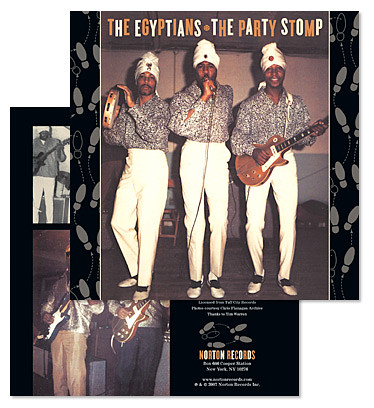
This is the cover of Norton's 2009 catalog. Unfortunately I can't find a better reproduction. Note that it features turbaned artists like Rudy Moore, Sam the Sham, Hannibal, Screamin' Jay Hawkins and The Egyptians, and that it advertises "Turban Contemporary Music."

Still more. Two LP covers from be-turbaned Hammond B3 ace Lonnie Smith: Afrodesia (1975) and Funk Reaction (1977).


Finally, another from King Khan, who is truly keeping "turban contemporary" alive.

The new album of King Khan and the Shrines, Invisible Girl, is terrific. And turbanated.

Ok, one more. This is the last, and from a different turban context and aesthetic. Kate Moss, May 2009.

Wednesday, December 30, 2009

More attacks on hipster kufiyas

Maybe 'attacks' isn't the right word. Maybe 'snide satire.' However you want to characterize it, hipsters continue to be the object of ridicule and fun-poking. No one ever seems to get tired of it. I guess 'they' are an easy target, because, apparently, no one ever seems to want to claim to actually be a hipster. And the kufiya continues to be one of the stereotypical signs of the supposedly absurd, poseur hipster. A quintessential sign of "fakery," which for the critics, is what hipsterism is all about.

Here are a couple recent examples. Note--although the point is dead obvious--that the targets in both cases are women.

Thanks to Katie for this one. This is Ms. 2005, the fauxhemian, from Paste Magazine's feature on "The Evolution of the Hipster, 2000-09," in its November '09 issue. This is one of those "decade retrospectives" that we've seen and heard everywhere over the past few weeks. The caption reads:

2005: The Fauxhemian

She suffers for fashion, wearing a furry hat, boots and keffiyah even during the warmest months. Her new wrist tattoo is the Japanese symbol for beauty—or at least that’s what the guy at the tat shop told her.


Th next one, the "Apple Store Indie," is from yourscenesucks.com, authored by Rob Dobi, and it is rather more finger-pointing and mean-spirited in its take on the "scenesters," i.e., hipsters. The "Apple Store Indie" is a recent addition to yourscenesucks' rogue gallery of "ridiculous" hipsters..

The description of this scenester is also rather more elaborate. Notice, once again, the use of the term, fauxhemian. All emphases are mine.

Looking something like a mix of Pocahontas and a tornado at a thrift store, the Apple Store Indie is your typical #fauxhemian. Masking her love for Steve Jobs products with whatever your blind grandma wore 40 years ago, she blends in seamlessly with the rest of her contemporaries at All Points West Festival.

Tweeting endlessly about nothing other than questions to a fake Ezra Koenig account, her main source of news is whatever happens to be a trending topic on twitter. Her iphone isn’t just a means to tell people what type of sandwich she is eating, she also uses it to cover Passion Pit’s “Sleepyhead” using only app store instruments with her hipster friends.

Getting musical recommendations from last.fm or whatever Jenny Eliscu and Jake Fogelnest play on satellite radio, her entire “scene” seems to only exist in digital format. The only physical music she owns are vinyl hand me downs that serve as decorative filler for her Ikea Billy bookshelf. She rarely if ever supports her local indie music scene unless it is someone spinning records (see: itunes playlist) at a scenester bar.

Unable to make sales of her diy junk through her etsy store, she has set up shop at a number of craft fairs across the tri state area. Unfortunately everyone else was selling the same trite octopus necklaces, owl earrings and onesies she slapped together. Upset with the lack of enthusiasm towards her creations, she will later blog about it to an audience of spambots.

Wow, not really funny, eh? I learned about this in a recent issue of Spin. For the life of me I can't understand why Spin was promoting yourscenesucks.com, but I'm glad they did, for the sake of my kufiyaspotting.

Monday, December 28, 2009

Tarbushes and kufiyas (but no Arabs) in "Kazablan"

Someone who follows this blog wrote to me awhile back and said to look for kufiyas in the Israeli film Kazablan (sometimes spelled, Casablan). Thanks! (I can't find your email...so no personalized message.) Kazablan (1974, dir. Menahem Golan) is an example of a "bourekas" film, a genre that was dominant in the Israeli film industry from 1967-1977. The bourekas feature Mizrahi Jews, Jews of "Eastern," primarily Arab background, who in an earlier era, were usually called Sephardim. Today "Mizrahim" is favored.
The classic study of bourekas is Chapter 3 of Ella Shohat's highly respected and invaluable Israeli Cinema: East West and the Politics of Representation (University of Texas, 1989). Shohat shows how these films, while they represented a massive new presence of Mizrahim on the screen, nonetheless continued a tradition of stereotyping "Eastern" Jews. Bourekas tend to present the Mizrahim in folkloric and colorful fashion, and hence, as ultimately different from and ultimately inferior to Ashkenazim, European Jews. Most bourekas are (like Kazablan) directed by Ashkenazi Jews, thereby continuing the long-standing practice in Israel whereby Mizrahim and Arabs are denied self-representation: they must be represented. The typical plot of the bourekas is one in which unity of the (Israeli) Jewish community is achieved, and affirmed, between Ashkenazi and Mizrahi Jews, usually by means of a "mixed" marriage. Some of the problems and grievances of the (mostly poor and working-class) Mizrahim are staged, usually in quite muted form, but these are always "overcome" by an ending that brings everyone together. It is significant that the era of the bourekas' popularity coincided with heightened Mizrahi political militancy, exemplified in particular by the emergence of the Israeli Black Panthers
 
Kazablan, then, is a typical bourekas product. What I want to focus on here is how, by paying attention to how of signs of "Arabness" surface in Kazablan, we can see how these are on the one hand, used to contribute to the "exotic" nature of the Mizrahim, and on the other, how their actual Arab character is systematically effaced.
 
Kazablan is the nickname of the protagonist of the film (played by Yehoram Gaon). The name, of course, comes from Casablanca, where the character was born. Kazablan, and his "gang," are clearly marked as Jews of Arab origin. This is accomplished several ways. Among these are the fact that some characters put on a tarbush (fez) to sell goods in the exotic market where they live, in a declining neighborhood of Tel Aviv (that happens to be formerly-Palestinian Arab Jaffa, most of whose population was expelled/fled in 1948). Due to its colorful nature, and its cheap prices, the open-air market is patronized by more well-to-do Ashkenazim from surrounding neighborhoods. Here a Mizrahi character tries to sell a very "ethnic" clay pot to an Ashkenazi shopper, who is clearly marked, and distinguished from the Mizrahi peddler, by his distinctive, kibbutnik, headgear. 
 
 
Here the Mizrahi characters are ethnically marked by the fact that they are smoking a nargila or sheesha ("hubbly-bubbly"), a traditional Middle Eastern smoking contraption. They are marked too by their stereotypical position of repose (signifying Oriental "laziness").


In this scene, the Mizrahi character, at left, smoking nargila, is exchanging insults with Yanush, the Ashkenazi character at right, the owner of a shoe store, who is presented in an entirely unsympathetic light. (The latter is Kazablan's rival in the quest for the hand of the Ashkenazi girl Rachel.)


The exoticness of the Mizrahim of Kazablan is also established by the neighborhood in which they live--one which is crumbling, and threatened with demolition by the municipality. It is in fact a "mixed" neighborhood of Ashkenazim and Mizrahim--not in fact very sociologically accurate--but it is the Mizrahim who seem to define its character, who seem to "belong" in a way that poorer Jews from Eastern Europe appear not to. Of course the neighborhood is old Jaffa, the historic Arab-Palestinian city just to the south of Tel Aviv, denuded of most (but not all) of its Arab inhabitants in 1948. Nowhere in the film, I'm pretty sure, is the name Jaffa (Yaffa, in Arabic), mentioned. Here's a shot of the open-air market, from above. Note the rubble (Mizrahim are of the slums), note the primitive atmosphere lent by the horse drawn carriages, near the beach, and at the bottom, at the left and the right. Note that the stone structures clearly signify "Eastern." They are typical of Arab structures throughout in cities throughout the Mediterranean from the first half of the twentieth century. As a resident of Beirut from 1964-1976, they are entirely familiar to me. 


Here's another view. The impressive structure on the right, with its red-tiled roof, is entirely typical of Arab cities like Jaffa, Haifa, Beirut... 

At the same time, while the architecture suggests Arabness, in the film, it is not allowed to say it. One of the most fascinating ways in which the Arabness of the Mizrahi characters is erased in the film is through the music. The film is a musical, full of staged scenes that appear (to me) rather silly and ridiculous. But what is particularly remarkable is the fact that the music is the typical popular Israeli music of the era, rooted in Eastern-European styles, with only a hint or two of Easternness. It reflects hegemonic ideas about the nature of national music, but it has almost nothing to do with the reality of what Mizrahim were into at the time. Their music was rooted in the East, in the Arab world, and the broader Mediterranean. This was a dynamic time for the development of what is variously known as Israeli Mediterranean Music or Mizrahi Music. In the film, however, the Arab musical traditions that were popular in real Mizrahi neighborhoods is nowhere present. The only time it is suggested is in the nightclub that Kazablan and his pals frequent, where Greek music (acceptable because it's "Eastern" and exotic without being Arab) is performed. I know virtually no Hebrew, but it also struck me that the Hebrew spoken by the Mizrahi characters was sprinkled with less Arabic than I would have expected. The Arabness of Jaffa, and of Israel more generally, nonetheless haunts the movie. For instance, this scene, where Kazablan and his pals are prancing around, singing a song. In the background is Jaffa, where a minaret and church steeple are visible, signs of a former presence of a now mostly vanished Arab community, that add to the picturesque atmosphere of the scene. (Kazablan is in the center, dressed in denim, with the fisherman's cap.) 


Now we come to the kufiya scenes. The first occurs in the course of one of Kazablan's most well-known songs, "Kulanu Yahudim" (We Are All Jews), which sums up the ideological point of this, and all other bourekas films: despite the differences between Jews of European and Eastern background, all are ultimately united as Jews, and as Israelis, in a common purpose, in the Jewish state. (You can watch the scene here. The quality is poor, but you will get the idea. And also a flavor of the music that characterizes the film.) What is amusing is that if you watch closely, a male figure in a kufiya (and 'iqal, the headband) appears at one point, dancing with a blonde, presumably Ashkenazi, Jewish woman. (Bottom right.) What are we to make of this? It would appear to signify that even Arabs in the Jewish state are "all Jews." Or is this some kind of joke on the part of the director. Whatever the case, the Palestinian Arab, citizen of Israel, certainly haunts the scene. 


A kufiya shows up at one other point. Rachel, the love interest of Kazablan and Yanush, is walking through the neighborhood market. If I'm not mistaken, pondering who to choose. For just a moment, just behind Rachel, we spot another person wearing a kufiya--this time, black-and-white. He is probably present so as to mark the neighborhood, once again, as exotic and colorful. But he is not offered any opportunity to assert his Arabness. Nonetheless, he, and his kufiya, is a mark of the specter that cannot, will not, be eliminated. 

Sunday, December 27, 2009

Footnotes on Rihanna

Courtesy of what I've learned from friends, some more commentary on Rihanna and her notorious "Hard" video.

First, and I found this rather astounding, among Rihanna's 13 tattoos (I think that the count is correct) is one written in Arabic script! It reads, as far as I can tell, al-hurriya fî masîh (الحرية في مسيح) or maybe al-hurriya fî al-masîh (the latter would be more correct), that is, "freedom in Christ" or more literally, "freedom in the messiah." Christ/masîh appears right under her left breast, so it's not seen all that often. These are the two shots I could find.


This looks like it says al-hurriya fi masîh.


This one, curiously, makes it look as though the original had been altered slightly, so that the article al- had been added. It doesn't show masîh (Christ), just al-hurriya fi-al.... Those of you who know Arabic will note that there should be no link between the fi and the al. So it's corrected incorrectly.

The statement of course is not one that you would probably want display when prancing around in your porno-military outfits on your invasion of Iraq/Afghanistan. It would make you appear as if your campaign for freedom/democracy was in fact a Crusade. But in fact, my friend Robin said that she thought she spotted an Arabic tattoo, in the late sequence where Rihanna carries the banner. (Here's the shot from my original post.) Given, Robin says, that the banner is black, might it be Shi'ite/Abbasid?!!

Keen eyes, Robin! Here's another shot, with the banner.


The friend who brought Rihanna's Arabic tattoo to my attention said that he had thought it might mean that Rihanna was not imperialistic in her views, in contrast with the very patriotic, and Walmart-friendly, Beyoncé. Turns out not to be so.

(Did Rihanna get the idea of an Arabic tattoo from Angelina Jolie, whose right arm is adorned with a tattoo that reads العزيمة, "al-'azeema" or determination?)

Second, Robin comments on the Arabic that appears on the wall of the house. 'The arabic graffiti on the wall reads: "li-llah [can't see] ilayhi raji'un," which is for some reason broken out from the expression "*inna* li-llah wa-inna ilayhi raji'un," "we belong to god & to him we return," from Surat al-Baqarah, verse 156 [the Qur'an], what you say when you hear that somebody has died. it's interesting in the context of the song; hard to believe that anybody involved in the production had thought it through that much, though maybe somebody had.'

Thanks to Robin and her keen eyes and superior (to my own) Qur'anic knowledge.

ADDENDUM, Jan. 7, 2010. Iraqiguy put up this comment on the original Rihanna post:

...the expression "انا لله و اتا اليه راجعون" meaning "we all belong to Allah and verily to him we shall return"

It's usually written on the walls of houses where people would have just passed away. It's arabic and islamic etiquette for what to say when you hear about a death.

this expression is ofcourse very prevalent in Iraq and Palestine and every arabic country involved in war or civil unrest, where death is a common occurrence.

Thanks! I would only add that, in the context of the vid, it's interesting that the soldier walks by that written on the wall. When the perpetrator of the death being commemorated may, in all likelihood, have been the US military.

Third, Geoff says: "the hat in the card-playing still looks VERY much like a WW2-era German military cap; note the eagle ... maybe Afrika Korps? Disturbing."

I think he's right, especially about the eagle. See here.

Saturday, December 26, 2009

BrAsian post-punk band Alien Culture


Thanks to Nabeel Zuberi, I was led to this post about the post-punk British Asian band Alien Culture. The post is informative, it's very important history, especially if you are interested in the emergence into visibility of BrAsians in Brit pop culture and anti-racist politics. You can also download the only two songs that the band ever recorded, "Asian Youth" and "Culture Crossover." John Peel played them on his show, but the band never "made" it.

I had thought the only visible Asian music in Britain at the time was Monsoon. I am now disabused.

People rather fear being swamped by an alien culture” – Margaret Thatcher 1979

Thursday, December 24, 2009

Rihanna's "Hard" Video: Supporting the Afghan Surge


Over the past year, I've heard my MERIP comrade Moustafa Bayoumi give the same, great, paper twice, at last year's MESA (Middle East Studies Association) conference, and at this year's American Studies Association (ASA) conference. It's entitled, "The Race is On: Muslims and Arabs in the American Imagination," and I hope it's published soon. He argues that, since 9/11, the formerly mostly invisible Arabs and Muslims in the US have become massively visible, and increasingly, racialized. And racialized in a particular way: associated with blackness, and hence, turned into a social problem.

At the same time, Bayoumi argues, "African Americans have emerged in popular culture in recent years as the leaders of an American nation and an American empire." Moreover, he says, " this image often revolves fundamentally around the idea of black friendship with Muslims and Arabs, a friendship not among equals but of a modified projection of American power." To simplify, then, the long and venerable tradition of African-Americans opposing US imperialism is increasingly abandoned in favor of a civil rights position of actively participating in all aspects of US life, including US imperialism. Colin Powell, Condoleezza Rice, Barack Obama: all faces designed, or used, to make our empire acceptable, at home, and abroad. (Of course it's not just "faces." It's active involvement and even policy determination.)

And so we come to Rihanna, whose new "Hard" video I found shocking, even though I was very familiar with Bayoumi's argument. But no doubt it's my residual and very out-of-date expectations that African-American popular culture should somehow be oppositional that makes me outraged at how pro-imperialist Rihanna's vid is. And how it deploys so many signs of "coolness" to push the imperial agenda.

I would like the song a lot if I had not seen the vid. Now I cannot listen without seeing it. Militaristic and battlefield scenes (which are made to look like they are shot in Iraq) serve as a kind of runway for Rihanna, where she can display various outfits and demonstrate her "hard"-ness. "Yeah yeah yeah, I'm so hard," she sings over and over again in the chorus.

Rihanna appears in various outfits and scenarios.

In bright red lipstick, in GI fatigues, as if on the set of a GI-themed porn shoot. Her mouth ready to receive...what?


More is revealed, and we see black tape over her nipples. At least that's what it looks like at first glance, but then we notice it's actually over a low-cut, skin-colored tank top. The tape over nipples stunt was done recently by Lady Gaga and Amy Winehouse. But I think it was Wendy O of the Plasmatics who was most famous for this look.


Rihanna is also shown as if she were the commander, inspecting her unit of (all-male) troops who are in formation. Here she looks like classic Grace Jones.


Later we see Cmdr Rihanna before "her" troops, shouldering a heavy weapon. If you watch the vid (and you must) you'll notice that this outfit includes a bikini bottom showing off a very shapely booty.


Here, she looks something like Nona Hendryx in '83-'84, when she was all about that sci-funk look. I saw Nona in concert back then but can't find a good photo of what she looked like. The outfits looked aluminum. This is more or less it.


Garbed in her sci-fi gear, "hard" Rihanna strolls through the desert, unconcerned by the explosions going off around her.


We also see Rihanna with bandoliers over either shoulder. And without them, but in the same outfit, atop a pink tank. Between her legs. Really hard, a for-sure phallic female here. I guess the pink tank makes it feminine. And the Mickey Mouse ears on her helmet--is that supposed to be funny? If so, it's about the only element of humor in the vid.


And there is the Madonna-esque outfit--the bronze bikini top. In which Rihanna is variously displayed strutting atop a sandbagged position with some GIs.

Or lying supine.

There are other outfits whose referents are less clear to me. Rihanna plays poker with the guys in this one. And she wins. Because she's hard. "And my runway looks so clear," she sings. "But the hottest bitch in heels right here."

Here, she's wearing a camouflage/net thing. And her weapon.

This outfit, which appears towards the end of the vid, also escapes me. A leopard-skin Prussian looking helmet? And the black banner she is waving?

Young Jeezy appears in the video with a guest rap. He's in GI gear, smoking a cigar, but he is much more relaxed in his poses. He's already hard, just puffing on the blunt.


In case it wasn't clear, the video also clues you into the fact that this is the Middle East, and probably Iraq, that we're in. The Arabic script is sort of passable. This last word here reads raj'iun, or 'returning.' An important slogan for the Palestinians.


As I read this vid, it all adds up to an articulation of support for the upcoming Afghanistan surge. The militaristic poses make Rihanna look hard. Alternatively, they help make her look freaky and kinky. At the same time, she, by her very presence on the battlefield, makes the US military invasion of Iraq/Afghanistan look sexy. And bloodless. There are no 'bad guys.' There are no civilians in the desert. No one gets injured. It's all fabulous.

The US military and African-American r'n'b and fashion and sex are all in synchrony here.

I cannot imagine Grace Jones ever performing in such a blatant display of support for US imperial adventure. In the run-up to the Iraq invasion, African-American musicians like Nas, Outkast, Mobb Deep, Jay-Z, Busta Rhymes, George Clinton, Raphael Saadiq, Missy Elliott and others came out to express their opposition, as part of Musicians United to Win Without War. (They signed an ad that appeared in the New York Times on Feb. 26, 2003, among other things.)

Where is the "cultural" opposition to the Afghan surge?