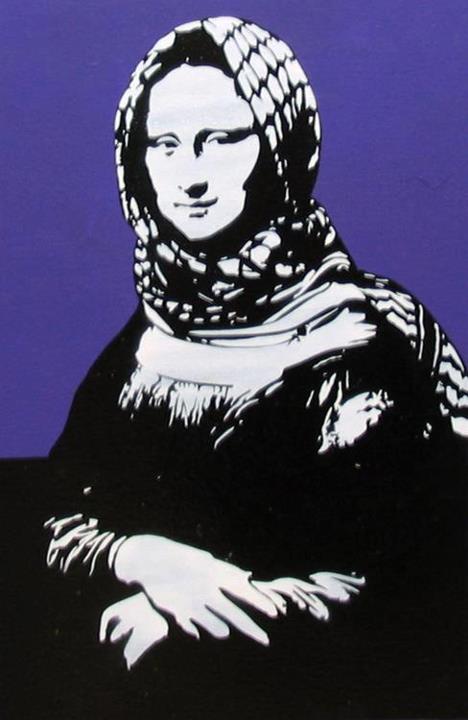
Friday, January 04, 2013

Kathryn Bigelow in kufiya, again (Zero Dark Thirty)

I was just watching a report on MSNBC about how a Senate committee is about to investigate whether the CIA gave "inappropriate" material to Kathryn Bigelow and Mark Boal, the director and producer, respectively, of Zero Dark Thirty. There is of course a raging discussion about how torture of US detainees is portrayed in the film. And given that the film has not seen nationwide release, I've of course not seen it.

What interested me about the MSNBC report was that while the talking heads were doing their thing, in the background footage was rolling, which showed Kathryn Bigelow at work, and she was always or almost always wearing a kufiya around her neck.

Bigelow, right, on the set of Zero Dark Thirty (Jonathan Olley, Columbia Pictures)

Readers of this blog will remember that Bigelow also used to wear a kufiya while on the set of her previous film, The Hurt Locker. Look here. And here.

I really loved The Hurt Locker. Something tells me I many not feel the same way about Zero Dark Thirty.

dangerous turbans: Iqbal Singh


Iqbal Singh does Elvis. "A Beautiful Baby of Broadway," from the 1960 Hindi film, Ek Phool Char Kaante.


revolutionary headgear: liberty caps and kufiyas

"Among the Romans the cap of felt was the emblem of liberty. When a slave obtained his freedom he had his head shaved, and wore instead of his hair an undyed pileus. Servos ad pileum vocare is a summons to liberty. In late Republican Rome, the cap of freedmen served as a symbol of freedom from tyranny.

The Liberty Cap as an emblem of liberty was used by the Sons of Liberty as early as 1765. During the American Revolution, particularly in the early years, many of the soldiers who fought for the Patriot cause wore knitted stocking liberty caps of red, sometimes with the motto "Liberty" or "Liberty or Death" knitted into the band."

via the blog, Liberty Hat.

From my book, Memories of Revolt, regarding the campaign of the revolutionaries of the 1936-39 rebellion to impose the kufiya on urban Palestinians.

"The Igal [that is, kûfiya] of the Arab today is surely a liberty cap but conceived in an original and native fashion. By making Supreme Court judges, big Government officials, important merchants and the entire professional class and in fact every body, wear an igal the rebels have made a grand sweep in the direction of democracy. The fellahin do not concel their delight at seeing their "uppers," the effendis, come down a peg and look like them in the matter of head dress. They feel proud of having raised themselves on the social scale." (Khalil Totah, director of the American Friends School, Ramallah, writing in 1938).

Thursday, January 03, 2013

fashion politics, 2002

From an article by Duncan Campbell in The Guardian way back in September 2002.

Kenneth Cole, the New York clothing, footware and accessory company, has launched a major advertising campaign based on statements on key political issues. In the most controversial advert, carried in leading US newspapers this week, a young man carries a newspaper headlined 'Holy War' under his arm while wearing the company's pinstriped suit, brown shirt and blue tie. The slogan reads: "Mideast peace is the must-have for fall." 

Another advert shows a model in jeans, sweater and scarf with two small boys playing with toy guns behind her. "Gun safety... it's all the rage," it reads.

"There seem to be a number of companies doing this now," said James MacKinnon, senior editor of Adbusters, the Vancouver magazine which describes itself as "the journal of the mental environment" and specialises in deconstructing advertisements and media messages. 

"They usually use very softball, very mild social messages," said MacKinnon. "Kenneth Cole clearly recognises that people want to feel as though they are buying into some social value as they buy belts and shoes. Who doesn't want Middle East peace? Putting something like 'Ending the occupation in Palestine is the must-have for fall' would be actually saying something." 

MacKinnon said that the trend of using social messages to sell fashion was started by Benetton, which ran an a series based on the idea of a multi-racial "united colours of Benetton". One advert featured a dying Aids patient. 

"This is just an empty stunt to stir up an empty controversy to sell an empty brand," said MacKinnon. 

A more thoroughgoing analysis can be found in "Gendered Security/National Security: Political Branding and Population Racism by Patricia Ticineto Clough and Craig Willse, writing in Social Text, available here.

Borrowing from the advertorial genre, the Kenneth Cole photos and text make the theme of security a matter of fashion, just a year after the attacks on the World Trade Center, and a few months before the invasion of Iraq in March 2003. Through the gendered codes of fashion, the photos and text link national security to personal security, proposing that the for-mer is essential to the latter, and that the latter might be gendered in sucha way as to concern women in particular and — in the visual treatment of the white woman and black woman as equivalent and interchangeable — all women in the same way. 

Alas, I cannot find the images referred to, but here's a more recent KC "gun control" ad, from 2011.


Wednesday, January 02, 2013

Sunny Ali and the Kid - MUSLIM RAGE #drones

they're runnin but there's
drones up ahead
drones in your bed
drones in your home
drone give me head
drone give me dome
preacher preacher
leave them kids alone


More on Sunny Ali and the Kid here.

Monday, December 31, 2012

Mandela in kufiya: Algeria 1990

Nelson Mandela and his comrade Robert Resha received training from the Algerian FLN in Morocco in 1962. Shortly thereafter he returned to South Africa and was captured, tried, convicted of sabotage, and imprisoned until February 1990. In May 1990 he visited Algiers to meet his former FLN comrades. (Resha died in exile in London in 1973.)


Saturday, December 29, 2012

Marilyn Monroe & James Dean in kufiya


It makes sense that this t-shirt, of Marilyn in a kufiya, would be from a clothing line produced by Iranian designers living in New York City. Check out Nimany's other stuff, it's fantastic. Most of it with terrific calligraphy. (The back of this shirt says Marilyn, written in Arabic script.)

And now that we have learned that Marilyn was a Commie symp, this is all the more appropriate. Even if she was sympathetic to Zionism.


I've seen nothing to suggest that James Dean had any "Communist" sympathies, but it nonetheless makes some sort of sense that an icon of disaffected youth would be posthumously kufiya-clad.

Wednesday, December 19, 2012

DJ Islam Chipsy live (mahragan)

Great short vid of mahragan (AKA 'techno shaabi' or 'electro shaabi') artist DJ Islam Chipsy working his keyboard magic, in a popular quarter in Cairo.


This is a great one too.

Tuesday, December 18, 2012

Time's Joe Klein on why we kill 'their' 4 year olds with drones

Joe Klein really said this. On MSNBC's Morning Joe on October 23. From a recent piece by Vijay Prashad:

'On Oct. 23, Time’s Joe Klein was on MSNBC’s Morning Joe. Host Joe Scarborough spoke passionately against the use of drones, saying “it seems so antiseptic and yet you have 4-year-old girls being blown to bits because we have a policy that now says, ‘You know what? Instead of trying to go in and take the risk and get the terrorists out of hiding in a Karachi suburb, we’re just going to blow up everyone around them.’”

Klein, a defender of the Obama record, answered emotionlessly, “The bottom line in the end is — whose 4-year-old gets killed? What we’re doing is limiting the possibility that 4-year-olds here will get killed by indiscriminate acts of terror.” (emphasis added)'

Meanwhile, 178 children have died in US drone strikes on the Pakistan-Afghanistan borderlands.

Friday, December 14, 2012

Rihana Arabic Tat Reprise: "Numb"

"Numb" is a fantastic song. Let's just get that out there at the outset.


The video is great too. It's also an occasion to for Rihanna to show off all her tattoos as well as lots of flesh.


At 1:43 you can spot her tat which reads (though you can't in fact read it) in Arabic (roughly translated) "Freedom in Christ/the Messiah." Viewers might not have noticed because they were looking at something else. Or maybe at her new Isis tattoo. (For a better view of the Egyptian goddess Isis tat and the Arabic one, go here.) Another view of the Isis tat is: here.

I've blogged about these Arabic tats before. And about Rihanna's pro-imperialist vid, "Hard," too.

I just thought you Rihanna heads should know about this latest sighting. Don't forget to listen to the song. (I want to know who is rapping early on. Before Eminem kicks in.)

Saturday, December 08, 2012

Apache (Apaçi) Kurdish Turkish dance. Or is it?

Young Turkish Kurds (reportedly from Ağrı, near the border with Iran) doing 'Apache (apaçi) dancing' (a Turkish subcultural dance style) to a song by the Mehmet Ali Arslan Grup. Well, I assume they are Kurds. (Turks and Azeris also live in Ağrı.)


A comment on a blog that discusses "Apache dancing" tries to explain:

Actually "apaçi" is a trending word in Turkish slang. It is used when describing uneducated and wannabe young people that has immigrant parents and live in suburbs of big cities like Istanbul, Ankara or Izmir. These young people can never completely integrate themselves to the city life because of their origins and that's why they have a "mutant" style, a bit from city life and a bit from their conservative family life.

"Apaçi dance" term came up from a dance style that is performed by these apaçi people when they're in a clubs :)


It's seems then that apaçi is a pejorative term used to describe young Kurds in Turkey. A term of denigration that, perhaps, young Kurds have embraced and attempted to detourn?

A friend who is in Alanya, Turkey, which is far from Turkey's eastern border but has lots of workers from the east, says "the young men with those kinds of hairstyles (standing up in the middle, lots of gel, long on the sides and back, etc) call their style 'apache'."

Meanwhile, as far as I can determine, Mehmet Ali Arslan is from Northeastern Turkey (near Ardahan) and the music may have Georgian, Azeri and Iraqi (Kurdish) influences. (I used Google translate to try to make sense of this.)  

Interestingly, the dance performed above is very similar to the dance performed in the video below. This is from Iranian Kurdistan. Fatima Al Qadiri has written about it here. Not very informatively, as she doesn't even mention that the singer, Mehdi Alizadeh, is from Iran. He is really great, no? 


So maybe (as Sherifa has noted in a bit of conversation about this on FB), there isn't any specific "Apache" dance tradition, so much as it is a matter of apaçi-s who are doing it.

Here's another Mehdi Alizadeh vid.


Who knows, maybe this is more like what Apaçi dance is supposed to be:


Saturday, December 01, 2012

hip-hop homophobia

In a move that shocked many, Kanye collaborator Frank Ocean came out publicly this year, but it’s been the loud and proud shamelessness of the openly gay underground rappers that’s shaken up the dialogue the most—artists such as Le1f, Mykki Blanco, and Nicky Da B have had the Internet going nuts. The walls protecting hip-hop’s historical homophobia and perplexingly arbitrary code of masculinity are finally getting wavvy.

@ LIL INTERNET writing on the best music of 2012 in Artforum. It's well worth reading both his take as well as Jason Moran's. Here.

More on Le1f here. And this:


Mykki Blanco here. Plus:


Nicky Da B talks. Sissy bounce!


Sunday, November 25, 2012

drones of war: kill a man with a dronestick in your hand

John Caramanica reviewed Fatima Al Qadiri's new release Desert Strike today in the New York Times. Given the subject matter and its stylistic connections to grime, I of course immediately purchased it. I'm not entirely convinced that it does all that Caramanica claims it does. It's good but I don't find it so "morose, ominous, moving" as JC. I don't hear "Ghost Raid" quite as "nihilistic" as he does. The "hints of grime" on "Hydra" are too weak for me. It's true that "Oil Well" is "littered with the sounds of weapons being cocked and emptied" but given that the EP is meant, according to JC, to be "a conversation piece about war," I want it to be "grimier." I want it to convey much more of the horror and the blood and guts. Especially after Gaza.

Louis Pattison also reviewed Al Qadiri's EP for The Guardian last Friday. There we learn that Al Qadiri was raised in Kuwait, that she used to play a Megadrive game called "Desert Strike: Return To The Gulf" when she was 10, in 1992, just two year after the Iraqi invasion. She now lives in Brooklyn. (Of course!).

I think Pattison overplays the "horrors" evoked by Al Qadiri's music as much as Caramanica does. But Pattison did alert me to a much more interesting piece of music that reflects much more vividly on the interconnections between war, video games, and drones: Montreal producer d'Eon's "Kill a Man with a Dronestick in Your Hand."

I find the video and the song to be quite riveting. It's electronic, it opens with some great, electronically altered oud playing (perhaps played by d'Eon), then shifts to a slow dance beat. The sing-songy lyrics are a bit hard for me to catch because the voice is slightly modified through electronics. But it's a very simple and clever rhyme scheme where all the lines rhyme with Man and Hand. Thus: Taliban, Pakistan, etc. Two lines I can catch are "Kill a man far away in Pakistan" and "There's no blood on your hand."

The video mixes images of what appears to be the men and women who sit in rooms in the US and guide the drones to their targets; video footage of "real" drone strikes from above and on-the-ground; video games that simulate drone war; a woman in a very short skirt dancing; scenes of the Taliban flogging a prisoner, and so on. Sometimes it's not clear whether you're watching video games or "real" war scenes.

You can watch the vid below. You can buy the song (well worth it) from iTunes and, no doubt, other venues. d'Eon records on the Hippos in Tanks label. "Kill a Man with a Dronestick in Your Hand is from his album Palinopsia. (In 2011 d'Eon recorded a split 12" with the fabulous Grimes, called Darkbloom. For the record, Grimes has been kufiyaspotted.)

d'Eon "Kill a Man With a Joystick In Your Hand" from OLDE ENGLISH SPELLING BEE on Vimeo.

Saturday, November 24, 2012

Gaza, the numbers (Gideon Levy)

Writing in Ha'aretz:

Since the first Qassam rocket fell on Israel in April 2001, 59 Israelis have been killed - and 4,717 Palestinians...

between the start of the year and the outbreak of Operation Pillar of Defense, only one Israeli was killed by rocket and mortar-shell fire from Gaza (the figure should have been three, according to Haaretz's data ). During that same period, Israel killed no fewer than 78 Palestinians in Gaza. That was during a period of calm that, according to Israel, was broken only by the Palestinians. 

To these figures must be added the data from Pillar of Defense: 156 Palestinians killed, and six Israelis. The Economist reminds us that 19 of those killed were children...

During this period, Palestinians fired 7,361 rockets at Israel. It's hard to find data on how many missiles, shells and bombs Israel launched, but the numbers would be immeasurably higher...

In 2001, the year the Qassam was born, four rockets were fired from Gaza, killing one Israeli. And how many Palestinians were killed that year? One-hundred and seventy-nine. In 2002, 34 rockets were fired, from which not a single Israeli died, yet 373 Palestinians were killed. In the two years after that, the picture is even more stark: In 2003, there were 155 rockets; 370 Palestinians were killed, and not a single Israeli. In 2004, there were 281 rockets; 625 Palestinians were killed, and seven Israelis...

what does Israeli propaganda try to do? To paint the south as the sole and only victim...

the primary victim, the one who is bleeding most, is Gaza; Israel is only in second place. It's impossible to ignore this. In Gaza, the death toll is enormous. 


"all that is left for the inhabitants of Gaza is the thin surface of the earth that is sandwiched between Israeli-controlled zones"

Israeli architect Eyal Weizman on Gaza, writing online for the London Review of Books.

'knock on the roof' or, ‘teaser’ bombs/missiles 

fired "onto houses designated for destruction, with the intention of making an impact serious enough to scare the inhabitants into fleeing their homes before they are destroyed completely...Teaser bombs are just another means of sending a warning."

warning civilians

"if a warning has been issued, and not heeded, the victim is no longer a ‘non-combatant’ but a voluntary ‘human shield’."

perpetual "surveillance and strike" capacity

"Israel’s real power over Gaza is invisible. It is the ability of the Israeli air force to maintain a perpetual ‘surveillance and strike’ capability over Gaza – drones can stay in the air around the clock – that made the territorial withdrawal possible. Together with its control of the Gazan subsoil – manifested in the robbing of much of the water from coastal aquifers – and over the airwaves, including the use of electromagnetic jamming technology, all that is left for the inhabitants of Gaza is the thin surface of the earth that is sandwiched between Israeli-controlled zones. No wonder they try to invade the space below and above them with tunnels and rockets."

Sara Roy on Gaza

 Ayman Mohyeldin

In The Boston Globe, Nov. 23, 2012.

Gaza’s economic decline is seen in the near collapse of its agricultural sector. One factor is the destruction of around 7,800 acres of agricultural land during Cast Lead. Consequently, approximately one-third of Gaza’s total arable land is out of production. Furthermore, Israeli-imposed buffer zones — areas of restricted access — now absorb nearly 14 percent of Gaza’s total land and at least 48 percent of total arable land...

Another critical constraint is water. Gaza’s aquifer has been ruined by prolonged over-pumping and sewage and contaminant infiltration...

Israel’s blockade policy restricts the entry of materials needed to repair, maintain, and upgrade Gaza’s sewage and wastewater treatment infrastructure. Save the Children reported in 2011 that Israeli airstrikes destroyed water and sanitation infrastructure valued at $1.3 million.

The impact on health is clear: Just under 10 percent of Gazan children under five suffered from chronic malnutrition in 2010. According to Save the Children, “Diseases of poverty and conflict combined with a degenerating health care system are claiming growing numbers of Gaza’s children.”

Birth defects, congenital anomalies, and cancer cases are reportedly rising. This is likely due to environmental contamination, including the possible use of toxic weaponry during Cast Lead. The current military assault will undoubtedly worsen environmental conditions.

Thursday, November 22, 2012

Kufiyaspotting: Jill Dougherty, CNN (Gaza coverage)


Thanks to Youssef for taking this photo and sharing it with me (here's the source). This is from yesterday's CNN coverage of the Gaza ceasefire (November 21). Jill Dougherty, CNN's Foreign Affairs correspondent, showed up to discuss the Gaza agreement with Wolf Blitzer wearing a pink kufiya scarf. Did she do it on purpose? Is this, as Youssef observes, why Wolf looks bummed? Given that Wolf studied at Hebrew University, speaks Hebrew, worked for AIPAC, and covered Washington, DC for the Jerusalem Post from 1973-1990, he (unlike some US correspondents), definitely knows what a kufiya is and what it might mean.

Thursday, November 08, 2012

Mutamassik "Coptic Guts" متمسك

It takes GTS to be a QPT in GYPT (here's only one reason why)

new one from mutamassik's Rekkez album. Chant sampled from Xmas makeshift Coptic church, California, in abandoned office space.

Saturday, November 03, 2012

poetry of US war on terror 2.0


“light footprint”
combo clandestine Special Operations raids
drone strikes
continuous surveillance
cyberwarfare
locally trained proxy forces hunt capture kill manage perceived threats to American interests
on global scale

see Steve Niva," The “Matrix” Comes to Libya," the Merip blog, November 2.

Sunday, October 28, 2012

Abdou el-Omari: Moroccan psych shaabi organ player


 One of the cool things that happened when I had coffee and crepes with Majid Bekkas and Brahim Fribgane a couple weeks ago was that I learned about some Moroccan artists who I'd never heard of before. One of them was Abdou el-Omari, who they told me was the first Moroccan organ player. Today, finally, I had a few minutes to hunt down some information about him.

From various sources, I learned that he was born in Tafraout, Morocco in 1945, and passed away on March 3, 2010 in Casablanca. Bladi.net informs us: "Abdou El Omari compte à son actif plusieurs œuvres musicales notamment "Zifaf Al Fadae", ainsi que des chansons qu’il a composées pour les chanteuses Naima Samih "Dani Rih" et "Khallani Ghriba", Fatima Mekdadi, Laila Ghofrane et Aicha El Waad."

I found three of his songs posted on youtube: "Raajat Layoun," "Fatine," and "Afrah el-Maghreb." They were all, it seems, recorded in 1976, and they are all quite trippy. I especially like "Afrah el-Maghreb," with its qaraqeb-propelled percussion. It is from his album, Nuits d'Été. You can download "Raajat Layoun" from the invaluable Radiodiffusion Internationaal Annexe here. The blog Arab Tunes has all three of the songs mentioned available for downloading.

I wish I could learn more, but at least I've now got those three great songs!

Saturday, October 27, 2012

"The Italians of Egypt": trailer

Trailer for an 80 minute documentary by Sherif Faty Salem, produced in 2011 for SPOT1.tv and Al Jazeera. One man interviewed in the trailer asserts that Italians lived mostly in Egyptian and not foreign districts. We learn that Italians had a major influence on the architecture of Alexandria (where most of them lived), and that Mario Rossi, the chief architect of the awqaf commission, built most of the city's mosques. One interviewee claims that there was equality between Egyptians and Italians (a rosy view, bathed in nostalgia).

Italians, like other foreign residents in Egypt, who played a major role in the economic development of Egypt from the reign of Muhammed Ali in the early nineteenth century, mostly left Egypt in the 50s and 60s, especially after Gamal Abdel Nasser's moves to nationalize the economy in 1962. The film interviews some of those who remained. The Italians, however, were distinct from other foreign communities in Egypt in that their community took a big hit during the Second World War, when the British colonial overlords rounded them up and interned them.

Among the famous Italian-Egyptians are the poets Filippo Marinetti and Giuseppe Ungaretti.

I look forward to finding this film and watching it in full.

More on Paco (RIP) and Nass El Ghiwane

Please read this great obituary on Paco (Abderrahmane Kirouche), the gnawi from Essaouira, and member (from 1974-1993) of one of Morocco's best and most beloved bands, Nass El Ghiwane. The obit, from The Audiotopia, is full of info about both Paco and Nass El Ghiwane. The piece confirms that Paco had an affiliation with The Living Theater. According to The Audotopia, Paco met up with them in summer 1966 while traveling in England. Maybe the group's encounter with Paco is what brought them to Essaouira, where they spent part of the summer of 1969 (July) in Essaouira. Who knows? I've read about The Living Theater's time in Essaouira in John Tytell's The Living Theatre: Art, Exile, and Outrage (New York: Grove Press, 1995). Tytell tells us that a group of Gnawa slept on the roof of the company’s group house and that they performed a purification ceremony and taught company members how to trance and stick knives into their bodies without drawing blood. Tytell does, however, specifically name Pacca. During their stay in Essaouira, the Living Theater were also visited by psychiatrist R.D. Laing, Stokely Carmichael, Anaïs Nin and Jimi Hendrix. The Audotopia claims that Paco jammed with Hendrix. I met other gnawa in Essaouira when I was there in 1999 who claimed the same thing. Caesar Glebbeek claims that this didn't happen, that Hendrix didn't even bring his guitar with him to Essaouira. Who knows, maybe someone handed him a guitar. The legend lives large in Essaouira.

Paco married a woman named Christine who was affiliated with The Living Theater, according to The Audiotopia, and the post comes with a picture of Christine. But he eventually divorced her. I'd like to track down more info on this.

Check out as well this blog devoted to the poetry of Nass El Ghiwane (in Arabic). Be sure to download the rare Nass El Ghiwane sides that The Audiotopia has posted with the obit. Finally, Tim over at Moroccan Tape Stash has recently posted some more recorded material from Paco. Allah yarhamu.


Majid Bekkas

Majid Bekkas was in Fayetteville (Arkansas) last week, as part of the Caravanserai program. He performed in a number of venues, together with his Gnawa ensemble and the multi-talented Brahim Frigbane ('ud, percussion) -- at Fayetteville and Bentonville High Schools, for several classes at the University of Arkansas, and at the Walton Arts Center. I was out of town for the WAC performance, alas, but I did see him perform at Fayetteville High, and I also got to spend a couple hours hanging out with him and Brahim at Arsaga's cafe on Dickson.

I had seen Bekkas perform with a Moroccan jazz ensemble (a kind of Gnawa-jazz fusion) at the Salé festival in Morocco in summer 1999, and since then I've acquired a number of his recordings. But seeing him perform again here as well as speaking with him made me appreciate even more how serious and multi-talented a musician he is. At the high school, besides performing his Gnawa repertoire (singing and playing guimbri), he also played the kalimba (the African thumb piano), and played it incredibly well. (And I think his vocals might have been in Zulu. Not sure.) No doubt he learned to play on one of his tours of sub-Saharan Africa. Here's a taste, from his performance in Grand Rapids, Minnesota.


He is also a very accomplished 'ud player, as demonstrated below, as he performs the song "Louhid," from his latest album (highly recommended), Makenba.


Another of my faves from Makenba is this song, "Bambrouia," which features Majid on guimbri. On the album the song has a very African feel. Here it sounds somewhat different, as he performs with a sax player and a drummer.


Majid has recorded three albums (Out of the Desert, Kalimba, and Chalaba) with the very talented and respected German jazz pianist and saxophone player Joachim Kühn, with Ramon Lopez on drums. So far I've only heard Out of the Desert, which is very, very fine and one of the best gnawa "fusion" recordings ever done. I asked Majid how he started working with Kühn. He said that Kühn saw him in concert in Europe, came up after the show, introduced himself, and suggested that they try working together.

Here's the trio playing live, performing the song "Sandiye" (recorded by Majid on his African Gnaoua Blues album).


Finally, here's a photo of Majid and his group performing at Fayetteville High School on October 17. He's in the center, on guimbri, and Brahim Fribgane, on 'ud, is at the left.


Here are his qarqaba players and dancers.


Majid at Arsaga's cafe, Fayetteville, October 16.


Wednesday, October 24, 2012

BBC World Service: Arab Jews - A Forgotten Exodus, Episode 2

Inside El Ghriba synagogue, Djerba, Tunisia

First broadcast on October 20, 2012.

Jewish communities that have survived in Arab countries for centuries are under a new threat. In the second part of a two part series Magdi Abdelhadi tells the story of the last few thousand Jews that remain in Arab countries and how they are surviving in “hostile” territory.

Travelling to Tunisia, he visits one of the oldest and most traditional Jewish diasporas in the world, a society that has stared threats in the face for centuries and is now being endangered once again. 

Following the revolution that took place in the country eighteen months ago, an alarming brand of extreme Islamism has emerged. There have been a number of Salafist demonstrations calling for death to the Jews and attacks on synagogues, which have spread fear and concern amongst this 1500 strong Jewish community. 

Magdi looks at how they are coping, whether their existence is under threat and what the future now holds for them as this new Islamist threat increases. 

Listen here

Palestinian dub from: Ministry Of Dub-Key - Dumyeh Plastikieh دميه بلاستيكيه

Dub-key -- get it? (dabkeh, the Palestinian national dance.)

Great vid, featuring (among others) Mahmoud Jrere and Suheil Nafar of the Palestinian rap group DAM, and Mahmoud Shalaby, of the first Palestinian rap group, MWR, from Acre, now defunct. Shalaby is also a very accomplished actor. I recently saw him, as Algerian Jewish singer Salim Halali, in the terrific film Les Hommes Libres (Free Men). The film is based on the true story of how the Great Mosque of Paris sheltered and saved many Jews (mostly of North African background) during the Nazi occupation of France in the Second World War.

Tuesday, October 16, 2012

Abderrahmane Paco, Gnawi, member of Nass El Ghiwane: RIP

The great Paco passed away over the weekend. Trained as a gnawa m'allim in Essaouira, he was a key member of Nass El Ghiwane in its heyday, bringing the sound of the guimbri/hajhouj and Gnawa influences in general into the distinctive ghiwanian mix. Here's a short obit from Libération (Morocco). Here, thanks to Tim, is an example of Paco's work with Nass El Ghiwane.


Here, at Moroccan Tape Stash, you can find, and download for free, a couple Paco cassettes and a rare casette of Nass El Ghiwane featuring both Paco and the late Boujemâa.

Monday, October 15, 2012

BBC World Service - Arab Jews: A Forgotten Exodus

"Magdi Abdelhadi meets Jews from Egypt, Iraq, Libya and Syria, and discovers what life used to be like for them, how they got on with their Muslim neighbours and what prompted the disappearance of these ancient communities." Listen to the entire episode (1 of 2) here. First broadcast on October 13, 2012.

Sunday, October 14, 2012

Yasmine Hamdan's new (May) album on soundcloud

Listen to it here: yasminehamdan.

It was released in France in May, still not out in the US.

"El Gusto": trailer, reviewed by the New York Times, screened in Cairo

 I've been blogging about the film El Gusto ever since I met the director, Safinez Bousbia, in Essaouira in November 2007. The film was released in France, finally, a little less than a year ago. Elaine Sciolino gave the film, and the tour of the El Gusto orchestra, a very nice plug in the New York Times on Friday. The film screened at the 5th Panorama of the European Film festival in Cairo on October 8, and given that the film is about the reunion of Algerian Muslim and Jewish chaabi musicians, I'm quite impressed. Hani Mustafa gave the film a nice review in alahram.online. One thing I learned from Mustafa's review is about the 1995 Tunisian film, Habiba M'sika, a documentary about a Tunisian-Jewish singer of the same name.


I've not yet seen El Gusto myself, and who knows when I'll have the chance to. In the meantime, the album El Gusto is terrific -- but seemingly only available in the US as a download.

And here's the trailer for the film. Let's all cross our fingers that both the Orchestra and the film will be touring extensively in the US, and soon. And let's play for El Gusto's pianist, Maurice El Medioni, who was hospitalized with a stroke in August.


Saturday, October 13, 2012

Notes of Exile - Maurice El Medioni documentary movie

Teaser for a documentary about the great Algerian-Jewish pianist Maurice El Medioni. Medioni is also part of El Gusto. He has a great sense of humor, a great interview subject.

Occuper Tahrir en chantant

Music from the Egyptian revolution. Eskenderella, Ramy Essam, rapper Mohammed el-Deeb. Shaikh Imam and Sayyid Darwish. Ahmad Fouad Negm. Great stuff, courtesy France 24. French subtitles.

Interview with the poet Ahmad Fouad Negm

This is quite wonderful. Negm talks about his poems, his career with Sheikh Imam, and about the January 25 revolution in Egypt. We see a number of contemporary Egyptian artists (including Eskenderella) interpret his and Sheikh Imam's songs. Subtitled in French. From the France 24 web documentary, "Tahrir, je chante ton nom" (http://tahrirmusique.france24.com).

Clips from a French documentary, featuring "mahragan" ('techno shaabi) music

These are great clips, with subtitles in French, featuring DJ Omar Haha, Sadate and Vigo. "Lots of people criticize this music, but it's spreading like a virus."

Don't Panik! Islam and Europe's 'Hip Hop Wars' by Hishaam Aidi

From the always insightful Hishaam Aidi. Yes, it's from back in January, but it's still essential reading.

Don't Panik! Islam and Europe's 'Hip Hop Wars' - Opinion - Al Jazeera English

Tuesday, October 09, 2012

Chicago's Charter Schools Fail the Math Test

From Naked Capitalism, October 8.

I found this bit very telling:

In the 1970, teacher starting pay in New York City was only $2000 below that of starting salaries at top law firms. But now, as the relative status and pay of public school teachers having declined, so too has educational achievement among teachers. A recent McKinsey study found that nearly half of the K-12 teachers in the US had graduated in the bottom third of their college classes. It recommended increasing starting teacher pay from an average of $39,000 to $65,000 in high needs classes in order to attract instructors who had graduated in the top third of their classes.

So why should we be surprised that charter schools, which pay teachers less than public school teachers in the same geographic area, are having trouble delivering the educational goods?

Monday, October 08, 2012

Alexandrians: Eric Hobsbawm (Egyptian Jew by birth)

The Guardian published a great obituary on Hobsbawm, who died on October 1. He was born in Alexandria in 1917, and moved to Vienna with his family in 1919. His father Leopold worked in a shipping office in Alexandria. A fitting birthplace for this noted cosmopolitan leftist.


Wadad: Lebanese-Jewish singer

One of my lovely FB friends (I forget who) turned me on to the Lebanese Jewish singer Wadad (Bahiya Wahbeh) and her terrific song, from 1962, "Tindam" (You'll regret). Listen here.

بتندم
وحياة عيوني بتندم
بدك تقهرني؟ طييب
غبلك شي غيبة وجرّب
ولما بترجع يا حبيّب يا حبيّب شو بدك تندم
يا كويس شو بدك تندم
بتندم

According to Angry Arab Bahiya Wahbeh was originally from Aleppo. Wadad was one of the few Lebanese Jews who remained in Lebanon through the civil war, and she passed away in Beirut in 2009. She was married to the famous Lebanese composer Abdel Jalil Wahbeh, and, again according to Angry Arab, she never converted to Islam, and yet all the obituaries about her never mentioned that she was Jewish. (When the much more famous Egyptian singer and actress Leila Mourad passed away in 1995, the Egyptian papers for the most part did not mention her Jewishness either.)

There is a documentary out about Wadad called "Un instant mon glamour," directed by Shirin Abu Shaqra. It looks gorgeous, at least from this extract. Arabic title: لحظة أيها المجد.


I also found one other Wadad song on youtube besides "Tindam": دور يا حبيبي العين ضياء (Dor Ya Habibi al-'Ayn Dia'). It's a great one too. Music by Tawfiq al-Basha, lyrics Sami Sidawi.

Wish I could find out more about this great singer.

"Jews of Egypt": new documentary film by Amir Ramses

The film was screened at the Galaxy Theater in Manial, Cairo on October 6, as part of the Fifth Panorama of the European Film festival, sponsored by Misr International Films (Youssef Chahine).

Arabic title: عن يهود مصر.

Naira Antoun did a fine review of the film in today's Egypt Independent.

The film website is here.

Here's the English trailer:


Here's an even more substantive review by Joseph Fahim, from Variety Arabia.

Too bad the director didn't interview Joel Beinin, author of the definitive study of Egyptian Jews.


More Saidi Hardcore from Mutamassik

From her new (August) LP, Rekkez

"Wishik" (Your Face)


"Dr. Aida."


My 2005 review of mutamassik's Masri Mokkassar: Definitive Works is here.

Wednesday, September 26, 2012

Iraqi Jewish singer Salima Pasha Murad

Here are two sources for a bio, one from a project for a documentary on the singer, the other, from wikipedia. Written sources are paltry. Here's a more general one on Iraqi Jewish music.

But there is lots of her music up on youtube, including television footage. Here's a great one:


You can find many more, especially by searching with her name in Arabic: سليمه مراد

Monday, September 24, 2012

Cairo Graffiti: Nefertiti in teargas masks

Courtesy El Zeft.


Karen Lewis addresses CTU

Karen Lewis, President of the Chicago Teachers Union, addresses their rally last Saturday. She is so impressive and so inspiring. She gets some great digs in at the billionaires who want to tell teachers how to teach, at the Walton and the Gates Foundations, and at John Legend. A must, must see.


Monday, September 17, 2012

Little Egypt (Lorraine Shalhoub) bellydancing on "Batman"

Little Egypt (Lorraine Shalhoub) dances for the Penguin's electoral campaign, backed by Paul Revere and The Raiders, in the TV show Batman. The episode is "Hizzoner the Penguin." Airdate: Wednesday November 02nd, 1966.


You can see the complete bellydance sequence here, starting at 0:59.


And here's a publicity still for the episode, with Little Egypt and the Penguin.

Friday, September 14, 2012

Statement from the Ramat Gan Committee of Baghdadi Jews

Statement from the Ramat Gan Committee of Baghdadi Jews, 14 September, 2012 / 27 Elul, 5772 

A) We most sincerely thank the Israeli government for confirming our status as refugees following a rapid, 62-year-long evaluation of our documents.

B) We request that Ashkenazi Jews are also recognized as refugees so that they won't consider sending to our homes the courteous officers of the Oz immigration enforcement unit.

C) We are seeking to demand compensation for our lost property and assets from the Iraqi government - NOT from the Palestinian Authority - and we will not agree with the option that compensation for our property be offset by compensation for the lost property of others (meaning, Palestinian refugees) or that said compensation be transferred to bodies that do not represent us (meaning, the Israeli government).

D) We demand the establishment of an investigative committee to examine: 1) if and by what means negotiations were carried out in 1950 between Israeli Prime Minister David Ben-Gurion and Iraqi Prime Minister Nuri as-Said, and if Ben-Gurion informed as-Said that he is authorized to take possession of the property and assets of Iraqi Jewry if he agreed to send them to Israel; 2) who ordered the bombing of the Masouda Shem-Tov synagogue in Baghdad, and if the Israeli Mossad and/or its operatives were involved. If it is determined that Ben-Gurion did, in fact, carry out negotiations over the fate of Iraqi Jewish property and assets in 1950, and directed the Mossad to bomb the community's synagogue in order to hasten our flight from Iraq, we will file a suit in an international court demanding half of the sum total of compensation for our refugee status from the Iraqi government and half from the Israeli government.

E) Blessings for a happy new year, a year of peace and prosperity, a year of tranquility and fertility.

 ~ The Ramat Gan Committee of Baghdadi Jews

(As originally posted by Almog Behar on FB. I got it via Racheli.)

Wednesday, September 12, 2012

Cafe Noah

Very moving documentary about musicians who were Jewish Arabs and ended up in Israel after 1948. They attempted, as best they could, to recreate their musical culture in exile, at Cafe Noah, in Tel Aviv. From Al Jazeera English.


Saturday, August 18, 2012

Elliott Erwitt, 'Amsterdam 1982' : kufiya spotting

© Elliott Erwitt /Magnum Photos

This is quite random -- I found this via an article in the latest New York Review of Books. This is the source. The photographer is the well-known Elliott Erwitt, who is known for photographing absurd, but at the same time 'everyday,' black-and-white photos. Here's wikipedia on Erwitt, and you can also check out his Magnum site. I don't know exactly what to say about this photo. What's this guy doing with a bunch of topless girls in a hot-tub in Amsterdam in 1982. Is he supposed to represent the stereotypical rich Arab? Is this a rendering of free-wheeling Amsterdam? What is it?

Anyway, you know why it's here. It's that kufiya.


Pussy Riot vs. Al Haqed

I'm really glad that there has been such an outpouring of support for the three members of Pussy Riot who were convicted yesterday of charges of hooliganism motivated by religious hatred, and sentenced to two years imprisonment each. Everyone is all over this, Amnesty International, the major news media, and US pop musicians are falling all over themselves to express their solidarity. Most notably, of course, Madonna. The fabulous J.D. Samson (Le Tigre, MEN, Peaches and the Herms) was on Democracy Now! yesterday to make the pitch for Pussy Riot, stressing that they are a feminist band.

 But why has Moroccan rapper Al Haqed ('sullen/rancorous/enraged one'; born name, Mouad Belghouat) not garnered 1/100th of the attention that Pussy Riot has received? Al Haqed was sentenced in May to a one-year prison sentence for insulting the Morrocan police. Meanwhile, as Mark Levine has noted, the likes of Lenny Kravitz, Pitbull, Khaled, Mariah Carey, Scorpions, LMFAO, and Evanescence all played the Mayazine Festival in Rabat, Morocco in May. Not one said a word in support of Al Haqed. Joan Baez (!) and Bjork played the Sacred Music Festival in Fez in June. Didn't mention his name.

In July Al Haqed launched a 48-hour hunger strike to protest his conditions of detention. I didn't hear any messages of solidarity from our progressive musicians.

This is not to say Al Haqed's case has not received any coverage. Human Rights Watch has raised his case. Human Rights Watch has covered it, Torie Rose DeGhett has covered the story for The Guardian, The Huffington Post, and so on. And of course most importantly, Mark Levine. But where are the Madonnas in support of Al Haqed?

Here are a few possible reasons that the likes of Madonna haven't shown up to express solidarity with Al Haqed and outrage at the Moroccan monarch.

1. Morocco's King Muhammad VI is a strategic ally of the West.

2. Muhammad VI has successfully presented himself to the West as a "moderate." We love "moderates." They don't criticize us. They don't criticize Israel.

3. The Moroccan regime has successfully sold itself as a "moderate" government in contrast to those radical Islamist trends.

4. The Moroccan state has very effectively used its massive Festival industry and its tourism industry to sell its moderate image. The Mayazine and the Sacred Music festivals (plus the Gnawa Festival at Essaouira) are key elements in the selling of this image. Levine calls it "art-washing." Aomar Boum recently published an excellent piece on the regime's use of festivals in Middle East Report. Waleed Hazboun in his book Beaches, Ruins, Resorts: The Politics of Tourism in the Arab World shows how Tunisia was able to use tourism in the same way (see my review here.)

5. As Gene Lyons remarked on Facebook, people really seem to get a charge out just saying "Pussy Riot."

6. There is no charge to saying "Al Haqed."

7. Putin isn't our strategic ally.

8. Putin isn't going along with our Syria policy or our Iran policy.

9. Pussy Riot is a feminist band. Al Haqed is an Arab Muslim guy. And he is angry.

10. We can't understand what Al Haqed is saying. Of course, we can't understand Pussy Riot's Russian either, but it's been widely translated. And people like JD Samson can read their lyrics on Democracy Now! (Of course, if anyone tried a little bit, they could have found a translation of one of Al Haqed's songs at Revolutionary Arab Rap.)

11. The "Arab Spring" is so over. So 2011.

12. "Arab rap" is so over. Been there. Done that.

13. We love monarchs.

14. The pot is so good in Morocco.

15. Morocco is so cool, man. Didn't Paul Bowles and Brion Gysin and William Burrough say so? Don't harsh on my mellow.

End of rant. You add your own reasons. I leave you with the offending video from Al Haqed. "Klab al-dawla." The dogs of the state. Why doesn't Madonna like this vid?


Friday, August 17, 2012

Syria's drought and the uprising

From the Bulletin of the Atomic Sciences. Read the rest here.

The drought in Syria is one of the first modern events in which a climactic anomaly resulted in mass migration and contributed to state instability. This is a lesson and a warning for the greater catalyst that climate change will become in a region already under the strains of cultural polarity, political repression, and economic inequity.

Meanwhile, let's just frack away in the good old USA. 

"Over its lifetime an average well requires 3 to 5 million US gallons (11,000 to 19,000 m3) of water for the initial hydraulic fracturing operation and possible restimulation frac jobs." (wikipedia)

Sunday, August 12, 2012

The (separation/apartheid) Wall: 10 Years On (+ Pink Floyd)

Invaluable resource from Haggai Matar at +972. Check it out here


And check out Pink Floyd, reunited to raise money for Palestinian children, playing 
"Another Brick in the Wall." Hoping Foundation fundraiser, July 11, 2011.


For the whole concert -- with better audio -- go here.

Thursday, August 02, 2012

Louisiana: Public Funding to Teach Creationism


The wonders of Jindal, ever willing to fuel the desires of Tea Party anti-big government creationists to feed at the public trough.

At Northlake Christian High School, 18 voucher students will be taught “a creation worldview of life origins” according to the curriculum of the biology teacher. Slated to receive $375,000 in voucher payments, the Northlake teacher has rejected fossil evidence of evolution on a website, stating that such evidence is incompatible with the Bible.

For more go here.

More Cinnabon: this time Damascus


Now I understand why NPR was so excited about Cinnabon in Tripoli. Because they were hoping Libya would now become "free" just like Asad's Syria. (Cinnabon opened in Damascus in 2007.)

Cinnabon in Tripoli, Libya


NPR's Morning Edition seemed very excited today that Cinnabon had opened a branch in Tripoli, Libya. They didn't get all Thomas Friedman about it, but they didn't have to. The fact that it functioned as a symbol of "freedom" went without saying. Given, I guess, that Friedman had already commented on the food in Libya (Benghazi) back in May 2011, and told us: "The pizza, too, is respectable, especially at Pisa Pizza in Benghazi, where the pies are about a yard in diameter. Proof that Italian colonialism accomplished something after all." (Sarah Carr penned an unforgettable spoof of Friedman's piece here. Thanks for the reminder, John.)

Yesterday, CNN told us a bit more:

American business interest in Libya is growing, said Chuck Dittrich, executive director of the U.S.-Libya Business Association, a trade group representing American companies that are interested in doing business in Libya.


In April, the trade group led a delegation of 20 American companies to Libya to discuss business opportunities...


"In the new Libya, people are seeing franchising as an opportunity to become entrepreneurs," said Dittrich.


"This is one of the questions I get asked most," he said. "When are American franchises coming to Libya?"


Back in May 2003 (shortly after the Green Zone was up and running, under the supervision of the twenty-something apostles of neo-liberalism) the inimitable Zippy had this to say about what it would mean when Damascus finally had its Krispy Kreme outlet. (Thanks, Walid.)


It's pretty amazing that, despite all the evidence to the contrary, despite all the ridicule from the likes of Sarah Carr and her ilk, Friedman continues to promote his McDonald's Doctrine, according to which no two countries, once they have the Golden Arches, will ever go to war with each other (The Lexus and the Olive Tree). 

I remember when the world changed, forever, when Krispy Kreme finally arrived here in Arkansas. Janet Huckabee, the wife of the gov, was present for the opening of the first franchise in Little Rock in February 2004. I'm pretty sure she was in Bentonville later that year for the Krispy Kreme opening there, and I think the cars lining up for the donuts were backed up all the way to I-540. But I can't find any articles on the internet. You'll just have to trust my memory.

In any case, just like the Tripolitans, we in Northwest Arkansas were really and truly glad to enter the flat world of freedom.


Tuesday, July 31, 2012

Cindy Sherman in a Balenciaga Kufiya Dress: Untitled #463 (2007-2008)

© 2012 Cindy Sherman

I learned of this fabulous Cindy Sherman photo through Persis, who saw it on exhibit at the San Francisco Museum of Modern Art, where it will be hanging through October 8. You can learn more about the photo by listening to what the Museum of Modern Art has to say about it, here.

Sherman shot the photo during the height of the kufiya craze of the mid-aughties, which I have obsessively documented and commented upon on hawgblawg. Nicholas Ghesquière produced a kufiya-themed line for Balenciaga that was introduced in 2007. W magazine's Meggan Crum declared it to be one of Fall 2007's Top Ten Accessories. I was, however, only aware of this Balenciaga kufiya-style accessory (selling for a reported £3,000 -- or maybe £750):


I did not, however, know that Balenciaga had produced a kufiya dress. So thanks again, Persis. And Cindy. (If anyone spots anything more about that kufiya dress, please let me know.)

Wednesday, July 25, 2012

Louisiana: state will continue to fund private and charter schools even if students fail

From Reuters, Monday, July 23

State money will continue to flow to scores of private and religious schools participating in Louisiana's new voucher program even if their students fail basic reading and math tests, according to new guidelines released by the state on Monday. 

The voucher program, the most sweeping in the nation, is the linchpin of Louisiana's bold push to reshape public education. The state plans to shift tens of millions of dollars from public schools to pay not only private schools but also private businesses and private tutors to educate children across the state... 

Under the new rules, schools will not be penalized for poor scores on state standardized tests if they have fewer than 40 voucher students enrolled in the upper elementary or secondary grades. Those schools can continue to receive state funds even if their voucher students fail to demonstrate basic competency in math, reading, science and social studies... 

Some of the schools the state has approved for voucher students use Bible-based science textbooks and other controversial teaching approaches.

Achieving excellence through education reform: outsource the failures

"A high-performing Bronx public high school [Bronx Health Sciences HS in Baychester] has been maintaining its 95 percent graduation rate by forcing dozens of students who underperform to transfer to other schools, students, staffers and other sources charge."

Read more here.

Note: the blog of the hog is now receiving lots of info on education "reform." I'm gonna be posting a lot on this in future. Inshallah, as they say.

Sunday, July 22, 2012

Heavy Metal (Anti-)Islam


On July 11, The Atlantic published a piece on its website by Kim Kelly, entitled "When Black Metal's Anti-Religious Message Gets Turned on Islam." The article begins by describing a track called "Burn the Pages of Quran" by a female-fronted heavy metal band from Iraq called Janaza. It also describes the metal band Seeds Of Iblis (Iblis = Satan in Arabic), fronted by Anahita, the same woman who fronts Janaza, which has released an EP entitled Jihad Against Islam. Two other bands mentioned in this camp of "blasphemers" are Damaar and Ayat, both from Lebanon.

Kelly concludes by describing Anahita and her projects in quite laudatory terms:

In a scene revered and reviled for its commitment to darkness and blasphemy, it's nevertheless rare to encounter musicians who are, quite literally, willing to die for their art. Anahita's message is controversial, but it also comes with sobering, almost-jarring humanity. As her one-woman war against Islam rages on, her deepest desire seems to be for peace—or at least, for understanding. 

"The goals of Janaza and Seeds Of Iblis are to show the world that Islam is dangerous," she said, "and even the people who live in the Middle East get hurt by this religion and seek for freedom of speech, just like the other people from all over the world."

Only two days later Hetal, writing for Metalluminati exposed Janaza as a (probable) hoax. The artists hide behind fake, re-purposed photos. They only communicate with journalists via Facebook. Their stories don't add up.

In fact, the whole notion that there is something called The Arabic Anti-Islamic Legion (The Atlantic for some reason renders "legion" as "league") seems to me highly suspect. On the one hand, the very existence of such a "legion" seems like a wet dream designed to appeal to Westerners (metal fans and non-metal fans alike) on the lookout for local critics of "Islam" with whom to sympathize (cf. Hirsi Ali). Better yet if these Arab or Middle Eastern critics are motivated by their embrace of a Western popular culture form. Isn't it cool and awesome that they are using metal to blast the bejesus out of that awful and threatening doctrine of "Islam." On the other, the whole thing seems like a propaganda gift to local forces who are always on the lookout for immoral, anti-religious behaviors by Arab or Middle Eastern youth who have been corrupted by various forms of Western popular culture (cf. "moral panics" in Egypt [1997], Morocco [2003] and Lebanon [2002-3] against "Satanic" heavy metal). The metal scenes in Egypt, Morocco, and Lebanon have bounced back from the early attacks, but witch hunts keep occurring, as Beth Winegarner writes in an article for PopMatters in June. (And see, of course, Mark Levine's book, Heavy Metal Islam.)

My guess is that the perpetrators of the hoax are Western metal heads, not Arab ones. They may have been successful in creating a ruckus, and the music is pretty decent -- but they have, wittingly or not, probably done more harm to the Arab and Middle Eastern metal scene that they claim to be a part of. Too bad that The Atlantic also, irresponsibly, played along and gave the "Arabic Anti-Islamic Legion" even more publicity.

Director Alison Klayman: Kufiya Dress

 Fred R. Conrad/The New York Times

From today's New York Times (July 22, 2012), a review of first-time director Alison Klayman's documentary about Chinese avant-garde artist Ai Weiwei, and showing Klayman wearing: a kufiya dress. (Klayman is a Brown graduate; perhaps she picked up her fashion sense there.)

Thursday, July 19, 2012