Sunday, September 21, 2014

Turban alert: TM Mike Love (Beach Boys)

I came across these images of Mike Love from a post on the super super music blog Aquarium Drunkard. It presents and discusses a video of The Beach Boys singing with the Alexander Hamilton Double Rock Baptist Choir. The song, "That Same Song," is, well, vintage Beach Boys + gospel. It was released on their album 15 Big Ones in 1976.


One of the things that struck me was Mike Love in turban (the second photo shows him with Al Jardine.)


Mike had gone to Rishikesh, India, as part of a group of sixty, organized by The Beatles and including also Donovan and Paul Horn, in February. There they studied Transcendental Meditation with Maharishi Mahesh Yogi. I guess this is evidence that Mike was still fully in to TM in the mid-seventies.

While they were all there, The Beatles wrote and recorded a lot of music, that would show up on the White Album and Abbey Road.

And they recorded this, which never appeared on record: the very very BeachBoysesque "Spiritual Regeneration/Happy Birthday Mike Love," on the occasion of Mike's birthday.


I guess the most Beach Boys-sounding Beatles song ever recorded is "Back in the USSR," penned by Paul McCartney. Mike Love has stated that he encouraged McCartney to "talk about the girls all around Russia, the Ukraine and Georgia" to make the song sound more Beach Boys.

Saturday, September 20, 2014

Jewish Algerian Mixtape

Jewish Morocco's Chris Silver is in Algeria. He prepared this terrific guest mixtape for Afropop Worldwide. Please listen: you will immediately be sucked in by the amazing vocalizing of Salim Halali on the first track, "Layali Maghrabi." Beautiful.

Here's the link to the posting on Afropop Worldwide.

And Silver's longer discussion, plus the track listing, at Jewish Morocco.

Or, just go right to the music (which you can also download for free):


Monday, September 15, 2014

Revolutionary rap from Egypt: Katiba (Batallion) 101

A friend passed this on to me awhile back and I want to recommend it to you. It's from Egyptian rap group Katiba ("Batallion") 101. The title is "Shaytan wa Malak" (Demon and Angel). It proposes that the battle in Egypt is between the good or angelic forces, the forces of the revolution, and the demonic force of the authorities. According to the notes on youtube, the song was recorded two years ago (summer 2012), and is only now released.

I hope someone with better translation skills could translate the Arabic. The lyrics are there, on the youtube notes, so have at it. Katiba 101 also rap in English, and make a pretty good go of it. And it is really a slamming track. Have a listen. And I will try to learn more.


Essential resources on Palestine from B'Tselem

The Israeli human rights outfit B'Tselem has just won the 2014 Stockholm Human Rights Award.

In my opinion, part of the reason it deserves the reward is for its massive and careful documentation effort. Check out, for instance, this amazing interactive map of the West Bank, delineating Areas A, B and C, checkpoints, settlements, barriers, tunnel entrances, and so on.

And then there is this pie chart of Area C, which I found at B'Tselem's report on Israel's latest West Bank land grab, of 380 hectares. Absolutely essential for making sense of what is happening in Area C. Israel's occupation of the West Bank and its ongoing colonization is all about creating facts on the ground. B'Tselem is scrupulously documenting them, item by item.


Check out all B'Tselem's resources here.

Sunday, September 14, 2014

Massive Attack: Gaza/Palestinians/Syria

I know, I'm not up to date at all. Catching up on items that I saved and didn't post about because I spent 7 weeks or so following the awful events in Gaza and not doing much else.

The great band Massive Attack however did do something.

First, when they headlined at the Longitude Festival late July, they sent messages to their audience about Gaza. 


For more, read this article in The Independent.

Second, also in late July (28), two members of Massive Attack, Robert Del Naja and Grant Marshall, toured the Al Naqab Center at Burj al-Barajneh refugee camp in Lebanon. The center offers remedial classes, a meeting place for active youth and other social activities, primarily  for Palestinians recently arrived from Syria. On the 29th, they staged a concert to benefit the Al Naqab Center, organized by the Hoping Foundation. The money also went to fund building a new public library in a camp in the north of Lebanon and to supporting the ambulance service in Gaza. Read more here, also from The Independent.

Massive Attack at Burj al-Barajneh, wearing kufiya scarves. 
Robert Del Naja is in front, Grant Marshall in back

Here's a short AFP report on the concert in Lebanon, and here is some amateur footage.

Finally, here's a post I did back in 2010 on Massive Attack and Palestine.

Saturday, September 13, 2014

Nation of Islam Hip-Hop Again?

Zaheer Ali wonders whether a hip-hop/Nation of Islam connection might be on the horizon again, in The Root. He is inspired to speculate in this regard by Jay Electronica's performance at the recent Brooklyn Hip-Hop Festival, where he appeared with a phalanx of NOI Fruit of Islam guards as he arrived. And performed in his own Fruit of Islam garb. (Jay is in the center in the photo below.)


Frankly, I wonder whether NOI rap will really become a trend, but it's an interesting thought, and I urge you to read about it here.

I blogged about Jay Electronica back in 2012, when I spotted him in kufiya. I concluded at the time, based on his lyrics, that he was a member of the Nation of Gods and Earths (Five Percenters). I may have been right, that at the time, he was. He now seems to have more clearly aligned to the NOI.

Gnawa NYC

Yep, there is now a Gnawa zawiya in the South Bronx.


The photo is courtesy Samir LanGus via Facebook. LanGus is the guy in green clanging the kerakeb in the photo above. He is part of the South Bronx-based Gnawa troupe Innove, who, amazingly, were selected in May by the MTA to be part of their Music Under New York program, meaning they would get perform in “prime subway station spots.”

 Innove Gnawa Band

And here is a vid of them playing "Merhaba" (a song that welcomes the mluk, the "spirits" that the Gnawa cult propitiates), on September 7, at the 34th St Herald Square station (on the BMT Broadway Line and the IND Sixth Avenue Line of the New York City Subway), the third busiest station in the system.

For more on how Gnawa music can now be seen commonly in New York City, please read the fantastic article in the New Yorker (September 2) by my friend and colleague Hisham Aidi, entitled "Claude McKay and the Gnawa Scene." And yes, McKay first saw the Gnawa in 1928, in Casablanca.

And Innove isn't the only Gnawa group in the city. As Aidi informs us, there is also Gnawa Boussou and Nass Gnawa.

Nass Gnawa (which includes the great Brahim Fribgane) live:


And Gnawa Boussou (also featuring Brahim Fribgane):


I went to several Gnawa lilas when I was in Morocco in summer 1999. I hope I get to go to one in NYC, sometime soon! 

Friday, September 12, 2014

A plug for some "experimental Arab music": Radio Tashweesh #11 and Annihaya Records


I really like the latest (well, four months old) mix on Soundcloud from Algeria's Radio Tashweesh. Very nice, very experimental stuff from the Arab world, from the likes of Land of Kush (one of Sam Shalabi's many projects), Mahmoud El-Kholy, who 'wrecks' Umm Kalthoum's famous 1969 song "Asbaha ‘andi al-an banduqiya" (Now I've got a rifle), Zeid Hamdan with Miryam Saleh, Kamilya Jubran, and more. Plus, the photo that accompanies the mix (reproduced above) is just perfect to describe my mood at the moment. (Sorry, you really have to know Arabic to get it.)

And I also just noticed that Radio Tashweesh has produced a more recent mix in tribute to Ahmed Basiony, the multi-talented artist who was a martyr of the 2011 Egyptian uprising.


And then there is Annihaya Records on Soundcloud. Out of Lebanon, they are 'a conceptual music label that specializes in the displacement, deconstruction and 'recycling' of popular or folkloric musical cultures.' I recommend checking out all that they have, but I particularly liked the tracks "Najwa (Malayeen 2013)" by Malayeen:


and Raed Yassin's "Naima":

.

Listening again while writing this, my mood is improved. But I still think the photo at the top is an accurate assessment of what's going on in much of the Arab world today. At least there is some good music being produced.

Added September 20, 2014: according to the comment posted by Redha, the photograph is by Nadia Elissa, from Alexandria. I've not been able to find any internet link to her.

Sunday, September 07, 2014

Palestinian music: sources

Re: Palestinian music: I just wanted to give a plug to two fairly new books and one quite new posting.

First, Palestinian Music and Song: Expression and Resistance Since 1900, Moslih Kanaaneh, Stig-Magnus Thorsén, Heather Bursheh, and David A. McDonald, eds, 2013. It's in the Indiana University book series that I co-edit, Public Cultures of the Middle East and North Africa. Shayna Silverstein just published a very smart review of it in Journal of Folklore Research, which you can read here.

Then there is David McDonald's, My Voice Is My Weapon: Music, Nationalism, and the Poetics of Palestinian Resistance (Duke, 2013). I'm one of the folks who blurbed it, and I said the following: "David A. McDonald has written a singular, ambitious, and much-needed book that explores a very important dimension of the Palestinian-Israeli question. He provides an invaluable historical overview of Palestinian resistance music since the 1930s and an ethnography of music and musicians during the Second Intifada and its aftermath." I used the book in class last semester, and I highly recommend it for teaching.

Finally, if you are going to teach about Palestinian music, and use these books, then you should grab the following:


The album came out in 1989, from Virgin Records, but I've never seen it before, and I'm pretty sure it would be hard to track down a copy. But thanks to the estimable music tumblr naksh al sanadeeq, you can download it here.

When I taught McDonald's book I was able to find a lot of the music he discusses on Youtube. But it helps to know Arabic in order to track it down. Perhaps I'll do a follow-up.

In sum: we are now much more blessed with excellent materials, recorded and academic, on Palestinian music.

Wednesday, September 03, 2014

and in South Africa kufiya news...

At the World Debating Championships in Thailand in early August, the South African team put on kufiya scarves, as well as badges in the form of Palestinian flags, at the opening ceremony, in protest of Israeli human rights violations against the people of Gaza. And they took a photo, posted on Facebook on August 6. 


As a result, a petition was circulated calling for the team captain, Joshua Broomberg (on far right in the photo), who is also deputy head boy of the King David Victory Park High School, a Jewish day school, to be removed as deputy head boy. The petition picked up 2,000 signatures; a petition opposing his removal garnered 4,000, according to the Times of Israel.

Yoni Bass, writing for 972, explains that the uproar over the incident is symptomatic of a strong and perhaps growing conservative trend in South Africa's Jewish community. Read more here.

Sunday, August 31, 2014

Swedenburg family Middle East photos

Sultan Hassan mosque, Cairo, December 1961 (Photo: Romain Swedenburg)

My family made its first trip to the Middle East in December 1961-January 1962. We visited Egypt, Syria, Lebanon, Jordan (East and West Banks), and Israel. In January 1964 we moved to Beirut, Lebanon. My parents lived there until fall 1972; I stayed on until January 1976.

The last time we were at my parents, my brother and I went through some of the many slides that my father took over the years, selected a number and had them scanned professionally. My dad was an amateur, but he was a quite accomplished photographer. I've started to post the photos on flickr, and assembled them in an album called Swedenburg Family, Middle East. You can access them here. I will continue to add 3-5 per week, so if you find them of interest, you can check back to find more in future. I have received very positive feedback when I've also posted the photos on Facebook, and I may do something further with the photos in future. At the least, hopefully, publish a photo essay. The photos are varied, all from the nineteen sixties: you'll find shots of Tahrir Square, Abu Simbel in the process of being raised, Jericho refugee camp, Aqaba, Sinai, Damascus, the Cedars...Please have a look. Feedback appreciated.

Wednesday, August 27, 2014

Youssef Rakha on Adaweyah


 This is just the best thing I've ever read on the great Egyptian shaabi singer Adaweyah. You must read it. There's no way to summarize, but here's a sample.

As the lager moistens your gut, the shade winding you down, Adaweyah’s lyric tenor – full-bodied, clarion, gravelly at the high ends – transports you back to Cairo, a city very like the jerkwater megalopolis you just came from but infinitely more euphonic for the ultra-urban tarab of the voice. Tarab: the participatory aesthetic register of modal singing, translated as ‘enchantment’ though it really can’t be translated. Adaweyah’s is one of the rawest examples of it you’ve heard in any genre.

The song he is referring to is "El Marassi," which you can listen to here.


If you are interested in listening to more Adaweyah, you can download a huge collection of his cassettes here, courtesy ARAB TUNES الإيقاعات العربية

I highly recommend the first offering, Qala2 -  قلق

Tuesday, August 26, 2014

More on 'Traitors': #women #punk #Morocco

Back in March I posted about the film Traitors, which deals with Moroccan women punkers. (And which I have not yet seen. I've since came across a couple more interesting sources.

1. An article about the film's star, Chaimae Ben Acha, in Brownbook.

Chaimae plays Malika, leader of an all-girl punk band in Tangier (she's in white in the photo below).


Ben Acha’s preparation for the role required her to cut her hair like Joan Jett, enrol in singing lessons and wear combat boots while off-set so as to acquire a rebellious strut. She admits that prior to the filming of ‘Traitors’, she had ‘nothing to do’ with rock music. ‘To sing rock ’n’ roll, you have to be hard-edged. It’s not feminine,’ she says.

2. And, another preview. Music sounds great. Can't wait to see it.

More on Wafa Hourani's 'Qalandia 2067 [87?]' from Robin Creswell

I posted about Hourani's Qalandia piece at the New Museum a couple days ago. Now Robin Creswell has reviewed the exhibit for the Harper's Blog. And he has this to say about the Hourani piece. (Which is called Qalandia 2067 on his website. Maybe it was renamed for this exhibit?)

Here is Creswell: 

The eeriest exhibit, which has stayed with me in the days following my visit, is Wafa Hourani’s Qalandia 2087. The installation is a diorama built of simple materials, imagining what the Qalandia refugee camp, situated just west of Jerusalem, will look like one hundred years after the first Intifada. The camp is an orderly sort of ghetto: one of its taller buildings is conspicuously aslant, but the roads are straight and lined with prim little streetlamps. The security wall that cuts through the real Qalandia has become a wall of mirrors; on the other side of it — the Israeli side — are a nightclub with a goldfish tank and an airport with toy jetliners.

“Qalandia 2087, 2009,” a mixed-media installation in six parts by Wafa Hourani, photographed by Wilfried Petzi.

Walking through the space of the mock-up, which is about half the size of a handball court, you are made to think what it would be like to live in or visit such a place. And as you approach the mirror-clad separation barrier, you’re confronted with the image of yourself in two very different landscapes — as though asked to choose which side you’re on, or to think about the restrictions such a choice might entail. Like several other exhibits in the show, Qalandia 2087 suggests the power of images to limit the imagination, by reflecting back at us the picture of ourselves we would like to see, or might prefer to see in place of another, perhaps truer one.

Monday, August 25, 2014

Salah Sadaoui's Scopitone: "Nezouedj Ouahdi"

I love this Scopitone from 1968. The Algerian Kabyle singer Salah Sadaoui, who migrated to France in 1954 and made his career as a singer there, appears in this scopitone as an Algerian immigrant who gets all dressed up, goes out, picks up a blonde chick, gets into a fight with a guy over the girl, beats him up, is arrested and jailed, and gets beat up by the French police. He shows a comic flare through the piece. It all happens in 2 minutes and 19 seconds.


Sadaoui often sang about the problems of the migrant, including the difficulties that ensued from trying to hook up with European women. The title of the song, "Nezouedj Ouahdi," means, roughly, "I'll get married on my own," that is, I'll arrange my marriage by myself, like a "modern" European. It won't be an arranged marriage. The real point, however, seems to be the very typical mistreatment of Algerian immigrants by French police. I find it surprising that Scopitone allowed the filming of such blatant racist cop violence. 

Read more about Sadaoui here. And here for a documentary in French about Scopitones in Arabic and Berber, called Trésors des Scopitones.

Sunday, August 24, 2014

Adam Shatz, Edward Said, and kufiyas

Adam Shatz, contributing editor at the London Review of Books, recently published an excellent essay ("Writers or Missionaries?") in The Nation that, among other things, took on the critique of Orientalism that Edward Said launched in the late '70s, and that continues in full force in academic studies of the Middle East. I first met Edward Said in 1977 and met up with him several times since then, in Austin, Ithaca, Egypt...I've read and absorbed and taught much of his work and and used it extensively in my own. And yet...I find what Shatz has to say about where it has evolved, into a kind of orthodoxy, to be quite salutary and bracing, and needed. (And I'll be teaching parts of Said's Covering Islam in class this week.)

And yes, it mentions the kufiya, in the context of Palestine solidarity.

"Writing about the region, never an easy undertaking, is likely to become still more difficult. I am not sure whether the most influential current of oppositional thinking about the Middle East is equipped to deal with the changes the region is undergoing. I am referring to the critique of Orientalism that Edward Said initiated. This style of thinking was formative for me, but I fear that it has congealed into an orthodoxy; and, as George Orwell wrote, “orthodoxy, of whatever colour, seems to demand a lifeless, imitative style.” That we are now able to have a more open conversation about Palestine, that students are mobilizing against the occupation, is welcome; but Palestine is not the Middle East, and it seems peculiar, if not myopic, to talk about Palestine as if it were insulated from the rest of the region. And while it is understandable that young American students are particularly concerned about their government’s policies in the region, these policies do not wholly determine its shape and direction. America’s power in the Middle East has weakened, though not in favor of forces that most of us would consider progressive. Today, we are witnessing a tacit alliance of Israel, the military regime in Egypt and the Gulf states—particularly Saudi Arabia—against Iran, with which the United States, in conflict with its own regional allies, is seeking rapprochement. The latest Israeli offensive in Gaza is a measure of how marginal Palestine has become to the agenda of Arab states...

Today, it seems to me, Palestinians are for the radical Western left what Algerians were for Third World–ists in Vidal-Naquet’s day: natural-born resisters, fighting not only Israel but its imperial patrons, as much on our behalf as theirs. That is the role assigned to them in the revolutionary imagination. Like the kaffiyeh worn by anti-globalization protesters, this Palestine is little more than a metaphor. Palestine is still “the question” because it holds up a mirror to us. “Too many people want to save Palestine,” one activist said to me. But it could just as well be said that too many people want to be saved by Palestine...

Enormously liberating when it was developed, the critique of Orientalism has often resulted in a set of taboos and restrictions that inhibit critical thinking. They pre-emptively tell us to stop noticing things that are right under our noses, particularly the profound cleavages in Middle Eastern societies—struggles over class and sect, the place of religion in politics, the relationship between men and women; struggles that are only partly related to their confrontation with the West and with Israel. Indeed, it is sometimes only in those moments of confrontation that these very divided societies achieve a fleeting sense of unity. The theoretical intricacy of academic anti-Orientalism, its hermetic and sophisticated language, sometimes conceals an attempt to wish away the region’s dizzying complexity in favor of the old, comforting logic of anticolonial struggle. Anti-Orientalism will continue to provide a set of critical tools and a moral compass, so long as it is understood as a point of departure, not a destination. Like all old maps, it has begun to yellow. It no longer quite describes the region, the up-ender of all expectations, the destroyer of all missionary dreams.

Saturday, August 23, 2014

Wafa Hourani, Qalandia 2067

I first saw Qalandia (Kalandia) refugee camp in December 1961, on my first visit to the "Holy Land," with my family, when we flew into Jerusalem and landed at Qalandia (Kalandia) airport. When I did fieldwork in Palestine/Israel in 1984-85 I drove by it, on my way between Ramallah and Jerusalem, multiple times. I saw it again many times, between Ramallah and Jerusalem, on research trips in the summer of 1992 and again in 1993. In summer 2008, my last trip, I waited for long periods at the checkpoint, which is the site of a huge Israeli checkpoint that controls travel between East Jerusalem (annexed by Israel in 1967) and the West Bank. It is an awful ugly edifice, that looks like it belonged at an international border. (It's not, since the Palestinian authority enjoys no sovereignty, and there is no Palestinian checkpoint checking passes/passports after you leave the Israeli checkpoint.)

Here's my photo of the checkpoint, and here's one of the separation barrier/apartheid wall at Qalandiya.

As for Qalandiya camp, I don't think I ever actually visited it, just viewed it from the outside. But I've had many many views between 1961 and 2008. The camp has been there since 1949, to house refugees who fled the fighting and expulsions of 1947-48, and today has around 11,500 residents. It has been in existence for 65 years.

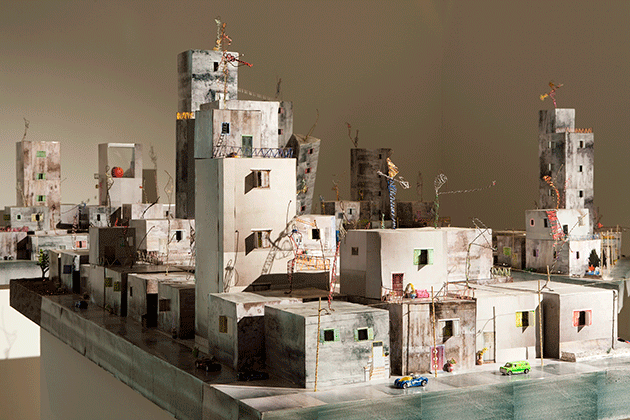
I have just read a very fine New Yorker review of the current New Museum exhibit of contemporary art from or about the Arab World, by Andrea K. Scott. What really struck me was this photo, of Wafa Hourani's piece "Qalandia 2067."


Scott describes it as follows: “Qalandia 2087,” [in fact it's 2067- TS] an elaborate architectural model by the Ramallah-based Wafa Hourani, reimagines a Palestinian refugee camp as a utopian zone of playgrounds, cafĂ©s, and landscaped courtyards—there’s even a glitter-paved aquarium, stocked with fish.

Fair enough, this seems a plausible enough reading, and I don't want to be too hard on Scott here, as her review of the exhibit as a whole is very favorable and very smart.

But notice the date in that title, and imagine what a Palestinian artist is thinking when he imagines that a refugee camp that was established 65 years ago will still exist 53 years hence.

If you consult the page for Hourani's "Qalandia 2067" exhibit at London's Saatchi Gallery, however, you will read the following:

Qalandia 2067 takes its name from the main check point crossing through the West Bank Security Fence which divides the cities of Ramallah and ar-Ram; it is a site of political unrest and human rights concerns. Dating his piece 2067 – one hundred years after the Arab-Israeli 6 Day War – Hourani has constructed 5 scale models envisioning the future of a refugee camp where time seems to have regressed rather than evolved. Basing each segment on an actual site – the airport, border crossing, and 3 settlements – the buildings are rendered as war-ravaged and crumbling, crowned by implausibly archaic remnants of TV antennae. Each building is a miniature light-box illuminating glimpses into the private lives of the residents through film strips placed in the windows, an unnerving reminder that this science fiction horror is, for many, an everyday experience.

In fact, I think both readings hold. Yes, Qalandia is a "horror" for its residents, due to circumstances, and at the same time it is where people manage to make a life and homes for themselves and manage to persist despite the ongoing, seemingly endless, displacement and occupation and oppression.

Check out these photos of the exhibit, from the Saatchi exhibit (and there are more to view at the link above):


Remarkable, no? I sooooo wish I could make it to this exhibit.

Friday, August 22, 2014

You are the aqal that is the pride of your people

 
....by Allah we will level the enemy's necks....

Here's one of the exhibits at the New Museum's show of contemporary art from and about the Arab world, Adel Abidin's Three Love Songs. It consists of three videos, one lounge, one jazz, one pop, featuring non-Arabic speaking singers who don't know what they were singing. The lyrics are from songs commissioned by Saddam Hussein to glorify him and his regime. Above are a couple of choice lyrics. (An aqal is the black cord that Arab men use to keep their kufiyas in place.)

The juxtaposition of lovely blonde women singing such lyrics...

and I quote from the description: 'It is this uncomfortable juxtaposition – between the lush visual romanticism and the harsh meaning of the lyrics, between the seduction of the performer and comprehension of the viewer – that forms the main conceptual element of this work.'

See excerpts from the vids and read about the sound installation here.

Here are links to a couple Saddam Hussein music videos, courtesy Frontline.

And for an introduction to some of the really great music produced during the Saddam era, I highly recommend the Choubi Choubi! collections produced by Sublime Frequencies. Volume 1 for now is out of stock, but I'm sure you could find one somewhere. Volume 2, only released on LP, was released this year, and is available. Really essential for your collection.

Here's a sample from Volume 1:


Once Upon A Time In The West by Hiwa K with Jim White


This is a pretty astonishing example of intercultural collaboration. This piece emerged from a friendship and long-term collaboration between Iraqi Kurdish artist Hiwa K, who took asylum in Germany, and Jim White, a former American soldier and subsequently a caretaker at a German art academy where Hiwa studied. Hiwa taught Jim to play country guitar (!) and songs by country singers like Johnny Cash. 

This piece,  work consists of a live, ten-minute performance simulating Ennio Morricone’s score for the final duel scene of Sergio Leone’s spaghetti western, Once Upon a Time in the West. The work is "an inquiry into the redistribution of dominant cultural representations and competences." 

Hiwa K (harmonica) and Jim White (guitar) perform with orchestra. 

This was performed at the New Museum in New York City, as part of the museum's exhibit of  contemporary art from and about the Arab World, called "Here and Elsewhere." I found it by going to the exhibit link and going to "Dig Deeper."

Here's an excellent review of the exhibit, which runs through September 28.

Here is Hiwa K's website, so you can dig deeper yourself.

Saturday, August 16, 2014

Moroccan rapper L'Haqed (El Haqed/al-Haqed): two day hunger strike


Huffington Post Algérie reports that the rapper L'Haqed went launched a two day hunger strike on August 13, to protest against the humiliating treatment he is receiving in prison.

L'Haqed was sentenced to four months in prison on July 1, for "violence" against police and drunkenness. Completely bogus, trumped-up charges, as he has been the constant target of Moroccan authorities for the last two plus years due to his consistent, outspoken criticism of the regime.

Among L'Haqed's complaints about his treatment in prison: he has been unable to get the writing that he does out of prison, newspapers he receives are torn, he is not allowed to receive the music that he likes, and he is subject to humiliating body searches.

Update, August 23, 2014.

More on L'Haqed's conviction:

"Moroccan Dissident Rapper Sentenced," Project on Middle East Democracy (POMED)
"Morocco jails dissident rapper El-Haqed," Massoud Hayoun, AlJazeera America, July 1, 2014.

The Washington Post used to have a link up, under the title "Morocco rapper rebel gets 4 months in prison," but it has mysteriously vanished.