Showing posts with label intifada. Show all posts

Friday, August 14, 2020

#kufiyaspotting: Zebda, L'Arène des Rumeurs (1992)


The cover of the 1992 release from the great French band, Zebda. Released during the height of the Palestinian intifada. David fighting Goliath, 1992.  

Their name, Zebda, is Arabic for butter, or "beur" in French. "Beur" is slang in French for those of Arab background. The band is multi-ethnic, but its vocalists are the Beurs Magid Cherfi, the band leader, plus Hakim and Mustapha Amokrane.

For a flavor of the band, check out the first track from the album, "Arabodub."

Sunday, September 07, 2014

Palestinian music: sources

Re: Palestinian music: I just wanted to give a plug to two fairly new books and one quite new posting.

First, Palestinian Music and Song: Expression and Resistance Since 1900, Moslih Kanaaneh, Stig-Magnus Thorsén, Heather Bursheh, and David A. McDonald, eds, 2013. It's in the Indiana University book series that I co-edit, Public Cultures of the Middle East and North Africa. Shayna Silverstein just published a very smart review of it in Journal of Folklore Research, which you can read here.

Then there is David McDonald's, My Voice Is My Weapon: Music, Nationalism, and the Poetics of Palestinian Resistance (Duke, 2013). I'm one of the folks who blurbed it, and I said the following: "David A. McDonald has written a singular, ambitious, and much-needed book that explores a very important dimension of the Palestinian-Israeli question. He provides an invaluable historical overview of Palestinian resistance music since the 1930s and an ethnography of music and musicians during the Second Intifada and its aftermath." I used the book in class last semester, and I highly recommend it for teaching.

Finally, if you are going to teach about Palestinian music, and use these books, then you should grab the following:


The album came out in 1989, from Virgin Records, but I've never seen it before, and I'm pretty sure it would be hard to track down a copy. But thanks to the estimable music tumblr naksh al sanadeeq, you can download it here.

When I taught McDonald's book I was able to find a lot of the music he discusses on Youtube. But it helps to know Arabic in order to track it down. Perhaps I'll do a follow-up.

In sum: we are now much more blessed with excellent materials, recorded and academic, on Palestinian music.

Wednesday, February 09, 2011

Music of the Egyptian Revolution

It's been pouring out, released in a fury of creativity set off by the astonishing events in Egypt over the last 16 days. Tahrir Square itself is one center. Check out this amazing video, of a singer and guitar (not shown), singing some of the key slogans of the uprising, with the crowd chanting and singing along. [Added February 12: I've learned his name: Ramey Essaam.] What is remarkable and rather surprising is that the song resembles "unplugged" grunge. This particular video helpfully translates the lyrics into English. But it makes a mistake in the beginning. Re: Mubarak, it should read: "We want to make Hosni Mubarak hear our voices!"


The original video (here) has gone viral. 545,932 views as of this writing.

Numerous accounts suggest that this is typical of what is going on at Tahrir Square on a daily basis. A group of people gathered around a singer (injured in the fights against the security forces or the pro-Mubarak thugs in earlier days) and an 'ud player, singing along with a tune that they have just learned from these two men, "Expel Hosni Mubarak." The men resemble roaming troubadors. These lyrics are translated as well.


And chants are song throughout the day and night. Here are some comic ones (which someone will hopefully at some future moment translate).


The last of the Tahrir songs is this one. Accompanying himself on guitar, the singer sings a comic song about a donkey refusing to step down for a younger one--an allegory about the old man Mubarak.


One more thing to add is that, according to Angry Arab, it is the songs of Abdel Halim Hafez that are played most often over the soundsystems on Tahrir. My friend Gamal Eid has also remarked that one hears the songs of Egypt's most beloved and important revolutionary singer, Sheikh Imam, on Tahrir.

Then there are the solidarity songs from "outside." One of the most impressive is Mohamed Mounir's "Azzay? (Why?)." Mounir, an Egyptian Nubian, has been a huge star, of music, cinema and theater, since the mid-1970s. Clearly this song was recorded prior to the outbreak of the uprising, but the video is full of scenes of the revolt, and the lyrics, ostensibly those of a love song, can also be read as a kind of allegory about Egypt and its conditions. The song is slamming, the video very moving. The video opens with the words: To every Egyptian citizen who participated in January 25...or who didn't participate. (There's a rough translation to the song in the comments.)


"Back Down Mubarak!" is a very lively, upbeat and oldschool sounding rap from Master Mimz, a Moroccan woman rapper, born in Casablanca, now based in England. The video features many shots of women who have participated in the protests.


There is also this rap, "#Jan25 Egypt," from Freeway, The Narcicyst, Omar Offendum, HBO Def Poet Amir Sulaiman, and Canadian R&B vocalist Ayah. Freeway's rap in particular is very compelling, at about 2:50.


In a quite different vein is this very beautiful chant from the Kuwaiti munshid, "Egypt Prayers." There is a rough translation into English in the comments.


There is "Long Live Egypt," by Scarabeuz and Omima. Scarabeuz's dad is Egyptian, his mother Dutch, and he was born in Berlin, where he is still based.

I at first thought the song was a little too sentimental and shlocky, but I came to like it more after listening to it all the way through. The images are quite moving, and the auto-tuned effects are endearing.


Finally, there's the free release, the Khalas Mixtape Vol. 1: Mish Ba'eed. With songs from rappers based in Tunisia, Algeria, Egypt and Libya. I particularly like the tracks from Tunisia's El Génèral and Algeria's Lutfi Double Kanon. Download it here.


Long live Egypt!

Kufiyas in the Egyptian revolution, cont'd.


This photo is from Jason Parkinson's riveting and disturbing video, Battle of the Interior Ministry, Jan. 29, 2011. View it here. Towards the beginning, we see a large crowd, marching through Tahrir Square. The man in the middle is holding up his kufiya, as if it were a flag or a symbol. There are other kufiyas in the footage too. And shots of men holding up spent cartridges, shot by the security forces, that say, Made in USA. And a deadly teargas canister, also from the USA.

Kufiya in action in Revolutionary Cairo

A protester carries an Egyptian flag and hangs it on the top of a traffic light post at
Tahrir Square in Cairo January 30, 2011. REUTERS/Asmaa Waguih

From a great collection of photos of the Egyptian revolution. (If you click on the photo to enlarge it, you'll notice the Che t-shirt.)

I've been asking friends who have lived in Cairo about the kufiya. In the early nineties, when I lived there, it was hardly to be seen. A friend of mine who was there at the same time says he only saw it among a small group of leftists, who put it on for revolutionary and Palestine-solidarity reasons. A friend who has been in Cairo the last couple years claims it is/was hipster garb. If the latter is (partially) true, then, these are very different hipsters from the US variety. These have been politicized and are important troops of the revolution.

See this, for instance. I think I see some kufiyas here. Even if not, this is the so-called "hipster" kufiya demographic. Now turned revolutionary. (Was that a Moz t-shirt I saw?)

Meet Egypt's Future Leaders

A run-down of the youthful leaders of the Egyptian Revolution, and much more, from Esam Al-Amin at Counterpunch.

Essential links on Egypt

Compiled by Seham, posted by Arabist. As of February 8.

The Egyptian Democracy Movement's Clear and Non-negotiable Demands

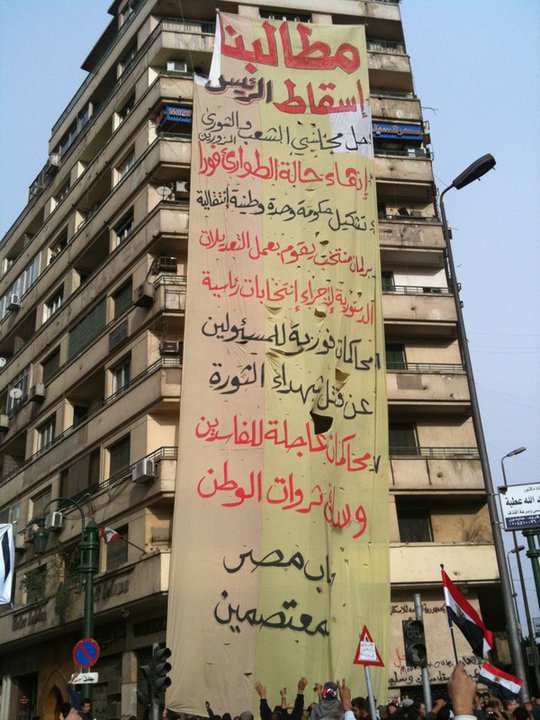
Here they are, clear and consistent. Let's circulate them widely and support them tenaciously. They were posted on a huge banner on Tahrir Square a few days ago. The movement is sticking to them.

Mubarak should step down from power immediately.

Dissolving of the national assembly and the senate.

Establish a “national salvation group” that includes all public and political personalities, intellectuals, constitutional and legal experts, and representatives of youth groups who called for the demonstrations on the 25th and 28th of January. This group is to be commissioned to form a transitional coalition government that is mandated to govern the country during a transitional period. The group should also form a transitional presidential council until the next presidential elections.

Drafting a new constitution that guarantees the principles of freedom and social justice.

Prosecute those responsible for the killing of hundreds of martyrs in Tahrir Square.

The immediate release of detainees.


This is from an absolutely essential article by Anthony Alessandrini, "Non-Negotiable," in Jadaliyya.

Monday, February 07, 2011

More on Ahmed Basiony


The article below, entitled "Fallen faces of the uprising: Ahmed Basiony" was published in Al-Masry Al-Youm today, and written by Mia Jancowicz.

I learn two key things from this is: (1) how gifted and talented and promising an artist Ahmed Basiony was. You also get this from his live videos, mentioned in my earlier post. You can download an mp3 of one of his live performances, "Abou Alaa aal Dish," here. One hopes the album he was working on will be released soon. Alas, the website for his label, 100copies, remains down as of this writing. (2) how brutal was his murder, presumably at the hands of the security forces. He was beaten, shot five times and run over. God rest his soul, and let us pray that the criminals responsible for his murder will be run out of power and brought to trial.

Ahmed Basiony, a Cairo-born artist, experimental musician and teacher in his early thirties, was killed while participating in the first week of the January 25 uprising. Basiony is a husband and the father of two children, four-year-old Adam and several months year old Selma. He taught at the Art Education College at Helwan University, where he was pursuing his doctoral studies in the field of interactive arts and open source technology.

Early in his career as an artist, he received several prizes for his participation at the annual Youth Salon since 2001; he was the recipient of the Grand and Salon prizes in 2007 and 2008, respectively. Basiony exhibited his work, which spans multi-media, installation, performance and sound, in various spaces including the Gezira Art Center and the Townhouse gallery in Cairo, most recently participating in the shows Invisible Presence and Cairo Documenta. In his musical capacity, he was developing a strong personal language, experimenting with popular forms to produce a visceral, charged energy. He performed at festivals such as 100live, and with musician Abou Asala was working on an album with the label 100copies.

His influence across creative fields was felt not only through his practice but through his intellectual and teaching contribution. Supplementary to his formal teaching work he organized educational workshops for digital, live and sound art, enabling numerous young musicians to enter the field. “What he was doing with his music, performances, artwork and discussion had resonance with others and opened up thought for others,” says artist and musician Hassan Khan. His close friend and artist Shady Noshokaty says “he was a brave, funny man with an independent intellect and crazy energy; he put so much into everything he did, in his practice, as a person and in his teaching. This is a huge loss.”

Basiony’s last Facebook post said: “I have a lot of hope if we stay like this. Riot police beat me a lot. Nevertheless I will go down again tomorrow. If they want war, we want peace. I am just trying to regain some of my nation’s dignity.”

Ahmed Basiony died on January 28, the Friday of Anger. It is reported that the day prior to his death, he was severely beaten by Central Security Forces: he had been carrying a video camera. The day he died, he was separated from his friends at around 7PM. Several days later his body was found at the Um Al Masreyeen hospital in Giza. Hospital reports indicate he was shot five times, and run over by a vehicle. A Facebook “kolna Ahmed Basiony” has become a virtual memorial, where students, colleagues, friends, family and mentors share memories, anecdotes and prayers for him and his family.

Sunday, February 06, 2011

Asian Dub Foundation, "History of Now" video: Tunisia and Egypt

Great song, great images of the struggles in Egypt and Tunisia


Here are the lyrics:

I give up I live up I fill up
Gotta keep my mind in motion
Gotta keep motion in my mind
Cut it out Leave it out take it out
All the things that make confusion
And diversions in these times
Breathing out Hold it out hold it down
buttoning down frustration out of neutral into drive
ray of hope keep afloat take a note
Need another survival strategy just to keep myself alive
Too many ideas buzzin round inside my brain
Live in the history of now
And I'm feelin like there's
Nothing left that I can really explain l
Live in the history Live in the history Of now
In a maze In a haze In a rage
Can't tell the difference between
My TV internet or me
Who is that Who is this Who said that
America's next top strictly dancing ghost celebrity
And I'm always phasing between blinding lights and the deafening sound
And I can't even make out the words
Or make them match up with the mouths
Too many ideas buzzing round inside my brain
Live in the history of now
And I'm feeling like there's nothing left that
I can really explain
Live in the history
Live in the history Of now

Eye to Eye
Gotta get back to the desert
Gotta get right back to my soul
Burning sky
Where every drop of rain Is a blessing to behold
Cos I can't be be a relay
On an expanding circuit board
My mind won't fit on a server somewhere I could never afford
You can't download the sun
You can't download the sea
You can't download the sun
You'll never download me
Too many ideas buzzin round inside my brain
Live in the history of now
And I'm feelin like there's
Nothing left that I can really explain l
Live in the history
Live in the history of Now

Cross and Qur'an at Tahrir Square

This is one of many incredible photos from a wonderful gallery published by The Guardian. Very significant.

Here's the caption:
Protesters hold a Christian coptic cross and copies of the Qur'an as they take part in 'Sunday of the martyrs'. Photo: Amel Pain/EPA

Saturday, February 05, 2011

Adam Shatz names the elephant(s) in the (Egyptian) room: Israel, the US imperium

Invaluable article from the estimable Adam Shatz, in London Review of Books. Read it here. Key extract:

The men and women congregating in Tahrir Square have the misfortune to live in a country that shares a border with Israel, and to be fighting a regime that for the last three decades has provided indispensable services to the US. They are well aware of this. They know that if the West allows the Egyptian movement to be crushed, it will be, in part, because of the conviction that ‘we are not them,’ and that we can’t allow them to have what we have. Despite the enormous odds, they continue to fight.

Tweets from Gamal Eid

If you're on twitter and read Arabic, follow him. An old friend. He also puts out some tweets in English. He's a lawyer and a tireless democracy activist.

Elliott translates one of them: 'Scene from Tahrir: A small boy says, "I'm a poor street kid who doesn't know a lot of things, but I have my pride. My pants might be falling off me, but we just made a revolution. What have you done?"'

Here's what Gamal looked like almost 20 years ago.

Essential reading on the Egyptian Uprising

Issandr El Amrani, writing in the London Review of Books.

There has been a lot of great analysis of this ongoing intifada, but this is one of the best.

Did you know that the recently cashiered minister of interior, Habib al-Adly, had received FBI training. Good job, G-men! This is the guy that unleashed the thugs and opened the prisons to inflict chaos on the democracy movement and the Egyptian people.

Here's the conclusion:

When Ben-Ali fled from Tunis, he created a vacuum at the top of the state that was imperfectly but quickly filled. The initial interim government did not please many, but a sense of civic duty appears for now to have stabilised the situation without a resort to authoritarianism. Mubarak, on the other hand, created a security vacuum in order to spread panic. In agreeing to step down, he tried to ensure that the regime would survive. Egypt is not Tunisia, at least not yet.

Friday, February 04, 2011

Ahmed Basiony, Tahrir Square martyr, electronics musician

Ahmed Basiony was a brilliant Egyptian electronics musician.

Ahmed at Tahrir Square, Jan. 25, 2011

Please check out these videos of Basiony live in concert.

Ahmed basiony & Abou Asala - "Abou Asala aal Dish". from Basiony on Vimeo.


EL KHATIA - remix from Basiony on Vimeo.

Ahmed, 31, taught in the Art Education, Painting and Drawing department at Helwan University. He was the father of two children. He was killed on Friday January 25 at Tahrir Square, while participating in the pro-democracy demonstrations. Cause of death: asphyxiation from tear gas. Source of tear gas: USA.

There are facebook pagse dedicated to him here and here. And here's a tribute to him at the blog disquiet.

You can also find videos of him performing on youtube. I think the ones from Vimeo, above, are the best ones.

Basiony was a collaborator with experimentalist Mahmoud Refat, founder of the label 100 copies. The site (100copies.com) has been offline since the uprising. I hope this changes soon.

RIP. الله يرحمه

More kufiyas from the Tahrir Commune

The first two photos are from a wonderful photo gallery, courtesy Time Magazine, "A Night at Tahrir Square," photos by Jacopo Quaranta.

The caption reads: "Tahrir Square, February 3. After two days of clashes with pro-Mubarak groups, demonstrators calling for the end of the regime of Hosni Mubarak remained on Tahrir Square. This woman, a former television journalist, occupied a checkpoint on the square, where she checked women who wished to enter."

I love how stylish her kufiya is, and I want to know where to get one like this!

This photo, from the same photogallery, reads: "Headrest. A demonstrator sleeps on the truck [a burned-out police truck]."


This is a screensave from tonight's Parker Spitzer show on CNN, during the segment where they interviewed the well-known Egyptian blogger and tweeter Sandmonkey. It was a phone interview, so CNN rolled some images, and they showed some good ones. This shot is of two demonstrators on Tahrir Square, bandaged up from wounds incurred from the attacks of thugs sent after the democracy forces by the Egyptian government. Upwards of 500 were wounded in the attacks of the night of February 1-2, which the democracy forces successfully repelled. You can read a good account of it here, by Hani Shukrallah.

The comparison of the democracy forces on Tahrir Square to the Paris Commune of 1871 comes from an essay posted today on Jadaliyya by Sinan Antoon.

No You Can't

(I got this through Beth, on Facebook. Not sure of the provenance, other than AFP.)

[PS, Feb. 4, 10:30 PM. Beth got it from BBC, thinks it's a photo of a demo in Turkey]

Thursday, February 03, 2011

Headgear of the Egyptian Pro-Democracy Demonstrators at Tahrir Square

(Mohammed Abed, AFP/Getty Images / February 3, 2011)

The demonstrators for democracy at Tahrir Square, as you no doubt know, have been the targets of heavy violence at the hands of government thugs, the baltagiya, violence that was launched on Tuesday February 1st. They've been the targets of rocks, concrete blocks, molotov cocktails...some of them thrown from the tops of buildings that the government-sponsored hooligans (and security forces in civilian clothes) had occupied. To protect themselves, they have erected barriers, thrown stones back at their attackers, and, we learn from The Guardian, improvised a variety of headgear to protect their heads. (100's have been injured by the flying debris.) Today The Guardian featured a photo gallery of their ingenious forms of head protection. I of course particularly liked this one, featuring a kufiya, which helps hold in place what appears to be the bottom of an oil drum, re-jigerred as a kind of wok. Robin, who suggested this, saw one used by a Bedouin woman in Sinai who was cooking fish by the side of the road.

Long live the ingenuity of the Egyptian people!

Monday, January 31, 2011

The Egyptian Revolution: Cleansing the Country


Check out this amazing and heartwarming video about a wave of national pride in revolutionary Egypt. Teams of volunteers cleaning up the streets around Tahrir Square.

Here's a kufiya clad volunteer street cleaner.

Free medical care offered by health professionals. Passing out food.

This really is something to be scared of: people power.

Sunday, January 30, 2011

Kufiyas in the Egyptian Intifada

This is a footnote to the bigger story going on. Or maybe it's not just a footnote. I never saw many kufiyas when I lived in Cairo, between 1992-1996. Checking out footage on Al Jazeera, the youtube videos, and the photos, of the ongoing Egyptian Uprising against the Mubarak regime over the last several days, I've spotted many, many kufiyas. So many that I've not even bothered to try to put together a collection.

What do they signify? Solidarity with Palestinians? The influence of Western hipster fashion? A resurgence of secular pan-Arab identity, that several observers have noted? I think it's all three, and probably others that I can't think of right now.

In any case, here's a photo that I very much like, from a post on the blog of The Economist. (It's not credited to any photographer.) It seems particularly iconic. A young Egyptian male (the youth have played a critical role in organizing and activizing the uprising--although all segments of society have participated). He's carrying an Egyptian flag (signs of nationalism have prevailed over assertions of religious identity in this intifada). A cellphone is in his right hand (mobile phones & tweets & text messages have played a significant part in the movement, so critical in fact that the Egyptian government cut all cell service on February 27). He is walking in Tahrir (Liberation) Square, the focal point of the movement (although significant mobilizations have occurred all over the country, Tahrir, for all kinds of historical, cultural, and spatial reasons, remains very critical). The Nile River (Egypt's lifeblood) and the Egyptian Museum (the repository of the country's antiquities) are in the background.

And a black-and-white kufiya is draped around his neck, sign of global style, Palestine solidarity, and pan-Arabism.

Long live Egypt and its courageous and humane people.