Thursday, July 22, 2010

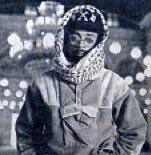
Nico, Kufiya, "Chelsea Girls"

Nico (1938-1988) chose to look like this when she appeared in the 1981 BBC4 documentary on New York City's Chelsea Hotel.


She sings "Chelsea Girls," authored by Lou Reed and Sterling Morrison (of Velvet Underground), which appeared on her 1967 album solo album, Chelsea Girl. The song, and album, refer to Andy Warhol's 1966 film Chelsea Girls (which I've never seen). The youtube segment from the BBC documentary opens with some clips from Warhol's film. Then Nico starts singing Chelsea Girls--not the entire song, just selected verses--backed by Joe Bidewell on electric guitar. Nico talks about how the girls at the Chelsea were her friends and how she was the person who made the Chelsea famous. These are the lyrics from the much longer song that she sings in the film segment.

Here's Room 506
It's enough to make you sick
Bridget's all wrapped up in foil
You wonder if she can uncoil.

(chorus) Here they come now
See them run now
Here they come now
Chelsea Girls

Pepper she's having fun
She thinks she's some man's son
Her perfect loves don't last
Her future's died in someone's past.

Chorus

Dropout, she's in a fix,
Amphetamine has made her sick
White powder in the air
She's got no bones and can't be scared

Chorus

Here comes Johnny Bore,
He collapsed on the floor
They shot him up with milk
And when he died sold him for silk

Chorus

But what about the kufiya?

It could "mean" any number of things. Or all of them. At the time, Nico was living in New York City, when the kufiya was quite the fashionable item for hipsters in the city. Like, for instance, Madonna and all the punk and hip-hop kids hanging around places like the Roxy, watching Afrika Bambaataa. And the kufiya would have been seen as well on the shoulders of left-wing activists involved in the anti-nuclear movement. And you might have seen it on post-punk bands like Delta 5. Or who knows, maybe Nico (who was living in Europe in the late seventies, as far as I can tell) was "citing" the Red Army Faction (Baader-Meinhof Gang), whose politics were so (unfortunately and tragically) tied up with Palestinian solidarity.

Moritz Bleibtreu as Andreas Baader, from the film, The Baader Meinhof Complex

Or the choice of the kufiya may have had more to do with cultural affinities. Nico recorded the album, Drama of Exile, in 1981, which has a bit of an "Eastern" feel to it, due to the presence of the Algerian Muhammad Hadi (a.k.a. Mad Sheer Khan) on guitar and buzuki. The production of the album has a murky history, and two different versions were released. (Unfortunately, it is currently out of print.)

Interestingly, this is one version of the cover of the re-released album, on Invisible Records (1983) and on Rakos (2004). Again, it shows Nico in what looks to be a kufiya.

(More research needed!)

Tuesday, July 13, 2010

Friday, July 09, 2010

Hipster Runoff & Kufiyas

My ongoing investigations (AKA hysterical obsessions) with kufiyas has led me to numerous critiques of kufiya style/fashion that essentially work through send-ups of the phenomenon of the hipster. I think that what I've ultimately determined is that (a) making fun of hipsters is like shooting fish in a barrel and (b) about 95% of the criticism of hipsterdom is dumber than the phenom under discussion.

I think it's taking a look at the blog Hipster Runoff that finally made me come to this conclusion. As I said, I've been looking at a lot of stuff of this ilk, and had concluded awhile back that poking fun at hipsters has become a very popular spectator sport--indulged in by legions of folks who are just too cool & clever for words.

It's Ben Sisario of the New York Times who hipped me to Hipster Runoff. In an article entitled "When Indie-Rock Genres Outnumber the Bands" (Jan. 2, 2010), Ben calls Hipster Runoff "a blog that ridicules bohemian culture with hilarious precision." Ben is usually an incisive cat, but I beg to differ on this particular claim.

Let's check out what Hipster Runoff has to say about the kufiya by running a search for keffiyeh (the conventional spelling) and Palestinian scarf. Here's what I found.


#1. The title of this post:

NYTimes writes article about Christian counseling 4 female porn addicts, includes photo of hipster porn addict

Regarding the photo, it says: "It also really helped that they had a photo of an entry-level alt girl as the physical representation of female porn addiction. Do u think she uses her keffiyeh as a cum rag?"

Error! This is not a kufiya. Hardly even a faux one. And...not funny.


On to #2.

Title: Japanese figure skater wears keffiyeh at Olympics.


Here are excerpts from the post:

Popular Japanese Figure Skater Daisuke Takahashi had a keffiyeh integrated into his cute little costume for his Olympic Contest. We cannot confirm if he is ‘alt’ or if this was actually an anti-Israeli message, showing support for the 1972 massacre of members of the Israeli Summer Olympic Team at the Munich Olympics. Based on his Japanese heritage, we find it safe to assume that he was

Do u think this was a real ‘hipster scarf’ or a politically motivated message? Is he ‘just a harmless queen on ice’?

We can only assume that his Palestinian scarf gave him the warrior power that won him the bronze medal.


Ding! Again, this scarf is so far from being a kufiya it's ridiculous. And is it really "funny" to link the supposed kufiya to anti-Israeli messages and the hostage taking and murder of Israeli athletes by Black September in 1972?

Are we laughing yet??

#3. Alt Jews launch 'Star of David' keffiyehs, 'piss off' Arabs/Palestinians

This post is actually somewhat reasonable, it contains nothing blatantly stupid. No comment from me. But it is in no way hilariously precise in its ridicule.

#4. Is the 'tube scarf' 20k10's first relevant alternative trend?

The post makes fun, in a light-hearted way, of the (apparent) emergence of the alt tube scarf. The subjects wearing tube scarves look so hideous that you can't imagine that this is even a trend.

Along the way, the author makes some comments about the kufiya. First:

I will never forget the altstreamification of the keffiyeh/Palestinian scarf. Feel like I watched this trend evolve, much like a proud father watches his son grow into an NFL player.
I'm afraid I'm not hip enough to comprehend the ironic twists involved in this statement.

But I think I grasp the next one, which ridicules the would-be, neophyte, "entry level" hipster who cluelessly wears the kufiya.

Always start to ‘giggle’/’scoff’ whenever I see some1 of any age wearing a keffiyeh, the ’scarlet letter’ of an entryleveler.

The image below follows the statement. Of course, the author doesn't really 'miss' the kufiya. This is some kind of hipster irony from someone who is way cooler than any hipster.
#5. Feeling sad that altbros got violent at the G20 Summit protests

Here the author pokes ironic fun at the April 2009 protests at the G20 Summit in London. You learn nothing here about the politics of the protesters, only about the 'amusing' confusion of the author.

As for the kufiya, the author has this to say, below this photo:


Sad that the altBro in a Keffiyeh/neon palestinian scarf gave alternative people a bad name. Think these scarves might be dead. Not sure if I want 2 wear mine, or else riot police will break into my apartment and execute my family. Not sure why the bro is throwing a sweet ass flat screen through a window. Seems like a good screen to chill and watch DVDs on. Think this protest was in France, so not sure why he is wearing an Atlanta Braves baseball cap. Must be ‘alt’ to wear American caps in France.

Is it supposed to be 'cute' that the author thinks the protests were in France, when they were in London?

The layers of ironic humor are almost too many for me to make sense of. (a) The 'bro' gave 'alt' a bad name by wearing a kufiya? Because it's Palestinian? Because it's neon? Because it's out of style? (b) The scarf is 'dead' (stylistically-speaking) anyway? (c) The author is afraid to wear his scarf because the cops might see him as a political radical. But he wouldn't wear one anyway, because he thinks it's dead.

Too much for me...

#6. This post makes fun of the trompe l'oeil kufiya t-shirt. (I blogged about this twice, here and here.)


It says, with the blindingly clever insight so characteristic of Hipster Runoff: This shirt is crafty enough to feature a Keffiyeh AKA a Palestinian scarf AKA that A-rab Scarf that hipsters wear AKA an ‘I hate Israelis’ scarf.

Yeah, that's it, a kufiya 'means' 'I hate Israelis.'

#7. Here's one where the author uses his "Palestinian scarf" for something 'functional': to cover up the smell of a port-a-potty at an outdoor concert. Given that all the authors of Hipster Runoff appear to be snarky twenty-something white males, I suppose that some kufiya-related potty humor was inevitable.


#8. A post from Feb. 27, 2009: Are Palestinian Scarves Still Authentically Alt?

The answer appears to be 'no,' in part because they are advertised--in numerous guises, including the Kanye West Houndstooth style--on Amazon.com and: 'I think in recent months, it has become ‘cool’ to support Israel and altJews.'

I have no idea where this notion comes from.

#9. The Search for the Most Authentic Alternative Scarf. (January '09)

General making fun of scarves, including wearing them when it's 85+ outside.

Notable for this remark:
h8 u Palestinian scarves. trying 2 forget abt 2k8, yall.

Incisive critique of hipsterdom: anything worn last year is worthy of h8.

#10. Altbro or altbag.

A contest to decide what is the true nature of this gentleman:


Please justify your answer in order to be mailed your $5 Chili’s gift card. For example: “He is an altBro because he has a gymbag full of miscellaneous alternative g00dies and his palestinian scarf. And also his sunglassies.” or “He is an altBag because of his progressive bowlcut + postAltBro humble loafers.”
The knowledgeable reader, of course, is supposed to recognize that the guy is ridiculous and looks like a douchebag. I guess.

===

There are a few more references to "Palestinian scarves" but they don't really bear discussing.

I'm worn out from trying to make sense of all the layers of irony and 'subtle' humor. No doubt I am showing my age. But I think I can conclude that kufiyas/Palestinian scarves remain a useful and productive stick with which to beat up hipsters. After reading through so much of this, my sympathies now lie much more with the hipsters (who, of course, everyone denies being) than with the lame ass critics.

Thursday, July 08, 2010

interzone radio podcast for July 6 is up

featuring music from the likes of:
Harry Belafonte & Miriam Makeba,
Fairuz,
Amália Rodriguez,
Kamilya Jubran & Werner Hasler,
Rango,
& more

podcast can be found here

playlist here

Wednesday, June 30, 2010

interzone radio podcast, june 29


it can be found here

and the playlist is exactly here

music from DuOud, BLK JKS, Estrella Morente, Wadali Bros., and more!

enjoy

Sunday, June 27, 2010

Kufiyas in "From Paris with Love," "The A-Team," and "Glee"

I have posted previously about the kufiya-wearing Charlie Wax character in the film, From Paris with Love, played by John Travolta. I have finally seen the film. It was agony. If not for the sake of research, I would have turned it off long before the end. It's a real turkey of a film, but the kufiya does play a prominent role. CIA agent Charlie Wax, who lays waste to multiple "bad guys" in the film--Chinese, Pakistanis, devious beautiful women, banlieusards--at the rate (his partner James Reese [Jonathan Rhys Meyers] estimates) of one an hour--wears a kufiya in almost every scene. Along with his bald pate, goatee, earring, and leather jacket, the kufiya seems to be essential to Wax's image as a kind of rogue secret agent who uses unconventional (i.e. bloody) methods to track down and get his prey. (He's also supposed to be funny, but the humor never really works.) The kufiya has nothing to do with any identification on the part of Wax with Arabs, who he at one time refers to as "ragheads." Rather it seems to involve a kind of sympathetic magic that, through mimesis, taps into the power of the Other (terrorist, raghead)--see Taussig, Mimesis and Alterity, 1993. This seems key to the phenomenon of what I'm calling the "tough guy" kufiya. (After I re-read Taussig I will probably have more to say about this.)

As if to reinforce the fact that Wax is tapping into the strength and energy of the bad guys, the ragheads, one of the banlieusards who is a member of Rashid's gang that deals in cocaine and other crime wears a kufiya. Rashid is on the right. (The fact that Wax and Reese at first get held up by a gun-yielding 10-year old gang member works in the film to show how pathological these gangsters are. To deal with such criminals, whose drug ventures are linked to the Pakistani terrorist suicide bombers, the final targets of Wax and Reese, of course requires "unconventional," i.e., lethal methods.)

Wax's guns are almost as ubiquitous as his kufiya.

Here's a different look, with a baseball cap. (I never could figure out why Reese was carrying around the vase with cocaine.)

This is one of the film's "humorous" scenes, which I suppose is intended to lend Wax, who is otherwise preoccupied with killing bad guys non-stop, a human and likable side. Wax is on his way to take out the Pakistani terrorist who is driving Reese's erstwhile girlfriend Caroline on a mission to bomb a summit meeting. Wax gets the driver to play a bit of pop fluff on the radio, and, as he pops his fingers, he tells the driver not to tell anyone that he ever listens to such "soft" music.

I learned today, courtesy a photo in the New York Times, that a kufiya also appears in the new film, The A-Team. Another "tough guy" kufiya.

Here's a photo. That's Bradley Cooper as Lt. Templeton ‘Faceman’ Peck on the left, and Liam Neeson as Col. John ‘Hannibal’ Smith on the right.

I suppose I will also need to see that film as well--and I dread that it will be even worse than From Paris with Love. I also plan to see The Book of Eli soon but I have higher hopes for it.

A couple friends have told me that the character of Mercedes wears a kufiya in the TV show Glee. I have not seen the show, and have been unable to track down an image of Mercedes in kufiya. If anyone has any ideas about how I might do so, please, do tell.

Tuesday, June 15, 2010

interzone radio show, june 15: podcast + playlist

these can be found here.
music from:
Dhafer Youssef, Tinariwen,
Ralph Marterie, FufĂĽ-Ai...and much more!

Friday, June 11, 2010

Back on the tarbush/fez tip: Shafiq Husayn (plus Edward Said and a kufiya)

Thanks to Omar for turning me on to the video of Shafiq Husayn's "The U.N. Plan," from his album Shafiq En A-Freek-A.


I've mostly paid attention to the video and the general sound, so I'm turning to this account of the lyrics, courtesy The Quietus.

'The U.N. Plan' is about being stuck in a rut, "living in circles". A tight, delicious groove and surging drums accompany vocals about remembering to be a star. They duel with reflections in reverb, saying things like "her name was boo and she left me all alone to expand", as if a consciousness were struggling to put positive light on a situation.

As for the video, there are a number of intriguing elements. Shafiq appears in it in five guises: as a kind of Lonnie Liston Smith in red turban and camo fatigues; as a kind of Rasta-ish boho wearing a knit hat with Ethiopian colors; a somewhat similar look to the former, but with a red hat (you can see this guise in the frame of the embedded video above); in dark glasses and red beret; and finally, and most remarkably, as an old-school Afrocentric intellectual, complete with Malcolm-style glasses and a fez (tarbush).


The provenance of Shafiq's very intello look here is given in an earlier frame, with the titles for the video, when we see this title page, from a text by the Moorish Science Temple, founded by Noble Drew Ali. The fez was part of the outfit worn by adherents of Moorish Science. And in fact, in the photo above, not only does Shafiq recall Malcolm X, but also Noble Drew Ali (see the photo from this previous fez post.)


With these images Shafiq is conjuring with the racialist theories of Moorish Science, which proposes that African-Americans are of Moorish origin. But he also conjures up the image of post-Mecca Malcolm, who abandoned the racialist doctrines of Elijah Muhammad and advocated progressive alliances with peoples of all races. The gentleman sitting at the table with Shafiq-in-fez could be Arab or Hispanic or South Asian. The video also shows images of the Buddha and a text about Tibet.

And then the Shafiq-in-beret is shown with a woman wearing what may be an Islamic headscarf (worn pretty loosely). In one scene the two of them are shown in front of a mural that depicts a woman in red kufiya, who appears to be depicted with "African" features. (The woman also appears with Shafiq-in-red-hat.)


We see a shot of another page of a book toward the end of the video, another text that the Shafiq-in-fez is presumably reading.


Look closely, and you will see that it is the top of page 175 of Edward Said's Orientalism, from Chapter Two, "Orientalist Structures and Restructures." The passage is about Chateaubriand's visit to Egypt.

How cool is that, Edward Said in a music video? Of course, it would be a video from an artist who belongs to the afro-futurist ensemble Sa-Ra Creative Partners, a group that evokes the name, sensibilities, and mythologies of Sun Ra and his Arkestra. A group responsible for production on Erykah Badu's incredible New Amerykah: Part One.

There is no doubt more to say about how expansive and complex is Shafiq Husayn's "U.N. Plan," but I'll leave it there for now.

Monday, June 07, 2010

Kufiyas: new & old (Mavi Marmara, Spike Lee, Madonna)

New kufiyas

Like all Palestinosymps, I've been following the Gaza flotilla outrage obsessively. It has been impressively covered--although not, of course, by the mainstream media in the US. (Did Maddow or Olbermann give it any meaningful coverage?)

My comments are just a side note, motivated by my kufiya obsession. I watched a bit of the live feed from the Turkish vessel, the Mavi Marmara, right before the Israeli attack. One of the things that I noticed was that everyone seemed to be wearing kufiyas of some sort--as scarfs, as headgear, and so on. I did not realize at the time that the passengers on the boat were mostly Turks, mostly affiliated with the IHH.

But it was not just the Turks, it was everyone, it seemed. Here's a photo captured from the live feed, an interview with a British-Asian woman with a red kufiya wrapped around her neck (I did not catch her name).


And here's a photo of one of the Turkish passengers who was wounded in the Israeli assault, from a report from Al Jazeera English which conducted interviews in Istanbul with several of the wounded. (The US media, of course, saw fit to do no such interviews.) Several of the interviewees were adorned with kufiya-patterned scarves and Palestinian flags.


Here's a photo of Irish activist, spokesperson for the Free Gaza Movement, which sponsored the flotilla, together with the IHH. (I have lost her name: someone help!) [added, June 8: it's Caiomhe Butterly]


Here's a photo of the ship the Rachel Corrie, with its crew of Irish and Malaysian humanitarians, before it was launched on its mission.


And the kufiya was so scary for the Israelis that it showed up in one of the propaganda photos put out by the Israeli Ministry of Foreign Affairs to illustrate to what extent the passengers on the Mavi Marmara were armed and ready to "lynch" the Israeli military personnel who landed on the vessel.


So you get the (perhaps all-too-obvious) point. Ubiquity of kufiyas in the Gaza flotilla.

Here's a somewhat silly kufiya item, in my opinion. (No doubt my take on this is influenced by Angry Arab, who is constantly making fun of the seemingly never-ending efforts in Lebanon to get into the Guinness Book of World Records, by making the biggest tabbouleh or the biggest kunafeh or the biggest hummos or whatever.) The world's biggest kufiya, certified as such by the Guinness Book, was put together in an effort to publicize the 62nd anniversary of the Nakba and to call attention to the plight of Palestinian refugees in Lebanon, whose conditions are abysmal. The kufiya was sewn by children and youth groups from Lebanon's 12 Palestinian refugee camps. I'm all in favor of calling attention to the Nakba and in particular the dire situation of Palestinian refugees in Lebanon. They and their conditions have been criminally ignored, particularly since the so-called "peace process" was launched in the early 90s. But using the Guinness Book as a means of publicity? Symptomatic of the Lebanese disease diagnosed by Angry Arab.


Old kufiyas

I've beem trying to put the current "kufiya craze" in historical context, arguing that there is a history, going back to the early 70s, of the kufiya being used for both political and stylistic purposes in the US. And, I would argue, the line between the two is not fixed and rigid, but rather, fluid, and hard, at times, to delineate. Here are two examples.

From the Village Voice in 1992 (November 10), a photo of Spike Lee, who has just released his Malcolm X movie. (The photo accompanies an article by Hilton Als on Spike and his new film.) How to read the kufiya here? It was all over New York City, worn by hipsters, by lefty politicos, by African-Americans. What sort of message is Spike broadcasting here, in his kufiya and his X baseball cap. Style and politics are intimately linked here, mutually interdependent.


And here is Madonna. Thanks to Nihal for this. I guess this photo is from around 1981-1984, when the kufiya was showing up in the downtown NYC scene, in hip circles.


The kufiya probably circulated with the same white kids who were the first to get into hip-hop, as documented by Jeff Chang in his invaluable Can't Stop Won't Stop. Madonna was part of the crowd at the Roxy, the downtown club that was the first to feature hip-hop, imported from the Bronx. One of the most important hip-hop pioneers in that group was Afrika Bambaata. Here's a photo of him, in faux kufiya.

Clearly more research is needed on the dates of the Madonna and the Bam photos. And, inshallah, a better copy of the Madonna photo.

Saturday, June 05, 2010

Henning Menkell's Gaza flotilla diary

This was published today, June 5, in The Guardian, on the 43rd anniversary of the June 1967 war, which led to the occupation of Gaza. I found it incredibly moving, in its very mundane and lowkey description of all the indignities and abuses heaped upon nonviolent humanitarians attempting to bring aid to Gaza. Some of the more memorable passages are excerpted below:

Those who are to board the ships somewhere off the coast of Cyprus are gathering at Hotel Centrum in Nicosia. It's like being in an old Graham Greene novel. A collection of odd people assembling in some godforsaken place to set off on a journey together...

It takes exactly an hour for the speeding black rubber dinghies with the masked soldiers to reach us and start to board. We gather, up on the bridge. The soldiers are impatient and want us down on deck. Someone who is going too slowly immediately gets a stun device fired into his arm. He falls. Another man who is not moving fast enough is shot with a rubber bullet. I think: I am seeing this happen right beside me. It is an absolute reality. People who have done nothing being driven like animals, being punished for their slowness...

We are put in a group down on the deck. Where we will then stay for 11 hours, until the ship docks in Israel. Every so often we are filmed...

Eleven hours, unable to move, packed together in the heat. If we want to go for a pee, we have to ask permission. The food they give us is biscuits, rusks and apples. We're not allowed to make coffee, even though we could do it where we are sitting. We take a collective decision: not to ask if we can cook food.

Then they would film us. It would be presented as showing how generously the soldiers had treated us. We stick to the biscuits and rusks. It is degradation beyond compare...

So in those 11 hours, I have time to take stock. We have been attacked while in international waters. That means the Israelis have behaved like pirates, no better than those who operate off the coast of Somalia. The moment they start to steer this ship towards Israel, we have also been kidnapped. The whole action is illegal...

Quayside somewhere in Israel. I don't know where. We are taken ashore and forced to run the gauntlet of rows of soldiers while military TV films us. It suddenly hits me that this is something I shall never forgive them. At that moment they are nothing more to my mind than pigs and bastards.

We are split up, no one is allowed to talk to anyone else. Suddenly a man from the Israeli ministry for foreign affairs appears at my side. I realise he is there to make sure I am not treated too harshly. I am, after all, known as a writer in Israel. I've been translated into Hebrew. He asks if I need anything.

'My freedom and everybody else's,' I say. He doesn't answer. I ask him to go. He takes one step back. But he stays.

I admit to nothing, of course, and am told I am to be deported. The man who says this also says he rates my books highly. That makes me consider ensuring nothing I write is ever translated into Hebrew again...[I wish he'd demand that Wallander never be shown on PBS until the US changes its Gaza policy. It was the best mystery show I ever saw on PBS, so that would be too bad, but....--TS.]

Agitation and chaos reign in this "asylum-seekers' reception centre". Every so often, someone is knocked to the ground, tied up and handcuffed. I think several times that no one will believe me when I tell them about this. But there are many eyes to see it. Many people will be obliged to admit that I am telling the truth. There are a lot of us who can bear witness.

A single example will do. Right beside me, a man suddenly refuses to have his fingerprints taken. He accepts being photographed. But fingerprints? He doesn't consider he has done anything wrong. He resists. And is beaten to the ground. They drag him off. I don't know where. What word can I use? Loathsome? Inhuman? There are plenty to choose from...

The myth of the brave and utterly infallible Israeli soldier is shattered. Now we can add: they are common thieves. For I was not the only one to be robbed of my money, credit card, clothes, MP3 player, laptop; the same happened to many others on the same ship as me, which was attacked early one morning by masked Israeli soldiers, who were thus in fact nothing other than lying pirates.

Wednesday, June 02, 2010

Do MIA's gingers stand for Malcolm McLaren?

Is Nabeel right? Do the gingers in MIA's 'Born Free' video really stand for the late (and seriously ginger) Malcolm McLaren? That reading would actually make MIA's vid a little more comprehensible: as both a tribute to the recently departed punkmaster and Situationist, and as a kind of allegory about the threat posed by McLaren style punkers.

Waddya think?

A ginger from MIA's vid:


Mr. McLaren (RIP, ginger):


Not to mention that Johnny Rotten of Sex Pistol fame was (often) a ginger:


Previous post on the MIA vid is here.

interzone radio, podcast for 6/1/10 + muslimgauze + Gaza's DARG Team


the podcast for the june 1 show is here

playlist is here

as you might imagine, as I was preparing this show, I was thinking a lot, obsessing in fact, about Gaza.

(a very good commentary on the Israeli assault on the Freedom Flotilla, from Merip, is here).

so, among the tracks I played were Muslimgauze's "Curfew, Gaza," from the album Zul'm. an earlier post about Muslimgauze can be found here. if you go there, be sure to read the comments. and thanks to Nabeel, I learned about this site, where you can download, for free, the album El Tafkeera: Re-mixs in Remembrance of Muslimgauze. It's produced by Islamophoniacs. (I love the name.)


I also played a track by a rap group from Gaza that I quite like, DARG Team (DARG stands for Da Arabian Revolutionary Guys). You can go here (at palrap.net) to listen to some of their very fine tracks. (And PalRap is a great place to access all sorts of Palestinian rap. But it helps to know Arabic to navigate the site.)

Tuesday, May 25, 2010

Sex and the City 2: Abu Dhabi Decadence

Check out this preview.


I think this is a must-see. The fact that four sexy women from Manhattan take a vacation to Abu Dhabi for decadence represents some kind of change, no?! Or does the film represent a return to 19th century Orientalist ideas about the Arab East as the height of decadence?

But...Abu Dhabi??? In fact, it's Dubai that is the "decadent" place in the UAE. Among other sources, please check out Waleed Hazbun's invaluable Beaches, Ruins, Resorts: The Politics of Tourism in the Arab World. I reviewed it a few months back, read it here.

Here's my summary of some of Hazbun's main conclusions regarding Dubai:

Dubai is the most spectacular post-9/11 winner, a city whose image is tied up with tourism like an upscale Las Vegas. It attracts a diverse clientele, with British visitors first on the list. In the past few years, Dubai has had immense publicity success with high-profile projects, such as indoor skiing facilities, the iconic Burj Hotel, and plans to open branches of the Louvre and the Guggenheim museums designed by top-drawer architects, all receiving overwhelmingly favorable coverage in the Western media. Commentators like Thomas Friedman have come to regard Dubai, with its reputation as a “cosmopolitan oasis,” as a model for Middle Eastern globalization, through economic liberalization, “dynamic free trade zones,” and “sound economic management” (p. 213). It is as if the specter of Islamic terrorism has helped transform the negative stereotype of the “rich Arab oilman” into a positive one. Yet Hazbun reveals that Dubai's fabled cosmopolitan spaces are anything but open. Instead, they are rigidly controlled, carefully segregating Dubai's workers (mostly migrants from South and Southeast Asia) from the contained spaces reserved for tourists. Moreover, the state has successfully purchased its citizens' acquiescence by extending almost free housing, due to its near total control over urban development and land rights.

Dubai has emerged as the most successful tourism model in the Middle East, a kind of enclave where tourists are insulated, where security for visitors--a priority since 9/11--is highly visible, and where the potential negative social and cultural impacts of tourism are mitigated. Since the book was published, the Dubai economy has collapsed, though the tourism model remains an eminently viable one, as recent reports of the revival of Beirut's nightlife niche tourism (now depicted as gay-friendly) suggest.


So, for "Abu Dhabi," I read "Dubai." It will be interesting to see to what extent the film conforms to the updated image of Dubai, that Dubai has been so successfully spinning, and to what extent it resorts to Orientalist tropes.

Perhaps it's some sort of clever mix? I mean, check out this wild "hijab" worn by Samantha!


Samantha seems to be simulating Middle Eastern "modesty" but in a super-chic (but at the same time wacky) way, while Carrie manages to cover her hair but not her ample bosom. (Sorry, the image just seemed to automatically call forth Victorian language.)

And possibly another reason to see the film is the fact that my Merip comrade, Moustafa Bayoumi, appears as an extra. Read his account for the New York Times here. As he remarks, "It could have been worse. I could have been a Middle Eastern extra on '24.'”

Saturday, May 22, 2010

Kufiyas in the video for MIA's, "Born Free" -- and a note on my kufiya lecture


M.I.A, Born Free from ROMAIN-GAVRAS on Vimeo.
If you read this blog you were probably already aware of this video. In fact, you are probably one of the many people who wrote to me to tell me about it. And if you read this blog, you no doubt notice that I've really slacked off for the last few months. One of the things that has been going on is that I've been posting a lot to facebook. But I have realized that, while the social interaction of facebook is something I like, my posts there nonetheless are only seen by a few people, and they leave no permanent record. So, I've decided to re-commit to hawgblawg.

The video, directed by the son of the celebrated director Constantinos Costa-Gavras, shows male "gingers" (redheads) being rounded up and then forced to run through a minefield. It's clearly meant to be a kind of allegory for the persecution of ethnic minorities, and leaves itself open to a variety of interpretations. Is it meant to be about the persecution of Tamils in Sri Lanka? Of Mexicans without papers in Arizona? It seems to be up to the viewer. But there are two clear references. The mural that is seen while the bus carrying the prisoners drives through town looks very reminiscent of the kind that one might have seen in Belfast, especially given the look of the redheads it depicts. And the mural reads, "Our Day Will Come," which was in fact an IRA slogan.
And of course there are the kufiyas, with their unmistakable Palestine reference. Gingers garbed in red kufiyas, wrapped so as to partially disguise their faces, appear in the video at about 4:06.


They are hiding around a corner, waiting to make their assault on the armored bus carrying the prisoners.


They launch some stones and bottles, in a manner very reminiscent of the iconic Palestinian stone throwers of the two intifadas.


Their attack does no damage to the vehicles, and the drivers don't pay attention and do not slow down. The kufiya clad attackers, however, appear to be pleased that they at least made the effort. They raise their arms above their had, as if signaling victory, or perhaps solidarity with the prisoners. The prisoners make no visible response.


The video is quite bloody and graphic. I am not sure that it is particularly effective as a political allegory--but it sure did manage to attract a lot of comment and attention, both positive and negative.

I do quite like the MIA song. The lyrics, when you work them out, are really quite non-political and non-incendiary, and have really next to nothing to do with the video itself, whose purpose seems to have been more to gain publicity for the song rather than make any kind of explicit political point. The kufiya, then, seems to serve more as a kind of iconic sartorial item of struggle, in the vaguest of senses.

I gave a lecture entitled "Keffiyeh: From Resistance Symbol to Retail Item" at the Palestine Center on April 6, 2010. You can view the video here. Comments are welcome.

Sunday, May 16, 2010

interzone radio: podcasts & playlist, may 4 & 11


the podcast for the May 11 show is here


the playlist is here


and


the podcast for May 4th's show is here


+ the playlist is here

peace,

d.j. teo

Tuesday, March 23, 2010

Rachel Leah Jones' "Targeted Citizen"

Targeted Citizen - English from Adalah on Vimeo.

You really must see this film from Rachel Leah Jones and Adalah-The Legal Center for Minority Rights in Israel. In 15 minutes, it systematically exposes the manifold ways in which the Palestinian Arab citizens of Israel (20% of its population) are discriminated against by the self-proclaimed Jewish state. 20% of the population that owns only 2.5% of the land. Particular difficulty is faced by the 60,000 Arab Palestinians who live in "unrecognized villages." Director and producer Rachel Leah Jones has made a brilliant film about one such "unrecognized village," Ayn Hawd Jadida, which is called 500 Dunam on the Moon.

Hip-hop heads will like the fact that the film opens with a scene of Mahmoud Jrere, a rapper for the Palestinian-Israeli rap group DAM, in the studio, recording an original tune made for the film, called "Targeted Citizen." We see the group in the studio again later, and then, in the closing scene, we see DAM talking to attorney Hassan Jabareen, founder and General Director of Adalah. He is explaining to DAM the new restrictions imposed by Israel, which make it impossible for Palestinian citizens of Israel to marry and live with anyone from the West Bank, from Gaza, of Iraqi, Syrian or Iranian background. DAM uses the occasion to write a song about a Palestinian-Israeli who wants to marry a girl from Ramallah. If only her name was Natasha, i.e., if she were Russian, would he be able to marry her, raps DAM member Tamer Nafar.

One of the most shocking scenes in the film occurs when two male interviewers for the film talk (in Hebrew and English) to a South African Jew, a recent immigrant. She goes on about how she can't stand Arabs, how they don't work, how they are ugly, how awful their clothes are, etc. (Later we meet an Israel Jew who likes Arabs, so the film is balanced.) In the wonder postscript to the film, the two interviewers are shown speaking to the South African woman, in English, and revealing to her the fact that they are Arabs. I won't give away how it all ends, but it is really worth watching until the end, as it reveals the basic humanity of the Palestinians who conduct the interview, and of the film itself. (I don't want to be a spoiler, but the end also reveals the humanity of the South African woman who had made all the horrible racist remarks.)

And by the way, this will make a terrific teaching tool.

Tuesday, March 02, 2010

interzone radio, march 2


podcast for the show is here. and the playlist is here.

be sure to check out this video, "Ali Baba Twist," from Bob Azzam, of "Ya Mustapha" fame:


and make sure you check out Mutamassik's terrific new release, ThatWhichDeathCannotDestroy.

read about what wayne says about it here. You can download it for free via wayne as well.

here is what I wrote about her 2005 album, Definitive Works.