This, from Chris Silver's essential blog Gharamaphone. Essential listening and essential reading. The Tunisian Jew, Flifla Chamia, reportedly the greatest dancer of her generation (interwar period), an actress, and an accomplished singer. The recording is from c. 1930, and treats the scandalous murder of the superstar Tunisian Jewish singer, Habiba Messika, who I've blogged about briefly here.
Flifla Chamia, from the 1937 film Le Fou de Kairouan.
A friend recently posted a link to my blog, which prompted me to think that I should put up some new content. Resolution to self: more blog content! Resolution #2: be satisfied with short posts!
The highly recommended music blog Wallahi Le Zein! recently posted this, a tribute to the Algerian singer Bashir Sahraoui, and a link to mp3 tracks of one of his cassettes. I was not familiar with Bashir, who was born in the Algerian Sahara, fought with POLISARIO against the Spanish occupiers of Spanish Sahara, and then turned to a musical career. He does music in the Bedouin style, backed only by reed flutes (gasbas). It is beautiful, gorgeous music. Do download it. And watch this.
This is the photo of actress and director Asia Argento that appeared in the New York Timesreport on the millions who demonstrated in the Women's Marches around the globe, on January 20 and 21, 2018.
Argento is one of many actresses who have complained about being sexually assaulted by movie mogul Harvey Weinstein. Her complaints have not been well received by the Italian mainstream, but the New York Times reports that Argento was welcomed enthusiastically by the women at the Rome demonstration.
I don't know anything about Argento's politics, but her current boyfriend is Anthony Bourdain, who did a segment of his TV series Parts Unknown in the West Bank and Gaza Strip in 2013. In 2014 he expressed public criticism over Israel's assault on the Gaza Strip. I assume Argento isn't wearing a kufiya just to be "stylish."
Ramy Essam was at the University of Arkansas campus on January 22, courtesy The House of Songs Ozarks (based in Bentonville). He did a jam and Q&A session with students, a lecture/Q&A, and a concert in the evening. I had the pleasure of running the lecture/Q&A session with Ramy. I spent about 9 days in Egypt in December, where I purchased the red hat, which has the logo of the Ahly Football Club. I guessed Ramy might be an Ahly fan, and I was right!
In the latest season (#3) of the Netflix series Narcos, "CIA Bill," the CIA station chief in Colombia, shows up on occasion to confound DEA agent Peña, to explain to him that things are more complicated than he imagines, to frustrate his efforts, etc. I can't remember which episode this is, but what is remarkable is that Bill shows up wearing a kufiya.
Here's how I make sense of this. In the show, Peña is depicted as a straight-ahead guy who goes after the drug dealers with all he's got. CIA Bill, on the other hand, is entangled in complicated, realpolitik arrangements, willing to make alliances with whatever political forces that are on-hand, to further the larger strategic interests of the United States. If that means strategic alliance with one drug cartel to wipe out another, fine. If that means supporting murderous and psychotic anti-communist militias and death squads, fine. To the extent that Narcos brings to bear any criticism of US government policies in Colombia, CIA Bill is the murky, powerful presence who represents the "bad" elements of US actions. Peña on the other hand is the straight arrow.
I think the kufiya is used here to mark that distinction, the fact that CIA Bill is a kind of "rogue" element (not rogue in terms of US official policy, but rogue from the perspective of the show, where the higher morality is to stop the drug trade). The kufiya is, I think, an anachronism, and an unusual one for a show that tries its best to depict Colombia in the 90s with verisimilitude.
The best example of the kufiya as a sign of the roguish tendency in US foreign policy can be seen in The Hurt Locker, where Ralph Fiennes, who plays the Contractor Team Leader, is shown in kufiya. He's not regular military, he and his band at first look like "hajis" to the bomb squad that encounters them. Fiennes' group is not on a regular, scripted mission, they don't play by the normal rules of engagement, and so on. (I've discussed this a bit previously here, and you can see photos here.) And I discuss the emergence of the kufiya as an item worn by US soldiers, especially post-Iraq invasion, and the related phenomenon of it being worn by tough guys on counter-terror or other missions (see: John Travolta in From Paris with Love) here.
There is more to be said, more to work through, but that is it for now.
Terrific ten track mix of Sudanese music from back in the day, with Abdelkarim
Al-Kabli, Al Bilabil, Sayed Khalifa and Khogali Osman, who was murdered
by an Islamist assassin in 1994, and others. Courtesy Aquarium Drunkard. Grab it now.
I've been reading Margaret Farrell's excellent dissertation ("Aspects of
Adaptation in the Egyptian Singing Film", CUNY 2012) and learned this: the
operetta " Mā Ta’ūlsh le Ḥad" which concludes the film of the same
name (1952) runs consecutively through these styles: Modern Egyptian,
Tango, Waltz, Calypso, Arabic traditional, Egyptian traditional,
Egyptian samba. I was familiar with Egyptian music adapting all these
styles but it was "Calypso" that really stuck out. Fuller doesn't
discuss this segment, so I checked out the clip on YouTube. It's amazing. The
calypso segment (yes, with calypso beat, starting at 5:19) features a Sudanese
singer (I don't know who it is), black dancers, and Samia Gamal dancing in
(subdued) blackface. Farid El Atrash joins in the calypso song at the
end. Check out the entire operetta, it's great. Samia Gamal dances throughout, she's the best, and the woman singing in the operetta is Nur al-Huda.
A side note on calypso, courtesy Billy Bragg's new book, Roots, Radicals, and Rockers. The mass migration of West Indians to the UK was launched with the arrival on June 21, 1948 of the Empire Windrush at Tilbury in Essex. On the boat were two of calypso's finest singers, Lord Beginner and Lord Kitchener. Lord Kitchener was filmed on deck singing his new composition, "London Is the Place for Me." Newsreel footage was shown around Britain and calypso was presented as the music of the new immigrant community. One of the earliest calypso recordings to be released in the UK was Lord Beginner's "Victory Test Match Calypso" (1950) in celebration of the West Indian cricket team's first victory over England.
It is said that the world craze for calypso was launched in 1956, with the success of Harry Belafonte's "Banana Boat Song." So Egypt -- or maybe it was Sudan -- was ahead of the cultural curve.
My review of Syrian Prayers: Sacred Music from Bilad Al Sham was just published by RootsWorld.
You can read it here. Here's a sample from the review:
Erik Hillestad of the Norwegian record label KKV, in an attempt to
highlight the diversity of religious faiths in the Arab world, traveled
to Lebanon and made a series of recordings of Christian and Muslim
vocalists, including Syrian and Iraqi refugees now living in Lebanon, as
well as Lebanese nationals. The singers represent a broad range of
religious traditions, all with deep roots in this region, known in
Arabic as Bilad al-Sham (in English, the Levant, encompassing Palestine,
Syria, Lebanon, Iraq and Jordan). On this recording, we hear a sampling
of just a few of the many Christian churches in the region: Armenian
Apostolic (Orthodox), Maronite, Syriac Orthodox, Greek Orthodox,
Chaldean Catholic, and the Assyrian Church of the East. We also hear
from Muslim vocalists representing the two main branches of Islam, Sunni
and Shi'ite. A hear a range of languages as well: Arabic, Armenian,
varieties of Eastern Aramaic (Syriac, Assyrian, Chaldean), and Greek.
And please watch Hillestad's documentary about the project.
here's a better shot of the document. source is here.
What is this document? According to the British Library blog: "A mid-12th century trilingual Greek, Latin and Arabic Psalter from Sicily illustrates an intricate propagandistic message. The manuscript contains the trilingual text in the ancient layout of three separate columns, but its function was probably much more than fulfilling the practical needs of a multilingual liturgical environment or serving as a textbook of an eccentric scholar. It was designed as a tool in the political propaganda of the Norman dynasty, ruling an essentially trilingual Sicily in the 12th century. Its threefold layout with one and the same text in Greek, Latin and Arabic testifies to a society in which multiple language groups had come together under a new Norman rule."
A
mid-12th century trilingual Greek, Latin and Arabic Psalter from Sicily
illustrates an intricate propagandistic message. The manuscript
contains the trilingual text in the ancient layout of three separate
columns, but its function was probably much more than fulfilling the
practical needs of a multilingual liturgical environment or serving as a
textbook of an eccentric scholar. It was designed as a tool in the
political propaganda of the Norman dynasty, ruling an essentially
trilingual Sicily in the 12th century. Its threefold layout with one and
the same text in Greek, Latin and Arabic testifies to a society in
which multiple language groups had come together under a new Norman
rule. - See more at:
https://www.bl.uk/greek-manuscripts/articles/multilingualism-in-greek-manuscripts#sthash.3weXifTN.dpuf
A
mid-12th century trilingual Greek, Latin and Arabic Psalter from Sicily
illustrates an intricate propagandistic message. The manuscript
contains the trilingual text in the ancient layout of three separate
columns, but its function was probably much more than fulfilling the
practical needs of a multilingual liturgical environment or serving as a
textbook of an eccentric scholar. It was designed as a tool in the
political propaganda of the Norman dynasty, ruling an essentially
trilingual Sicily in the 12th century. Its threefold layout with one and
the same text in Greek, Latin and Arabic testifies to a society in
which multiple language groups had come together under a new Norman
rule. - See more at:
https://www.bl.uk/greek-manuscripts/articles/multilingualism-in-greek-manuscripts#sthash.3weXifTN.dpuf
When Gaston Ghrenassia left Algeria for France in 1961, he hoped to continue his musical career by playing the ma'louf repertoire of his master, Cheikh Raymond Leyris, in the company of his father Sylvain, who had accompanied the cheikh on violin. But French audiences greeted their performances with hostility and racism. So Gaston opted to try to make a career for himself by playing a more mainstream and acceptable genre. In Constantine, he had not only mastered ma'louf, learned through his apprenticeship of Cheikh Raymond, but he also had performed French variety music, particularly the sort of Mediterranean-inflected variety performed by the likes of Luis Mariano, Charles Aznavour and Dalida. In addition to playing with Cheikh Raymond, as a teenager Gaston joined a gypsy musical ensemble in Constantine. The band was led by a singer named Enrico, and in the group Gaston was known as “little Enrico.” While on the boat taking him into exile from Algiers to Marseille, Gaston composed a song about his sorrow over leaving Algeria, called “Adieu Mon Pays.” He recorded the song for Pathé-Marconi in 1962, adopting the recording name Enrico. He planned to use the last two syllables of his family name, Nassia, as his second name, but the Pathé-Marconi secretary with whom he spoke on the phone transcribed it incorrectly, so “Adieu Mon Pays” was released under the name Enrico Macias.
In October 1962, the song was broadcast on a national radio program focusing on the pieds noirs, the European Algerian settlers who left Algeria after it gained independence. It became an immediate sensation, selling 50,000 copies in just a few days, and Enrico Macias became the singer, in France, of the pieds noirs, who had only just left what they regarded as their “pays.”
During the course of his career from the sixties through the eighties, Enrico performed and recorded music that was frequently tinged with Andalusian sounds. On occasion, in concert, he would play ‘ud for one number, or feature belly dancers, or spotlight his father Sylvain on Andalusian violin for one song. He did not feel able to experiment in this vein a great deal, and the Andalusian element remained at the level of frills and embellishments rather than forming the musical basis for his work. Too emphatic an Arabic sound invariably incited negative reactions from French audiences. But if there were pieds noirs in the audience, they would greet Macias's use of Andalusian features (and even vocals in Arabic) with enthusiastic applause and shouts of approval.
In 1972 he put out the album À La Face de l'Humanité, which included the track, "La Fête Orientale." You can listen here. Enrico sings in French, and only adds "Arab" vocal embellishments at one point, at around 2 minutes into the song. But the instrumental opening of the song sounds like it is the start of an Arabic song, and it has this feel at the end as well. And right before Enrico shifts briefly into Arabic mode, we also hear very "Eastern" sounding ululations.
In March 1972, Enrico performed the song on television, in a quite different version, which you can see here.
The version here is twice as long as the original. And it opens with a slow, improvised introduction, known as the istikhbar or mawwal that is typical of Andalusian music. It starts with a refrain on violin from Enrico's father Sylvain Ghrenassia, some improvised oud playing from Enrico, a bit of improvisation on the qanun, and then vocals from Enrico, singing in French about the "fête oriental" but in Arabic style. The ensemble is a typical traditional Andalusian one, and the players are all dressed up in fancy "Oriental" style, seated on the floor in traditional style. The set has all the trappings of a staged "Oriental" scene as well. After the mawwal, Enrico proceeds to perform "La Fête Oriental" as he recorded it, but with the backing of an Andalusian orchestra.
The lyrics are as follows (grabbed from here).
Alléluia, c'est la fête orientale
Venez chez moi, je suis heureux
Laissez venir tous mes amis, tous mes parents
Et pour qu'il n'y ait pas d'oubli
Laissez la porte ouverte
Alléluia, que les foulards des femmes
Alléluia, dansent de joie
Alléluia, il faut de la musique
Car on est là pour s'amuser
Les musiciens ont dans leur cœur nos souvenirs
Et sous leurs doigts c'est le bonheur qui rythme la musique
Alléluia, suivez bien la cadence
Alléluia, des cris de joie
Alléluia que le festin commence
Tout le monde est là, n'attendez pas
Que l'on apporte les plateaux chargés de fruits
Une montagne de gâteaux, du vin et des galettes
Alléluia, c'est la fête orientale
Restez chez moi toute la nuit
Alléluia c'est la fête orientale
Alléluia toute la nuit
The lyrics could describe any kind of "Oriental" feast day, Jewish or Muslim. Note that the women are described as wearing foulards, or headscarves -- something that both Jewish and Muslims would have worn on traditional feast days.
And here is another TV appearance of Enrico on oud and his father on violin, doing another "Oriental" number. Unfortunately I'm unable to identify the song.
Update, May 22, 2018: It's "La Folle Espérance, a
song based on a folkloric Arab melody that Cheikh Raymond used to play. The
song's lyrics praised Sadat's November 1977 visit to Jerusalem, and asserted,
“we [Muslims and Jews] are brothers.”
A list of songs in Arabic that Enrico has performed or recorded over the years can be found here. Some are available for listening. Unfortunately the information is not very detailed. I intend to do more hunting and research.
Many are trumpeting the fact that Oscar winner Mahershala Ali (Moonlight) is a
Muslim, but not noting that he is Ahmadi. For background on the
important role that African-Americans converts to the Ahmadi brand of
Islam played in jazz, you should check out Hisham Aidi's
book Rebel Music. A few of the more illustrious names: Yusef Lateef,
Ahmad Jamal, Art Blakey, McCoy Tyner, Abbey Lincoln, Ahmed Abdul-Malik.
Yusef Lateef and McCoy Tyner were Grammy winners and Art Blakey elected
to the Grammy Hall of Fame.
Grammys: way ahead of Oscars when it comes
to honoring US Muslims and their contribution to the cultural life of the country.
On a side note: articles about Mahershala Ali that have appeared over the last few months often leave out his important role in Free State of Jones. It is an excellent film that was too quickly trashed as a "white savior" narrative. I think this is a bad misreading of the film and the events that it deals with. If you think I'm wrong, then please read Cedric Johnson's review, published here. Johnson argues that Free State of Jones "may be the most politically important film about the Civil War and its aftermath to appear in a quarter century."
One more side note: Mahershala Ali's grandparents were Communists, and his grandfather was fired from his job at the navy yards in Alameda because of it.
One of the things I wrote about was the appearance of Enrico Macias in Egypt in 1979, at the invitation of Anwar Sadat. I only just discovered that the concert he gave on September 22, 1979 at Gazira Stadium was actually released as an album, called Enrico Macias en Egypte, on the Phillips label, that same year. Ah, the marvels of discog.com and YouTube.
Here is the discographical information, and you can listen to the entire recording on YouTube here.
And here is the tracklist:
A1 La Musique Et Moi A2 Aux Talons De Ses Souliers A3 Solenzara A4 La Folle Esperance B1 Le Grand Pardon B2 Kelbi-Btala B L'Oriental B4 Oumparere
Below I've excerpted what I had to say about Macias' visit to Egypt in 1979, and I discuss the song "La Folle Esperance" and the role it played in the trip. He only performs two "Oriental" tracks here: first, "Kelbi-Btala," which he describes as an "Algerian classical" number, featuring Enrico's father Sylvain Ghrenassia (who used to back Cheikh Raymond Leyris) and oud playing from Enrico and second, "L'Oriental," which he originally recorded in 1962. "L'Oriental" was originally made famous by the great Algerian Jewish singer Lili Boniche (I'm not sure in which year). It was composed by the Tunisian Jewish artist, Joseph Hadjedj, better known by his performing name, José de Souza. Here Macias gives it a more "Oriental" inflection than he did on his original recording of 1962, when, as he outlines in his autobiography, he was trying to make it as an artist in France and in order to do so, it was necessary to downplay his Algerian-Arab heritage. Here's what I wrote in 2005:
In September 1979, Egypt's President
Anwar Sadat organized a festival of peace, on the first anniversary of the Camp
David Peace Accords. The Egyptian government invited Enrico Macias to
participate, and contacted him--significantly--via the Israeli government (Monestier, Enrico Macias, 178). Clearly, President Sadat did not see
Macias as simply a knee-jerk backer of Israel. During the seventies, Macias
continued to insert small doses of Arabic music into his live performances and
his recordings. In 1977, he composed and recorded “La Folle Esperance,” a song
based on a folkloric Arab melody that Cheikh Raymond had played. The song's
lyrics praised Sadat's November 1977 visit to Jerusalem, and asserted, “we
[Muslims and Jews] are brothers.” Macias reports that, when he first performed
the song, on French television, it was a big success, and that the studio
audience included many Maghrebis, who clapped and sang along enthusiastically (Macias, Non,
je n'ai pas oublié, 327). Another song Macias composed in the
early seventies, “Le Grand Pardon,” expressed his hopes that the “sons of
Abraham” would achieve peace. In a 1974 interview, Macias went so far as to
assert his sympathy for the Palestinians, because they had been uprooted. He
did not agree, however, that the Jews were responsible for the Palestinians'
dispossession (Monestier, 145).
Macias
writes that when Sadat met him in Egypt, he “said first he invited me because
his people like me. But he also said to me, 'I made peace with Israel, but I
want also to make peace with all Jews in all the world, and for the moment you
are the representative of these Jews'” (Richard Cromelin, “Macias: Singer for the
Dispossessed,” Los Angeles Times,
November 22, 1985, part 6, p. 1). The fact that Sadat chose an Algerian
Jew who spoke Arabic to represent world Jewry at the peace festival, rather
than an Ashkenazi, is certainly significant; this was not a choice based on
European notions of Jewish “representativeness.” Macias was warmly greeted in Egypt
where, despite the boycott, his music was well known due to the underground
market. In Egypt, Macias did not simply perform his variety hits, but felt
comfortable enough to indulge in his Arabic repertoire. At a private concert,
for instance, he performed a song by one of Egypt's most beloved stars, Farid
al-Atrash, in Arabic.Macias played his third show in Egypt at
Gazira Stadium for the general public, with his father Sylvain joining the band
on violin. The crowd of 20,000 was enthusiastic, knew the lyrics to his songs,
and went wild when Macias took up the 'ud (Monastier, 183). Macias and his father were invited to an
audience with Sadat at his winter palace in Ismailiya, and Macias performed a
few songs for the small gathering, including “La Folle Esperance,” which he
sang in Arabic. Macias has called his encounter with Sadat “the crowning
achievement” of his life (Monastier, 183).
(If you want to know my entire "take" on Macias, you'll have to check out the book chapter.)
Very good documentary on a lila, or ritual of possession, of the Gnawa. This is filmed in Essaouira (where I spent part of summer 1999), and features the late, great Gnawa master, M'allim Mahmoud Guinea (1951-2015), and his wife Malika, a shuwwafa (clairvoyant), who is in charge of the ceremony. Directed by Frank Cassenti (2011).
You can find a number of great Mahmoud Guinea recordings at Moroccan Tape Stash.
This is an old friend of mine, attending the women's march (against Trumpism, for freedom) in Ann Arbor, Michigan, January 21, 2017. Update, Jan. 22: 11,000 attended this march!
A Facebook friend posted this on his wall this week. I've not been able to find the original source, but it is a great one.
The great Moroccan Israeli singer Neta Alkayam covers a song from Jacob Abitbol -- father of the much better known Moroccan Jewish singer Haim Botbol. On Haim Botbol, please check out this post from the invaluable blog Jewish Morocco Jukebox. Jacob, the post says, was a respected vocalist and violin player who released a number of 45s in Morocco during the 1950s. I've not been able to find much else about Jacob. The video is, it's not surprising, drenched in nostalgia.
Update, January 11, 2017. Here is the original, Jacob Abitbol's "Khoti Khoti Ghadroni," posted on YouTube by the inimitable toukadime.
I'm in the middle of trying to finish off an article about pop-rai, and hunting for photos of Cheb Khaled and his first band, Les Cinq Étoiles (Ennoujoum El Khams). It was modeled after the Moroccan neo-folk bands like Nass El Ghiwane that were so popular in Morocco, and then were disbanded after Morocco invaded and occupied Spanish Sahara in 1975. Khaled formed the group in 1971 or 1972, performing Moroccan neo-folk material, but by 1974 he was already doing his own material, with "Trig Lycée."
In the course of my research I came across this photo:
I found it here -- a YouTube video created for the posting of a Cheb Khaled song called "Rayha Ghaydana."
The posting suggests the recording was released in 1979. A Khaled discography that I found (where? I now can't remember) states that this song is from Cheb Khaled's second cassette release, with the name Deblet Galbi. Khaled's first recording (Trig Lycée -- a cassette with four songs) came out in 1974, so this seems like a long gap, as "Trig Lycée" was a hit, but...I just don't know. The musicians shown here could be the ones who played on the Deblet Galbi recording. On some of the tracks, you also hear a guitar. Khaled, of course, plays accordion. Were these guys in Les Cinq Étoiles? Did they also appear on the Trig Lycée release?
Still hunting...I do love the fact that people post photos with YouTube vids.
I had actually seen the trailer for Logan in the movie theaters last
week, but this scene flashed by so quickly that I don't think I noticed
the kufiya. Today's New York Times has a short article by Michael Gold
called "4 Trailers That Have Us Excited for 2017." One of the four trailers the article features is Logan, starring Hugh Jackman, and it's accompanied by this photo. In the trailer, this scene is to be found at 1:20. It appears, based on what I can deduce from the trailer, that the Logan character is being chased down, in the US, by military types. The kufiya on the soldier would appear to reflect that he had done service in Iraq or Afghanistan, where the wearing of kufiyas by soldiers has been quite common over the last 14 years, and I've documented several instances on this blog. I own a military issue kufiya, khaki colored, that is flame retardant, given to me by someone who served in Iraq.
Early August 1966. I was 16, on "home leave" from Beirut with my family, staying with friends in Los Gatos, where we had lived before moving to Beirut in January 1964. I had friends in Los Gatos who played in a rock band (for the life of me I can't remember their name). The drummer was Randy Ritchie, who passed away in 2012. They took me along to the club, Losers South, in San Jose, on a few occasions, because they performed there on occasion. This was the first live rock show I ever went to in the US (I'd seen bands in Beirut, of course).
I don't remember whether it was the first night I went that I saw Jefferson Airplane perform. I was really blown away, I'd never heard anything like it. This was when Signe Toly Anderson was the female lead singer. She was to leave the band shortly thereafter, doing her last show in October 1966. The Airplane's first album, Jefferson Airplane Takes Off, was released in August as well, and I grabbed a copy and took it back with me to Beirut. Wish I still had it!
The opening band the night I went (not sure which of the dates) was Big Brother & the Holding Company. I have to admit that they were too loud and intense and I was not into them. This was less than two months after Janice had joined the band -- she first performed with them on June 10, 1966. Of course when I returned to the US in 1968 for college, I had seen the error of my ways, and I went to see them live that fall.
The one thing I remember about the show was that there was a go-go dancer onstage with the Airplane while they were playing. This was a common feature of shows in the early to mid-sixties but it went out of style with the rise of psychedelia. I think the presence of the dancer must have been something that the club management put on the program. I have to say that at the San Jose there was no flavor of the emerging psychedelic scene that was emerging 60 miles away in San Francisco. Check out this footage of the Airplane playing at the Filmore in 1966 -- there was no light show in San Jose, that's for sure. (The sound is not live, it's from the record, but you can see Signe Toly Anderson onstage.)
I found a blog post which has this to say about the Losers South club: "The venue never caught on, both because of the terminal unhipness of San
Jose and the fact that Losers South was apparently notorious for not
paying its acts (and no doubt, unlike the Avalon would not even give
unpaid bands a kilo of weed)." Well, at least it was hip enough to book the Airplane and I got exposed! [Added 23 August: Another thing that was great about Losers South was that I was allowed in as a teenager, aged 16. There was no checking of ID. I didn't have one!]
The poster -- which I now of course wish I had snagged -- was apparently designed by Stanley Miller ("Mouse") and Alton Kelley, whose most famous psychedelic poster work was for the Grateful Dead.
In the very fine documentary Nuh el-Hamam (Wailing of the Doves), 2004, directed by Amir Ramsis, 2006), we learn that the Port Said singer and simsimiyya player El-Sayed Abdou Mahmoud, known as El-Gizawy, appears in the 1964 film, Fatat al-Mina' (The Harbor Girl), which is set in a village on the Suez Canal. (That's him on the left.)
He tells us that he worked as an ironer (mikwagi) and that he used to sing at parties in the street -- the traditional way that simsimiyya music, known as damma, was performed at the time. He says he was contacted by director Hossam el-Din Mustafa to appear in the film, which stars Farid Shawki, Mahmoud El-Meleigy, Nahed Sharif, and Nagwa Fouad. He says that he sings on two songs, but I can only find one. The song starts at about 31:45. Check it out.
When the group El Tanbura was formed in late 1988 under the leadership of Zakaria Ibrahim, el-Gizawy was one of the veteran artists recruited to join the project of reviving the Port Said musical tradition that seemed to be dying out. He appears as a singer on all four of the group's albums. Sayed Gizawy passed away in October 2015. Allah Yarhamu.
In a previous post I wrote about Spanish dancer Blanca Li's connection with Hassan Hakmoun and Safia Boutella. Here is a bit from an article about Blanca Li by Luke Jennings that appeared in The New Yorker, April 28 & May 5, 1997, entitled "The Days and Nights of Blanca Li." The Etienne in question is Etienne Li, Blanca's partner, a Franco-Korean mathematician and graffiti artist who was posted to teach in Morocco in 1986.
Screen shots of the relevant sections:
Here's a video of excerpts from "Nana et Lila." It looks and sounds quite remarkable. Damn it, I was at the 1992 Avignon festival, missed it by one year! The Gnawa who perform are Gnawa Halwa from Marrakesh, led by the terrific singer and guinbri player, the late Abdenbi Binizi, who I had the privilege of meeting in Morocco in 1999.
I'm doing a lot of reading and video and movie watching on the topic of mahraganat for a writing project, and I thought I'd share this nugget.
In
2012 mahraganat artist Sadat was asked to compose a song for the
mainstream film Game
Over,
released in June, a remake of the Hollywood release Mother-In-Law
(starring Jane Fonda and Jennifer Lopez).
The song, “Haqqi Bi-raqabti” (my right to my neck? -- help, please!) appears in a scene where Egyptian
film stars Yousra and Mai Ezzedine lip-synch it. The scene looks pretty fairly ridiculous, especially Yousra (at age 61) dancing and
singing to the autotuned vocals of Sadat.
Here's the scene:
Sadat’s name does not
appear in the movie credits. I learned this from watching Hind Meddeb's 2013 documentary, Electric Chaabi, which you can purchase from Amazon.
I highly recommend it.
Very soon thereafter it would be hard to imagine mahraganat artists not
receiving credit or anyone other than the artists themselves
performing their own songs.
Ben Ehrenreich's new book about Palestine, The Way to the Spring: Life and Death in Palestine, has been receiving rave reviews. I finally ordered it, and just started reading it. Only a few pages in, it's terrific. What really struck me on the first page was his description of how "Palestine has a way of enchanting people." He goes on to describe what hooked him.
Yes, it was seeing and hearing a Palestinian kid singing that great number by the Bendaly Family, "Do You Love Me?" that captured Ehrenreich for Palestine.
Back in 2007 I did a post about the song called "Is this the best clip of Arab music ever?" Tongue in cheek of course, because the song is sung almost entirely in English, but also heartfelt, because it is great Arab music. And since then, a couple more posts, one with a bit more info about the Bendalys, and links to videos I particularly like, and another about a re-fix of the song by Dub Snakker.
Great to know that the Bendalys continue to be loved. And finally, go read Ehrenreich's book.
Isn't this great? First off, in Arabic the cover says al-Cheikh al-Rimitti, that is, the male form, and not Cheikha. And in Latin script, it says only "Rimitti." Now, it's not as if the record company (Oasis, based in Algiers) who put out this 45" didn't know who the artist was. The record itself says Cheikha Rimitti.
As does the reverse side of the record jacket.
Was the record company trying to entice buyers by tricking them into thinking the recording was by a male singer? Who knows?
(The source for the cover is here, from Jeremy Phillips, who made a shopping trip for vinyl in Morocco in 2014, and posted a mix based on his findings on Psych Funk. You can listen to the B-Side of the Rimitti release, "Zoubida Tendmi." It's straight-up Algerian cheikha music, known at the time as elklâm elhezal.)
The other cool thing about the cover is that the illustration is a cartoon, not a photo. I've not seen a Cheikha Rimitti record jacket with a cartoon on it before, nor do I recall in fact other rai recordings or for that matter, other Algerian recordings with a cartoon. Other Cheikha Rimitti record jackets I've seen have photos, and with possibly one exception, photos that are not of the Cheikha but of another woman, usually blonde and Western. Like this one (from the Casaphone label, based in Casablanca and Paris).
I did also find this recording, which features a drawing and not a photo. It's the jacket for "Ya Ouled El Djazaïr," also from Oasis -- but it's not a cartoon. This release, celebrating Algeria's independence, is from shortly after the FLN tossed out the French from Algeria, during the brief period of revolutionary ferment, when female artists like Cheikha Rimitti were not considered unrespectable, a period which ended in 1965 when Boumedienne toppled Ben Bella. You can listen to one version here, another here. I've no idea whether either of these are the original recording.
I posted about the "Balek Balek" record and someone commented that they had seen record jackets with the name "Cheikha Remettez" -- the spelling based on the story about how the cheikha got her name, ordering another drink at a saint's festival sometime in the 1940s. "Remettez la tournée," give me another drink. I'd love to see these.
And just for the record, I came across another photo of the Cheikha. She is the one with the tambourine. (I have to say, based on other photos I've seen, I'm not certain it is her.) The source is this blog post.
I've not yet seen Star Trek Beyond but I plan to. Safia Boutella, who plays the alien scavenger Jaylah, has received quite good reviews.
Safia Boutella, born in Bab El Oued, Algiers, is an Algerian dancer and actress. You can read about the high points of her career here.
She is the daughter of Algerian jazz musician Safy Boutella, who is best known to me due to the fact that he co-produced with Martin Meissonier, and and collaborated on, Cheb Khaled's great 1988 album Kutché. (He's shown on the cover reclining in a chair.) I have a longer post where I explain the context in which this album -- the first Khaled album produced in France -- is made, but briefly, the story is that members of the liberal wing of the Algerian government paid for its production and sent Khaled to France to produce it. It was not a major seller but it is the prelude to Khaled's 1992 breakthrough with "Didi" and the album Khaled.
Safia has worked with Spanish choreographer Blanca Li (born Blanca Gutierrez) since age 17 (she is now 34).
It was Bianca Li who recruited Gnawa musician Hassan Hakmoun in 1986 to appear in a collaboration called Trio Gna & Nomadas, a "fusion" project involving a Gnawa group (including Hakmoun) and a Spanish dance group (flamenco, modern) led by Bianca's partner Etienne Li, and in which she danced. You can see a video here, with a number of photos. Trio Gna & Nomadas traveled to the US in 1987, and Hakmoun stayed, in New York, where he has been ever since. He put out his terrific first album, Gift of the Gnawa in 1992. And he performed together with Adam Rudolph at the MESA meetings in San Antonio in November 1991, which is when I first became familiar with him.
So, the connections: Star Trek - Khaled - Hassan Hakmoun. There you have it.
One more: Blanca Li also collaborated with the late great Gnawa artist Abdenbi Binizi, who sang on her project "Blanco Y Pan." Check out the CD by Gnawa Halwa called Rhabaouine.
Back in late May, I reviewed Spain-based Sahrawi singer Aziza Brahim's fourth album, Abbar el Hamada, for RootsWorld. Read it here. And check out "Calles de Dajla," from the album, below.
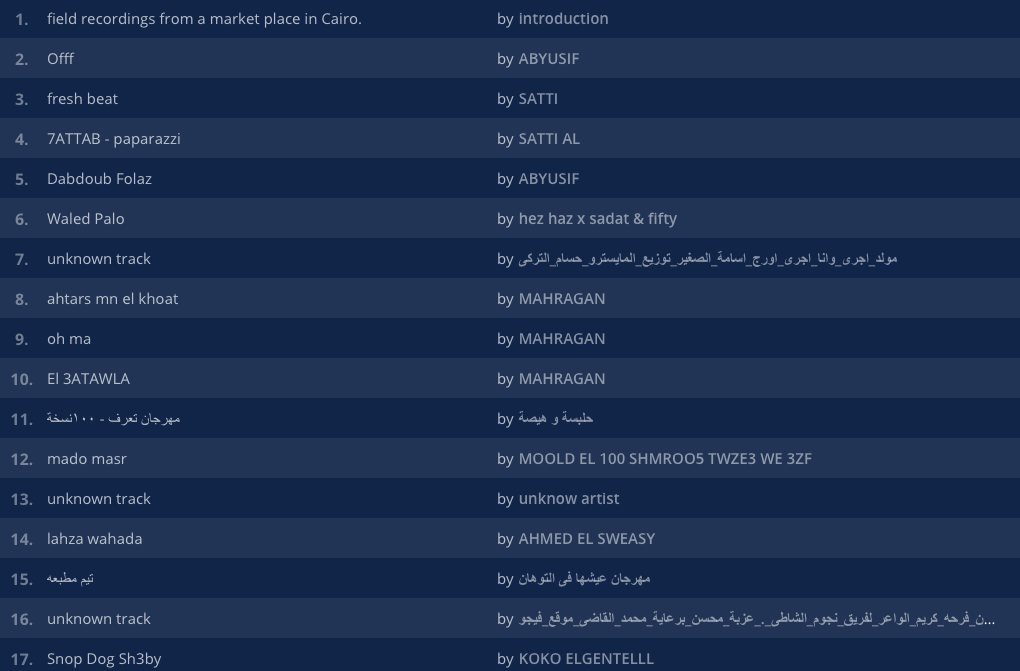
Ok, so I'm behind on posting...this is from 4 months ago, sorry! In any case, it's an excellent one from France's DJ No Breakfast, great fun, and it gives a sense of the great variety and clever mixing going on today in the mahraganat and hip hop scenes in Egypt. I really like what Abyusif is up to on the mahraganat front, and Satti is very cool too -- categorized as rap, I guess. The songlist is to be found here.
Here are a couple fine photos I found awhile back of the mahraganat scene -- I can't remember the source. If anyone knows let me know, it's important to give credit. I've now found the source for the top one: it's from CBS News, a wonderful portfolio of photos of the mahraganat scene. This is from a concert in April 2013.
(Nariman El-Mofty/AP)
This one is from the Manchester Guardian, "The World in Pictures," Jan. 2, 2014. It's a bachelor party with mahraganat music in El Marg, a large and very populous informal district on the northeastern edge of Greater Cairo.
Professor of Anthropology, University of Arkansas. Author of Memories of Revolt: The 1936-39 Rebellion and the Palestinian National Past. Co-editor of Palestine, Israel and the Politics of Popular Culture and of Displacement, Diaspora, and Geographies of Identity.