Wednesday, October 26, 2011

How the New York Times spins the news (misleadingly) on #occupyoakland

Check out this. Here's a screengrab of what is on the New York Times home page right now (10 a.m. Eastern Standard Time, October 26, 2011):


If you click on the link right now, you will get to a page that says this:


The blog headline is much more accurate, in fact almost the exact opposite, of what it says on the Times' home page. (I.e., the home page depicts the protesters as the aggressors, the actual report suggests that the police were the aggressors.)

If you read the article, you will note that the headline could in fact be much improved. It should read, "Oakland police fire teargas, rubber bullets, beanbags, and flash grenades at largely peaceful protesters."

This is one for the ombudsman, no? And for journalism students.

#occupy

Tuesday, October 25, 2011

Grimes (Claire Boucher) Kufiya


How about that for a kufiya? I came across this one thanks to an article by Simon Reynolds (New York Times, October 7) about new women artists with a penchant for synthesizers who are making feminized electronica (that's more or less how Reynolds puts it). They sounded interesting, so I checked some of them out. I found this photo at the website for Arbutus Records, which is Grimes' (the stage name for Claire Bouchard, of Montreal) label. Go here and you can download two Grimes albums (Halfaxa and Geidi Primes). I tried to pay but the site wouldn't let me, so I grabbed them for free. They are definitely worth a listen. I am quite gobsmacked by how Boucher uses the kufiya. She definitely has a unique look.

Monday, October 24, 2011

Arab Traces: Grace Slick in Jefferson Airplane's "The Ballad of You & Me & Pooneil"

One of my favorite Jefferson Airplane songs, off of After Bathing at Baxters (1967). There's a lot of melisma in this song from Marty Balin and especially from Grace Slick. It's not the kind of melisma that has become so banal and over-used courtesy of Mariah Carey and American Idol. Check out what Slick does with her voice from around 2:43 to 2:45 on this song. Listening to Arab singers must have been an influence. Umm Kalthum? Bob Dylan did.

It's not just the pot, or the LSD.


The quality of the sound on this vid is pretty lousy, perhaps deliberately so. So go out and buy a decent copy already. Finally, isn't Jack Cassidy's bass solo, starting at 2:08, just to die for?

Other, random, Arab traces in the Airplane. From "White Rabbit," this lyric: "Tell them a hookah smoking caterpillar/Has given you the call."

Sunday, October 23, 2011

Kufiya'd Keira Knightley in 'Domino' (2005)


I'm surprised that none of my more avid movie-watching friends spotted this before me. Kiera Knightley plays Domino, a hard-assed bounty hunter in Domino (2005), alongside Mickey O'Rourke (who turns in a creditable performance as Ed) and Edgar Ramirez (as Choco). I found the film pretty enjoyable, although the effects, courtesy director Tony Scott, are sometimes too over-the-top for my tastes, and the plot makes little sense. (But neither for that matter did that of The Big Lebowski.)

Knightley as Domino appears garbed in the purple kufiya pictured here several times. I intend/hope in future to get hold of the DVD and take some photos of all the scenes (which occur at about 30 minutes, 45 minutes, 1 hour and 1:15, for those who need to know) when I have the chance. These shots were what I could pull off the web. Domino (the film is based very loosely on the real-life story of Domino Harvey, daughter of actor Laurence Harvey) as played by Knightley is a tough, reckless, gorgeous young woman who can handle guns and nunchucks (shown above) expertly and can tangle with the best of them. No doubt the kufiya, along with the leather jacket that she also wears frequently, is here to contribute to her tough-bitch image.

In terms of the history of kufiya craze in the West during the aughts, the appearance of the kufiya in Domino precedes, by just a bit, the full blown kufiya explosion of 2006-2007 (quite a bit of which was documented here, on hawgblawg).

As for the film, it received a lot of bad reviews. But the New York Times' Manohla Dargis rather liked it.

Monday, September 26, 2011

hijabistas

Entrepreneurial Muslim women, making modest dress mainstream in Europe.

Her customers include non-Muslims too. "You don't have to be Muslim to prefer conservative dress," she said.

Saturday, September 24, 2011

Lupe Fiasco waves Palestine flag in concert, and endorses Palestine's admission to the UN

This happened when Lupe Fiasco played at the Merriweather Post Pavilion in Maryland on September 16.


The vid below gives the wider context. It seems that a fan, waving the Palestinian flag, jumped up on stage during the performance of Lupe's "Beautiful Laser." As an impromptu gesture, Lupe took the flag and talked about the fact that the Palestinian leadership was going to the UN on September 23 to request UN membership. Lupe expressed his endorsement for the move, and then asked the fan if he could keep the flag. The crowd cheered Lupe's pro-Palestine sentiments, and booed when he mentioned the US intention of a veto.


Lupe Fiasco was spotted wearing kufiyas during the so-called "kufiya craze," and I (of course), blogged about it here, saying that unlike many kufiya-clad celebrities, Lupe was probably quite well informed about Palestine, and given that he is an (out) Muslim. His Palestine endorsement in Maryland last week certainly supports the point.

To quote the flag-waving fan: Long Live Palestine.

P.S. (added a few minutes later)

Will put me onto this, from Lupe Fiasco's song, "Words I Never Said":

Limbaugh is a racist, Glenn Beck is a racist
Gaza Strip was getting bombed, Obama didn’t say shit
That's why I ain't vote for him, next one either
I’m a part of the problem, my problem is I’m peaceful
And I believe in the people


And some more lines:

I really think the war on terror is a bunch of bullshit
Just a poor excuse for you to use up all your bullets...


And these, showing that Lupe will throw his criticisms fearlessly:

Now you can say it aint our fault if we never heard it
But if we know better than we probably deserve it
Jihad is not a holy war, where's that in the worship?
Murdering is not Islam!

And you are not observant
And you are not a Muslim
Israel don’t take my side cause look how far you’ve pushed them

Tuesday, August 16, 2011

Kufiya'd protester in Lebanon: Down with Bashar

Via The Middle East Channel, August 16, 2011, this photo:

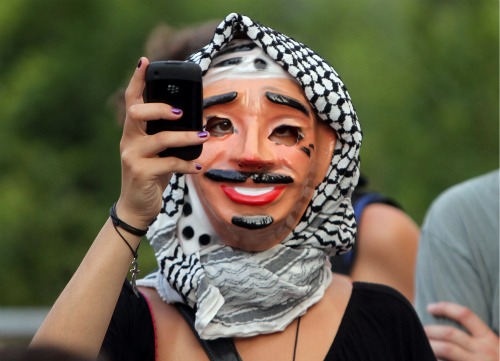
with this caption: A woman wearing a mask and an Arab Keffiyeh head dress uses her mobile photo to record a protest in the Lebanese capital Beirut in support of the five month uprising in neighboring Syria, on August 15, 2011, as Syrian troops clamp down on flash point towns and cities (ANWAR AMRO/AFP/Getty Images).

I'm not sure whether this is supposed to be an Arafat mask. My guess is that the woman is wearing a mask not so much to identify with Arafat as to disguise herself, since demonstrators in Lebanon who have come out in support of the democracy movement have, on occasion, been attacked by local agents of Syrian intelligence, to wit, the local branch of the Ba'ath Party that is affiliated with Syria and by members of the SSNP (Syrian Social Nationalist Party, ex-PPS).

Saturday, August 13, 2011

British Urban Music and the Riots

This is probably the most interesting commentary on the riots in England that I've seen, primarily because you hear the voices of the artists who, collectively, are being blamed for the 'disturbances.' ("Rap responds to the riots: 'They have to take us seriously'" by Dan Hancox, The Guardian, August 12, 2011.)

The artists are so incisive, so smart, and their music is so brilliant. Professor Green, Lethal Bizzle, and Wiley. Mostly "grime" artists, not "rap." Please read, and please watch the vids. Here's a particularly terrific one, Lethal Bizzle's "Babylon's Burning the Ghetto," from 2007. Prophetic, no?


If all those pundits and talking heads in England who are blaming "rap" for the riots really knew something, or anything, about the history of rap, they would know this: after the LA Rodney King riots of 1992, rappers were widely blamed. In fact, if one had been following the rap of artists like Ice Cube, NWA or Ice-T, one could have predicted that LA was headed for a blow-up, and one could have understood the sources of the rage that boiled over in the wake of the acquittal of the officers charged with beating King. Ditto: grime, UK hip-hop and road rap, as this article makes clear.


Saturday, August 06, 2011

Tahrir in Tel Aviv (traces, at least): Irhal!


"Irhal" or "Leave!" was the slogan of the Egyptian revolution. And he (Mubarak) did leave. Let's hope for an early exit of Bibi too. The photo is from the progressive Israeli blog +972. The banner says "Irhal" in Arabic, and in Hebrew, "Egypt is here!" It was taken at today's demo in Tel Aviv, which numbered an estimated 200,000, in favor of social justice, and in particular, focusing on the housing crisis.

According to +972, among those who addressed the rally in Tel Aviv was Palestinian author Uda Basharat, who stated: ”It’s about time this protest will be become the protest for all those exploited, Jews and Arabs.”

Connections between Israel's housing movement and the so-called Arab Spring have been, on occasion, raised explicitly. Joel Beinin reports in an absolutely essential piece on the connections between today's social struggles in Israel and the Arab Spring (published by Middle East Report Online) that: 'During the first week of the protest one Rothschild Boulevard demonstrator interviewed on Israeli radio’s Channel 2 told a reporter, “We have to do what they did in Egypt. Yalla, tahrir, jihad.” The fact that a middle-class Israeli suggested, even if it was only rhetorical excess, that this Israeli movement had anything to learn from an Arab political phenomenon is astonishing and unprecedented, to say nothing of the use of the hyper-provocative word jihad.' Beinin also underlines the important obstacles to the explicit making of such connections.

Note too this excellent report from The Real News, which shows large numbers of protesting Israelis last week chanting, "Mubarak, Asad, Bibi Netanyahu!"


The best slogan to come out of Tel Aviv would be one, however, where "irhal" referred not to the departure of Bibi from politics but the departure of Israeli troops from the West Bank and the Gaza Strip.

Thursday, August 04, 2011

El Tanbura Live, "Old Port Said"

One of the most fabulous things I did while in Cairo in late March was go to see the group El Tanbura perform on March 24, at El Tanbura Hall in Abdeen. El Tanbura perform Egyptian "folk" music from the city of Port Said. Port Said's music is famous for being driven by an instrument known as the simsimiyya, the lyre. (I've posted on El Tanbura previously here.) El Tanbura was actively involved in the protests at Tahrir from January 25-February 11 (see this video), as were other groups affiliated with the El Mastaba Center for Egyptian Folk Music, established by Zakaria Ahmed, who performs with El Tanbura.

I was told that a song or two of El Tanbura's revolutionary repertoire were quite popular among the crowd at Tahrir. This is one of them. I've been unable to identify an Arabic title for the song. In English it's "Old Port Said." It's a nationalist song, about the Suez Crisis of 1956, when Egypt's president Gamal Abdel Nasser nationalized the Suez Canal, and was attacked by Israel, France and Great Britain. CNN recently published a report on Egypt's revolutionary music on the occasion of the performance of Egyptian musicians (including El Tanbura and Ramy Essam) at the Barbican in London. It discusses El Tanbura and has a link to a recording of "Old Port Said." You can also read more about El Tanbura here.


(I filmed El Tanbura with Zakaria Ahmed's permission. Zakaria is the one who introduces the song.)

Saturday, July 23, 2011

Anthony Shadid on "Yalla Irhal Ya Bashar": Syria's Revolutionary Anthem

Check out his video report here, and his article in the New York Times, yesterday, here.

The vid, with performance by Ibrahim Qashush (whose throat was cut soon thereafter) is here, with subtitles.


Note that the subtitles do not capture this: at about 2:30 the chanter says "ru7 sale7 7aref il S" which means go fix your pronunciation of the letter S, referring to Bashar's lisp! (Thanks to Yusef for this.)

Saturday, July 16, 2011

No SCAF Rap: Message to Tantawi, by Ramy Donjewan

I've been complaining of late that the role of hip-hop in the "Arab" Spring has been somewhat exaggerated. I plan, or I should say, hope, to do a post on this later, once I've thought it through more. But I really like this rap, from Ramy Donjewan, that was posted today on youtube.


It's called "Message to Tantawi," and it is just that, a message to Field Marshal Mohamed Hussein Tantawi, the Commander-in-Chief of the Egyptian Armed Forces, the Minister of Defense, and the chair of the Supreme Council of the Armed Forces or SCAF, which has ruled Egypt since the departure of Hosni Mubarak on February 11. The message to Tantawi is in his capacity as the head of SCAF. The democracy movement in Egypt has become increasingly frustrated with the SCAF, and in particular, of late, its failure to prosecute effectively those responsible for the 800+ deaths at the hands of the security forces during the revolution. Donjewan articulates this, and other demands, and frustrations of the revolutionary movement.

I like this song's flow, its lyrics, the calculated urgency of the Donjewan. Its slow, measured beats, convey a sense of dread, and the simple, repetitive guitar playing adds to the effects. I especially like the chorus, which can be translated as: What we did at first we'll do again Tantawi if our demands aren't implemented. (It's very poetic and effective in Arabic.)

(Once again, I urge someone who can do it quicker and more effectively than me to translate the lyrics of this song.)

You can download the song for free here.

Donjewan put out a song right before the start of the revolution, called "Against the Government," that was quite fantastic as well. Check it out here.

The title of this post: No SCAF Rap, is lifted from the 3Arabawy blog, where I first learned about this song.

(Footnote: the wikipedia entry on Tantawi says he's of Nubian origin, but the sources for this claim are gone. Is this true?)

UPDATE (later the same day): Robin translated a bit more: "Oh Tantawi, my brother's blood is very dear, and we are not making threats... where is the right of the poor, the one who died?"

Ultras in kufiya (Cairo, Tahrir)

One of the great stories from the Egyptian revolution is how the "ultras" (fanatical football/soccer fans) of Cairo's two main clubs, Ahli and Zamalek, played a key role in defending, and in fact saving, the Revolution, on the night of February 2nd. When I was in Cairo, a good friend (and a reliable source) told me about how, on that night, when the thugs (baltagiyya) of the regime attacked, the word was sent out from ultras on the square, and 2000 more ultras showed up to organize those on Tahrir, many of them middle class youths not so accustomed to street fighting, as well as to fight for the revolution themselves. As my friend explained, the "ultras" detest the police, who have been as tough on them as on any Egyptians causing "trouble," or not. They've experienced the beatings, the torture, the abuse that so many young Egyptians have routinely faced at the hands of Egyptian security. And, what is more, the ultras have lots experience fighting the police and the security. The other key force that came to the rescue of the revolution on the night of February 2 were the Muslim Brothers. Their leadership was also called from the square when the regime thugs launched their attacks, and so the Brothers sent out about 2000 of their own "self-defence squads," i.e., their toughs, their enforcers. A coalition of ultras and Ikwhan therefore saved the revolution that night, along with the less-experienced but willing-to-fight thousands of pro-democracy demonstrators who were already there. (A great source on the intersection of politics and Middle East soccer is James Dorsey's invaluable blog, The Turbulent World of Middle East Soccer. He has posted several times about the role of the ultras in the Egyptian revolution.)

This Friday, July 15, the Brotherhood boycotted the protests at Tahrir. But the ultras were there, as this photo, and account, from 3Arabawy, shows. And I quote:


Ahmed Bahar and Tarek “Masaken” of Zamalek’s Ultras White Knights in Tahrir Square on Friday night. 


I had an interesting chat with Tarek, a young UWK member who’s also a staunch pro-Palestine supporter. He told me he’s been attending demos in solidarity with Palestine since he was a prep school student. Both Bahar and Tarek in addition to thousands of other UWK members took part in the January uprising, and their role, as well of that of the Ultras Ahlawy, were sometimes central in confrontations with the Central Security Forces troops on the Friday of Anger, and against the thugs during the “Battle of the Camel” on 2 February.

It's great to learn that some of the ultras are not just struggling for democracy in Egypt, but are also supporters of the struggle of the Palestinians. And please note the Che t-shirt.

kufiyas: Cairo airport and Riyadh shopping mall


This is from Cairo airport, July 2011 (thanks, NT). You might think this represents an Arab woman in "traditional" fashion, but women don't usually wear kufiyas as headscarves. Swarovski is an Austrian company that produces lead crystal and other related luxury products, so this mannequin doesn't seem to have anything to do with the kiosk behind it.

Then there are these, from Mamlaka Shopping Mall, in Jedda, Saudi Arabia, January 2010 (thanks, EC). Very deluxe kufiyas, that have nothing to do with Palestine solidarity or any progressive politics whatsoever, and everything to do with elite Saudi identity. (The red kufiya, with white dishdash, is traditional Saudi dress.)  Kenzo, Lamborghini, Borsalino, Versace: very swank. Please get me a Versace next time you're in Jedda, won't you?


Monday, July 11, 2011

kufiyaspotting: "Nick and Norah's Infinite Playlist" (2008)


Nick (Michael Cera) and Norah (Kat Dennings) are on the track of a band called Where's Fluffy. They get to a NYC club, where everyone is waiting for the late-night appearance of Where's Fluffy. This band (Are You Randy) comes on instead. Everyone is disappointed, boos, and leaves. Except for one loser, who takes his shirt off and dances around like a loon. The fact that the deejay of the band (played by Sammy Marc Rubin) was wearing a cool kufiya didn't dissuade anyone from leaving.

Monday, June 27, 2011

Coke & Pepsi and the Egyptian Revolution (+, yes, kufiyaspotting)

Like all companies trying to make money in the new Egypt after Mubarak, Coke & Pepsi are trying to ride the revolution. (Thanks to Robin for calling them to my attention.)

Check out this ad from Coca-Cola, with the theme, "Make Tomorrow Better." We see the middle class youth of Egypt (the presumed revolutionary subjects) ushering in a new dawn. Note that the focus is entirely on Cairo's downtown, which has both been a site that the upwardly mobile in neo-liberal Egypt have been fleeing for the upscale satellite suburbs, and which is also the focus of plans for gentrification. Finally, and perhaps most significantly, note the penultimate shot, which shows Tahrir Square, with a crowd (meant, of course, to evoke a demonstration, right before the last shot of a young person drinking a bottle of Coke.


Then check out this Pepsi advert. Again, the middle class youth of Egypt are the subject. They are shown to be adding color (literally) and life to Cairo's downtown (which has, in fact, been renovated in recent years). They possess the trappings of advanced modernity (flat screen televisions, laptops) and also evoke the youth of the revolution. This young woman carries the iconic cellphone (the "twitter revolution") and, yes, yes, you guessed it, she wears the requisite iconic accessory of the revolution, the kufiya.


And towards the end of the video, youth begin to gather at a street intersection in what looks like it could be a demonstration, and from a balcony looking over the intersection, a young man gives an enthusiastic revolutionary salute, with a can of Pepsi in his hand.


The overall theme is "express yourself." Among the lyrics of the song are the lines, "you are the new, you are the unique," and "tomorrow is waiting for you." And here's the vid:


Don't be too surprised, or dismayed. Both Coke and Pepsi attempted to ride the waves of the sixties counterculture and oppositional movements in the US.

Here's a "psychedelic" ad from Pepsi, from 1969.


And one from Coke, featuring Lady Soul Aretha Franklin, from 1968, when she had only recently crossed over, as a sign of Black Pride.


Big capital will, of course, inevitably, try to profit from the revolutionary fever...

Update (one hour later): Just a bit after I posted the above, I came across an article from Al-Masry Al-Youm on the same subject (although less critical), entitled "Soft-drink giants ride wave of post-uprising optimism." “It’s about empowering youth to come up with ideas and do something about them,” said Karim Khouri, managing director at Impact BBDO, the agency that designed ads for Pepsi.

Sunday, June 26, 2011

Songs of the Syrian Revolt

It's thanks to Iman that I know about these two songs.

The first is by Syrian singer Samih Choukeir. I knew nothing of him before hearing this song. What I now know is based on this wikipedia entry, in Arabic. He is an established artist in Syria (or at least he was--who knows, after this song!), active since 1982, composing for the theater and t.v. serials as well as performing his own compositions. He studied art in the Ukraine (like so many other Syrians, who got advanced degrees from Eastern Bloc universities prior to the collapse of the Soviet Union) and is married to a Ukrainian woman. He does not belong to any political party in Syria but appears to be on the Syrian "left." (Here's his official bio in English.)

The song, "Ya Hayf (Oh Oppression)," is dedicated to the martyrs of Dera'a, March 15. Dera'a is where the Syrian revolt started. (It's also where T.E. Lawrence was tortured, if you remember the film Lawrence of Arabia.)


This one features someone leading a call-and-response song at a pro-democracy demonstration in the city of Hama, uploaded on June 23. It's entitled, "Bidkum Bashar (You want Bashar)." The singer chants various lines of government propaganda, and then chants Bidkum Bashara, and the crowd responds loudly, "La wallah" (No, by God!). It's quite wonderful.


(Again, I hope someone will translate these into English, and other languages, at some point.)

Saturday, June 25, 2011

The Turban Makes a Glorious Comeback (last fall!)

Kirsten Luce for The New York Times

I clipped this article from the New York Times last fall, but it got misplaced in some pile or other, and I've just recovered it. I think it's still of interest.

It focuses on the claim of June Ambrose (pictured above) who, it says, wore a turban every day during New York Fashion Week. And it traces the current trend to a Prada show in 2006, which wasn't picked up, but then began to catch on by 2009. Kate Moss wore one at the Met gala in May 2009. And it started showing up on the street, on young women.

The new fashion connected them to "sophistication linked with Hollywood glamour of the 1920s and ’30s, when women like Garbo, Gloria Swanson and Joan Crawford wore them. “From way back, turbans signified a woman who was very educated and worldly,” said Caroline Rennolds Milbank, the fashion historian."

The article goes on to say that, 'Because turbans have historically been associated with Arab dress, it is tempting to connect them with the conflict in the Middle East. “They make a strong political statement, like wearing harem pants,” Ms. [June] Ambrose said. “We take an element of other cultures and internalize it”'

For his part, the curator of the Costume Institute at the Met, Harold Koda, 'isn’t convinced that they have anything to do with politics: “It’s not a part of a Kumbaya fashion movement. I think it’s more of Poiret’s view of Orientalism than women watching the news and referencing what’s going on in Afghanistan. It’s an exoticism, a sense of the other that is visually compelling.”'

Fashion historian Caroline Rennolds Milbank meanwhile 'noted that in the past, Western culture looked at the Middle East for its exotic form of dress, which was seen as sexually liberating. “If you look back at the portrayal of women in films like ‘1,001 Nights,’ ‘Lawrence of Arabia’ or even the television show ‘I Dream of Jeannie,’ the West depicted those women very sexually with sheer fabrics and an exposed midriff,” she said. “Going back to the turban is a return to the allure and sexiness of a foreign culture.”'

My opinion is not that it's a question of either/or. Probably the trend has something to do with Middle East politics--in some displaced fashion. And no doubt it's also rooted in the history of popular Orientalism in the US. Check out the slideshow that goes along with the article for more turbans. I particularly liked the photo of Nina Simone wearing one.

(credit: Associated Press)

I've posted a few times on turbans, as well as related Orientalist fashions. Re Maria Montez and Lana Turner, here. Rudy Ray Moore and more here. Beyoncé here. Kim Wilson. Chuck Willis. The Fabulous Ottomans and Sam the Sham. Prince and Prada. Ongoing obsession.

Gaza (dancehall version)

(Niketa Thomas, New York Times, June 19, 2011)

There's no evidence that Vybz Kartel gives two whits about Palestine's Gaza. Gaza is the name of Vybz's dancehall posse, as well as the name of the section of the Waterford housing scheme in Portmore, Jamaica, where Vybz Kartel grew up. He is also known as Gaza Emperor. Gully is the name of the actual gully which bisected Cassava Piece in St Andrew, where Vybz's rival Mavado grew up, and it's the name of his posse. Gaza/Gully feuding is constant in Jamaica. Read more here. (Thanks to Wayne Marshall for the reference. Don't blame Wayne for the fanciful account of the 'real' Gaza.)

(There is also a 'Tel Aviv' area in central Kingston.)

Vybz has released two albums called Pon Di Gaza. Please check out his Mavado dis song, "Pon Di Gaza":


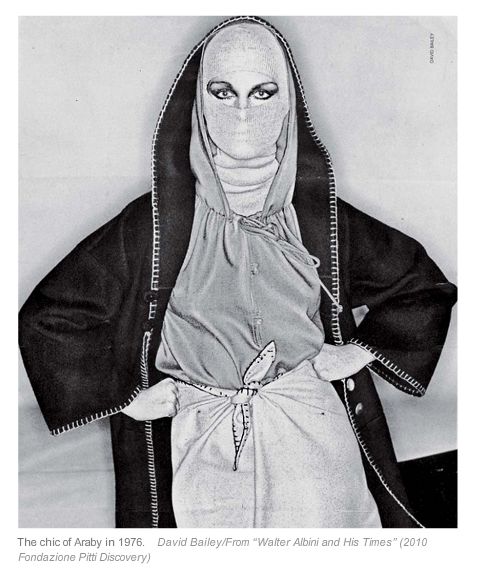
Chic of Araby


Italian designer Walter Albini created this in 1976 (photo from the New York Times, Oct. 12, 2010). Read more about him here. You'd think that, today, the more germane term would be hijab chic.

The phrase, Chic of Araby, isn't original. In fact, the Times used it for a men's fashion spread in Spring 2010. Below is a representative photo. Very Lawrence of Arabia retro. More here. (Maybe the Times got the name from the John Abercrombie 2009 track.)

Is White the New Black?

"Beyond the Pale" -- Kelefa Sanneh in The New Yorker, April 12, 2010.

Friday, June 17, 2011

Kurdish Kufiyas/PuĹźis

(Photo by Jodi Hilton for The New York Times. Caption: "Kurdish youth commemorated the 1977 May Day massacre last month during a march to Taksim Square in Istanbul")

This photo appeared in a recent article in the New York Times about the Kurdish struggle in Turkey for cultural autonomy, and particularly in the field of music.

I found the article quite enlightening, but I was, of course, particularly struck by the photo, which features Kurds wearing very stylish kufiyas. These are known in Kurdish as puĹźis. The puĹźi is traditional wear for men in Kurdistan, and is often taken as an insignia of Kurdish identity. In my investigation of kufiyas, I've not yet devoted much time to the Kurdish angle.

An article in the Turkish newspaper Hurriyet states that kufiyas/puĹźis have also become trendy in Istanbul, and that the origin of the trend is via the West. One vendor claims that it was due to the fact that Angelina Jolie was spotted wearing one. (I've not seen a photo of this. But I will look.) The kufiyas, in multiple colors, are made in Syria, the article claims.

But apparently, based on the evidence in this photo, it's not simply about trendiness. These Kurds are trendy, yes, but they are also political activists.

To be continued.

Wednesday, June 15, 2011

not your 'typical' electronics musicians

photo: Abdel-Rahman Hussein

Meet Yara Mekawie and Ola Saad, performing "abstract minimalist electronica" at the 100 Live Electronic Music Festival in Cairo last Thursday (as reported by Abdel-Rahman Hussein in Al-Masry Al-Youm).

Surprised by their "Islamic dress"? Yes, contemporary Egypt continues to surprise.

The 100 Live Electronic Music Festival is put on by 100 Copies Music, the Cairo label devoted to experimental music, and the label associated with the music of Ahmed Basiouny, who I have posted about several times, a martyr of the revolution.

I've not been able to learn much more about these two artists, who perform as RGB, other than what is written in Al-Masry Al-Youm. What I find of note is this:

1. RGB's music is very conceptual. Their performance was not, they say "about making music." “It’s about the sound and trying to convey colors through it,” Saad told Al-Masry Al-Youm. Mekawie concurred, adding, “When you hear what we do, the intent is for you to see light.”

2. They cite Ahmed Basiouny as their inspiration.

3. According to Hussein, "their work evokes Brian Eno and Robert Fripp’s “sonic landscapes” pioneered in the 1970s, but is more minimalist, less textured."

4. Most interesting, perhaps, is that the duo claim that the fact that they are women, and the only women in the festival, is "irrelevant." "The important thing is what we do."

The fact that they wear "Islamic dress": not even mentioned. At all.

Tuesday, June 14, 2011

Sennheiser headphones kufiya


Thanks to both @southsouth (who blogs here) and @wayneandwax (he blogs here) for informing me about the kufiya in the packaging for Sennheiser headphones. (Sennheiser is a German company.) I've used @southsouth's photo, which is to be found here. Wayneandwax's is here.

Hip, eh? Powerful bass goes perfectly with a kufiya, no?

And thanks to all my kufiyaspotting friends and comrades.

Friday, June 03, 2011

Oh so hip Wal-Mart


Another Wal-Mart Shareholders' Meeting has descended upon my hometown, Fayetteville. And more pop stars have joined the Wal-Mart Hall of Shame, lending their voices to shill for one of the world's premier anti-labor corporations. This year brought us: Will Smith, Black Eyed Peas, Alicia Keyes, Darius Rucker, and Bob Seger. Previous years have brought such luminaries as J-Lo, Beyoncé, Kool and the Gang, Journey, Shakira, Taylor Swift...the list goes on and on.

Okay, let's forget about workers' rights, for the sake of argument. The Walmart Visitors' Center in Bentonville, on the site of Sam Walton's original Five and Dime store in that city, sits right across the street from a statue to Confederate soldier James Berry, erected on the town square in 1908 by the Daughters of the Confederacy. You can see how close that monument to the heroes of the War of Treasonous Secession is to the monument to corporate America from the photo above, which I shot on a visit to Bentonville a couple weeks ago.

Seriously, Will & Fergie & Alicia, couldn't you at least ask why Wal-Mart, with all its corporate power, doesn't insist that the statue to those who fought for their Confederate home and fatherland be taken down? Do you really need the money that badly?

And seriously, why does no one ever seem to complain about the fact that our beloved pop stars cavort so shamelessly for corporate power?

And then there's the issue of Crystal Bridges, the museum of American art that will open in Bentonville this November. It was initiated with funds from Alice Walton (daughter of Sam, founder of Wal-Mart, and the 8th richest American -- 3 of her siblings are alson in the top 10), and just received another huge endowment from the Walton Family Foundation. It will be a fabulous museum, and the architecture and the site promise, according to all reports, to be amazing. (Expect a report in the New Yorker soon.) And at the same time it will serve the function of art-washing: to clean up the Wal-Mart image through the Walton family's "disinterested" support of culture and the arts.

Wednesday, June 01, 2011

Lady Gaga gets the Bollywood treatment

Read about it (and watch the vid) in/on the Wall Street Journal here.

India is an appealing target for entertainers, as it has 700 million people under the age of 30.

And watch the Salim and Sulaiman Desi remix of "Judas" here:

Saturday, May 21, 2011

Kufiya and some Islamic refs in Digable Planets' "Where I'm From"


"Where I'm From" is off of Digable Planet's first album, Reachin' (A New Refutation of Time and Space), released in 1993. The best known single from the album is "Rebirth of Slick (Cool Like Dat)," a Grammy winner for best rap performance by a duo or group, and a crossover hit. Due to the album's jazzy feel and its apparently pop and light feel, the group was hailed by white hipsters and, as a consequence, got a reputation for being the opposite of hard and "street." A look at the video for "Where I'm From," which is all "street" scenes, and an investigation of the lyrics reveal that this impression was quite mistaken, and that there was a great deal of continuity between Reachin' (A New Refutation of Time and Space) and their second, much more overtly political album, Blowout Comb.

What I want to point out here are a few "Islamic" references. The kufiya worn by one of the Digable's posse in the video is one. As is the shot of some members of the Nation of Islam (NOI), including a woman in distinctive NOI dress (on left) and the man in bowtie, who looks like a member of NOI's paramilitary organization, Fruit of Islam. (Ladybug, a.k.a. Ladybug Mecca, is at the right.)


One line from Butterfly, whose influences seem not to drawn from any Islamic sources, goes "We be reading Marx where I'm from."

Meanwhile, one of Doodlebug's lines goes, "That's most asked by 85, where I'm from." This is a reference to the beliefs of the Nation of Gods and Earths (Five Percenters), that the world is divided into the 5%, those with knowledge of self, the poor righteous teachers, the "gods," the 10%, the bloodsuckers of the poor, who teach lies for the sake of personal gain, and the 85%, the masses, the people who are ignorant of the truth -- but to whom the 5% attempt to bring true knowledge.

Doodlebug (Craig Irving) hung out with Five Percenters while a student at Howard University. I don't know whether he considers himself to be a full-fledged "God," but he now goes by the name Cee Knowledge -- a very Five Percenter sounding name -- and tours with a group called Cee Knowledge & the Cosmic Funk Orchestra. The Digables' second album, Blowout Comb, is full of Five Percenter wisdom and references.

As for Butterfly (Ishmael Butler), his terrific, experimental-rap musical project Shabazz Palaces references the name of the ancient tribe that, according to NOI doctrine, settled in Mecca and then was led by a scientist, named Shabazz, into Africa. It was also the surname adopted by Malcolm X.

Shabazz Palaces' first performance in Seattle (where Butler is from) earlier this month certainly played up the Afro-Islamic imagery. Check out how Butler/Butterfly, who goes by the moniker Palaceer Lazaro, was decked out.


This was the poster for the show.


And check out the cover of Shabazz Palaces' 2009 album, Of Light.


My last example of Shabazz Palaces' crypto-Islamic references is from the group's 2009 video, "Bellhaven Meridian," directed by Kahlil Joseph, shot in Watts, which is a kind of tribute to Charles Burnett's film Killer of Sheep.

In this video the Arabic word
ينقذنا
appears at 0:36. It means "he saves us." I have no idea how it fits into the theme of the video.


Shabazz Palaces has recently been signed by Sub Pop, the first rap group the Seattle label has ever signed, and has an album called Black Up, due out in June.

One last thing. Cee Knowledge recorded a version of "Space Is the Place" with the Sun Ra Arkestra. Check it out. (Five Percent knowledge is afro-futuristic too.)

Thursday, May 19, 2011

Cleo Cola: Popular Orientalism

Cleo Cola by tsweden
Cleo Cola, a photo by tsweden on Flickr.


I found this item at the Walmart Visitors Center (the Walmart museum) in Bentonville. It's part of a display of soft drinks that used to be sold in Bentonville over the last several decades. Cleo Cola, the "Queen of sparkling drinks," bottled in St. Louis, was introduced in 1935 by the Whistle Company.


Note the resemblance of the outfit worn by Cleo to the popular Orientalism developed by the likes of Maude Allen and other Salomé dancers. I posted about this briefly here.

Friday, May 13, 2011

Popular Orientalism: Tuli Kupferberg in "Voulez-Vous Coucher Avec God?"


Here's another example of "popular" Orientalism, put to avant-garde and subversive purposes. It's not quite as subversive and avant-garde as Jack Smith's work, but it is still of interest.

I learned of this 1972 film, directed by Michael Hersh and Jack Christie, from a Facebook post by the Moorish Orthodox Church of America. It's called Voulez-Vous Coucher Avec God?, and all I really know about it is from this opening segment, featuring Tuli Kupferberg (of The Fugs) as God. God who speaks English with a strong Eastern European Jewish accent. God who smokes hash from the houka.


God who lives in Hashish Seventh Heaven, surrounded by a harem of barebreasted hippy bellydancers. Who loves Al Jolsen's "Swanee." Who sings The Trashmen's surf-punk avant-le-lettre "Surfing Bird."


Kupferberg is hilarious in this clip. I'm ambivalent about the claymation stereotypical-black figure in tarbush who introduces the film (see above). The barebreasted 'houris' of the harem are typical of the sixties counter-cultural sexual revolution, which seemed in large part to be about hippy women taking off their bras and tops so that hippy men could ogle them. But I've only seen this clip, so there may be more too all this. A DVD should be out later this year. The film has played in New York recently in tributes to Kupferberg, who passed away in July 2010. J. Hoberman wrote an interesting if short review of the film in The Village Voice, calling it "strenuously druggy, anarchic, and blasphemous," and writing that Kupferberg's God is "an unkempt, hairy schmoozer, consorting with his female subjects in a vaguely Baghdadian crash pad".

I continue to be interested in how significant a role Orientalist images of the Arab world and the Middle East played in avant-garde, counter-cultural, and hippy pop cultural manifestations of "the sixties." Besides several posts in hawblawg on Jack Smith, I've also written posts on the film Performance (here and here) and a few asides. More to come. I don't want to claim that such deployments of "Orientalism" are necessarily progressive, but I am against a certain kind of dogmatic and all-too-common deployment of Said's critique of Orientalism, that describes any Western consumption of "The Orient" as "flexible positional superiority," and therefore, exploitative.

P.S. If you don't know The Fugs, please check out their brilliantly hilarious zen nihilist song, "Nothing." "Social anthropology, uckalcucka, nothing."

Vigon, '60s 'soul man' of France: a Moroccan, real name Abdelghafour Mouhsine

I just learned about Vigon thanks to Jeff, who posted an AFP article on Facebook. I used Google Translate, and then modified the translation. (My French is very far from perfect, so if yours is better, please correct any mistakes. The original is here.)

Vigon, Moroccan "soul man," emerges from obscurity 40 years later

AFP, Oct. 9, 2008

PARIS (AFP) - He was a vegetable vendor in Morocco before discovering soul at U.S. bases and then becoming a minor star in Paris in the '60s: thanks to a reissue, Vigon, the singer with an amazing voice, is experiencing a second youth [revival], 40 years later.

"What is happening now is what should have happened 40 years ago," marvels the affable sexagenarian, delighted that a new audience discovering his music.

The Barclay (Universal) label reissued in early September an album of his songs, "The End of Vigon," in its vinyl series "Back to Black" and its CD vintage series "Vinyl Replica."


Critics were quickly excited about his covers of great soul / rhythm 'n'blues songs of Bob & Earl, Ray Charles and Bo Diddley, discovering, amazed, that in the "sixties" France had a singer to rival African-American masters of the genre.


Critics highly praised the velvety voice of Vigon and the song arrangements, the strings and the hot sweet brass worthy of Motown or Stax, yet "made in France."


"Even when it came out 40 years ago, there was not this much enthusiasm!" smiled the Moroccan, in dark glasses, elegant clothes, and the mock [?] air of elegant black-American singer Sam Cooke.


Vigon took that nickname from his childhood, when he mispronounced the word "wagon" in school.


He was born Abdelghafour Mouhsine in Rabat in 1945. At first working as a greengrocer with his father, he fell madly in love with R & B at the U.S. military bases in Kenitra and Sidi Slimane and he learned the standards phonetically, since he does not speak English.


"I was going to the grunts' [troufions] dances every Saturday, and there, they bought the records that came from America on the week of their release," he recalls. "Twist and Shout" by the Isley Brothers, it was sung in Morocco before the Beatles covered it!"

In 1964, he was on vacation in Paris and went to the Golf Drouot, the Mecca of rock music. He went on stage, bluffing the public and then joined the Lemons, along with another young man named Michel Jonasz on keyboards.

The group scoured the [music] scenes, Golf Drouot or Bus Palladium, made [assied] its reputation and opened the first [concerts] [in France] of Stevie Wonder, Otis Redding, Wilson Pickett, Little Richard, the Who and the Rolling Stones.


"In late September, I went to see Stevie Wonder at Bercy: when I think of that time we spent in night clubs and how crazy it was!" exclaims Vigon, who will sing Saturday and Sunday a Cidisc (Convention of record collectors) in Paris and then on Oct. 15 at the Petit Journal Montparnasse.

One of his singles, "It's all over", was released in 1968 on the American label Atlantic. [check out "It's all over" here, on youtube] The previous year he released his only song in French, "Un petit ange noir"
[on youtube here].

He returned to Morocco in the mid 70's for two weeks. "I stayed 23 years!" he enjoys explaining that he was a singer in a hotel in Agadir.


In 2000, back in France, where 60's retro fashion was once again popular. Vigon the showman performed regularly at private parties, and his fans included other artists from Morocco, the comedians Gad Elmaleh and Jamel Debbouze, at whose wedding he sang.

"I'm sometimes asked if America did not tempt me. But I never imagined, coming from Morocco, so it's not bad!" he assures. "Kid, I slept on a sheepskin. Now, in hotels, they say: 'Do you like the room?' It makes me laugh!"

The entry on Vigon on the French wikipedia tells us that Vigon's recordings were a critical, but not a commercial, success. And that he and his group, opened for Otis Redding, Bo Diddley and Stevie Wonder, at their first performances in Paris, at the Olympia, in September 1966. The video of "It's all over" (link above) features a number of photos of Vigon with the acts he opened for, including this one, with Mick Jagger.

Please check out this scopatone of Vigon performing "Harlem Shuffle," originally recorded by Bob and Earl in 1963. It's a pretty divine cover, and the dancers are pure sixties go-go.


And here are the jackets for some of Vigon's releases. The EP with "Harlem Shuffle" and "Un Petit Ange Noir."

This single has a cover of The Righteous Brothers' "Unchained Melody." The hair is to die for.

The cover of Vigon's only single released in the US, on Atlantic. Quite remarkable, given that Aretha Franklin also recorded on Atlantic at the time. Not to mention Solomon Burke, Clarence Carter, Wilson Pickett, Sam & Dave, Percy Sledge, Joe Tex...


Here's a photo of Vigon with his soul review, at the Olympia. Looking very James Brown.


Here's Vigon (looking like Jimi Hendrix) with French pop star Claude François, known for, among other things, penning "Comme d'habitude," the original version of "My Way." What I wonder is, what language did these two speak when they met. Claude François, like Dalida, was born in Egypt, in Ismailiya. His mother was Italian, his father, who worked as a shipping traffic controller on the Suez Canal, was French. In 1951 the family moved to Port Tawfik. The family moved to Monaco when Egypt nationalized the canal in 1956. If I remember correctly from David McMurray's article "La France Arabe" (in A. Hargreaves and M. McKinney, eds., Post-Colonial Cultures in France), Claude used to speak Arabic when he got together with Dalida's brother Orlando, who also served as her manager. But perhaps the gap between Vigo's Moroccan dialect and Claude's Egyptian was too great.

This is what Vigon looks like today.


Many of the photos are from this informative blogpost.

While writing this up, I came across another article, from Jukebox, which I will summarize soon. In the meantime, it's here.

Wednesday, May 11, 2011

Kufiya (+dishdasha) Watch: Snoop Dogg in Abu Dhabi


Or as U-Cef has put it, Shaikh Dogg. Wearing the prototypical dress of the Gulf Arab, the white dishdasha and the kufiya. (My knowledge of Snoop is not as deep as it should be, so if someone can identify this song, I would appreciate it.) Here's the video, filmed at Yas Arena, Abu Dhabi, UAE, May 6, 2011. (The screen grab is from this vid.)

Folk music of Isamailiyya: the El Waziry Group

One of the best things I did while in Cairo in late March was to go to see the El Tanbura group perform at El Tanbura Hall in Abdeen. El Tanbura play the music of Port Said, which is well-known for the fact that its central instrument is the simsimiyya, a lyre of very ancient origin. (There are paintings of the instrument on the tombs of the Pharaohs.)

Here's a photo of El Tanbura Hall, from the outside.


And here's a shot of some of the members of the group, from their concert on March 24. The photo shows two simsimiyyas. I filmed the concert, and hope, eventually, to post some of the concert footage on youtube.


El Tanbura Hall is a project of the El Mastaba Center for Egyptian Folk Music. You can read about El Mastaba here. It was founded by Zakaria Ibrahim, who I met, and who performs with El Tanbura. El Mastaba sponsors a posse of groups who perform regularly at El Tanbura, including Rango, who are absolutely terrific and who you can read about here. El Mastaba has also issued a number of CD's, which are excellent, and are for sale at El Tanbura Hall.

El Mastaba participated actively in the Egyptian Revolution. Three groups associated with El Mastaba performed in Tahrir Square when it was occupied by pro-democracy forces: the Hinna band from Suez, from the El Tanbura band (Port Said), and the El Waziry band from Ismailiyya. Please watch a video of the El Mastaba groups at Tahrir here.

I recently read the posting below on Facebook, announcing a concert by the El Waziry group. I reproduce it below, because it provides an invaluable account of the history of the "popular art of Ismailiyya," which flourished from the 50s til 1967, and which El Mastaba is doing its best to revive and to promote. I don't know who wrote the text below (it's translated from Arabic), but I hope the author will not mind my attempt to recirculate it. It announces a performance by the El Waziry group at El Tanbura Hall, that will happen tomorrow, Thursday May 12. Wish I could be there. In the meantime, I do have a CD from El Waziry himself: El Wazery & Suhbagiyya, Wallah Zaman (El Mastabah Center for Egyptian Folk Music, 2006).

El Mastaba Center for Egyptian Folk Music presents

El Waziry Group

The three cities of the Canal (Port Said, Ismailiyya and Suez) share similar traditions of music and song, though each has its special features.

Three tributaries combined to bring these arts to Ismailiyya, which is located half-way along the Canal. The first of these was the Sudanese, who have lived in the oldest quarters of the city–the “Slave Stockades” (‘arayshiyyit il-‘abid)—since it was built in the last third of the nineteenth century. The second was the interaction of local musicians with others from Port Said or Suez, as well as with the shipping passing through the Canal, which, at the end of the 1930’s, brought the instrument known as the simsimiyya (a type of lyre). And the third was the influence of the other shores of Lake Manzalla, at one end of which Isma’iliyya lies, and especially that of the fisher families living in ‘Izbit el-Bahtini, who brought with them fishing songs and the songs of the damma (“street gathering”- a genre with its roots in Sufi music).

On the streets of the city, these tributaries mingled to produce what may be called “the popular art of Ismailiyya,” which flourished from the beginning of the 1950’s up to the war of June 1967.

After the war, the inhabitants of the city were forced to migrate to areas further inside Egypt, far from the battle line. In their diaspora, in the cities and villages and displacement camps, the people of Ismailiyya survived, and shared their singing with the displaced from Port Said and Suez, to the accompaniment of the simsimiyya, which, with its songs expressive of their common concerns, played an important role in creating a bond among them.

With the end of the war and the return of the displaced to their cities, things were different, in Ismailiyya as in the rest of Egypt. When the “open door” economic policy was adopted, social values changed and, at the beginning of the 1970’s, the trend towards commercialism started to take over the old artistic tradition. Competition for the rich pickings of the wedding market intensified, leading to the withdrawal from this field of the authentic musicians, as some died and others retired.

Only one, the musician Muhammad El-Waziri, refused to retire into obscurity and continued to cherish his own simsimiyya, though he had no idea what to do with it on his own. Things changed when El-Waziri met the writer, and embarked on a relationship with the Tanbura troupe experiment in Port Said, which attempted to collect the music and songs of Port Said by bringing together the old musicians, who, like their fellows in Ismailiyya, had gone into retirement.

The legend "Muhammad El-Waziery" the king of simsimiyya at Canal zone had passed away in 2008 in the age of 73 years old, cuddling the simsimiyya instrument and leave the heritage of Ismailia city in the hand of his troupe which he was the leader of it (Souhgbagya group) and we changed its name to "El Waziery group" in recognition of his history and saving the heritage of Ismailia city.

Now there was hope that what had happened in Port Said might happen in Ismailiyya, as, together, we were able in the same year to begin the foundation of the El Waziery troupe, by bringing together the old popular musicians of Ismailiyya to prevent the loss of this heritage.

To date the El Waziri Group have performed a number of times, in Ismailiyya itself and in Port Said, Suez and Cairo, gaining new friends all the time.

Thursday, May 05, 2011

Even more Ahmed Basiony (Bassiouny)

Ahmed Bassiouny, Tahrir Square, Feb. 28

Here is a fabulous website dedicated to Ahmed Basiony (Bassiouny), an incredible teacher, visual artist and sound artist. Lots of photos of his art and of his teaching and sound art workshops. Examples of his music. Articles about him. I recommend exploring in depth. I need to explore more myself. The more I learn about him, the more I am saddened, and the more I am impressed. One of 800+ martyrs of the Egyptian revolution, he fell to sniper bullets on February 28th, at Tahrir Square. May his spirit endure in Egypt's future.

Eskenderella, "Rag'een"

For the moment, this is just a place maker, and a tribute. I really like the Alexandrian music group Eskenderella. (And think about it, what a clever name!)

This is their song, Rag'een (returning), their tribute to the Egyptian revolution, and their first video. It is far better than most of the songs of and for the revolution that I have come across. It is certainly far superior to and has way more integrity than any of the martyr pop critically discussed by Dan Gilman. (See my earlier post here.)


Hopefully, in future, I will learn more. In the meantime, here's the one bio I've been able to find on the web. They are known for doing material by Sayyid Darwish, Shaykh Imam, and Ziad Rahbani, as well as original numbers.