Monday, August 22, 2016

Shows I've been to: Jefferson Airplane & Big Brother & the Holding Company, August, 1966


Early August 1966. I was 16, on "home leave" from Beirut with my family, staying with friends in Los Gatos, where we had lived before moving to Beirut in January 1964. I had friends in Los Gatos who played in a rock band (for the life of me I can't remember their name). The drummer was Randy Ritchie, who passed away in 2012. They took me along to the club, Losers South, in San Jose, on a few occasions, because they performed there on occasion. This was the first live rock show I ever went to in the US (I'd seen bands in Beirut, of course).

I don't remember whether it was the first night I went that I saw Jefferson Airplane perform. I was really blown away, I'd never heard anything like it. This was when Signe Toly Anderson was the female lead singer. She was to leave the band shortly thereafter, doing her last show in October 1966. The Airplane's first album, Jefferson Airplane Takes Off, was released in August as well, and I grabbed a copy and took it back with me to Beirut. Wish I still had it!

The opening band the night I went (not sure which of the dates) was Big Brother & the Holding Company. I have to admit that they were too loud and intense and I was not into them. This was less than two months after Janice had joined the band -- she first performed with them on June 10, 1966. Of course when I returned to the US in 1968 for college, I had seen the error of my ways, and I went to see them live that fall.

The one thing I remember about the show was that there was a go-go dancer onstage with the Airplane while they were playing. This was a common feature of shows in the early to mid-sixties but it went out of style with the rise of psychedelia. I think the presence of the dancer must have been something that the club management put on the program. I have to say that at the San Jose there was no flavor of the emerging psychedelic scene that was emerging 60 miles away in San Francisco. Check out this footage of the Airplane playing at the Filmore in 1966 -- there was no light show in San Jose, that's for sure. (The sound is not live, it's from the record, but you can see Signe Toly Anderson onstage.)


I found a blog post which has this to say about the Losers South club: "The venue never caught on, both because of the terminal unhipness of San Jose and the fact that Losers South was apparently notorious for not paying its acts (and no doubt, unlike the Avalon would not even give unpaid bands a kilo of weed)." Well, at least it was hip enough to book the Airplane and I got exposed! [Added 23 August: Another thing that was great about Losers South was that I was allowed in as a teenager, aged 16. There was no checking of ID. I didn't have one!]


The poster -- which I now of course wish I had snagged -- was apparently designed by Stanley Miller ("Mouse") and Alton Kelley, whose most famous psychedelic poster work was for the Grateful Dead.

Monday, August 08, 2016

Simsimiyya in Egyptian Popular Culture: El-Gizawy in "Fatat al-Mina (The Harbor Girl)"

In the very fine documentary Nuh el-Hamam (Wailing of the Doves), 2004, directed by Amir Ramsis, 2006), we learn that the Port Said singer and simsimiyya player El-Sayed Abdou Mahmoud, known as El-Gizawy, appears in the 1964 film, Fatat al-Mina' (The Harbor Girl), which is set in a village on the Suez Canal. (That's him on the left.)


He tells us that he worked as an ironer (mikwagi) and that he used to sing at parties in the street -- the traditional way that simsimiyya music, known as damma, was performed at the time. He says he was contacted by director Hossam el-Din Mustafa to appear in the film, which stars Farid Shawki, Mahmoud El-Meleigy, Nahed Sharif, and Nagwa Fouad. He says that he sings on two songs, but I can only find one. The song starts at about 31:45. Check it out.


When the group El Tanbura was formed in late 1988 under the leadership of Zakaria Ibrahim, el-Gizawy was one of the veteran artists recruited to join the project of reviving the Port Said musical tradition that seemed to be dying out. He appears as a singer on all four of the group's albums. Sayed Gizawy passed away in October 2015. Allah Yarhamu.

Blanca Li, Gnawa, Nana et Lila, Abdenbi Binizi (allah yarhamu)

In a previous post I wrote about Spanish dancer Blanca Li's connection with Hassan Hakmoun and Safia Boutella. Here is a bit from an article about Blanca Li by Luke Jennings that appeared in The New Yorker, April 28 & May 5, 1997, entitled "The Days and Nights of Blanca Li." The Etienne in question is Etienne Li, Blanca's partner, a Franco-Korean mathematician and graffiti artist who was posted to teach in Morocco in 1986.

Screen shots of the relevant sections:


Here's a video of excerpts from "Nana et Lila." It looks and sounds quite remarkable. Damn it, I was at the 1992 Avignon festival, missed it by one year! The Gnawa who perform are Gnawa Halwa from Marrakesh, led by the terrific singer and guinbri player, the late Abdenbi Binizi, who I had the privilege of meeting in Morocco in 1999.


Nana et Lila from Blanca Li on Vimeo.

Here's a video clip of Abdenbi performing by himself:


And a photo of him with Gnawa Halwa. 


Sunday, August 07, 2016

Mahraganat's march into the mainstream


I'm doing a lot of reading and video and movie watching on the topic of mahraganat for a writing project, and I thought I'd share this nugget.

In 2012 mahraganat artist Sadat was asked to compose a song for the mainstream film Game Over, released in June, a remake of the Hollywood release Mother-In-Law (starring Jane Fonda and Jennifer Lopez). The song, “Haqqi Bi-raqabti” (my right to my neck? -- help, please!)  appears in a scene where Egyptian film stars Yousra and Mai Ezzedine lip-synch it. The scene looks pretty fairly ridiculous, especially Yousra (at age 61) dancing and singing to the autotuned vocals of Sadat. 

Here's the scene:


Sadat’s name does not appear in the movie credits. I learned this from watching Hind Meddeb's 2013 documentary, Electric Chaabi, which you can purchase from Amazon. I highly recommend it. 

Very soon thereafter it would be hard to imagine mahraganat artists not receiving credit or anyone other than the artists themselves performing their own songs. 

As a footnote, I love Yousra, especially in Mercedes and Al-Irhab wa al-Kebab.

Ben Ehrenreich, Palestine and the Bendaly Family

Ben Ehrenreich's new book about Palestine, The Way to the Spring: Life and Death in Palestine, has been receiving rave reviews. I finally ordered it, and just started reading it. Only a few pages in, it's terrific. What really struck me on the first page was his description of how "Palestine has a way of enchanting people." He goes on to describe what hooked him. 


Yes, it was seeing and hearing a Palestinian kid singing that great number by the Bendaly Family, "Do You Love Me?" that captured Ehrenreich for Palestine.


Back in 2007 I did a post about the song called "Is this the best clip of Arab music ever?" Tongue in cheek of course, because the song is sung almost entirely in English, but also heartfelt, because it is great Arab music. And since then, a couple more posts, one with a bit more info about the Bendalys, and links to videos I particularly like, and another about a re-fix of the song by Dub Snakker. 

Great to know that the Bendalys continue to be loved. And finally, go read Ehrenreich's book.

Friday, August 05, 2016

Very cool Cheikha Rimitti 45" jacket


Isn't this great? First off, in Arabic the cover says al-Cheikh al-Rimitti, that is, the male form, and not Cheikha. And in Latin script, it says only "Rimitti." Now, it's not as if the record company (Oasis, based in Algiers) who put out this 45" didn't know who the artist was. The record itself says Cheikha Rimitti.


As does the reverse side of the record jacket.


Was the record company trying to entice buyers by tricking them into thinking the recording was by a male singer? Who knows?

(The source for the cover is here, from Jeremy Phillips, who made a shopping trip for vinyl in Morocco in 2014, and posted a mix based on his findings on Psych Funk. You can listen to the B-Side of the Rimitti release, "Zoubida Tendmi." It's straight-up Algerian cheikha music, known at the time as elklâm elhezal.)

The other cool thing about the cover is that the illustration is a cartoon, not a photo. I've not seen a Cheikha Rimitti record jacket with a cartoon on it before, nor do I recall in fact other rai recordings or for that matter, other Algerian recordings with a cartoon. Other Cheikha Rimitti record jackets I've seen have photos, and with possibly one exception, photos that are not of the Cheikha but of another woman, usually blonde and Western. Like this one (from the Casaphone label, based in Casablanca and Paris).


I did also find this recording, which features a drawing and not a photo. It's the jacket for "Ya Ouled El Djazaïr," also from Oasis -- but it's not a cartoon. This release, celebrating Algeria's independence, is from shortly after the FLN tossed out the French from Algeria, during the brief period of revolutionary ferment, when female artists like Cheikha Rimitti were not considered unrespectable, a period which ended in 1965 when Boumedienne toppled Ben Bella. You can listen to one version here, another here. I've no idea whether either of these are the original recording.


I posted about the "Balek Balek" record and someone commented that they had seen record jackets with the name "Cheikha Remettez" -- the spelling based on the story about how the cheikha got her name, ordering another drink at a saint's festival sometime in the 1940s. "Remettez la tournée," give me another drink. I'd love to see these.

And just for the record, I came across another photo of the Cheikha. She is the one with the tambourine. (I have to say, based on other photos I've seen, I'm not certain it is her.) The source is this blog post.


Monday, July 25, 2016

Star Trek Beyond marginalia: Safia Boutella

I've not yet seen Star Trek Beyond but I plan to. Safia Boutella, who plays the alien scavenger Jaylah, has received quite good reviews.


Safia Boutella, born in Bab El Oued, Algiers, is an Algerian dancer and actress. You can read about the high points of her career here.


She is the daughter of Algerian jazz musician Safy Boutella, who is best known to me due to the fact that he co-produced with Martin Meissonier, and and collaborated on, Cheb Khaled's great 1988 album Kutché. (He's shown on the cover reclining in a chair.) I have a longer post where I explain the context in which this album -- the first Khaled album produced in France -- is made, but briefly, the story is that members of the liberal wing of the Algerian government paid for its production and sent Khaled to France to produce it. It was not a major seller but it is the prelude to Khaled's 1992 breakthrough with "Didi" and the album Khaled.


Safia has worked with Spanish choreographer Blanca Li (born Blanca Gutierrez) since age 17 (she is now 34).


It was Bianca Li who recruited Gnawa musician Hassan Hakmoun in 1986 to appear in a collaboration called Trio Gna & Nomadas, a "fusion" project involving a Gnawa group (including Hakmoun) and a Spanish dance group (flamenco, modern) led by Bianca's partner Etienne Li, and in which she danced. You can see a video here, with a number of photos. Trio Gna & Nomadas traveled to the US in 1987, and Hakmoun stayed, in New York, where he has been ever since. He put out his terrific first album, Gift of the Gnawa in 1992. And he performed together with Adam Rudolph at the MESA meetings in San Antonio in November 1991, which is when I first became familiar with him.


So, the connections: Star Trek - Khaled - Hassan Hakmoun. There you have it.

One more: Blanca Li also collaborated with the late great Gnawa artist Abdenbi Binizi, who sang on her project "Blanco Y Pan." Check out the CD by Gnawa Halwa called Rhabaouine.

Tuesday, July 19, 2016

Review of Aziza Brahim's "Abbar el Hamada"

Back in late May, I reviewed Spain-based Sahrawi singer Aziza Brahim's fourth album, Abbar el Hamada, for RootsWorld. Read it here. And check out "Calles de Dajla," from the album, below.


Monday, July 18, 2016

Mahraganat & hip hop mix from DJ No Breakfast


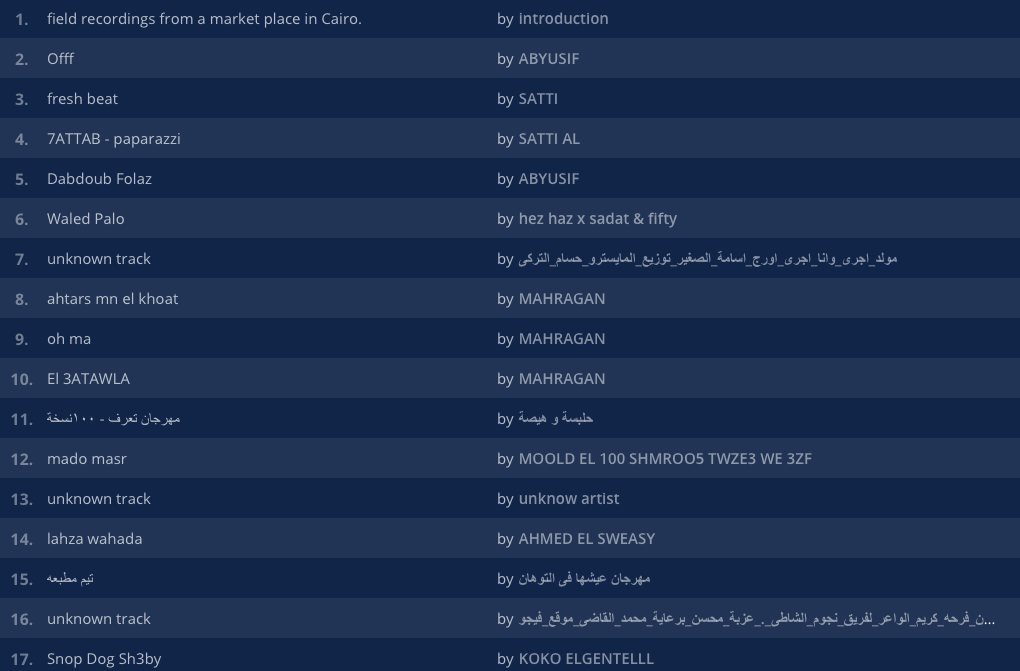
Ok, so I'm behind on posting...this is from 4 months ago, sorry! In any case, it's an excellent one from France's DJ No Breakfast, great fun, and it gives a sense of the great variety and clever mixing going on today in the mahraganat and hip hop scenes in Egypt. I really like what Abyusif is up to on the mahraganat front, and Satti is very cool too -- categorized as rap, I guess. The songlist is to be found here.

Here are a couple fine photos I found awhile back of the mahraganat scene -- I can't remember the source. If anyone knows let me know, it's important to give credit. 

I've now found the source for the top one: it's from CBS News, a wonderful portfolio of photos of the mahraganat scene. This is from a concert in April 2013.

 
 (Nariman El-Mofty/AP)

This one is from the Manchester Guardian, "The World in Pictures," Jan. 2, 2014. It's a bachelor party with mahraganat music in El Marg, a large and very populous informal district on the northeastern edge of Greater Cairo.

New mix (well, a month old now) from Habibi Funk

"get to know what fadoul sounded like when he was playing around with rapping, disco from egypt, coladera from algeria, an arabic take on zouk music and much more. it also includes 2 tracks from egypts al massrieen which will be the next reissue on habibi funk."

This is all the information provided by Jannis of Jakarta Record (based in Berlin and Cologne), so, alas, no track list. But it is a sweet list.

Jakarta has released three notable Middle East albums of late:

Fadoul, Al Zman Saib -- Algerian funk from the 1970s, pretty amazing.

Ahmed Malek, Musique Originale de Films -- terrific music soundtracks from the Algerian master, including music from the soundtrack to Merzak Allouache's brilliant 1976 film Omar Gatlato.

Dalton, Alech/Soul Brother -- a 7" from Tunisian funk/rock band, released in 1971/72


Wednesday, July 13, 2016

MTV documentary on Egyptian 'rebel music,' the massive June 30, 2013 demonstrations against Morsi, and the aftermath

This is a quite interesting documentary, from MTV, about the period running up to the Tamarrod-organized demonstration of June 30, 2013, and the role of musicians in that movement. Ramy Essam, Karim Adel Eissa of the rap group Arabian Knightz, and Nariman El Bakry, a music promoter, are all strong supporters of Tamarrod and critics of Morsi and the Muslim Brotherhood. After the coup, Karim Adel Eissa expresses support the army, who he says he did not support previously. [Addendum from just a couple hours after this was posted. I posted more or less the same thing on FB. A FB re-posted, and within minutes a comment from Karim Adel Eissa, who says, "my stand openly and publicly changed shortly after that tho."] Nariman seems to shut down emotionally. Ramy got alienated by the crowds expressing support for the army at an event the night before the June 30, and so did not play at the June 30 demo. He says he was glad that Morsi got tossed out but not with the coup.

Good resource that is not always terribly accurate -- claims that 33 million Egyptians demonstrated against Morsi on June 30. Its estimate of 1200 killed in the Rabaa massacre of Muslim Brotherhood supporters on August 14 is more sound. Human Rights Watch estimates at least one thousand.


Wednesday, June 15, 2016

Mashrou' Leila (Lebanese alt-rock band) & Orlando on NPR

The great Lebanese alt-rock band Mashrou' Leila is on tour in the US (and bands like this, of course, always skip Arkansas in such cases), and they played DC and showed up in the NPR studio to do a Tiny Desk concert. Their appearance (Monday June 13) coincided with the news of the Orlando massacre. Their lead singer, Hamed Sinno, is out gay, and they have been the subject of some controversy in Lebanon for their queer positivity.

Anastasia Tsioulcas (NPR Associate producer), who you should, btw, follow on twitter -- @anastasiat -- writes:

The group opened its Tiny Desk set with "Maghawir" (Commandos), a song Sinno wrote in response to two nightclub shootings in Beirut — a tragic parallel to what happened in Orlando. In the Beirut shootings, which took place within a week of each other, two of the young victims were out celebrating their respective birthdays. So "Maghawir" is a wry checklist of sorts about how to spend a birthday clubbing in their home city, but also a running commentary about machismo and the idea that big guns make big men.

"All the boys become men / Soldiers in the capital of the night," Sinno sings. "Shoop, shoop, shot you down ... We were just all together, painting the town / Where'd you disappear?"


It's a terrific song, very moving, and wow, so appropriate.

In an article about Mashrou' Leila by Kim Taylor Bennett, on Vice's musical channel Noisey, the group elaborate further about the song:

"‘Maghawir’ narrates a possible version of a club shooting in Beirut, drawing on references to real Lebanese case histories from two different shootings that took place within the same week, both of which resulted in the deaths of extremely young victims, each of who was out celebrating their birthday.

"The lyrics are formatted to read like a list of steps to follow on a night out in Beirut, satirically referencing the hordes of tourist-targeting bucket lists that overshadow readership on Lebanon like 'Things to do in the city of nightlife,' while maintaining a conscious attempt to sketch out the more tangibly tragic facets of such rampant and un-policed violence and gun ownership by accentuating the innocence of the victims involved—be that by opening the lyrics with a happy birthday wish, or only alluding to the actual death of the victim by running the metaphor of losing someone in the crowd of a club.

"On the other hand, the lyrics constantly brings up gender to situate the events within a broader discourse on gender and the recruitment of Lebanese men into locally-revered militarized masculinities, where said violence often becomes not only common, but rather part of a list of gendered provisions for the preservation of men’s honor, as demonstrated in the case studies the song refers to, where both assailants shot in retaliation to having their pride (masculinity) publicly compromised.

"In marrying the lyrics with upbeat dance-worthy music, the song gestures towards the evident normalization of such behavior, wherein lies the critique of the 'capital of the night,' by questioning whether or not violence is just another thing we can dance to, another element of the country’s nocturnal paysage under the continued patronage of the political elite which often chooses to protect criminals because of vested political interests."

Three different transliterated and translated versions of the song are here.

Also, check out this very smart article from Good by Tasbeeh Herwees, who interviewed Mashrou' Leila when they performed in Los Angeles in November 2015, on their first US tour. (They're now on their second.) A few choice excerpts:

The musicians, however, are rarely asked to talk about technique and style. “We’ll go to France, someone will ask how we feel about Charlie Hebdo,” says Sinno. “Or we'll go to Italy and someone will ask us if we can buy CDs where we come from. It's embarrassing.”

With the advent of the 2011 Arab uprisings, Mashrou Leila’s fans conceived new explications for the music. “The interpretations go their own way,” says Abou-Fakher. “[Our music] gets appropriated for movements in Egypt at a particular time or to a cause in Palestine at another time.” Songs that previously gestured at discontent were reappropriated as calls to revolution. They were played at political rallies in Cairo, Tunis, and Amman, where the band has massive—and growing—audiences. “Inni Mnih,” a song on their 2011 album El Hal Romancy—in which Sinno sings, “let’s burn this city down and build a more honorable one”—was misread as an anthem for the Egyptian revolution. Once, at a music festival in Beirut where the group Gorillaz was also playing, the band sang an Arabic rendition of Gorillaz’s “Clint Eastwood” as a tribute. The clip found its way online, where it was reinterpreted as a rallying call for protesters in Tunisia. “It gets all these political associations slapped onto it,” Sinno says...

In “Djin,” the third track, Sinno sings, “I don’t do sodas, I don’t do teas / I drown my sorrows, forget my name and give myself to the night / liver baptized in gin, I dance to ward off the djin.” The lyrics are an exercise in demystification, an attempt to dismantle the myth of Beirut as a playground for Western jet-setters and nightclub-hopping tourists. “At the very beginning, we were sort of pissed off about the way Beirut is always portrayed as this party destination,” says Sinno. “For people who live there, there's a lot of actual politics that get negotiated in these spaces, in bars and clubs.”

The “danciest” song on the album is also one of their most sobering. “Maghawir”—which begins by narrating a night out in Beirut—is about nightclub shootings in Lebanon. “Shootings in clubs in Beirut happen more frequently than I think people would like to admit,” says Sinno. Only last month, a club shoot-out in the city killed eight people. “Wear your black suit and come down,” Sinno sings on the track, “bearing that when snow caps the hill / all the boys become men / soldiers in the capital of the night.”


 And...here's what Sinno said in the group's Washington, DC concert on Monday, according to CNN.

He reacted strongly to a crowd following the mass shooting at an Orlando gay nightclub, lamenting the attack against the LGBT community as well as the rhetoric against Muslims and Arabs that followed.

"Suddenly, just because you're brown and queer you can't mourn and it's really not f---ing fair," Sinno said on stage while performing at the band's sold out show Monday night at The Hamilton in Washington. "There are a bunch of us who are queer who feel assaulted by that attack who can't mourn because we're also from Muslim families and we exist ... this is what it looks like to be called both a terrorist and a faggot." 

Saturday, May 21, 2016

Mediterranean: sea of death (2014-2016)

From the International Organization for Migration's Missing Migrants project. Check it out here.

Wednesday, May 11, 2016

May 11 is World Kufiyah Day

Who knew? I only just found out, thanks to Elliott.

World Kufiyah Day was started by Solidarity for Palestinian Human Rights, a Montreal-based organization with university chapters across Canada. The group started World Kufiyah Day to bring awareness and solidarity to Nakba Day, which is May 15. 

Read more here.


Tuesday, March 15, 2016

#dronelife: "Drone Bomb Me" by ANOHNI

 
A remarkable video of a gorgeous and terrifically brave song by ANOHNI, formerly known as Antony, best known as lead singer of Antony and the Johnsons. I can't embed it but you can watch it here. Directed by Nabil Elderkin--who has directed a lot of great videos, including the stunning "Two Weeks" by FKA twigs--and starring supermodel Naomi Campbell.

The vid is visually stunning, the singing sooooo beautiful, but the lyrics, damn!

Love, drone bomb me
Blow me from the mountains
And into the sea
Blow me from the side of the mountain
Blow my head off
Explode my crystal guts
Lay my purple on the grass

I have a glint in my eye
I think I want to die
I want to die
I want to be the apple of your eye

So drone bomb me
(Drone bomb me)
Blow me from the mountains
And into the sea
Blow me from the side of the mountain
Blow my head off
Explode my crystal guts
Lay my purple on the grass
(Lay my purple on the grass)

Let me be the first
I'm not so innocent
Let me be the one
The one that you choose from above
After all
I'm partly to blame


Has there been a more stunning pop culture response to the drone program than this? I don't think so.

Lest we forget, the cruel stats of the US drone program, from The Bureau of Investigative Journalism:

Pakistan, since 2004:
Total strikes: 423
Obama strikes: 372
Total killed: 2,497-3,999
Civilians killed: 423-965
Children killed: 172-207
Injured: 1,161-1,744

Yemen, since 2002:
Confirmed drone strikes: 113-133
Total killed: 514-747
Civilians killed: 65-101
Children killed: 8-9
Injured: 94-223

Possible extra drone strikes: 81-97
Total killed: 337-489
Civilians killed: 26-61
Children killed: 6-9
Injured: 78-105

Other covert operations: 15-72
Total killed: 156-365
Civilians killed: 68-99
Children killed: 26-28
Injured: 15-102

Afghanistan, from 2015:
Total strikes: 293-295
Total killed: 1,321-1,800
Civilians killed: 61-62
Children killed: 4-18
Injured: 160-165

Sunday, March 13, 2016

Trump opposition at Chicago: kufiyas


This gif was flying around FaceBook, from the Chicago events last night at UIC, where Trump got shut out. Notice that, behind the guy whose sign gets torn up is a guy in glasses, holding aloft a kufiya-patterned scarf, with the collars of the Palestinian flag on either end. Behind him someone is holding is a Mexican flag. On the left, you can spot a woman wearing a cap with "African" colors. The protests against Trump were an occasion for the mobilizing of Muslims, Arabs, Hispanics and blacks, with identity symbols much in evidence. But photos and video footage of the protests also show that it was very much a coalition of people who came out, a multi-racial, multi-ethnic, multi-varied coalition.

I wasn't surprised to see video footage of protesters wearing kufiyas. Below are screen shots of two, that I found on this broadcast. I'm sure there were more.


Sunday, January 31, 2016

Supermodel Gigi Hadid, Palestinian (and the kufiya proves it); Zayn Malik's "Pillowtalk"

Supermodel Gigi Hadid has been coming out as Palestinian (or, half-Palestinian--her mother, Yolanda Foster, is Dutch, her father is real estate developer Mohamed Hadid), ever since December 2015, and her Palestinian-ness has been getting a lot of attention in the media, as reported by Khelil Bouarrouj on the blog of the Institute for Palestine Studies. Gigi's instagram photo of her (and her girlfriends') henna'd hands is what prompted all the attention, but she has also posed in a Coco Chanel designed kufiya-styled top. (More on Chanel's kufiya-styled line in a future post!)


I hope Bouarrouj is correct in his optimism that it's good for Palestinians when some high-profile figures like Gigi celebrate their heritage.

Meanwhile, Gigi's boyfriend (or is he?) Zayn Malik (ex-One Direction) has a new single "Pillowtalk" that was (from January 28-29) at position #1 on the Billboard + Twitter Trending 140 chart. Zayn Malik's dad is British Pakistani. In Zayn's video he is snoggling with the half-Palestinian Gigi Hadid. Both of 'em are blonde -- is this how "Muslims" subversively penetrate mainstream Western popular culture? The vid was only released on January 28, and as of this posting on January 31, it had over 23 million views. So I guess it's rather popular. What does it say when people named Malik and Hadid sit at the commanding heights of US-Euro popular culture? What do people who click on that YouTube video think of Donald Trump's Islamophobia?


UPDATE February 1: I've been informed that the reason Gigi was wearing that kufiya-themed outfit was that she was flown in to Dubai to showcase it for the Chanel resort collection. Nothing at all to do with Palestinian pride. (Thanks, Mezna!)

Saturday, January 30, 2016

A new generation of Palestinian strugglers and their kufiyas

The Electronic Intifada recently (January 28) published a set of stunning photographs, courtesy ActiveStills, of young Palestinians confronting the Israeli forces of the occupation as well as the security forces of the PA, over the last four months. They are amazing photos (by Anne Paq in Bethlehem, Ezz Al-Zanoon in the Gaza Strip, Mohannad Darabee in the Ramallah area, Oren Ziv in Bethlehem and the Ramallah area). I find EI's report somewhat disingenuous, however, in that it fails to mentions one key aspect of the recent upsurge in confrontations -- that many have called this the "knife intifada," given that it has been characterized by a series of lone wolf knife attacks, as well as car rammings and shootings, aimed at Israelis, both soldiers and civilians, and has resulted in the deaths (between September 13 and January 5) of 25 Israelis. The period of course has been marked by clashes between groups of Palestinians (usually, rock-throwing) and Israeli soldiers, and of course Palestinian casualties are far higher, totaling over 160. (EI does mention the numbers of Israeli dead, but not the nature of the killing.) Since the fact that knife attacks are a significant element of the current struggle, it seems odd to me that EI doesn't discuss them at all. Instead, the quite striking images of Palestinian resistance seem to be the story.

And while I admire the courage as well as the stylistic flare of those Palestinians now fighting the occupation, at the same time it pains me to think that these young people represent yet another generation of Palestinians condemned to confronting violence. This occupation is about to be (in June) 49 years old. FORTY NINE. How can this keep going on and on and on and on? What does it mean for us to admire the bravery and fortitude of this new generation of heroic Palestinian strugglers? I would much rather not see such photos any more, instead I want to see photos of young Palestinians dancing and partying and studying and enjoying "normal" life. I am sick of it. And yet...don't they look flash?

Bethlehem

 
North of Ramallah, near Beit El settlement

 North of Ramallah, near Beit El settlement

 
 Bethlehem

“We cover our faces because the occupying authority might [otherwise] arrest us. We also 
fear our own [Palestinian] authority would arrest us in the same way.” Bethlehem


North of Ramallah, near Beit El settlement 
(the insignia of the Popular Front for the Liberation of Palestine is on the headband)

Bethlehem

 
Bethlehem

Gaza Strip, east of al-Bureij refugee camp

 
Bethlehem

Gaza Strip, east of al-Bureij refugee camp 

Wednesday, January 20, 2016

Another Jajouka movie

There is the 1983 documentary that Philip Schuyler worked on, Master Musicians of Jahjouka.

(And please see Schuyler's astute article, "Joujouka/Jajouka/Zahjoukah: Moroccan Music and Euro-American Imagination", which you can read here.)

There is Augusta Palmer's Hand of Fatima (2010).

The Master Musicians Of Jajouka with Bachir Attar (Roskilde Festival 2014); photo: Morten Aagaard Krogh

And now there is another, Jajouka Quelque Chose De Bon Vient Vers Toi, by Eric and Marc Hurtado, members of the experimental/industrial music group Étant Donnés from Grenoble. The brothers were born in Rabat, Morocco. The film is entered in the 27th Marseille International Film Festival, to be held in July 2016. The festival website has this to say about the film:

The film opens with an archaic tale, in brief stylised tableaux, concerning the divine creation of music. The myth is extended to a universe of sacred dimensions where it is difficult to differentiate the legend from its current perpetuation. Where are we? In the Moroccan Rif, in Jajouka, a village where, for over two thousand years, fertility rites involving music and dance, have been presided over by Bou-Jeloud, “the Father of Skins”, a local version of the god Pan.

The Hurtado brothers are famous musicians: their group Etant Donnés came to prominence through collaborations with various artists including Alan Vega, Genesis P-Orridge and Philippe Grandrieux (they produced original soundtracks for several of his films). They are also known as experimental filmmakers. Here their two passions are combined, raising the challenge of travelling back in time to hail the Master Musicians of Jajouka, yesterday and today. Besides, has time passed? It is therefore not about concocting a score destined to accompany autonomous images, but about making the music (its strident nudity, its incantatory austerity) and its history the very substance of the images and the scenario being staged. Their choice was obviously Pasolinian: to resurrect the archaic while remaining faithful to it, through the treatment of decor, lighting, acting and costumes. Here, the beauty lies in the rough friction between the muteness of the characters and their unbridled momentum towards another potential voice.

--Jean-Pierre Rehm

Based on the write-up, it seems the film is going to go over the familiar myths surrounding Jajouka (it's about the rites of Pan, Jajouka and its rites are located in archaic times, and so on), that Schuyler's article so cleverly deconstructs. But maybe someone who reads this will be able to see the film and can tell us differently...