Monday, February 06, 2006

U-Cef: New release (shortly!)


U-Cef, the Moroccan musician/producer based in London, has a new release scheduled, called Halalwood. U-Cef's first full-length release, Halalium (2000, Apartment 22), is an amazing blending of various genres of traditional Moroccan music (including Gnawa) with hip-hop and drum 'n' bass. U-Cef is not of course unique in his efforts to put together Moroccan folk and Afro-Euro funk, but he is definitely one of the best practitioners. I got to hang out for him for a few hours in July 2003, in London's small but cool Moroccan district, and in the course of the afternoon he introduced me to Damon Albarn (Blur, Gorillaz) and Steve Hillage (producer of Rachid Taha). Both Albarn and Hillage appear on the new release, as do Natacha Atlas, Rachid Taha, and Justin Adams (who also guests on Halalium).

U-Cef played at the 2005 Essaouira Festival of Gnawa and World Music.

Check out U-Cef's new website. If you go here you can download a sample from Halalium. Halalium is highly recommended, so go get it so you'll be primed for Halalwood when it comes out.

Tags: ,

Sunday, February 05, 2006

Wu Man: Live in Fayetteville


I got to see Wu Man, the pipa (Chinese lute) virtuoso, perform last night at the Walton Arts Center in Fayetteville.

I was introduced to the work of Wu Man by my ethnomusicologist colleagues Rembrandt Wolpert and Elizabeth Markham, who run the Center for the Study of Early Asian and Middle Eastern Music at the U of A. They brought her here a couple years ago, and she performed at the celebrated Mildred B. Cooper Chapel, designed by renowned architect Faye Jones, in Bella Vista.

What I particularly admire about Wu Man is her ability to move easily between the classical Chinese pipa (pronounced 'pee-puh') tradition and the Western avant-garde. At the Cooper Chapel she performed music from the Tang Dynasty (7th and 8th centuries), recovered by Rembrandt Wolpert. On her album Pipa from a Distance (Naxos, 2003), she performs both the classical repertoire as well as wailing like Hendrix on electric pipa ("Shanghai Blues"). She has collaborated with Philip Glass, the Kronos Quartet, and Yo-Yo Ma. She even shows up on anarchist theorist Hakim Bey's album T.A.Z. (The Temporary Autonomous Zone), where he reads passages from his book of the same name.

Wu Man's concert last night similarly ran the gamut from the classical tradition to the avant-garde. In the avant vein, she performed a composition by Eric Moe, "The Sun Beats the Mountain Like a Drum," with a taped "electroacoustic sound" accompaniment.

Most amazing though, in a concert with NO low points, was "Ancient Dances," written by composer Chen Yi (commissioned by the Walton Arts Center) in collaboration with Wu Man. It's inspired by three poems by the famous "drunken" Tang Dynasty poet Li Bai. Wu Man performed this piece accompanied by John Hanks (of Duke University) on percussion and with a video by Catherine Owens (who has worked with U2, among others), based on Chinese calligraphy and artwork, playing in the background. The effect of the music and video was magical and almost overwhelming. (Given my lack of background in Chinese and avant-garde music, I'm left incapable of offering any kind of meaningful account of the music.)

I'm not a big fan of the Waltons, to put it mildly, but I really like the fact that the Walton Arts Center has recently begun commissioning works like "Ancient Dances." Wu Man will perform "Ancient Dances" at Carnegie Hall, New York City, April 6-8, 2006.

Tags: , ,

Friday, February 03, 2006

Hizbollah Gimme Cap


My friend Elliott brought me this Hizbollah baseball cap from Lebanon. Since Hizbollah is classified as a terrorist organization by the US government, it's important to note that Elliott bought the cap not from the party, but from a street vendor in Beirut. (I can't remember who is pictured wearing the hat.) The cap features the Hizbollah flag, which reads, "Hizbollah (the party of God) are the victors: The Islamic Resistance Movement in Lebanon." 23 Hizbollah members sit in the current Lebanese parliament, and two members of Hizbollah are ministers in the Lebanese government.

Tags:

Wednesday, February 01, 2006

"Paradise Now" Nominated for Oscar


I am blown away: the Academy has nominated Hany Abu-Assad's Paradise Now for an Oscar, in the Foreign Language Film category. This is the first time a Palestinian film has ever been nominated, a truly historic event. I have seen it, but have not had the time to write any kind of review. And I won't now, except to say that it is great, and entirely worthy of winning the Oscar. I doubt it will win (I don't know anything about the quality of the other films nominated for best foreign film), and no doubt there will be political maneuvering against it, but the mere fact of nomination constitutes a victory in and of itself.

As for the other categories, I'm hoping that Brokeback Mountain, Crash, Capote, Transamerica, The Constant Gardener, and Syriana (especially George Clooney as supporting actor) win awards, and I hope, against hope, that Munich wins nothing.

(Earlier posts on Paradise Now, here and here).

Tags: ,

Sunday, January 29, 2006

Kufiyaspotting #8: 'Arabistan/Khuzistan

....Or Does It Explode? alerts us to conditions in the southern Iranian province of Khuzestan (often referred to in the Arab world as 'Arabistan), where the Iranian regime has been cracking down on overt expressions of Arab ethnicity, including the wearing of the red kufiya. According to a report published by the Underrepresented Nations and Peoples Organization, "In November's Eid-al-Fitr demonstrations in Ahwaz, Governor General Heyat Mojadam ordered all those wearing keffiyeh be arrested. An Ahwazi Arab youth freed from prison following his arrest during the Eid-al-Fitr protests spoke of how the prosecutor, Mr Farhadi-Rad, argued that the wearing of the red keffiyeh was a 'political statement' that indicated support for secessionism." Another report states that the state has banned the wearing of the kufiya at work. This includes the state oil company, NOIC, the largest employer in the province.

This occurs in the background of the recent upsurge of protests by Arabs in Khuzestan over the past several months.

Latest death count: Iraq


My neighbor continues to keep a daily count of US military casualties in Iraq.

Iraqi civilian casualties: today Iraq Body Count puts the estimates at between 28,198 and 31,800.

Tags:

Kufiyaspotting #7: David Mamet


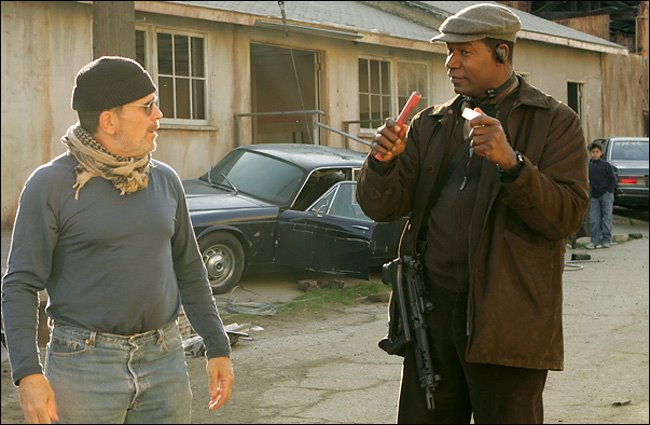
These photos accompany an article in today's New York Times on David Mamet's new CBS series, "The Unit." The article does not call attention to, or comment on, the fact that Mamet is wearing a kufiya. It does mention that Mamet's left-wing political views are well known.

The David Mamet Society informs us that Mamet was offered a special tribute at the Jerusalem Film Festival in July, 2001, and that he "toured Jerusalem with Mayor Ehud Olmert [currently Israel's PM], visiting the sites of numerous suicide bombings."

In a column written for The Guardian in January, 2003, Mamet predicted the rise of Israelis as villains or monsters in film of the next few years. He begins the essay by extolling the film, Exodus, in which Israelis appear as epic and beautiful heroes, and goes on to assert that the turnabout whereby Israelis emerge as villains "is fair play and it is merely the Jews' turn in the barrel."

So now, the enigmatic Mamet is wearing the kufiya...

Earlier kufiyaspottings: One, two, three, four, five, six.

Tags: , ,

Postscript, July 10, 2011:

From Christopher Hitchens' review of David Mamet's new book, The Secret Knowledge: On the Dismantling of American Culture (New York Times Book Review, June 19, 2011). The book marks Mamet's lurch to the right. Hitchens finds it dull and irritating. But Mamet does say: "the Israelis would like to live in peace within their borders; the Arabs would like to kill them all." If Mamet's donning of a kufiya in 2006 was an enigma, today, no doubt, he would consider that fashion accessory to have been a deluded mistake.

Monday, January 23, 2006

Nadi Cinema


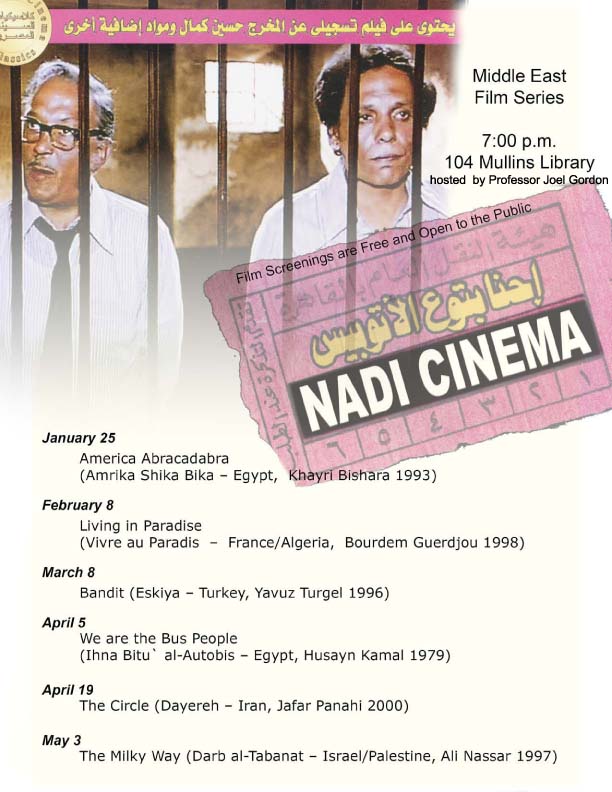
Here's an item of interest mostly to locals: a Middle East film series, "Nadi Cinema," hosted by my colleague Joel Gordon in History. All films are at 7 PM, in 104 Mullins Library, University of Arkansas.

The schedule:

January 25: Amrika Shika Bika (America Abracadabra), dir. Khayri Bishara, Egypt, 1993

February 8: Vivre au Paradis (Living in Paradise), dir. Bourdem Guerdjou, Algeria/France, 1998

March 8: Eskiya (Bandit), dir. Yavuz Turgel, Turkey, 1996

April 5: Ihna Bitu' al-Autobis (We Are the Bus People), dir. Husayn Kamal, Egypt, 1979

April 19: Dayereh (The Circle), dir. Jafar Panahi, Iran, 2000

May 3: Darb al-Tabanat (The Milky Way), dir. Ali Nassar, Palestine/Israel, 1997

Outed by Campus Watch

I just discovered that, for a time last fall, my photo and a quote from me was featured on the homepage of Daniel Pipes' notorious Campus Watch. It is now in the archive of "Previous Quotes of the Month." Here's the quote:
"Many of the clauses in the new [Iraqi] constitution are 'extremely problematic' when compared to the progressive laws concerning women's rights under the secular regime of Saddam Hussein..."

Campus Watch features quotes without commentary. Presumably from the perspective of Campus Watch, such a claim needs no comment because it is so self-evidently outrageous. From what I know of Campus Watch, I guess Pipes & Co. would claim this statement makes me some kind of Saddamist fellow traveler, and would put it in the category of what they call "apologetics." Incidentally, the link to my statement is wrong, or perhaps no longer exists. I'm pretty sure I was quoted saying this by the University of Arkansas student newspaper, The Traveler, while speaking at a bi-weekly public forum, Diwan Baghdad, that I run with my colleagues Joel Gordon and Najib Ghadbian.

Other quotes in the archive are from usual suspects, such as Rashid Khalidi, Juan Cole, Joel Beinin, and so on. What I find remarkable about all this is that (a) no one ever bothered to inform me that Campus Watch had featured me as a notorious "apologist" Middle East specialist of the month and (b) I received not a single piece of hate mail in response to my presumably extremist, Baathist dead-ender statement. No one, whether friend or foe of Campus Watch, cared much about the matter. So much for the power of Campus Watch to intimidate wayward academics. (Or perhaps it's just that no one thinks it's worth harassing a professor in what many folks on the two coasts consider the boondocks of Arkansas?)

This is not to say that Campus Watch-style forces are not able to harass professors, as can be witnessed by recent reports of the efforts of a right-wing alumni group to pay student informants to gather information on "radical professors." This is juicy stuff, and if you've not seen it, please go here and here.

Tags:

Saturday, January 21, 2006

Marilyn Monroe in Egypt


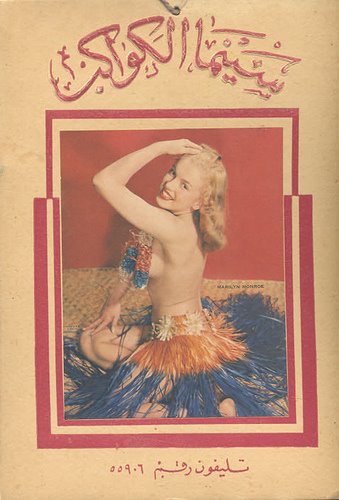
A placard advertisement for Cinema al-Kawkab, a movie theater in the Husayn district, Cairo, Egypt, featuring Marilyn. Husayn is a traditional district, located near al-Azhar. The placard dates from the early '50s, was given away for free and presumably was hung in shops throughout Cairo.

Tags: , ,

Wrestlers in Egypt


A poster widely available in popular quarters in Cairo in the mid-'90s. It says: Egyptian and World Champions. The wrestlers, from left to right, are Makkawi, 'Imadi and Shahhat.

Tags: , ,

Monday, January 16, 2006

Shawarma Lights Up Sharon's Brain?


Last Tuesday, the doctors of Israel's ex-PM Sharon tried to stimulate his brain by putting a plate of shawarma--reportedly Arik's favorite dish--next to his head.

Ironies abound here. First, that Sharon's favorite food would be Arab. (Shawarma, for those readers who do not know, is slices of lamb roasted on a skewer. Like gyros, but much tastier. Shawarma is ubiquitous in Syria, Lebanon, Palestine, and Jordan. To my mind, the true shawarma masters are the Lebanese.) Second, that the doctors tried to revive Sharon's brain with the smell of meat, the massive consumption of which probably caused his stroke. (Sharon was also a big fan of other meat dishes prepared in the Arab style, especially kabob.) Third, despite the fact that Israel has tried to turn shawarma, as well as falafel and tabbouleh and "pita" (Arabic bread or khubz) into Israeli national dishes, they remain indelibly Arab in their origins and names. (Although these foods arguably are the "native" foods of a majority of Israelis, if we consider that the majority of Israeli citizens are "Eastern" in origin, if we add together Palestinian citizens and Mizrahi Jews of Arab origin.)

Despite Sharon's best efforts, over the entire course of his career, to deny the Arab/Palestinian traces that Israel attempted to obliterate in the course of its founding, they remain there to haunt him, and perhaps even revive him.

And here is another one of those indelible traces: Sharon is being treated in Hadassah Ein Kerem hospital. 'Ayn Karim was a Palestinian village that fell to Israel during the 1947-48 war, and was annexed to Jerusalem, its 3000+ inhabitants (Muslim and Christian), expelled. Many of the original homes and churches remain, lending a tony atmosphere to this upscale suburb inhabited mostly by Israeli Jews. Yad Vashem, the Holocaust memorial, is also built on the lands of 'Ayn Karim.

Every time we hear about Sharon and Hadassah Ein Kerem, it reminds us that Arik is being cared for on the land of ethnically-cleansed Palestinians.

Tags: , ,

Away...

I've been away...first it was because of work on the house (check out my flickr account, on the right-hand column, for photos) and then I was in Washington, DC, reading proposals for the Department of Education. Alas, classes start tomorrow, but I am nonetheless determined to get back to blogging!

Monday, January 02, 2006

Architectural Debate in Israel on "The Wall"


Very useful article by Nicolai Ouroussoff in the Sunday New York Times on the wall and the architectural debate over it in Israel. A key figure in the debate is architect Eyal Weizman, who has published a report that "essentially accused Israeli architects of being collaborators in the colonization of the West Bank." Says Weizman, "We examined these architectural drawings in a clinical manner...We showed that the crime was in the making of the line - in the drawing itself - not only in the principle of building a settlement."

Shimon Navez, a retired brigadier general and director of the Israeli Defense Forces' Operational Theory Research Institute, is also a critic of the wall, but from a position that endorses, rather than critiques, Israeli colonialism. Navez deploys the theories of Deleuze, Bataille and the Situationists, claiming that the West Bank is already a "smooth space," and the wall (the "barrier," in his parlance) a kind of ineffective anachronism, representative of "striated space." Navez cites Gaza as an example of how Israeli forces are effectively using "smooth space" as a mechanism of control, "saying that as long as Israel controls the air space, what happens on the ground is essentially irrelevant from a security standpoint. 'The main idea is that we can see and do what we please,' [Navez] said."

According to Weizman, General Navez "is simply trying to replace one form of control with another that is less visible."

Ouroussoff proceeds to give a very useful description of the wall, and he concludes (very surprisingly, for a NYT article):

The consequences extend beyond the ghettoization of Palestinians and Israelis. The wall destroys the space for those who once occupied the middle ground: those who refuse to divide the world into good and bad, civilization and barbarity. It threatens to sever the threads, already fragile, that might one day be woven into a more tolerant image of coexistence.

(My only complaint about the article: no Palestinian voices! Why not talk to Palestinian architects like Suad Amiri?)

Some articles by Weizman:

"Strategic Points, Flexible Lines, Tense Surfaces and Political Volumes: Ariel Sharon and The Geometry of Occupation." In Cities, War and Terrorism: Towards an Urban Geopolitics, ed. Stephen Graham (Blackwell, 2004)

A piece (I can't locate the title) in Against the Wall: Israel's Barrier to Peace, ed. Michael Sorkin (The New Press, 2005)

Tags: , ,

Sexy Beirut

As reported by Queer Arabs, the Jan/Feb issue of The Out Traveler features an article on "Surprising, Sexy Beirut." The article excerpt available online states:
Indeed, it’s tourism that has empowered the country’s gay and lesbian community and has made it the most liberal place in the Arab world. “Tourists come from all over the world because they know Lebanon is a fairly open society,” says Georges Azzi, head of the Beirut-based organization Helem (Arabic for “dream”), the Arab world’s first and only gay advocacy group. “This is especially so for Gulf Arabs,” he explains, referring to the Middle East’s most lavish spenders, from countries like Saudi Arabia, Kuwait, and the United Arab Emirates. “So the police couldn’t crack down on the nightlife scene even if they wanted to.”

Helem's website is here.

(Out Traveler identifies Beirut nightclub BO18 as being built on the site of a "onetime Palestinian refugee camp." This is incorrect. BO18 is built on the ruins of Qarantina, an urban slum cleared by the Phalangists in early 1976, during the Lebanese civil war, and many of its inhabitants massacred, 1500, according to journalist Michael Jansen. It was a heterogeneous slum, with Kurds, Palestinians, and Shi'ite migrants and refugees from southern Lebanon.)

Tags: ,

Thursday, December 29, 2005

best “world” music of ‘05


I’ve not compiled a best-of list for a couple years, although I used to do it regularly on my Interzone Radio show. But lately I’ve been consuming music in a somewhat different way, sampling cuts from here and there, and I’ve been less focused on what is the most “current” or hip in the world music scene. But inspired by Steven Shaviro, I’ve decided to have at it again. My top 10 is all “world music”, whatever that is. My "others" ventures a bit further generically. This list is not necessarily in order of what I think is best, and for sure I’ve forgotten some things....

1. Kamilya Jubran and Werner Hasler, Wameedd. Amazing collaboration between former Sabreen vocalist and Swiss electronic sound producer. Spare, beautiful, experimental, eerie.

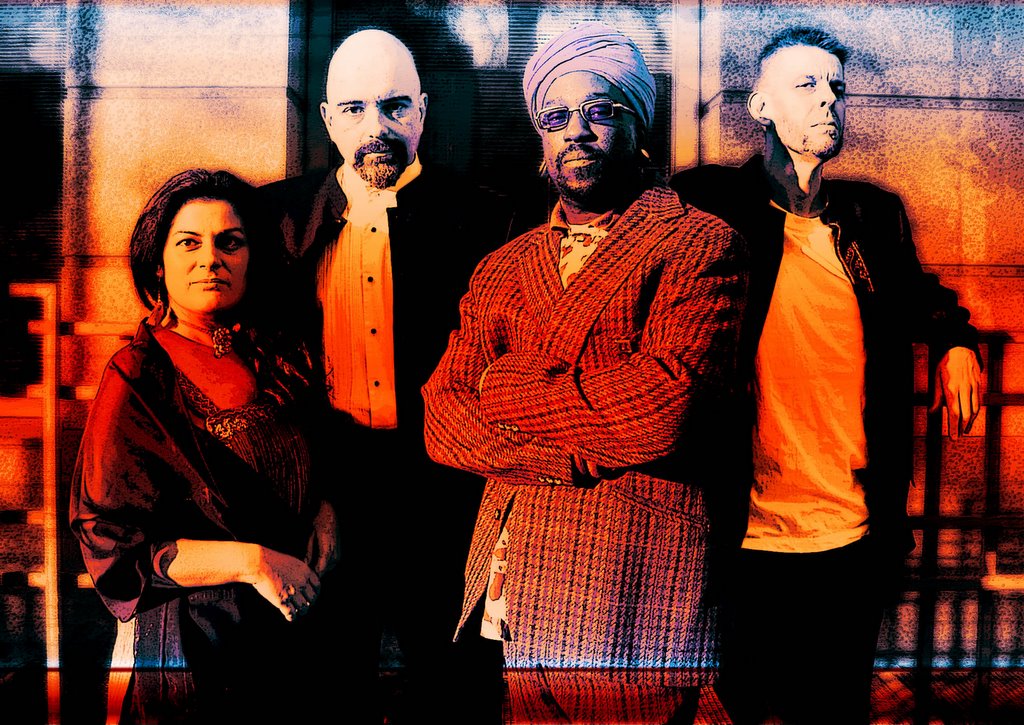
2. Tranglobal Underground, Impossible Broadcasting. TGU (pictured above) finally return to their true transnational ethno-funk roots, this time with some great Bulgarian assistance.

3. Mutamassik, Masri Mokkassar: Definitive Works. Egyptian-Italian American d.j.’s collection of her finest work. Breaking down Arabic music, cutting it into hip-hop & drum ‘n’ bass.

4. Konono No 1, Congotronics. A total assault from Kinshasa: massively-distorted electric thumb piano and frenetic percussion. (Congotronics #2 now available from emusic.com.)

5. V.A., Guitars of the Golden Triangle: Folk and Pop Music of Myanmar (Burma), vol. 2. Another Sublime Frequencies revelation: more wonderful surf and psychedelic rock from Southeast Asia. After hearing various S.F. collections from Thailand and Cambodia, these rockified versions of Myanmar cease to sound weird.

6. Baba Zula & King Tubby, Duble Oryantal. Despite the punned title and the presence of King Tubby, the dub is lowkey, just enough to lend the various Turkish folk-based genres presented here an edge, and an element of subtle strangeness.

7. V.A., Rough Guide to the Music of the Sahara. The revelation here is that the incredible gutbucket blues guitar of the legendary Malian group Tinariwen is not a one-off, but a much wider phenomenon. Check out Nayim Alal and Mariem Hassan.

8. Balkan Beat Box, Balkan Beat Box. New York based underground Israeli scenesters Ori Kaplan and Tamir Muskat lead a high energy romp that fuses not just the Balkans but also Israel and the Arab World, an Eastern Mediterranean with the boundaries--temporarily at least--blown apart.

9. MIA, Arular. This dancehall/grime blowup, with its Tamilese Sri Lanka tinges, is on everyone’s list, and I am compelled to concur. Although MIA’s references to violence and terrorism are controversial,she does namecheck the PLO--and gets away with it.

10. Khaled, Ya-Rayi. The US mix was released in 2005, but the producers almost wrecked it for me by putting the execrable “Love to the People” (English and Arabic versions) onto what, in the French version, was in part a return and tribute to the roots of rai, the Wahrani genre. So skip cuts 2 and 11 and all the “peace through music” bullshit.

Other favorites: I get lots of my music from emusic, and lately have been very keen on all the offerings from Tzadik (John Zorn’s project to expand our notions of Jewish music) and Doublemoon, which features all kinds of great Turkish music. I’ve also been into favela funk and reggaeton, like everyone else. Also into Ellen Allien (everything! this year’s release is Thrills), Laura Veirs’ Year of Meteors, and OOIOO’s gold & green.

Good news from the NYT: "Independent labels account for more than 18 percent of album sales this year - their biggest share of the market in at least five years, according to Nielsen SoundScan data...The independent sector as a whole already outsells two of the big four companies, Warner Music and EMI."

Tags:

Monday, December 26, 2005

Hakim in "Vanity Fair"


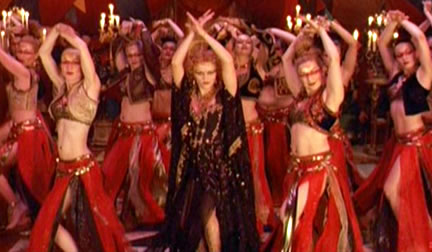
I finally have seen Mira Nair's film Vanity Fair (2004), starring Reese Witherspoon as Becky Sharp. I found it somewhat entertaining but felt by the end that it had run aground. But really, what I want to comment upon is the unbelievable and completely non-credible "dance scene," staged by the Marquess of Steyne (Gabriel Byrne) and featuring Becky Sharp, to impress the King of England.

It's hard to imagine why Indian director Nair would put such a sequence on screen, where a posse of white British dancers wear what basically are bellydance outfits (somewhat Indianized) and perform ersatz bellydance moves, and where Reese Witherspoon wears Goth-style eye makeup. Such "bellydance" costumes were invented, in fact, by Hollywood in the early 20th century, and eventually adopted back in the Middle East. But what is really strange about the sequence is that it features Egyptian bellydance music by acclaimed sha'bi vocalist Hakim. The song, "El Salam," (from Hakim's 2002 Mondo Melodia release, Takatik), features all acoustic accompaniment, but nonetheless it's entirely inauthentic and anachronistic. Normally I like such "Arab inroads" into Western culture, but this one sits ill with me. Plus it fits into that standard Orientalist trope, whereby all "wog" culture, whether Indian or Arab, is more or less equivalent.

I also hated the end of the film, where Becky realizes her dreams and ambitions by finally marrying Joseph Sedley and traveling to India. The last scene shows Becky and Joseph riding elephants in a gorgeously colorful and exotic India. Pure raj/imperial nostalgia.

Tags: ,

"has so Eunucht our Husbands...": The 1674 Women's Petition Against Coffee

London, 1674, women petition against the "Grand INCONVENIENCIES accruing to their SEX from the Excessive Use of that Drying, Enfeebling LIQUOR [coffee]." Here are a few choice bits:

"Never did Men wear greater Breeches, or carry less in them of any Mettle whatsoever."

"They come from it [coffee] with nothing moist but their snotty Noses, nothing stiffe but their Joints, nor standing but their Ears..."

"...like young Train-band-men when called upon Duty, their Amunition is wanting; peradventure they Present, but cannot give Fire, or at least do but flash in the pan, instead of doing Execution."

"Certainly our Coutrymens pallates are become as Fanatical as their Brains; how else is't possible they should Apostatize from the good old primitive way of Ale-drinking, to run a whoreing after such variety of distructive Foraign Liquors...this ugly Turkish Enchantress..."

(I found this thanks to the latest issue of Harper's.)

Tags:

Arkansas Democrat-Gazette: "Paradise Now" #14 in best movies of '05

Philip Martin, the Arkansas Democrat-Gazette's very fine film reviewer, ranked Paradise Now (dir. Hany Abu-Assad) #14 in his review of the best films of 2005 yesterday (Dec. 25). Unfortunately, as far as I'm aware, the film hasn't opened anywhere in Arkansas. (I saw it in Washington, DC.)

Here's what Martin had to say: "While geopolitical realities shape this story of two would-be suicide bombers from Palestine, the characters remain recognizably human, to the point where we begin to suspect their arguments are voiced largely to convince themselves."

Sunday, December 25, 2005

Christmas Benefits of "Separation Barrier"


Great and unexpected news! Now it is easier, and cheaper, to buy olive wood carvings from Bethlehem (nativity scenes, rosaries, crosses, etc.) due to in part to their availability on the internet--a boon not just for consumers but for the woodcarvers as well. And as an AP report by Sarah El Deeb explains, "Bethlehem's woodcarvers are getting another unexpected boost: cheap olive wood from the construction of Israel's controversial West Bank separation barrier. Thousands of olive trees have been uprooted to make way for the barrier, creating an abundance that has driven the price from $260 to $195 per ton, carvers said."

Who would have thought that Israel's construction of the apartheid wall (shown above, with Christmas pilgrims passing through) could have such positive benefits for producers and consumers?

There is, however, a downside, as El Deeb explains, "the barrier is creating new hardships for Bethlehem, cutting off many people from farmlands and defacing the landscape that draws tourists."

But does that really matter, as long as we can still buy our Christmas creches and our rosaries, made from authentic Holy Land olive wood?

Merry Christmas!

, , ,