Sunday, February 19, 2006

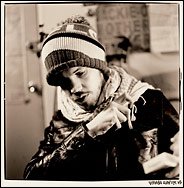
Kufiyaspotting #9A: Prefuse 73 -- and starving the Palestinians


From Ben Ratliff's "Playlist" column in today's NYT, a review of producer Guillermo Scott Heren, who records as Prefuse 73, and his new release Security Screenings.

I really like what I've heard of Prefuse 73, although I've not heard the new album. And I like the political sympathies of G. Scott Heren, which can be gauged in this interview with Pitchfork. But today, because the enormity of what is facing the Palestinians seems even more grim, I'm feeling that such kufiya style gestures are pretty insignificant. Of course, what should I expect one, single, solitary producer of music to do?

Here's what's bugging me: Israel is going to do its best to cut off funding to the Palestinian authority, in order to try to "starve" Hamas--which now controls the Parliament--into submission. Today the Israeli government announced it will stop turning over the tax receipts it collects on behalf of the Palestinian authority, amounting to $50 million a month.

Dov Weissglass, advisor to Acting Prime Minister Olmert, explained the Israeli government's logic as follows: "It's like a meeting with a dietitian. We need to make the Palestinians lose weight, but not to starve to death (my italics)."

Bravo to Weisglass for striking a blow against obesity. Those Palestinians have gotten way too fat!

Or have they? The New York Times reported on January 17, "According to recent assessments by the World Bank and the UN Development Program, up to 60 percent of Palestinians now live under the poverty line, which suggests that even those who are employed are barely subsisting."

The UN's Food and Agriculture Organization (FAO) reported, in its 2006 Humanitarian Appeal, that, "For the fourth consecutive year humanitarian agencies are appealing to donors for funding for the West Bank and Gaza Strip. "The labour market is characterized by informal, short-term and low-paid work. Poverty has climbed to 64 percent and unemployment is at 27 percent, almost three times as high as in 2000. The situation is particularly grave in the Gaza Strip, where almost all areas are experiencing high levels of food insecurity."

UNICEF reports (2006): "Malnutrition for children [in Gaza] under the age of five (U5) remains high at 10% and the risk of malnutrition for the very young children is increasing. The most vulnerable age group are children aged 12-23 months with stunting reaching 16%.

"Chronic macro- and micronutrient malnutrition in children under five has continuously increased. One in ten children under five are chronically malnourished (stunted), meaning that about 50,000 children will not reach the standards for growth and development. The heaviest burden is carried out by the children 12-23 months (almost 16% of them are stunted), a critical age when the biological and developmental future of the child is at stake. The malnutrition rathttp://www.blogger.com/img/gl.link.gifes in Gaza Strip, in all urban areas, as well as in girls, are above average levels.

"The micronutrient malnutrition - iron, vitamin A and iodine deficiencies - are affecting around 40% of children U5. These issues are directly related to the household impoverishment and degradation of coping strategies, as well as of practices of breastfeeding and young child feeding."

Clearly, these kids need the help of the "dietitian."

(The last two kufiyaspottings are here and here.)

Tags:

Saturday, February 18, 2006

Bellydancing: Shakira


Back to the frivolous, and acknowledging another bellydancer: Shakira Mebarak, who goes simply by Shakira. Colombian superstar whose father is Lebanese. She definitely has bellydance moves. I know of only one song where she sings a verse in Arabic: "Ojos Asì," off the album, Dónde Están los Ladrones? It's also the only song of hers I know that has any Arab flavor. But at least the bellydancing moves, which Shakira employs frequently, always do.

Tags: ,

Friday, February 17, 2006

Hijabspotting: Cat Power


I frequently kufiyaspot on this blog, but rarely bother with the hijab, or alternately, veil, or alternately, Islamic dress. Hijabs are just too obvious, for the most part, whereas kufiyas, much more subtle. (Not of course if worn over the head, but as a scarf, yes.)

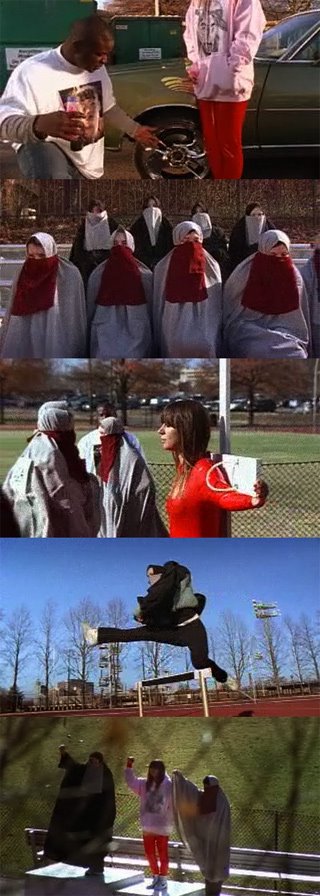
But here's a case where the symbolic usage of the hijab is pretty inscrutable, and more interesting to discuss. It's from a video for Cat Power's song "Living Proof," off her new, widely hailed album The Greatest, recorded in Memphis.

As Kelefa Sanneh notes, the Cat Power vid opens with what appears to be a tribute to a video by Mafia rappers Three 6 Mafia video that features group members drinking coffee syrup out of baby bottles. Chan Marshall (who records as Cat Power) is wearing a 2Pac hoody and drinking cough syrup out of a baby bottle together with a black man. (Cough syrup is the preferred intoxicant of the great rappers in Houston who produce a southern brand of hip-hop known as "screw.") But the more remarkable feature of the video is this. Chan Marshall takes off her hoody and puts a large white cross over her back, and, dressed in a red catsuit, races around a track with several women dressed in the kind of veils and Islamic dress typically worn in Iran. (The outfits look a bit sloppily conceived, not exactly what women wear in Iran.) Chan comes in second. She and the veiled first and third place medalists raise clenched fists, evoking the black power salutes of Tommie Smith and John Carlos at the 1968 Olympics in Mexico City.

I have no idea how to read this vid. Is the cross carried by Chan/Cat supposed to represent a burden, the analog of the religious burden of the Islamic dress worn by the other runners? Is Chan/Cat's red catsuit also supposed to represent a burden, the female burden of "looking good for men"? One of the veiled women is shown jumping over a hurdle in the course of the footrace. Does this suggest that Islamic dress is not a burden for women, since it doesn't hinder them from participating in athletic activity? Do the clenched fists a moment of female solidarity, transcending religious divisions? And why is Chan/Cat drinking cough syrup with her black companion/boyfriend?

I have no idea what the answers are, but I love the questions the video raises...

,

Even more queer cowboy...

Here are three verses from "Cowboys Are Frequently Secretly (Fond of Each Other)" that don't show up on Willie Nelson's version of the song (see below) but are on Pansy Division's. I don't think Willie was editing, he just couldn't fit all the verses into a 3:33 song. Pansy Division is a punk band and storms through the verses much more quickly.

Ten men for each woman was the rule way back when on the prairie,
And somehow those cowboys must have kept themselves warm late at night.
Cowboys are famous for getting riled up about fairies,
But I'll tell you the reason a big strong man gets so uptight.

Cowboys are frequently secretly fond of each other
That's why they wear leather, and Levi's and belts buckled tight.
There's many a cowboy who don't understand the way that he feels towards his brother,
There's many a cowboy who's more like a lady at night.

Cowboys are frequently secretly fond of each other,
Even though they take speed and drive pickups and shoot their big guns;
There's many a cowboy who don't understand the way that he feels towards his brother,
There's many a cowboy who keeps quiet about things he's done.

Tags: , , ,

Wednesday, February 15, 2006

More Queer Cowboys from Willie


Willie Nelson has recorded a wonderful new song called “Cowboys Are Secretly, Frequently (Fond Of Each Other).” It was debuted on Howard Stern's morning Sirius Radio program yesterday, Valentine's Day. Listen to it here, or buy it from iTunes.

The song was written by Ned Sublette, author of the essential, and critically hailed, Cuba and Its Music: From the First Drums to the Mambo. Ned Sublette, like Buddy Holly, Butch Hancock, Jimmie Dale Gilmore and Joe Ely, hails originally from that crucible of US popular music, Lubbock, Texas.

According to an article in the Dallas Morning News, Willie was inspired to record the song after his friend and tour manager of thirty years, David Nelson, told him that he was gay. The Morning News also reports that this is the first time a major country artist has recorded a "gay-themed" song. "Before that," the article goes on, "the closest is Garth Brooks' 1992 single 'We Shall be Free,' a cry for peace and equality with the pro-gay line 'When we're free to love anyone we choose.' Though it didn't focus exclusively on gays, the tune stirred some controversy; some radio stations across the country wouldn't play it. We Shall be Free' peaked at No. 12 on Billboard's country singles chart, ending a string of Top 10 hits for Mr. Brooks."

The song was earlier recorded by the queercore band Pansy Division, and appears on their 1995 album, Pile Up. I'm not sure that the lyrics are exactly the same on the Pansy Division and the Willie versions. [Correction: I've checked more carefully--see above.]

But here are a couple good lines, on both versions:

"Well, a cowboy may brag about things that he does with his women,
But the ones who brag loudest are the ones that are most likely queer."

And,

"Well there's always somebody who says what the others just whisper,
And mostly that someone's the first one to get shot down dead"

My cowboy hat is off to Willie!

Tags: , , ,

Saturday, February 11, 2006

Academic Discussion of Israel Boycott? Not OK!

It was announced Thursday that an AAUP-sponsored conference on academic boycotts, scheduled to be held in Bellagio, Italy, on February 13-17, would be "indefinitely postponed." According to Haaretz, it was the successful pressure of US Jewish groups, including the ADL (Anti-Defamation League) and American Jewish Conference, that led to the "postponement."

Here's how Abraham Foxman, National Director of the ADL justifies his organization's opposition:

"We were troubled to learn that eight of the 21 participants in this conference support the use of boycotts against the state of Israel...We support academic freedom, but one needs to proceed with caution when the views being included are far outside of the mainstream, or when the message involves anti-Semitism, Holocaust denial, or questions Israel's right to exist."

The eight pro-boycott academics in question are:

Omar Barghouti, Tel Aviv University
Yehudith Harel, Tel Aviv University
Rema Hammami, Birzeit University (Palestine)
Lisa Taraki, Birzeit University (Palestine)
Sondra Hale, University of California, Los Angeles
Shireen Hassim, University of Witwatersrand (South Africa)
Hilary Rose, City University (London)
Ur Schlonsky, University of Geneva

I know Rema Hammami, an anthropologist who did her Ph.D. at Temple University, and Lisa Taraki, a sociologist, and I've met Sondra Hale. At least three of the eight are Jewish, and two teach in Israel. It is typical of the defamation that ADL routinely circulates that the eight are smeared with accusations of anti-Semitism, Holocaust denial, and denial of Israel's right to exist. Not a shred of evidence is adduced, and I strongly doubt that any exists.

There was, however, a cock-up in the organization of the conference. According to the AAUP,"due to an egregious error, we had included in the pre-conference packet a deeply offensive article by a Holocaust denier. The article had been collected during our research for the conference, but it was never intended for distribution to the participants or, indeed, to anyone else. We notified all the participants in the conference at once of this blunder and that the article had been pulled."

Haaretz claims that the article was passed out (it's not clear how or to whom); according to the AAUP, the article was pulled and never intended for distribution.

The AAUP, having acknowledged its mistake, intended to proceed with the conference, but according to the ADL statement, Ford, Rockefeller, and Nathan Brown did not agree. Apparently this is what caused the "postponement."

AAUP attempted to organize a conference to discuss the question of academic boycotts. AAUP is on record as being against such boycotts. The discussion at Bellagio in no way would have resulted in any change in its policy or any other group's policy regarding boycott, it would have simply been an airing of differences. The AAUP mistakenly put in an inappropriate article that had nothing to do with its own positions or the political positions of the participants. The AAUP caught its own error and apologized. The ADL and like-minded Jewish groups apply pressure and--a predictable denouement.

The affair is entirely representative of the skittishness and lack of courage prevalent in the US academy, when it comes to even discussing applying pressure to Israel for its occupation policies in the West Bank and Gaza. (We will get to celebrate the 39th anniversary of the Occupation this June.)

The US Presbyterian Church, which voted in June 2004 to divest from companies doing business with or in Israel, is so much more courageous than the US academy.

Tags: ,

Friday, February 10, 2006

Architects and Planners for Justice in Palestine Threatens Israel Boycott


An article in today's The Independent reports: "A group including some of Britain's most prominent architects is considering calling for an economic boycott of Israel's construction industry in protest at the building of Israeli settlements and the separation barrier in the Occupied Territories."

Israeli architect Eyal Weizman, director of the Center for Research Architecture at Goldsmith's College, London, agreed: "A boycott would be totally legitimate...The wall and the settlements have been deemed illegal by the International Court of Justice and we should boycott any company which does business, any architects that participate - anyone facilitating these human rights violations and war crimes."

Weizman was featured in an excellent New York Times article ( Jan. 1, '06) on the debate over the role of Israeli architects in the building of the apartheid wall.

Charles Jencks, a member of Architects and Planners for Justice in Palestine, is one of Britain's leading landscape architects. He is the author, among other books, of The Language of Post-Modern Architecture (1977), often credited with having popularized the term, post-modernism. Jencks is quoted by The Independent as saying: "There reaches a certain point where an architect can't sit on the fence. Not to stand up to it would be to be complicit."

Jencks described what the Independent politely calls the "separation barrier" as "a contorted, crazy, mad, divisive, drunken thing".

Jenckes went on: "In 10 years' time its builders will see it as a great folly... Architecturally it is madness. I understand fully that security is the problem for Israel and they have the right to protect themselves. But this is not the solution...It is an extremist measure which forments extremism, by incarcerating and intimidating Palestinians." Jencks "called for architects to gradually increase pressure on Israeli."

(Chalk up one for post-modernist theorists.)

Tags: , ,

AFSC Nominates Jeff Halper, Ghassan Andoni for Nobel Peace Prize


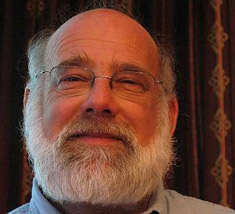
The American Friends Service Committee announced on February 3 that it had nominated Ghassan Andoni and Jeff Halper for the Nobel Peace Prize. Andoni is a Palestinian, a Professor of Physics at Birzeit University, well known for co-founding the Palestinian Center for Rapprochement between People and the International Solidarity Movement (ISM). Jeff Halper (pictured) is Israeli, Professor of Anthropology at Ben Gurion University, and co-founder of the Israeli Committee Against House Demolition (ICAHD), which is exemplary among Israeli peace groups for its activism on the ground in the West Bank and Gaza Strip. (I can't find a good photo of Andoni.)

As an aside, because I'm particularly interested in this, Halper was a pioneering scholar in the field of Mizrahi, or "Israeli Mediterranean," music (the music of Jews of "Eastern," mostly Arab, origin). Here are a couple references:

Jeff Halper, Edwin Seroussi, and Pamela Squires-Kidron, "Musica Mizrahit and the Realignment of Israeli Society: The Case of Hayyim Moshe." 1789-1989 Musique, Historie, Democratie, 3 vols., ed. Antoine Hennion. Paris 1992, vol. III, pp. 669-672.

Jeff Halper, Edwin Seroussi, and Pamela Squires-Kidron. "Musica Mizrahit: Ethnicity and Class Culture in Israel." Popular Music 8/2 (1989), 131-141.

Tags: , ,

Church of England Votes to Divest from Caterpillar


War on Want reports: "The General Synod of the Church of England voted yesterday evening (6 February 2006) 'to disinvest from companies profiting from the illegal occupation, such as Caterpillar Inc, until they change their policies'...Caterpillar has been singled out by the United Nations for complicity in human rights abuses in the Occupied Palestinian Territories. Thousands of Palestinian homes and vast swathes of agricultural land have been destroyed by the Israeli military using armoured Caterpillar D9 bulldozers." In addition, it was an IDF Caterpillar that killed Rachel Corrie on March 13, 2003.

Read about War on Want's Caterpillar campaign here.

Tags: , , ,

Wednesday, February 08, 2006

10,000+ Mobile Homes Stockpiled in Hope, AR


I can't believe the national media has not picked up on this one yet: Arkansas Congressman Mike Ross has written three letters to FEMA's interim director since December asking why 10,000 plus mobile homes are being stockpiled at the Hope, Arkansas airport (pictured above.) FEMA hasn't yet answered his letters, although a FEMA employee recently contacted Ross's office to say they are fixin' to.


This news comes as FEMA is starting to stop paying for hotel rooms for Katrina victims who have not found housing.

Says Ross, “This is the craziest thing I’ve ever heard in all my life, and it makes me angry — angry as a taxpayer and angry for the victims of Hurricane Katrina...There’s no reason why FEMA — after five months — should not have been able to build some manufactured-housing parks.”

This was published in today's Arkansas Democrat-Gazette, but the article--unbelievably--is available by subscription only.

Tags: , ,

Monday, February 06, 2006

'Ud Spotting: Fannypack, "So Stylistic"


The first 15 seconds of the Brooklyn girlgroup Fannypack's "So Stylistic" (title track from their 2003 Tommy Boy release) is a sample of an 'ud solo. Seven seconds of just 'ud and derbouka, and then joined by Fannypack's characteristic, retro, early '80s electrobeat. I have no clue as to the provenance of this sample, but it is great. Cut'n'mix the 'ud everywhere, I say.

But why the 'ud, in Fannypack's delicious, carefully crafted, and eminently fun, old school sound? Is it just a bit of exotica? A random, weird sample, meant to trick the listener into thinking the song is heading somewhere else? Or does it reflect the fact that the 'ud is to be heard all over Brooklyn--in all those great Arab shops on Atlantic Avenue as well as in Rashid's Music Sales, which opened on Atlantic in 1947 and relocated to 155 Court St. in the late nineties?

The answer is, probably all, or none of the above. (Thanks to Steven Shaviro for turning me on to Fannypack.)

(And by the way, weren't fannypacks one of the most unattractive inventions of the late '80s? I'm so glad they've vanished from the scene.)

Tags: ,

U-Cef: New release (shortly!)


U-Cef, the Moroccan musician/producer based in London, has a new release scheduled, called Halalwood. U-Cef's first full-length release, Halalium (2000, Apartment 22), is an amazing blending of various genres of traditional Moroccan music (including Gnawa) with hip-hop and drum 'n' bass. U-Cef is not of course unique in his efforts to put together Moroccan folk and Afro-Euro funk, but he is definitely one of the best practitioners. I got to hang out for him for a few hours in July 2003, in London's small but cool Moroccan district, and in the course of the afternoon he introduced me to Damon Albarn (Blur, Gorillaz) and Steve Hillage (producer of Rachid Taha). Both Albarn and Hillage appear on the new release, as do Natacha Atlas, Rachid Taha, and Justin Adams (who also guests on Halalium).

U-Cef played at the 2005 Essaouira Festival of Gnawa and World Music.

Check out U-Cef's new website. If you go here you can download a sample from Halalium. Halalium is highly recommended, so go get it so you'll be primed for Halalwood when it comes out.

Tags: ,

Sunday, February 05, 2006

Wu Man: Live in Fayetteville


I got to see Wu Man, the pipa (Chinese lute) virtuoso, perform last night at the Walton Arts Center in Fayetteville.

I was introduced to the work of Wu Man by my ethnomusicologist colleagues Rembrandt Wolpert and Elizabeth Markham, who run the Center for the Study of Early Asian and Middle Eastern Music at the U of A. They brought her here a couple years ago, and she performed at the celebrated Mildred B. Cooper Chapel, designed by renowned architect Faye Jones, in Bella Vista.

What I particularly admire about Wu Man is her ability to move easily between the classical Chinese pipa (pronounced 'pee-puh') tradition and the Western avant-garde. At the Cooper Chapel she performed music from the Tang Dynasty (7th and 8th centuries), recovered by Rembrandt Wolpert. On her album Pipa from a Distance (Naxos, 2003), she performs both the classical repertoire as well as wailing like Hendrix on electric pipa ("Shanghai Blues"). She has collaborated with Philip Glass, the Kronos Quartet, and Yo-Yo Ma. She even shows up on anarchist theorist Hakim Bey's album T.A.Z. (The Temporary Autonomous Zone), where he reads passages from his book of the same name.

Wu Man's concert last night similarly ran the gamut from the classical tradition to the avant-garde. In the avant vein, she performed a composition by Eric Moe, "The Sun Beats the Mountain Like a Drum," with a taped "electroacoustic sound" accompaniment.

Most amazing though, in a concert with NO low points, was "Ancient Dances," written by composer Chen Yi (commissioned by the Walton Arts Center) in collaboration with Wu Man. It's inspired by three poems by the famous "drunken" Tang Dynasty poet Li Bai. Wu Man performed this piece accompanied by John Hanks (of Duke University) on percussion and with a video by Catherine Owens (who has worked with U2, among others), based on Chinese calligraphy and artwork, playing in the background. The effect of the music and video was magical and almost overwhelming. (Given my lack of background in Chinese and avant-garde music, I'm left incapable of offering any kind of meaningful account of the music.)

I'm not a big fan of the Waltons, to put it mildly, but I really like the fact that the Walton Arts Center has recently begun commissioning works like "Ancient Dances." Wu Man will perform "Ancient Dances" at Carnegie Hall, New York City, April 6-8, 2006.

Tags: , ,

Friday, February 03, 2006

Hizbollah Gimme Cap


My friend Elliott brought me this Hizbollah baseball cap from Lebanon. Since Hizbollah is classified as a terrorist organization by the US government, it's important to note that Elliott bought the cap not from the party, but from a street vendor in Beirut. (I can't remember who is pictured wearing the hat.) The cap features the Hizbollah flag, which reads, "Hizbollah (the party of God) are the victors: The Islamic Resistance Movement in Lebanon." 23 Hizbollah members sit in the current Lebanese parliament, and two members of Hizbollah are ministers in the Lebanese government.

Tags:

Wednesday, February 01, 2006

"Paradise Now" Nominated for Oscar


I am blown away: the Academy has nominated Hany Abu-Assad's Paradise Now for an Oscar, in the Foreign Language Film category. This is the first time a Palestinian film has ever been nominated, a truly historic event. I have seen it, but have not had the time to write any kind of review. And I won't now, except to say that it is great, and entirely worthy of winning the Oscar. I doubt it will win (I don't know anything about the quality of the other films nominated for best foreign film), and no doubt there will be political maneuvering against it, but the mere fact of nomination constitutes a victory in and of itself.

As for the other categories, I'm hoping that Brokeback Mountain, Crash, Capote, Transamerica, The Constant Gardener, and Syriana (especially George Clooney as supporting actor) win awards, and I hope, against hope, that Munich wins nothing.

(Earlier posts on Paradise Now, here and here).

Tags: ,

Sunday, January 29, 2006

Kufiyaspotting #8: 'Arabistan/Khuzistan

....Or Does It Explode? alerts us to conditions in the southern Iranian province of Khuzestan (often referred to in the Arab world as 'Arabistan), where the Iranian regime has been cracking down on overt expressions of Arab ethnicity, including the wearing of the red kufiya. According to a report published by the Underrepresented Nations and Peoples Organization, "In November's Eid-al-Fitr demonstrations in Ahwaz, Governor General Heyat Mojadam ordered all those wearing keffiyeh be arrested. An Ahwazi Arab youth freed from prison following his arrest during the Eid-al-Fitr protests spoke of how the prosecutor, Mr Farhadi-Rad, argued that the wearing of the red keffiyeh was a 'political statement' that indicated support for secessionism." Another report states that the state has banned the wearing of the kufiya at work. This includes the state oil company, NOIC, the largest employer in the province.

This occurs in the background of the recent upsurge of protests by Arabs in Khuzestan over the past several months.

Latest death count: Iraq


My neighbor continues to keep a daily count of US military casualties in Iraq.

Iraqi civilian casualties: today Iraq Body Count puts the estimates at between 28,198 and 31,800.

Tags:

Kufiyaspotting #7: David Mamet


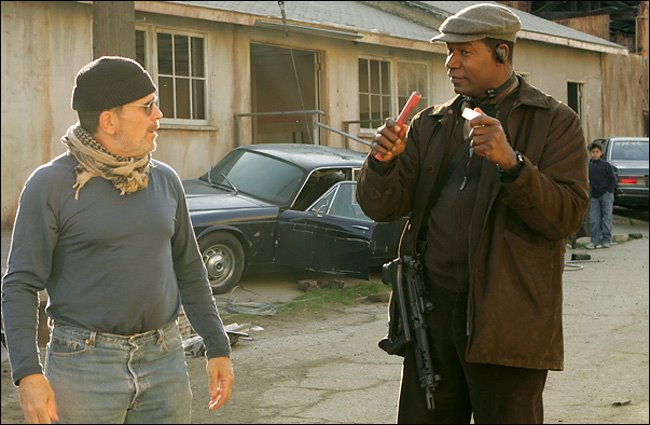
These photos accompany an article in today's New York Times on David Mamet's new CBS series, "The Unit." The article does not call attention to, or comment on, the fact that Mamet is wearing a kufiya. It does mention that Mamet's left-wing political views are well known.

The David Mamet Society informs us that Mamet was offered a special tribute at the Jerusalem Film Festival in July, 2001, and that he "toured Jerusalem with Mayor Ehud Olmert [currently Israel's PM], visiting the sites of numerous suicide bombings."

In a column written for The Guardian in January, 2003, Mamet predicted the rise of Israelis as villains or monsters in film of the next few years. He begins the essay by extolling the film, Exodus, in which Israelis appear as epic and beautiful heroes, and goes on to assert that the turnabout whereby Israelis emerge as villains "is fair play and it is merely the Jews' turn in the barrel."

So now, the enigmatic Mamet is wearing the kufiya...

Earlier kufiyaspottings: One, two, three, four, five, six.

Tags: , ,

Postscript, July 10, 2011:

From Christopher Hitchens' review of David Mamet's new book, The Secret Knowledge: On the Dismantling of American Culture (New York Times Book Review, June 19, 2011). The book marks Mamet's lurch to the right. Hitchens finds it dull and irritating. But Mamet does say: "the Israelis would like to live in peace within their borders; the Arabs would like to kill them all." If Mamet's donning of a kufiya in 2006 was an enigma, today, no doubt, he would consider that fashion accessory to have been a deluded mistake.

Monday, January 23, 2006

Nadi Cinema


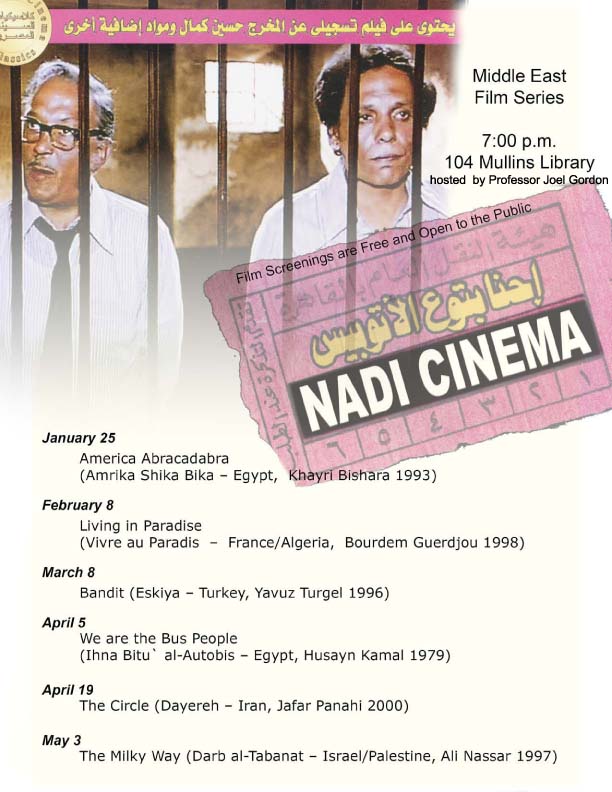
Here's an item of interest mostly to locals: a Middle East film series, "Nadi Cinema," hosted by my colleague Joel Gordon in History. All films are at 7 PM, in 104 Mullins Library, University of Arkansas.

The schedule:

January 25: Amrika Shika Bika (America Abracadabra), dir. Khayri Bishara, Egypt, 1993

February 8: Vivre au Paradis (Living in Paradise), dir. Bourdem Guerdjou, Algeria/France, 1998

March 8: Eskiya (Bandit), dir. Yavuz Turgel, Turkey, 1996

April 5: Ihna Bitu' al-Autobis (We Are the Bus People), dir. Husayn Kamal, Egypt, 1979

April 19: Dayereh (The Circle), dir. Jafar Panahi, Iran, 2000

May 3: Darb al-Tabanat (The Milky Way), dir. Ali Nassar, Palestine/Israel, 1997

Outed by Campus Watch

I just discovered that, for a time last fall, my photo and a quote from me was featured on the homepage of Daniel Pipes' notorious Campus Watch. It is now in the archive of "Previous Quotes of the Month." Here's the quote:
"Many of the clauses in the new [Iraqi] constitution are 'extremely problematic' when compared to the progressive laws concerning women's rights under the secular regime of Saddam Hussein..."

Campus Watch features quotes without commentary. Presumably from the perspective of Campus Watch, such a claim needs no comment because it is so self-evidently outrageous. From what I know of Campus Watch, I guess Pipes & Co. would claim this statement makes me some kind of Saddamist fellow traveler, and would put it in the category of what they call "apologetics." Incidentally, the link to my statement is wrong, or perhaps no longer exists. I'm pretty sure I was quoted saying this by the University of Arkansas student newspaper, The Traveler, while speaking at a bi-weekly public forum, Diwan Baghdad, that I run with my colleagues Joel Gordon and Najib Ghadbian.

Other quotes in the archive are from usual suspects, such as Rashid Khalidi, Juan Cole, Joel Beinin, and so on. What I find remarkable about all this is that (a) no one ever bothered to inform me that Campus Watch had featured me as a notorious "apologist" Middle East specialist of the month and (b) I received not a single piece of hate mail in response to my presumably extremist, Baathist dead-ender statement. No one, whether friend or foe of Campus Watch, cared much about the matter. So much for the power of Campus Watch to intimidate wayward academics. (Or perhaps it's just that no one thinks it's worth harassing a professor in what many folks on the two coasts consider the boondocks of Arkansas?)

This is not to say that Campus Watch-style forces are not able to harass professors, as can be witnessed by recent reports of the efforts of a right-wing alumni group to pay student informants to gather information on "radical professors." This is juicy stuff, and if you've not seen it, please go here and here.

Tags:

Saturday, January 21, 2006

Marilyn Monroe in Egypt


A placard advertisement for Cinema al-Kawkab, a movie theater in the Husayn district, Cairo, Egypt, featuring Marilyn. Husayn is a traditional district, located near al-Azhar. The placard dates from the early '50s, was given away for free and presumably was hung in shops throughout Cairo.

Tags: , ,

Wrestlers in Egypt


A poster widely available in popular quarters in Cairo in the mid-'90s. It says: Egyptian and World Champions. The wrestlers, from left to right, are Makkawi, 'Imadi and Shahhat.

Tags: , ,

Monday, January 16, 2006

Shawarma Lights Up Sharon's Brain?


Last Tuesday, the doctors of Israel's ex-PM Sharon tried to stimulate his brain by putting a plate of shawarma--reportedly Arik's favorite dish--next to his head.

Ironies abound here. First, that Sharon's favorite food would be Arab. (Shawarma, for those readers who do not know, is slices of lamb roasted on a skewer. Like gyros, but much tastier. Shawarma is ubiquitous in Syria, Lebanon, Palestine, and Jordan. To my mind, the true shawarma masters are the Lebanese.) Second, that the doctors tried to revive Sharon's brain with the smell of meat, the massive consumption of which probably caused his stroke. (Sharon was also a big fan of other meat dishes prepared in the Arab style, especially kabob.) Third, despite the fact that Israel has tried to turn shawarma, as well as falafel and tabbouleh and "pita" (Arabic bread or khubz) into Israeli national dishes, they remain indelibly Arab in their origins and names. (Although these foods arguably are the "native" foods of a majority of Israelis, if we consider that the majority of Israeli citizens are "Eastern" in origin, if we add together Palestinian citizens and Mizrahi Jews of Arab origin.)

Despite Sharon's best efforts, over the entire course of his career, to deny the Arab/Palestinian traces that Israel attempted to obliterate in the course of its founding, they remain there to haunt him, and perhaps even revive him.

And here is another one of those indelible traces: Sharon is being treated in Hadassah Ein Kerem hospital. 'Ayn Karim was a Palestinian village that fell to Israel during the 1947-48 war, and was annexed to Jerusalem, its 3000+ inhabitants (Muslim and Christian), expelled. Many of the original homes and churches remain, lending a tony atmosphere to this upscale suburb inhabited mostly by Israeli Jews. Yad Vashem, the Holocaust memorial, is also built on the lands of 'Ayn Karim.

Every time we hear about Sharon and Hadassah Ein Kerem, it reminds us that Arik is being cared for on the land of ethnically-cleansed Palestinians.

Tags: , ,

Away...

I've been away...first it was because of work on the house (check out my flickr account, on the right-hand column, for photos) and then I was in Washington, DC, reading proposals for the Department of Education. Alas, classes start tomorrow, but I am nonetheless determined to get back to blogging!

Monday, January 02, 2006

Architectural Debate in Israel on "The Wall"


Very useful article by Nicolai Ouroussoff in the Sunday New York Times on the wall and the architectural debate over it in Israel. A key figure in the debate is architect Eyal Weizman, who has published a report that "essentially accused Israeli architects of being collaborators in the colonization of the West Bank." Says Weizman, "We examined these architectural drawings in a clinical manner...We showed that the crime was in the making of the line - in the drawing itself - not only in the principle of building a settlement."

Shimon Navez, a retired brigadier general and director of the Israeli Defense Forces' Operational Theory Research Institute, is also a critic of the wall, but from a position that endorses, rather than critiques, Israeli colonialism. Navez deploys the theories of Deleuze, Bataille and the Situationists, claiming that the West Bank is already a "smooth space," and the wall (the "barrier," in his parlance) a kind of ineffective anachronism, representative of "striated space." Navez cites Gaza as an example of how Israeli forces are effectively using "smooth space" as a mechanism of control, "saying that as long as Israel controls the air space, what happens on the ground is essentially irrelevant from a security standpoint. 'The main idea is that we can see and do what we please,' [Navez] said."

According to Weizman, General Navez "is simply trying to replace one form of control with another that is less visible."

Ouroussoff proceeds to give a very useful description of the wall, and he concludes (very surprisingly, for a NYT article):

The consequences extend beyond the ghettoization of Palestinians and Israelis. The wall destroys the space for those who once occupied the middle ground: those who refuse to divide the world into good and bad, civilization and barbarity. It threatens to sever the threads, already fragile, that might one day be woven into a more tolerant image of coexistence.

(My only complaint about the article: no Palestinian voices! Why not talk to Palestinian architects like Suad Amiri?)

Some articles by Weizman:

"Strategic Points, Flexible Lines, Tense Surfaces and Political Volumes: Ariel Sharon and The Geometry of Occupation." In Cities, War and Terrorism: Towards an Urban Geopolitics, ed. Stephen Graham (Blackwell, 2004)

A piece (I can't locate the title) in Against the Wall: Israel's Barrier to Peace, ed. Michael Sorkin (The New Press, 2005)

Tags: , ,

Sexy Beirut

As reported by Queer Arabs, the Jan/Feb issue of The Out Traveler features an article on "Surprising, Sexy Beirut." The article excerpt available online states:
Indeed, it’s tourism that has empowered the country’s gay and lesbian community and has made it the most liberal place in the Arab world. “Tourists come from all over the world because they know Lebanon is a fairly open society,” says Georges Azzi, head of the Beirut-based organization Helem (Arabic for “dream”), the Arab world’s first and only gay advocacy group. “This is especially so for Gulf Arabs,” he explains, referring to the Middle East’s most lavish spenders, from countries like Saudi Arabia, Kuwait, and the United Arab Emirates. “So the police couldn’t crack down on the nightlife scene even if they wanted to.”

Helem's website is here.

(Out Traveler identifies Beirut nightclub BO18 as being built on the site of a "onetime Palestinian refugee camp." This is incorrect. BO18 is built on the ruins of Qarantina, an urban slum cleared by the Phalangists in early 1976, during the Lebanese civil war, and many of its inhabitants massacred, 1500, according to journalist Michael Jansen. It was a heterogeneous slum, with Kurds, Palestinians, and Shi'ite migrants and refugees from southern Lebanon.)

Tags: ,

Thursday, December 29, 2005

best “world” music of ‘05


I’ve not compiled a best-of list for a couple years, although I used to do it regularly on my Interzone Radio show. But lately I’ve been consuming music in a somewhat different way, sampling cuts from here and there, and I’ve been less focused on what is the most “current” or hip in the world music scene. But inspired by Steven Shaviro, I’ve decided to have at it again. My top 10 is all “world music”, whatever that is. My "others" ventures a bit further generically. This list is not necessarily in order of what I think is best, and for sure I’ve forgotten some things....

1. Kamilya Jubran and Werner Hasler, Wameedd. Amazing collaboration between former Sabreen vocalist and Swiss electronic sound producer. Spare, beautiful, experimental, eerie.

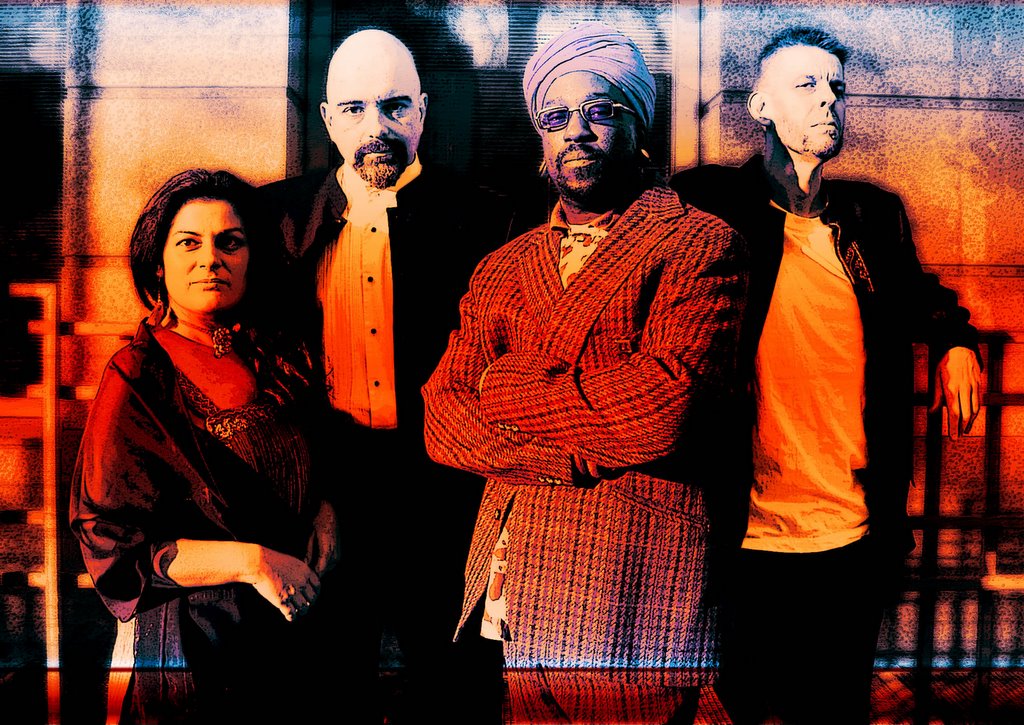
2. Tranglobal Underground, Impossible Broadcasting. TGU (pictured above) finally return to their true transnational ethno-funk roots, this time with some great Bulgarian assistance.

3. Mutamassik, Masri Mokkassar: Definitive Works. Egyptian-Italian American d.j.’s collection of her finest work. Breaking down Arabic music, cutting it into hip-hop & drum ‘n’ bass.

4. Konono No 1, Congotronics. A total assault from Kinshasa: massively-distorted electric thumb piano and frenetic percussion. (Congotronics #2 now available from emusic.com.)

5. V.A., Guitars of the Golden Triangle: Folk and Pop Music of Myanmar (Burma), vol. 2. Another Sublime Frequencies revelation: more wonderful surf and psychedelic rock from Southeast Asia. After hearing various S.F. collections from Thailand and Cambodia, these rockified versions of Myanmar cease to sound weird.

6. Baba Zula & King Tubby, Duble Oryantal. Despite the punned title and the presence of King Tubby, the dub is lowkey, just enough to lend the various Turkish folk-based genres presented here an edge, and an element of subtle strangeness.

7. V.A., Rough Guide to the Music of the Sahara. The revelation here is that the incredible gutbucket blues guitar of the legendary Malian group Tinariwen is not a one-off, but a much wider phenomenon. Check out Nayim Alal and Mariem Hassan.

8. Balkan Beat Box, Balkan Beat Box. New York based underground Israeli scenesters Ori Kaplan and Tamir Muskat lead a high energy romp that fuses not just the Balkans but also Israel and the Arab World, an Eastern Mediterranean with the boundaries--temporarily at least--blown apart.

9. MIA, Arular. This dancehall/grime blowup, with its Tamilese Sri Lanka tinges, is on everyone’s list, and I am compelled to concur. Although MIA’s references to violence and terrorism are controversial,she does namecheck the PLO--and gets away with it.

10. Khaled, Ya-Rayi. The US mix was released in 2005, but the producers almost wrecked it for me by putting the execrable “Love to the People” (English and Arabic versions) onto what, in the French version, was in part a return and tribute to the roots of rai, the Wahrani genre. So skip cuts 2 and 11 and all the “peace through music” bullshit.

Other favorites: I get lots of my music from emusic, and lately have been very keen on all the offerings from Tzadik (John Zorn’s project to expand our notions of Jewish music) and Doublemoon, which features all kinds of great Turkish music. I’ve also been into favela funk and reggaeton, like everyone else. Also into Ellen Allien (everything! this year’s release is Thrills), Laura Veirs’ Year of Meteors, and OOIOO’s gold & green.

Good news from the NYT: "Independent labels account for more than 18 percent of album sales this year - their biggest share of the market in at least five years, according to Nielsen SoundScan data...The independent sector as a whole already outsells two of the big four companies, Warner Music and EMI."

Tags:

Monday, December 26, 2005

Hakim in "Vanity Fair"


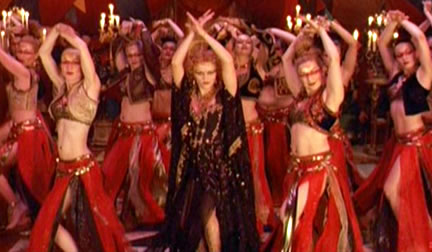
I finally have seen Mira Nair's film Vanity Fair (2004), starring Reese Witherspoon as Becky Sharp. I found it somewhat entertaining but felt by the end that it had run aground. But really, what I want to comment upon is the unbelievable and completely non-credible "dance scene," staged by the Marquess of Steyne (Gabriel Byrne) and featuring Becky Sharp, to impress the King of England.

It's hard to imagine why Indian director Nair would put such a sequence on screen, where a posse of white British dancers wear what basically are bellydance outfits (somewhat Indianized) and perform ersatz bellydance moves, and where Reese Witherspoon wears Goth-style eye makeup. Such "bellydance" costumes were invented, in fact, by Hollywood in the early 20th century, and eventually adopted back in the Middle East. But what is really strange about the sequence is that it features Egyptian bellydance music by acclaimed sha'bi vocalist Hakim. The song, "El Salam," (from Hakim's 2002 Mondo Melodia release, Takatik), features all acoustic accompaniment, but nonetheless it's entirely inauthentic and anachronistic. Normally I like such "Arab inroads" into Western culture, but this one sits ill with me. Plus it fits into that standard Orientalist trope, whereby all "wog" culture, whether Indian or Arab, is more or less equivalent.

I also hated the end of the film, where Becky realizes her dreams and ambitions by finally marrying Joseph Sedley and traveling to India. The last scene shows Becky and Joseph riding elephants in a gorgeously colorful and exotic India. Pure raj/imperial nostalgia.

Tags: ,

"has so Eunucht our Husbands...": The 1674 Women's Petition Against Coffee

London, 1674, women petition against the "Grand INCONVENIENCIES accruing to their SEX from the Excessive Use of that Drying, Enfeebling LIQUOR [coffee]." Here are a few choice bits:

"Never did Men wear greater Breeches, or carry less in them of any Mettle whatsoever."

"They come from it [coffee] with nothing moist but their snotty Noses, nothing stiffe but their Joints, nor standing but their Ears..."

"...like young Train-band-men when called upon Duty, their Amunition is wanting; peradventure they Present, but cannot give Fire, or at least do but flash in the pan, instead of doing Execution."

"Certainly our Coutrymens pallates are become as Fanatical as their Brains; how else is't possible they should Apostatize from the good old primitive way of Ale-drinking, to run a whoreing after such variety of distructive Foraign Liquors...this ugly Turkish Enchantress..."

(I found this thanks to the latest issue of Harper's.)

Tags:

Arkansas Democrat-Gazette: "Paradise Now" #14 in best movies of '05

Philip Martin, the Arkansas Democrat-Gazette's very fine film reviewer, ranked Paradise Now (dir. Hany Abu-Assad) #14 in his review of the best films of 2005 yesterday (Dec. 25). Unfortunately, as far as I'm aware, the film hasn't opened anywhere in Arkansas. (I saw it in Washington, DC.)

Here's what Martin had to say: "While geopolitical realities shape this story of two would-be suicide bombers from Palestine, the characters remain recognizably human, to the point where we begin to suspect their arguments are voiced largely to convince themselves."

Sunday, December 25, 2005

Christmas Benefits of "Separation Barrier"


Great and unexpected news! Now it is easier, and cheaper, to buy olive wood carvings from Bethlehem (nativity scenes, rosaries, crosses, etc.) due to in part to their availability on the internet--a boon not just for consumers but for the woodcarvers as well. And as an AP report by Sarah El Deeb explains, "Bethlehem's woodcarvers are getting another unexpected boost: cheap olive wood from the construction of Israel's controversial West Bank separation barrier. Thousands of olive trees have been uprooted to make way for the barrier, creating an abundance that has driven the price from $260 to $195 per ton, carvers said."

Who would have thought that Israel's construction of the apartheid wall (shown above, with Christmas pilgrims passing through) could have such positive benefits for producers and consumers?

There is, however, a downside, as El Deeb explains, "the barrier is creating new hardships for Bethlehem, cutting off many people from farmlands and defacing the landscape that draws tourists."

But does that really matter, as long as we can still buy our Christmas creches and our rosaries, made from authentic Holy Land olive wood?

Merry Christmas!

, , ,

Tuesday, December 20, 2005

No More "Hotel California" in Iran: Great!


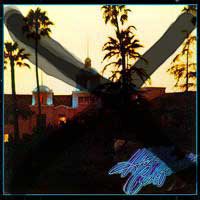
Along with all the world's civil libertarians, music lovers, neo-cons, and professional Iran bashers, of course I think it's awful that Western music is banned from state broadcast outlets in Iran. But I'd like to also dissent, slightly. Is it really so bad that the Eagles' "Hotel California" will now no longer be heard accompanying Iranian news broadcasts? I wouldn't mind visiting a country where you couldn't hear that execrable song, which has been torturing me for years and years.

(On second thought, if it's banned that will, inevitably, make it that much more popular. Strike a blow for freedom and listen to "Hotel California" in Tehran. Argh!)

Monday, December 19, 2005

North African Chic in Paris

In the Travel section in the Sunday New York Times, an article by Seth Sherwood describes the multiple ways that North African fashion, cuisine, and music are so-o-o hip today in Paris. Inappropriately titled, "In the Heart of Paris, an African Beat" (inappropriate because Moroccans, Algerians, and Tunisians most often tend to think of themselves as part of the Maghreb, the "West" of the Arab-Islamic world), it elaborates on the ubiquity of North African culture in the French capital. Seth describes many of the hippest restaurants, clubs, and boutiques, and his descriptions of the varieties of couscous and tajine dishes is especially enticing. Two of the most noteworthy restaurants are 404 and Andy Wahloo, owned by Hakim and Mourad Mazouz, who own Momo and Sketch in London.

I've been to both Sketch and Momo in London. (An old friend of mine who is a friend of Mourad got us in.) Sketch is unbelievably posh and gorgeous, but not Middle Eastern themed. Momo by contrast is ultra-chic Middle Eastern, with a hookah bar/café upstairs and a restaurant downstairs that features very fine world music. (And Mourad has compiled 3 volumes of fabulous Middle Eastern music, Arabesque [vols. 1-3].)

Andy Wahloo, in Paris, is a wonderful pun on "Andy Warhol" which means, "I have nothing" in Maghrebi Arabic.

I'm pleased that Maghrebi culture has become so mainstream in France, and have been involved over the past 15 years in documenting the movement of Arabic music in France from the margins to the center of French pop culture. I'm glad as well that entrepreneurs like Mourad Mazouz, and not just white French citizens, have been key figures in these moves.

But while the "Beurgoisie" has moved into the center of French pop culture, the unemployed and working-class youths of the banlieues have been mostly left behind, as the recent riots show dramatically showed. The fact that Maghrebi culture attracts French bohos (and boho US tourists, if this article does its work) doesn't guarantee jobs, or respect, to Franco-Maghrebi residents of the cité. (Nor does the fact that rap music dominates US pop culture mean that poor blacks will be treated with any consideration when a disaster like Katrina strikes.)

Tags: , ,

More on Rock Music as a US Military Weapon

The HRW report on the US use of Eminem and Dr. Dre as tools of torture reminds me of how US forces used loud rock in the December 1989 invasion of Panama ("Operation Just Cause"). President Noriega (sought after on drug charges) took refuge in the Nunciatare of the Vatican Embassy. US troops surrounded it and attempted to use loud rock music as a form of psychological warfare to drive him out. The Vatican protested and the troops shut off the noise. Noriega finally surrendered on January 3, 1990.

The president in charge: President George H.W. Bush. Secretary of Defense and director of "Operation Just Cause": Dick Cheney. Chairman of the Joint Chiefs of Staff: Colin Powell.

You can see a list of songs here, courtesy of the National Security Archive.

Tags: ,

Eminem & Dr. Dre: Weapons of Torture in the "War on Terror"


The Associated Press informs us that Human Rights Watch released a report today on a secret US prison outside Kabul, Afghanistan, where as recently as last year, detainees were tortured by, among other things, being forced to listen to loud music in the dark for days. "They were chained to walls, deprived of food and drinking water, and kept in total darkness with loud rap, heavy metal music or other sounds blared for weeks at a time."

One detaine, Benyam Mohammad, an Ethiopian-born Guantánamo detainee who grew up in Britain, said that he was "forced to listen to Eminem ["Slim Shady," to be precise] and Dr. Dre for 20 days before the music was replaced by 'horrible ghost laughter and Halloween sounds.'"

The HRW report can be read in full here.

So much for music as a "universal language"...

I've not heard Eminem and Dr. Dre's position on the use of their music as a torture, but teenagers have deliberately used loud rap and heavy metal for years to torture their parents. And remember ghetto blasters on city buses?

(To his credit, Eminem is against the war, as is evident from his video "Mosh.")

Tags: , , ,

Sunday, December 18, 2005

The Kominas: Islamic Punk


Taqwacores: 4 songs available to download from The Kominas' homepage. My fave, right now, is "Sharia Law in the USA," recorded with 8bit, which invokes "Anarchy in the UK": "I am an Islamist, I am an anti-Christ."

Thanks to Michael Muhammad Knight, I have learned that Kominas member Basim is now in Pakistan, volunteering for the Kashmiri relief effort. That is so punk rock. You can read his "punkistani" blog here. [Correction: for some reason that link doesn't work, so paste this into your browser: www.livejournal.com/users/punkistani.]

Tags:

Why Bin Laden Will Lose


George W. Bush, December 11, 2001: " I couldn't imagine somebody like Osama bin Laden understanding the joy of Hanukkah, or the joy of Christmas, or celebrating peace and hope." On the occasion of the first lighting of the Hanukkah Menorah at the White House.

I was, of course, tipped off to this by The Daily Show. You can hear these immortal words here.

Tags: ,

Thursday, December 15, 2005

Kamilya Jubran: Wameedd


Kamilya Jubran, lead vocalist for Palestine's beloved, avant-folk group Sabreen from 1982 to 2002, has recently put out a solo recording called Wameedd. I don't yet have the album, but I've listened to the quite long samples from the album that are up on Kamilya's website and they are just amazing. Wameedd features the voice and 'ud playing of Kamilya and the very creative electronic sounds produced by Swiss composer and sound wizard Werner Hasler. The result is truly remarkable, about as unusual a recording of "Arabic" music as I've ever heard. It puts me in mind of Sabreen's last release, Hases Maz'ooj, not because the latter sounds like Wameedd but because both are so singular, so unlike anything else. Someday (but not now) I hope to write something about Hases Maz'ooj, which is very hip-hop/electronic and a radical departure from Sabreen's earlier work.

I highly, highly recommend Wameedd. I will be reviewing it soon for RootsWorld, along with the new solo release, Min Ba'd, from Wissam Murad, also of Sabreen.

Wameedd is available from CDRoots (and so is Hases Maz'ooj).

Tags:

Wednesday, December 14, 2005

Psychebelly: Baba Zula


Continuing the bellydancing theme...This is the cover to Baba Zula's album, Psychebelly Dance Music (2003). Baba Zula perform what one might call "treatments" or "wreckings" of Turkish folk music. They play traditional Turkish acoustic instruments and mix them up with electronica. Although Mad Professor works with them on Psychebelly, the dub elements are quite subtle and organic sounding, not as crazy and excessive as the Professor's usual outings. I highly recommend this, and all of Baba Zula's recordings. They are put out by Doublemoon; I access them through the fantastic online music source, emusic.com. Psychebelly is available from cdroots.

Baba Zula, along with many other great Turkish artists, are featured in Fatih Akin's film, Crossing the Bridge - The Sound of Istanbul. I've not yet seen it, but informants tell me it is fabulous.

Tags:

Make Love Not War


Another provocative work of art from Josephine Meckseper: Make Love Not War, 2003, Mixed media and gouache on paper. First, the two pieces as reproduced by Gavlak (West Palm Beach), second, as hung at the Galerie Borgmann.Nathusius, Cologne. Two works by Meckseper featuring the kufiya are here and here.

Grassroots Middle Class Antiwar Sentiment


A simple, low key yet effective expression of sentiment against the war. A ranch house, up the block from us on Olive St., with an enormous lawn, on one acre of prime real estate. I don't know the owners of the house, and I think this display went up only recently. I think it reflects the very widespread and deepseated public disaffection with the Iraq War, even among prosperous, upper middle class southerners. (Photo taken on December 13.)

Tags: ,

Monday, December 12, 2005

Green Party Calls for Divestment from and Boycott of Israel

Resolution: Adopted by the Green Party of the United States, November 21, 2005

1. The Green Party of the United States (GPUS) publicly calls for divestment from and boycott of the State of Israel until such time as the full individual and collective rights of the Palestinian people are realized.

To maximize the effect of the Green Party's support for divestment and boycott of Israel:

2. The party calls on all civil society institutions and organizations around the world to implement a comprehensive divestment and boycott program. Further, the party calls on all governments to support this program and to implement state level boycotts.
3. The party urges the Campus Greens network to work in cooperation with other campus organizations to achieve institutional participation in this effort.
4. The GPUS National Committee directs the Green Peace Action Committee (GPAX) to encourage the larger anti-war movement to promote the divestment/boycott effort.
5. The GPUS National Committee directs the International Committee to work with our sister Green parties around the world in implementing an international boycott.

On July 2, 2004, the 216th General Assembly of the Presbyterian Church (USA) voted 431-62 “to begin gathering data to support a selective divestment of holdings in multinational corporations doing business in Israel/Palestine.”

Tags: , ,

Saturday, December 10, 2005

Absolut Beirut.


I found this at Queer Arab and just had to put it up. (It's from absolutads.com.) It reminds me that I must get back to my beloved Beirut, where I lived from January 1964 to January 1976 (with a couple sojourns in the US).

Tags:

Iranian Girl Rock Group Orkideh


...Or Does It Explode? reports that a pair of concerts (women-only) by the Iranian rock group Orkideh ("Orchid") are upcoming in Tehran on December 16 & 17. No mp3's available yet!

Tags:

Condaleeza Greeted by Nadia Comaneci


Romanian gymnast Nadia Comaneci greets Condi on her arrival at Bucharest airport, Romania, on December 6. Before the visit, one of Condaleeza's senior staff predicted, "Romanians 'will go crazy' over the meeting"--confirming Condi's "rock star image."

Although Romania is now post-Communist, Nadia continues to show her good training under Stalinism as she greets the torture-apologist on behalf of the state.

Tags:

Friday, December 09, 2005

Fred Pfeil, R.I.P.


I just received word about the passing of Fred Pfeil, on November 29. Fred, who taught in the English Department at Trinity College, was 56.

I had the great privilege of getting to know Fred during the First Gulf War. I had previously read some of his essays and had seen him at a conference or two, but I first met him in the offices of the Seattle Coalition Against the War (I think that was the name), shortly after the US invaded Kuwait, in early 1991. We got to be good friends. I was living in Seattle, teaching (sometimes) at UW, and looking for a tenure track job. Fred was on a post-doc and living in Seattle. We were both heavily involved in anti-war organizing. The day of the invasion the Seattle Coalition mounted a sit-in at the Federal Building in Seattle. (I was in the Coalition 'leadership', so I didn't sit in.) Fred cut off his long hair, put on a suit so that he looked like a bureaucrat, and stood outside the Federal Building, telling federal workers that they could go home. (And a lot of them took his word for it.) When the police started arresting protesters, Fred was one of the first they grabbed. (He later served a day or so in prison for the offence.)

So, we hung out a lot, discussing politics, film, music, and reading each other's work. I remember lots of great times, and one night in particular, when we went to a concert of jazz saxophonist Courtney Pine, who Fred turned me on to. It was a simply great and inspiring concert (although a lot of Courtney's recordings are too commercial). We next went and caught the end of Maceo Parker's set at Blues Alley. We topped the night off by going to the ReBar (Seattle's best dance club at the time), where it turned out to be Fetish Night. A truly memorable night.

Fred was working on his great book on masculinity, White Guys, at the time. In particular, he was doing the chapter on the Men's Movement. One Saturday he convinced me to go along to a men's meeting, he thought he should have a "real" ethnographer assist him with his fieldwork. It was quite interesting, and even though the stereotypical men's movement things happened, such as the dancing and drumming at the beginning and end and the passing around of the "wisdom stick" to those who addressed the crowd, I came away with a much more sympathetic and nuanced sense of the men's movement, thanks to Fred.

Fred was incredibly multi-talented, and I don't ever think he received the academic props he was due. His highest advanced degree was "only" an MFA, and this, I believe, kept him from landing a position at a more "prestigious" institution. But never mind that, and Fred himself was never bitter about this. His two "theory" books, Another Tale to Tell: Politics and Narrative in Postmodern Culture (1990) and White Guys: Studies in Postmodern Domination and Difference (1995) are first rate: smart, theoretically astute, witty as all hell, politically engaged and nuanced, extremely well written. Many scholars, as we all know, never manage a second book, and Fred produced two first-rate ones. But he was also a writer of very fine fiction. His novel, Goodman 2020 (1986), is a fabulous work of science fiction, very dystopian, very depressing. I've never understood why it is not more widely read and celebrated. I try to foist it off on friends to read, and those who do, seem to like it as much as I do. What They Tell You to Forget: A Novella and Stories (1996) got a lot more props, and won the Editors' Book Award of 1996. It is just brilliant. Also very depressing and has a very dreadful (because so depressingly bad) sex scene. Fred was brilliant at writing about the depressing stuff, in part because he came from a real working class family (but he never beat people on the left up with his proletarian background) and he had some good old Scandinavian blood (on his mother's side, I think). On occasion he'd venture into Ballard, Seattle's Scandinavian neighborhood and bring back some pickled herring to share with me. While we were sojourning together in the Northwest, he was also working on a libretto for an opera. I can't remember the title, it had to do with dogs, and it was performed. I mention it only to give another dimension of Fred's many activities.

I only got to hang out with him 2 or 3 times after I moved to Cairo in 1992. I visited him once in Trinity, in fall 1993, I think. I may have seen him in summer 1996, but I'm not sure. The last time was in September '02, when I was lecturing at Wesleyan and my friend Elliott drove me over to see him for a couple hours in Hartford. We had the usual great Fred conversation. One of the things I remember talking about was, what anti-war slogan was he gonna write on a highway overpass, once the Iraq invasion started. (Fred and his direct-action pals already had it planned out.) For me, Fred was an exemplary political academic, always working with students and community-based groups on progressive political action. One of his favorite activities was "improving" billboards, and he had lots of stories. He was also involved, after going back to Trinity in the nineties, in work with prisoners, promoting alternatives to violence. I don't think I've ever met an academic who was so politically engaged, and in such nuanced, lving, humane and non-dogmatic ways.

Fred wrote a very moving obituary in New Left Review for his departed buddy Michael Sprinker. (And Fred co-edited, A Singular Voice: Collected Writings of Michael Sprinker [2003]). I hope someone writes an equally brilliant and compelling tribute for Fred. (I'm not up to the task, either intellectually or stylistically.)

I miss you buddy. You made the world a much better place by your example. Thank you so much.

Thursday, December 08, 2005

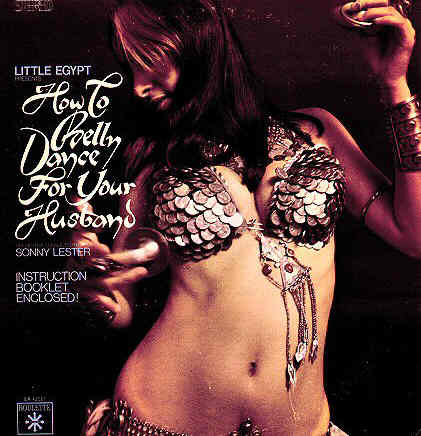
Sonny Lester: How to Belly Dance For Your Husband


The cover of the 1968 release from Sonny Lester - His Orchestra & Chorus:
Little Egypt Presents: How to Belly Dance For Your Husband.

The “Little Egypt” referred to is not a real person but a marketing hook. The name evokes the “original” Little Egypt, the scandalous sensation who bellydanced at the 1893 Chicago World’s Fair. There was probably no “real” person called Little Egypt at the World’s Fair but there were a number of bellydancers from Egypt and Algeria at the Fair and they did create a sensation and a longlasting legacy. The scandal and sensation launched a “shimmying” trend in female dancing that reverberated in carnival sideshows and burlesque halls and strip clubs for decades, and it lives on today in the huge network of US bellydancers and the performances of Shakira and Britney and....

Bellydancing music was HUGE in the US in the 1950s and early and there are dozens of recordings and many amazing covers. The theme was: middle class women, spice up your married lives by bellydancing for your spouse. Belly dance clubs in New York City and other urban centers were hip meccas for middle class whites looking for exotic and wild experiences. Radiobastet.com has a great archive of album covers and also uploads albums once a month. The Lester recording is still up as of today. I’m not sure about it’s legality but....

Sonny Lester (b. 1924) was an important figure in the “exotica” genre, so popular in the 50s and 60s. (Check out David Toop’s book Exotica for a great account.) He was especially well known for his album, How to Strip for Your Husband, and put out a number of exotica stripping and bellydance releases on the Roulette label. I was somewhat surprised to learn that this release appeared in 1968. I wasn’t aware that the “craze” was still going on at that late date.

The music on How to Belly Dance For Your Husband is in the exotica vein and evokes rather than performs Arab/Middle Eastern bellydance music. It is nonetheless quite fun. Most of the releases I’ve heard from the period by contrast are quite “authentic” bellydance tunes performed by Arab or Armenian or Turkish musicians.

Earlier bellydance posts: a description of an album featuring Özel Türkbas here and covers with Özel Türkbas are here and here. A photo of bellydancing in stereo is here.

Tags:

Condaleeza's "Rock Star Image"


Joel Brinkley had a silly piece in the New York Times on Monday, entitled "The Man Behind the Secretary of State's Rock Star Image." (I'm commenting on this a little late, because I've been away at the American Anthropological Association Annual Meetings in Washington, DC.)

Silly on a number of accounts. First, because: what "rock star" has to spend all his/her time attempting to explain away torture, secret prisons and extraordinary renditions as s/he travels around the globe?? The worst that a "rock star" might be called account for might be, what, sexist or homophobic lyrics? Second, silly because Brinkley seems to agree with "the diplomats, politicians and journalists of the world, [who believe that] there is no argument that [Condi] has ascended to rock star status." Who are these foolish diplomats and pols and journalists? Brinkley gives us no evidence that this benighted circle includes any other than US pols and journalists. When Forbes magazine put Condi at the top of its list of the 100 most powerful women in the world, the New York Post's headline read, "Condi Rules the World!" Brinkley somehow doesn't understand that the statement, "Condi Rules!" means something very different than, say, "Missy Elliott Rules!" Celebrity showbiz and politics have been getting more and more intertwined in the US for years but this doesn't guarantee that when Condi is greeted by Olympics gymnast Nadia Comaneci on her visit to Romania, the images of Abu Ghraib are automatically obliterated and forgotten. Plus, when did the New York Post become a rock star maker?

A close reading of Brinkley's article leads one to suspect that it is mostly Condi's staff and especially the man in charge of Condi's image-making, Jim Wilkinson, who believe this rockstar nonsense. (Another case, I think, of a Times reporter getting so "embedded" in his sources that he can't see the obvious.) The staff seems quite convinced that their efforts at image-making, such as having Condi greeted by Japanese-American sumo star Konishiki on her arrival in Japan, are brilliant strategy successes that help her "connect with the ordinary citizens of the countries she visits." Maybe her staff is compensating for the fact that no other foreign policy strategy seems to be working?

Given that all the news about Condi's trip to Europe that has come out this week since Brinkley's report is about how she is dealing with the question of torture and renditions--how rockstar could she be?

I'll leave the last word to a real rockstar: Mick Jagger. Mick is a multimillionaire and is in his mid-sixties and we don't really expect much of him anymore, but he is much more clued-in than Brinkley and all those pols and diplomats and journalists. From the Rolling Stones' recent song, "Sweet Neocon," off the album A Bigger Bang:

You parade around in costume, expecting to be believed
But as the body bags stack up, we believe we’ve been deceived


Tags: ,