The Electronic Intifada recently (January 28) published a set of stunning photographs, courtesy ActiveStills, of young Palestinians confronting the Israeli forces of the occupation as well as the security forces of the PA, over the last four months. They are amazing photos (by Anne Paq in Bethlehem, Ezz Al-Zanoon in the Gaza
Strip, Mohannad Darabee in the Ramallah area, Oren Ziv in Bethlehem and
the Ramallah area). I find EI's report somewhat disingenuous, however, in that it fails to mentions one key aspect of the recent upsurge in confrontations -- that many have called this the "knife intifada," given that it has been characterized by a series of lone wolf knife attacks, as well as car rammings and shootings, aimed at Israelis, both soldiers and civilians, and has resulted in the deaths (between September 13 and January 5) of 25 Israelis. The period of course has been marked by clashes between groups of Palestinians (usually, rock-throwing) and Israeli soldiers, and of course Palestinian casualties are far higher, totaling over 160. (EI does mention the numbers of Israeli dead, but not the nature of the killing.) Since the fact that knife attacks are a significant element of the current struggle, it seems odd to me that EI doesn't discuss them at all. Instead, the quite striking images of Palestinian resistance seem to be the story.
And while I admire the courage as well as the stylistic flare of those Palestinians now fighting the occupation, at the same time it pains me to think that these young people represent yet another generation of Palestinians condemned to confronting violence. This occupation is about to be (in June) 49 years old. FORTY NINE. How can this keep going on and on and on and on? What does it mean for us to admire the bravery and fortitude of this new generation of heroic Palestinian strugglers? I would much rather not see such photos any more, instead I want to see photos of young Palestinians dancing and partying and studying and enjoying "normal" life. I am sick of it. And yet...don't they look flash?
Bethlehem
North of Ramallah, near Beit El settlement
North of Ramallah, near Beit El settlement
Bethlehem
“We cover our faces because the occupying authority might [otherwise]
arrest us. We also
fear our own [Palestinian] authority would arrest us
in the same way.” Bethlehem
North of Ramallah, near Beit El settlement
(the insignia of the Popular Front for the Liberation of Palestine is on the headband)
The Master Musicians Of Jajouka with Bachir Attar (Roskilde Festival 2014); photo: Morten Aagaard Krogh
And now there is another, Jajouka Quelque Chose De Bon Vient Vers Toi, by Eric and Marc Hurtado, members of the experimental/industrial music group Étant Donnés from Grenoble. The brothers were born in Rabat, Morocco. The film is entered in the 27th Marseille International Film Festival, to be held in July 2016. The festival website has this to say about the film:
The film opens with an archaic tale, in brief stylised tableaux,
concerning the divine creation of music. The myth is extended to a
universe of sacred dimensions where it is difficult to differentiate the
legend from its current perpetuation. Where are we? In the Moroccan
Rif, in Jajouka, a village where, for over two thousand years, fertility
rites involving music and dance, have been presided over by Bou-Jeloud,
“the Father of Skins”, a local version of the god Pan. The Hurtado
brothers are famous musicians: their group Etant Donnés came to
prominence through collaborations with various artists including Alan
Vega, Genesis P-Orridge and Philippe Grandrieux (they produced original
soundtracks for several of his films). They are also known as
experimental filmmakers. Here their two passions are combined, raising
the challenge of travelling back in time to hail the Master Musicians of
Jajouka, yesterday and today. Besides, has time passed? It is therefore
not about concocting a score destined to accompany autonomous images,
but about making the music (its strident nudity, its incantatory
austerity) and its history the very substance of the images and the
scenario being staged. Their choice was obviously Pasolinian: to
resurrect the archaic while remaining faithful to it, through the
treatment of decor, lighting, acting and costumes. Here, the beauty lies
in the rough friction between the muteness of the characters and their
unbridled momentum towards another potential voice.
--Jean-Pierre Rehm
Based on the write-up, it seems the film is going to go over the familiar myths surrounding Jajouka (it's about the rites of Pan, Jajouka and its rites are located in archaic times, and so on), that Schuyler's article so cleverly deconstructs. But maybe someone who reads this will be able to see the film and can tell us differently...
One of the best reissuers out there, Shellachead, put out a wonderful collection of Sudanese music last month, all 45s recorded on Sudan's Munisphone label in the sixties and seventies. I was only familiar with two of the artists previously, the fabulous female trio al-Bilabil (read about them here) and Sayed Khalifa, who is most well-known in Egypt, at least, for his song "Mambo Soudani," which he performs in the 1957 film Tamr Hinna.
And here is a bit of info about Khalifa, courtesy Heather Maxwell of the VOA:
More than any other singer of his generation, Sayed Khalifa, is
responsible for the popularity of ‘Omdurman songs’ throughout the Muslim
Sahel and the Horn of Africa. A dynamic performer, Khalifa won fans
throughout Africa with his reinterpretations of classic Sudanese songs
in the national languages of his African audiences. He was born in 1928
in the village of Ad Dibeiba, not far from Khartoum, and in 1947
received a scholarship to study at the Arab Music Institute in Cairo.
He made his first radio broadcasts, on Egyptian radio, during these
student years, and in 1956 wrote his name into Sudanese history with his
recording of ‘Ya Watani’ a patriotic song praising Sudanese
independence. Like many of his musical peers, Sayed Khalifa’s career
was curtailed by the Islamic regimes of the late 1980s, with some of his
more sensual songs purged from the Radio Omdurman archives. The great
Sayed Khalifa passed away on July 2, 2001 while undergoing treatment for
heart disease.
His most famous song, and one of the Sudan’s most well travelled
melodies, is ‘El Mambo Soudani’. The music was composed by Sayed Abdel
Ray, and Sayed Khalifa himself composed the lyrics. This song has
become a staple of Sudanese wedding bands, and was also the title of the
1998 Piranha records ‘El Mambo Soudani’ by the Cairo based group
Salamat (Sayed Khalifa appears on the group’s 1998 CD ‘Ezzayakoum’).
After encouraging his listeners to dance the Sudanese Mambo, Sayed
Khalifa sings of his beloved, of her beauty and graceful silhouette, and
of the suffering she puts him through.
But the other tracks on the collection are all worth listening to. You can listen to the entire collection here, via bandcamp, and you can download it for the very reasonable price of $5. (Plus you get the booklet that goes along with the music, as a pdf.) Highly recommended.
Aki Nawaz (of Fun'Da'Mental) posted this photo of the late David Bowie on Facebook yesterday (January 14).
It's David's wedding (1992) to Iman Mohamed Abdulmajid, daughter of Marian and Mohamed Abdulmajid, all shown here. Aki states that he had not seen any condolences to Iman on social media, and so he wrote, 'for
what it's worth and respectfully in the traditional religious manner
we say "From God we come and return" and may your pain and loss be
bearable to all the family.'
I found this incredibly moving, both to be reminded that Bowie, besides being all the other incredible things that he was, which so many great articles and posts have told us over the past few days, was also a married man, and, yes, was married into a Muslim family. Some folks objected to Aki's post saying, she wasn't an observant Muslim, she posed for Playboy, etc. On the other hand, I've never seen evidence that Iman ever publicly abandoned or criticized her faith. I'm not a Muslim myself, but I'd say that, from the Muslim perspective as I would want to understand it, it is up to God to judge Iman and not us, and therefore, Aki's condolences seem entirely appropriate.
As an aside, Aki's post impelled me to do a bit of reading, and I have learned that Iman's father was a Somali diplomat and her mother a gynecologist, and that Iman attended high school in Egypt and speaks (apparently) Arabic. And as for David Bowie, allah yarhamu.
The inimitable Toukadime did a mix for Onorient awhile back. Check it out here:
I didn't know people were doing mixes like this: you play the first tune on YouTube, leave it on, and it cycles you through the next 11 tracks. Great stuff, including the likes of Ahmed Wahby, Reinette l'Oranaise, Cheb Khaled, Line Monty (who I recently learned was 'discovered' by Charles Aznavour), Haim Botbol, El Kahloui Tounsi...
And I learned something I had not known from this mix, that the sample that the renowned French rap group 113 use on their 2000 hit (#5 on French charts) "Tonton du Bled" is from the first track on this playlist, Algerian ouahrani star Ahmed Wahby's "Harguetni Eddamaa." Check it out.
A couple informants have clued me into a 'new' music scene happening in Algeria. Three examples of what is a broader trend, that includes Kabylia -- but I have no examples yet from the latter.
1. NOMAD'stones
The sound is very French, with vocals in Arabic, and the look of the vid is too. And no wonder, it was filmed (for reasons I don't know) in Montreal. Can't find much material on them as of yet, but it's a great sound.
2. Labess
Labess are in fact a Montreal-based Algerian group, led by singer and guitarist Nedjim Bouizzoul, who was born in Algeria, and moved to Montreal with his family in 2003. Although based in Canada, their reputation has spread to the Maghreb and the Maghrebi diaspora, and so it makes sense to link them to the "Algerian" scene. Read more about the group here.
3. Sofiane Saidi
This track is my favorite of the three, probably because it kicks so, so hard, and is at basis a modernized version of a "rai trab" song, rai in the style of a Cheikha Rimitti or a Cheikha Rabia. (And perhaps the presence of Transglobal Underground's Tim Whelan on the track helps too.) Sofiane Saidi was born in Sidi Bel Abbès, one of the birthplaces of rai music. (Although Oran is often considered to be the wellspring of rai, both Sidi Bel Abbès and Aïn Témouchent are important cradles of the genre as well.) He has been performing for some time, at least since the mid-90s, and has worked in the past with the likes of Natacha Atlas (he appears on her 2006 album Mish Maoul) and with Tunisian oudist Smadj (on his 2015 album Spleen). His first album, El Mordjane (The corral), was released in December 2015. It's quite good, but this track, "Gasbah Ya Moul El Taxi" (roughly, take me to the Casbah, cabbie), is by far the best.
Courtesy Professor Kelly Hammond, History Department, University of Arkansas. I hope she passes on some more! (The photo is from a publication by the Japanese Muslim Association that she came across during her archival research.)
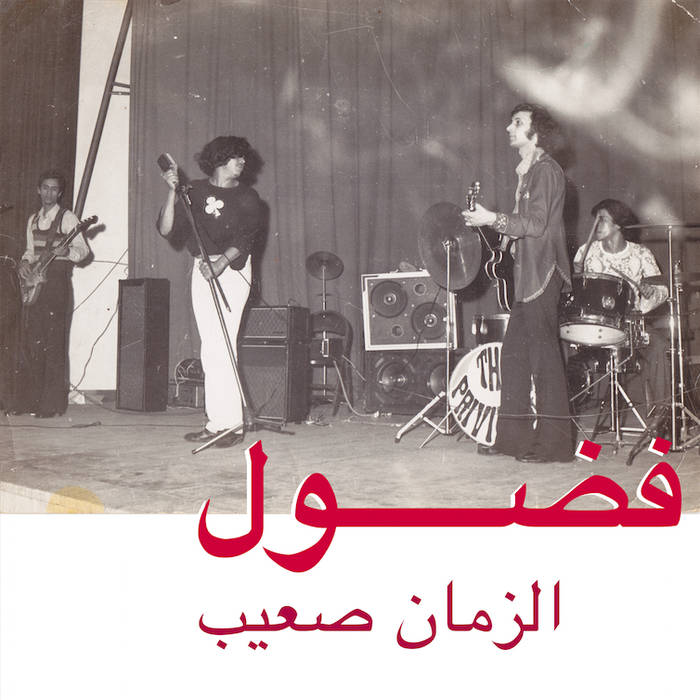
Habibi Funk Records has tracked down the until-now obscure, and amazing funk recordings, of Fadoul et les Privilèges (sometimes spelled Fadaul et les Privilèges), and released them, on vinyl, CD, and download. You can listen to the tracks and read about them and order them here, on the Habibi Funk bandcamp site.
The recording has received a fair amount of press, and it is well deserved. Jannis Stürtz, who runs the label, describes the sound as "Arabic funk played with a punk attitude," and that seems pretty accurate. Even if the music was recorded before anyone in Morocco was imagining punk.
If/when you go to listen, I recommend starting with "Sid Redad," which is an Arabic cover of James Brown's "Papa's Got a Brand New Bag," and "Al Zman Saib," an Arabic cover of Free's "All Right Now." Then try "La Tiq Tiq Latiq," which is the Spencer Davis Group's "I'm A Man," in Arabic.
I was surprised by how "Al Zman Saib" (Times are tough, roughly) was rendered on the cover as الزمان صعيب as I would have thought that الزمان صعب was the correct spelling. But maybe that's how it is spelled in Moroccan colloquial?
R. Crumb is known not just for his comics but also for his prodigious collection of old '78s. Here he shares some of his Turkish records on John Henegahn's "Old Time Radio Show." Neither of them have much of a clue about the musicians or the instruments or the names, but they really do appreciate the tracks. And they are great. The only one of the artists I was familiar with on the list is Udi Hrant Kenkulian (listed here as Oudi Hrant), many of whose recordings are in print. (Crumb is apparently unaware that Hrant was Armenian.)
I really liked the track by Fikriye Hanim who, it turns out, was a companion and lover of Mustafa Kemal Atatürk during the 1920.
Here's what was published about her in the Turkish Daily News, July 4, 2006:
The burial location of Fikriye Hanim,
companion and lover of Turkey's founder Mustafa Kemal Ataturk during
the 1920s, is still unknown according to a heartbreaking story published
in Sabah on Monday. Although no one is certain about how her death took
place, Turkey's first unofficial "first lady" is commonly believed to
have killed herself in the proximity of the Presidential Palace. Voicing
speculation on the whereabouts of Fikriye Hanim's
grave, Sabah writes that it could be located under a statue of Ataturk
located at the Etnographic Museum, as evidence suggests that her body
was transported to that location before the museum there was opened.
However, there are no official records from the time of her death says
Sabah, quoting a cemetery official as saying, "The systematization of
burial and death records came much later than Fikriye Hanim's death."
I wish I could find more about her. If you read Turkish, there is an entry for her on the Turkish wikipedia. (Unfortunately Googletranslate did not help me much in understanding it.)
Several people alerted me to the widely-circulated photos of the armed anti-government militants who occupied the Oregon nature refuge.
Rob Kerr/AFP/Getty Images
The photo (source: The Guardian), from January 4, shows Ammon Bundy speaking at the militants' daily press conference. I have no idea who the guy is on Bundy's right, garbed in the green kufiya.
As you can see from the photos below, from January 8, taken by Rick Bowmer for AP (found here), sporting kufiyas seems to be pretty routine for these guys.
I suppose there are at least a couple of sources here, and I'm pretty sure that donning kufiyas for these guys has nothing at all to do with Palestinian solidarity. First, kufiyas were and no doubt still are worn routinely by US soldiers in Iraq and Afghanistan, going back to 2003. You can find "military" ones easily with a google search, although they are more commonly called shemaghs in such circles, it seems. I have a fire retardant (!) khaki kufiya brought me by someone who served in Iraq, and I think it is military issue. I've posted about military kufiyas, which I've described as examples of "tough guy" kufiyas, here and here.
Second, over the past decade or so, there have been several occasions where bad-ass tough guys in Hollywood movies are shown in kufiyas. My favorite is John Travolta in From Paris with Love, but there are lots of examples. Here's a few, but you can find many more in this blog.
Finally, kufiyas have been showing up in gun catalogs. For instance, this photo, from the Griffon Industries 2011 calendar. The woman (Miss June) in the kufiya and camo bikini top is being used to market the gun. (There are more items around like this, and I need to do more searching, and posting.)
My guess is that the armed militants in Oregon are wearing kufiyas, inspired or influenced by the three sorts of uses described above.
Syrian singer and oud player Samir al-Tawil wrote "Linda, Linda" and released it in 1967. It was his biggest hit and has been covered numerous times. You can grab it from the inimitable music tumblr Naksh al-Sanadeeq here.
Check out this blogpost by Aziza al-Tawil, a US belly dancer. Her mother Johanna was a belly dancer, who Samir Tawil met in the US. The two apparently had a relationship and a child (Aziza), and Aziza claims that the song "Linda, Linda" was written for her mother. You can read more here, on Aziza's blog, and also view a Dutch TV report where Aziza is interviewed about the strange, and somewhat unbelievable, story (English subtitles).
Also somewhat unbelievable, but true without a doubt, is that the Israeli Yemeni singer Haim
Moshe recorded "Linda Linda," and it was a big hit for him in the Arab world in particular during the
mid-'80s. The story is covered by Amy Horowitz in her excellent book Mediterranean Israeli Music and the Politics of the Aesthetic. Horowitz has copies of letters written to Haim Moshe by Syrian fans, sent via Europe.
The world music group 3 Mustaphas 3 covered "Linda Linda" in 1988. (You can find it on their Friends, Fiends & Fronds album.) Here they are performing it live:
I was recently informed of a 'left' tendency in Germany, known as the Anti-Germans (Antideutsch) that is motivated, in part, by a very radical critique of German anti-Semitism, and whose expression includes strong support for Israel.
An important element of that tendency is a struggle against the kufiya, known in Germany as the Palituch (short for Palästinensertuch) or Palestinian scarf, and widely worn by German lefties, as well as Middle Easterners. (My first recollection of this phenomenon is when I saw the 1978 documentary Germany in Autumn (Deuschland Im Herbst) by Werner Fassbinder, Alexander Kluge, Edgar Reitz, and Volker Schlöndorff. It concerns the terrorist events involving the Red Army Faction (RAF) and the PFLP, and ends with scenes of the funeral for the three RAF members, Ingrid Schubert, Gudrun Esslin, and Jean-Carl Raspe, who committed suicide in prison in October 1977. I remember very vividly the fact that several in the crowd of German far-leftists were wearing kufiyas. You can see a few clearly at 1:43:59, if you check out the film (no English subtitles) posted on YouTube. (I don't mean to suggest that the RAF is representative of the German left, but rather that this was my first visual experience of the phenomenon.)
The Anti-Germans launched a campaign against the kufiya over ten years ago, and their chief claim is that the leader of the Palestinian national movement during the Mandate period, the Grand Mufti Hajj Amin al-Hussayni, was responsible for making the kufiya a Palestinian national symbol, when he ordered all Palestinian men to put on the kufiya during the 1936-39 revolt. In fact, as I discuss in my book, the order came from the rebel command, not from Hajj Amin. The Anti-Germans then go on to raise the issue of the Mufti's support for Nazism and implication in the Holocaust. Leaving for the moment the question of the exact nature of the Mufti's involvement in Hitler's atrocities against the Jews, the move that the Anti-Germans make here is entirely coherent with longstanding mainstream Israeli propaganda against Hajj Amin, which recalls him simply as a collaborator with the Nazis and thereby metonymically associates the entire Palestinian people with Nazi anti-Semitic crimes against humanity. By implication, anyone who puts on a kufiya in solidarity with Palestinians is lending support to anti-Semitism. The Anti-Germans have devoted a webpage to their campaign against the kufiya, which you can view here. Note that they claim as well that putting on the kufiya also shows some kind of affinity with al-Qaida.
The Anti-German campaign against the kufiya has gone so far as to provide justification to a Berlin club called ://about blank to deny entry to anyone wearing a kufiya. The pretext is that the club tries to avoid the promotion of any national symbol in the club, but as critics of the ban have noted, it seems to be applied most stringently to kufiyas. You can read more about the policy of ://about blank and the protests against its policy here, in a 2013 article by John Riceburg in Exberliner, entitled, "Do cool kids wear a Palituch?"
Manchester artist Hannah Blank, now resident of Berlin, refused to perform at ://about blank due to their policy, and issued a very fine statement about her reasons for boycotting. Below are a couple exemplary bits:
In keeping with the essentially white-supremacist modern desire for the
“multicultural” homogenization of peoples (always according to the baseline of
dominant whiteness), About Blank has banned tokens of cultural or national
specificity. In practice, this just means that people are not allowed to enter
wearing the keffiyeh. The argument is that it has become symbolic not only of
the Palestinian liberation struggle but also of neo-Nazi anti-semitism. The
problematic conflation of these two symbolic meanings of the keffiyeh also
ignores that it is also a garment of predominantly Arab origin and use. The
origin of anti-semitism is not Arab but European. Forcing an Arab garment,
sometimes associated with Palestinian liberation, to stand in for contemporary
anti-semitism suggests a strange dissociation on the part of white Germans. Is
anti-semitism a problem of Palestinian liberation, or, rather, is the
colonization of Palestine a problem partly created by European anti-semitism?...
This small matter of a scarf is worth dwelling on because it evokes the way
that white Europe, despite centuries of astonishing innovations in violence,
somehow manages to perceive itself as the ethical and temporal metric of
history. This habit blunts analysis and licenses bigotry. Despite the best
efforts of your governments, you have no automatic right to legislate the meaning
or disposition of non-white lives and cultures.
It's always a good day when Toukadime decide to put out another broadcast, and they've just put out #28. As always, a number of very fine tunes. I was impressed by the look of the track by Tazi ("404 Kahla"), which they posted with the broadcast.
It is a wonderful track, and you can also check it out here, on YouTube. Tazi Boukhari himself posted it to YouTube, and he includes this information in the comments:
The song is written by Tazi, the music's by Blaoui Houari. Released in Lyon, France in 1972. The song deals with the French police and their dealings with the youth of the Place du Pont quarter in Lyon, in 1969. (If someone has more information on this, please post a comment.)
But my absolute favorite track from this broadcast was "Touil Elkelma" from Houria Wahab. It is not posted on YouTube, but you can purchase 4 other tracks by Houria on Amazon or eMusic, although I'm not sure any of these are quite as great as "Touil Elkelma."
I follow Grey Filastine on Facebook, and he turned me onto this amazing website, Radiooooo.com. It works like this: you see a map of the globe, you click on a country, you choose a decade, and it starts spinning tunes.
There is much more to explore, but I, typically, went to Algeria, 1970s, and came up with a track by Ahmed Malek, called "Autopsie d'un complot." Check it out:
The track is from an album of film music composed by Ahmed Malek called Musique Originale de Films, and the track is from a 1978 film, Autopsie d'un complot, from the Algerian director Mohamed Slim Riad. You can check out a bit of the film here.
And I learned from reading about the album on discogs.com that Ahmed Malek also did the soundtrack for one of my favorite Algerian films of all time, Merzak Allaouche's Omar Gatlato. Here's a bit of that soundtrack. And if you hunt on YouTube, you can find more of Ahmed Malek's work. But I particularly liked "Autopsie."
All that from just a few short minutes listening to Radiooooo.com. There's much much more to explore!
As found on Mixcloud, courtesy Columbus Music Magazine, an Israeli outfit that seems to live exclusively on Mixcloud. I've no idea who the pair are that chose the songs, except that they are Israeli. And based on the choices they've made, we can presume that (a) they listen to a lot of Arab music (b) they have quite good taste and (c) they are not afraid of progressive political music.
Most of the tracks are what one might call "alternative" Arab music, with roots in rock, but there is also some hip-hop. "Arabic" for Engelberg and Jurkevitch seems to mean "Eastern" or "Mashreqi," as there are no tracks from any Arab country east of Egypt. Nonetheless it's a quite good set, and it introduced me to a lot of material I did not know. Of the artists I am familiar with, there are quite good tracks from Mashrou' Leila (Lebanon), Ramy Essam (Egypt, though now based in Sweden), Maryam Saleh & Zeid Hamdan (Egypt/Lebanon), DAM (Palestinian citizens of Israel), Zeid and the Wings (Lebanon), Massar Egbari (Egypt), and Youssra El Hawary & Salam Yousry (Egypt).
I was most impressed by the track by Jowan Safadi, called "To Be An Arab." It surprised me when I listened for the first time, because the vocals are in Hebrew, not Arabic, and the song is not rock or rap but sounds very much like standard Israeli Mizrahi pop. (There is, however, a spoken bit in Arabic.) I did a bit of googling and learned from an article on Mondoweiss that Safadi is a Palestinian citizen of Israel (don't you dare call someone like him an "Israeli Arab"), and that the lyrics are quite amazing. The YouTube video (below) is terrific, and it is aimed at/addressed to Israeli Jews of Arab heritage, known in Israel as Mizrahim (or alternatively, to use an earlier terminology, Sephardim). The video provides a translation of the Hebrew (and Arabic) into English, which Mondoweiss has helpfully transcribed. Here's a few sample lines. I urge you to watch the vid and read the article.
Hardcore homophobes Are the most gay on the inside Mizrachi Arabophobes Are Arabs themselves Who are just afraid And prefer to stay in the closet Because they know, they know the best That to be an Arab is not that great
Interesting, no, to compare Mizrahis who hate Arabs to homophobes?
The song represents a quite remarkable reaching out, on the part of a Palestinian Arab citizen of Israel, to the Mizrahi Jewish minority, who are of Arab heritage. When it comes to a one-on-one "talk," the address is in Arabic, presuming the ability of the Mizrahi addressee to understand the language of heritage -- which in fact many young Mizrahim would not. It expresses a great deal of sympathy for the Mizrahi position, but ends on a tough note: dude, you are in Palestine.
Hey you imported Arab Take it from a local Arab You were dragged here To take my place It’s hard to be an Arab It’s really hard, ask me It’s hard to be an Arab How much can one be black Under the rule of the rich and white In the land of Palestine
Hey you imported Arab,
Take it from a local Arab
You were dragged here
To take my place
It’s hard to be an Arab
It’s really hard, ask me
It’s hard to be an Arab
How much can one be black
Under the rule of the rich and white
In the land of Palestine
- See more at: http://mondoweiss.net/2015/08/radical-talent-safadis#sthash.dVU4a8Vc.dpuf
Hardcore homophobes
Are the most gay on the inside
Mizrachi Arabophobes
Are Arabs themselves
Who are just afraid
And prefer to stay in the closet
Because they know, they know the best
That to be an Arab is not that great - See more at: http://mondoweiss.net/2015/08/radical-talent-safadis#sthash.dVU4a8Vc.dpuf
Hardcore homophobes
Are the most gay on the inside
Mizrachi Arabophobes
Are Arabs themselves
Who are just afraid
And prefer to stay in the closet
Because they know, they know the best
That to be an Arab is not that great - See more at: http://mondoweiss.net/2015/08/radical-talent-safadis#sthash.dVU4a8Vc.dpuf
A YouTube video published on December 31, 2015, featuring Maurice El Medioni on keyboards and vocals, and Neta Elkayam handling the vocals, beautifully. The two of them will be featured in concert at the Havana Music Club in Tel Aviv on January 13, in a "Latino-Algerian" show. Wish I could be there.
I've mentioned both of these artists in earlier posts, but briefly: Maurice El Medioni is the renowned Algerian-Jewish pianist from Oran (Wahran), Algeria, who has performed with many artists, and also as a solo artists, in the course of a career that was launched in the 1940s. He had a stroke back in late 2012 or 2013, which is the main reason he relocated to Israel from Marseille, but he seems to still be going strong, and ilhamdulillah. Neta Elkayam is a young Moroccan-Israeli singer based in Jerusalem, who is one of the foremost Mizrahi artists keeping alive the flame of Jewish Arab Maghrebi culture.
Here is Line Monty's version of "Ana Loulia," accompanied on this recording by, I believe, Maurice El Medioni. (And here is a more recent version by Line.) I'm not sure when this great Jewish Algerian singer recorded the song. You can read more about her here, on the French wikipedia.
Fish Mooney is trying to flee Gotham by boat. The boat is attacked by mercenaries, and this guy enters her cabin to get her. In the next episode, she wakes up in what turns out to be a prison run by a doctor who is harvesting organs, as well as limbs, and not just selling them but conducting his own terrifying and sadistic experiments on the inmates. Lots of truly horrific things happen in Gotham, but the Dollmaker (Dr. Dulmacher) might rank as the worst, his projects evoking the most awful practices of the Nazi concentration camps. Naturally, I guess, by a kind of unconscious Orientalist logic, the mercenary sent to grab Mooney would be in a kufiya. It's the only one I've spotted, after watching the entire first season of Gotham and the first two episodes of the second. But I'll keep looking!
I wrote about Belkacem Bouteldja in my very long post on the origins of pop-rai. Bouteldja was, of course one of the pioneers. His first recording, released in 1965 when the lad was thirteen years old, was a cover of a 1957 recording by Cheikha El Ouachma, from Aïn Témouchent, called "Gatlek Zizia."
Another of Cheikha El Ouachma's well-known songs was "Sid El Hakem" (His honor the judge). According to Bouziane Daoudi (Le rai, 2000), the lyrics evoke the ordinary Algerians' everyday experience of military repression during wartime.
I've just come across Belkacem Bouteldja's cover of "Sid El Hakem," courtesy the latest broadcast (#26) of Toukadime Radio. (Read more about Toukadime here.) It's the first track, check it out, it really kicks. Then compare it to Cheikha El Ouachma's original. Comparing the versions, you'll get a sense of how Bouteldja (and whoever else was involved in the production) was taking the music of the cheikhat in the direction of what, eventually, less than a decade later, became known as pop-rai. Bouteldja recorded another, much more modern, version of "Sid El Hakem," with his collaborator Messaoud Bellemou, probably in the 1980s.
I also recently came across a photo of the cover of an early Bouteldja release, "Milouda Ouine Kounti," from the mid-sixties. Note that it was advertised as "Chant Folklorique Oranais." It's a cover of a song originally done by Cheikh El-Younsi Berkani. Listen here.
While looking around at YouTube vids of Belkacem, I only just now discovered that this giant, this pioneer of rai, passed away in early September. Of cancer, in poverty. He had complained in the previous month to the Algerian daily El Watan: "je suis seul, sans ressource. Je n'ai ni retraite, ni pension, ni assurance, ni couverture sociale". Although he was well known as one of the pioneers of the now world-famous genre of rai, he never benefited financially. He complained of this in an earlier interview with El Watan in 2009. What a crime that the Algerian state, which puts on big annual festivals to celebrate rai (held, since 2008, in Sidi Bel-Abbès), did nothing to provide this great artist a pension. Read an obit here, in Nouvel Obs. Allah yarhamou.
Finally, check out this kicking track, from 1976, which Belkacem recorded with the troupe of Messaoud Bellemou, one of the recordings from the mid-seventies that defined "pop-rai."
I was very struck by the images used by this UK Muslim rap group, for their album, Extreme Gentlemen.
In an interview, The Brotherz note that "The
concept of being an "Extreme Gentlemen" is still subtly conveyed based
on the association of "extremism" with the scarf and "gentlemanliness"
with the suit." Elsewhere in the interview, they make clear that scarf is a "Palestinian" scarf.
I discovered The Brotherz in a 2009 article ("Hip Hop and Urban Islam in Europe) by Peter Mandaville published in The Global Studies Review 5(2). According to Mandaville The Brotherz call themselves "salafi rappers." They also call what they do "nasheeds" -- they use no instruments other than percussion. But there is in fact singing, as well as rapping, on at least this track. It's certainly not "traditional" nasheed.
A photo posted by REORIENT Magazine (@reorientmag) on
(I've posted about this phenomenon previously -- it was very trendy for the adventurous middle and upper classes in the US and Europe to dress up in Middle Eastern fashion. Check out this post and this one. I'm very pleased to find this photo of the Poirets, courtesy Reorient's Instagram feed. You should follow it too.)
I posted what I've written below on my flickr account, but I thought it belonged here too. More photos of al-Tuwani to follow in future.
photo: Romain Swedenburg
Al-Tuwani (also spelled At-Tuwani) is what as known as a
"frontier village," that is, a village that is near the 1948 border
between Israel and the West Bank (occupied by Jordan) and that lost its
agricultural lands due to Israel. Residents of frontier villages are not
considered refugees, because they still live in their original homes
although they lost their chief means of livelihood. As they're not
refugees, they were not covered by the the mandate of UNRWA, the agency
charged with serving the needs of Palestinian refugees. We (the Swedenburg family) visited
al-Tuwani on December 26, 1961, with Robert Lapham, an employee of
Church World Service, one of the few aid agencies to do work in
al-Tuwani. The Laphams resided in Hebron (al-Khalil), the only
Christians, they reported, in the city. (You can read about Lapham here:
www.nytimes.com/1988/02/25/obituaries/robert-lapham-58-de...; he passed away in 1988.)
The
village, we were told, had 300 residents. We reached it over a
dirt/stone track (no road) They were very, very poor -- the surrounding
land was very rocky and not suitable for agriculture. My father writes
in his diary: "Children without shoes, clothes in tatters." You can see
an example in the photo. The villagers were extremely hospitable -- we
were invited for tea at the house of the village headman, and they were
about to prepare chicken for lunch but we said our thanks and departed.
Reportedly we were the only Americans to have visited the village
besides our host (who lived in Amman) and Mr. and Mrs. Lapham.
Since
the Israeli occupation, al-Tuwani has come under very severe pressure
from nearby Israeli settlers and military. You can get an introduction
to the issues at wikipedia: en.wikipedia.org/wiki/At-Tuwani and from the Christian Peacekeeper Teams: www.cpt.org/taxonomy/term/6. There is also a FB page for an organization called Humanity Together: Supporting At-Tuwani, Palestine: www.facebook.com/HumanityTogether.
Addendum: the best academic source I've read on Palestinian border villages (of which there were/are 111) is Avi Plaskov's The Palestinian Refugees in Jordan 1948-1957 (Routledge 1981).
On July 31 The Guardian reported on the release of the song "Frank Brazil," by the Indian ska group Ska-Vengers.
Frank Brazil is the alias of Udham Singh, who was an eyewitness to the notorious Amritsar massacre of April 13, 1919, when British soldiers killed over 1000 Indian civilians at Jallianwalla Bagh. In 1940 Singh took his people’s revenge in London when he assassinated Michael O’Dwyer, former Lieutenant-Governor of
the Punjab and the purported architect of the massacre. After he was arrested by police, Singh
reportedly signed his name Ram Mohammed Singh Azad, signifying the joint Muslim-Sikh-Hindu
participation in the anti-colonial freedom struggle (“Azad” means freedom in Punjabi; Ram is a
Hindu god, hero of the Ramayana epic). By doing so, and by asking Heer of Waris Shah rather than a religious text, Udham Singh underscored that his vision of revolutionary politics was secular and anti-imperialist and not sectarian.
Singh was subsequently convicted and hanged for his
crime.
The tale of Udham Singh, sometimes known as Shaheed-i-Azam Udham Singh or the “great martyr,” has been
retold in numerous bhangra tracks since the early seventies as well as by
Asian Dub Foundation in the song “Assassin” (on Rafi's Revenge, 1998), and he is the subject of
at least three films.
Mohammed Singh Azad
Sindabad!
No apologies
Not a shot in the dark
This is a warning
The sleeping tiger awakes each and every morning
The time is now right to burst the imperial bubble
And my act of revenge is just a part of the struggle
A bullet to his head won't bring back the dead
But it will lift the spirits of my people
We'll keep on fighting
We've been a nation abused
Your stiff upper lip will bleed
And your pride will bruised
Fun'Da'Mental also do a verse about Udham Singh on the song "Electro G-had," off their controversial 2006 album All Is War: The Benefits of G-had. The song celebrates the memory of the so-called “terrorists” who fought the British in India during the colonial period. It was composed and sung by then-19-year old British-Asian musician Subiag Singh Kandola, a Punjabi folk song put to electronic beats. It is in the
vein of a BrAsian tradition of "revolutionary’ poetry recitations” held periodically to commemorate the heroes of India’s anti-colonial struggle.
Fun'Da'Mental provide this translation of the Udham Singh verse:
On the day of Vaisakhi, Udham Singh made this solemn prayer:
"Oh my Guru, may I take revenge on those who murdered my people at Jallianwalla Bagh. I ask for your blessings in this task."
After 20 long years, the hero Udham Singh tracked down the main culprit, Sir Michael O’ Dwyer and exacted his revenge in the home country of his oppressor.
The evil regime was knocked into place by his back handed stroke.
In conclusion, it should be noted that Mahatma Gandhi condemned Singh's assassination of Dwyer.
I only just noticed this verse from Eddy Grant's classic "Living on the Front Line," even though I must have heard this song dozens of times.
Me, no want nobody's money There lord they sugar me no want to see Me, no want to shoot Palestines OhI have land, oh I have mine
Way to go, Eddy!
Thesong is off of Grant's1979 album, Walking on Sunshine, and it reached #11 in the UK; in the US it hit #86 on the R&B charts.Grant was born in British Guiana, moved to England as a youngster. He was a member (lead guitarist and main songwriter) of The Equals, who had a number one hit in 1968 with "Baby Come Back." He is probably best known for his song, "Electric Avenue," which reached #2 in both the US and UK in 1983. But I think this is his best, and his most "political" song.
Brownbook is a magazine focusing on urban design, travel and culture in the Middle East. It's published (paper) six times a year, in London, but also has a website, and a music section. Periodically they introduce you to a new artist or mixtape or whatever. Recent items include:
DJ K-Sets' mixtape of Persian Pop made in LA in the 1980s and 90s...
I'm trying to work out the history and trajectory of "N'sel Fik," by Cheb Sahraoui and Chaba Fadela, one of the first rai recordings to be released in Europe -- in 1986 on the Paris label Attitude, and in 1987 (October) on -- if you can believe it -- the famous Manchester label Factory Records, as a 12" single. Yes, Factory: the company that released all those great recordings from Joy Division, New Order, Happy Mondays, The Durutti Column.
Here's the story of how that Factory release came about: It was "selected after Pickering heard the exotic Arabic-disco hybrid at Mark Kamins' Harem club in New York. 'Mark talked Tony into licensing Fadela and I remixed it,' says Pickering."
Mike Pickering was Factory's A&R Chief. Tony Wilson was part owner and manager of Factory.
As for Mark Kamins, the legendary New York producer and DJ, here's the story of Harem, in his own words:
I went to open my own club, which was called the
Harem, and I rented out a belly dance studio in Time Square at 48th
Street and Eighth Avenue. God, why did I leave? I just think I got fed
up. Well, actually, I started getting a lot of work in the studio and I
wanted to DJ something new. I started this club called the Harem where I
had five Turkish musicians behind me who played live with instrumental
house tracks that I would play. It was completely spontaneous. It was
about me being more of an artist than a DJ. There was an English band
came down – “pump up the volume, pump up the volume, dance” – remember
those guys?...
M/A/R/R/S, OK. They came one night with a white
label. And I played the white label, and then I would play an Egyptian
singer, a cappella on top of M/A/R/R/S. So they went back to London and
remixed it with my Arabic a cappella. That’s when I made my record United House Nations,
which was one of the first releases on Circa, where I took house beats
and I sampled music from all over the world. So I took that hiatus, I
would say, for one year and the Harem became the hippest club in New
York. We shut it down after we did a party for New Order. We shut it
down after one year, at the peak.
"Pump Up the Volume" from M/A/R/R/S, you may recall, samples Dunya Yunus' "Abu Zuluf" from the album Music in the World of Islam, 1: The Human Voice. You can check this out here.
The one "Middle Eastern" recording that you will find on Kamin's United House Nations LP is "Muhammad's House" by Sheik Fawaz, released in the US in 1988. I in fact purchased it back then, there wasn't anything else much like it coming out at that time. Check it out:
Here is the jacket for the Factory release of "N'sel Fik" (You Are Mine). Like all Factory products I've seen, it has a great design. But...(and thanks to Geir for making me notice this) Fadela is spelled incorrectly in Arabic. It should be فضيلة and not فظيلة
Although credited to Fadela, the track in fact is by Chaba Fadela and her husband Cheb Sahraoui (the couple married in 1982). I believe that this is the version that Factory released (the discography says the Factory track is 7:10, and this one is 7:09 -- close enough).
Below is perhaps the first recording of the song, off of a 1982 cassette. Note the spellings here: Chaba Fadila, and "N'sal Fik." According to maghrebunion, who posted in on Youtube, the male singer on this recording is Cheb Hindi, and Cheb Sahraoui is on the accordion.
I presume this is not the version recorded by producer Rachid Baba Ahmed. According to Abdi and Daoudi (1995), Rachid Baba's recording came out in 1983, and it was, they say, the first rai international hit. They say that Rachid wrote it, but other sources credit it to Cheb Sahraoui, and I believe the latter is correct. I guess that when they say 'hit' are referring to its release on Attitude (France), Factory (UK), and then on two very influential and groundbreaking rai albums put out in the West, in the earliest wave of the world music rai phenom: (1) Rai Rebels, released on Virgin in the UK in 1988, and on Earthworks in the US in the same year. Although this LP features a photo of Khaled on the cover, the opening track is "N'sel Fik," credited here to Fadela and Sahraoui; (2) You Are Mine, a Chaba Fadela album put out in 1988 by Mango in both the US and UK. Since "N'sel Fik" is translated as You Are Mine, that makes it in fact the title track of the album. Interestingly, the recording here is credited to Chaba Fadela, although her husband of course also sings on it.
The jacket for Rai Rebels provides a translation of a few lines of "N'sel Fik," and as far as I can tell by checking other translations, these seem about right:
Cheb: Looking to God, waiting, you are mine
Chaba: I saw you in the dark and my heart stopped
Cheb: I didn't say a word, but her eyes said it all
Chaba: You are mine, your body and your soul
Cheb: In the evening we go to her place and spend the night
Based on the evidence of the video below, clearly shot in a studio in Algeria, it would seem that the version of "N'sel Fik" that was exported abroad was basically the same as what was released in Algeria -- in 1983, if we are to believe Abdi and Daoudi. The vid shows Fadela and Sahraoui doing the song and Rachid Baba on the mixing controls.
Here's the vid:
On the other hand, if you check out this vid, of a TV show tribute to Rachid Ahmed, one might think that the 1983 version was somewhat different. Rachid in the interview footage says that Sahraoui brought in his wife to the studio, when he was to record "N'sel Fik" for a cassette to be put out by Rachid et Fethi, his company. Rachid had not met Fadela before. He suggested to them that they sing the song as a duo. They did it as a trial, and it was perfect the first time, did not need to be re-recorded. The version you see them do here, however, is a bit different from what was released on Factory in 1987. Check it out, Rachid speaks about the song starting at 7:13.
Rachid Baba Ahmed and his brother Fathi fronted a band called Les Vautours (The Vultures) and then went on, in the early 70s, to enjoy some modest success with rock recordings released under the name, Rachid et Fethi. (Check out some footage of them here.) The brothers went on to open a very advanced, 16-track studio at Tlemcen (their home town) as well as a record label (Rallye). In 1976, a rai cassette producer sent Rachid a young rai singer Cheb Sahraoui. At that point Rachid had no interest in rai, but was instead into the synthesized pop of the likes of Jean-Michel Jarre. Rachid commenced to work with rai singers, recording their vocals and them sending them off as he and his studio musicians laid down the instrumental tracks (see Abdi & Daoudi 1995). I believe that Rachid is the one who is primarily responsible for really changing the sound of pop-rai (I posted earlier about pop-rai's seventies origins) both through this production method and also by the heavy use of synthesized keyboards, electric guitar, and the like. Baba was assassinated in February 1995, probably by militants of the Armed Islamic Group.
Rachid produced many, many great pop-rai tracks, but "N'sel Fik" remains one of the greatest.
Professor of Anthropology, University of Arkansas. Author of Memories of Revolt: The 1936-39 Rebellion and the Palestinian National Past. Co-editor of Palestine, Israel and the Politics of Popular Culture and of Displacement, Diaspora, and Geographies of Identity.