Showing posts with label rap. Show all posts

Monday, July 18, 2016

Mahraganat & hip hop mix from DJ No Breakfast


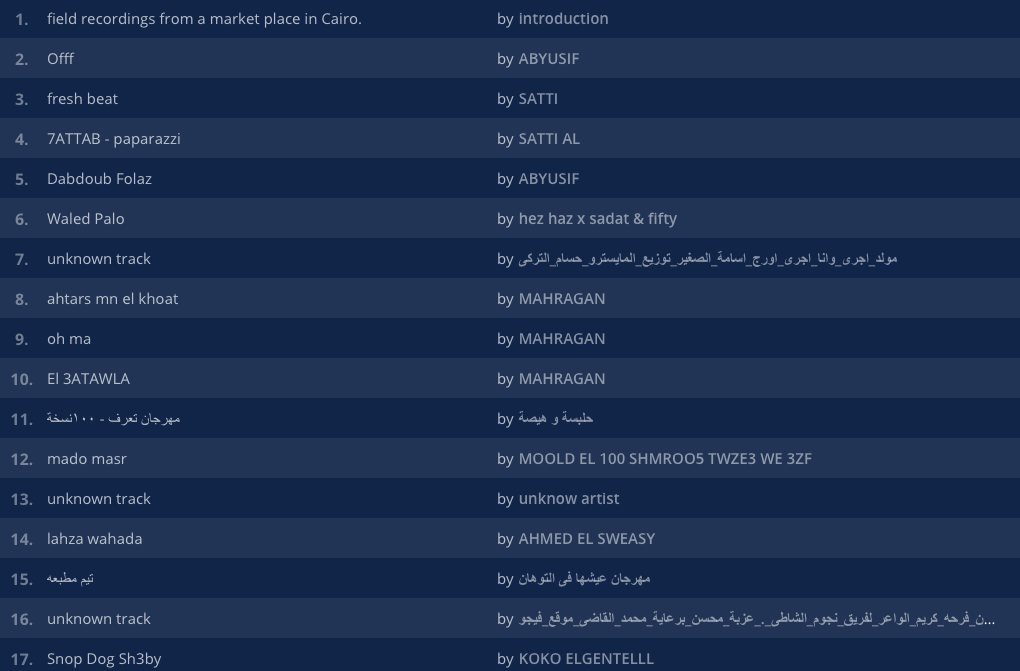
Ok, so I'm behind on posting...this is from 4 months ago, sorry! In any case, it's an excellent one from France's DJ No Breakfast, great fun, and it gives a sense of the great variety and clever mixing going on today in the mahraganat and hip hop scenes in Egypt. I really like what Abyusif is up to on the mahraganat front, and Satti is very cool too -- categorized as rap, I guess. The songlist is to be found here.

Here are a couple fine photos I found awhile back of the mahraganat scene -- I can't remember the source. If anyone knows let me know, it's important to give credit. 

I've now found the source for the top one: it's from CBS News, a wonderful portfolio of photos of the mahraganat scene. This is from a concert in April 2013.

 
 (Nariman El-Mofty/AP)

This one is from the Manchester Guardian, "The World in Pictures," Jan. 2, 2014. It's a bachelor party with mahraganat music in El Marg, a large and very populous informal district on the northeastern edge of Greater Cairo.

Wednesday, July 13, 2016

MTV documentary on Egyptian 'rebel music,' the massive June 30, 2013 demonstrations against Morsi, and the aftermath

This is a quite interesting documentary, from MTV, about the period running up to the Tamarrod-organized demonstration of June 30, 2013, and the role of musicians in that movement. Ramy Essam, Karim Adel Eissa of the rap group Arabian Knightz, and Nariman El Bakry, a music promoter, are all strong supporters of Tamarrod and critics of Morsi and the Muslim Brotherhood. After the coup, Karim Adel Eissa expresses support the army, who he says he did not support previously. [Addendum from just a couple hours after this was posted. I posted more or less the same thing on FB. A FB re-posted, and within minutes a comment from Karim Adel Eissa, who says, "my stand openly and publicly changed shortly after that tho."] Nariman seems to shut down emotionally. Ramy got alienated by the crowds expressing support for the army at an event the night before the June 30, and so did not play at the June 30 demo. He says he was glad that Morsi got tossed out but not with the coup.

Good resource that is not always terribly accurate -- claims that 33 million Egyptians demonstrated against Morsi on June 30. Its estimate of 1200 killed in the Rabaa massacre of Muslim Brotherhood supporters on August 14 is more sound. Human Rights Watch estimates at least one thousand.


Friday, January 15, 2016

Toukadime mix for Onorient + what 113 sampled on "Tonton du Bled"

The inimitable Toukadime did a mix for Onorient awhile back. Check it out here:


I didn't know people were doing mixes like this: you play the first tune on YouTube, leave it on, and it cycles you through the next 11 tracks. Great stuff, including the likes of Ahmed Wahby, Reinette l'Oranaise, Cheb Khaled, Line Monty (who I recently learned was 'discovered' by Charles Aznavour), Haim Botbol, El Kahloui Tounsi...

And I learned something I had not known from this mix, that the sample that the renowned French rap group 113 use on their 2000 hit (#5 on French charts) "Tonton du Bled" is from the first track on this playlist, Algerian ouahrani star Ahmed Wahby's "Harguetni Eddamaa." Check it out.

Tuesday, January 05, 2016

Best Arabic Songs of 2015, as picked by Nitzan Engelberg & Yaniv Jurkevitch -- and including a great track by Jowan Safadi

As found on Mixcloud, courtesy Columbus Music Magazine, an Israeli outfit that seems to live exclusively on Mixcloud. I've no idea who the pair are that chose the songs, except that they are Israeli. And based on the choices they've made, we can presume that (a) they listen to a lot of Arab music (b) they have quite good taste and (c) they are not afraid of progressive political music.

Most of the tracks are what one might call "alternative" Arab music, with roots in rock, but there is also some hip-hop. "Arabic" for Engelberg and Jurkevitch seems to mean "Eastern" or "Mashreqi," as there are no tracks from any Arab country east of Egypt. Nonetheless it's a quite good set, and it introduced me to a lot of material I did not know. Of the artists I am familiar with, there are quite good tracks from Mashrou' Leila (Lebanon), Ramy Essam (Egypt, though now based in Sweden), Maryam Saleh & Zeid Hamdan (Egypt/Lebanon), DAM (Palestinian citizens of Israel), Zeid and the Wings (Lebanon), Massar Egbari (Egypt), and Youssra El Hawary & Salam Yousry (Egypt).

I was most impressed by the track by Jowan Safadi, called "To Be An Arab." It surprised me when I listened for the first time, because the vocals are in Hebrew, not Arabic, and the song is not rock or rap but sounds very much like standard Israeli Mizrahi pop. (There is, however, a spoken bit in Arabic.) I did a bit of googling and learned from an article on Mondoweiss that Safadi is a Palestinian citizen of Israel (don't you dare call someone like him an "Israeli Arab"), and that the lyrics are quite amazing. The YouTube video (below) is terrific, and it is aimed at/addressed to Israeli Jews of Arab heritage, known in Israel as Mizrahim (or alternatively, to use an earlier terminology, Sephardim). The video provides a translation of the Hebrew (and Arabic) into English, which Mondoweiss has helpfully transcribed. Here's a few sample lines. I urge you to watch the vid and read the article.

Hardcore homophobes 
Are the most gay on the inside 
Mizrachi Arabophobes 
Are Arabs themselves 
Who are just afraid 
And prefer to stay in the closet 
Because they know, they know the best 
That to be an Arab is not that great 

Interesting, no, to compare Mizrahis who hate Arabs to homophobes?


The song represents a quite remarkable reaching out, on the part of a Palestinian Arab citizen of Israel, to the Mizrahi Jewish minority, who are of Arab heritage. When it comes to a one-on-one "talk," the address is in Arabic, presuming the ability of the Mizrahi addressee to understand the language of heritage -- which in fact many young Mizrahim would not. It expresses a great deal of sympathy for the Mizrahi position, but ends on a tough note: dude, you are in Palestine.

Hey you imported Arab
Take it from a local Arab

You were dragged here

To take my place

It’s hard to be an Arab


It’s really hard, ask me

It’s hard to be an Arab

How much can one be black

Under the rule of the rich and white

In the land of Palestine
Hey you imported Arab,
Take it from a local Arab
You were dragged here
To take my place
It’s hard to be an Arab
It’s really hard, ask me
It’s hard to be an Arab
How much can one be black
Under the rule of the rich and white
In the land of Palestine
- See more at: http://mondoweiss.net/2015/08/radical-talent-safadis#sthash.dVU4a8Vc.dpuf
Hardcore homophobes Are the most gay on the inside Mizrachi Arabophobes Are Arabs themselves Who are just afraid And prefer to stay in the closet Because they know, they know the best That to be an Arab is not that great - See more at: http://mondoweiss.net/2015/08/radical-talent-safadis#sthash.dVU4a8Vc.dpuf

Monday, September 21, 2015

kufiyas: UK 'Islamic' rappers The Brotherz

I was very struck by the images used by this UK Muslim rap group, for their album, Extreme Gentlemen.


In an interview, The Brotherz note that "The concept of being an "Extreme Gentlemen" is still subtly conveyed based on the association of "extremism" with the scarf and "gentlemanliness" with the suit." Elsewhere in the interview, they make clear that scarf is a "Palestinian" scarf.

I discovered The Brotherz in a 2009 article ("Hip Hop and Urban Islam in Europe) by Peter Mandaville published in The Global Studies Review 5(2). According to Mandaville The Brotherz call themselves "salafi rappers." They also call what they do "nasheeds" -- they use no instruments other than percussion. But there is in fact singing, as well as rapping, on at least this track. It's certainly not "traditional" nasheed.

Monday, October 06, 2014

El Haqed in Aljazeera

The Moroccan rapper, El Haqed, recently released from prison for the third time, published an opinion piece today (October 6) in Al Jazeera (English) -- it's translated from French and English by Mark Levine.

He writes:

In 2007, a new kind of rap began to spread, with roots in groups like H-Kayne who rapped about social but not quite political issues. It was authentic rap, not imitating anyone. These dangerous ideas led the system to try to shut us down, put us in a big prison so to speak, a prison for ideas and freedoms to try to hem in our dangerous ideas...
 
And so we called our rap ar-rab muhabsi - "prison rap" - rap that expresses reality and sings about freedom, breaking down the borders and chains. We need to understand the power of prison rap in the context of most rappers being little more than marionettes, wholesale puppets of power. You can count the number of truly political rappers on one hand. And yet, the small number makes our music that much more powerful. The intellectual and cultural prison only made our music more powerful. The state still doesn't get that.

I learned at a workshop this past weekend that, in fact, you can in fact count the number of Moroccan political rappers on one hand. In fact, there are three--El Haqed, Hoba Hoba Spirit, and Muslim--who truly support the Moroccan revolutionary movement. The rest, while they deal sometimes with social issues, scrupulously avoid politics.

Thank gods for El Haqed!

P.S. October 7. Hisham Aidi adds (via twitter) that perhaps there is one more 'revolutionary' Moroccan rapper: Sí Simo of Fez City Clan -- but he raps more about poverty than politics.

P.S. October 11. Please check out this article in Jadaliyaa (Oct. 7) by Jessica Rohan, on the Mawazine Festival. She provides a discussion of rappers, including El Haqed and Muslim, and their positioning in relation to pro-regime rap stars like Bigg and Cheikh Sar. And she provides a link to a song by Sí Simo called "Kilimini," a song about social inequality in Morocco. Rohan tells us that kilimini  man is a "recently-coined slang term for wealthy Moroccans." It literally means “he eats from me,” "suggesting the elite gained their wealth through corruption" and also connotating shallowness.

http://youtu.be/bEV0s0tWZ6E

Monday, September 15, 2014

Revolutionary rap from Egypt: Katiba (Batallion) 101

A friend passed this on to me awhile back and I want to recommend it to you. It's from Egyptian rap group Katiba ("Batallion") 101. The title is "Shaytan wa Malak" (Demon and Angel). It proposes that the battle in Egypt is between the good or angelic forces, the forces of the revolution, and the demonic force of the authorities. According to the notes on youtube, the song was recorded two years ago (summer 2012), and is only now released.

I hope someone with better translation skills could translate the Arabic. The lyrics are there, on the youtube notes, so have at it. Katiba 101 also rap in English, and make a pretty good go of it. And it is really a slamming track. Have a listen. And I will try to learn more.


Saturday, September 13, 2014

Nation of Islam Hip-Hop Again?

Zaheer Ali wonders whether a hip-hop/Nation of Islam connection might be on the horizon again, in The Root. He is inspired to speculate in this regard by Jay Electronica's performance at the recent Brooklyn Hip-Hop Festival, where he appeared with a phalanx of NOI Fruit of Islam guards as he arrived. And performed in his own Fruit of Islam garb. (Jay is in the center in the photo below.)


Frankly, I wonder whether NOI rap will really become a trend, but it's an interesting thought, and I urge you to read about it here.

I blogged about Jay Electronica back in 2012, when I spotted him in kufiya. I concluded at the time, based on his lyrics, that he was a member of the Nation of Gods and Earths (Five Percenters). I may have been right, that at the time, he was. He now seems to have more clearly aligned to the NOI.

Saturday, August 16, 2014

Moroccan rapper L'Haqed (El Haqed/al-Haqed): two day hunger strike


Huffington Post Algérie reports that the rapper L'Haqed went launched a two day hunger strike on August 13, to protest against the humiliating treatment he is receiving in prison.

L'Haqed was sentenced to four months in prison on July 1, for "violence" against police and drunkenness. Completely bogus, trumped-up charges, as he has been the constant target of Moroccan authorities for the last two plus years due to his consistent, outspoken criticism of the regime.

Among L'Haqed's complaints about his treatment in prison: he has been unable to get the writing that he does out of prison, newspapers he receives are torn, he is not allowed to receive the music that he likes, and he is subject to humiliating body searches.

Update, August 23, 2014.

More on L'Haqed's conviction:

"Moroccan Dissident Rapper Sentenced," Project on Middle East Democracy (POMED)
"Morocco jails dissident rapper El-Haqed," Massoud Hayoun, AlJazeera America, July 1, 2014.

The Washington Post used to have a link up, under the title "Morocco rapper rebel gets 4 months in prison," but it has mysteriously vanished.


Tuesday, June 24, 2014

More (free) cool music: Moroccan Street; For Stuart Hall; Egyptian trip-hoppy Nadah El Zhazly; more mahraganat

 
1. Thanks to Tim Abdellah Fuson and his invaluable blog Moroccan Tape Stash, a link to samples from the Moroccan Field Recordings at the Pitt Rivers Museum. The recordings in question were made in 1961 by an Oxford University "expedition." And Tim does us the favor of describing and adding his own keen insights into these recordings.


2. Nabeel Zuberi, author of, among other things, Sounds English: Transnational Popular Music (2001, University of Illinois Press), has done a wonderful mixtape in tribute to the late Stuart Hall. As you would expect, it's very political, transnational Caribbean, etc. And illuminating -- I was not familiar with most of the material, except for Pete Rock & C.L. Smooth's "Good Life" and Linton Kwesi Johnson's "Reggae Fi' Peach." And I was familiar with some of the artists. And I loved these lines from a great track by Eddy Grant, "Living on the Front Line":
Me, no want nobodys money
There lord they sugar me no want to see
Me, no want to shoot Palestines
Oh I have land, oh I have mine

3. Thanks to Sherine for alerting me to this article in Mada Masr about Egyptian singer Nadah El Shazly, who I had never heard of. The article doesn't mention it, but the clear influence, at least as far as "Western" sources, seems to be trip-hop, of early to mid nineties vintage. Particularly on the songs "Shorbet Rosas" and "Ghaba." (Check them out on El Shazly's Soundcloud page.) They also remind me of the work of Lebanese group Soapkills (vocals, Yasmine Hamdan), who I think wore their trip-hop influences on their sleeve. There is more going on than that, of course, and El Shazly is capable of other sounds as well, as in her collaboration "Athar Nowaa" with Egyptian rapper El Rass.


4. And Cairo Liberation Front (who are Dutch) have a new mahraganat mixtape, available here. With music from Islam Chipsy and Sadat & Alaa Fifty Cent and more.

Enjoy.

Saturday, May 31, 2014

Interview with lawyer of El Haqed (Al Haqed/L7a9ed) + more


Freemuse's Daniel Brown (son of Kenneth Brown, editor of Mediterraneans/Méditerranéennes) interviewed Mohemed Messoudi, the lawyer of imprisoned Moroccan rapper El Haqed, on May 27 and a member of the Administrative Committee of the Moroccan Association for Human Rights. Here is some of what we learn:

Did El Haqed recently compose and release songs that could have angered the authorities?
“He has just released an album called Walou which means ‘Nothing’ (nothing has changed in the fields of justice, education, democracy, there is too much corruption and we are living under a dictatorship, with torture, etc…). The presentation (sic) of the album has already been banned by the Moroccan authorities. There has also been several of Haqed’s concerts that have been vetoed.”

How would you describe the current situation for musicians in Morocco?
“It’s simple: If you sing for the governors and the statesmen you are given the support that you need – money, publicity and the possibility of performing at festivals and on stage. You can even be decorated. If you take the opposite stance and dare criticise the current political, economic and social situation in the country, you run the risk of going to prison and you are banned from playing or appearing in any (official) media.”

....
...can this album [Walou] can be found in stores?
“No, you can not find this album in stores in Morocco, as Haqed criticizes the Moroccan political system, no distributor agrees to cooperate with him, the only option is direct sale to people who are interested in his music and also via social networks facebook youtube, and so on, and yes, there were sales using its own means.”

NOTE: go here, on Youtube, for the song "Walou," and it will lead you to all the other songs on the album. Nearly 71,000 views of the song. Let's bump those numbers up!]

...
What is the popularity of El Haqed?
“Considering he is banned by all media and official festivals because of his activism and political positions, EL Haqed finds his popularity via social media. His songs are listened to by thousands of people on Youtube. His first arrest was adopted by Amnesty International and several  international and national human rights associations.”

....
What are the political views of Haqed?
“He criticizes the corruption, which reigns the political, economic and social life. Considering his reputation and sincerity to the Moroccan people – his voice and his songs disturb authorities more and more.”

*******
Here is a link to a petition to sign in support of El Haqed.

When the interview was done El Haqed was scheduled to appear before the court for a hearing on May 29. Facebook connections now say that it has been rescheduled for June 6. [Update, a few minutes after the original post: Mark Levine notes that the postponement means that El Haqed conveniently will be kept out of public view until the Mawazine festival (see below) is almost over.}

At his first court hearing (he was arrested May 18) he is reported to have said to the judge "Prison won't make me cry. I am free wherever I am. What makes me weep is the plight of the [Moroccan] people."

Meanwhile, international artists like Justin Timberlake, Ne-Yo, Alicia Keys, IAM and Robert Plant are appearing at Mawazine, the state-sponsored festival in Rabat, from May 30 to June 7. There has been a campaign to get at least some of these artists to at least say something in solidarity with El Haqed, but to date I've heard nothing of such a response. If it were Russia and Pussy Riot, of course, there would be a big international fuss. But even the most progressive artists (seriously, IAM!) seem to think that the makhzen is "moderate" and so shouldn't be criticized. The not so progressive I guess are just happy to get the pay check. 

It is not of course El Haqed who is the target of state repression. According to this report from ABC on May 29, 

Morocco's most prominent independent rights group, the Moroccan Association for Human Rights, has been sounding the alarm since March, saying that many of its young activists around the country face police intimidation.

Veteran activist Samira Kinani cited the case of Oussama Housne, a 22-year-old activist who, in a video posted online, said he was snatched by three men, beaten and tortured.

Last month, police arrested 11 young activists who had joined a large labor union demonstration and chanted anti-monarchy slogans, later sentencing them to up to a year in prison for illegally protesting and attacking police.

"It is a campaign of repression against the weakest young members of the February 20 movement," said Kinani. "Unlike us they did not live through the dark period of King Hassan II and they aren't scared to express their opinions against the king for example, so I think they are trying to scare them into quitting activist circles."

My previous post on El Haqed, with details on his arrest, is here.

Monday, May 19, 2014

Moroccan Rapper Al Haqed (El Haqed/L7a9ed) Arrested Again


Yesterday, May 18, the Moroccan rapper Al Haqed (Mouad Belghouat) and a group of his friends approached by police while about to enter the Casablanca soccer stadium to see a match. The cops targeted Al Haqed, accused him of buying tickets on the black market, and proceeded to beat up him and his brother.

According to the blog of Zineb Belmkaddem, the source for this information, the day before Al Haqed put up a post on Facebook "mocking the fact that the King was going to perform Friday’s Jumuah prayer, and on his way there, a traditional music group was playing. In Islam, this would be highly disrespectful given the spiritual solemnity of Jumuah prayer, and an even bigger mistake to be made by the ‘Commander of the Faithful’ who claims part of the legitimacy of his rule from his religious status." 

Who knows whether the arrest is linked to the post, but it no doubt has everything to do with the fact that Al Haqed refuses to shut up about the repressive acts of the Moroccan government, the makhzen.

Al Haqed was supposed to appear before a judge today.

I've posted about Al Haqed and his problems with the Moroccan authorities a few times in the past. And I've also ranted about the fact that Pussy Riot gets so much support and attention in the West, and especially from US artists, while almost no one seems to care about Al Haqed. Consider this another rant.

Videos of Al Haqed's most famous song "Klab al-dawla" or "The Dogs of the State" keep getting shut down. Here's another link to it.

Wednesday, April 02, 2014

Wu-Tang kufiya


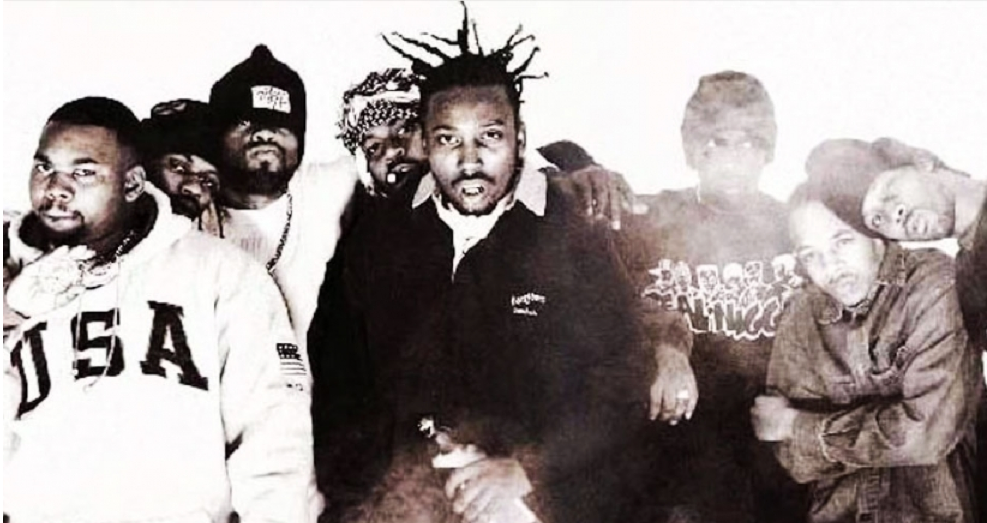
 I recently came across this photo of the Wu-Tang Clan, taken in 1993. I think that is Method Man behind Old Dirty Bastard, wearing a kufiya. I believe it is from a Wu video, but I've not been able to identify it.

Method Man of course recorded a song called "PLO Style" on his 1994 album Tical. It really only gestures to the PLO in a stereotypical way and seems to have nothing to do with solidarity.

The street life is the only life I know
I live by the code style it's mad P.L.O.
Iranian thoughts and cover like an Arabian
Grab a nigga on the spot and put a nine to his cranium


Saturday, December 07, 2013

Tunisian rapper Weld El 15 sentenced to jail for 4 months


The author of the infamous and incendiary song "Boulicia Kleb" (Cops Are Dogs) has turned himself in (December 5) to Tunisian authorities, and will serve a 4 month prison sentence, after his 21 month sentence for "insulting the authorities" was reduced. (As reported by Informed Comment.)

I've posted previously about Tunisian rappers (including Weld El 15) and their struggles with the authorities, post-revolution, here and here.

And, as noted previously, Pussy Riot continue to receive lots of publicity and support in the West. Tunisian rappers: almost none.

Sunday, October 20, 2013

Tunisian rappers form union; Klay BBJ acquitted

Tunisia's rappers, of all Arab hip-hop artists, continue to be the most politicized. At least it would so appear.

BBC News reported on October 15 that Tunisian rappers are forming a union to defend their interests. According to the Italian news agency ANSA, "Born under the guidance of a minor trade federation called the CGL, the rappers union has little to do with work contracts and a lot to do with sending a signal to the powers that be. These appear unable to take any criticism, no matter where they come from, and especially if they call for social change."

Klay BBJ

 Meanwhile, AhramOnline reported on October 19 that rapper Klay BBJ (named after boxer Cassius Clay/Muhammad Ali), had been acquitted on appeal, after serving six months of his jail sentence of 21 months. He had been convicted of insulting government officials, undermining public morals, and defamation, based on a performance he did together with rapper Weld El 15 during a concert at a sea resort south of Tunis. Weld El 15, notorious for his song "Boulicia Kleb" (Cops Are Dogs), was also convicted, but remains at large. (I wrote a brief post on Weld El 15 in April, here.)

 Aymen El-Fikih (l), Mustapha Fakhfakh (r) photo: AFP

Tunisian rappers Mustapha Fakhfakh and Aymen El-Fikih for their part are about to go to trial for "insulting public officials" and "affronting morals" in the course of protests surrounding the trial of Weld El 15.

Tuesday, September 24, 2013

Orient-Institut Studies 2 (2013) - Inverted Worlds: Cultural Motion in the Arab Region

Volume 2 of Orient-Institut Studies (put out by the Orient-Institut Beirut and the Orient-Institut Istanbul) recently came out (the journal is published only online). It's the Proceedings of the Conference, "Inverted Worlds: Cultural Motion in the Arab Region," Beirut, October 4–8 2012. I've not had time to do more than skim some of the articles, but they are all about the Arab uprisings and culture. Since my main area of interest is music, I thought these essays seemed particularly interesting:

Yves Gonzalez-Quijano: Rap, an Art of Revolution or a Revolution in Art?

Nader Srage: The Protest Discourse: The Example of “Irhal” (Go/Get Out/Leave)

And there are more articles on graffiti, poetry, jokes and more. All the articles are online. Please check it out.

Monday, September 23, 2013

more kufiyaspotting: Main Attrakionz


Main Attrakionz are a rap duo from Oakland, California, 
well known players in the "cloud rap" rap subgenre.


And they seem to really like kufiyas. In all the colors.


Sunday, April 21, 2013

Lebanese rapper El Rass الرأس

When I was in Beirut last month the hip-hop heads I met there were touting Lebanese rapper El Rass as one of the most impressive of the current crop. Rima Marrouch did a nice piece on him for the LA Times on March 30. Here are some excerpts:


"His forte is the way that he is able to incorporate an understanding of nuance of language perhaps better than anybody," says Jackson Allers, founder of the U.S.-based Beats and Breath blog. El Rass, wrote Allers in the World Hip Hop Market website, "has emerged as a lyrical soothsayer for a new school of Arab hip-hop."

El Rass' signature style is an animated fusion of classical Arabic — an idiom seldom employed in rap — and contemporary wordplay gleaned from the Lebanese streets and elsewhere...

From his viewpoint, there is a kind of continuum of language and purpose from early Koranic verse to today's Arab-language MCs. The Arabic word taaliq (a commentary), he notes, has the same root as the word muallaqat, which refers to the first pre-Islamic poems.

"Arabs first wrote poetry, not prose[...][Reciting] the Koran is also close to what we do" as rappers.

...One of his favorite singers is Abida Parveen, a Pakistani singer well know for her interpretations of Sufi poetry.

...He is an equal-opportunity critic, lashing out at the Muslim Brotherhood, radical Islamists, Iran, Turkey, Gulf "tyrants," the United States and various Lebanese figures and mores, among other targets. Playing the part of disgruntled contrarian seems to suit him.

...His debut CD, "Kachf el Mahjoub/Unveiling the Hidden" (the title is from a Sufi master-work penned some 900 years ago), recorded with avant-garde musician Jawad Nawfal (a.k.a. Munma) was released last year on Ruptured, a Beirut-based independent record label. El Rass is working on tracks for a second album.

"My Arabic identity is a digital bedouism," he writes. "No nationalism, no nostalgia, only passion for creating our new identity. This is how I understand our revolution."


You can listen to El Rass here, on Soundcloud.


Do give a listen.

Here are some reviews of El Rass's first album.

Revolutionary Arab Rap provides a translation of the lyrics of El Rass' song, "The Volcano of Beirut," here.

Wednesday, April 17, 2013

new one from Ramallah rapper boikutt

Palestinian rapper Boikutt (ex-Ramallah Underground, currently a member of Tashweesh and also a solo artist) contributes a terrific vocal on the Beatoven track "Falstaf," from the album Tangled (to be released on the 7th of May - or is it the 5th of July?).

Monday, April 15, 2013

would supporters of Pussy Riot care about Al Haqed, Oday Khatib, Weld El 15?

Last August I posted a complaint about the vast discrepancy in Western media coverage and popular and celebrity solidarity between the case of Pussy Riot and that of Al Haqed. I've been ranting about the cases below on Facebook. A friend said I should consider asking the legions of Pussy Riot supporters and admirers to pay attention to these cases rather than mocking them for not doing so. So that's what I'm doing: Please, lovers of Pussy Riot (and I include myself in that camp), note these cases and publicize them, if you love music and the freedom of expression.

1. The Moroccan rapper Al Haqed (Mouad Belghouat) was released from prison on March 29, after serving a year's sentence for insulting a public official in his video, "Dogs of the State."


Predictably, not much publicity in the Western media. At least this from Huffington Post.

2. Sandy Tolan has been blogging about the 22 year-old Palestinian singer Oday Khatib,  who has been arrested and charged with throwing stones, which could send him to prison for up to 10 years. According to Tolan the evidence is ambiguous. Read about the case here. (The trial keeps getting postponed: the scheduled date is now April 17.) Nicola Perugini also reported on Oday for the LRB Blog.


Check out Oday's singing, backed by Ramzi Aburedwan.


3. Amira Masrour reported on tunisia live that Tunisian actress Sabrine Klibi and cameraman Mohamed Hedi Belgueyed were sentenced on March 21 to six months in prison for defaming police officers and contributing to civil disobedience, through their role in the video "Cops Are Dogs" (Boulicia Kleb) by rapper Weld El 15 (Ala Yaakoubi). Weld El 15, who is on the run, was sentenced to two years in absentia. HipHopDX reports that Tunisian rapper Emino, who was thanked in the credits section at the end of the music video, also received a two year sentence. He's on the run too. 


According to, Weld El 15, Masrour reports, the song was inspired by his prison experiences after the 2011 revolution and the treatment he received at the hands of the police. “‘Cops are Dogs’ is a song based on metaphors with which I wanted to send a message to policemen,” Yaakoubi said. “I wanted them to respect people so that people respect them.”

 
How about some solidarity from Ice Cube, a member of NWA? NWA's classic song "Fuck the Police" was massively condemned, and even prompted a letter of complaint to NWA's label, Priority, from the FBI director of public affairs. Cops throughout the country refused to provide security at many of NWA's concerts.

Or from Ice-T, whose group Body Count released the song "Cop Killer" in 1992. The song inspired so much outrage, ranging from President George Bush the First to various law enforcement agencies, that Ice-T felt compelled to recall the Body Count album and re-release it without "Cop Killer."

Both the Ice-T and the NWA cop songs are way, way more incendiary than Weld El 15's.

Where's the solidarity, folks?