I was very struck by the images used by this UK Muslim rap group, for their album, Extreme Gentlemen.
In an interview, The Brotherz note that "The
concept of being an "Extreme Gentlemen" is still subtly conveyed based
on the association of "extremism" with the scarf and "gentlemanliness"
with the suit." Elsewhere in the interview, they make clear that scarf is a "Palestinian" scarf.
I discovered The Brotherz in a 2009 article ("Hip Hop and Urban Islam in Europe) by Peter Mandaville published in The Global Studies Review 5(2). According to Mandaville The Brotherz call themselves "salafi rappers." They also call what they do "nasheeds" -- they use no instruments other than percussion. But there is in fact singing, as well as rapping, on at least this track. It's certainly not "traditional" nasheed.
Showing posts with label UK. Show all posts
Monday, September 21, 2015
Tuesday, August 18, 2015
Eddy Grant, "Living on the Front Line," Palestine
I only just noticed this verse from Eddy Grant's classic "Living on the Front Line," even though I must have heard this song dozens of times.
Me, no want nobody's money
There lord they sugar me no want to see
Me, no want to shoot Palestines
Oh I have land, oh I have mine
Me, no want nobody's money
There lord they sugar me no want to see
Me, no want to shoot Palestines
Oh I have land, oh I have mine
Way to go, Eddy!
The song is off of Grant's 1979 album, Walking on Sunshine, and it reached #11 in the UK; in the US it hit #86 on the R&B charts. Grant was born in British Guiana, moved to England as a youngster. He was a member (lead guitarist and main songwriter) of The Equals, who had a number one hit in 1968 with "Baby Come Back." He is probably best known for his song, "Electric Avenue," which reached #2 in both the US and UK in 1983. But I think this is his best, and his most "political" song.
Friday, December 06, 2013
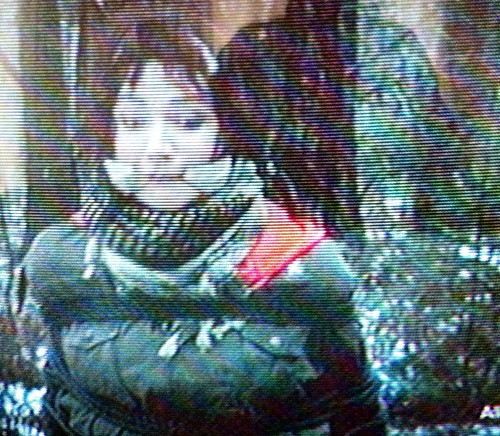
Kufiyaspotting: Psychosis 2010
This lame British horror film opens with a group of anarchist squatters who, in 1992, are attempting to preserve the local wildlife in the vicinity of a village. All except for one are slaughtered by a serial killer. This is one of the victims. The kufiya signals her politics.
Sunday, January 13, 2013
sins of style: kufiya no good because Justin Bieber wears one?
I found this by doing a search for "keffiyeh" on Pinterest. I found a lot of excellent stuff which I will post in future. At first I thought this kufiya statement might be kinda racist but it turns out all the models for the 25 "sins of style," a website based in the UK, are people of colors. I guess you could read this statement as: if Bieber wears one, people of color shouldn't.
What I want to know is, where is the photo of Bieber in a kufiya?
My position on this blog has always been, why let a fact that Bieber is wearing one (if he is) bother you?
And if this model were wearing a kufiya over a black leather jacket instead of a t-shirt (bleh!), wouldn't it look way cooler?
And couldn't we also call this a Kurdish style scarf?
Saturday, August 13, 2011
British Urban Music and the Riots
This is probably the most interesting commentary on the riots in England that I've seen, primarily because you hear the voices of the artists who, collectively, are being blamed for the 'disturbances.' ("Rap responds to the riots: 'They have to take us seriously'" by Dan Hancox, The Guardian, August 12, 2011.)
The artists are so incisive, so smart, and their music is so brilliant. Professor Green, Lethal Bizzle, and Wiley. Mostly "grime" artists, not "rap." Please read, and please watch the vids. Here's a particularly terrific one, Lethal Bizzle's "Babylon's Burning the Ghetto," from 2007. Prophetic, no?
If all those pundits and talking heads in England who are blaming "rap" for the riots really knew something, or anything, about the history of rap, they would know this: after the LA Rodney King riots of 1992, rappers were widely blamed. In fact, if one had been following the rap of artists like Ice Cube, NWA or Ice-T, one could have predicted that LA was headed for a blow-up, and one could have understood the sources of the rage that boiled over in the wake of the acquittal of the officers charged with beating King. Ditto: grime, UK hip-hop and road rap, as this article makes clear.
The artists are so incisive, so smart, and their music is so brilliant. Professor Green, Lethal Bizzle, and Wiley. Mostly "grime" artists, not "rap." Please read, and please watch the vids. Here's a particularly terrific one, Lethal Bizzle's "Babylon's Burning the Ghetto," from 2007. Prophetic, no?
If all those pundits and talking heads in England who are blaming "rap" for the riots really knew something, or anything, about the history of rap, they would know this: after the LA Rodney King riots of 1992, rappers were widely blamed. In fact, if one had been following the rap of artists like Ice Cube, NWA or Ice-T, one could have predicted that LA was headed for a blow-up, and one could have understood the sources of the rage that boiled over in the wake of the acquittal of the officers charged with beating King. Ditto: grime, UK hip-hop and road rap, as this article makes clear.
Subscribe to:
Comments (Atom)