"Aswan Dam. We are loyal to our friends and always help them in a brotherly unmercenary way." Soviet poster, 1970s. Source here.
The effect of the Aswan Dam on Nubians, one elderly Nubian told me in the late 90s: "Have you heard of the atom bomb dropped on Hiroshima? The Aswan Dam was our Hiroshima bomb."
I very much like this photo of a Nubian (I presume) kid looking at the photo welcoming USSR Premier Nikita Krushchev on his May, 1964 visit to Egypt. (I apologize for not keeping a record of where I grabbed this from.) I visited Aswan with my family that same year, in November. Here's a photo.
“Hajj Elias holds picture of himself playing oud before Tahgeer [removal” [photo: Nour El Refai]
Amazing photo from an article in AlAraby.com, "For the National Good: Casting out Egyptian Nubians," by Gehad Quisay, November 17, 2017. On the current struggles of Egyptian Nubians, but also with historical background. Egyptian Nubians were removed from their historical homeland in 1964, due to the construction of the Aswan High Dam and the flooding of their villages and farmland. The article, alas, tells us nothing about Hajj Elias.
I gave a paper at the conference last December, and posted last month a bit from my paper, about Khidr and his song, "Ismi Hunak."
Here is a report on the conference from the online Cairene culture magazine Scene/Noise. It was posted in January, but I just now ran across it. There were many excellent papers presented at the conference, but the author, Tucker McGee, who I met, chose to provide summaries of just three papers: mine, Mark LeVine's and Michael Frishkopf's. Too bad he didn't cover more.
One small error in his report on my paper: I never saw Hamza El Din at Cairo's General Nubian Club, but I did see him perform at the Opera. (And I met him several times in the US, after I left Cairo.)
When I lived in Cairo (1992-96), and once work
on my book on Palestine was wrapping up, I started doing research on Nubian
music. This involved hanging out at the General Nubian Club, conveniently
located right off of Tahrir Square, and right across from the campus of AUC,
where I taught at the time. The friends I developed at the Nubian Club were all
very engaged in Nubian culture, some were musicians themselves or belonged to
folkloric troupes, and they invited me to lots of weddings, which always
featured live music from Nubian (and sometimes Sudanese) performers. I also
made one trip to New Nubia, near Kom Ombo, the area where Nubians were
resettled when the High Dam completely flooded their villages, in 1963-64. And
I returned to Cairo for more research on Nubian music, in the summers of 1997,
1998 and 2000. Then I stopped going to Cairo, not returning until March 2011,
for a very short visit. I was back again in Decembers 2017 and 2018, again for
very short visits. There was not time to pick up my Nubian research during
those very short visits, but on my last trip I did make a presentation on
Nubian music, based chiefly on my research during the nineties, at a
conference, “Egyptian Soundscapes: Music, Sound, and Built Environment” put on
by the American Research Center in Egypt (ARCE). (You can see a report on three
of the presentations at the conference, by me and Michael Frishkopf and Mark
Levine, here.) One of the musicians I discussed in my talk was
the late Khidr al-‘Attar, who passed away in 2014. I saw him perform at several
weddings, and here is a photo from one of them, probably taken in 1995.
Khidr was born in 1962 in the village of Ibrīm,
in Old Nubia, and one or two reports I’ve read report that he lived there until
age five. (Frankly, this doesn’t seem quite right, as his village would have
been re-located in 1963 or 1964.) He was a Fadikka speaker, but he sang in both
Fadikka and Kenuz (Faddika and Kenuz are the two Nubian languages.) He was a
great artist, who released lots of cassettes, and I collected most of them when I
lived in Cairo. (Nubian musicians released many, many cassette recordings between
the 1970s and the 1990s, and this was an important means by which their music,
which for the most part did not get aired on TV or radio, could be circulated
and disseminated.) (Three of his cassettes are listed at discogs.com;
and you can also hear him on that great, 1999 world music collection of
Egyptian popular music, Yalla - Hitlist Egypt). The music played at weddings was for the sake
of entertainment, for dancing. Songs for the bride and groom, popular songs
dealing with themes of love, and so on. At the same time, the practice of music
on such occasions was a time for the celebration of Nubian culture –
modernized, for modern times – and Nubian community, as these were gatherings
that brought together Nubian Egyptians, and few outsiders – other than invited
guests like myself. At the same time, everyone gathered together
was well aware of the tragedy that had befallen the community of Nubians as a
result of the total inundation of their homeland by the Aswan High Dam. One
elderly Nubian I met in Cairo described the event as the equivalent, for
Nubians, of the dropping of the atom bomb on Hiroshima. In the political
atmosphere of the time, however, expression of such public sentiments needed to
be kept muted, and so, to a great degree, Nubian political issues were to a
great degree expressed and kept alive through cultural and musical means. At many
of the weddings I attended, a song would come on, which I came to know as “Al-Higra
al-Murra” (the bitter migration). It was principally performed by and known as
Khidr’s song, but if my memory serves me, other artists performed it as well.
At the time, I was never able to find any recordings of it. When song would come on, everyone would get up
and dance, and chant along with the song, especially the lines, “faradu
‘alayna al-higra al-murra,” or, “they imposed the bitter migration upon us,”
referring to the displacement of 50,000 Nubians by the High Dam. The wedding,
for the period of the song, would turned into something that resembled a
political rally, and often people in the crowd would break into tears.
Last year, while teaching about Nubia, I came
across a video on YouTube of that Khidr song that I used to see performed
during the nineties. There are several versions on the web, the first one I
found was this one, available here. It's not an "official" video clip for the song, but is an interesting one, full of nostalgia-inducing photos of Old Nubia. I learned from the YouTube vid that the song is
actually called “Ismi Henak” (My name is there). Below are the lyrics (by
Khidr, I believe) and the translation, on which Elliott Colla did the bulk of
the work. The lyrics are fairly straightforward, but just a couple of
observations. Note that Khidr refers to Old Nubia as a “civilization,” not just
a bunch of agricultural villages, and the reference to the waterwheel or
saqiya, the ancient mode of irrigation used by Nubians, which serves as a key
symbol of Old Nubia in contemporary Nubian cultural expression. “Kom Ombo”
refers to the space of New Nubia, which the Egyptian regime in the era of
Nasser promised to those who were moved would be a “new dawn,” where life would
be much improved, with modern housing and electricity. O people, they've erased an entire
civilization شطبوا يا ناس
حضارة كاملة And killed the hopes of a black
Nubia [looking at this again, I think the word 'samra' should be translated not as 'black' but as 'chocolate'] واغتالواامانيالنوبة السمرة The sighing of the waterwheel
calls me back بتناديعليا انينالساقية As they've ground up what's left
of my forefathers' bones
وطحنوا
عظام اجدادنا الباقية
My name is there, my homeland is
there
اسمي هناك بلدي هناك
I myself am there, and Nubia is
there
انا ذاتى هناك والنوبة هناك
Standing witness, O people,
behind the dam
شاهدة
يا ناس خلف السد
Come, O Nubian man and woman!
هيا
يا نوبي ويا نوبية
Bang the drums of the coming return
دقوا
طبول العودة الجاية
They imposed the bitter migration
upon us فرضوا
علينا الهجرة المرة
They said Kom Ombo was the verdant heaven قالوا كوم امبو الجنة الخضرا
We’ve lived sad nights there وعشنا
فيها ليالي حزينة
We've walked for years, and our exile has been long مشينا سنين
والغربة طويلة
My name is there, I myself am there
اسمي
هناك ذاتي هناك
My homeland is there and Nubia is there
بلدي هناك والنوبة
هناك
I hope in future to post some
more bits from the paper I gave in December. Inshallah.
I first heard Bob Azzam's "Ya Mustapha" when I moved to Beirut in 1964, it was one of the very few songs in Arabic that any American kid would have been familiar with. It was a hit all over the Mediterranean, and I've posted about it previously. If you're not familiar with it, here it is:
I've since discovered a bit more about the song. First, it shows up in the Egyptian film "El Hob Kedda" (1961) which stars, among others, Salah Zo El Faqqar, Sabah and Abdelmonem Ibrahim. I'm not sure who is shown performing the song here, but it's the Bob Azzam's version.
There is also another version, overshadowed by Bob Azzam's version, recorded by Dalida's younger brother Bruno
Gigliotti, known in Egypt as Bruno Mory, and better known in France as "Orlando." Bruno had a brief career as an actor and a recording artist but then went on to become Dalida's artistic director and producer. It sounds much more "Egyptian" and less campy then Bob Azzam's version.
It was released on record by the Egyptian label Sawt al-Qahira, and who knows, maybe it came out before Bob Azzam's version. Note that the lyrics are credited to Sa'id al-Masri, and the music to Muhammad Fawzi. According to an article from Rotana on "Franco-Arab" music, Bruno's version did precede Bob Azzam's.
Bruno's "Ya Mustapha" can also be found on a cassette, issued in 1978, called Al-Aghani
al-Raqisa (Franco-Arab), or Dance Songs (Franco-Arab). I'd love to get my hands on this cassette.
The second song from Bruno on the cassette, "Fattouma," can be heard on YouTube (below). It's very very cool, more "Franco Arab" than his version of Mustapha.
"Fattouma" was released, according to discogs.com, in 1960, from the Egyptian label Misrphone. This song too was by Muhammad Fawzy and Sa'id al-Masri.
Finally, please check out the amazing scene of Bruno Mory, doing "Fattouma" while dancing the cha-cha-cha with the divine Egyptian actress Hind Rustom, from an online article from Rotana. Sorry, the article is in Arabic, it's the second video embedded here. Really, you must watch it.
Bruno Mory and Hind Rustom in Fattouma, 1961
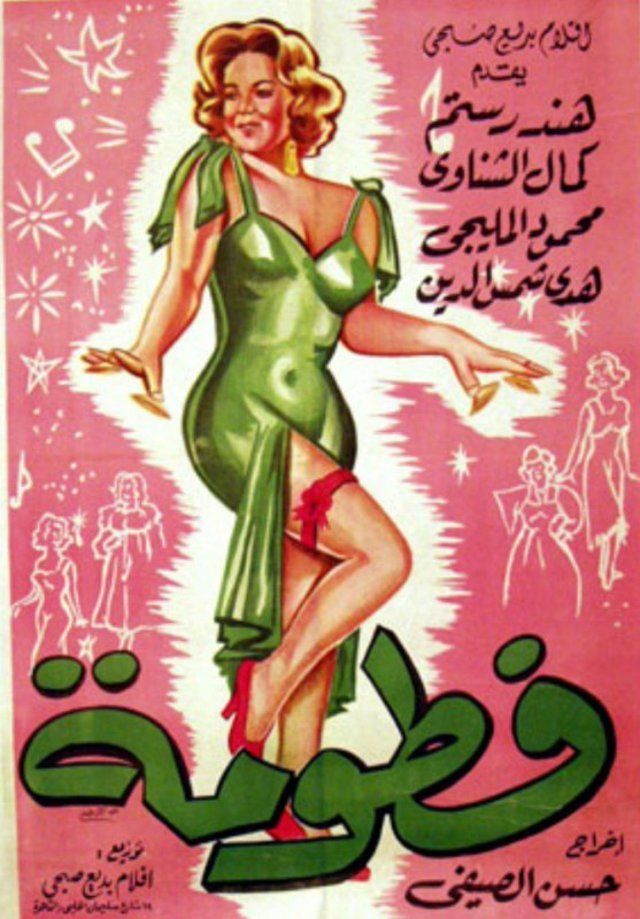
The scene is from the film of the same name, Fattouma, released in 1961. Here's a poster for the film. I've not seen it and don't know much about it.
And here is another poster for Fattouma, and note that it announces the participation of "Orlando" (on the right of the photo) in the film. (I cannot make out what it says above Orlando, sorry.)
That Franco-Arab cassette also has some songs from Karim Shukry, including "Take Me Back to Cairo," released on Sono Cairo, with lyrics in England. Not as interesting as Bob Azzam and Bruno's material, I don't think, but have a listen, you decide.
Nubian Egyptian composer, oud player, tar player, and vocalist Hamza El
Din live in concert at the Borough of Manhattan Community College
Triplex Theater (now known as the BMCC Tribeca Performing Arts Center)
on April 15, 1989, broadcast on WNYC's show "Folkwave."
The divine Shadia, who passed away in November 2017, performs a song composed by Munir Mourad (Leila's brother), "Ya Habibi Oud Li Tani," in Omdurman, Sudan, sometime during the 1960s. The original recording was done in distinctly Sudanese style, it's not just for this performance, and of course the Sudanese audience receives it warmly. I'm sorry about the quality of the video, it's not great, but the song really is. I don't know of other examples of well-known Egyptian singers of the period performing in Sudanese mode, but perhaps there are some. Please let me know! And thanks to Rania for the tip.
One of my favorite tracks by the legendary Egyptian star Mohamed Mounir. From his 1981 album, Shababeek. Lyrics by Sayed Higab; melody, Yahya Khalil. Backing Mounir are: on drums, the legendary Egyptian drummer Yahya Khalil; keyboards, Fathy Salama; guitar, Aziz al-Nassir; bass, Michael Cokis. Produced by Yahya Khalil.
Yahya Khalil is one of Egypt's most celebrated jazz drummers. Fathy Salama has recorded several albums with the group Sharkiat. One of my fave recordings he was involved with is Roman Bunka's Color Me Cairo (1995).
Sorry that this recording is not complete, I grabbed it from YouTube. You can hear the complete song here.
You may still be able to find this recording on cassette tape, although when I was in Egypt recently it was hard to find shops selling cassettes. Everything, alas, has gone digital.
Ramy Essam was at the University of Arkansas campus on January 22, courtesy The House of Songs Ozarks (based in Bentonville). He did a jam and Q&A session with students, a lecture/Q&A, and a concert in the evening. I had the pleasure of running the lecture/Q&A session with Ramy. I spent about 9 days in Egypt in December, where I purchased the red hat, which has the logo of the Ahly Football Club. I guessed Ramy might be an Ahly fan, and I was right!
I've been reading Margaret Farrell's excellent dissertation ("Aspects of
Adaptation in the Egyptian Singing Film", CUNY 2012) and learned this: the
operetta " Mā Ta’ūlsh le Ḥad" which concludes the film of the same
name (1952) runs consecutively through these styles: Modern Egyptian,
Tango, Waltz, Calypso, Arabic traditional, Egyptian traditional,
Egyptian samba. I was familiar with Egyptian music adapting all these
styles but it was "Calypso" that really stuck out. Fuller doesn't
discuss this segment, so I checked out the clip on YouTube. It's amazing. The
calypso segment (yes, with calypso beat, starting at 5:19) features a Sudanese
singer (I don't know who it is), black dancers, and Samia Gamal dancing in
(subdued) blackface. Farid El Atrash joins in the calypso song at the
end. Check out the entire operetta, it's great. Samia Gamal dances throughout, she's the best, and the woman singing in the operetta is Nur al-Huda.
A side note on calypso, courtesy Billy Bragg's new book, Roots, Radicals, and Rockers. The mass migration of West Indians to the UK was launched with the arrival on June 21, 1948 of the Empire Windrush at Tilbury in Essex. On the boat were two of calypso's finest singers, Lord Beginner and Lord Kitchener. Lord Kitchener was filmed on deck singing his new composition, "London Is the Place for Me." Newsreel footage was shown around Britain and calypso was presented as the music of the new immigrant community. One of the earliest calypso recordings to be released in the UK was Lord Beginner's "Victory Test Match Calypso" (1950) in celebration of the West Indian cricket team's first victory over England.
It is said that the world craze for calypso was launched in 1956, with the success of Harry Belafonte's "Banana Boat Song." So Egypt -- or maybe it was Sudan -- was ahead of the cultural curve.
One of the things I wrote about was the appearance of Enrico Macias in Egypt in 1979, at the invitation of Anwar Sadat. I only just discovered that the concert he gave on September 22, 1979 at Gazira Stadium was actually released as an album, called Enrico Macias en Egypte, on the Phillips label, that same year. Ah, the marvels of discog.com and YouTube.
Here is the discographical information, and you can listen to the entire recording on YouTube here.
And here is the tracklist:
A1 La Musique Et Moi A2 Aux Talons De Ses Souliers A3 Solenzara A4 La Folle Esperance B1 Le Grand Pardon B2 Kelbi-Btala B L'Oriental B4 Oumparere
Below I've excerpted what I had to say about Macias' visit to Egypt in 1979, and I discuss the song "La Folle Esperance" and the role it played in the trip. He only performs two "Oriental" tracks here: first, "Kelbi-Btala," which he describes as an "Algerian classical" number, featuring Enrico's father Sylvain Ghrenassia (who used to back Cheikh Raymond Leyris) and oud playing from Enrico and second, "L'Oriental," which he originally recorded in 1962. "L'Oriental" was originally made famous by the great Algerian Jewish singer Lili Boniche (I'm not sure in which year). It was composed by the Tunisian Jewish artist, Joseph Hadjedj, better known by his performing name, José de Souza. Here Macias gives it a more "Oriental" inflection than he did on his original recording of 1962, when, as he outlines in his autobiography, he was trying to make it as an artist in France and in order to do so, it was necessary to downplay his Algerian-Arab heritage. Here's what I wrote in 2005:
In September 1979, Egypt's President
Anwar Sadat organized a festival of peace, on the first anniversary of the Camp
David Peace Accords. The Egyptian government invited Enrico Macias to
participate, and contacted him--significantly--via the Israeli government (Monestier, Enrico Macias, 178). Clearly, President Sadat did not see
Macias as simply a knee-jerk backer of Israel. During the seventies, Macias
continued to insert small doses of Arabic music into his live performances and
his recordings. In 1977, he composed and recorded “La Folle Esperance,” a song
based on a folkloric Arab melody that Cheikh Raymond had played. The song's
lyrics praised Sadat's November 1977 visit to Jerusalem, and asserted, “we
[Muslims and Jews] are brothers.” Macias reports that, when he first performed
the song, on French television, it was a big success, and that the studio
audience included many Maghrebis, who clapped and sang along enthusiastically (Macias, Non,
je n'ai pas oublié, 327). Another song Macias composed in the
early seventies, “Le Grand Pardon,” expressed his hopes that the “sons of
Abraham” would achieve peace. In a 1974 interview, Macias went so far as to
assert his sympathy for the Palestinians, because they had been uprooted. He
did not agree, however, that the Jews were responsible for the Palestinians'
dispossession (Monestier, 145).
Macias
writes that when Sadat met him in Egypt, he “said first he invited me because
his people like me. But he also said to me, 'I made peace with Israel, but I
want also to make peace with all Jews in all the world, and for the moment you
are the representative of these Jews'” (Richard Cromelin, “Macias: Singer for the
Dispossessed,” Los Angeles Times,
November 22, 1985, part 6, p. 1). The fact that Sadat chose an Algerian
Jew who spoke Arabic to represent world Jewry at the peace festival, rather
than an Ashkenazi, is certainly significant; this was not a choice based on
European notions of Jewish “representativeness.” Macias was warmly greeted in Egypt
where, despite the boycott, his music was well known due to the underground
market. In Egypt, Macias did not simply perform his variety hits, but felt
comfortable enough to indulge in his Arabic repertoire. At a private concert,
for instance, he performed a song by one of Egypt's most beloved stars, Farid
al-Atrash, in Arabic.Macias played his third show in Egypt at
Gazira Stadium for the general public, with his father Sylvain joining the band
on violin. The crowd of 20,000 was enthusiastic, knew the lyrics to his songs,
and went wild when Macias took up the 'ud (Monastier, 183). Macias and his father were invited to an
audience with Sadat at his winter palace in Ismailiya, and Macias performed a
few songs for the small gathering, including “La Folle Esperance,” which he
sang in Arabic. Macias has called his encounter with Sadat “the crowning
achievement” of his life (Monastier, 183).
(If you want to know my entire "take" on Macias, you'll have to check out the book chapter.)
In the very fine documentary Nuh el-Hamam (Wailing of the Doves), 2004, directed by Amir Ramsis, 2006), we learn that the Port Said singer and simsimiyya player El-Sayed Abdou Mahmoud, known as El-Gizawy, appears in the 1964 film, Fatat al-Mina' (The Harbor Girl), which is set in a village on the Suez Canal. (That's him on the left.)
He tells us that he worked as an ironer (mikwagi) and that he used to sing at parties in the street -- the traditional way that simsimiyya music, known as damma, was performed at the time. He says he was contacted by director Hossam el-Din Mustafa to appear in the film, which stars Farid Shawki, Mahmoud El-Meleigy, Nahed Sharif, and Nagwa Fouad. He says that he sings on two songs, but I can only find one. The song starts at about 31:45. Check it out.
When the group El Tanbura was formed in late 1988 under the leadership of Zakaria Ibrahim, el-Gizawy was one of the veteran artists recruited to join the project of reviving the Port Said musical tradition that seemed to be dying out. He appears as a singer on all four of the group's albums. Sayed Gizawy passed away in October 2015. Allah Yarhamu.
I'm doing a lot of reading and video and movie watching on the topic of mahraganat for a writing project, and I thought I'd share this nugget.
In
2012 mahraganat artist Sadat was asked to compose a song for the
mainstream film Game
Over,
released in June, a remake of the Hollywood release Mother-In-Law
(starring Jane Fonda and Jennifer Lopez).
The song, “Haqqi Bi-raqabti” (my right to my neck? -- help, please!) appears in a scene where Egyptian
film stars Yousra and Mai Ezzedine lip-synch it. The scene looks pretty fairly ridiculous, especially Yousra (at age 61) dancing and
singing to the autotuned vocals of Sadat.
Here's the scene:
Sadat’s name does not
appear in the movie credits. I learned this from watching Hind Meddeb's 2013 documentary, Electric Chaabi, which you can purchase from Amazon.
I highly recommend it.
Very soon thereafter it would be hard to imagine mahraganat artists not
receiving credit or anyone other than the artists themselves
performing their own songs.
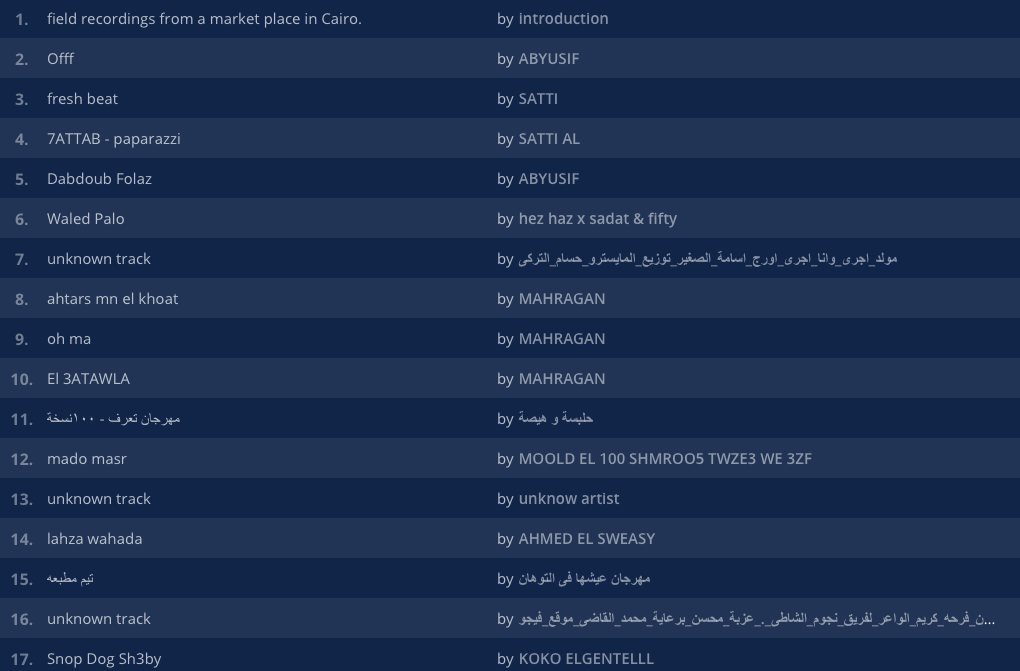
Ok, so I'm behind on posting...this is from 4 months ago, sorry! In any case, it's an excellent one from France's DJ No Breakfast, great fun, and it gives a sense of the great variety and clever mixing going on today in the mahraganat and hip hop scenes in Egypt. I really like what Abyusif is up to on the mahraganat front, and Satti is very cool too -- categorized as rap, I guess. The songlist is to be found here.
Here are a couple fine photos I found awhile back of the mahraganat scene -- I can't remember the source. If anyone knows let me know, it's important to give credit. I've now found the source for the top one: it's from CBS News, a wonderful portfolio of photos of the mahraganat scene. This is from a concert in April 2013.
(Nariman El-Mofty/AP)
This one is from the Manchester Guardian, "The World in Pictures," Jan. 2, 2014. It's a bachelor party with mahraganat music in El Marg, a large and very populous informal district on the northeastern edge of Greater Cairo.
"get to know what fadoul sounded like when he was playing around with
rapping, disco from egypt, coladera from algeria, an arabic take on zouk
music and much more. it also includes 2 tracks from egypts al massrieen
which will be the next reissue on habibi funk."
This is all the information provided by Jannis of Jakarta Record (based in Berlin and Cologne), so, alas, no track list. But it is a sweet list.
Jakarta has released three notable Middle East albums of late:
This is a quite interesting documentary, from MTV, about the period
running up to the Tamarrod-organized demonstration of June 30, 2013, and
the role of musicians in that movement. Ramy Essam, Karim Adel Eissa of
the rap group Arabian Knightz, and Nariman El Bakry, a music promoter,
are all strong supporters of Tamarrod and critics of Morsi and the
Muslim Brotherhood. After the coup, Karim Adel Eissa expresses support the army, who he says he did not support previously. [Addendum from just a couple hours after this was posted. I posted more or less the same thing on FB. A FB re-posted, and within minutes a comment from Karim Adel Eissa, who says, "my stand openly and publicly changed shortly after that tho."]
Nariman seems to shut down emotionally. Ramy got alienated by the crowds expressing
support for the army at an event the night before the June 30, and so
did not play at the June 30 demo. He says he was glad that Morsi got
tossed out but not with the coup.
Good resource that is not always terribly accurate -- claims that 33 million Egyptians demonstrated against Morsi on June 30. Its estimate of 1200 killed in the Rabaa massacre of Muslim Brotherhood supporters on August 14 is more sound. Human Rights Watch estimates at least one thousand.
Professor of Anthropology, University of Arkansas. Author of Memories of Revolt: The 1936-39 Rebellion and the Palestinian National Past. Co-editor of Palestine, Israel and the Politics of Popular Culture and of Displacement, Diaspora, and Geographies of Identity.