I've recently been indulging of late in some additional Jack Smith investigations. I've recently watched the documentary,
Jack Smith and the Destruction of Atlantis, Smith's film
Normal Love (1963, available for viewing at
ubuweb), and
Ali Baba and the 40 Thieves (1944), starring Maria Montez, who was one of Smith's main inspirations. I also recently read two very informative articles about Smith: Dominic Johnson, "The Wound Kept Open: Jack Smith, Queer Performance and Cultural Failure" (
Women and Performance 17[1], 2007) and Michael Moon, "Flaming Closets" (
October vol. 51, Winter 1989).
I got interested in Jack Smith after I had the good fortune to see his most well-known film,
Flaming Creatures (1963) in the early nineties in Seattle. At the time was quite a rarity. Now it's available for viewing at
ubuweb, and I own a bootleg copy that I purchased on ebay. What struck me when I watched the documentary recently was how many signs of what I want to call Smith's Orientalism it showed--although the film, alas, did not give these trappings of Orientalism the kind of detailed discussion that they deserve. The film is full of snippets of the words of Smith, some of them relevant to this point, and show how much he had internalized "Orientalist" influences in the ways in which he represented the world. At one point he declares, "Me, I'm Ali Baba. The man without his dreams withers and grows old." At another Smith is asking for volunteers to help out on one of the performance pieces he used to stage for free at his apartment in New York City during the seventies. He says, "I need an exotic volunteer of the desert of cheerfulness." Responding to objections about the fact that audience typically had to wait for hours for the show to go on at his apartment, he states, "I don't want the scum of Baghdad" to be there for the performance. He thought audiences needed to work in order to be deserving of art. They weren't automatically entitled to it.
The documentary also offers abundant visual evidence. Smith is shown in kufiya several times throughout the film. Often the provenance of the shots is not identified. It appears that the shots of Smith in kufiya are from his appearance in films by other experimental filmmakers. He appeared, for instance, in a number of Warhol films, but I don't know whether any of the images below are from a Warhol vehicle.
The first three stills are all from the same film, showing Smith in black-and-white checked kufiya. I don't know what the original source is.
The next two are stills from underground filmmakers Scott B and Beth B's 1980 film, The Trap Door.
This is a fairly late appearance of Jack Smith, probably after he had contracted HIV. (He died in 1989.)

Smith also performed as a "harem girl," but I noticed no shots of him in that role in the documentary. Moon (1989: 41-42) has this to say about Smith in both roles: Smith seems to have performed the roles of the "sheik" or the (presumably male) "vampire" at least as frequently as he did those of the "vamp" or "harem girl" in '60s films. He played all these roles, and directed others to play them, in ways that short-circuit their relations to the heterosexualized representational regimes from which they derive. What is compelling about these figures in Smith's films is not the sheik's enactment of virility or the harem girl's of femininity; nor is it simply the reversal of these roles, as it might be if Smith's were simply another version of traditional transvestite comedy. To underestimate or dismiss the real erotic appeal Smith's "comedies" have had for many gay viewers is to ignore the primary source of their power: his films are incitements to his audience not only to play fast and loose with gender roles but also to push harder against prevailing constraints on sexuality.
As should be obvious, when Smith put on the kufiya, he was not asserting any kind of political identification with Palestinians (the resistance movement and its kufiya symbol did not appear til 1969-70). Rather, the point of reference is the "sheik" movies starring Rudolph Valentino, and their offspring, and in particular, the "Orientalist" films of Maria Montez. And the point, according to Moon, is gender-bending. (I take his word for it, as it is not apparent from the scenes of Smith in kufiya that we see in the documentary that this was about transgressing conventions of gender and sexuality.)
It's perhaps a minor point, but I don't believe that the "sheik" in Hollywood cinema fits so neatly into "heterosexualized representational regimes" as a symbol of virility. Valentino's "virility" is not, I think, so clear-cut. His masculinity was frequently questioned in the media and public discourse during his career, and his sleekness, pomaded hair, dandyish clothing and so on were all pointed to as examples of his effeminacy. Steve Caton has discussed at length the gender ambiguity of T.E. Lawrence, as portrayed by Peter O'Toole in
Lawrence of Arabia (1962)--whose release and widespread popularity preceded the appearance of Smith's
Flaming Creatures and
Normal Love by just a year. And as we will see below, the Maria Montez vehicle,
Ali Baba and the Forty Thieves, also has its moments of gender ambiguity. The "sheik," therefore, may in fact be an image that is already somewhat ambiguous and therefore readily available for further deconstruction.
We also see evidence of Jack Smith's Orientalism in some of the photos and movie stills shown in the documentary. I learned from the film that prior to getting into film making Smith was an accomplished photographer. In particular he was a pioneer in the field of color photography, playing an important role in helping turn it into an "art" form (previously color photos had mainly been considered tainted by commercialism and therefore degraded.) But Smith also worked in black-and-white, what was considered the "art" form of photography. He used to get people into his photo studio, where he stored all kinds of costumes, and then get them to dress up. It seems that the status of Smith's
estate is still not resolved, and so it is difficult to find many examples of Smith's photography.
Here is an interview with filmmaker Mary Jordan, which shows a few examples of Jack's stunning photography and provides some background about the film and the fact that Jordan had limited access to the Jack Smith archive.
Here's one of the photos shown in the film, which is from the only book of Jack Smith's photography to appear in print,
The Beautiful Book. (It is, alas,
out of print.) If you just look at the top half of the photo, with its unveiled women whose breasts are visible through the gauzy, veil material, you would think that it superficially resembles the kind of Orientalist French colonial photography that Malek Alloula so brilliantly analyzes in
The Colonial Harem. But then you notice the male lying supinely on the floor below the women, his flaccid penis exposed, his eyebrows and eyelids made up in a manner similar to the women's. This sexual economy is therefore radically other the stereotypical Orientalist/colonial imagery. Not only is it different, it puts that stereotypical Orientalist imagery in the service of an imaginary that is radically and subversively queer, in a manner that remains (I would maintain) still explosive today.
I think this still from the documentary is also one of Smith's photos (and not from a film), an occasion where his subject was invited to dress up in costume (his studio seems to have been full of "Orientalist fancy" props). It resembles more closely than the previous photo the sort of photos we find in the Alloula book. But it is put to different purposes. This woman is not, I would argue, the object of a peeping tom, of the colonial gaze. She is not passively submitting to the gaze, and she seems to be in possession of her own sexuality.

This still may be from one of Smith's films. The woman at right may be a man in drag. It shows the importance of decadence and vivid color in Smith's imagery.
Here is a still of a belly dancer (I'm not sure whether this was from a film, or a photograph--I took photos from the film, and then sent the DVD back to Netflix, so I'm sometimes vague on details).
If you watch Smith's film
Normal Love, however, you won't see anyone dressed up in any costume that is overtly Orientalist. But the feel of the film is very much in the vein of Smith's Orientalist fantasy, with its lavish and extravagant color (although one suspects that the version available on ubuweb is somewhat faded from the versions that Smith might have screened), its frolicking and dancing (all of it out-of-doors), its decadence, indolence and desultoriness, its casual and polymorphous, collective and frequently undecipherable sexuality. Smith used the term "moldy" and "swampy" to describe the sorts of scenes we see in
Normal Love, what Moon views as the sort of "unconscious processes that have, over the past couple of decades, fueled innumerable small- and large-scale eruptions of queer rebellion against the institutions of the closet" (1989: 53-54; see also Johnson 2007: 8).
(I love the deadpan nature of the film title--this is so far from anything that one would conventionally term either/or normal/+love.)
The soundtrack for
Normal Love, however,
affirm's the films Orientalist bases. When Jack Smith presented his films, as far as I understand, he would play records on a turntable as the movie screened. (After
Flaming Creatures, Smith produced no finished movies, in order that they could not be seized by the authorities, turned into product, or put in the service of a political agenda--all of which happened in the case of
Flaming Creatures.) So the soundtrack is not exactly in "synch" with the action onscreen--or rather, it is situated in a kind of wondrous out-of-synchness. For example, when we first see the fearful Mongo figure in
Normal Love, stalking one of the women, we hear music that is jumpy and scary. Then, we hear the lush and idyllic sounds of Rimsky-Korsakov's famous
Scheherazade, and we next see Mongo pushing the woman on a swing, dressed all in pink. Selections from
Scheherazade are heard throughout film, as well as three songs by Mohammed El-Bakkar and his Oriental Ensemble. I've been able to identify only one of the songs: "Ya Habibi," from the album
Sultan of Baghdad (originally released in 1958). You can listen to a snippet by going
here. (Of course you can hear the entire song if you watch the film -- which you must do. "Ya Habibi" starts
roughly at minute 28.)
Muhammad El-Bakkar is somewhat notorious, in retrospect, for his quite risqué album covers. In particular, this one (released in 1958, on Audio Fidelity).

And this one, released in 1960, shortly after El-Bakkar's death, on Audio Fidelity.
It's rather remarkable that El-Bakkar's releases were rather mainstream recordings, marketed to the middle class. It appears that in the 1950s you could get away with showing lots of breast if, and only if, the subject were "exotic." (Check out this
gallery of belly dance LP covers.) It's rather like the
National Geographic and its nudes back in the day. Note that the Arab (closer to white) dancers have their nipples covered, whereas the more "primitive" black African does not. Moreover, the scene on the cover of the
Music of the African Arab LP appears to be that of an African slave girl, up for auction.
The aim of these salacious covers was to sell the albums. And sell they did. According to
Saki Knafo, Bakkar's first release,
Port Said (which also had a salacious
cover, featuring Turkish belly dancer Nejla Ates), may have sold a million copies. The liner notes on the albums, Knafo notes, were also pure Orientalist fantasy, with little reliable information about the music or the culture that produced them. But the music in fact was basically authentic, contemporary popular Arabic music, with the percussion perhaps a bit pumped up in volume. Belly dance music was quite popular at the time in the US, an outgrowth of the earlier interest in "exotica," as well as in Cuban music (cha cha cha, mambo), calypso, and so on. There were lots of clubs in the urban US featuring belly dancers and Middle Eastern music, and these were quite hip places for would-be sophisticated middle class patrons. (You can find lots of examples of El-Bakkar's music to listen to on youtube.)
El-Bakkar was Lebanese, and had worked as an actor and singer in the Egyptian film industry. He arrived in New York City in 1952, and passed away, at the age of 47 and at the height of his career in the US, in 1959. Again, the look of the album covers of his LP's obscures the fact that the music on the vinyl was in fact fairly conventional Arabic music--although somewhat edgy and exotic in the US context. And, on the basis of this photo of El-Bakkar's ensemble (he is front and center, holding an 'ud), his shows were not particularly "wild" either--although they probably featured a belly dancer.

I want to the point that the music Jack Smith used on Normal Love was "real" (more or less) Arabic music. Arabic music, moreover, that would have been familiar, and not entirely foreign, to much of his audience. It's no doubt rather hard to believe that white middle class Americans might have been "familiar" with Arabic music in the late 1950s and early 1960s, but I would argue that we have a distorted view of this period. (There is an excellent accounting of the popularity of belly dance music in Incredibly Strange Music, I think it's volume 1, by V. Vale.)
An essential source of Jack Smith's Orientalism is Maria Montez. Montez was born in the Dominican Republic, and achieved fame in Hollywood in the 1940s when she starred a series of films, usually with "exotic" themes, which were notable for being filmed in Technicolor. Montez was the object of Smith's admiration for a number of reasons. One of the chief reasons, as far as I can understand it, is that he found a level of truth and authenticity that emanated from her despite, or perhaps because, of her legendary "bad" acting. Smith also appreciated Montez for her magic, her beauty, her mystery. He writes in his essay, "The Perfect Film Appositeness of Maria Montez: "Wretch actress - pathetic as actress, why insist upon her being an actress - why limit her? Don't slander her beautiful womanliness that took joy in her own beauty and all beauty - or whatever in her that turned plaster cornball sets to beauty. Her eye saw not just beauty but incredible, delirious, drug-like hallucinatory beauty...To admit of Maria Montez validities would be to turn on to moldiness, Glamorous Rapture, schizophrenic delight, hopeless naivete, and glittering technicolored trash!
It would seem that viewing Montez's films is largely responsible for feeding Smith's brand of Orientalism. As he writes in his Montez essay, "You may not approve of the Orient but it's half of the world and it's where spaghetti came from." (You may think he's crazy, but pasta was introduced to Italy when the Arabs conquered Sicily, by the 9th century.)
Check out these stills from Maria Montez's 1944 film, Ali Baba and the Forty Thieves (which I have just seen for the first time). Montez plays the character of Amara, the daughter of Prince Cassim, who betrays the caliph, Hassan, and enables the Mongol invader Hulagu Khan to capture Baghdad. As a young girl, Amara pledged herself to Ali, the son of the caliph. Ali is presumed to have drowned shortly after his father was murdered due to Cassim's treachery, and when Amara grows up, she is promised to Hulagu by her father.
How glamorous she is. And steely eyed. The veil is not a sign of disempowerment here.
And gorgeous. Who cares if her acting is wooden?
Here is Amara with her servant, Jamiel, played by Turhan Bey. In some ways, Jamiel is the most audacious and brave of all the male characters in the film. Jamiel saves Ali Baba. He is sent on numerous dangerous missions. His talent with his knives is prodigious. It's Jamiel who hoists the flag of the victorious party of the caliph on top of the tallest tower at the end of the film. Turhan Bey, born in Austria to a Turkish diplomat and a Czech mother, appeared in a number of "exotic" roles in Hollywood during the fourties, often in the company of Maria Montez. It's quite interesting that he, the "exotic," the Arab, is in no way depicted in this film as deviant or fanatical or venal or corrupt or decadent...His "positive" role flies in the face of conventional critiques of "Orientalist" cinema. (How interesting, too, that this Hollywood film stars a Dominican and a Turk.)

Montez's costume, meant to represent thirteenth-century Baghdad, would not have been out of place at a Hollywood party at the time. It in no way marks her as "Other." Here, for instance, is a photo of Greta Garbo, from roughly the same time period. And check out the ravishing, be-turban'd
Lana Turner, in a scene from
The Postman Always Rings Twice.Here is Amara (Montez) with Ali Baba (John Hall). When the two meet again as adults they do not recognize each other. Ali believes that Amara betrayed him to Hulagu, when he is captured, but eventually they reconcile. John Hall's acting is as sub-par as Montez's, but he is much less charismatic as a person. Here, even with her face-covering, Montez, as usual, manages to look styling.

Another shot of Amara talking to Jamiel. Another stylish outfit for Montez.

I love this shot of Amara (Montez), her father Prince Cassim (Frank Puglia) in the center, and the Mongol Hulagu Khan, on the right. The colors in this scene are simply spectacular. Too bad I can't quite capture their full impact with my camera. You will have to watch the film.

And a final shot of the fabulous Maria Montez as Amara.

The film ends when Ali's men defeat those of Hulagu, take over Baghdad, and restore the caliphate. The last item is that Hulagu's flag must be taken down and the flag of the Abbasid caliphate put up in its place. It's Jamiel (as noted above) who accomplishes this. When the flag goes up and begins to fly, everyone cheers, and that's the end of the film.
The curious thing is that the flag shown is not that of the Abbasids. The Abbasid flag was pure black, not green, and it had no crescent and no "allahu akbar" written on it . The flag flown in the movie resembles the Saudi flag, which, however, has a sword on it rather than a crescent.
More curious, isn't it, that the characters in the film, with whom we have come to identify, cheer at the sight of a film inscribed with "allahu akbar," as they defeat the Mongol oppressors and usurpers? What kind of "Orientalism" is this, when we are urged to align ourselves with such a moment, with such a scene?
Overall, Ali Baba and the Forty Thieves is "Orientalist" in that it depicts the Arabs of the medieval as exotic. At the same time, the protagonists (Ali Baba and his men) are presented as romantic characters with whom we can identify, not as ontological Others. And yes, we see scenes of women in the harems, in "belly dance" costumes. But they are not presented as women who need to be liberated, and the Amara (Montez) character in particular is depicted as anything but coy and repressed.
I think Smith drew something additional from this film besides the inspiration provided by Montez, an interest in vivid Technicolors (which was reflected in his photography), and the images of the harem (which inform both Flaming Creatures and Normal Love). There is also gender play.
When the boy Ali escapes from Hulagu and his men, he comes upon a band of thieves, discovers the secret of their hiding place, and so says "Open sesame" and makes his way into their cave The thieves, led by Old Baba, return and find the boy. Abdallah, Old Baba's lieutenant, raises objections to his presence. Ali holds his own in a fight against Abdallah. Old Baba, impressed by Ali's courage, accepts him into the gang, adopts him as his son, and appoints the tough guy Abdallah as Ali's "nanny." When Old Baba dies, Ali Baba takes over leadership of the gang, but keeps 'Abdallah as his lieutenant. At the same time, it continues to be necessary for Abdallah to look after and protect Ali, thus reconfirming his position as both a tough guy and a "nanny."
Interestingly, 'Abdallah is played by the famous Hollywood character actor Andy Devine, who was notable for his wheezy voice and for playing the role of the side-kick who was usually reluctant to get involved in any violent action. Given that he had firmly established himself in such roles during the thirties, prior to the filming of Ali Baba, it must have been difficult for Jack Smith, as it is for us, not to think of Devine's well-established persona as he watched the film. That is, it's hard to take the Abdallah character entirely seriously as a daring and frightening thief, given that he is played by Andy Devine.
The scene where Ali and his men dressing up in disguise in order to enter Baghdad so that they can rescue Amara from the clutches of Hulagu, Abdallah tries on this costume, the dress of an aristocratic woman of Baghdad. After Ali tells Abdallah, good-naturedly, that the outfit looks ridiculous, chiefly because of his beard, 'Abdallah opts for another costume.
Is this one of the sources of Frank Smith's distinctive brand of drag in Flaming Creatures and other films, where men dress up in female costume and makeup, but many retain their facial hair?
Francis Francine (Frank di Giovanni) wears a similar tall hat in the opening scenes of
Flaming Creatures. You can't see the full height of Francis' hat in this shot, but you will get the idea if/when you watch the film. (Francis Francine later became, like other Jack Smith regulars, a Warhol superstar, and appeared as the transvestite sheriff in Andy Warhol & Paul Morissey's 1968 film,
Lonesome Cowboys.)
When Ali's his men penetrate Baghdad in disguise, in preparation for Ali Baba's entrance and the eventual assault on the Mongolian usurper Hulagu, they spread the word among the denizens of Baghdad, alerting them to be prepared to assist him once the attack is launched. In one scene, 'Abdullah (Andy Devine) is shown in disguise, telling the Baghdadis around him, "Today, Ali Baba comes...Today, Ali Baba comes, today," as the movie's stirring, Eastern-inflected orchestral score plays.
You will recall that this is the bit of the soundtrack from Ali Baba and the Forty Thieves that opens Jack Smith's film, Flaming Creatures. (Yes, it is the words of...Andy Devine as Abdullah that open this groundbreaking underground film.) But what we see onscreen in Flaming Creatures is not Ali Baba and his men but some of Smith's fabulous creatures.
As Moon observes,
Flaming Creatures was, in a sense, a kind of "Scheherazade party," referring to Diaghilev's revolutionary 1910 Ballet Russes production of
Scheherazade, starring Nijinsky and Ida Rubenstein, featuring choreography from Fokine and set design and costume from Bakst. (Recall that we hear Rimsky-Korsakov's
Scheherazade throughout
Normal Love.) As Peter Wollen shows in his essential article "Fashion/Orientalism/The Body" (New Formations 1, 1987), the Orientalism displayed in Diaghilev's
Scheherazade part was a much wider phenomenon, one that had an enormous impact on both high art and popular culture during this period. It all started, I'm fairly certain, with the appearance of Arab dancers (mythologized as the character of Little Egypt) at the Chicago World's Fair in 1893. By the first decade of the twentieth century, it was common practice for the more fashionable and sophisticated of the urban middle classes (and especially the women) to dress up in "Oriental" costume for evening soirées. (I write just a bit about this phenomenon in an earlier
post; there are some good images there as well.) Moon shows how Smith subversively taps into the (ambiguous) queer tendencies of this trend.
Here's a characteristic still from
Flaming Creatures, from the infamous "orgy" scene, which invokes the indolence and decadence of the Orientalist "harem" (gauzy dress, African slave/eunuch with an "Arab headdress," and so on). Except that, with all the extravagant disguises and the cross-dressing and the mingling and entangling of bodies in ways that are often difficult to apprehend and the casualness of the bodily exposure and the touching of sexual organs, one must agree with Moon (42) that erotic charges in a work like
Flaming Creatures do not follow hard-wired gender lines, but move powerfully across circuits of gender and sexual identity in not altogether predictable fashions." The scenario is utterly queer, in the most subversive sense, scrambling notions of gay, lesbian, bisexual, transvestite and hetero identities in ways that remain deeply provocative today.

I refer you to Moon and Johnson for much more thorough readings of Smith and Montez and Orientalism.
I want to conclude with a brief expression of dissent from what has by now become a convention of critical readings of Orientalist manifestations in Western culture. Starting from Said, the assumption of such critics is that the deployment of Oriental imagery is always oppressive and colonialist in its foundations and in its uses, always mobilized from a position of "flexible positional superiority," to use Said's phrase (
Orientalism, p. 7). Orientalist "stereotypes" seem inevitably, in such uses, to have negative impacts upon actual Middle Easterners. No "fantasy" that deploys them would, it seems, be ethically possible.
An investigation of Smith and his sources, I think, opens up different possibilities. In a certain sense, Smith's mobilization of Orientalist imagery is so far removed from a "real" Arab world, given the layers of fantasy and the distance in time, as to be difficult to read in any easy way as having any implications for contemporary US politics regarding the Middle East.
But if we do want to think along those lines, are Smith's uses of the Arabic music of Bekkar in
Normal Love "negative" in their implications? And what about his devotion to the films of Maria Montez? What about the fact that the viewer of
Ali Baba and the Forty Thieves is urged to sympathize with the Arabs in their struggle against the Mongols? Are the women of these films presented as Other, in need of liberation (by us)? As objects of colonialist scopophilia and voyeurism? Perhaps not, given that Maria Montez does not play helpless characters in need of liberation or depict women who passively accept the gaze. In addition, her outfits are not, usually, entirely foreign and exotic and symptoms of the oppression and seclusion of Arab women.
And what about the fact that the Orientalist imagery was absolutely essential to what Smith considered the "baroque" character of his art (he describes it as such in the documentary) and that he deployed it in such fundamentally subversive ways?
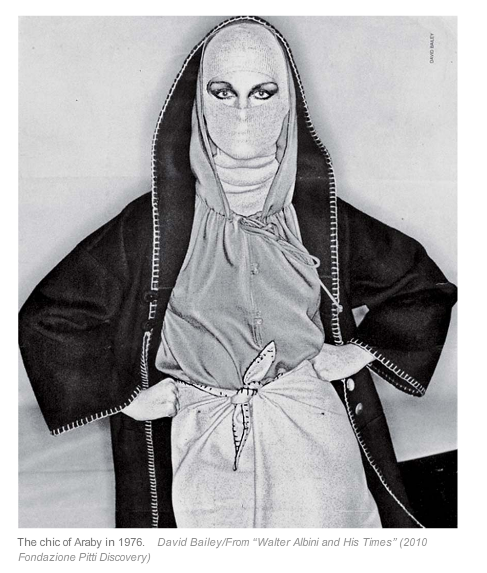
I am generally in sympathy with the Orientalist critiques. But I think they are often fundamentally limited in their vision, and I am starting to get bored with them. I am more interested in exploring the ways in which the "East" contaminates the "West" and how it messes with its supposedly essential and superior character. Thus my interest in Jack Smith and kufiyas and "Islamic" rap and punk and the writings of Peter Lamborn Wilson.
To be continued.