From artist Laura Harling:
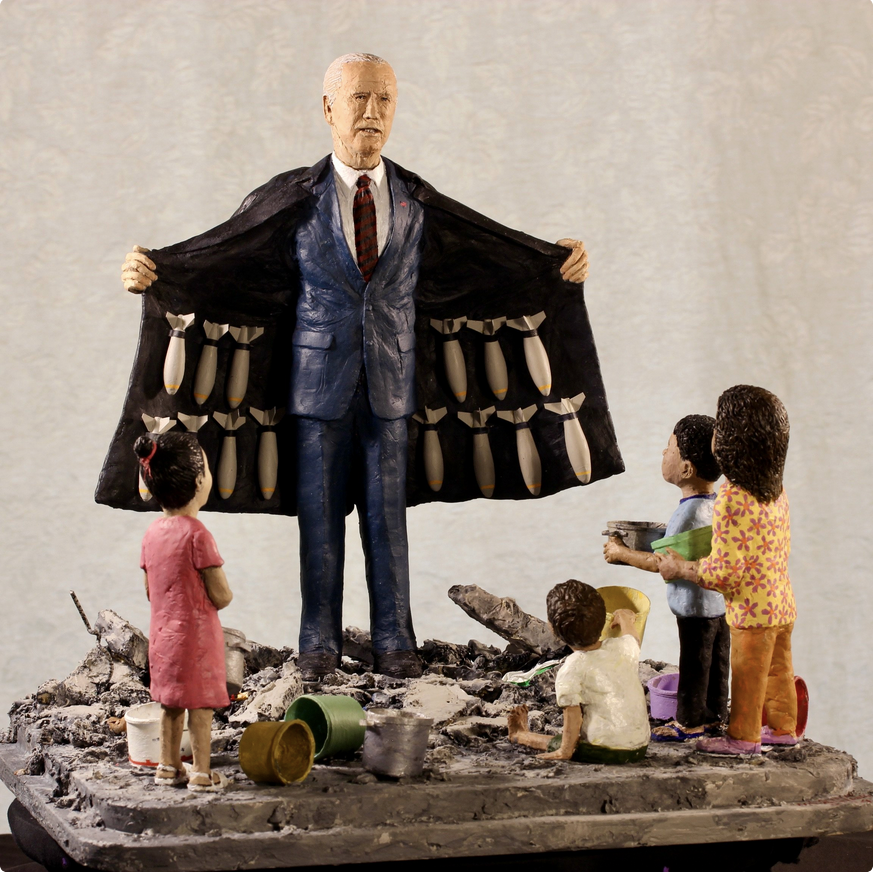
Monday, October 14, 2024
Friday, October 22, 2021
Simon Peres on Palestinians in kufiyas and tarbushes (#kufiyaspotting)
Simon Peres, former Israeli PM, former president of Israel, former Defense Minister of Israel, and oh so respected in US official circles, on what he thought of Palestinians wearing kufiyas and tarbushes, when he landed up in Palestine in 1934. From his 1995 book, Battling for Peace.
Wednesday, September 23, 2020
#kufiyaspotting -- Palestinian Communists in Israel
This is from the anthropologist Sharif Kanaana's article, "Survival Strategies of Arabs in Israel," published in Merip Reports #41 (October 1975). It is based on research he conducted in Israel in 1969-70 for his dissertation. Kanaana received his PhD in Anthropology from the University of Hawaii. Kanaana began his teaching career at Birzeit University in 1975; he has since retired, I'm not sure what year.
The quote is from his discussion of what he calls the "middle peasant" survival strategy of the Arabs in Israel. (Interestingly, he does not use the term, "Palestinian," which has more recently become the preferred nomenclature: rather than "Arabs in Israel" (state language), "Palestinian-Israelis" or, "Palestinian citizens of Israel."
I'd love to find some photographs of Israel's Palestinian Communists garbed in kufiyas, from the 1950s, 60s, and 70s. If you've got a clue as to where I might find some, please let me know.
Wednesday, August 12, 2020
#kufiyaspotting: Kobi Farhi of Israeli metal band Orphaned Land
Orphaned Land were founded in 1991, led by Jaffa-born singer Kobi Farhi. Mark Levine discusses them in his book Heavy Metal Islam, and he calls them an "Oriental death-doom metal" band. Their orientation is very much about peace, and according to Levine, they have lots of fans in the Middle East outside of Israel. Kobi is Ashkenazi, the band's lead guitarist until 2014, Yossi Sassi is Mizrahi (Libyan-Iraqi). Given their political orientation, I don't regard this use of the kufiya as appropriation, but rather a signifier of solidarity/identification with Palestinian/Arab culture. I'm not much of a metal head but I respect Mark Levine's opinion about their virtuosity. Here is a YouTube video of one of their songs, to give you flavor of what they do.
Sunday, April 08, 2018
Gaza
I think this photo, by Mohammed Salem of Reuters, is the best I've seen from the recent Gaza events, the state-sponsored mass shootings in response to Palestinian protests. Click on it, fill your screen with it. I posted the photo on Facebook and one of my friends observed that it was like a Delacroix painting. It's from Friday, April 6, the second big day of the weekly rallies of the Great March of Return, when protesters burned tires to try to hinder the Israeli snipers posted at the border, who killed at least 20 people and wounded hundreds on the previous Friday. They were only partially successful: the snipers took out 9 more on the 6th.
The photo, I think, shows the indomitable spirit of the Gaza Palestinians who live in a huge open air prison, with very limited access to the outside world, whether coming or going, with massive unemployment, very degraded water resources, etc. Note that these protesters are unarmed. Note their youth, And note, of course, the inevitable kufiyas. Long Live Palestine.
Sunday, January 08, 2017
Neta Alkayam covers Jacob Abitbol, "Khoti Khoti"
Saturday, January 30, 2016
A new generation of Palestinian strugglers and their kufiyas
And while I admire the courage as well as the stylistic flare of those Palestinians now fighting the occupation, at the same time it pains me to think that these young people represent yet another generation of Palestinians condemned to confronting violence. This occupation is about to be (in June) 49 years old. FORTY NINE. How can this keep going on and on and on and on? What does it mean for us to admire the bravery and fortitude of this new generation of heroic Palestinian strugglers? I would much rather not see such photos any more, instead I want to see photos of young Palestinians dancing and partying and studying and enjoying "normal" life. I am sick of it. And yet...don't they look flash?
Sunday, January 10, 2016
"Linda, Linda": Samir Tawil, Haim Moshe, 3 Mustaphas 3
Syrian singer and oud player Samir al-Tawil wrote "Linda, Linda" and released it in 1967. It was his biggest hit and has been covered numerous times. You can grab it from the inimitable music tumblr Naksh al-Sanadeeq here.
Check out this blogpost by Aziza al-Tawil, a US belly dancer. Her mother Johanna was a belly dancer, who Samir Tawil met in the US. The two apparently had a relationship and a child (Aziza), and Aziza claims that the song "Linda, Linda" was written for her mother. You can read more here, on Aziza's blog, and also view a Dutch TV report where Aziza is interviewed about the strange, and somewhat unbelievable, story (English subtitles).
Also somewhat unbelievable, but true without a doubt, is that the Israeli Yemeni singer Haim Moshe recorded "Linda Linda," and it was a big hit for him in the Arab world in particular during the mid-'80s. The story is covered by Amy Horowitz in her excellent book Mediterranean Israeli Music and the Politics of the Aesthetic. Horowitz has copies of letters written to Haim Moshe by Syrian fans, sent via Europe.
Tuesday, January 05, 2016
Best Arabic Songs of 2015, as picked by Nitzan Engelberg & Yaniv Jurkevitch -- and including a great track by Jowan Safadi
Most of the tracks are what one might call "alternative" Arab music, with roots in rock, but there is also some hip-hop. "Arabic" for Engelberg and Jurkevitch seems to mean "Eastern" or "Mashreqi," as there are no tracks from any Arab country east of Egypt. Nonetheless it's a quite good set, and it introduced me to a lot of material I did not know. Of the artists I am familiar with, there are quite good tracks from Mashrou' Leila (Lebanon), Ramy Essam (Egypt, though now based in Sweden), Maryam Saleh & Zeid Hamdan (Egypt/Lebanon), DAM (Palestinian citizens of Israel), Zeid and the Wings (Lebanon), Massar Egbari (Egypt), and Youssra El Hawary & Salam Yousry (Egypt).
I was most impressed by the track by Jowan Safadi, called "To Be An Arab." It surprised me when I listened for the first time, because the vocals are in Hebrew, not Arabic, and the song is not rock or rap but sounds very much like standard Israeli Mizrahi pop. (There is, however, a spoken bit in Arabic.) I did a bit of googling and learned from an article on Mondoweiss that Safadi is a Palestinian citizen of Israel (don't you dare call someone like him an "Israeli Arab"), and that the lyrics are quite amazing. The YouTube video (below) is terrific, and it is aimed at/addressed to Israeli Jews of Arab heritage, known in Israel as Mizrahim (or alternatively, to use an earlier terminology, Sephardim). The video provides a translation of the Hebrew (and Arabic) into English, which Mondoweiss has helpfully transcribed. Here's a few sample lines. I urge you to watch the vid and read the article.
Hardcore homophobes
Are the most gay on the inside
Mizrachi Arabophobes
Are Arabs themselves
Who are just afraid
And prefer to stay in the closet
Because they know, they know the best
That to be an Arab is not that great
Interesting, no, to compare Mizrahis who hate Arabs to homophobes?
The song represents a quite remarkable reaching out, on the part of a Palestinian Arab citizen of Israel, to the Mizrahi Jewish minority, who are of Arab heritage. When it comes to a one-on-one "talk," the address is in Arabic, presuming the ability of the Mizrahi addressee to understand the language of heritage -- which in fact many young Mizrahim would not. It expresses a great deal of sympathy for the Mizrahi position, but ends on a tough note: dude, you are in Palestine.
Hey you imported Arab
Take it from a local Arab
You were dragged here
To take my place
It’s hard to be an Arab
It’s really hard, ask me
It’s hard to be an Arab
How much can one be black
Under the rule of the rich and white
In the land of Palestine
Take it from a local Arab
You were dragged here
To take my place
It’s really hard, ask me
It’s hard to be an Arab
How much can one be black
Under the rule of the rich and white
In the land of Palestine
Monday, January 04, 2016
Neta Elkayam and Maurice El Medioni do Line Monty's "Ana Loulia"
Friday, August 21, 2015
Villagers, al-Tuwani, West Bank, Palestine, Hebron District, 12/26/1961
The village, we were told, had 300 residents. We reached it over a dirt/stone track (no road) They were very, very poor -- the surrounding land was very rocky and not suitable for agriculture. My father writes in his diary: "Children without shoes, clothes in tatters." You can see an example in the photo. The villagers were extremely hospitable -- we were invited for tea at the house of the village headman, and they were about to prepare chicken for lunch but we said our thanks and departed. Reportedly we were the only Americans to have visited the village besides our host (who lived in Amman) and Mr. and Mrs. Lapham.
Since the Israeli occupation, al-Tuwani has come under very severe pressure from nearby Israeli settlers and military. You can get an introduction to the issues at wikipedia: en.wikipedia.org/wiki/At-Tuwani and from the Christian Peacekeeper Teams: www.cpt.org/taxonomy/term/6. There is also a FB page for an organization called Humanity Together: Supporting At-Tuwani, Palestine: www.facebook.com/HumanityTogether.
Addendum: the best academic source I've read on Palestinian border villages (of which there were/are 111) is Avi Plaskov's The Palestinian Refugees in Jordan 1948-1957 (Routledge 1981).
Wednesday, December 17, 2014
Excellent introduction to Mizrahi music
If you've read Amy Horowitz's excellent book, Mediterranean Israeli Music and the Politics of the Aesthetic, you will probably know much of this story. But Horowitz's book only takes us up to the early 90s, prior to the mainstreaming of Mizrahi music, the success of artists like Eyal Golan. And it mentions more recent developments, like the Jaffa bar Anna Loulou, and the fabulous singer Neta Elkayam. The article mentions one artist I was not familiar with, a pioneer figure in the movement, Ahuva Ozeri. Check out her song ‘Haikhan ha-Khayal?’ (Where is my soldier?) here.
I particularly liked Ohayon's summary of what happened to the Jews from the Arab countries who ended up in Israel after 1948:
Mizrahi is the subsequent result of Egyptian Jews befriending Moroccan Jews who married other eastern Jewish communities from Algeria to Dagestan within the ghettos of peripheral Israel, creating the Israeli ‘ethnic other’. Mizrahi is the result of side-lined communities, uprooted, destitute and further victimised in a state that told them not to be ‘too Arab’. A state built on Ashkenazic foundations, under a Eurocentric educative system that sought to pressurise Mizrahi Jewry into leaving their Middle Eastern cultures at the border and adopting a new Ashkenazi-Israeli identity. All this subsequently resulted in a dichotomy that only served to create a form of identity-based schizophrenia amongst Mizrahi Jewry.
Monday, December 08, 2014
Growing popularity of Fairuz in Israel?
He goes on to say that Israeli society has "opened up somewhat to Arab music since then," although it still looks down on Mizrahi music. As evidence, he cites, first of all, the fact that Palestinian-Israeli singer Lina Makhoul, the winner of the second season of the Israeli TV program The Voice of Israel, performed a Fairuz song, "Bizakker Bel Kharif" (I remember autumn), at her audition in 2012. The song, set to the tune of "Autumn Leaves," was a great success with the judges as well as the audience.
Coming soon: Gil Hochberg, "Visual Occupations: Violence and Visibility in a Conflict Zone"
"Focusing on the politics of visuality, Visual Occupations engages the Zionist narrative in its various scopic manifestations, while also offering close readings of a wide range of contemporary artistic representations of a conflictual zone. Through such key notions as concealment, surveillance, and witnessing, the book insightfully examines the uneven access to visual rights that divides Israelis and Palestinians. Throughout, Gil Z. Hochberg sharply accentuates the tensions between visibility and invisibility within a context of ongoing war and violence. Visual Occupations makes a vital and informed contribution to the growing field of Israel/Palestine visual culture studies."
and mine:
"Gil Z. Hochberg's brilliant and lucidly written text provides a vivid analysis of the sharp limits on visibility in Palestine/Israel. The expulsions of Palestinians in 1948 are invisible in Israel, and yet they continue to haunt its citizens and mobilize Palestinian resistance. Palestinians under occupation are hyper-visible, as victims and militants, and they seek both non-spectacular images and a measure of opacity. Through her critical readings of an array of Palestinian and Israeli artistic works, Hochberg offers other ways of looking and being seen, in this vastly unequal field of visibility."
and Duke Press' description:
"In Visual Occupations Gil Z. Hochberg shows how the Israeli Occupation of Palestine is driven by the unequal access to visual rights, or the right to control what can be seen, how, and from which position. Israel maintains this unequal balance by erasing the history and denying the existence of Palestinians, and by carefully concealing its own militarization. Israeli surveillance of Palestinians, combined with the militarized gaze of Israeli soldiers at places like roadside checkpoints, also serve as tools of dominance. Hochberg analyzes various works by Palestinian and Israeli artists, among them Elia Suleiman, Rula Halawani, Sharif Waked, Ari Folman, and Larry Abramson, whose films, art, and photography challenge the inequity of visual rights by altering, queering, and manipulating dominant modes of representing the conflict. These artists' creation of new ways of seeing—such as the refusal of Palestinian filmmakers and photographers to show Palestinian suffering, or the Israeli artists' exposure of state manipulated Israeli blindness—offers a crucial gateway, Hochberg suggests, for overcoming and undoing Israel's militarized dominance and political oppression of Palestinians."
Monday, November 24, 2014
Bogus National Parks
"Visit the parks to see how East Jerusalem is being made Jewish and the lives of its Palestinian residents made miserable."
For more on ethnic cleansing via national parks, here.
The source for B'Tselem's excellent, thorough account is Bimkom -- Planners for Planning Rights, an Israeli non-profit organization formed in 1999 by a group of planners and architects, "in order to strengthen democracy and human rights in the field of planning."
Monday, September 15, 2014
Essential resources on Palestine from B'Tselem
In my opinion, part of the reason it deserves the reward is for its massive and careful documentation effort. Check out, for instance, this amazing interactive map of the West Bank, delineating Areas A, B and C, checkpoints, settlements, barriers, tunnel entrances, and so on.
And then there is this pie chart of Area C, which I found at B'Tselem's report on Israel's latest West Bank land grab, of 380 hectares. Absolutely essential for making sense of what is happening in Area C. Israel's occupation of the West Bank and its ongoing colonization is all about creating facts on the ground. B'Tselem is scrupulously documenting them, item by item.
Check out all B'Tselem's resources here.
Wednesday, September 03, 2014
and in South Africa kufiya news...
As a result, a petition was circulated calling for the team captain, Joshua Broomberg (on far right in the photo), who is also deputy head boy of the King David Victory Park High School, a Jewish day school, to be removed as deputy head boy. The petition picked up 2,000 signatures; a petition opposing his removal garnered 4,000, according to the Times of Israel.
Yoni Bass, writing for 972, explains that the uproar over the incident is symptomatic of a strong and perhaps growing conservative trend in South Africa's Jewish community. Read more here.
Sunday, August 31, 2014
Swedenburg family Middle East photos
My family made its first trip to the Middle East in December 1961-January 1962. We visited Egypt, Syria, Lebanon, Jordan (East and West Banks), and Israel. In January 1964 we moved to Beirut, Lebanon. My parents lived there until fall 1972; I stayed on until January 1976.
The last time we were at my parents, my brother and I went through some of the many slides that my father took over the years, selected a number and had them scanned professionally. My dad was an amateur, but he was a quite accomplished photographer. I've started to post the photos on flickr, and assembled them in an album called Swedenburg Family, Middle East. You can access them here. I will continue to add 3-5 per week, so if you find them of interest, you can check back to find more in future. I have received very positive feedback when I've also posted the photos on Facebook, and I may do something further with the photos in future. At the least, hopefully, publish a photo essay. The photos are varied, all from the nineteen sixties: you'll find shots of Tahrir Square, Abu Simbel in the process of being raised, Jericho refugee camp, Aqaba, Sinai, Damascus, the Cedars...Please have a look. Feedback appreciated.
Monday, May 26, 2014
Pope and Baby Jesus Kufiya vs. Hillary Clinton
Please contrast the Pope at the Wall to Hillary Clinton and what she said about it 2005, when as a Senator she visited Israel: "This is not against the Palestinian people," Clinton said as she gazed over the massive wall. "This is against the terrorists. The Palestinian people have to help to prevent terrorism. They have to change the attitudes about terrorism."
Meanwhile, the Pope also conducted a mass at Jesus' birthplace, in Manger Square in Bethlehem, in front of a mural featuring the baby Jesus wrapped in kufiya swaddling clothes.
By contrast, when Hillary visits Israel/Palestine, she prefers to look tough, even visionary, in front of the wall.
Sunday, May 18, 2014
Mizrahis and the Holocaust
Living in Israel as a Mizrahi means growing up in a society that sanctifies the memory of the Holocaust and turns it into symbolic capital that is passed on from father to son. At the same time, it means belonging to an excluded group that is devoid of status, whose history and chronicles are of no interest except to the extent that they pertain to a colorful folklore or affirm the Zionist rescue narrative...
And this, which really made me want to read Yossi Sucary:
Lea Aini in Rose of Lebanon (2009) and Yossi Sucary in Benghazi-Bergen-Belsen (2013) claim their own family and community’s part in the established historical memory of the Holocaust. In both cases the survivors’ experience of the Holocaust had not been acknowledged by the establishment, and despite having undergone such terrible suffering they received no recognition whatsoever from the Israeli public and memorial institutions.
Aini describes her father, an Auschwitz survivor: “[h]e sits there on the eve of the Holocaust Memorial Day, scrunched under his robe, already perched across from the TV that repeatedly broadcasts the appropriate programs and films, which offer no mention of the Jews of Greece – thus, Father continued sacrificing himself, and us, on the altar of Survival, as if none of it had ever ended” (228). The terrible rage that built up inside him was violently directed at his family members.
Rage is where Sucary’s novel begins, telling the story of a group of Libyan Jews that were sent to the Bergen-Belsen concentration camp. The many reviews written about the novel highlighted the historical importance of the issue that had finally been brought into public awareness. However, Sucary was not only seeking to present the common fate shared by Libyan and European Jews. His main aim was to show the hatred of Jews directed at their own brethren, and how the European Jews themselves abused the Libyan Jews. The last part of the novel describes the horrors of the concentration camp through the eyes of Silvana, the central protagonist.
From her first encounter with the Ashkenazi prisoners in the camp, she is marked out as a “darkie,” as someone who is “not one of our own.” Her “inferior” status, owing to her ethnicity, enables one of the prisoners to harass her, verbally abuse her and sexually assault her. Finally, he sets up a trap for her, seducing her to a remote spot where she is degraded and raped by three Dutch kapos.
The descriptions of the brutality shown towards Silvana by the European Jews seem far more extreme than those of the Germans. When dealing with the Germans, Silvana is resourceful and manages to find solutions, while in her encounters with the Ashkenazi Jews she is humiliated in the most extreme and vulgar way. As she’s being raped, a thought crosses her mind: “who could save her? Her own white Jewish brethren, who treated her as though she were a human animal that weaseled her way into their group?” (299).
These descriptions illustrate the novel’s underlying agenda, which is not merely to depict the experience of the Libyan Jews in the Holocaust, but also, and perhaps mainly, to protest against the condescending and hurtful attitude the Ashkenazi Jews had towards them. This was the same attitude the Libyan Jews were shown later on, upon their arrival in Israel.
Sucary's Benghazi-Bergen-Belsen was published in Hebrew. The only translation of his work available is, apparently, Emilia et le sel de la terre -- but in French. It sounds like a great read.


