Showing posts with label Morocco. Show all posts

Sunday, July 09, 2023

Cheikha Rimitti Scopitone!


Watch it here.

 This is courtesy the FaceBook page (which I hope you can access) of the Archives Numérique du Cinéma Algérien, who say about it:

"Alors voici un document extrêmement rare et inédit sur internet: il s'agit d'un large extrait d'un scopitone de Cheikha Remitti tourné très probablement au début des années 1970 et dans lequel elle interprète le morceau "Aïn Kahla".
Nous sommes très heureux de partager avec vous ce document qui nous parait tout à fait exceptionnel.
Si vous reconnaissez le lieu de tournage n'hésitez pas à nous l'indiquer. S'agit-il de l'ouest algérien, d'un village du nord marocain, difficile à dire...
 
MAJ 22h08 : le film aurait été tourné à Debdou à l'est du Maroc, un grand merci à Nehams Ta pour la recherche
🙏
Un grand merci à la cinémathèque de Saint-Etienne de nous avoir permis de numériser ce scopitone au format super 8mm issu de notre collection."
 
For those of you who don't know French, the key points: it's an extract of a Cheikh Remitti scopitone, probably shot in the beginning of the 1970s, a segment of her song "Aïn Kahla." Filmed in the town of Debdou in eastern Morocco. (My guess is that the Algerian government would not have allowed, or made it very difficult, to film a Scopitone there.)

Monday, August 12, 2019

Rescuing my old reviews for PopMatters: Hamid El Gnawi, Saha Koyo

I wrote a number of reviews for PopMatters back in the day, and most of them have now disappeared from the PopMatters website. So I've decided to use the Wayback Machine to try to recover them. Here's the first. More to come. This was published some time in 2001.

Hamid El Gnawi
Saha Koyo
(Wea/Atlantic/Detour)
US release date: 16 January 2001


by Ted Swedenburg
PopMatters Music Critic

e-mail this article
 
Of all the music genres produced in Morocco, it is Gnawa that has gained most circulation in the West. Jazz luminaries like Randy Weston, Pharoah Sanders and Don Cherry have recorded with master Gnawa musicians, as have Robert Plant and Jimmy Page, most notably on No Quarter. A stream of albums by gnawa musicians continues to be released; probably the most well known of the lot is the Bill Laswell-produced Night Spirit Masters (1990).
The appeal of the Gnawa is apparent from the first listen. The distinctive sound of the central Gnawa instrument, the three-stringed guimbri, resembles that of the acoustic bass. The music, moreover, is based on a pentatonic (five-note) scale, and hence is more readily accessible to the Western ear than other North African music, mostly based on Other-sounding Oriental modes. Finally, the most important point of attraction is that the Gnawa has the same origins as African-American music, for it is music played by the descendants of slaves from West Africa who began to settle in Morocco in the medieval period. 

It is the similar origins of the blues and Gnawa music that have inspired the collaborations between Western and Gnawa artists. When a Gnawa master plays his guimbri, it is fairly easy for blues-trained Westerners to play over him. But only seemingly so. In fact, Randy Weston and Pharoah Sanders' recordings with Gnawa do not really work all that well. Such collaborations frequently turn out to be not a dialogue but extemporaneous playing while the Gnawa do their thing. In effect, the Gnawa provide the "natural" base and the Western musicians provide the (supposedly) "creative" juice. This mode of engagement has become so popular, in fact, that it forms the basis for the annual Essaouira festival, a three-day musical extravaganza held since 1998. Every year the festival in Essaouira attracts more Western and "World" musicians, who jam on stage with the major Gnawa ensembles from around Morocco. I attended in 1999, and found the experience both invigorating and frustrating. By themselves, the Gnawa groups were simply awesome. But when the "guest" musicians jammed with them, the results were, at best, mixed. Great musicians (these included the likes of Archie Shepp, Reggie Workman, Doug Wimbush, and Susan Dayhem) frequently came in over Gnawa vocals, regularized the beat in a way violated the usual Gnawa flow, and sometimes turned the overall sound into a muddy mess. 

On occasion, Gnawa collaborations do work, usually as a result of sustained ensemble practice rather than just jamming. The work of Don Cherry, Adam Rudolph, and Richard Horowitz with Hassan Hakmoun on Gift of the Gnawa is a stellar example, and Plant & Page's collaboration with M'allim Brahim on "City No Cry" from No Quarter is surprisingly satisfying. 

But the singular contribution of Hamid El Gnawi's Saha Koyo is that it shows that the Gnawa don't need outsiders to "help" them develop and modernize their music. Saha Koyo is the result of a collaboration between Gnawa musician Hamid Faraji (a.k.a. El Gnawi), who sings and plays guimbri, and producer and jazz keyboard player Issam-Issam. The result is a kind indigenous Gnawa jazz. Unlike most of the collaborations with Western jazz or rock players, here the fit between the playing of the guimbri and the jazz keyboards is just perfect. The keyboard work is faithful to the spirit of the Gnawa, and yet turns it into something new. Issam-Issam's playing on the organ and the Rhodes piano not only meshes, but also manages to capture the mood of the Gnawa songs, which are sometimes joyful, sometimes redolent with dread. The spirits (known as muluk) the songs are meant to propitiate are capricious, neither wholly good nor evil, and they can bring blessings, or harm. 

The overall sound is rich and full, although produced by only keyboards, guimbri, and the distinctive Gnawa percussion, metal castanets known as qaraqeb. Issam-Issam's playing, especially when he's on the Rhodes piano, reminds me of 1970s Creed Taylor/CTI vintage jazz-only funkier. Hamid Faraji has chosen to sing well-known numbers from the vast Gnawa repertoire, and each one receives a fine treatment. My favorite, however, is "Merhaba", a song that welcomes and calls the spirits to the healing ceremony. (The true function of Gnawa music is to propitiate the spirits at healing rituals.) "Merhaba" demonstrates the funky side of Gnawa, moving at a fast pace, with booming guimbri basslines. The album might seem, on the first few listens, to have a certain sameness, but repeated listenings will reveal the distinct beauty of each of the songs. 

When I visited Essaouira in summer 1999, I found two cassettes from this group (known in Morocco as Saha Koyo and not Hamid El Gnawi), and I heard these cassettes played all over town-in restaurants, shops, on the street. Hamid El Gnawi not the only example of indigenous experimentation with the Gnawa form. Gnawa master Mahmoud El-Guinea (who recorded with Pharoah Sanders) has released some "experimental" Gnawa cassettes in Morocco, and there are other local examples of Gnawa jazz groups. I hope that even more examples of these indigenous experiments will become available here. It's time that the music of the Gnawa stop being treated as raw material for outsiders to play with, and be regarded as dynamic, creative and experimental in its own right.


Monday, July 25, 2016

Star Trek Beyond marginalia: Safia Boutella

I've not yet seen Star Trek Beyond but I plan to. Safia Boutella, who plays the alien scavenger Jaylah, has received quite good reviews.


Safia Boutella, born in Bab El Oued, Algiers, is an Algerian dancer and actress. You can read about the high points of her career here.


She is the daughter of Algerian jazz musician Safy Boutella, who is best known to me due to the fact that he co-produced with Martin Meissonier, and and collaborated on, Cheb Khaled's great 1988 album Kutché. (He's shown on the cover reclining in a chair.) I have a longer post where I explain the context in which this album -- the first Khaled album produced in France -- is made, but briefly, the story is that members of the liberal wing of the Algerian government paid for its production and sent Khaled to France to produce it. It was not a major seller but it is the prelude to Khaled's 1992 breakthrough with "Didi" and the album Khaled.


Safia has worked with Spanish choreographer Blanca Li (born Blanca Gutierrez) since age 17 (she is now 34).


It was Bianca Li who recruited Gnawa musician Hassan Hakmoun in 1986 to appear in a collaboration called Trio Gna & Nomadas, a "fusion" project involving a Gnawa group (including Hakmoun) and a Spanish dance group (flamenco, modern) led by Bianca's partner Etienne Li, and in which she danced. You can see a video here, with a number of photos. Trio Gna & Nomadas traveled to the US in 1987, and Hakmoun stayed, in New York, where he has been ever since. He put out his terrific first album, Gift of the Gnawa in 1992. And he performed together with Adam Rudolph at the MESA meetings in San Antonio in November 1991, which is when I first became familiar with him.


So, the connections: Star Trek - Khaled - Hassan Hakmoun. There you have it.

One more: Blanca Li also collaborated with the late great Gnawa artist Abdenbi Binizi, who sang on her project "Blanco Y Pan." Check out the CD by Gnawa Halwa called Rhabaouine.

Tuesday, July 19, 2016

Review of Aziza Brahim's "Abbar el Hamada"

Back in late May, I reviewed Spain-based Sahrawi singer Aziza Brahim's fourth album, Abbar el Hamada, for RootsWorld. Read it here. And check out "Calles de Dajla," from the album, below.


Wednesday, January 20, 2016

Another Jajouka movie

There is the 1983 documentary that Philip Schuyler worked on, Master Musicians of Jahjouka.

(And please see Schuyler's astute article, "Joujouka/Jajouka/Zahjoukah: Moroccan Music and Euro-American Imagination", which you can read here.)

There is Augusta Palmer's Hand of Fatima (2010).

The Master Musicians Of Jajouka with Bachir Attar (Roskilde Festival 2014); photo: Morten Aagaard Krogh

And now there is another, Jajouka Quelque Chose De Bon Vient Vers Toi, by Eric and Marc Hurtado, members of the experimental/industrial music group Étant Donnés from Grenoble. The brothers were born in Rabat, Morocco. The film is entered in the 27th Marseille International Film Festival, to be held in July 2016. The festival website has this to say about the film:

The film opens with an archaic tale, in brief stylised tableaux, concerning the divine creation of music. The myth is extended to a universe of sacred dimensions where it is difficult to differentiate the legend from its current perpetuation. Where are we? In the Moroccan Rif, in Jajouka, a village where, for over two thousand years, fertility rites involving music and dance, have been presided over by Bou-Jeloud, “the Father of Skins”, a local version of the god Pan.

The Hurtado brothers are famous musicians: their group Etant Donnés came to prominence through collaborations with various artists including Alan Vega, Genesis P-Orridge and Philippe Grandrieux (they produced original soundtracks for several of his films). They are also known as experimental filmmakers. Here their two passions are combined, raising the challenge of travelling back in time to hail the Master Musicians of Jajouka, yesterday and today. Besides, has time passed? It is therefore not about concocting a score destined to accompany autonomous images, but about making the music (its strident nudity, its incantatory austerity) and its history the very substance of the images and the scenario being staged. Their choice was obviously Pasolinian: to resurrect the archaic while remaining faithful to it, through the treatment of decor, lighting, acting and costumes. Here, the beauty lies in the rough friction between the muteness of the characters and their unbridled momentum towards another potential voice.

--Jean-Pierre Rehm

Based on the write-up, it seems the film is going to go over the familiar myths surrounding Jajouka (it's about the rites of Pan, Jajouka and its rites are located in archaic times, and so on), that Schuyler's article so cleverly deconstructs. But maybe someone who reads this will be able to see the film and can tell us differently...

Wednesday, January 13, 2016

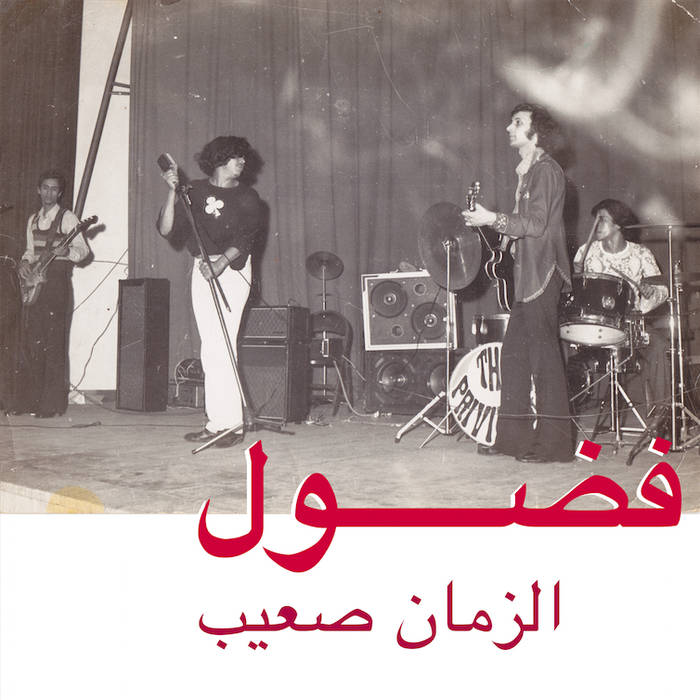
Recommended: Fadoul -- Moroccan funk from the 70s

Habibi Funk Records has tracked down the until-now obscure, and amazing funk recordings, of Fadoul et les Privilèges (sometimes spelled Fadaul et les Privilèges), and released them, on vinyl, CD, and download. You can listen to the tracks and read about them and order them here, on the Habibi Funk bandcamp site.

The recording has received a fair amount of press, and it is well deserved. Jannis Stürtz, who runs the label, describes the sound as "Arabic funk played with a punk attitude," and that seems pretty accurate. Even if the music was recorded before anyone in Morocco was imagining punk.

If/when you go to listen, I recommend starting with "Sid Redad," which is an Arabic cover of James Brown's "Papa's Got a Brand New Bag," and "Al Zman Saib," an Arabic cover of Free's "All Right Now." Then try "La Tiq Tiq Latiq," which is the Spencer Davis Group's "I'm A Man," in Arabic.

I was surprised by how "Al Zman Saib" (Times are tough, roughly) was rendered on the cover as الزمان صعيب as I would have thought that الزمان صعب was the correct spelling. But maybe that's how it is spelled in Moroccan colloquial?

Tuesday, December 23, 2014

recommended Middle Eastern music for your hols: Syria, North Africa, El Ghorba

More great stuff I've come across:

1. Sabri Mudallal (Moudallal), live in concert in Cologne (1988) and studio recordings (1989).


This two CD set is available to download here, courtesy the music blog Oriental Traditional Music from LPs & Cassettes. Sabri Moudallal (1918-2006) was one of the twentieth centuries most renowned singers hailing from Aleppo, Syria. He was both a muezzin and a singer of the distinctive Aleppo genre of music, the wasla 'suite.' He is probably best known outside of Syria as a vocalist with the al-Kindi Ensemble. Essential reading on Aleppo's music scene, including a discussion of Moudallal, is Jonathan Shannon's Among the Jasmine Trees Music and Modernity in Contemporary Syria.

2. A collection of recordings, courtesy the music blog Arab Tunes, by Cheikha Habiba Saghira dating from the seventies and eighties. Habiba Saghira is one of the great rai cheikhas. The set commences with the song "Nebghi Nechreb" (I want to drink). It concludes with "Yasker Ou Yebki" (He drinks and cries). You get the idea. I posted photos of a couple Habiba Saghira record jackets awhile back, here

3. Courtesy the music blog Phono Mundial, a mixtape of music of El Ghorba or exile, a "cassette" composed of two "sides" of Maghrebi music. Side A is a set of music, produced mostly in France, dating from post Algerian independence. Great tracks from the likes of Abranis, Doukkali and Mazouni. Side B is a bit more contemporary than Side B, with some great twist, yé-yé, rock'n'roll and Kabyle fusion, from the likes of Karoudji, Mazouni (again), and Rachid et Fathi. It also includes a song very dear to my heart, Bellemou's "Zerga ou Mesrara," with vocals from Hamani Tmouchenti, one of the original pop-rai songs. I've written about it previously here and here. (Phono Mundial claims the recording of this Bellemou track was done in Marseille. I wonder...) [Correction, December 30, 2014: apologies to Phono Mundial, who say the track was issued in Marseille, and not recorded there. So cool that it was issued there!]


4. Courtesy Jewish Morocco, a mixtape for Hanukkah (or any other holiday you like, in fact), titled "Mazal Haï Mazal: Eight North African Tracks to Light Your Soul On Fire." It is not free, it's $5, or more, if you'd care to donate to Jewish Morocco's digitalization project. You won't find these rare tracks elsewhere, by such renowned artists as Albert Suissa, Reinette l'Oranaise, and Zohra El Fassia. I'm particularly excited about getting my hands on a recording of  Blond-Blond's "La Bombe Atomique." Read more about this collection here.

Happy holiday listening!

Monday, October 06, 2014

El Haqed in Aljazeera

The Moroccan rapper, El Haqed, recently released from prison for the third time, published an opinion piece today (October 6) in Al Jazeera (English) -- it's translated from French and English by Mark Levine.

He writes:

In 2007, a new kind of rap began to spread, with roots in groups like H-Kayne who rapped about social but not quite political issues. It was authentic rap, not imitating anyone. These dangerous ideas led the system to try to shut us down, put us in a big prison so to speak, a prison for ideas and freedoms to try to hem in our dangerous ideas...
 
And so we called our rap ar-rab muhabsi - "prison rap" - rap that expresses reality and sings about freedom, breaking down the borders and chains. We need to understand the power of prison rap in the context of most rappers being little more than marionettes, wholesale puppets of power. You can count the number of truly political rappers on one hand. And yet, the small number makes our music that much more powerful. The intellectual and cultural prison only made our music more powerful. The state still doesn't get that.

I learned at a workshop this past weekend that, in fact, you can in fact count the number of Moroccan political rappers on one hand. In fact, there are three--El Haqed, Hoba Hoba Spirit, and Muslim--who truly support the Moroccan revolutionary movement. The rest, while they deal sometimes with social issues, scrupulously avoid politics.

Thank gods for El Haqed!

P.S. October 7. Hisham Aidi adds (via twitter) that perhaps there is one more 'revolutionary' Moroccan rapper: Sí Simo of Fez City Clan -- but he raps more about poverty than politics.

P.S. October 11. Please check out this article in Jadaliyaa (Oct. 7) by Jessica Rohan, on the Mawazine Festival. She provides a discussion of rappers, including El Haqed and Muslim, and their positioning in relation to pro-regime rap stars like Bigg and Cheikh Sar. And she provides a link to a song by Sí Simo called "Kilimini," a song about social inequality in Morocco. Rohan tells us that kilimini  man is a "recently-coined slang term for wealthy Moroccans." It literally means “he eats from me,” "suggesting the elite gained their wealth through corruption" and also connotating shallowness.

http://youtu.be/bEV0s0tWZ6E

Tuesday, August 26, 2014

More on 'Traitors': #women #punk #Morocco

Back in March I posted about the film Traitors, which deals with Moroccan women punkers. (And which I have not yet seen. I've since came across a couple more interesting sources.

1. An article about the film's star, Chaimae Ben Acha, in Brownbook.

Chaimae plays Malika, leader of an all-girl punk band in Tangier (she's in white in the photo below).


Ben Acha’s preparation for the role required her to cut her hair like Joan Jett, enrol in singing lessons and wear combat boots while off-set so as to acquire a rebellious strut. She admits that prior to the filming of ‘Traitors’, she had ‘nothing to do’ with rock music. ‘To sing rock ’n’ roll, you have to be hard-edged. It’s not feminine,’ she says.

2. And, another preview. Music sounds great. Can't wait to see it.

Saturday, August 16, 2014

Moroccan rapper L'Haqed (El Haqed/al-Haqed): two day hunger strike


Huffington Post Algérie reports that the rapper L'Haqed went launched a two day hunger strike on August 13, to protest against the humiliating treatment he is receiving in prison.

L'Haqed was sentenced to four months in prison on July 1, for "violence" against police and drunkenness. Completely bogus, trumped-up charges, as he has been the constant target of Moroccan authorities for the last two plus years due to his consistent, outspoken criticism of the regime.

Among L'Haqed's complaints about his treatment in prison: he has been unable to get the writing that he does out of prison, newspapers he receives are torn, he is not allowed to receive the music that he likes, and he is subject to humiliating body searches.

Update, August 23, 2014.

More on L'Haqed's conviction:

"Moroccan Dissident Rapper Sentenced," Project on Middle East Democracy (POMED)
"Morocco jails dissident rapper El-Haqed," Massoud Hayoun, AlJazeera America, July 1, 2014.

The Washington Post used to have a link up, under the title "Morocco rapper rebel gets 4 months in prison," but it has mysteriously vanished.


Tuesday, June 24, 2014

More (free) cool music: Moroccan Street; For Stuart Hall; Egyptian trip-hoppy Nadah El Zhazly; more mahraganat

 
1. Thanks to Tim Abdellah Fuson and his invaluable blog Moroccan Tape Stash, a link to samples from the Moroccan Field Recordings at the Pitt Rivers Museum. The recordings in question were made in 1961 by an Oxford University "expedition." And Tim does us the favor of describing and adding his own keen insights into these recordings.


2. Nabeel Zuberi, author of, among other things, Sounds English: Transnational Popular Music (2001, University of Illinois Press), has done a wonderful mixtape in tribute to the late Stuart Hall. As you would expect, it's very political, transnational Caribbean, etc. And illuminating -- I was not familiar with most of the material, except for Pete Rock & C.L. Smooth's "Good Life" and Linton Kwesi Johnson's "Reggae Fi' Peach." And I was familiar with some of the artists. And I loved these lines from a great track by Eddy Grant, "Living on the Front Line":
Me, no want nobodys money
There lord they sugar me no want to see
Me, no want to shoot Palestines
Oh I have land, oh I have mine

3. Thanks to Sherine for alerting me to this article in Mada Masr about Egyptian singer Nadah El Shazly, who I had never heard of. The article doesn't mention it, but the clear influence, at least as far as "Western" sources, seems to be trip-hop, of early to mid nineties vintage. Particularly on the songs "Shorbet Rosas" and "Ghaba." (Check them out on El Shazly's Soundcloud page.) They also remind me of the work of Lebanese group Soapkills (vocals, Yasmine Hamdan), who I think wore their trip-hop influences on their sleeve. There is more going on than that, of course, and El Shazly is capable of other sounds as well, as in her collaboration "Athar Nowaa" with Egyptian rapper El Rass.


4. And Cairo Liberation Front (who are Dutch) have a new mahraganat mixtape, available here. With music from Islam Chipsy and Sadat & Alaa Fifty Cent and more.

Enjoy.

Saturday, May 31, 2014

Interview with lawyer of El Haqed (Al Haqed/L7a9ed) + more


Freemuse's Daniel Brown (son of Kenneth Brown, editor of Mediterraneans/Méditerranéennes) interviewed Mohemed Messoudi, the lawyer of imprisoned Moroccan rapper El Haqed, on May 27 and a member of the Administrative Committee of the Moroccan Association for Human Rights. Here is some of what we learn:

Did El Haqed recently compose and release songs that could have angered the authorities?
“He has just released an album called Walou which means ‘Nothing’ (nothing has changed in the fields of justice, education, democracy, there is too much corruption and we are living under a dictatorship, with torture, etc…). The presentation (sic) of the album has already been banned by the Moroccan authorities. There has also been several of Haqed’s concerts that have been vetoed.”

How would you describe the current situation for musicians in Morocco?
“It’s simple: If you sing for the governors and the statesmen you are given the support that you need – money, publicity and the possibility of performing at festivals and on stage. You can even be decorated. If you take the opposite stance and dare criticise the current political, economic and social situation in the country, you run the risk of going to prison and you are banned from playing or appearing in any (official) media.”

....
...can this album [Walou] can be found in stores?
“No, you can not find this album in stores in Morocco, as Haqed criticizes the Moroccan political system, no distributor agrees to cooperate with him, the only option is direct sale to people who are interested in his music and also via social networks facebook youtube, and so on, and yes, there were sales using its own means.”

NOTE: go here, on Youtube, for the song "Walou," and it will lead you to all the other songs on the album. Nearly 71,000 views of the song. Let's bump those numbers up!]

...
What is the popularity of El Haqed?
“Considering he is banned by all media and official festivals because of his activism and political positions, EL Haqed finds his popularity via social media. His songs are listened to by thousands of people on Youtube. His first arrest was adopted by Amnesty International and several  international and national human rights associations.”

....
What are the political views of Haqed?
“He criticizes the corruption, which reigns the political, economic and social life. Considering his reputation and sincerity to the Moroccan people – his voice and his songs disturb authorities more and more.”

*******
Here is a link to a petition to sign in support of El Haqed.

When the interview was done El Haqed was scheduled to appear before the court for a hearing on May 29. Facebook connections now say that it has been rescheduled for June 6. [Update, a few minutes after the original post: Mark Levine notes that the postponement means that El Haqed conveniently will be kept out of public view until the Mawazine festival (see below) is almost over.}

At his first court hearing (he was arrested May 18) he is reported to have said to the judge "Prison won't make me cry. I am free wherever I am. What makes me weep is the plight of the [Moroccan] people."

Meanwhile, international artists like Justin Timberlake, Ne-Yo, Alicia Keys, IAM and Robert Plant are appearing at Mawazine, the state-sponsored festival in Rabat, from May 30 to June 7. There has been a campaign to get at least some of these artists to at least say something in solidarity with El Haqed, but to date I've heard nothing of such a response. If it were Russia and Pussy Riot, of course, there would be a big international fuss. But even the most progressive artists (seriously, IAM!) seem to think that the makhzen is "moderate" and so shouldn't be criticized. The not so progressive I guess are just happy to get the pay check. 

It is not of course El Haqed who is the target of state repression. According to this report from ABC on May 29, 

Morocco's most prominent independent rights group, the Moroccan Association for Human Rights, has been sounding the alarm since March, saying that many of its young activists around the country face police intimidation.

Veteran activist Samira Kinani cited the case of Oussama Housne, a 22-year-old activist who, in a video posted online, said he was snatched by three men, beaten and tortured.

Last month, police arrested 11 young activists who had joined a large labor union demonstration and chanted anti-monarchy slogans, later sentencing them to up to a year in prison for illegally protesting and attacking police.

"It is a campaign of repression against the weakest young members of the February 20 movement," said Kinani. "Unlike us they did not live through the dark period of King Hassan II and they aren't scared to express their opinions against the king for example, so I think they are trying to scare them into quitting activist circles."

My previous post on El Haqed, with details on his arrest, is here.

Monday, May 19, 2014

Moroccan Rapper Al Haqed (El Haqed/L7a9ed) Arrested Again


Yesterday, May 18, the Moroccan rapper Al Haqed (Mouad Belghouat) and a group of his friends approached by police while about to enter the Casablanca soccer stadium to see a match. The cops targeted Al Haqed, accused him of buying tickets on the black market, and proceeded to beat up him and his brother.

According to the blog of Zineb Belmkaddem, the source for this information, the day before Al Haqed put up a post on Facebook "mocking the fact that the King was going to perform Friday’s Jumuah prayer, and on his way there, a traditional music group was playing. In Islam, this would be highly disrespectful given the spiritual solemnity of Jumuah prayer, and an even bigger mistake to be made by the ‘Commander of the Faithful’ who claims part of the legitimacy of his rule from his religious status." 

Who knows whether the arrest is linked to the post, but it no doubt has everything to do with the fact that Al Haqed refuses to shut up about the repressive acts of the Moroccan government, the makhzen.

Al Haqed was supposed to appear before a judge today.

I've posted about Al Haqed and his problems with the Moroccan authorities a few times in the past. And I've also ranted about the fact that Pussy Riot gets so much support and attention in the West, and especially from US artists, while almost no one seems to care about Al Haqed. Consider this another rant.

Videos of Al Haqed's most famous song "Klab al-dawla" or "The Dogs of the State" keep getting shut down. Here's another link to it.

Friday, March 21, 2014

The film "Traitors": women, punk, Morocco


Traitors (dir. Sean Gullette) has been on the festival circuit for a couple years. It looks, based on the reviews and the available trailers, to be a good one. I was alerted to it by Joobin Bekhrad's review in REORIENT, which also features one of the trailers. The latter features the lead, Malika, and her all-female Moroccan punk band doing a version of The Clash's "I'm So Bored with the USA," in Arabic, but with the chorus, "I'm so bored with Mo-ro-cco" sung in English.

Among other things, Bekhrad writes, "Gullette’s film appears to be one centred around the power and allure of rock music, particularly in a North African context; however, as it progresses, it also comes to provide a powerful social commentary on the current generation of Morocco’s youth and their hopes, aspirations, frustrations, dilemmas, and anxieties, evoking at times a mood similar to that prevalent in earlier films such as Fatih Akin’s Head On..." If it's anything like Head On I it should be worth watching. We can only hope.

(I liked Bekhrad's review but it was marred by a move that everyone writing in English about Middle Eastern pop music seems to make, which is "clever" puns. A couple examples: "stuck between Maroc and a hard place" and "Maroc and roll, baby." Er, enough.)

Here's another clip from the film:


And some more info:

"Features original songs sung by its riveting star Chaimae Ben Acha [who plays Malika, the leader of a Tangier punk band], and new music from much-hyped all-female bands Savages and Talk Normal." (I've not been able to find any of their music, however.)

Here's an interview with the director, published in Variety. Where we learn, among other things, that the film was funded with a grant from the Sharjah Art Foundation.

And, a review in The Hollywood Reporter, quite positive.


Saturday, March 01, 2014

Yasmine Hamdan, "Beirut" (from the forthcoming album)

Back in 2012, I posted (on one of my other blogs, mepop) about Yasmine Hamdan's self-titled album, released in Lebanon and France in 2012, and the song "Beirut" from the album.  Here is the video that came out at that time.


The lyrics were posted as well, which I've copied below.

بيروت
شرب العرق
 شرب العرق
 لعب الورق
 خيل السبق
 صيد الحمام
 رسمال بيروت

 لبس الغوى
 شم الهوى
 اكل الهوى
 شاغل عقول
 سكان بيروت

 بيروت
 زهرة من غير أوانها
 بيروت
محلاها ومحلا زمانها
 بيروت
 يا حينها وياضيعانها
 تدبل

 ما في عمل
 ما في امل
 برك الجمل
 ركب النحس
 تجار بيروت

 الغندرة
 والفنغرة
 والبهورة
كتر البطر
 هالك بيروت

Beirut
Arak drinkin'

Card playin'
Racehorse cheerin'

Pigeon huntin'

The essence of Beirut

Seduction crowd

Cruisin' around
Foolin' about

Tis' all there is on the minds
Of the citizens of Beirut

Beirut

A flower off its terrain

Beirut
Oh her beauty, her good old days

Beirut

That dire end, all a waste

Withering

All unemployed
Hopeless
Ruined and rusted
Jinxed and accursed
Those dealers of Beirut

Oh the strutting
That fancy livin'
Excess of splurging
Exploded vanity
Smothering Beirut

Now, finally, the album (under the title Ya Nass) is being released in the US, on March 25, from the Crammed Discs label. Why the wait? Who knows? Why now? Maybe to coincide with the appearance of Yasmine in Jim Jarmusch's film Only Lovers Left Alive, which I posted about a couple weeks ago.

Here's some promo about the "new" album. In it we learn that the lyrics to "Beirut" were adapted from a poem written in the 1940s by poet Omar El Zenni. And there is new video, about which the promo tells us: "Yasmine Hamdan and her director Nadim Asfar used footage from super 8 films which were purchased in a Lebanese souk by one of Yasmine's friends, who collects them. These films were shot in various eras (from the 40s to the 70s), and are bringing these bygone times back to life." Check it out. If you've lived in Beirut, like I have, you will really like that super 8 footage.


We also learn from the promo that the song "Hal" from the album which is not on the French/Lebanese version, and this is the song that Yasmine does in the Jarmusch film. You can check it out here.

The very sharp observer Hammer commented on my earlier post. He has seen the movie, he doesn't think much of Yasmine's singing (I don't agree but I understand why he is critical). Here's what he says about the song: "The whole gig is a way to ride a now-defunct wave of using qaraqeb in pop music. [i.e. it incorporates Gnawa percussion]. Her song which she sang is not a song actually: It's a medley of words taken from old, '40s songs that most Arabs still hum and sing. The anachronistic twist is that, most Moroccans do not sing these songs or maybe know of them, as their musical tastes veer off into the malhoun and the ever-present chaabi." 

That is to say, the scene where she sings is set in Tangier, but she isn't singing Moroccan music. Unfortunately, you can't ever imagine that US directors like Jarmusch would ever care about such things. He heard Yasmine's music, he met her, she's an Arab...you know.

Here is the list of songs on the album, via iTunes. This is what the cover looks like:


 And here's the cover of the 2012 album. 


And here's more about Yasmine and the Lebanese album, from Kwaidan Records. 

I can't find a tracklist online right now for the 2012 version, so here it is: 

1. In Kan Fouadi          
2. Beirut      
3. Samar       
4. Baaden           
5. Ya Nass        
6. Irss       
7. Nediya       
8. Nag          
9. Shouei       
10. La Mouch       
11. Bala Tantanat         
 
You can check out the song "Deny" here (not on album 1). Also "Khalas" (not on album 1) here. "Samar," on album one, and two, here. "In Kan Fouadi," on one and two here.

Monday, December 30, 2013

Maya Casabianca

I recently ran across an article in Haaretz by Daphna Lewy, published on September 13, 2001, about the Moroccan Jewish (and Israeli citizen) singer Maya Casabianca. Maya is interesting for several reasons. First, she was something of a star in France during the 1960s. Second, she carried on a love affair with Farid Al-Atrash (the singer-'udist-actor, born in Syria but whose career was made in Egypt, brother of Asmahan) during the last four years of his life (he died in 1974).

Maya was born Margalit Azran in Casablanca in 1945 (I believe) and emigrated to Israel with her aunt and uncle in 1948, while her parents went to Paris. Her aunt and uncle, it seems, weren't able to adapt to life in Israel, so when she was 11 (1956) the family moved to Paris and she was reunited with her parents. She was discovered by a neighbor who worked for the Philips recording company, and she was signed by Philips under the name Maya Casabianca and was a sensation in France by the late fifties. (The name evokes Casablanca without actually being Moroccan. No doubt in order to lend her a bit of Mediterranean exotica but at the same to disguise her Arabness.) Philips aimed to groom her as a teen successor or even rival to Dalida, and they were at least in part successful. Her total record sales, according to the Haaretz article, were 38 million. Like Dalida, and like so many of France's pop stars of the era who were "Mediterranean," she sang in French and Spanish. But she certainly is not remembered today anywhere near as reverentially as is Dalida. 
 

I don't know what her big hits were in France, but I note that she did a version of "Zoubisou Bisou," originally made popular in France by Gillian Hills and of course famously revived when Megan performed it for Don in Mad Men. Maya's is perfectly decent, as you can hear here.

She also covered Little Anthony and the Imperials' 1959 hit, "Shimmy Shimmy Ko-Ko-Bop," as 
"Cherie Cherie Je Reviens." Check it out here.

But I think this song, "El Matador," is more representative of what she became famous for, and the video gives us a chance to see her performing on television.


Casabianca reportedly met Farid Al-Atrash at the first party that Philips put on in her honor, and he pursued her, sending a limo to pick her up on her first trip to Beirut to sing in concert, and it took her to his luxurious palace. They were friends for several years and eventually, for four years, lovers, splitting up shortly before he died. (I am told by someone who is connected that his family denies the story.)

 Maya and Farid

Farid al-Atrash reportedly encouraged her to record Sephardic songs (but I haven't found any) and also to adapt some of his songs. The best known of these is her version of his famous "Ya Gamil, Ya Gamil," which you can listen to here.

Here's Farid's original.

Eventually (and I'm not sure when -- in the late 70s?) Maya returned to Israel and mostly lived off the royalties of her hits. But she did record an album of Farid al-Atrash songs, including "Ya Gamil, Ya Gamil." Here's the cassette jacket.


Maya also wrote a book, published in 2001, about her career and her time with Farid, under the Hebrew title Ani Vehu ("He and I"), and it also appeared in Arabic, issued by the Arabic culture department of the Israeli Ministry of Science, Culture and Sport.

If you understand Hebrew (and I don't), here's a report on her from Israeli TV.

Friday, December 27, 2013

Cafe Gibraltar mix from Maor Anava, with Jasmin & Acher Almagribi, Raymonde, and Koko

Café Gibraltar, from the progressive Israeli online publication 972 Magazine, often presents some nice mixes. I particularly liked the first three tracks on this recent mix ("Sounds from the Other Israel") from Israeli DJ Maor Anava, whose father is Syrian (Aleppo) and whose grandmother was Moroccan. He was one of the founders of Fortuna Records, whose project is to put out rare psychedelic Middle Eastern and Israeli recordings. You can listen to some of their stuff here, including a sample of their first release, by Grazia. And you can check out a podcast that Zack from Fortuna did for Gilles Peterson World Wide here. (It has some Cheikh Mwijo and some Omar Khorshid, so it's worth a listen.)

The first track (after an introduction) is a great one, "Loumina" from Jasmin and Acher Almagribi. I really like Jasmin's voice. I can't find anything about them, but there are a number of recordings of Acher up on youtube. I particularly liked this one, a live performance of "Mahani Zine," a song made popular originally (I believe) by Sami Halali.


The electric guitar is great here. Comments suggest that the more common English spelling of this singer is El Maghribi, and that this is recorded in Morocco but that Acher is now based in Israel.

The second track is "Ash Blani Bik Tah Blitini" from Raymonde. This is Raymonde El Bidaouia, born in Casablanca in 1943, emigrated to Israel with her family in 1952, and who recorded in Israel but was also very popular back in Morocco. She gets a great writeup from Jewish Morocco here.

Here she is doing "Chouf Ghero," a really terrific song.


It was also a hit for the great Najat Aatabou, and appears (spelled "Shouffi Rhirou") on her 1991 release for Global Style, The Voice of the Atlas, and also, as "Go Find Another Guy (Shoufi Ghirou)," on her 1997 Rounder recording, Country Girls and City Women. Here's a great live recording of Najat Aatabou doing the song on Beur TV. 3 Mustaphas 3 covered quite decently on their first album (1987), Shopping. I don't know when Najat first recorded it, but presumably it was before 1987, when 3 Mustaphas 3 got their hands on it. And I assume that Najat was covering an original by Raymonde.

Finally, there is "Echo Capsses" from Koko. I have no idea who Koko is but I love the song, especially the Greek style guitar. Listen to it here. This is typical "Israeli Mediterranean Music," the hybrid musical genre created by Israeli Mizrahis. It's typical because when it was still on the margins -- the sixties through the eighties -- it was not really acceptable for it to sound too "Eastern," i.e., Arab, and so a Greek sound was a way to be acceptably, sort of, Eastern. You can read all about the genre in Amy Horowitz's great book, Mediterranean Israeli Music and the Politics of the Aesthetic

Finally, check out the website of Victor Kiswell, which is where Maor Anava acquires a lot of his rare music. Click on the Arabic Oriental link and you will find all sorts of amazing stuff. If you are like me you will find the prices a bit rich for your taste, but it's a way to find out about rare recordings that you will not know about. I plan to introduce some here in future.

Sunday, December 15, 2013

Mandela Morocco/Algeria postscript

I posted a photo of Nelson Mandela in a kufiya on December 21, 2012. He was wearing it Algiers, which he visited in May 1990 to see his former FLN contacts, who gave him and his comrade Robert Resha (d. 1974) military training in Morocco in March-April 1962.

Since Mandela's death this photo of him in Oujda, Morocco in March 1962 has been circulating a lot.


Mandela is in the second row, wearing shades. The man in front of him, in the brown sports jacket, is Ahmed Ben Bella, first President of Algeria, from 1963-65. He was deposed by the man with the mustache, wearing a tie and a light overcoat, Houari Boumedienne, who served as Chair of Algeria's Revolutionary Council from June 1965 to December 1976, and from then until December 1978 as Algeria's second President. (It may be Amilcar Cabral of the PAIGC standing between Boumedienne and Ben Bella.)

(As an aside, I'm glad that Mandela and the ANC did not adopt the policy toward Jewish South Africans that the FLN took toward Jewish Algerians.)

Mandela stated, on his arrival in Algeria on a state visit in 1990 that "it was the Algerian army [i.e., the Algerian Liberation Army] that made him a man."


Here's a photo of Mandela (center), his ANC comrade Robert Resha, and his trainer Mohamed Lamari. (For some reason several Algerian sources identify Resha mistakenly as Hamilcar [sic] Cabral. Amilcar Cabral was the leader of the Guinea-Bissau and Cape Verde national movement for independence, the PAIGC.) Lt. Gen. Lamari was part of the officer corps that overthrew Algerian President Chadli Benjadid in 1992, and he became the army Chief of Staff in 1993, a position he held until 2004. That is, he was the head military man during the bloody Algerian civil war. As head of the army, and as an "eradicationist," that is, someone who rejected any negotiation with the Islamist opposition. No doubt he was responsible for numerous war crimes.

Read more about Mandela and Algeria here (in French).

Sunday, December 08, 2013

Robert Crumb plays his North African 78s

The iconic cartoonist R. Crumb is well-known as a collector of 78s, many of which he has picked up during his residence in southern France, where he has lived since 1993. (He owns around 5,000 of them.)

He has appeared a number of times over the last year on John's Old Time Radio Show, most recently to play a number of 78s in his collection recorded by North African musicians.

It's really an amazing show, and the music quite remarkable. I was quite surprised at how good those old 78 rpms sounded. I highly recommend that you download the podcast and listen repeatedly.

Some of the artists on the session are quite well known, such as the Jewish-Arab singer Habiba Msika from Tunisia, about whom I recently posted. (Unfortunately, the track is not identified, presumably because the title is written in Arabic on the album label. I urge you to post a comment, asking that R. Crumb post photos of the labels of the songs in question, so that those of us who read Arabic can identify the songs.)

There is the great Morrocan singer Hocine Slaoui, who recorded the famous song “Dakhlau Al-Merikani” (The Coming of the Americans), a comment on the arrival of Allied Troops in North Africa in 1942. It includes the recurring refrain in English, “All I hear is ‘Ok, Ok. C’mon. Bye-bye.’” (It's also known as "El Marikan Ain Zerka" (The American with the blue eye)). Check it out here.

And there is the celebrated violinist Sami Shawa, who was born in Syria but whose career was in Cairo, who was known both for his solo recordings (here is his "Taqsim Hijaz") and also for his work with great singers like Umm Kalthoum.

And according to JewishMorocco, there are two other Tunisian Jewish singers on the set, besides Habiba Msika: Fritna Darmon (here's another track from her) and Asher Mizrahi.

The rest of the artists, I've been unable to track down any information about.

R. Crumb put out a collection in 2003 called Hot Women: Women Singers from the Torrid Regions of the World, with tracks culled from his 78s collection. (He airs his rather antediluvian geographical theories about what produces "hot" music on the radio show as well.)
It contains three tracks from North Africa: (1) "Guenene Tini" by Cheikha Tetma (1930). Cheikha Tetma was a singer and 'ud player from Tlemcen, Algeria, who performed in the hawzi genre, the brand of Andalusian music specific to Tlemcen. Listen here. (2) "Khraïfi" by Aïcha Relizania (1938): listen here). I know nothing about her, but the name indicates that she was from Rélizane (Arabic, Ghalīzān), a village of European colonizers in the Oran region of Algeria. It's the same town that rai star Cheikha Rimitti (who originally recorded as Cheikha Remitti Relizania) grew up in. (3) "Yama N'Chauf Haja Tegennen" by Julie Marsellaise (1929). Again, I have no information about her, other than that she is from Tunisia, and I've not yet heard the song in question, but here's another recording by her, "Ya Helaouet el-Clap." (The video for that song shows the record in question, and it appears that her full name might be Julie Marsellaise Mahieddine.)

[Correction added December 9, 2013, thanks to Chris Silver (see comments below). Julie Marsellaise should be spelled Marseillaise -- the misspelling is from the Crumb collection, and is no doubt what is written on the record label. She got her name (and is also known as Julie La Marseillaise) from a stint she did at the Alcazar Theater in Marseille. No surprise, there was lots of cultural traffic, then and now, between North Africa and France. Julie's family name was Abitbol, and her daughter Ninette Abitbol was married in 1941 to the great Tunisian singer, oudist, and composer, Hédi Jouini. Ninette was a singer and dancer in her own right, who took the stage name of Widad. (Jouini, born Hédi Belhassine, has been called the "Frank Sinatra" of the Arab World, and his granddaughter Claire Belhassine has recently made a film about him called "Papa Hedi.") 

The "Mahieddine" that I saw on the Julie Marseillaise record label refers to the great Algerian singer and actor Mahieddine Bachetarzi, who also managed many acts.]

Let's pray that another collection, devoted to music of North Africa, is forthcoming. It would be great if an expert on North African music could be hired to work on the notes!

Wednesday, November 06, 2013

Satanism, West and East

Dangerous Minds has recently been reporting on US hysteria over Satanism (I guess it's a Halloween season theme)? One of them is on a 1970 film, in the pseudo-documentary/ethnographic Mondo Cane vein, called Witchcraft '70. The other is about an evangelical preacher, Dr. Jerry Johnston, and a video he is in that dates from the late 1980s.

In both cases it is all moral panic: Satanism and animal sacrifice, human sacrifice, ritualistic sex, drug use and abuse, desecration of Christian symbols, and so on. In Witchcraft '70, it's hippies who are the focus, and we see nude hippy Satanists doing hallucinogenic drugs and a ritual that involves the violation of nubile young women. In the Johnston vid it is heavy metal music that is associated with the evils of Satanism. In both instances, Satanism is presented as a danger that threatens young people, and urges more sober adults to be on the look-out for the warning signs.

I presented a paper at the American Anthropological Association meetings in 2000 on the 1997 crackdown on Satanic heavy-metal fans in Egypt. I've never published the paper, but you can read an account of it here.

Below is a photo of one of several popular exposés of Satanism that I found in Cairo in summer 2000. This one is entitled: Satan Worship: Rituals of Sex and Blood.


As I am considering reworking the paper for eventual publication, I find it interesting to what degree the 1997 panic over heavy metal Satanism in Egypt (and another, much less hysterical one in 2012), Morocco in 2003, Lebanon in 1996-98 and 2002, and 2012, among others, have their ideological origins in the various panics over Satanism (probably dating from the late sixties) in the US. The discourse, East and West, is remarkably similar, as are the themes and motifs.

The big difference, of course, is that in the case of the US, the danger is internal, whereas in the Arab World, the danger is presented as external: Satanism is an alien, Western, sometimes Zionist, threat.

(Some of these issues are also discussed, of course, in Mark Levine's Heavy Metal Islam.)

More, inshallah, later.

P.S. added 11/11/13: I just came across this source on Egypt's heavy metal, which I've not yet read (but I just ordered the book on Interlibrary Loan): Benjamin J. Harbert, "Noise and its Formless Shadows: Egypt's Extreme Metal as Avant-Garde Nafas Dawsha," in Thomas Burkhalter et al, eds.,  The Arab Avant-Garde: Music, Politics, Modernity, Wesleyan University Press. (The book comes out this Wednesday!)