Showing posts with label Islam. Show all posts

Friday, February 10, 2023

Forthcoming book chapter: Rai, World Music, and Islam

Very honored to have been asked to contribute to this great volume, to be published, inshallah, in October. Look for it! My chapter is entitled: "Rai, World Music, and Islam." More details here.


Friday, January 15, 2016

David Bowie was many things, and among them, he was married to a Muslim

Aki Nawaz (of Fun'Da'Mental) posted this photo of the late David Bowie on Facebook yesterday (January 14).


It's David's wedding (1992) to Iman Mohamed Abdulmajid, daughter of Marian and Mohamed Abdulmajid, all shown here. Aki states that he had not seen any condolences to Iman on social media, and so he wrote, 'for what it's worth and respectfully in the traditional religious manner we say "From God we come and return" and may your pain and loss be bearable to all the family.'

I found this incredibly moving, both to be reminded that Bowie, besides being all the other incredible things that he was, which so many great articles and posts have told us over the past few days, was also a married man, and, yes, was married into a Muslim family. 

Some folks objected to Aki's post saying, she wasn't an observant Muslim, she posed for Playboy, etc. On the other hand, I've never seen evidence that Iman ever publicly abandoned or criticized her faith. I'm not a Muslim myself, but I'd say that, from the Muslim perspective as I would want to understand it, it is up to God to judge Iman and not us, and therefore, Aki's condolences seem entirely appropriate. 

As an aside, Aki's post impelled me to do a bit of reading, and I have learned that Iman's father was a Somali diplomat and her mother a gynecologist, and that Iman attended high school in Egypt and speaks (apparently) Arabic.

And as for David Bowie, allah yarhamu.

Sunday, May 24, 2015

The 'rai rebel' Cheikha Rimitti was also a 'hadja'


The typical bio of the great rai artist Cheikha Rimitti will almost invariably label her as a "rebel," as the well-informed music journalist John Pareles does in his New York Times obituary of May 28, 2006. Also typical is an account of how she got her name -- which had to do with drinking -- and how, in a song recorded in 1954, Rimitti challenged sexual taboos regarding virginity for unmarried women. Pareles raises these two issues, as does almost everyone else. In an earlier post, I've tried to problematize, or at least complicate, both these stories.

The discourse surrounding Rimitti is consistent with the usual world music accounts of rai music, which stress its "rebel" quality and tend to emphasize the antagonism between the rai rebels and Islam.

To his credit, Pareles' obit does (as do many other accounts) acknowledge that Rimitti made the hajj to Mecca in 1976 (some say 1975) and that as a consequence she gave up drinking and smoking. She did not, however, give up performing, and her songs continued to be "edgy" when it came to the subjects of women and sex. I do not have the space to elaborate here, but it should be asserted that there is no necessary inherent contradiction between being a believing Muslim and singing in public about women's issues, including sexuality. (Unless, of course, one believes that salafist Wahhabis get to define what "real" Islam is.) The key source to consult on these issues, when it comes to rai, is Marie Virolle's La chanson raï.

When I visited the Barbès district of Paris in summer 1992, I found this cassette in one of the many cassette shops selling vast quantities of rai tapes. It's the only recording I've ever seen where Rimitti is called "Hadja" rather than "Cheikha."

The tracks are: "Sidi Bouabdala" (I presume this is the name of a saint); "Ya Mohamed Ya Rassoul" (O Mohamed O Prophet); "Sinia Halouha"; Hamra Ou Baida (Red and White); "Haoulih Ya Zerga"; and "Ya Oulidi Ouankhaf Aalik."

As far as I can tell "Ya Mohamed Ya Rassoul" is the only track that is unambiguously "religious," but of course, to do such a set of songs and include a song in praise of the Prophet Mohamed was a way of making the other material (if it does indeed deal with "secular" concerns like male-female relations) socially acceptable. (Virolle has written about how [Cheb] Khaled has used the same mechanism as a strategy. He typically used the song "Salu' 'ala al-Nabi" (Praise the Prophet) to open or close concerts in Algeria during the eighties, as a means of making his other material, dealing with, say, alcohol and dancing, acceptable.)

Sunday, July 22, 2012

Heavy Metal (Anti-)Islam


On July 11, The Atlantic published a piece on its website by Kim Kelly, entitled "When Black Metal's Anti-Religious Message Gets Turned on Islam." The article begins by describing a track called "Burn the Pages of Quran" by a female-fronted heavy metal band from Iraq called Janaza. It also describes the metal band Seeds Of Iblis (Iblis = Satan in Arabic), fronted by Anahita, the same woman who fronts Janaza, which has released an EP entitled Jihad Against Islam. Two other bands mentioned in this camp of "blasphemers" are Damaar and Ayat, both from Lebanon.

Kelly concludes by describing Anahita and her projects in quite laudatory terms:

In a scene revered and reviled for its commitment to darkness and blasphemy, it's nevertheless rare to encounter musicians who are, quite literally, willing to die for their art. Anahita's message is controversial, but it also comes with sobering, almost-jarring humanity. As her one-woman war against Islam rages on, her deepest desire seems to be for peace—or at least, for understanding. 

"The goals of Janaza and Seeds Of Iblis are to show the world that Islam is dangerous," she said, "and even the people who live in the Middle East get hurt by this religion and seek for freedom of speech, just like the other people from all over the world."

Only two days later Hetal, writing for Metalluminati exposed Janaza as a (probable) hoax. The artists hide behind fake, re-purposed photos. They only communicate with journalists via Facebook. Their stories don't add up.

In fact, the whole notion that there is something called The Arabic Anti-Islamic Legion (The Atlantic for some reason renders "legion" as "league") seems to me highly suspect. On the one hand, the very existence of such a "legion" seems like a wet dream designed to appeal to Westerners (metal fans and non-metal fans alike) on the lookout for local critics of "Islam" with whom to sympathize (cf. Hirsi Ali). Better yet if these Arab or Middle Eastern critics are motivated by their embrace of a Western popular culture form. Isn't it cool and awesome that they are using metal to blast the bejesus out of that awful and threatening doctrine of "Islam." On the other, the whole thing seems like a propaganda gift to local forces who are always on the lookout for immoral, anti-religious behaviors by Arab or Middle Eastern youth who have been corrupted by various forms of Western popular culture (cf. "moral panics" in Egypt [1997], Morocco [2003] and Lebanon [2002-3] against "Satanic" heavy metal). The metal scenes in Egypt, Morocco, and Lebanon have bounced back from the early attacks, but witch hunts keep occurring, as Beth Winegarner writes in an article for PopMatters in June. (And see, of course, Mark Levine's book, Heavy Metal Islam.)

My guess is that the perpetrators of the hoax are Western metal heads, not Arab ones. They may have been successful in creating a ruckus, and the music is pretty decent -- but they have, wittingly or not, probably done more harm to the Arab and Middle Eastern metal scene that they claim to be a part of. Too bad that The Atlantic also, irresponsibly, played along and gave the "Arabic Anti-Islamic Legion" even more publicity.

Thursday, May 31, 2012

“Taqwacore is dead. Long live Taqwacore”

Siddharta Mitter, writing for MTV Iggy, brilliantly assesses the history and future (if any) of Taqwacore, frequently mis-identified as "Muslim Punk." (But -- how would you identify it?)

...whether Taqwacore is dead or has simply mutated, the intersection of Islam, among other brown identities, and music will remain busy and vibrant so long as there are youth around to rebel against the boxes that confine them. 


“No one wants to be pigeonholed,” [Omar] Majeed says. “Taqwacore itself was a reaction against being labeled—as Muslim, brown, too religious, not religious enough. Now people are doing new things with the moniker. That’s happening, and that’s good.”

Sunday, November 06, 2011

Hishaam Aidi on US attempts to use hip hop as a foreign policy tool and US media's over-estimation of the role of hip hop in the Arab Spring

Please see this piece from Al Jazeera English by Hishaam Aidi, Columbia University, on hip-hop in US diplomacy. One of the points Aidi makes, which is also one of my peeves of late, is that 'the role of music should not be exaggerated: Hip hop did not cause the Arab revolts any more than Twitter or Facebook did. the countries in the region with the most vibrant hip hop scenes, Morocco and Algeria, have not seen revolts. Western journalists' focus on hip hop - like their fixation on Facebook and Twitter - seems partly because, in their eyes, a taste for hip hop among young Muslims is a sign of moderation, modernity, even "an embrace of the US."'

Thank you, Hishaam!

Here is a typical report, by Karl Bostic of NBC News, entitled "How Rap Fueled the Revolution." (It's not dated, but was broadcast in early September 2011, I believe.)


It claims, "Rap music has become the soundtrack of the revolution, and the symbol of resistance." I'm pretty unconvinced by a lot of what Bostic asserts. He presents two rather unimpressive Libyan rappers, who rhyme in English, and claims that Libyan rebels were going into battle inspired by local rap. The so-called "rapper" from Hama, Syria, who did the popular song "Come On Bashar, Leave," was not really a hip-hop artist, contrary to what Bostic states, but rather chanted, in traditional style, to a debke beat. (See Anthony Shadid's report on this song, and how the person who performed it, Ibrahim Qashoush, had his throat cut shortly thereafter, here.) Bostic does at least show that the person he says is Syria's most popular rapper, Murder Eyez, supports the Bashar regime, and that rap's appeal in Yemen is limited. It is true that rappers like Egypt's Deeb were active during the uprising centered at Tahrir in January and February, but I believe that he was of lesser importance in these events than artists working in other musical genres. I believe the only place where hip hop truly played a significant role was in Tunisia, and in particular, the rapper El General and his song "Rais el-Bled."

Hishaam also raises all kinds of important questions about hip hop cultural diplomacy. For a more in-depth look at the issues of race, hip hop, Islam, and foreign policy, please see Hishaam's recent article in Middle East Report (Fall 2012), "The Grand (Hip-Hop) Chessboard: Race, Rap and Raison d'Etat."

Saturday, May 21, 2011

Kufiya and some Islamic refs in Digable Planets' "Where I'm From"


"Where I'm From" is off of Digable Planet's first album, Reachin' (A New Refutation of Time and Space), released in 1993. The best known single from the album is "Rebirth of Slick (Cool Like Dat)," a Grammy winner for best rap performance by a duo or group, and a crossover hit. Due to the album's jazzy feel and its apparently pop and light feel, the group was hailed by white hipsters and, as a consequence, got a reputation for being the opposite of hard and "street." A look at the video for "Where I'm From," which is all "street" scenes, and an investigation of the lyrics reveal that this impression was quite mistaken, and that there was a great deal of continuity between Reachin' (A New Refutation of Time and Space) and their second, much more overtly political album, Blowout Comb.

What I want to point out here are a few "Islamic" references. The kufiya worn by one of the Digable's posse in the video is one. As is the shot of some members of the Nation of Islam (NOI), including a woman in distinctive NOI dress (on left) and the man in bowtie, who looks like a member of NOI's paramilitary organization, Fruit of Islam. (Ladybug, a.k.a. Ladybug Mecca, is at the right.)


One line from Butterfly, whose influences seem not to drawn from any Islamic sources, goes "We be reading Marx where I'm from."

Meanwhile, one of Doodlebug's lines goes, "That's most asked by 85, where I'm from." This is a reference to the beliefs of the Nation of Gods and Earths (Five Percenters), that the world is divided into the 5%, those with knowledge of self, the poor righteous teachers, the "gods," the 10%, the bloodsuckers of the poor, who teach lies for the sake of personal gain, and the 85%, the masses, the people who are ignorant of the truth -- but to whom the 5% attempt to bring true knowledge.

Doodlebug (Craig Irving) hung out with Five Percenters while a student at Howard University. I don't know whether he considers himself to be a full-fledged "God," but he now goes by the name Cee Knowledge -- a very Five Percenter sounding name -- and tours with a group called Cee Knowledge & the Cosmic Funk Orchestra. The Digables' second album, Blowout Comb, is full of Five Percenter wisdom and references.

As for Butterfly (Ishmael Butler), his terrific, experimental-rap musical project Shabazz Palaces references the name of the ancient tribe that, according to NOI doctrine, settled in Mecca and then was led by a scientist, named Shabazz, into Africa. It was also the surname adopted by Malcolm X.

Shabazz Palaces' first performance in Seattle (where Butler is from) earlier this month certainly played up the Afro-Islamic imagery. Check out how Butler/Butterfly, who goes by the moniker Palaceer Lazaro, was decked out.


This was the poster for the show.


And check out the cover of Shabazz Palaces' 2009 album, Of Light.


My last example of Shabazz Palaces' crypto-Islamic references is from the group's 2009 video, "Bellhaven Meridian," directed by Kahlil Joseph, shot in Watts, which is a kind of tribute to Charles Burnett's film Killer of Sheep.

In this video the Arabic word
ينقذنا
appears at 0:36. It means "he saves us." I have no idea how it fits into the theme of the video.


Shabazz Palaces has recently been signed by Sub Pop, the first rap group the Seattle label has ever signed, and has an album called Black Up, due out in June.

One last thing. Cee Knowledge recorded a version of "Space Is the Place" with the Sun Ra Arkestra. Check it out. (Five Percent knowledge is afro-futuristic too.)

Friday, January 15, 2010

"The Taqwacores" to screen at Sundance! Trailer now available on MTV!

Check out this terrific trailer for "The Taqwacores," courtesy MTV. It will screen soon at the Sundance Film Festival. Five chances to view it between January 24 and January 29. The Kominas will be there.

This makes me even more appreciative of Sundance, which screened Slingshot Hip-Hop, Jackie Salloum's film about Palestinian rap, in 2008.

Will Quentin Tarantino show up for an after-party, as he did for Slingshot?

Big congrats and mabrouk to all concerned, and particularly to Michael Muhammad Knight, the author of the novel The Taqwacores. And many other books, which all readers of this blawg should purchase and read. (Confession: I'm one of the inhabitants of Knight's Blue-Eyed Devil: A Road Odyssey Through Islamic America. It's cool to be part of MMK's vision of Islamic USA.

And of course, there are kufiyas, in the film, and in the trailer. This guy is the "West Coast Punk." From the trailer, it appears that he will be a quite interesting and provocative character in the film.


But the Riot Grrrl and the Queer Punk look promising too, eh?

Monday, August 31, 2009

Kufiya roundup: Fateh, DJ Rodrigo, Haifa, M-1, The Hurt Locker, Leila Khaled, DC, NYC, ties, and high fashion

PNA President Mahmoud Abbas, in the middle (Haytham Othman/MaanImages)

Here is the dead, the dessicated, the sucked-of-all life kufiya, as deployed by the dreadful mass assembled at the Fateh general conference, convened in Bethlehem earlier this month. Yasir Arafat was no angel, but at least he was the leader of a liberation movement. As a whole, the movement's leadership was corrupt, but at least it had the noble goal of national liberation. This new, post-Arafat crowd, headed by the atrocious Mahmoud Abbas, are simply Israel's and the US's guards in proxy of the concentration camp, the ghetto that is the Palestine National (sic) Authority. They have turned the kufiya into a kind of symbolic fetish, that all wear draped around their shoulders. As Sousan Hamad reported in Electronic Intifada, "As Abbas waited for his turn to read from what seemed like an inevitable 60-page speech, a man walked around the aisles handing out cheaply-made, Fatah-branded kuffiyehs (the traditional checkered scarf) to delegates and journalists. He insisted everybody wear it for the cameras." Abbas' own kufiya scarf was a bit fancier, with the Palestinian flag sewn into the ends.

Of course Fateh was too cheap to make any effort to support national kufiya production, seeing as how the organization is now all about neo-liberalization and capitalist globalization as the path to liberation. Meanwhile, University of Arkansas International Studies graduate Chris Wylie, and former student of mine, made a trip to Hebron where he bought his own, authentic, national production Palestinian kufiya, from the Hirbawi factory, the last remaining kufiya producer of kufiyas in Palestine. Bravo, Chris. Hmmm, if a young man from Arkansas could get to Hebron to buy a kufiya, why couldn't Abbas & Co. find their way there?

Despite Fateh's efforts to claim ownership of this symbol of resistance, there are lots of signs that its control is resisted. Check out the photos from this PANET article (in Arabic) about a hip-hop benefit for Gaza, held in Haifa, Israel in March--kufiyas are everywhere! Among the artists who performed: Awlad al-Hara (Nazareth), DAM (Lyd), Shadia Mansour (UK), The Patriarchs (US), Bihrang Mar'i (Sweden), and Lucky (UK).

Colombian DJ Rodrigo is also down with the kufiya. Go here to check out his latest release, through Indigenous Radio (IR), and go here to get a podcast of DJ Rodrigo, live mixing for IR. (Thanks to Dave Watts for alerting me to this.)


If you've not had enough of kufiyas, you could also purchase a limited edition Leila Khaled print, by Jesus Barraza, to benefit the Indigenous Youth Delegation to Palestine, now in progress.

According Muhaafiz Khan, writing in the blog As-Sabiqun, the act of converting to Islam has now become hip among African-American youths in the roughest neighborhoods of Washington, DC. And along with taking the shehadeh, apparently, comes wearing the kufiya. Khan writes:

The trend [of conversion] is still very much alive today, and it seems to have spread all across DC. As strange as it may sound to the suburbanite believer, it has now become en vogue in inner-city DC to be a Muslim; it is "cool" to sport a colorful kufi or Palestinian-style keffiyeh. Young brothers in thobes are becoming an increasingly common sight. Scented oils are in high demand. It is not uncommon to hear the greeting of "As-salamu 'alaikum" while walking down the street (that is, if you are obviously a Muslim).

Khan goes on to say that Islam is not just a "look" and external practice, and he expresses the hope that "with their constant expoure to the message (Jumu'ah khutbahs are hardly missed), some of it is bound to sink in and take root."

And you think kufiyas are no longer cool in New York City? Check out this guy, recently photographed on the New York subway by my friend Dave, a fellow kufiyaspotter, on the #1 train, Uptown, 125th and Broadway stop. The gentleman had fake vampire fangs in his mouth too. Dave calls it Harlem Punk Kufi.

And back in Palestine, here's a hot of a very stylish kufiya tie. I love it! Thanks to Rochelle, who alerted me to it, and to Howaida Arraf (an activist in ISM), who gave me permission to reproduce it here. The tie wearer is her brother, Wadeh.

Now a postscript on The Hurt Locker, which I finally got to see. Earlier I posted a photo of the character played by Ralph Fiennes. As my friend Carolina pointed out to me before I saw the film, he is wearing full-blown kufiya, as is the rest of his crew in the film. The Explosive Ordinance Disposal squad, protagonists of the film, comes upon them in the desert. When they first spot them, they think Fiennes & co. are insurgents, since they are in kufiyas. The disposal squad describe what they are wearing as 'haji' wear. Fiennes and his crew are not regular military, they're hunting most-wanted Iraqis, and have two guys who appear in the set of playing cards the US military developed to identify them. Meanwhile--as Carolina also pointed out--the bomb squad member played by Brian Geraghty also wears a kufiya, but it's quite subtle--a khaki scarf that seems to blend into his uniform. And, given that the scarf is khaki colored and not black-and-white or red-and-white, it's also "hipster."

M-1 of Dead Prez was recently in Gaza, as part of the Viva Palestina delegation. He writes about the experience here. Kufiyas were, as you might expect, worn by many in the delegation. M-1 describes what happened as the group approached the border:

On a comfortable chartered bus I daydreamed and listened to one the head organizers, Nancy, deejay to our anxiety and excitement. One of my favorite songs is the one that demanded us to “wave our kufiyas in the air!” which many of us wore. Even though they have become a passing fashion statement, we wore the red and white ones, and I felt extremely proud when the brothers got together to wave our red, black and green Liberation flag in the immigration office as they chanted loud enough for the people to hear us on the other side in Gaza.

I wish I knew what song that was! Note that red-and-white kufiyas have now become associated with Hamas, in the Palestine context. Here's a photo of M-1 from the post; I don't know who the guy is with him.

Do you remember when the kufiya was in all the fashion shows? In case you forgot: here are some 2008 photos of models dressed in "Fashion Week Style," from the fashion blog Jak & Jil. (Thanks, Rochelle!)

Sessilee Lopez, Peter Pilotto fashion show

Maryna Linchuk, Louis Vuitton fashion show

Hanne Gaby Odiele, Chloé fashion show

Is that enough kufiyas for now?

Thursday, April 02, 2009

Muslim Chic from Urban Outfitters


This is pretty unbelievable. A leather and rope bracelet with allah الله inscribed in Arabic. What is Urban Outfitters up to? First the kufiya, and now this? Is Islamic style really becoming chic?

Except that, the item is no longer available. Were their protests? I don't know. (I learned about this from Kabobfest awhile back. But no harm in recycling, is there?)

(And in the back of my mind, I'm hearing an objection. Allah in Arabic just means God. When Arabic-speaking Christians and Jews speak of God, they use the same word.)

When you could get it, the bracelet cost $8.

Monday, March 16, 2009

New Muslim Cool: Upcoming PBS documentary on POV

Check out this trailer for the forthcoming POV film, "New Muslim Cool," scheduled for broadcast on PBS in June:


And here is the blurb
, courtesy NewMuslimCool.com.

Puerto Rican American rapper Hamza Pérez ended his life as a drug dealer 12 years ago, and started down a new path as a young Muslim.

Now he’s moved to Pittsburgh’s tough North Side to start a new religious community, rebuild his shattered family, and take his message of faith to other young people through his uncompromising music as part of the hip-hop duo M-Team.

Raising his two kids as a single dad and longing for companionship, Hamza finds love on a Muslim networking website and seizes the chance for happiness in a second marriage.

But when the FBI raids his mosque, Hamza must confront the realities of the post-9/11 world, and challenge himself. He starts reaching for a deeper understanding of his faith, discovering new connections with people from Christian and Jewish communities.

NEW MUSLIM COOL takes viewers on Hamza’s ride through the streets, projects and jail cells of urban America, following his spiritual journey to some surprising places ---where we can all see ourselves reflected in a world that never stops changing.

For more on the rap group M-Team, and most important, to hear what they sound like: check out their myspace page. (I have to say, I HATE the way that myspace looks and works.)

Here's how they describe themselves:

If the word raw manifested itself in physical form, there is a strong possibility it would look, walk, and talk like MTEAM. These brothers view their mics as weapons, their words as ammunition, and the stage as a battle field. True champions of the poor and oppressed, they advance armed with songs of freedom. Born in the jungles of Brooklyn, New York, trained by the sounds of Hector Lavoie, Ishmael Rivera, Kool G. Rap, Public Enemy, and through the blessings of the Most High, their sound was formed. With artillery provided by the likes of BLM, Jihad, O.K., and March the 5th, these brothers have set out on a mission to transform the world with their words, vowing to change it with their hands if words fail them. Sending peace and blessings upon the Prophets and a warning to their enemies, their songs scream resistance and slap oppression in the face. Doc Zhivago and En Sabah Nur are the Young Lords, they are the Black Panthers, they are the Revolution: they are M Team. WAKE UP..it..s time for war!!!

You gotta love it, referencing Hector Lavoie and Ishmael Rivera in the same breath as Kool G. Rap and Public Enemy!

M-Team also have a facebook page, and if you become a fan, and then go to 'boxes' (what's up with the 'new' and not-improved FB??), you can listen to the songs from their album, My Enemy's Enemy.

You may be thinking, Puerto Rican Muslims?? The conversion of US Hispanics to Islam is a much bigger phenomenon than you might imagine, and for more information, I refer you to Hisham Aidi's essential article in Middle East Report, "Let Us Be Moors: Islam, Race and "Connected Histories."

The view of 1492 as a tragic date signaling the end of a glorious era, and the related idea that conversion to Islam entails a reclaiming of that past, is common among the Latino Muslim community in the US. That community, estimated in 2000 at 30,000 to 40,000 members, has grown in the past two years, with Latino Muslim centers and da'wa (proselytizing) organizations in New York, Los Angeles, Miami, Fresno and Houston.

Thursday, October 26, 2006

More on Islamic sci-fi/futurism


It turns out I was wrong in my post below when I wondered whether Fun^Da^Mental's song "786 All Is War" might "launch an Islamo-futurism trend?" I learned today of Yusuf Nuruddin's article, Yusuf Nuruddin on "Ancient Black Astronauts and Extraterrestrial Jihads: Islamic Science Fiction as Urban Mythology," published in the latest issue of Socialism and Democracy. It's part of a special issue on "Socialism and Social Critique in Science Fiction," and also includes articles by Steven Shaviro and Carl Freedman, among others. I look forward to checking it out.

Yusuf Nuruddin, by the way, is the author of a very fine, and groundbreaking study of the Nation of Gods and Earths: "The Five Percenters: A Teenage Nation of Gods and Earths," in Muslim communities in North America, Yvonne Yazbeck Haddad and Jane Idleman Smith, eds., Albany: State University of New York Press, 1994.

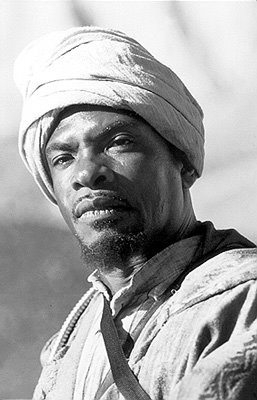
(Photo: Keith David as Abu 'Imam al-Walid in the Vin Diesel sci-fi movie Pitch Black [2000]).