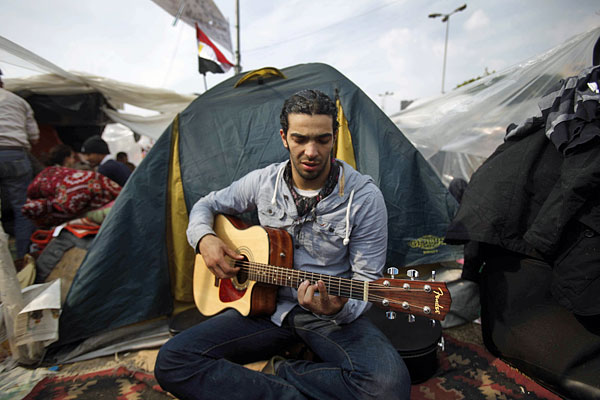
Ramy Essam was at the University of Arkansas campus on January 22, courtesy The House of Songs Ozarks (based in Bentonville). He did a jam and Q&A session with students, a lecture/Q&A, and a concert in the evening. I had the pleasure of running the lecture/Q&A session with Ramy. I spent about 9 days in Egypt in December, where I purchased the red hat, which has the logo of the Ahly Football Club. I guessed Ramy might be an Ahly fan, and I was right!
This is a quite interesting documentary, from MTV, about the period
running up to the Tamarrod-organized demonstration of June 30, 2013, and
the role of musicians in that movement. Ramy Essam, Karim Adel Eissa of
the rap group Arabian Knightz, and Nariman El Bakry, a music promoter,
are all strong supporters of Tamarrod and critics of Morsi and the
Muslim Brotherhood. After the coup, Karim Adel Eissa expresses support the army, who he says he did not support previously. [Addendum from just a couple hours after this was posted. I posted more or less the same thing on FB. A FB re-posted, and within minutes a comment from Karim Adel Eissa, who says, "my stand openly and publicly changed shortly after that tho."]
Nariman seems to shut down emotionally. Ramy got alienated by the crowds expressing
support for the army at an event the night before the June 30, and so
did not play at the June 30 demo. He says he was glad that Morsi got
tossed out but not with the coup.
Good resource that is not always terribly accurate -- claims that 33 million Egyptians demonstrated against Morsi on June 30. Its estimate of 1200 killed in the Rabaa massacre of Muslim Brotherhood supporters on August 14 is more sound. Human Rights Watch estimates at least one thousand.
As found on Mixcloud, courtesy Columbus Music Magazine, an Israeli outfit that seems to live exclusively on Mixcloud. I've no idea who the pair are that chose the songs, except that they are Israeli. And based on the choices they've made, we can presume that (a) they listen to a lot of Arab music (b) they have quite good taste and (c) they are not afraid of progressive political music.
Most of the tracks are what one might call "alternative" Arab music, with roots in rock, but there is also some hip-hop. "Arabic" for Engelberg and Jurkevitch seems to mean "Eastern" or "Mashreqi," as there are no tracks from any Arab country east of Egypt. Nonetheless it's a quite good set, and it introduced me to a lot of material I did not know. Of the artists I am familiar with, there are quite good tracks from Mashrou' Leila (Lebanon), Ramy Essam (Egypt, though now based in Sweden), Maryam Saleh & Zeid Hamdan (Egypt/Lebanon), DAM (Palestinian citizens of Israel), Zeid and the Wings (Lebanon), Massar Egbari (Egypt), and Youssra El Hawary & Salam Yousry (Egypt).
I was most impressed by the track by Jowan Safadi, called "To Be An Arab." It surprised me when I listened for the first time, because the vocals are in Hebrew, not Arabic, and the song is not rock or rap but sounds very much like standard Israeli Mizrahi pop. (There is, however, a spoken bit in Arabic.) I did a bit of googling and learned from an article on Mondoweiss that Safadi is a Palestinian citizen of Israel (don't you dare call someone like him an "Israeli Arab"), and that the lyrics are quite amazing. The YouTube video (below) is terrific, and it is aimed at/addressed to Israeli Jews of Arab heritage, known in Israel as Mizrahim (or alternatively, to use an earlier terminology, Sephardim). The video provides a translation of the Hebrew (and Arabic) into English, which Mondoweiss has helpfully transcribed. Here's a few sample lines. I urge you to watch the vid and read the article.
Hardcore homophobes Are the most gay on the inside Mizrachi Arabophobes Are Arabs themselves Who are just afraid And prefer to stay in the closet Because they know, they know the best That to be an Arab is not that great
Interesting, no, to compare Mizrahis who hate Arabs to homophobes?
The song represents a quite remarkable reaching out, on the part of a Palestinian Arab citizen of Israel, to the Mizrahi Jewish minority, who are of Arab heritage. When it comes to a one-on-one "talk," the address is in Arabic, presuming the ability of the Mizrahi addressee to understand the language of heritage -- which in fact many young Mizrahim would not. It expresses a great deal of sympathy for the Mizrahi position, but ends on a tough note: dude, you are in Palestine.
Hey you imported Arab Take it from a local Arab You were dragged here To take my place It’s hard to be an Arab It’s really hard, ask me It’s hard to be an Arab How much can one be black Under the rule of the rich and white In the land of Palestine
Hey you imported Arab,
Take it from a local Arab
You were dragged here
To take my place
It’s hard to be an Arab
It’s really hard, ask me
It’s hard to be an Arab
How much can one be black
Under the rule of the rich and white
In the land of Palestine
- See more at: http://mondoweiss.net/2015/08/radical-talent-safadis#sthash.dVU4a8Vc.dpuf
Hardcore homophobes
Are the most gay on the inside
Mizrachi Arabophobes
Are Arabs themselves
Who are just afraid
And prefer to stay in the closet
Because they know, they know the best
That to be an Arab is not that great - See more at: http://mondoweiss.net/2015/08/radical-talent-safadis#sthash.dVU4a8Vc.dpuf
Hardcore homophobes
Are the most gay on the inside
Mizrachi Arabophobes
Are Arabs themselves
Who are just afraid
And prefer to stay in the closet
Because they know, they know the best
That to be an Arab is not that great - See more at: http://mondoweiss.net/2015/08/radical-talent-safadis#sthash.dVU4a8Vc.dpuf
Rapper L7a9ed (El Haqed, rapper from Morocco), Ramy Essam (singer from Egypt, who raps here),
Karim Rush, Egyptian rapper from the group Arabian Knightz, Refugees of Rap (Palestine/Syria), Salomé MC
(Iranian rapper), Palestinian Rapperz (Gaza), Armada Bizerta (Tunisian rappers), and Moe
Hamzeh (Lebanese rapper) all appear on a new version of Nigerian singer Fela's immortal "Zombie." The rhythm track is provided by Voodoo Sound Club (Bologna), and the song opens with a segment from Fela's son Seun Kuti. Producers are Reda Zine (Morocco), Mark Levine, Anton Pukshansky and Andrea Deda. They plan to produce several more Fela re-visions over the year.
It's great, give it a listen (download here) -- I particularly like the segment from the one female rapper, also the only Iranian rapper, the super Salomé. Read more about it here from Freemuse.
I missed it, she covered mahragan (which she calls electro shaabi), as well as rocker Ramy Essam and graffiti artist Ganzeer, on September 4, 2012. She mentions Alaa Fifty, Amr Haha (7a7a) and Ahmed Vigo [the NPR transcript says: "Achmed (unintelligible)"]. It's a very short report, it doesn't tell us much we don't already know (other than the fact that mahragan vocalists are called "mike men" -- I need to check this), but it's basically on target.
And folks, there is more mainstream media coverage of mahragan in the offing. I can feel it.
Ramy Essam, singer of the Egyptian revolution, who produced the unforgettable song "Irhal," has put out a song in solidarity with the Syrian revolutionaries. It may be his best song since "Irhal." Helpfully, the video comes with subtitles in English, and the Arabic is written below the vid. Check it out.
Congratulations to Ramy Essam, winner of the 2011 Freemuse Award. Ramy, of course, was the author of the famous, unforgettable Tahrir song, "Erhal" (Leave).
And many other songs. Not only did Ramy sing for the revolution, he fought for the revolution. He was wounded fighting off the baltagiya, the regime thugs, on the night of February 4-5.
And he was arrested and tortured by soldiers, who dragged him and other Tahrir occupiers off the square, on March 9. The story was reported widely, most memorably (in my opinion) in this account by Steve Inskeep of National Public Radio, who visited Ramy in his home. I loved this part of the report:
We ask if, when he got hurt, his mother said, "I told you so."
They [Ramy and his brother Shady] laugh and say yes. Even in pain, Ramy Essam smiles.
Ramy continues to be active in support of the struggle, and especially, against the SCAF, the junta that continues to rule Egypt, the Supreme Council of the Armed Forces. Presumably it was due to this that the Dean of Cairo University's Medical School shut down a concert, in mid-performance, that Ramy was performing there on October 26. Read about it here.
FREEMUSE, The World Forum on Music and censorship, is an independent international organization, whose secretariat is based in Copenhagen, which advocates freedom of expression for musicians and composers worldwide. Pete Seeger was the Freemuse Award winner in 2009.
Mabrouk, ya Ramey. Why don't you learn this song from Pete Seeger and sing it in solidarity with #OccupyWallStreet when you go to Copenhagen Stockholm to receive your award on November 21?
ADDED October 31:
Ramy will receive his award at the Right! Freedom of Music & Speech conference in Stockholm on November 21. One of the speakers at the conference will be the artist Peaches! (Can you imagine the right-wing and conservative Islamist press having fun with this one?!) Thanks to 'anonymous' whose comment prompted this correction.
On February 9, which now seems so long ago, I wrote a post called "Music of the Egyptian Revolution." Included in it was the now famous youtube vid of Ramy Essam singing "Irhal" (Leave, or, Go Away). I also included a vid of a song about a donkey refusing to step down for a younger one, but I was unable at the time to identify either the lyrics or the singer.
Since then many have written about the music of Egypt's revolution, and I'm able to identify the song and the lyrics. It's Ramy Essam (again), and the lyrics are by the celebrated revolutionary poet Ahmad Fouad Negm, the lyricist for Egypt's beloved revolutionary singer Shaykh Imam.
An article in The Los Angeles Times about Essam gives the story of his performance of the song on Tahrir:
One song that he relished, and that late at night the crowd would want to hear again and again, was an ode written by well-known poet Ahmed Fouad Negm: "The Donkey and the Foal," which everyone knew to be a commentary on Mubarak and his son Gamal.
Essam had written the music and played it for himself alone at home before the revolution. And now everyone shouted for the scathing lyrics of the aging poet, who had been jailed under Mubarak's predecessor. He felt honored when the poet stood with him and recited the words.
The foal said to the donkey, "Father, hand me the cart. Father, you have aged and now it is my turn."
The donkey coughed too strongly and the passengers panicked.
"It isn't about health, son," the donkey said. " Even the bridle is too big for you, son. Think and don't be greedy, or the passengers will rise up."
Since Hosny Mubarak's resignation, Ramy Essam has received a great deal of media attention, and has become something of a celebrity. Featured in the article in The Los Angeles Times, mentioned above, celebrated by Mark Levine in The Huffington Post (Levine produced a remix of "Irhal" as well--I respectfully prefer the original), an featured in an article in The Guardian by respected Middle East music commentator Andy Morgan, who calls Essam the Billy Bragg of Tahrir Square.
Before you imagine that Ramy Essam has gone all rock star, check out this video. It shows Essam performing his song "Irhal" on Tahrir Square to a big crowd. Later that night, the crowd at Tahrir is attacked by Mubarak's thugs. The pro-democracy forces keep them at bay. The video then shows Ramy Essam on the following morning. He stayed the night, and was wounded on the head by the rocks hurled by the counter-revolutionary goons. As far as I can tell, this occurred on the night of February 4-5, 2011. I don't know many "rock stars" who have the street fighting cred and the courage of Ramy Essam. I don't know if I know of anyone, in fact. Below is a screen grab of Ramy with his head bandage, and then, the full video.
This video shows Essam singing "The Donkey and the Foal" before a small group, on Tahrir, and also performing "Irhal," on another occasion, before a large crowd at the square.
This vid is a full version of "The Donkey and the Foal."
Here's Negm's poem in Arabic:
الجحش قال للحمار *** يابا اديني الحنطور
يابا انت سنك كبر*** و وجب عليا الدور
كح الحمار كحة *** فزعت لها الركاب
مش يابني بالصحة *** ده كل شئ بحساب
وسواقة الحنطور *** محتاجة حد حكيم
وانت عينيك فارغة *** همك علي البرسيم
قوللي تسوق ازاي *** والتبن مالي عينيك
ده حتي حبل اللجام *** واسع يا ابني عليك
اعقل وبطل طمع *** لاتسخن الركاب
ما تجيش يا واد جنبهم *** لاتبقي ليلة هباب
دول صنف ناس جبار *** قادر مالوهش امان
يبان عليهم وهن *** لكنهم فرسان
يابا دا نومهم تقل *** وبقاله يابا سنين
كل البشر صحصحوا *** ولسه دول نايمين
يا جحش بطل هبل *** وبلاش تعيش مغرور
ركابنا مش اغبيا *** ولا عضمهم مكسور
بكرة حيصحولك *** ويزلزلوا الحنطور
وتلاقي في قفاك *** تمانين خازوق محشور
And you can find out more about Ramy Essam, and download some of his music (although not the songs discussed above) from his Facebook page.
Professor of Anthropology, University of Arkansas. Author of Memories of Revolt: The 1936-39 Rebellion and the Palestinian National Past. Co-editor of Palestine, Israel and the Politics of Popular Culture and of Displacement, Diaspora, and Geographies of Identity.