This is a couple months late, but in a sense, it's never too late to pay tribute to DJ Mehdi, who died on September 13. DJ Mehdi, a French music producer, of French-Tunisian background, worked with, among others, Cassius, Asian Dub Foundation and Akhenaton. DJ/rupture did a terrific tribute to DJ Mehdi shortly after his death (on his blog mudd up!), focusing in particular on one of the best tracks he produced for French rap group 113, "Tonton du Bled" (from their album Les Princes de la Ville, 1999). As rupture says, "it was DJ Mehdi’s beat that brought everything together, that made the whole articulation danceable and audible to us outside of the Afro- Arab- Francophone rap world."
Yeah, it's a terrific beat.
Check it out. It's Rim'K (of Algerian background) who does all the rapping on this track.
I found the lyrics, and a translation into English, here. And I reproduce below, with a bit of editing.
Tonton du Bled
(refrain)
Je voulais rester à la cité, mon père m'a dit: "le le la"
Dans ce cas-là, je ramène tous mes amis? "le le la"
Alors dans une semaine je rentre à Vitry? "le le la"
J'irai finir mes jours là-bas? "oua oua oua"
504 break chargé, allez monter, les neveux
Juste un instant que je mette sur le toit la grosse malle bleue
Nombreux comme une équipe de foot, voitures à ras du sol
On est les derniers locataires qui décollent
Le plein de gazoil et de gazouz pour pas flancher
Billel, va pisser le temps que je fasse mon petit marché
Direction le port, deux jours pied sur le plancher
Jusqu'à Marseille avec la voiture un peu penchée
Plus de 24 heures de bateau, je sais c'est pas un cadeau
Mais qu'est-ce que je vais kiffer sur la place Guido
A Béjaïa City du haut de ma montagne
Avant de rentrer feudarr, je fais un petit tour par Oran
Vu qu'à Paris, j'ai devalisé tout Tati
Je vais rassasier tout le village, même les plus petits
Du tissu et des bijoux pour les jeunes mariés
Et des jouets en pagaille pour les nouveaux-nés
(refrain)
Je suis sur la plage à Boulemat avec mon zink et son derbouka
Dans la main un verre de Selecto imitation Coca
Une couche de Zit-Zitoun sur le corps et sur les bras
Avec mon pote sur un fond de Zahouania
On parle de tout et de rien, des Nike Air aux visas
De la traversée du desert au bon couscous de Yema
Et mon cousin me dit: "Karim t'kiifeut eul zeut la?"
Il était tellement bon que j'ai jeté mon cirage en ras
Avec deux, trois blédards on tape la discussion
Mahmoud ne peut pas s'empêcher de dire que je suis dans la chanson
L'un d'eux me dit: "Moi je t'ai pas vu à la tilivision"
Et l'autre me demande: "Sarra teurlof Mickael Jackson ?"
Ils parlent trop vite et en argot de blédard
Je sais ce qu'ils feraient pour une poignée de dinars, counard
Le soleil se couche et tout l'monde rentre chez soi
C'est l'heure du repas et de la teille, pour d'autres la chicha
J'ai passé un bon mois dans ce qu'on appelle le Tiers-Monde
Et si j'avais assez d'oseille, je ramènerais tout le monde
Mais je peux pas fermer les yeux sur ce qu'y se passe vraiment
Je dédie ce morceau aux disparus, aux enfants et aux mamans
Et je suis rentré à la cité en Rrbia
Content de revoir mes potos et ma chebba
Pendant deux semaines, j'ai mangé que de la chorba
J'irai finir mes jours là-bas inch'Allah
(refrain x2)
Uncle from the homeland
[Chorus]
I wanted to stay in the ghetto, but my father said me - No no no
In this case, let me take all my friends - No no no
So in a week, I'm going back to Vitry - No no no [Vitry-sur-Seine: a French "suburb"]
I'll go end my days there - Yeah yeah yeah
Heavy 504 estate car, come on nephews, get in [504: 4-door Peugeot]
Wait a minute while I put the big blue trunk on the rooftop
As large as a soccer team, the car is at ground level
We're the last tenants leaving
Filling up with diesel oil and lemonade, so as not to give out
Bilel, go piss while I do a little shoppin'
Direction: the harbor, two days seated
All the way to Marseille in a rickety car
24 hours in the boat, I know it's not easy
But I'm gonna have a freaking good time on Guido place
In Bejaia city, from the top of my mountain [Bejaia: port city in Kabylia, Algeria]
Before going back home, I take a little turn in Oran
Since I cleaned out the Tati shop in Pars
I'm gonna make the whole village happy, even the kids
Some clothes and jewelry for the newlyweds
Heaps of toys for the newborns
[Chorus]
I'm on Boulemat beach with my cousin and his derbouka
A glass of Selecto in my hand, imitation Coke
A drop of olive oil on my body, on my arms
With my friend, listening to Zahouania
We talk about nothing and everything, from Nike air trainers to Visa
From the desert's crossing to Yema's good couscous
Then my cousin says "Karim, do you deal drugs?"
It tasted so good that I gave him the shoe polish I had left [cirage (shoe polish) must mean something else here!]
With a bunch of homies we're discussing
Mahmoud can't stop himself from telling them that I'm into music
One of them tells me "I've never seen you on TV"
Another asks me "Is it true you know Michael Jackson ?"
They talk too fast and use some out-of-date slang
I know what they could do for a fistful of dinars, asshole
For a fistful of dinars, asshole, I'd "kiss" your sister
The sun sets and everybody goes home
It's dinner time, beer time and for others, bong time
I spent a good month in what they call the third-world
And if I had enough money, I'd leave taking everyone with me
But I can't close my eyes to what's really going on
I dedicate this track to the people we miss, children and mothers
Then I went back to my ghetto
Happy to see my friends and my girlfriend
For two weeks, all I ate was soup
I'll go end my life there, inshallah
[Chorus, 2x]
Wednesday, November 09, 2011


Monday, November 07, 2011
Kufiya affectation, courtesy shirt woot vs. New York magazine's OWS kufiya
Shirt.woot launches a new original t-shirt design every midnight(central). This shirt design came in third in the Hipster Animals derby.

Along with a posted commentary (October 10), which included these lines:
"Personally, I’m sick of all these button-down mainstreamers giving me static about my scarf. “It’s September,” they say. “It’s basically still summer,” they say. “You can’t possibly be cold,” they say...“What’s wrong in your brain that makes a cheesy, affected fashion accessory seem more important to you than your physical comfort?”
Affected? Pshuh! “Dude,” I always want to say (before deciding to just sneer at them with silent disdain instead), “35% of the surface area of my body is neck. A scarf is essential for maintaining my core body temperature, OK?”
That’s right. Scarf life, y’all. Recognize.
On days when I wear a keffiyeh, though, that’s totally affectation, I’ll give you that."
More tongue-in-cheek hipster bashing. But then there's this. Is this "affected," shirt woot?!

Even New York magazine's cover story (October 24), which the image above thematizes, is much more positive than shirt woot, which tries to be cool. Although it does so in a kind of abashed, rather apologetic, but hopefully post-irony tone: "The Kids Are Actually Sort of Alright." Dude, seriously, let this sixties-era geezer tell you: these kids are way better than alright. Viva #ows.
I really, really, like that the person on the cover wears two, mixed-together scarves: an American flag scarf (we are reclaiming our country!) and a kufiya (we are inspired by the Arab spring and maybe, just a bit, by Palestine).

Along with a posted commentary (October 10), which included these lines:
"Personally, I’m sick of all these button-down mainstreamers giving me static about my scarf. “It’s September,” they say. “It’s basically still summer,” they say. “You can’t possibly be cold,” they say...“What’s wrong in your brain that makes a cheesy, affected fashion accessory seem more important to you than your physical comfort?”
Affected? Pshuh! “Dude,” I always want to say (before deciding to just sneer at them with silent disdain instead), “35% of the surface area of my body is neck. A scarf is essential for maintaining my core body temperature, OK?”
That’s right. Scarf life, y’all. Recognize.
On days when I wear a keffiyeh, though, that’s totally affectation, I’ll give you that."
More tongue-in-cheek hipster bashing. But then there's this. Is this "affected," shirt woot?!

Even New York magazine's cover story (October 24), which the image above thematizes, is much more positive than shirt woot, which tries to be cool. Although it does so in a kind of abashed, rather apologetic, but hopefully post-irony tone: "The Kids Are Actually Sort of Alright." Dude, seriously, let this sixties-era geezer tell you: these kids are way better than alright. Viva #ows.
I really, really, like that the person on the cover wears two, mixed-together scarves: an American flag scarf (we are reclaiming our country!) and a kufiya (we are inspired by the Arab spring and maybe, just a bit, by Palestine).
Tiariq Teguia's "Rome plutôt que vous"
I saw this film at Georgetown last week and I want to put in a very strong plug for it. It's not been released for the English-speaking market, so it's only available with French subtitles. It's a kind of road movie, with a very New Wave feel, telling the story of Zina and Kamal trying to find a guy who is going to supply Kamal with a fake passport, so he can migrate to Europe.
One of the the elements of the film that I was interested was in how rai music plays an important function, at key points in the film. The film rarely has a music soundtrack, it's quite bleak, sonically, just as is the urban and suburban environment, much of the time. Only once do we hear some rai music, while Zina and Kamal and Kamal's friend Merzak are caught overnight in a suburb of unfinished housing, and they take refuge with someone who works in a pizzeria kitchen. At one point, the worker puts some rai music on the cassette player, and they all engage in raucous dancing. It's a moment of very intense, and surprising, emotion in a film that is otherwise characterized for the most part by lassitude and waiting and frustrated searching. You can see a moment of the dancing, but without the music, at about 1:27 on the trailer below.
At another point, Kamal and Merzak (if I remember correctly) are talking and one of them recites a line or two of poetry. One says, that's Cheb Hasni. The other says, or maybe Rimbaud. Cheb Hasni is the much-beloved star of the rai sub-genre known as "love rai," who was assassinated in 1994 by the Armed Islamic Groups. (Probably. Although some say he was killed due to a dispute over money, by someone in the mafia-like syndicate of rai producers.)
At the end of the film, Kamal gets shot, as he and Zina drive away. We have no idea who did it or why and the violence comes out of the blue. Typical of life in Algeria, especially since the start of the civil war in 1992 and the unleashing of the shadowy forces of the pouvoir, the Algerian state, against the Islamist rebels. Kamal says to Zina (presumably he is badly wounded, although we can't see the wound), he hears Cheb Hasni. She calls him an idiot. The film ends.
There is much more to this film than the rai references, but given my interests, nay, obsession with rai, that's what I've discussed here. Again, I highly, highly recommend this film.
Miscellaneous Orientalia: The Heads, "Relaxing With..."
The Heads are a "stoner band" from Bristol, active during the 1990s. This is the cover of their 1995 album, Relaxing With...

Redolent with that sixties, hippy, Orientalist fantasy thing. Need I say more? (But I do like the music on this album.)

Redolent with that sixties, hippy, Orientalist fantasy thing. Need I say more? (But I do like the music on this album.)
Ok, here's another Pat Benatar kufiya
Because you wanted it:

Someone passed this on to me awhile back, but I can't remember who.
It turns out that this photo was used as the cover for the Japanese version of Pat's single, "Temporary Heroes," from her 1984 album Tropico. Here's the song, for the curious. No connection at all between its lyrics and the scarf Pat is wearing. Not that one would expect any.

Clearly, here, she is saluting the Palestinian cause, right? The US 12" single looks quite different.

I posted another photo of Benatar in kufiya previously, here. Here is a better version of the one I published earlier.

Sunday, November 06, 2011
Hishaam Aidi on US attempts to use hip hop as a foreign policy tool and US media's over-estimation of the role of hip hop in the Arab Spring
Please see this piece from Al Jazeera English by Hishaam Aidi, Columbia University, on hip-hop in US diplomacy. One of the points Aidi makes, which is also one of my peeves of late, is that 'the role of music should not be exaggerated: Hip hop did not cause the Arab revolts any more than Twitter or Facebook did. the countries in the region with the most vibrant hip hop scenes, Morocco and Algeria, have not seen revolts. Western journalists' focus on hip hop - like their fixation on Facebook and Twitter - seems partly because, in their eyes, a taste for hip hop among young Muslims is a sign of moderation, modernity, even "an embrace of the US."'
Thank you, Hishaam!
Here is a typical report, by Karl Bostic of NBC News, entitled "How Rap Fueled the Revolution." (It's not dated, but was broadcast in early September 2011, I believe.)
It claims, "Rap music has become the soundtrack of the revolution, and the symbol of resistance." I'm pretty unconvinced by a lot of what Bostic asserts. He presents two rather unimpressive Libyan rappers, who rhyme in English, and claims that Libyan rebels were going into battle inspired by local rap. The so-called "rapper" from Hama, Syria, who did the popular song "Come On Bashar, Leave," was not really a hip-hop artist, contrary to what Bostic states, but rather chanted, in traditional style, to a debke beat. (See Anthony Shadid's report on this song, and how the person who performed it, Ibrahim Qashoush, had his throat cut shortly thereafter, here.) Bostic does at least show that the person he says is Syria's most popular rapper, Murder Eyez, supports the Bashar regime, and that rap's appeal in Yemen is limited. It is true that rappers like Egypt's Deeb were active during the uprising centered at Tahrir in January and February, but I believe that he was of lesser importance in these events than artists working in other musical genres. I believe the only place where hip hop truly played a significant role was in Tunisia, and in particular, the rapper El General and his song "Rais el-Bled."
Hishaam also raises all kinds of important questions about hip hop cultural diplomacy. For a more in-depth look at the issues of race, hip hop, Islam, and foreign policy, please see Hishaam's recent article in Middle East Report (Fall 2012), "The Grand (Hip-Hop) Chessboard: Race, Rap and Raison d'Etat."
Thank you, Hishaam!
Here is a typical report, by Karl Bostic of NBC News, entitled "How Rap Fueled the Revolution." (It's not dated, but was broadcast in early September 2011, I believe.)
It claims, "Rap music has become the soundtrack of the revolution, and the symbol of resistance." I'm pretty unconvinced by a lot of what Bostic asserts. He presents two rather unimpressive Libyan rappers, who rhyme in English, and claims that Libyan rebels were going into battle inspired by local rap. The so-called "rapper" from Hama, Syria, who did the popular song "Come On Bashar, Leave," was not really a hip-hop artist, contrary to what Bostic states, but rather chanted, in traditional style, to a debke beat. (See Anthony Shadid's report on this song, and how the person who performed it, Ibrahim Qashoush, had his throat cut shortly thereafter, here.) Bostic does at least show that the person he says is Syria's most popular rapper, Murder Eyez, supports the Bashar regime, and that rap's appeal in Yemen is limited. It is true that rappers like Egypt's Deeb were active during the uprising centered at Tahrir in January and February, but I believe that he was of lesser importance in these events than artists working in other musical genres. I believe the only place where hip hop truly played a significant role was in Tunisia, and in particular, the rapper El General and his song "Rais el-Bled."
Hishaam also raises all kinds of important questions about hip hop cultural diplomacy. For a more in-depth look at the issues of race, hip hop, Islam, and foreign policy, please see Hishaam's recent article in Middle East Report (Fall 2012), "The Grand (Hip-Hop) Chessboard: Race, Rap and Raison d'Etat."
Saturday, November 05, 2011
Cheb Mami watches "Ya Del Marsam" with Natacha Atlas and Aki Nawaz
I'm working pretty hard and fairly steadily on the rai chapter of the book I've been trying to finish for ages, Radio Interzone.
Part of what I'm doing in the book is dealing with many of the myths about rai that have been spread, for about 25 years, about the music and the artists. A little over a year ago, I responded to a piece by Banning Eyre on NPR, which asserted that rai music was "banned" from Algerian state radio. I explained that it wasn't so much a ban as the encouragement of more "refined" and classicist culture, which the very idiomatic rai was not. I also wrote:
"The standard story told about rai is that the music didn't make it onto state radio until 1985, but it appears that the restrictions against rai were not iron-clad. For instance, Cheb Mami became known nationally in 1982 due to the fact that he performed on a very popular television show, Alhan wa chabab ("Melodies and youth"), a program devoted to discovering new talent. He also performed in a national song competition, singing "El Marsam." When it was announced that Cheb Mami had come in second, the crowd booed, believing that he should have come in first (Daoudi and Miliani 1996: 102)."
I've been working up this argument for the chapter. I had learned that "El Marsam" or "Yad El Marsam" as it is more commonly known, was originally written and performed by Cheikh Muhammad, a well-known artist from Oran working in the bedoui genre. Since there is a lot of material being posted all the time on youtube, from the rai tradition, I thought I'd see if there was a youtube of this song, by Cheikh Muhammad. I didn't find one, but I did find this very interesting vid. It shows Cheb Mami, wearing a t-shirt, sitting next to Natacha Atlas, with whom he is conversing in French, and a roomful of people, including Aki Nawaz (sitting on a couch, wearing a red kufiya, of course), watching a television screen that shows a very young Cheb Mami performing "Yad El Marsam."
The TV footage is probably from 1982. According to Daouidi (2000: 20), it was when Mami performed this song on television that he became well-known in Algeria. Note that Cheb Mami is backed by an "Oriental" orchestra, whose members are all wearing suits. (And isn't his vocal just gorgeous?) No electric guitar or electronic keyboards, no trappings of the "pop-rai" that was becoming so popular in Algeria at the time. (Here is Cheb Mami in a more characteristic mode.) Mami manages to get onto television because he is performing rai music from one of its respectable branches, the bedoui genre. Although bedoui was rural in origin and was not as prestigious as urban, Andalusian music, it could be made to fit within the national patrimony as "folklore." It did not have the risqué reputation of another of rai music's important roots, the music performed by the cheikhat, whose subject matter was more bawdy and whose image was tainted because the cheikhat frequently performed for mixed-gender audiences. It's the fact that Cheb Mami performs a song from the bedoui tradition that permits him, prior to the shift in state policy in 1985, when the regime (or at least its liberal elements) decide to take rai under its wing, to make it onto state media. The song he performed on the radio show Alhan wa chabab (referred to above), was "Wahran, Wahran," a much-beloved number written and originally recorded in 1950 by Ahmed Wahby, celebrated practitioner of ouahrani music, an urban genre of music developed in the '30 and '40s in Oran, and much influenced by the neo-classical music of Egypt, as performed by the likes of Muhammad Abd al-Wahhab, Umm Kalthoum, and Farid al-Atrash. Here is Ahmed Wahby's version (I can't find a version by Cheb Mami):
Again, this entry of Cheb Mami onto the national media was via a performance of a song from one of the "respectable" roots of rai, the ouahrani genre. Wahby moreover, joined the Algerian National Liberation Front, going into exile in Tunisia in 1957, and was a highly respected national figure.
I posted this video on youtube a few days ago, and "tagged" Aki Nawaz (of Nation Records and Fun'Da'Mental fame), who is a "FB friend." He wrote that he didn't remember the occasion, but that back in the day (I assume the early to mid '90s) he and Fun'Da'Mental used to share the stage on occasion with the "chebs" of rai.
The very sad thing about this video, of course, is what has happened to Cheb Mami. Or rather, what he has done, and the inevitable consequences.
Cheb Khaled has also recorded his own versions of "Yad El Marsem" and "Wahran Wahran." And the ouahrani artist Blaoui Houari has also done a well-known version of "Yad El Marsam."
Kufiyaspotting #9*6^_)3: Jean Grae

Thanks to John for this one. RCRDLBL_ says this about Jean Grae:
Jean Grae has been one of the most distinct and skilled voices in underground hip-hop for nearly 15 years. Her pitch-shifting, rhythmic, dip-diving flow and lyrics, heavy on allusive internal rhymes, was on display years before Nicki Minaj was picking up on it. On Grae's DJ Drama-hosted mixtape, Cookies Or Comas [get it here], you can hear this rollercoaster flow over and over again. The Boogie Blind-produced "Casebasket" is a sterling example [download here], with Grae's attitude-filled raps chipping into a chopped-up, funky drum loop, keeping it lean and mean.
What RCRDLBL_ doesn't tell you, and what I learned from this post about Jean Grae from Public Enemy Africa (also the source of the photo), is that Jean Grae is the daughter of famed South African jazz pianist Abdallah Ibrahim (Dollar Brand). She was born Tsidi Ibrahim in Capetown, South Africa, to Ibrahim and his wife Sathima Bea Benjamin, a jazz singer. The family went into exile in 1977, and moved to New York City. Holy Smokes, Batman!
She grew up in a household full of music, obviously. "At 13, she became the youngest dancer ever to earn a spot with the Alvin Ailey Repertory Ensemble, the second company of the famed modern dance company, the Alvin Ailey American Dance Theatre." She has appeared on recordings by, among others, Mos Def, Talib Kweli, Immortal Technique, and The Roots. And has seven albums out under her own name. Why she is not a star, not widely recognized, I do not know.
Wednesday, November 02, 2011
Lupe Fiasco & Erykah Badu at Hip Hop Awards '11: #occupy, Palestinian flag, kufiya, burkah...
Rapper Lupe Fiasco performed his song, "Words I Never Said," at the Hip Hop Awards 2011 on October 10. The performance was provocative in all kinds of ways that we like here at hawgblawg.
First, Erykah Badu backed him up on vocals (singing), dressed like this:

Yes, full-on burqa. And green fingernail polish. And a hat that makes her look, kinda like an Orthodox Jew? In any case, the most remarkable thing is the burqa. This does not mean that Badu (who in the past has laced her lyrics with the doctrine of the Nations of Gods and Earths, and who in the past used to dress in the style of an Earth, a modestly dressed female Five Percenter) has become a devout Muslimah. Rather, one guesses, she is expressing solidarity with the devout burqa wearer. Or trying, by putting the burqa on, to make it appear less strange, alien and exotic. I doubt it's a matter of burqa chic.
And then there is the matter of the banner that Lupe Fiasco has attached to his mike stand, a combination kufiya and Palestinian flag, with the word, Palestine stitched into it.

Avid readers of this blawg will know that Lupe was seen waving a Palestinian flag in concert on September 16, when he expressed his support for Palestine's admission to the UN. They will also recall that Lupe is a Muslim who doesn't hide it and that he has been spotted in a kufiya several times in the past. The real avid readers might also recall these lines from the song he performed at the Hip Hop Awards, "Words I Never Said":
Gaza Strip was getting bombed, Obama didn’t say shit
That's why I ain't vote for him, next one either
I’m a part of the problem, my problem is I’m peaceful
And I believe in the people...
I really think the war on terror is a bunch of bullshit
Just a poor excuse for you to use up all your bullets...
Now you can say it aint our fault if we never heard it
But if we know better than we probably deserve it
Jihad is not a holy war, where's that in the worship?
Murdering is not Islam!
And you are not observant
And you are not a Muslim
Israel don’t take my side cause look how far you’ve pushed them
And then there is the matter of the shirt that Lupe was wearing:

What can I say? We really like this. Occupy everything.
Erykah took her hat and face covering off at the end of the song:

The purpose was not to "disrobe." (Unlike Erykah did famously here.) The purpose was to show her face so that Mos Def could introduce her -- otherwise, I guess, no one in the audience would have known who that "weird" person in burqa was. Here, she looks like someone in less "severe" Islamic dress, in hijab rather than burqa.
I only wish I really loved the song, "Words I Never Said." I think the rap/rock combo is hard to pull off, and for me, it isn't successful in this case. I do, however, admire the performance and the lyrics, a lot. Especially all the provocation and the expressions of solidarity. And I do like a lot of Lupe's material. But not this song, so much.
First, Erykah Badu backed him up on vocals (singing), dressed like this:

Yes, full-on burqa. And green fingernail polish. And a hat that makes her look, kinda like an Orthodox Jew? In any case, the most remarkable thing is the burqa. This does not mean that Badu (who in the past has laced her lyrics with the doctrine of the Nations of Gods and Earths, and who in the past used to dress in the style of an Earth, a modestly dressed female Five Percenter) has become a devout Muslimah. Rather, one guesses, she is expressing solidarity with the devout burqa wearer. Or trying, by putting the burqa on, to make it appear less strange, alien and exotic. I doubt it's a matter of burqa chic.
And then there is the matter of the banner that Lupe Fiasco has attached to his mike stand, a combination kufiya and Palestinian flag, with the word, Palestine stitched into it.

Avid readers of this blawg will know that Lupe was seen waving a Palestinian flag in concert on September 16, when he expressed his support for Palestine's admission to the UN. They will also recall that Lupe is a Muslim who doesn't hide it and that he has been spotted in a kufiya several times in the past. The real avid readers might also recall these lines from the song he performed at the Hip Hop Awards, "Words I Never Said":
Gaza Strip was getting bombed, Obama didn’t say shit
That's why I ain't vote for him, next one either
I’m a part of the problem, my problem is I’m peaceful
And I believe in the people...
I really think the war on terror is a bunch of bullshit
Just a poor excuse for you to use up all your bullets...
Now you can say it aint our fault if we never heard it
But if we know better than we probably deserve it
Jihad is not a holy war, where's that in the worship?
Murdering is not Islam!
And you are not observant
And you are not a Muslim
Israel don’t take my side cause look how far you’ve pushed them
And then there is the matter of the shirt that Lupe was wearing:

What can I say? We really like this. Occupy everything.
Erykah took her hat and face covering off at the end of the song:

The purpose was not to "disrobe." (Unlike Erykah did famously here.) The purpose was to show her face so that Mos Def could introduce her -- otherwise, I guess, no one in the audience would have known who that "weird" person in burqa was. Here, she looks like someone in less "severe" Islamic dress, in hijab rather than burqa.
I only wish I really loved the song, "Words I Never Said." I think the rap/rock combo is hard to pull off, and for me, it isn't successful in this case. I do, however, admire the performance and the lyrics, a lot. Especially all the provocation and the expressions of solidarity. And I do like a lot of Lupe's material. But not this song, so much.
Mos Def to change his name to Yasiin in 2012

Mos Def (born Dante Smith), one of the most visible and well-known of today's rappers (but not one of the most productive, in terms of sheer quantity of recorded output), will change his name to Yasiin, starting in 2012. He converted to Islam (he is a Sunni, i.e. orthodox as opposed to Nation of Islam or Nation of Gods and Earths) as a teenager. He has stated, regarding the name change, that "[I don't want] to deal [any more] with having any moniker or separation between the self that I see and know myself as." I read this as meaning, he wants to be more open about his Muslim faith and identity.
I have written in the past that Mos Def has been spotted in a kufiya, but I've not found a photo, ever. My source was a piece in Kabobfest -- but there is no photo. We do have this evidence, from his song "War" (on the album The New Danger, 2004), that Mos Def did/does have some appreciation for the condition of the Palestinians:
But for now I'm a soldier abidin' my time
Writin' my rhyme behind enemy lines
Palestine, Kosovo, Kashmir
No different than the avenues right here
(Funny, Kashmir is usually spelled Cashmere, if you hunt for the transcription of these lyrics on line. C'mon, folks, learn some geography and history from our man Mos Def, soon to be Yasiin.)
I like the look he has in the photo above (courtesy GQ): it's kinda snappy NOI (the bowtie) and devout Sunni (the kufi) at the same time.
Were Kufiyas Used to Incite Fear of Attica Uprising, September 1971?
I meant to post something on the Attica massacre on the 40th anniversary of the event. I was living in New York City, and participated in a demonstration on the day that it happened, Monday, September 13. The demo got rather wild, we were marching in the street without a permit, people were very mad, and there was a bit of "trashing." There was also a big demonstration on the weekend, probably Saturday, September 18, that I attended as well. During that week, with 3 other friends, I also participated in a "tagging" of the Metropolitan Museum of Art. Our tag: "Pig Rockefeller, Attica Murderer." The New York Times published a photo of our tag a few days later. I have a note to myself to find a copy on microfilm and reproduce it. All this by way of saying that the Attica events were something that I and thousands of other US progressives felt very intensely about.
I was pleased to see that the New York Times published an excellent article on Attica, by Sam Roberts, on its 40th anniversary. I was also, again, incensed by what had happened, and felt that our description of New York governor Nelson Rockefeller as a pig murderer, was absolutely spot on. The complaints of the prisoners, who demanded better living conditions, were very justified. 29 inmates and 10 prison-guard hostages were shot in the course of the assault ordered by Rockefeller, all killed by New York State troopers. Prisoners were tortured and harassed without mercy after the prison was retaken. Roberts reports, based on recently published logs of phone conversations, that Rockefeller told President Richard Nixon that it was a "beautiful operation." Nixon, with his typical bluster, told Rockefeller “The courage you showed and the judgment in not granting amnesty, it was right, and I don’t care what the hell the papers or anybody else says."
Perhaps these photos, widely printed in newspapers at the time, played a part in the attempt to orchestrate mainstream sentiment against the inmates at Attica, mostly African-American, who had taken hostages.

This iconic photo featured pictures of those seen as representing the main actors, published in a round-up on the events in Attica on Sunday, September 19, 1971, in The New York Times.

It's cropped from this photo, also a widespread image at the time.

As was this one.
It's telling, don't you think, that, out of the 1,000 or so prisoners at Attica who participated in the uprising (the institution housed about 2,200 at the time), African-Americans in what looked like Arab headdresses were made so iconic?
We can speculate about what this was about. Progressive African-Americans had long felt a sense of solidarity with the Palestinians, particularly during the late sixties and early seventies, at the high point of guerilla activity by the Palestinian resistance movement. On the other hand, given that it was very hot in Attica, and that prisoners were in the yard in full sun during the days, it would have made sense to fashion head coverings to protect against the sun. (I remember that reports at the time said that, towards the end, the prisoners were short of water and very thirsty, and hence very tense.)
Another piece of the story may have to do with the fact that prison officials believed, or at least claimed to believe, that Muslim prisoners were responsible for organizing the uprising and for threats to the prisoners. There were, of course, considerable numbers of Nation of Islam adherents at Attica Prison, as well as members of the Moorish Science Temple, and the Nation of Gods and Earths (Five Percenters), as in all prisons with substantial African-American populations at the time. Members of each of these groups were active in the uprising. Non-recognition of their religious rights was an important motivation for their participation in the prison movement. Muslim prisoners were not permitted to hold religious services at Attica, and "any assembly in the prison yard of more than three Muslims was punishable by solitary confinement." One of the negotiators brought in, at the request of the prisoners, was Nation of Islam representative Louis Farrakhan. Of the five man committee negotiating on behalf of the prisoners, one (Carl X. Blyden) was a member of the Nation of Islam and two (Carl Jones-El and Donald Noble) were members of the Moorish Science Temple. When the prison was retaken, the Muslim prisoners (but accounts that I've seen don't distinguish between the NOI, Moorish Scientists and Five Percenters) were singled out for special retaliation on the part of the guards. It turned out that, in fact, the Muslim inmates (again, which "Muslims" is not clear) played a major role in protecting the hostages from other inmates.
Are the iconic Attica prisoners in the photos wearing what look like makeshift kufiyas in fact Muslims (of the Five Percent, Moorish Science or Nation of Islam persuasion)? Who knows? Did these photos play a role in inciting mainstream fears of the dangers that "radical" Black Muslims posed in the Attica uprising? Likely.
I was pleased to see that the New York Times published an excellent article on Attica, by Sam Roberts, on its 40th anniversary. I was also, again, incensed by what had happened, and felt that our description of New York governor Nelson Rockefeller as a pig murderer, was absolutely spot on. The complaints of the prisoners, who demanded better living conditions, were very justified. 29 inmates and 10 prison-guard hostages were shot in the course of the assault ordered by Rockefeller, all killed by New York State troopers. Prisoners were tortured and harassed without mercy after the prison was retaken. Roberts reports, based on recently published logs of phone conversations, that Rockefeller told President Richard Nixon that it was a "beautiful operation." Nixon, with his typical bluster, told Rockefeller “The courage you showed and the judgment in not granting amnesty, it was right, and I don’t care what the hell the papers or anybody else says."
Perhaps these photos, widely printed in newspapers at the time, played a part in the attempt to orchestrate mainstream sentiment against the inmates at Attica, mostly African-American, who had taken hostages.

This iconic photo featured pictures of those seen as representing the main actors, published in a round-up on the events in Attica on Sunday, September 19, 1971, in The New York Times.

It's cropped from this photo, also a widespread image at the time.

As was this one.
It's telling, don't you think, that, out of the 1,000 or so prisoners at Attica who participated in the uprising (the institution housed about 2,200 at the time), African-Americans in what looked like Arab headdresses were made so iconic?
We can speculate about what this was about. Progressive African-Americans had long felt a sense of solidarity with the Palestinians, particularly during the late sixties and early seventies, at the high point of guerilla activity by the Palestinian resistance movement. On the other hand, given that it was very hot in Attica, and that prisoners were in the yard in full sun during the days, it would have made sense to fashion head coverings to protect against the sun. (I remember that reports at the time said that, towards the end, the prisoners were short of water and very thirsty, and hence very tense.)
Another piece of the story may have to do with the fact that prison officials believed, or at least claimed to believe, that Muslim prisoners were responsible for organizing the uprising and for threats to the prisoners. There were, of course, considerable numbers of Nation of Islam adherents at Attica Prison, as well as members of the Moorish Science Temple, and the Nation of Gods and Earths (Five Percenters), as in all prisons with substantial African-American populations at the time. Members of each of these groups were active in the uprising. Non-recognition of their religious rights was an important motivation for their participation in the prison movement. Muslim prisoners were not permitted to hold religious services at Attica, and "any assembly in the prison yard of more than three Muslims was punishable by solitary confinement." One of the negotiators brought in, at the request of the prisoners, was Nation of Islam representative Louis Farrakhan. Of the five man committee negotiating on behalf of the prisoners, one (Carl X. Blyden) was a member of the Nation of Islam and two (Carl Jones-El and Donald Noble) were members of the Moorish Science Temple. When the prison was retaken, the Muslim prisoners (but accounts that I've seen don't distinguish between the NOI, Moorish Scientists and Five Percenters) were singled out for special retaliation on the part of the guards. It turned out that, in fact, the Muslim inmates (again, which "Muslims" is not clear) played a major role in protecting the hostages from other inmates.
Are the iconic Attica prisoners in the photos wearing what look like makeshift kufiyas in fact Muslims (of the Five Percent, Moorish Science or Nation of Islam persuasion)? Who knows? Did these photos play a role in inciting mainstream fears of the dangers that "radical" Black Muslims posed in the Attica uprising? Likely.
Tuesday, November 01, 2011
More on Tilda Swinton and her Palestine scarf in Vogue
I posted on this a few days ago. Since then I came across a nice piece on the subject by Emily Lawrence in Electronic Intifada, who meditates on whether Tilda's act is just a bit of provocative fashion, or real solidarity. This has been a long-standing issue in my kufiya posts on hawgblawg. She concludes: 'how better to convey a political message to a fashion-conscious audience than through the medium of clothing? Swinton is voicing her support for the Palestinian cause without ever having to speak. Such is the power of fashion.'
What I found most interesting is that the scarf in question was designed by Bella Freud for The Hoping Foundation (Freud is its co-founder), which raises money in the UK to fund projects to aid Palestinian refugee children. As I noted in an earlier post, is the great-granddaughter of Sigmund; an outspoken critic of Israel and; the elder sister of Esther Freud, author of the autobiographical novel Hideous Kinky (made into a fairly decent movie, starring Kate Winslet).
Freud and Hoping Foundation co-chair Karma Nabulsi are ever devising high-profile events to raise funds for Palestinian children, such as this event, where Italian fashion house Missoni designed a limited-edition shoulder bag to sell for Hoping projects.

Alas, it seems the scarf is no longer for sale at Hoping.
What I found most interesting is that the scarf in question was designed by Bella Freud for The Hoping Foundation (Freud is its co-founder), which raises money in the UK to fund projects to aid Palestinian refugee children. As I noted in an earlier post, is the great-granddaughter of Sigmund; an outspoken critic of Israel and; the elder sister of Esther Freud, author of the autobiographical novel Hideous Kinky (made into a fairly decent movie, starring Kate Winslet).
Freud and Hoping Foundation co-chair Karma Nabulsi are ever devising high-profile events to raise funds for Palestinian children, such as this event, where Italian fashion house Missoni designed a limited-edition shoulder bag to sell for Hoping projects.
@bellafreud (twitpic)
Alas, it seems the scarf is no longer for sale at Hoping.
Monday, October 31, 2011
Autotuned Egyptronica Sha'abi
I have no idea if that name is really appropriate. And I don't quite know what to make of these vids, and the music, that I've been running across, coming out of Egypt.
Check out this one.
The author of this piece is known as DJ Vigo. The title also indicates that this is a video from a wedding celebration. It certainly looks like farah, a wedding party, in a popular quarter of Cairo or some other Egyptian urban center. And it is the kind of dancing that you might see at a wedding party in a popular quarter (mantiqa sha'biya), with young women dancing together. What is a bit disconcerting is that the camera is fetishizing the body and movement of a young woman belly dancing, in a way that is perfectly appropriate in all-women company, but rather provocative when it is filmed and taken out of that context. As for the way the young woman is dressed, in higab (head-covering), t-shirt and rather tight jeans -- I've seen such outfits over a period of twenty years in Egypt. Even the t-shirt, which says "Let's Bring It On," is not completely surprising. I don't have time or the chops, really, to work through the lyrics right now, but there are references to smoking and hashish...The music (vocals and beats and instrumentation) are rather rudimentary, but they allow the singer to declaim whatever he wants. (Just as the much more famous Sha'bola does.) You will find a number of videos in this vein from DJ Vigo فىجو, some with as many as 20,000+ views.
Then there is this:
Advertised as a song from the Gamal 'Abd al-Nasir School for Girls, it features girls singing, lots of autotune, the occasional interjection of a mail voice, hot beats, and a video that consists entirely of teenaged girls (who seem to be both Egyptian and non-Egyptian). As of this writing, the song has over 270,000 hits, which is quite substantial. The comments, as far as I can tell, are entirely in Arabic. The music is much more interesting than the first, but more or less in the same vein. Other youtube subscribers have taken the same song (provenance: unknown to me as of now) and put other images of young girls to the music. This one has over 666,000 views to day; this one (with bawdier photos), over 182,000 hits.
Clearly this is a mass phenomenon, very sha'abi, in the sense that it no doubt is the object of scorn from the part of the educated and the mandarins, and very popular, with young people, especially in the popular quarters, the homes of the working classes, the lower middle classes, and the workers and entrepreneurs in the informal sector. This is, of course, just an educated guess. I hope this serves as a provocation to someone to find out more and tell us.
Check out this one.
The author of this piece is known as DJ Vigo. The title also indicates that this is a video from a wedding celebration. It certainly looks like farah, a wedding party, in a popular quarter of Cairo or some other Egyptian urban center. And it is the kind of dancing that you might see at a wedding party in a popular quarter (mantiqa sha'biya), with young women dancing together. What is a bit disconcerting is that the camera is fetishizing the body and movement of a young woman belly dancing, in a way that is perfectly appropriate in all-women company, but rather provocative when it is filmed and taken out of that context. As for the way the young woman is dressed, in higab (head-covering), t-shirt and rather tight jeans -- I've seen such outfits over a period of twenty years in Egypt. Even the t-shirt, which says "Let's Bring It On," is not completely surprising. I don't have time or the chops, really, to work through the lyrics right now, but there are references to smoking and hashish...The music (vocals and beats and instrumentation) are rather rudimentary, but they allow the singer to declaim whatever he wants. (Just as the much more famous Sha'bola does.) You will find a number of videos in this vein from DJ Vigo فىجو, some with as many as 20,000+ views.
Then there is this:
Advertised as a song from the Gamal 'Abd al-Nasir School for Girls, it features girls singing, lots of autotune, the occasional interjection of a mail voice, hot beats, and a video that consists entirely of teenaged girls (who seem to be both Egyptian and non-Egyptian). As of this writing, the song has over 270,000 hits, which is quite substantial. The comments, as far as I can tell, are entirely in Arabic. The music is much more interesting than the first, but more or less in the same vein. Other youtube subscribers have taken the same song (provenance: unknown to me as of now) and put other images of young girls to the music. This one has over 666,000 views to day; this one (with bawdier photos), over 182,000 hits.
Clearly this is a mass phenomenon, very sha'abi, in the sense that it no doubt is the object of scorn from the part of the educated and the mandarins, and very popular, with young people, especially in the popular quarters, the homes of the working classes, the lower middle classes, and the workers and entrepreneurs in the informal sector. This is, of course, just an educated guess. I hope this serves as a provocation to someone to find out more and tell us.
Sunday, October 30, 2011
Ramy Essam, voice of the Egyptian uprising, is the 2011 Freemuse Award winner
Congratulations to Ramy Essam, winner of the 2011 Freemuse Award. Ramy, of course, was the author of the famous, unforgettable Tahrir song, "Erhal" (Leave).
And many other songs. Not only did Ramy sing for the revolution, he fought for the revolution. He was wounded fighting off the baltagiya, the regime thugs, on the night of February 4-5.

And he was arrested and tortured by soldiers, who dragged him and other Tahrir occupiers off the square, on March 9. The story was reported widely, most memorably (in my opinion) in this account by Steve Inskeep of National Public Radio, who visited Ramy in his home. I loved this part of the report:
We ask if, when he got hurt, his mother said, "I told you so."
They [Ramy and his brother Shady] laugh and say yes. Even in pain, Ramy Essam smiles.
Ramy continues to be active in support of the struggle, and especially, against the SCAF, the junta that continues to rule Egypt, the Supreme Council of the Armed Forces. Presumably it was due to this that the Dean of Cairo University's Medical School shut down a concert, in mid-performance, that Ramy was performing there on October 26. Read about it here.
FREEMUSE, The World Forum on Music and censorship, is an independent international organization, whose secretariat is based in Copenhagen, which advocates freedom of expression for musicians and composers worldwide. Pete Seeger was the Freemuse Award winner in 2009.
Mabrouk, ya Ramey. Why don't you learn this song from Pete Seeger and sing it in solidarity with #OccupyWallStreet when you go toCopenhagen Stockholm to receive your award on November 21?
ADDED October 31:
Ramy will receive his award at the Right! Freedom of Music & Speech conference in Stockholm on November 21. One of the speakers at the conference will be the artist Peaches! (Can you imagine the right-wing and conservative Islamist press having fun with this one?!) Thanks to 'anonymous' whose comment prompted this correction.
And many other songs. Not only did Ramy sing for the revolution, he fought for the revolution. He was wounded fighting off the baltagiya, the regime thugs, on the night of February 4-5.

And he was arrested and tortured by soldiers, who dragged him and other Tahrir occupiers off the square, on March 9. The story was reported widely, most memorably (in my opinion) in this account by Steve Inskeep of National Public Radio, who visited Ramy in his home. I loved this part of the report:
We ask if, when he got hurt, his mother said, "I told you so."
They [Ramy and his brother Shady] laugh and say yes. Even in pain, Ramy Essam smiles.
Ramy continues to be active in support of the struggle, and especially, against the SCAF, the junta that continues to rule Egypt, the Supreme Council of the Armed Forces. Presumably it was due to this that the Dean of Cairo University's Medical School shut down a concert, in mid-performance, that Ramy was performing there on October 26. Read about it here.
FREEMUSE, The World Forum on Music and censorship, is an independent international organization, whose secretariat is based in Copenhagen, which advocates freedom of expression for musicians and composers worldwide. Pete Seeger was the Freemuse Award winner in 2009.
Mabrouk, ya Ramey. Why don't you learn this song from Pete Seeger and sing it in solidarity with #OccupyWallStreet when you go to
ADDED October 31:
Ramy will receive his award at the Right! Freedom of Music & Speech conference in Stockholm on November 21. One of the speakers at the conference will be the artist Peaches! (Can you imagine the right-wing and conservative Islamist press having fun with this one?!) Thanks to 'anonymous' whose comment prompted this correction.
kufiya higab in video for No Military Trials for Civilians (in Egypt)

I really love this kufiya higab. The kufiya has been an important sartorial symbol for the Egyptian struggle for democracy. I used to say, Egyptian revolution, but it is clear that it is, as of this date, a revolution in process, an incomplete revolution. One of the major issues confronting Egypt's democracy advocates is the ongoing military trials imposed upon civilians, and the Egyptian revolutionaries continue to mobilize against this great injustice. This video, from the Egyptian campaign called No to Military Trials for Civilians, contains some very compelling testimony from trial victims and their relatives. Please watch! Here is an English link to the organization, and here is the Arabic link.
Saturday, October 29, 2011
#occupy kufiyas
I predicted (to my FB friends) that, as the weather cooled off in the US, we would see more kufiyas in the #occupy movement. Of course I was correct (yeah, it was like shooting fish in a barrel, this prediction). So here is a small sampling.

This one is from today's events in Occupy Denver, where the police cleared out campers and the crowd, throwing all supplies and tents and food into a garbage truck, arresting 7 demonstrators. I'm sure tomorrow's event will be even bigger.

This is from Occupy Kansas City, posted by my friend and high school classmate Don Maxwell on Facebook today. (Thanks, Don.)

This is from the mother of the #occupies, Occupy Wall Street. It was posted on the Occupy Wall St. Facebook page yesterday, with this note:
SAVE THE DATE: November 17th. This will be big. VERY BiG. On November 17th, we call on all allies and supporters across the nation to put a stop to business as usual and reclaim this country for the 99%. Details to come
Today, at Occupy Wall St., was Existence is Resistance Keffiyeh Day. Here is a video about it -- not really very good quality, but it gives you some idea of what was going on.
The fact that this event happened drove to distraction at least one prominent Islamophobe, Pam Geller, a leading figure in raising the level of racist hysteria against the so-called Ground Zero Mosque and the author of the notorious Atlas Shrugs blog. She claims that the Kufiyeh Day is proof solid that the OWS movement is controlled, or being overrun by, anti-Semites and Nazis and Obama-ite Muslims and proponents of imposing shariah law on the US. She asks, when is it going to be kippah day at OWS. Well, I don't know how many kippahs there were (of course there were some), but between 700 and 1000 Jews participated in an open-air Kol Nidre service on the eve of Yom Kippur, at Occupy Wall Street, on October 7.
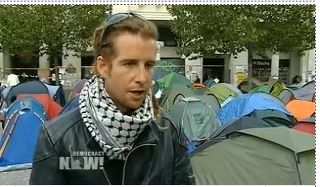
Finally, here's a screen shot of an Occupy London demonstrator, from the October 24 edition of Democracy Now! (Thanks, Pritam!)
Keep wearing those kufiyas, folks. It's getting chilly out there. And friends, send me photos, please!

Kathryn Scott Osler, The Denver Post

This is from Occupy Kansas City, posted by my friend and high school classmate Don Maxwell on Facebook today. (Thanks, Don.)

This is from the mother of the #occupies, Occupy Wall Street. It was posted on the Occupy Wall St. Facebook page yesterday, with this note:
SAVE THE DATE: November 17th. This will be big. VERY BiG. On November 17th, we call on all allies and supporters across the nation to put a stop to business as usual and reclaim this country for the 99%. Details to come
Today, at Occupy Wall St., was Existence is Resistance Keffiyeh Day. Here is a video about it -- not really very good quality, but it gives you some idea of what was going on.
The fact that this event happened drove to distraction at least one prominent Islamophobe, Pam Geller, a leading figure in raising the level of racist hysteria against the so-called Ground Zero Mosque and the author of the notorious Atlas Shrugs blog. She claims that the Kufiyeh Day is proof solid that the OWS movement is controlled, or being overrun by, anti-Semites and Nazis and Obama-ite Muslims and proponents of imposing shariah law on the US. She asks, when is it going to be kippah day at OWS. Well, I don't know how many kippahs there were (of course there were some), but between 700 and 1000 Jews participated in an open-air Kol Nidre service on the eve of Yom Kippur, at Occupy Wall Street, on October 7.
Finally, here's a screen shot of an Occupy London demonstrator, from the October 24 edition of Democracy Now! (Thanks, Pritam!)
Keep wearing those kufiyas, folks. It's getting chilly out there. And friends, send me photos, please!
Friday, October 28, 2011
Tilda Swinton in UK Vogue (November)

This photo has been passed around heavily by my Palestine-oriented FB friends. It was announced that this photo appeared in the November issue of Vogue. I immediately ran down to my local Barnes & Noble and thumbed through every single page of the November issue. I didn't see it. I deduce that it appears (alas!) in UK Vogue and not in the USA edition. I hope someone will send it to me as a gift. It's pretty amazing, no? For those of you who are not Palestine fanatics, the scarf is in the the colors of the Palestine flag.
(Meanwhile, you have to see Tilda in the film Gloria (2008). Absolutely phenomenal.)
World Book Kufiya

Thanks to Alyssa for sending me this. Unbelievable. And how do you read this: the kufiya subversively penetrating the mainstream? World Book coopting subversion? Or does that kufiya just look damned good? All of the above? Yeah, stunning. (Click on the photo for the full effect.)
Wednesday, October 26, 2011
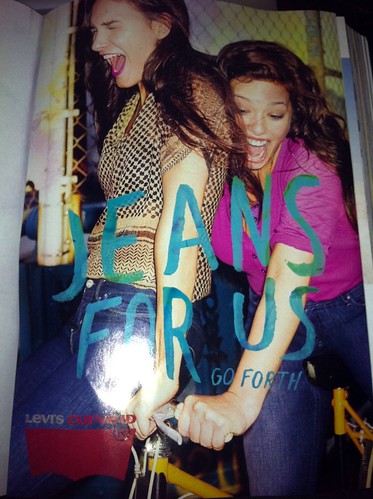
Levi's kufiya fashion, from last winter
I'm trying to catch up on kufiya fashion logging. I'm way behind. I was sent this photo back in February, by Nirvana. I wish I had bought the shirt for someone.
New York Times math: a growth of 275% is 'more than doubled'
Check out this headline from today's New York Times, reporting on the fact that the top 1% of the US population has seen their income grow by 275% between 1979 and 2007, according to a study by the CBO.

And then check out this one, from today's Huffington Post, reporting on the exact same study.


And then check out this one, from today's Huffington Post, reporting on the exact same study.

Which do you think is correct? A growth of 275% is more "nearly tripled" than it is "doubled," no? Is the Times trying to tamp down our anger? (The income of poorest fifth of the population rose only 18% during the same period, while the rise of the three-fifths of people in the middle of the income scale was just under 40 %.) Is the Times unconsciously biased in favor of the 1%, who own the paper?
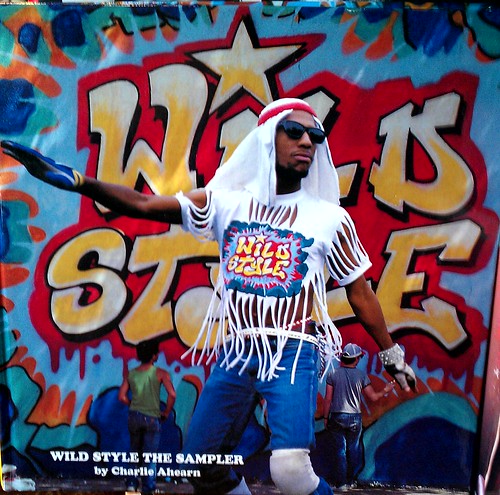
kufiyaspotting: on Charlie Ahearn's 'Wild Style The Sampler'
gotta get this book! (but not at Amazon, at my local bookstore).
How the New York Times spins the news (misleadingly) on #occupyoakland
Check out this. Here's a screengrab of what is on the New York Times home page right now (10 a.m. Eastern Standard Time, October 26, 2011):

If you click on the link right now, you will get to a page that says this:

The blog headline is much more accurate, in fact almost the exact opposite, of what it says on the Times' home page. (I.e., the home page depicts the protesters as the aggressors, the actual report suggests that the police were the aggressors.)
If you read the article, you will note that the headline could in fact be much improved. It should read, "Oakland police fire teargas, rubber bullets, beanbags, and flash grenades at largely peaceful protesters."
This is one for the ombudsman, no? And for journalism students.
#occupy

If you click on the link right now, you will get to a page that says this:

The blog headline is much more accurate, in fact almost the exact opposite, of what it says on the Times' home page. (I.e., the home page depicts the protesters as the aggressors, the actual report suggests that the police were the aggressors.)
If you read the article, you will note that the headline could in fact be much improved. It should read, "Oakland police fire teargas, rubber bullets, beanbags, and flash grenades at largely peaceful protesters."
This is one for the ombudsman, no? And for journalism students.
#occupy
Tuesday, October 25, 2011
Grimes (Claire Boucher) Kufiya

How about that for a kufiya? I came across this one thanks to an article by Simon Reynolds (New York Times, October 7) about new women artists with a penchant for synthesizers who are making feminized electronica (that's more or less how Reynolds puts it). They sounded interesting, so I checked some of them out. I found this photo at the website for Arbutus Records, which is Grimes' (the stage name for Claire Bouchard, of Montreal) label. Go here and you can download two Grimes albums (Halfaxa and Geidi Primes). I tried to pay but the site wouldn't let me, so I grabbed them for free. They are definitely worth a listen. I am quite gobsmacked by how Boucher uses the kufiya. She definitely has a unique look.
Monday, October 24, 2011
Arab Traces: Grace Slick in Jefferson Airplane's "The Ballad of You & Me & Pooneil"
One of my favorite Jefferson Airplane songs, off of After Bathing at Baxters (1967). There's a lot of melisma in this song from Marty Balin and especially from Grace Slick. It's not the kind of melisma that has become so banal and over-used courtesy of Mariah Carey and American Idol. Check out what Slick does with her voice from around 2:43 to 2:45 on this song. Listening to Arab singers must have been an influence. Umm Kalthum? Bob Dylan did.
It's not just the pot, or the LSD.
The quality of the sound on this vid is pretty lousy, perhaps deliberately so. So go out and buy a decent copy already. Finally, isn't Jack Cassidy's bass solo, starting at 2:08, just to die for?
Other, random, Arab traces in the Airplane. From "White Rabbit," this lyric: "Tell them a hookah smoking caterpillar/Has given you the call."
It's not just the pot, or the LSD.
The quality of the sound on this vid is pretty lousy, perhaps deliberately so. So go out and buy a decent copy already. Finally, isn't Jack Cassidy's bass solo, starting at 2:08, just to die for?
Other, random, Arab traces in the Airplane. From "White Rabbit," this lyric: "Tell them a hookah smoking caterpillar/Has given you the call."
Sunday, October 23, 2011
Kufiya'd Keira Knightley in 'Domino' (2005)

I'm surprised that none of my more avid movie-watching friends spotted this before me. Kiera Knightley plays Domino, a hard-assed bounty hunter in Domino (2005), alongside Mickey O'Rourke (who turns in a creditable performance as Ed) and Edgar Ramirez (as Choco). I found the film pretty enjoyable, although the effects, courtesy director Tony Scott, are sometimes too over-the-top for my tastes, and the plot makes little sense. (But neither for that matter did that of The Big Lebowski.)
Knightley as Domino appears garbed in the purple kufiya pictured here several times. I intend/hope in future to get hold of the DVD and take some photos of all the scenes (which occur at about 30 minutes, 45 minutes, 1 hour and 1:15, for those who need to know) when I have the chance. These shots were what I could pull off the web. Domino (the film is based very loosely on the real-life story of Domino Harvey, daughter of actor Laurence Harvey) as played by Knightley is a tough, reckless, gorgeous young woman who can handle guns and nunchucks (shown above) expertly and can tangle with the best of them. No doubt the kufiya, along with the leather jacket that she also wears frequently, is here to contribute to her tough-bitch image.
In terms of the history of kufiya craze in the West during the aughts, the appearance of the kufiya in Domino precedes, by just a bit, the full blown kufiya explosion of 2006-2007 (quite a bit of which was documented here, on hawgblawg).
As for the film, it received a lot of bad reviews. But the New York Times' Manohla Dargis rather liked it.

Monday, September 26, 2011
hijabistas
Entrepreneurial Muslim women, making modest dress mainstream in Europe.
Her customers include non-Muslims too. "You don't have to be Muslim to prefer conservative dress," she said.
Her customers include non-Muslims too. "You don't have to be Muslim to prefer conservative dress," she said.
Saturday, September 24, 2011
Lupe Fiasco waves Palestine flag in concert, and endorses Palestine's admission to the UN
This happened when Lupe Fiasco played at the Merriweather Post Pavilion in Maryland on September 16.
The vid below gives the wider context. It seems that a fan, waving the Palestinian flag, jumped up on stage during the performance of Lupe's "Beautiful Laser." As an impromptu gesture, Lupe took the flag and talked about the fact that the Palestinian leadership was going to the UN on September 23 to request UN membership. Lupe expressed his endorsement for the move, and then asked the fan if he could keep the flag. The crowd cheered Lupe's pro-Palestine sentiments, and booed when he mentioned the US intention of a veto.
Lupe Fiasco was spotted wearing kufiyas during the so-called "kufiya craze," and I (of course), blogged about it here, saying that unlike many kufiya-clad celebrities, Lupe was probably quite well informed about Palestine, and given that he is an (out) Muslim. His Palestine endorsement in Maryland last week certainly supports the point.
To quote the flag-waving fan: Long Live Palestine.
P.S. (added a few minutes later)
Will put me onto this, from Lupe Fiasco's song, "Words I Never Said":
Limbaugh is a racist, Glenn Beck is a racist
Gaza Strip was getting bombed, Obama didn’t say shit
That's why I ain't vote for him, next one either
I’m a part of the problem, my problem is I’m peaceful
And I believe in the people
And some more lines:
I really think the war on terror is a bunch of bullshit
Just a poor excuse for you to use up all your bullets...
And these, showing that Lupe will throw his criticisms fearlessly:
Now you can say it aint our fault if we never heard it
But if we know better than we probably deserve it
Jihad is not a holy war, where's that in the worship?
Murdering is not Islam!
And you are not observant
And you are not a Muslim
Israel don’t take my side cause look how far you’ve pushed them
The vid below gives the wider context. It seems that a fan, waving the Palestinian flag, jumped up on stage during the performance of Lupe's "Beautiful Laser." As an impromptu gesture, Lupe took the flag and talked about the fact that the Palestinian leadership was going to the UN on September 23 to request UN membership. Lupe expressed his endorsement for the move, and then asked the fan if he could keep the flag. The crowd cheered Lupe's pro-Palestine sentiments, and booed when he mentioned the US intention of a veto.
Lupe Fiasco was spotted wearing kufiyas during the so-called "kufiya craze," and I (of course), blogged about it here, saying that unlike many kufiya-clad celebrities, Lupe was probably quite well informed about Palestine, and given that he is an (out) Muslim. His Palestine endorsement in Maryland last week certainly supports the point.
To quote the flag-waving fan: Long Live Palestine.
P.S. (added a few minutes later)
Will put me onto this, from Lupe Fiasco's song, "Words I Never Said":
Limbaugh is a racist, Glenn Beck is a racist
Gaza Strip was getting bombed, Obama didn’t say shit
That's why I ain't vote for him, next one either
I’m a part of the problem, my problem is I’m peaceful
And I believe in the people
And some more lines:
I really think the war on terror is a bunch of bullshit
Just a poor excuse for you to use up all your bullets...
And these, showing that Lupe will throw his criticisms fearlessly:
Now you can say it aint our fault if we never heard it
But if we know better than we probably deserve it
Jihad is not a holy war, where's that in the worship?
Murdering is not Islam!
And you are not observant
And you are not a Muslim
Israel don’t take my side cause look how far you’ve pushed them
Tuesday, August 16, 2011
Kufiya'd protester in Lebanon: Down with Bashar
Via The Middle East Channel, August 16, 2011, this photo:
 with this caption: A woman wearing a mask and an Arab Keffiyeh head dress uses her mobile photo to record a protest in the Lebanese capital Beirut in support of the five month uprising in neighboring Syria, on August 15, 2011, as Syrian troops clamp down on flash point towns and cities (ANWAR AMRO/AFP/Getty Images).
I'm not sure whether this is supposed to be an Arafat mask. My guess is that the woman is wearing a mask not so much to identify with Arafat as to disguise herself, since demonstrators in Lebanon who have come out in support of the democracy movement have, on occasion, been attacked by local agents of Syrian intelligence, to wit, the local branch of the Ba'ath Party that is affiliated with Syria and by members of the SSNP (Syrian Social Nationalist Party, ex-PPS).
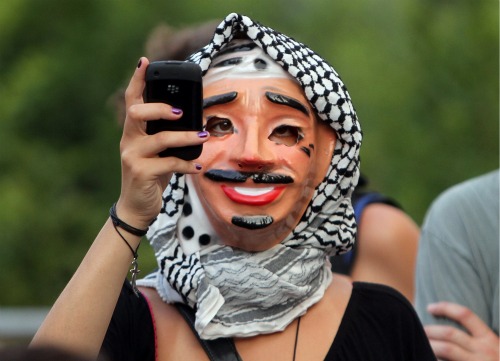
I'm not sure whether this is supposed to be an Arafat mask. My guess is that the woman is wearing a mask not so much to identify with Arafat as to disguise herself, since demonstrators in Lebanon who have come out in support of the democracy movement have, on occasion, been attacked by local agents of Syrian intelligence, to wit, the local branch of the Ba'ath Party that is affiliated with Syria and by members of the SSNP (Syrian Social Nationalist Party, ex-PPS).
Saturday, August 13, 2011
British Urban Music and the Riots
This is probably the most interesting commentary on the riots in England that I've seen, primarily because you hear the voices of the artists who, collectively, are being blamed for the 'disturbances.' ("Rap responds to the riots: 'They have to take us seriously'" by Dan Hancox, The Guardian, August 12, 2011.)
The artists are so incisive, so smart, and their music is so brilliant. Professor Green, Lethal Bizzle, and Wiley. Mostly "grime" artists, not "rap." Please read, and please watch the vids. Here's a particularly terrific one, Lethal Bizzle's "Babylon's Burning the Ghetto," from 2007. Prophetic, no?
If all those pundits and talking heads in England who are blaming "rap" for the riots really knew something, or anything, about the history of rap, they would know this: after the LA Rodney King riots of 1992, rappers were widely blamed. In fact, if one had been following the rap of artists like Ice Cube, NWA or Ice-T, one could have predicted that LA was headed for a blow-up, and one could have understood the sources of the rage that boiled over in the wake of the acquittal of the officers charged with beating King. Ditto: grime, UK hip-hop and road rap, as this article makes clear.
The artists are so incisive, so smart, and their music is so brilliant. Professor Green, Lethal Bizzle, and Wiley. Mostly "grime" artists, not "rap." Please read, and please watch the vids. Here's a particularly terrific one, Lethal Bizzle's "Babylon's Burning the Ghetto," from 2007. Prophetic, no?
If all those pundits and talking heads in England who are blaming "rap" for the riots really knew something, or anything, about the history of rap, they would know this: after the LA Rodney King riots of 1992, rappers were widely blamed. In fact, if one had been following the rap of artists like Ice Cube, NWA or Ice-T, one could have predicted that LA was headed for a blow-up, and one could have understood the sources of the rage that boiled over in the wake of the acquittal of the officers charged with beating King. Ditto: grime, UK hip-hop and road rap, as this article makes clear.
Monday, August 08, 2011
Saturday, August 06, 2011
Tahrir in Tel Aviv (traces, at least): Irhal!

"Irhal" or "Leave!" was the slogan of the Egyptian revolution. And he (Mubarak) did leave. Let's hope for an early exit of Bibi too. The photo is from the progressive Israeli blog +972. The banner says "Irhal" in Arabic, and in Hebrew, "Egypt is here!" It was taken at today's demo in Tel Aviv, which numbered an estimated 200,000, in favor of social justice, and in particular, focusing on the housing crisis.
According to +972, among those who addressed the rally in Tel Aviv was Palestinian author Uda Basharat, who stated: ”It’s about time this protest will be become the protest for all those exploited, Jews and Arabs.”
Connections between Israel's housing movement and the so-called Arab Spring have been, on occasion, raised explicitly. Joel Beinin reports in an absolutely essential piece on the connections between today's social struggles in Israel and the Arab Spring (published by Middle East Report Online) that: 'During the first week of the protest one Rothschild Boulevard demonstrator interviewed on Israeli radio’s Channel 2 told a reporter, “We have to do what they did in Egypt. Yalla, tahrir, jihad.” The fact that a middle-class Israeli suggested, even if it was only rhetorical excess, that this Israeli movement had anything to learn from an Arab political phenomenon is astonishing and unprecedented, to say nothing of the use of the hyper-provocative word jihad.' Beinin also underlines the important obstacles to the explicit making of such connections.
Note too this excellent report from The Real News, which shows large numbers of protesting Israelis last week chanting, "Mubarak, Asad, Bibi Netanyahu!"
The best slogan to come out of Tel Aviv would be one, however, where "irhal" referred not to the departure of Bibi from politics but the departure of Israeli troops from the West Bank and the Gaza Strip.
Thursday, August 04, 2011
El Tanbura Live, "Old Port Said"
One of the most fabulous things I did while in Cairo in late March was go to see the group El Tanbura perform on March 24, at El Tanbura Hall in Abdeen. El Tanbura perform Egyptian "folk" music from the city of Port Said. Port Said's music is famous for being driven by an instrument known as the simsimiyya, the lyre. (I've posted on El Tanbura previously here.) El Tanbura was actively involved in the protests at Tahrir from January 25-February 11 (see this video), as were other groups affiliated with the El Mastaba Center for Egyptian Folk Music, established by Zakaria Ahmed, who performs with El Tanbura.
I was told that a song or two of El Tanbura's revolutionary repertoire were quite popular among the crowd at Tahrir. This is one of them. I've been unable to identify an Arabic title for the song. In English it's "Old Port Said." It's a nationalist song, about the Suez Crisis of 1956, when Egypt's president Gamal Abdel Nasser nationalized the Suez Canal, and was attacked by Israel, France and Great Britain. CNN recently published a report on Egypt's revolutionary music on the occasion of the performance of Egyptian musicians (including El Tanbura and Ramy Essam) at the Barbican in London. It discusses El Tanbura and has a link to a recording of "Old Port Said." You can also read more about El Tanbura here.
(I filmed El Tanbura with Zakaria Ahmed's permission. Zakaria is the one who introduces the song.)
I was told that a song or two of El Tanbura's revolutionary repertoire were quite popular among the crowd at Tahrir. This is one of them. I've been unable to identify an Arabic title for the song. In English it's "Old Port Said." It's a nationalist song, about the Suez Crisis of 1956, when Egypt's president Gamal Abdel Nasser nationalized the Suez Canal, and was attacked by Israel, France and Great Britain. CNN recently published a report on Egypt's revolutionary music on the occasion of the performance of Egyptian musicians (including El Tanbura and Ramy Essam) at the Barbican in London. It discusses El Tanbura and has a link to a recording of "Old Port Said." You can also read more about El Tanbura here.
(I filmed El Tanbura with Zakaria Ahmed's permission. Zakaria is the one who introduces the song.)
Saturday, July 23, 2011
Anthony Shadid on "Yalla Irhal Ya Bashar": Syria's Revolutionary Anthem
Check out his video report here, and his article in the New York Times, yesterday, here.
The vid, with performance by Ibrahim Qashush (whose throat was cut soon thereafter) is here, with subtitles.
Note that the subtitles do not capture this: at about 2:30 the chanter says "ru7 sale7 7aref il S" which means go fix your pronunciation of the letter S, referring to Bashar's lisp! (Thanks to Yusef for this.)
The vid, with performance by Ibrahim Qashush (whose throat was cut soon thereafter) is here, with subtitles.
Note that the subtitles do not capture this: at about 2:30 the chanter says "ru7 sale7 7aref il S" which means go fix your pronunciation of the letter S, referring to Bashar's lisp! (Thanks to Yusef for this.)
Saturday, July 16, 2011
No SCAF Rap: Message to Tantawi, by Ramy Donjewan
I've been complaining of late that the role of hip-hop in the "Arab" Spring has been somewhat exaggerated. I plan, or I should say, hope, to do a post on this later, once I've thought it through more. But I really like this rap, from Ramy Donjewan, that was posted today on youtube.
It's called "Message to Tantawi," and it is just that, a message to Field Marshal Mohamed Hussein Tantawi, the Commander-in-Chief of the Egyptian Armed Forces, the Minister of Defense, and the chair of the Supreme Council of the Armed Forces or SCAF, which has ruled Egypt since the departure of Hosni Mubarak on February 11. The message to Tantawi is in his capacity as the head of SCAF. The democracy movement in Egypt has become increasingly frustrated with the SCAF, and in particular, of late, its failure to prosecute effectively those responsible for the 800+ deaths at the hands of the security forces during the revolution. Donjewan articulates this, and other demands, and frustrations of the revolutionary movement.
I like this song's flow, its lyrics, the calculated urgency of the Donjewan. Its slow, measured beats, convey a sense of dread, and the simple, repetitive guitar playing adds to the effects. I especially like the chorus, which can be translated as: What we did at first we'll do again Tantawi if our demands aren't implemented. (It's very poetic and effective in Arabic.)
(Once again, I urge someone who can do it quicker and more effectively than me to translate the lyrics of this song.)
You can download the song for free here.
Donjewan put out a song right before the start of the revolution, called "Against the Government," that was quite fantastic as well. Check it out here.
The title of this post: No SCAF Rap, is lifted from the 3Arabawy blog, where I first learned about this song.
(Footnote: the wikipedia entry on Tantawi says he's of Nubian origin, but the sources for this claim are gone. Is this true?)
UPDATE (later the same day): Robin translated a bit more: "Oh Tantawi, my brother's blood is very dear, and we are not making threats... where is the right of the poor, the one who died?"
It's called "Message to Tantawi," and it is just that, a message to Field Marshal Mohamed Hussein Tantawi, the Commander-in-Chief of the Egyptian Armed Forces, the Minister of Defense, and the chair of the Supreme Council of the Armed Forces or SCAF, which has ruled Egypt since the departure of Hosni Mubarak on February 11. The message to Tantawi is in his capacity as the head of SCAF. The democracy movement in Egypt has become increasingly frustrated with the SCAF, and in particular, of late, its failure to prosecute effectively those responsible for the 800+ deaths at the hands of the security forces during the revolution. Donjewan articulates this, and other demands, and frustrations of the revolutionary movement.
I like this song's flow, its lyrics, the calculated urgency of the Donjewan. Its slow, measured beats, convey a sense of dread, and the simple, repetitive guitar playing adds to the effects. I especially like the chorus, which can be translated as: What we did at first we'll do again Tantawi if our demands aren't implemented. (It's very poetic and effective in Arabic.)
(Once again, I urge someone who can do it quicker and more effectively than me to translate the lyrics of this song.)
You can download the song for free here.
Donjewan put out a song right before the start of the revolution, called "Against the Government," that was quite fantastic as well. Check it out here.
The title of this post: No SCAF Rap, is lifted from the 3Arabawy blog, where I first learned about this song.
(Footnote: the wikipedia entry on Tantawi says he's of Nubian origin, but the sources for this claim are gone. Is this true?)
UPDATE (later the same day): Robin translated a bit more: "Oh Tantawi, my brother's blood is very dear, and we are not making threats... where is the right of the poor, the one who died?"
Ultras in kufiya (Cairo, Tahrir)
One of the great stories from the Egyptian revolution is how the "ultras" (fanatical football/soccer fans) of Cairo's two main clubs, Ahli and Zamalek, played a key role in defending, and in fact saving, the Revolution, on the night of February 2nd. When I was in Cairo, a good friend (and a reliable source) told me about how, on that night, when the thugs (baltagiyya) of the regime attacked, the word was sent out from ultras on the square, and 2000 more ultras showed up to organize those on Tahrir, many of them middle class youths not so accustomed to street fighting, as well as to fight for the revolution themselves. As my friend explained, the "ultras" detest the police, who have been as tough on them as on any Egyptians causing "trouble," or not. They've experienced the beatings, the torture, the abuse that so many young Egyptians have routinely faced at the hands of Egyptian security. And, what is more, the ultras have lots experience fighting the police and the security. The other key force that came to the rescue of the revolution on the night of February 2 were the Muslim Brothers. Their leadership was also called from the square when the regime thugs launched their attacks, and so the Brothers sent out about 2000 of their own "self-defence squads," i.e., their toughs, their enforcers. A coalition of ultras and Ikwhan therefore saved the revolution that night, along with the less-experienced but willing-to-fight thousands of pro-democracy demonstrators who were already there. (A great source on the intersection of politics and Middle East soccer is James Dorsey's invaluable blog, The Turbulent World of Middle East Soccer. He has posted several times about the role of the ultras in the Egyptian revolution.)
This Friday, July 15, the Brotherhood boycotted the protests at Tahrir. But the ultras were there, as this photo, and account, from 3Arabawy, shows. And I quote:

Ahmed Bahar and Tarek “Masaken” of Zamalek’s Ultras White Knights in Tahrir Square on Friday night.
I had an interesting chat with Tarek, a young UWK member who’s also a staunch pro-Palestine supporter. He told me he’s been attending demos in solidarity with Palestine since he was a prep school student. Both Bahar and Tarek in addition to thousands of other UWK members took part in the January uprising, and their role, as well of that of the Ultras Ahlawy, were sometimes central in confrontations with the Central Security Forces troops on the Friday of Anger, and against the thugs during the “Battle of the Camel” on 2 February.
It's great to learn that some of the ultras are not just struggling for democracy in Egypt, but are also supporters of the struggle of the Palestinians. And please note the Che t-shirt.
This Friday, July 15, the Brotherhood boycotted the protests at Tahrir. But the ultras were there, as this photo, and account, from 3Arabawy, shows. And I quote:

Ahmed Bahar and Tarek “Masaken” of Zamalek’s Ultras White Knights in Tahrir Square on Friday night.
I had an interesting chat with Tarek, a young UWK member who’s also a staunch pro-Palestine supporter. He told me he’s been attending demos in solidarity with Palestine since he was a prep school student. Both Bahar and Tarek in addition to thousands of other UWK members took part in the January uprising, and their role, as well of that of the Ultras Ahlawy, were sometimes central in confrontations with the Central Security Forces troops on the Friday of Anger, and against the thugs during the “Battle of the Camel” on 2 February.
It's great to learn that some of the ultras are not just struggling for democracy in Egypt, but are also supporters of the struggle of the Palestinians. And please note the Che t-shirt.
kufiyas: Cairo airport and Riyadh shopping mall

This is from Cairo airport, July 2011 (thanks, NT). You might think this represents an Arab woman in "traditional" fashion, but women don't usually wear kufiyas as headscarves. Swarovski is an Austrian company that produces lead crystal and other related luxury products, so this mannequin doesn't seem to have anything to do with the kiosk behind it.
Then there are these, from Mamlaka Shopping Mall, in Jedda, Saudi Arabia, January 2010 (thanks, EC). Very deluxe kufiyas, that have nothing to do with Palestine solidarity or any progressive politics whatsoever, and everything to do with elite Saudi identity. (The red kufiya, with white dishdash, is traditional Saudi dress.) Kenzo, Lamborghini, Borsalino, Versace: very swank. Please get me a Versace next time you're in Jedda, won't you?


Monday, July 11, 2011
kufiyaspotting: "Nick and Norah's Infinite Playlist" (2008)

Nick (Michael Cera) and Norah (Kat Dennings) are on the track of a band called Where's Fluffy. They get to a NYC club, where everyone is waiting for the late-night appearance of Where's Fluffy. This band (Are You Randy) comes on instead. Everyone is disappointed, boos, and leaves. Except for one loser, who takes his shirt off and dances around like a loon. The fact that the deejay of the band (played by Sammy Marc Rubin) was wearing a cool kufiya didn't dissuade anyone from leaving.
Wednesday, July 06, 2011
Subscribe to:
Posts (Atom)


