Showing posts with label Tahrir Square. Show all posts

Sunday, December 15, 2013

Kufiyaspotting remembered: Tahrir in the New York Times

Today's (December 15) New York Times featured this photo (in both the print and the online versions) from Jehane Noujaim's very well-received documentary on the Egyptian uprising of January-February 2011, The Square ("Al Midan"), and its complicated. (From Manohla Dargis' article "The Festival World, and What's Beyond." Online, it's photo 14.)

Noujaim Films

Almost three years later, Egypt is a total mess. But those were glorious days on Tahrir, in early 2011, it is important to remember, and it ("the revolution" or whatever it is) is not necessarily over. And the kufiya was and continues to be an important sartorial symbol of those days. And of coming ones.

<Here are some earlier Tahrir kufiya posts.>

Meanwhile, here's a trailer for the film. And more kufiyas.


Saturday, July 16, 2011

No SCAF Rap: Message to Tantawi, by Ramy Donjewan

I've been complaining of late that the role of hip-hop in the "Arab" Spring has been somewhat exaggerated. I plan, or I should say, hope, to do a post on this later, once I've thought it through more. But I really like this rap, from Ramy Donjewan, that was posted today on youtube.


It's called "Message to Tantawi," and it is just that, a message to Field Marshal Mohamed Hussein Tantawi, the Commander-in-Chief of the Egyptian Armed Forces, the Minister of Defense, and the chair of the Supreme Council of the Armed Forces or SCAF, which has ruled Egypt since the departure of Hosni Mubarak on February 11. The message to Tantawi is in his capacity as the head of SCAF. The democracy movement in Egypt has become increasingly frustrated with the SCAF, and in particular, of late, its failure to prosecute effectively those responsible for the 800+ deaths at the hands of the security forces during the revolution. Donjewan articulates this, and other demands, and frustrations of the revolutionary movement.

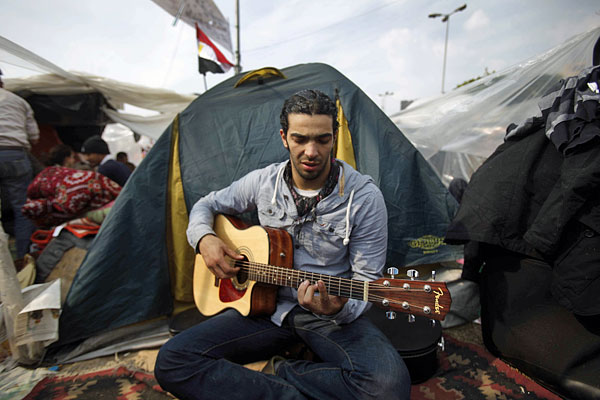
I like this song's flow, its lyrics, the calculated urgency of the Donjewan. Its slow, measured beats, convey a sense of dread, and the simple, repetitive guitar playing adds to the effects. I especially like the chorus, which can be translated as: What we did at first we'll do again Tantawi if our demands aren't implemented. (It's very poetic and effective in Arabic.)

(Once again, I urge someone who can do it quicker and more effectively than me to translate the lyrics of this song.)

You can download the song for free here.

Donjewan put out a song right before the start of the revolution, called "Against the Government," that was quite fantastic as well. Check it out here.

The title of this post: No SCAF Rap, is lifted from the 3Arabawy blog, where I first learned about this song.

(Footnote: the wikipedia entry on Tantawi says he's of Nubian origin, but the sources for this claim are gone. Is this true?)

UPDATE (later the same day): Robin translated a bit more: "Oh Tantawi, my brother's blood is very dear, and we are not making threats... where is the right of the poor, the one who died?"

Ultras in kufiya (Cairo, Tahrir)

One of the great stories from the Egyptian revolution is how the "ultras" (fanatical football/soccer fans) of Cairo's two main clubs, Ahli and Zamalek, played a key role in defending, and in fact saving, the Revolution, on the night of February 2nd. When I was in Cairo, a good friend (and a reliable source) told me about how, on that night, when the thugs (baltagiyya) of the regime attacked, the word was sent out from ultras on the square, and 2000 more ultras showed up to organize those on Tahrir, many of them middle class youths not so accustomed to street fighting, as well as to fight for the revolution themselves. As my friend explained, the "ultras" detest the police, who have been as tough on them as on any Egyptians causing "trouble," or not. They've experienced the beatings, the torture, the abuse that so many young Egyptians have routinely faced at the hands of Egyptian security. And, what is more, the ultras have lots experience fighting the police and the security. The other key force that came to the rescue of the revolution on the night of February 2 were the Muslim Brothers. Their leadership was also called from the square when the regime thugs launched their attacks, and so the Brothers sent out about 2000 of their own "self-defence squads," i.e., their toughs, their enforcers. A coalition of ultras and Ikwhan therefore saved the revolution that night, along with the less-experienced but willing-to-fight thousands of pro-democracy demonstrators who were already there. (A great source on the intersection of politics and Middle East soccer is James Dorsey's invaluable blog, The Turbulent World of Middle East Soccer. He has posted several times about the role of the ultras in the Egyptian revolution.)

This Friday, July 15, the Brotherhood boycotted the protests at Tahrir. But the ultras were there, as this photo, and account, from 3Arabawy, shows. And I quote:


Ahmed Bahar and Tarek “Masaken” of Zamalek’s Ultras White Knights in Tahrir Square on Friday night. 


I had an interesting chat with Tarek, a young UWK member who’s also a staunch pro-Palestine supporter. He told me he’s been attending demos in solidarity with Palestine since he was a prep school student. Both Bahar and Tarek in addition to thousands of other UWK members took part in the January uprising, and their role, as well of that of the Ultras Ahlawy, were sometimes central in confrontations with the Central Security Forces troops on the Friday of Anger, and against the thugs during the “Battle of the Camel” on 2 February.

It's great to learn that some of the ultras are not just struggling for democracy in Egypt, but are also supporters of the struggle of the Palestinians. And please note the Che t-shirt.

Wednesday, May 11, 2011

Folk music of Isamailiyya: the El Waziry Group

One of the best things I did while in Cairo in late March was to go to see the El Tanbura group perform at El Tanbura Hall in Abdeen. El Tanbura play the music of Port Said, which is well-known for the fact that its central instrument is the simsimiyya, a lyre of very ancient origin. (There are paintings of the instrument on the tombs of the Pharaohs.)

Here's a photo of El Tanbura Hall, from the outside.


And here's a shot of some of the members of the group, from their concert on March 24. The photo shows two simsimiyyas. I filmed the concert, and hope, eventually, to post some of the concert footage on youtube.


El Tanbura Hall is a project of the El Mastaba Center for Egyptian Folk Music. You can read about El Mastaba here. It was founded by Zakaria Ibrahim, who I met, and who performs with El Tanbura. El Mastaba sponsors a posse of groups who perform regularly at El Tanbura, including Rango, who are absolutely terrific and who you can read about here. El Mastaba has also issued a number of CD's, which are excellent, and are for sale at El Tanbura Hall.

El Mastaba participated actively in the Egyptian Revolution. Three groups associated with El Mastaba performed in Tahrir Square when it was occupied by pro-democracy forces: the Hinna band from Suez, from the El Tanbura band (Port Said), and the El Waziry band from Ismailiyya. Please watch a video of the El Mastaba groups at Tahrir here.

I recently read the posting below on Facebook, announcing a concert by the El Waziry group. I reproduce it below, because it provides an invaluable account of the history of the "popular art of Ismailiyya," which flourished from the 50s til 1967, and which El Mastaba is doing its best to revive and to promote. I don't know who wrote the text below (it's translated from Arabic), but I hope the author will not mind my attempt to recirculate it. It announces a performance by the El Waziry group at El Tanbura Hall, that will happen tomorrow, Thursday May 12. Wish I could be there. In the meantime, I do have a CD from El Waziry himself: El Wazery & Suhbagiyya, Wallah Zaman (El Mastabah Center for Egyptian Folk Music, 2006).

El Mastaba Center for Egyptian Folk Music presents

El Waziry Group

The three cities of the Canal (Port Said, Ismailiyya and Suez) share similar traditions of music and song, though each has its special features.

Three tributaries combined to bring these arts to Ismailiyya, which is located half-way along the Canal. The first of these was the Sudanese, who have lived in the oldest quarters of the city–the “Slave Stockades” (‘arayshiyyit il-‘abid)—since it was built in the last third of the nineteenth century. The second was the interaction of local musicians with others from Port Said or Suez, as well as with the shipping passing through the Canal, which, at the end of the 1930’s, brought the instrument known as the simsimiyya (a type of lyre). And the third was the influence of the other shores of Lake Manzalla, at one end of which Isma’iliyya lies, and especially that of the fisher families living in ‘Izbit el-Bahtini, who brought with them fishing songs and the songs of the damma (“street gathering”- a genre with its roots in Sufi music).

On the streets of the city, these tributaries mingled to produce what may be called “the popular art of Ismailiyya,” which flourished from the beginning of the 1950’s up to the war of June 1967.

After the war, the inhabitants of the city were forced to migrate to areas further inside Egypt, far from the battle line. In their diaspora, in the cities and villages and displacement camps, the people of Ismailiyya survived, and shared their singing with the displaced from Port Said and Suez, to the accompaniment of the simsimiyya, which, with its songs expressive of their common concerns, played an important role in creating a bond among them.

With the end of the war and the return of the displaced to their cities, things were different, in Ismailiyya as in the rest of Egypt. When the “open door” economic policy was adopted, social values changed and, at the beginning of the 1970’s, the trend towards commercialism started to take over the old artistic tradition. Competition for the rich pickings of the wedding market intensified, leading to the withdrawal from this field of the authentic musicians, as some died and others retired.

Only one, the musician Muhammad El-Waziri, refused to retire into obscurity and continued to cherish his own simsimiyya, though he had no idea what to do with it on his own. Things changed when El-Waziri met the writer, and embarked on a relationship with the Tanbura troupe experiment in Port Said, which attempted to collect the music and songs of Port Said by bringing together the old musicians, who, like their fellows in Ismailiyya, had gone into retirement.

The legend "Muhammad El-Waziery" the king of simsimiyya at Canal zone had passed away in 2008 in the age of 73 years old, cuddling the simsimiyya instrument and leave the heritage of Ismailia city in the hand of his troupe which he was the leader of it (Souhgbagya group) and we changed its name to "El Waziery group" in recognition of his history and saving the heritage of Ismailia city.

Now there was hope that what had happened in Port Said might happen in Ismailiyya, as, together, we were able in the same year to begin the foundation of the El Waziery troupe, by bringing together the old popular musicians of Ismailiyya to prevent the loss of this heritage.

To date the El Waziri Group have performed a number of times, in Ismailiyya itself and in Port Said, Suez and Cairo, gaining new friends all the time.

Thursday, May 05, 2011

Even more Ahmed Basiony (Bassiouny)

Ahmed Bassiouny, Tahrir Square, Feb. 28

Here is a fabulous website dedicated to Ahmed Basiony (Bassiouny), an incredible teacher, visual artist and sound artist. Lots of photos of his art and of his teaching and sound art workshops. Examples of his music. Articles about him. I recommend exploring in depth. I need to explore more myself. The more I learn about him, the more I am saddened, and the more I am impressed. One of 800+ martyrs of the Egyptian revolution, he fell to sniper bullets on February 28th, at Tahrir Square. May his spirit endure in Egypt's future.

Saturday, March 05, 2011

More on Ramy Essam and Ahmad Fouad Negm

(Michael Robinson Chavez / Los Angeles Times)

On February 9, which now seems so long ago, I wrote a post called "Music of the Egyptian Revolution." Included in it was the now famous youtube vid of Ramy Essam singing "Irhal" (Leave, or, Go Away). I also included a vid of a song about a donkey refusing to step down for a younger one, but I was unable at the time to identify either the lyrics or the singer.

Since then many have written about the music of Egypt's revolution, and I'm able to identify the song and the lyrics. It's Ramy Essam (again), and the lyrics are by the celebrated revolutionary poet Ahmad Fouad Negm, the lyricist for Egypt's beloved revolutionary singer Shaykh Imam.

An article in The Los Angeles Times about Essam gives the story of his performance of the song on Tahrir:

One song that he relished, and that late at night the crowd would want to hear again and again, was an ode written by well-known poet Ahmed Fouad Negm: "The Donkey and the Foal," which everyone knew to be a commentary on Mubarak and his son Gamal.

Essam had written the music and played it for himself alone at home before the revolution. And now everyone shouted for the scathing lyrics of the aging poet, who had been jailed under Mubarak's predecessor. He felt honored when the poet stood with him and recited the words.

The foal said to the donkey, "Father, hand me the cart. Father, you have aged and now it is my turn."

The donkey coughed too strongly and the passengers panicked.

"It isn't about health, son," the donkey said. " Even the bridle is too big for you, son. Think and don't be greedy, or the passengers will rise up."

Since Hosny Mubarak's resignation, Ramy Essam has received a great deal of media attention, and has become something of a celebrity. Featured in the article in The Los Angeles Times, mentioned above, celebrated by Mark Levine in The Huffington Post (Levine produced a remix of "Irhal" as well--I respectfully prefer the original), an featured in an article in The Guardian by respected Middle East music commentator Andy Morgan, who calls Essam the Billy Bragg of Tahrir Square.

Before you imagine that Ramy Essam has gone all rock star, check out this video. It shows Essam performing his song "Irhal" on Tahrir Square to a big crowd. Later that night, the crowd at Tahrir is attacked by Mubarak's thugs. The pro-democracy forces keep them at bay. The video then shows Ramy Essam on the following morning. He stayed the night, and was wounded on the head by the rocks hurled by the counter-revolutionary goons. As far as I can tell, this occurred on the night of February 4-5, 2011. I don't know many "rock stars" who have the street fighting cred and the courage of Ramy Essam. I don't know if I know of anyone, in fact. Below is a screen grab of Ramy with his head bandage, and then, the full video.


This video shows Essam singing "The Donkey and the Foal" before a small group, on Tahrir, and also performing "Irhal," on another occasion, before a large crowd at the square.

This vid is a full version of "The Donkey and the Foal."

Here's Negm's poem in Arabic:

الجحش قال للحمار *** يابا اديني الحنطور

يابا انت سنك كبر*** و وجب عليا الدور

كح الحمار كحة *** فزعت لها الركاب

مش يابني بالصحة *** ده كل شئ بحساب

وسواقة الحنطور *** محتاجة حد حكيم

وانت عينيك فارغة *** همك علي البرسيم

قوللي تسوق ازاي *** والتبن مالي عينيك

ده حتي حبل اللجام *** واسع يا ابني عليك

اعقل وبطل طمع *** لاتسخن الركاب

ما تجيش يا واد جنبهم *** لاتبقي ليلة هباب

دول صنف ناس جبار *** قادر مالوهش امان

يبان عليهم وهن *** لكنهم فرسان

يابا دا نومهم تقل *** وبقاله يابا سنين

كل البشر صحصحوا *** ولسه دول نايمين

يا جحش بطل هبل *** وبلاش تعيش مغرور

ركابنا مش اغبيا *** ولا عضمهم مكسور

بكرة حيصحولك *** ويزلزلوا الحنطور

وتلاقي في قفاك *** تمانين خازوق محشور


And you can find out more about Ramy Essam, and download some of his music (although not the songs discussed above) from his Facebook page.

Friday, February 18, 2011

Wisconsin/Tahrir (+kufiya)

Lots of evidence that demonstrators in Wisconsin against Gov. Walker's draconian anti-labor bill is inspired, in part, by recent events in Egypt. Check out this photo of a kufiya-clad demonstrator, from a fabulous video of the last three days of protests, with a stirring soundtrack from Arcade Fire.

Wisconsin Budget Repair Bill Protest from Matt Wisniewski on Vimeo.


Check out this headline from an article on Boing Boing: "Midwestern Tahrir: Workers refuse to leave Wisconsin capital over Tea Party labor law."

Protesters also evoked Egypt's democracy struggle, on their first day at the Capitol--I'll add those links when/if I can find them.

Monday, February 14, 2011

“Hold your head up high, for you are an Egyptian.”

Yasmine El Rashidi's article, "Freedom," in the New York Review of Books, really captures the euphoric atmosphere at Tahrir Square at the moment of the end of Mubarak. And it ends with this:

As I write this, a youth pop group is giving a concert in Tahrir Square, singing: “its the beginning, the beginning of your life, the beginning of stability, the beginning of security, the beginning of your life, say yes yes, say yes yes.” The crowd is waving flags and singing back.

I hope I can find out more about this unidentified group, and come back to this in future. This serves as a place holder. (Someone please message me!)

Sunday, February 13, 2011

Natacha Atlas, Egypt: Rise to Freedom Remix

The inimitable Natacha Atlas has released a remix of material her from most recent (and highly recommended) album Mounqaliba, in solidarity with the struggle of the people of Egypt. It's a wonderful remix, and the video footage, all from Tahrir, is quite stunning.


Please go to Natacha's webpage for an English translation of the lyrics.

Here's a sample:
Let us know there is a land
where words are the purveyors of truth,
heads are held high,
And human will is regarded above all.

I've posted about Natacha several times in the past. Here's my account of her performances in Chicago in 2006.

Saturday, February 12, 2011

Singing/chanting on Tahrir Square

This is a wonderful video, because it is yet another example of the great creativity and humor unleashed by the Egyptian Revolution, and because it demonstrates quite dramatically that the revolution was not simply a revolution of young, hip, middle class tweeters. Check out the chants (I've cribbed these from Haithem, who posted them on Facebook):

"e7na meen ou huwwa meen.. e7na el 3amel wil falla7.. ou huwwa 7arami linfita7.."
Who are we and who is he?... we are the laborer and peasant.. and he is the thief of the Infitah [Egypt's 'opening' --economic reforms, structural adjustment, etc.)

"e7na meen ou huwwa meen.. huwwa byelbes akher modah.. ou e7na bneskon 3ashara b2ouda.."
Who are we and who is he.. he wears the latest fashion.. and we live 10 in a room.

Wednesday, February 09, 2011

Music of the Egyptian Revolution

It's been pouring out, released in a fury of creativity set off by the astonishing events in Egypt over the last 16 days. Tahrir Square itself is one center. Check out this amazing video, of a singer and guitar (not shown), singing some of the key slogans of the uprising, with the crowd chanting and singing along. [Added February 12: I've learned his name: Ramey Essaam.] What is remarkable and rather surprising is that the song resembles "unplugged" grunge. This particular video helpfully translates the lyrics into English. But it makes a mistake in the beginning. Re: Mubarak, it should read: "We want to make Hosni Mubarak hear our voices!"


The original video (here) has gone viral. 545,932 views as of this writing.

Numerous accounts suggest that this is typical of what is going on at Tahrir Square on a daily basis. A group of people gathered around a singer (injured in the fights against the security forces or the pro-Mubarak thugs in earlier days) and an 'ud player, singing along with a tune that they have just learned from these two men, "Expel Hosni Mubarak." The men resemble roaming troubadors. These lyrics are translated as well.


And chants are song throughout the day and night. Here are some comic ones (which someone will hopefully at some future moment translate).


The last of the Tahrir songs is this one. Accompanying himself on guitar, the singer sings a comic song about a donkey refusing to step down for a younger one--an allegory about the old man Mubarak.


One more thing to add is that, according to Angry Arab, it is the songs of Abdel Halim Hafez that are played most often over the soundsystems on Tahrir. My friend Gamal Eid has also remarked that one hears the songs of Egypt's most beloved and important revolutionary singer, Sheikh Imam, on Tahrir.

Then there are the solidarity songs from "outside." One of the most impressive is Mohamed Mounir's "Azzay? (Why?)." Mounir, an Egyptian Nubian, has been a huge star, of music, cinema and theater, since the mid-1970s. Clearly this song was recorded prior to the outbreak of the uprising, but the video is full of scenes of the revolt, and the lyrics, ostensibly those of a love song, can also be read as a kind of allegory about Egypt and its conditions. The song is slamming, the video very moving. The video opens with the words: To every Egyptian citizen who participated in January 25...or who didn't participate. (There's a rough translation to the song in the comments.)


"Back Down Mubarak!" is a very lively, upbeat and oldschool sounding rap from Master Mimz, a Moroccan woman rapper, born in Casablanca, now based in England. The video features many shots of women who have participated in the protests.


There is also this rap, "#Jan25 Egypt," from Freeway, The Narcicyst, Omar Offendum, HBO Def Poet Amir Sulaiman, and Canadian R&B vocalist Ayah. Freeway's rap in particular is very compelling, at about 2:50.


In a quite different vein is this very beautiful chant from the Kuwaiti munshid, "Egypt Prayers." There is a rough translation into English in the comments.


There is "Long Live Egypt," by Scarabeuz and Omima. Scarabeuz's dad is Egyptian, his mother Dutch, and he was born in Berlin, where he is still based.

I at first thought the song was a little too sentimental and shlocky, but I came to like it more after listening to it all the way through. The images are quite moving, and the auto-tuned effects are endearing.


Finally, there's the free release, the Khalas Mixtape Vol. 1: Mish Ba'eed. With songs from rappers based in Tunisia, Algeria, Egypt and Libya. I particularly like the tracks from Tunisia's El Génèral and Algeria's Lutfi Double Kanon. Download it here.


Long live Egypt!

Essential links on Egypt

Compiled by Seham, posted by Arabist. As of February 8.

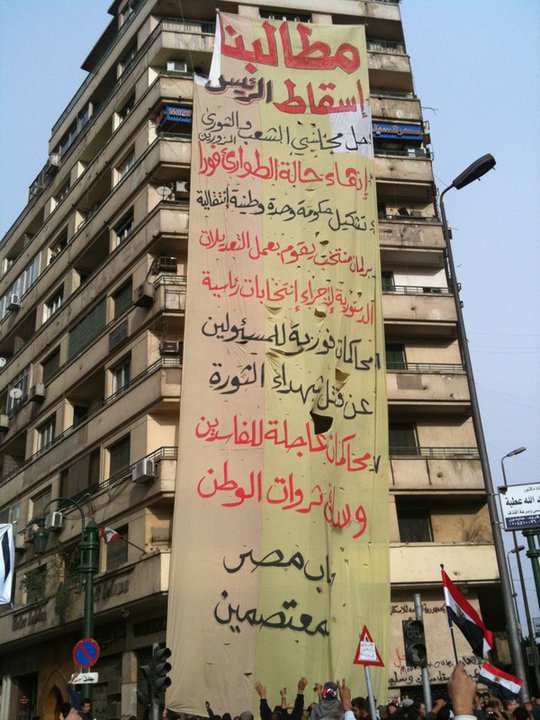
The Egyptian Democracy Movement's Clear and Non-negotiable Demands

Here they are, clear and consistent. Let's circulate them widely and support them tenaciously. They were posted on a huge banner on Tahrir Square a few days ago. The movement is sticking to them.

Mubarak should step down from power immediately.

Dissolving of the national assembly and the senate.

Establish a “national salvation group” that includes all public and political personalities, intellectuals, constitutional and legal experts, and representatives of youth groups who called for the demonstrations on the 25th and 28th of January. This group is to be commissioned to form a transitional coalition government that is mandated to govern the country during a transitional period. The group should also form a transitional presidential council until the next presidential elections.

Drafting a new constitution that guarantees the principles of freedom and social justice.

Prosecute those responsible for the killing of hundreds of martyrs in Tahrir Square.

The immediate release of detainees.


This is from an absolutely essential article by Anthony Alessandrini, "Non-Negotiable," in Jadaliyya.

Sunday, February 06, 2011

Cross and Qur'an at Tahrir Square

This is one of many incredible photos from a wonderful gallery published by The Guardian. Very significant.

Here's the caption:
Protesters hold a Christian coptic cross and copies of the Qur'an as they take part in 'Sunday of the martyrs'. Photo: Amel Pain/EPA

Friday, February 04, 2011

Ahmed Basiony, Tahrir Square martyr, electronics musician

Ahmed Basiony was a brilliant Egyptian electronics musician.

Ahmed at Tahrir Square, Jan. 25, 2011

Please check out these videos of Basiony live in concert.

Ahmed basiony & Abou Asala - "Abou Asala aal Dish". from Basiony on Vimeo.


EL KHATIA - remix from Basiony on Vimeo.

Ahmed, 31, taught in the Art Education, Painting and Drawing department at Helwan University. He was the father of two children. He was killed on Friday January 25 at Tahrir Square, while participating in the pro-democracy demonstrations. Cause of death: asphyxiation from tear gas. Source of tear gas: USA.

There are facebook pagse dedicated to him here and here. And here's a tribute to him at the blog disquiet.

You can also find videos of him performing on youtube. I think the ones from Vimeo, above, are the best ones.

Basiony was a collaborator with experimentalist Mahmoud Refat, founder of the label 100 copies. The site (100copies.com) has been offline since the uprising. I hope this changes soon.

RIP. الله يرحمه

More kufiyas from the Tahrir Commune

The first two photos are from a wonderful photo gallery, courtesy Time Magazine, "A Night at Tahrir Square," photos by Jacopo Quaranta.

The caption reads: "Tahrir Square, February 3. After two days of clashes with pro-Mubarak groups, demonstrators calling for the end of the regime of Hosni Mubarak remained on Tahrir Square. This woman, a former television journalist, occupied a checkpoint on the square, where she checked women who wished to enter."

I love how stylish her kufiya is, and I want to know where to get one like this!

This photo, from the same photogallery, reads: "Headrest. A demonstrator sleeps on the truck [a burned-out police truck]."


This is a screensave from tonight's Parker Spitzer show on CNN, during the segment where they interviewed the well-known Egyptian blogger and tweeter Sandmonkey. It was a phone interview, so CNN rolled some images, and they showed some good ones. This shot is of two demonstrators on Tahrir Square, bandaged up from wounds incurred from the attacks of thugs sent after the democracy forces by the Egyptian government. Upwards of 500 were wounded in the attacks of the night of February 1-2, which the democracy forces successfully repelled. You can read a good account of it here, by Hani Shukrallah.

The comparison of the democracy forces on Tahrir Square to the Paris Commune of 1871 comes from an essay posted today on Jadaliyya by Sinan Antoon.