Saturday, May 21, 2011

Kufiya and some Islamic refs in Digable Planets' "Where I'm From"


"Where I'm From" is off of Digable Planet's first album, Reachin' (A New Refutation of Time and Space), released in 1993. The best known single from the album is "Rebirth of Slick (Cool Like Dat)," a Grammy winner for best rap performance by a duo or group, and a crossover hit. Due to the album's jazzy feel and its apparently pop and light feel, the group was hailed by white hipsters and, as a consequence, got a reputation for being the opposite of hard and "street." A look at the video for "Where I'm From," which is all "street" scenes, and an investigation of the lyrics reveal that this impression was quite mistaken, and that there was a great deal of continuity between Reachin' (A New Refutation of Time and Space) and their second, much more overtly political album, Blowout Comb.

What I want to point out here are a few "Islamic" references. The kufiya worn by one of the Digable's posse in the video is one. As is the shot of some members of the Nation of Islam (NOI), including a woman in distinctive NOI dress (on left) and the man in bowtie, who looks like a member of NOI's paramilitary organization, Fruit of Islam. (Ladybug, a.k.a. Ladybug Mecca, is at the right.)


One line from Butterfly, whose influences seem not to drawn from any Islamic sources, goes "We be reading Marx where I'm from."

Meanwhile, one of Doodlebug's lines goes, "That's most asked by 85, where I'm from." This is a reference to the beliefs of the Nation of Gods and Earths (Five Percenters), that the world is divided into the 5%, those with knowledge of self, the poor righteous teachers, the "gods," the 10%, the bloodsuckers of the poor, who teach lies for the sake of personal gain, and the 85%, the masses, the people who are ignorant of the truth -- but to whom the 5% attempt to bring true knowledge.

Doodlebug (Craig Irving) hung out with Five Percenters while a student at Howard University. I don't know whether he considers himself to be a full-fledged "God," but he now goes by the name Cee Knowledge -- a very Five Percenter sounding name -- and tours with a group called Cee Knowledge & the Cosmic Funk Orchestra. The Digables' second album, Blowout Comb, is full of Five Percenter wisdom and references.

As for Butterfly (Ishmael Butler), his terrific, experimental-rap musical project Shabazz Palaces references the name of the ancient tribe that, according to NOI doctrine, settled in Mecca and then was led by a scientist, named Shabazz, into Africa. It was also the surname adopted by Malcolm X.

Shabazz Palaces' first performance in Seattle (where Butler is from) earlier this month certainly played up the Afro-Islamic imagery. Check out how Butler/Butterfly, who goes by the moniker Palaceer Lazaro, was decked out.


This was the poster for the show.


And check out the cover of Shabazz Palaces' 2009 album, Of Light.


My last example of Shabazz Palaces' crypto-Islamic references is from the group's 2009 video, "Bellhaven Meridian," directed by Kahlil Joseph, shot in Watts, which is a kind of tribute to Charles Burnett's film Killer of Sheep.

In this video the Arabic word
ينقذنا
appears at 0:36. It means "he saves us." I have no idea how it fits into the theme of the video.


Shabazz Palaces has recently been signed by Sub Pop, the first rap group the Seattle label has ever signed, and has an album called Black Up, due out in June.

One last thing. Cee Knowledge recorded a version of "Space Is the Place" with the Sun Ra Arkestra. Check it out. (Five Percent knowledge is afro-futuristic too.)

Thursday, May 19, 2011

Cleo Cola: Popular Orientalism

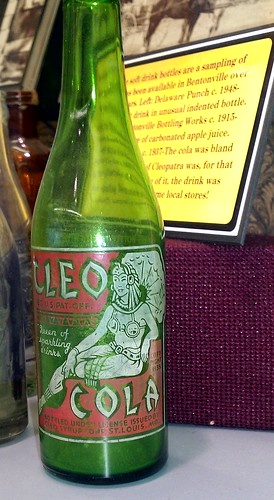
Cleo Cola by tsweden
Cleo Cola, a photo by tsweden on Flickr.


I found this item at the Walmart Visitors Center (the Walmart museum) in Bentonville. It's part of a display of soft drinks that used to be sold in Bentonville over the last several decades. Cleo Cola, the "Queen of sparkling drinks," bottled in St. Louis, was introduced in 1935 by the Whistle Company.


Note the resemblance of the outfit worn by Cleo to the popular Orientalism developed by the likes of Maude Allen and other Salomé dancers. I posted about this briefly here.

Friday, May 13, 2011

Popular Orientalism: Tuli Kupferberg in "Voulez-Vous Coucher Avec God?"


Here's another example of "popular" Orientalism, put to avant-garde and subversive purposes. It's not quite as subversive and avant-garde as Jack Smith's work, but it is still of interest.

I learned of this 1972 film, directed by Michael Hersh and Jack Christie, from a Facebook post by the Moorish Orthodox Church of America. It's called Voulez-Vous Coucher Avec God?, and all I really know about it is from this opening segment, featuring Tuli Kupferberg (of The Fugs) as God. God who speaks English with a strong Eastern European Jewish accent. God who smokes hash from the houka.


God who lives in Hashish Seventh Heaven, surrounded by a harem of barebreasted hippy bellydancers. Who loves Al Jolsen's "Swanee." Who sings The Trashmen's surf-punk avant-le-lettre "Surfing Bird."


Kupferberg is hilarious in this clip. I'm ambivalent about the claymation stereotypical-black figure in tarbush who introduces the film (see above). The barebreasted 'houris' of the harem are typical of the sixties counter-cultural sexual revolution, which seemed in large part to be about hippy women taking off their bras and tops so that hippy men could ogle them. But I've only seen this clip, so there may be more too all this. A DVD should be out later this year. The film has played in New York recently in tributes to Kupferberg, who passed away in July 2010. J. Hoberman wrote an interesting if short review of the film in The Village Voice, calling it "strenuously druggy, anarchic, and blasphemous," and writing that Kupferberg's God is "an unkempt, hairy schmoozer, consorting with his female subjects in a vaguely Baghdadian crash pad".

I continue to be interested in how significant a role Orientalist images of the Arab world and the Middle East played in avant-garde, counter-cultural, and hippy pop cultural manifestations of "the sixties." Besides several posts in hawblawg on Jack Smith, I've also written posts on the film Performance (here and here) and a few asides. More to come. I don't want to claim that such deployments of "Orientalism" are necessarily progressive, but I am against a certain kind of dogmatic and all-too-common deployment of Said's critique of Orientalism, that describes any Western consumption of "The Orient" as "flexible positional superiority," and therefore, exploitative.

P.S. If you don't know The Fugs, please check out their brilliantly hilarious zen nihilist song, "Nothing." "Social anthropology, uckalcucka, nothing."

Vigon, '60s 'soul man' of France: a Moroccan, real name Abdelghafour Mouhsine

I just learned about Vigon thanks to Jeff, who posted an AFP article on Facebook. I used Google Translate, and then modified the translation. (My French is very far from perfect, so if yours is better, please correct any mistakes. The original is here.)

Vigon, Moroccan "soul man," emerges from obscurity 40 years later

AFP, Oct. 9, 2008

PARIS (AFP) - He was a vegetable vendor in Morocco before discovering soul at U.S. bases and then becoming a minor star in Paris in the '60s: thanks to a reissue, Vigon, the singer with an amazing voice, is experiencing a second youth [revival], 40 years later.

"What is happening now is what should have happened 40 years ago," marvels the affable sexagenarian, delighted that a new audience discovering his music.

The Barclay (Universal) label reissued in early September an album of his songs, "The End of Vigon," in its vinyl series "Back to Black" and its CD vintage series "Vinyl Replica."


Critics were quickly excited about his covers of great soul / rhythm 'n'blues songs of Bob & Earl, Ray Charles and Bo Diddley, discovering, amazed, that in the "sixties" France had a singer to rival African-American masters of the genre.


Critics highly praised the velvety voice of Vigon and the song arrangements, the strings and the hot sweet brass worthy of Motown or Stax, yet "made in France."


"Even when it came out 40 years ago, there was not this much enthusiasm!" smiled the Moroccan, in dark glasses, elegant clothes, and the mock [?] air of elegant black-American singer Sam Cooke.


Vigon took that nickname from his childhood, when he mispronounced the word "wagon" in school.


He was born Abdelghafour Mouhsine in Rabat in 1945. At first working as a greengrocer with his father, he fell madly in love with R & B at the U.S. military bases in Kenitra and Sidi Slimane and he learned the standards phonetically, since he does not speak English.


"I was going to the grunts' [troufions] dances every Saturday, and there, they bought the records that came from America on the week of their release," he recalls. "Twist and Shout" by the Isley Brothers, it was sung in Morocco before the Beatles covered it!"

In 1964, he was on vacation in Paris and went to the Golf Drouot, the Mecca of rock music. He went on stage, bluffing the public and then joined the Lemons, along with another young man named Michel Jonasz on keyboards.

The group scoured the [music] scenes, Golf Drouot or Bus Palladium, made [assied] its reputation and opened the first [concerts] [in France] of Stevie Wonder, Otis Redding, Wilson Pickett, Little Richard, the Who and the Rolling Stones.


"In late September, I went to see Stevie Wonder at Bercy: when I think of that time we spent in night clubs and how crazy it was!" exclaims Vigon, who will sing Saturday and Sunday a Cidisc (Convention of record collectors) in Paris and then on Oct. 15 at the Petit Journal Montparnasse.

One of his singles, "It's all over", was released in 1968 on the American label Atlantic. [check out "It's all over" here, on youtube] The previous year he released his only song in French, "Un petit ange noir"
[on youtube here].

He returned to Morocco in the mid 70's for two weeks. "I stayed 23 years!" he enjoys explaining that he was a singer in a hotel in Agadir.


In 2000, back in France, where 60's retro fashion was once again popular. Vigon the showman performed regularly at private parties, and his fans included other artists from Morocco, the comedians Gad Elmaleh and Jamel Debbouze, at whose wedding he sang.

"I'm sometimes asked if America did not tempt me. But I never imagined, coming from Morocco, so it's not bad!" he assures. "Kid, I slept on a sheepskin. Now, in hotels, they say: 'Do you like the room?' It makes me laugh!"

The entry on Vigon on the French wikipedia tells us that Vigon's recordings were a critical, but not a commercial, success. And that he and his group, opened for Otis Redding, Bo Diddley and Stevie Wonder, at their first performances in Paris, at the Olympia, in September 1966. The video of "It's all over" (link above) features a number of photos of Vigon with the acts he opened for, including this one, with Mick Jagger.

Please check out this scopatone of Vigon performing "Harlem Shuffle," originally recorded by Bob and Earl in 1963. It's a pretty divine cover, and the dancers are pure sixties go-go.


And here are the jackets for some of Vigon's releases. The EP with "Harlem Shuffle" and "Un Petit Ange Noir."

This single has a cover of The Righteous Brothers' "Unchained Melody." The hair is to die for.

The cover of Vigon's only single released in the US, on Atlantic. Quite remarkable, given that Aretha Franklin also recorded on Atlantic at the time. Not to mention Solomon Burke, Clarence Carter, Wilson Pickett, Sam & Dave, Percy Sledge, Joe Tex...


Here's a photo of Vigon with his soul review, at the Olympia. Looking very James Brown.


Here's Vigon (looking like Jimi Hendrix) with French pop star Claude François, known for, among other things, penning "Comme d'habitude," the original version of "My Way." What I wonder is, what language did these two speak when they met. Claude François, like Dalida, was born in Egypt, in Ismailiya. His mother was Italian, his father, who worked as a shipping traffic controller on the Suez Canal, was French. In 1951 the family moved to Port Tawfik. The family moved to Monaco when Egypt nationalized the canal in 1956. If I remember correctly from David McMurray's article "La France Arabe" (in A. Hargreaves and M. McKinney, eds., Post-Colonial Cultures in France), Claude used to speak Arabic when he got together with Dalida's brother Orlando, who also served as her manager. But perhaps the gap between Vigo's Moroccan dialect and Claude's Egyptian was too great.

This is what Vigon looks like today.


Many of the photos are from this informative blogpost.

While writing this up, I came across another article, from Jukebox, which I will summarize soon. In the meantime, it's here.

Wednesday, May 11, 2011

Kufiya (+dishdasha) Watch: Snoop Dogg in Abu Dhabi


Or as U-Cef has put it, Shaikh Dogg. Wearing the prototypical dress of the Gulf Arab, the white dishdasha and the kufiya. (My knowledge of Snoop is not as deep as it should be, so if someone can identify this song, I would appreciate it.) Here's the video, filmed at Yas Arena, Abu Dhabi, UAE, May 6, 2011. (The screen grab is from this vid.)

Folk music of Isamailiyya: the El Waziry Group

One of the best things I did while in Cairo in late March was to go to see the El Tanbura group perform at El Tanbura Hall in Abdeen. El Tanbura play the music of Port Said, which is well-known for the fact that its central instrument is the simsimiyya, a lyre of very ancient origin. (There are paintings of the instrument on the tombs of the Pharaohs.)

Here's a photo of El Tanbura Hall, from the outside.


And here's a shot of some of the members of the group, from their concert on March 24. The photo shows two simsimiyyas. I filmed the concert, and hope, eventually, to post some of the concert footage on youtube.


El Tanbura Hall is a project of the El Mastaba Center for Egyptian Folk Music. You can read about El Mastaba here. It was founded by Zakaria Ibrahim, who I met, and who performs with El Tanbura. El Mastaba sponsors a posse of groups who perform regularly at El Tanbura, including Rango, who are absolutely terrific and who you can read about here. El Mastaba has also issued a number of CD's, which are excellent, and are for sale at El Tanbura Hall.

El Mastaba participated actively in the Egyptian Revolution. Three groups associated with El Mastaba performed in Tahrir Square when it was occupied by pro-democracy forces: the Hinna band from Suez, from the El Tanbura band (Port Said), and the El Waziry band from Ismailiyya. Please watch a video of the El Mastaba groups at Tahrir here.

I recently read the posting below on Facebook, announcing a concert by the El Waziry group. I reproduce it below, because it provides an invaluable account of the history of the "popular art of Ismailiyya," which flourished from the 50s til 1967, and which El Mastaba is doing its best to revive and to promote. I don't know who wrote the text below (it's translated from Arabic), but I hope the author will not mind my attempt to recirculate it. It announces a performance by the El Waziry group at El Tanbura Hall, that will happen tomorrow, Thursday May 12. Wish I could be there. In the meantime, I do have a CD from El Waziry himself: El Wazery & Suhbagiyya, Wallah Zaman (El Mastabah Center for Egyptian Folk Music, 2006).

El Mastaba Center for Egyptian Folk Music presents

El Waziry Group

The three cities of the Canal (Port Said, Ismailiyya and Suez) share similar traditions of music and song, though each has its special features.

Three tributaries combined to bring these arts to Ismailiyya, which is located half-way along the Canal. The first of these was the Sudanese, who have lived in the oldest quarters of the city–the “Slave Stockades” (‘arayshiyyit il-‘abid)—since it was built in the last third of the nineteenth century. The second was the interaction of local musicians with others from Port Said or Suez, as well as with the shipping passing through the Canal, which, at the end of the 1930’s, brought the instrument known as the simsimiyya (a type of lyre). And the third was the influence of the other shores of Lake Manzalla, at one end of which Isma’iliyya lies, and especially that of the fisher families living in ‘Izbit el-Bahtini, who brought with them fishing songs and the songs of the damma (“street gathering”- a genre with its roots in Sufi music).

On the streets of the city, these tributaries mingled to produce what may be called “the popular art of Ismailiyya,” which flourished from the beginning of the 1950’s up to the war of June 1967.

After the war, the inhabitants of the city were forced to migrate to areas further inside Egypt, far from the battle line. In their diaspora, in the cities and villages and displacement camps, the people of Ismailiyya survived, and shared their singing with the displaced from Port Said and Suez, to the accompaniment of the simsimiyya, which, with its songs expressive of their common concerns, played an important role in creating a bond among them.

With the end of the war and the return of the displaced to their cities, things were different, in Ismailiyya as in the rest of Egypt. When the “open door” economic policy was adopted, social values changed and, at the beginning of the 1970’s, the trend towards commercialism started to take over the old artistic tradition. Competition for the rich pickings of the wedding market intensified, leading to the withdrawal from this field of the authentic musicians, as some died and others retired.

Only one, the musician Muhammad El-Waziri, refused to retire into obscurity and continued to cherish his own simsimiyya, though he had no idea what to do with it on his own. Things changed when El-Waziri met the writer, and embarked on a relationship with the Tanbura troupe experiment in Port Said, which attempted to collect the music and songs of Port Said by bringing together the old musicians, who, like their fellows in Ismailiyya, had gone into retirement.

The legend "Muhammad El-Waziery" the king of simsimiyya at Canal zone had passed away in 2008 in the age of 73 years old, cuddling the simsimiyya instrument and leave the heritage of Ismailia city in the hand of his troupe which he was the leader of it (Souhgbagya group) and we changed its name to "El Waziery group" in recognition of his history and saving the heritage of Ismailia city.

Now there was hope that what had happened in Port Said might happen in Ismailiyya, as, together, we were able in the same year to begin the foundation of the El Waziery troupe, by bringing together the old popular musicians of Ismailiyya to prevent the loss of this heritage.

To date the El Waziri Group have performed a number of times, in Ismailiyya itself and in Port Said, Suez and Cairo, gaining new friends all the time.

Thursday, May 05, 2011

Even more Ahmed Basiony (Bassiouny)

Ahmed Bassiouny, Tahrir Square, Feb. 28

Here is a fabulous website dedicated to Ahmed Basiony (Bassiouny), an incredible teacher, visual artist and sound artist. Lots of photos of his art and of his teaching and sound art workshops. Examples of his music. Articles about him. I recommend exploring in depth. I need to explore more myself. The more I learn about him, the more I am saddened, and the more I am impressed. One of 800+ martyrs of the Egyptian revolution, he fell to sniper bullets on February 28th, at Tahrir Square. May his spirit endure in Egypt's future.

Eskenderella, "Rag'een"

For the moment, this is just a place maker, and a tribute. I really like the Alexandrian music group Eskenderella. (And think about it, what a clever name!)

This is their song, Rag'een (returning), their tribute to the Egyptian revolution, and their first video. It is far better than most of the songs of and for the revolution that I have come across. It is certainly far superior to and has way more integrity than any of the martyr pop critically discussed by Dan Gilman. (See my earlier post here.)


Hopefully, in future, I will learn more. In the meantime, here's the one bio I've been able to find on the web. They are known for doing material by Sayyid Darwish, Shaykh Imam, and Ziad Rahbani, as well as original numbers.

Monday, May 02, 2011

Cumbia kufiya: DJ Juan Data (+ Bin Laden)

Yes, I know that today is the day that Osama Bin Laden's death/targeted killing was announced. But my thoughts are a swirl of emotion and feeling and inchoate analysis. And life must go on. So here is another in my ongoing posts on kufiyas. (But as I turn to cumbia + kufiyas, it turns out that there is a Bin Laden connection.)

DJ Juan Data is a very interesting dj who hails from Buenos Aires, Argentina, and who has resided in San Francisco since 2001. (Oooo, significant year for OBL.) His work is in the contemporary cumbia vein, mixing cumbia with funk and hip-hop and soul and...


I like this image, from his 2009 Linyerismo mix (which you can download here). DJ Juan Data typically performs in the distinctive wrestler mask.

And, sometimes, in kufiya.

Here are some cool cumbia '45s to download, courtesy Juan Data. And here's some more info about him.

I learned about Bin Laden cumbias from a 2008 post on mudd up! It mentions a song, identified only as "2nd de la Cumbia Bin Laden," and says it is "an anti-war New York cumbia tune about the gringo response to the World Trade Center attack, from 2002." It's a straight cumbia number, and I've been able to identify the artist: Internacional Gitano. Since then, I've found several "Bin Laden" cumbias. I find them interesting, but don't have much if any idea about what they're about or what their significance is. In most cases the OBL reference seems to mark the fact that the song is a cumbia-bhangra mash-up, as in the case of "Cumbia de Osama":


or "La guitarra de Bin Laden":


Whereas "Guitarras Talibanas" has a South Asian vocal but isn't so bhangra.


Wish I could tell you more about these Bin Laden cumbias. And hopefully someone will, in future. In the meantime, let them remain swathed in mystery.

Saturday, April 30, 2011

Rap of the Syrian Revolution

First rate analysis by Nahrain Al-Mousawi of the only Syrian protest rap ("Communiqué No. 1") I know of that has appeared in the wake of the Arab Spring's spread to Syria. I suggest reading the entire article. Below I excerpt the lyrics that Nahrain translates:

The vid opens with the statement: “The revolution is faceless”

Statement [Communiqué[ No. 1
The Syrian people won’t be degraded
Statement No. 1
We won’t remain like this
Statement No. 1
From Houran* came the good news
Statement No. 1
The Syrian people are revolting …

You exterminated Hama as if it were nothing
Today our rights are in our hands and we will not forgive...

We live in silence/ It’s been years
how long do we have to stay like this—dead...

You sold the Golan for cheap
You sabotaged the cause and defiled it
History shows that no oppressor ever lasted
We will realize our dream of freedom even if it costs blood
The government is destined to fall
The king either flees or is buried

The vid ends with these lines from Syria's famous poet Nizar al-Qabbani:

How do we write with locks on our mouths
Marking each second for the butchers to arrive
I carried my poetry on my back and it has exhausted me
What will happen to the poetry when it collapses.

*Der'aa, where the revolt started, is in the Houran.

Now, watch the vid:

Friday, April 29, 2011

Dan Gilman on Egypt's new 'martyr pop'

I recommend, for your reading pleasure and for your edification, Dan Gilman's piece on Egypt's new "Martyr Pop." He shows how pop stars like Hamada Helal, Amr Diab, Tamer Hosny, and Mohamed Fouad have, post-Mubarak, produced songs and videos dedicated to the martyrs of the revolution. As Gilman, a graduate of the University of Texas' Anthropology Department and currently on a post-doc in Cairo, shows, these seem like belated attempts by artists not known for their strong support for the pro-democracy movement, and in some cases, as backers of Mubarak, to revive their reputations. The attempt seems lame. But the analysis is strong.

This is not the first time that Egyptian pop artists have attempted to express their solidarity with martyrs, with mixed results. See Elliott Colla's article on Egypt's pop intifadiana, "Sentimentality and Redemption: The Rhetoric of Egyptian Pop Culture Intifada Solidarity," in the book I co-edited with Rebecca Stein, Palestine, Israel, and the Politics of Popular Culture (Duke University Press, 2005.)

Wednesday, April 27, 2011

Palestinian kufiya fashion

Check these out, from the tumblr microblog KuffiyaClothing:

The original source of the photo below is: TEDxRamallah Adapt International / MCDM LiveStream event - Scott Macklin (taken by @saareal)


And this is a photo done for kuffiya.com (the site of Kuffiya Clothing).


And here is the website for Kuffiya Clothing, with more photos. If you can figure out how you actually order from this site, please let me know. I want a hoodie!

Kufiyas in Hard Kaur's "Desi Dance"

Hard Kaur is the UK's first Asian female rap artist, according to the BBC.

"Desi Dance," recorded with Detroit's D12 (Eminem's group), is the first single from her second, forthcoming album (which was announced awhile back but is yet to appear). I am unable to claim that this is a great song. But the vid is interesting, because:

It appears that a "desi dance" requires lots of kufiyas.

There is this, Hard Kaur's quite fabulous head wrap. I'd love to see Amy Winehouse done up in one of these.

And then there are the dancers accompanying Hard Kaur on the "desi dance." Not only do they look like Palestinian guerillas, but the kufiyas are wrapped around their head so as to expose only their eyes. In Palestine they are known as "mulaththamin," "masked men," who confront the Israeli occupiers with their faces wrapped in kufiyas, so as to evade identification by Israeli security. (Wearing the kufiya in this manner is now illegal in France.)

And note that here Hard Kaur not only has a black and white kufiya dangling from her neck, but also a red and white kufiya tucked into her belt, or her front pocket. Desis can't have too many kufiyas...


Here Hard Kaur appears with Bizarre of D12. Is B's shower cap an ironic commentary on Hard Kaur's head wrap?


And to balance the kufiya, a turban. Raja style.


Now watch the vid yourself:


Friday, April 22, 2011

In tribute to Ahmed Bassiouny: First Annual Egyptian Independent Artist Music and Film Festival

Smart review of the first annual Egyptian Independent Artist Music and Film Festival from Al-Masry al-Youm. The festival was a tribute to the martyr Ahmed Bassiouny (who I've posted about several times). The reviewer, Mia Jankowicz, liked the performance of the band, Machine Eat Man, but: 'Assured as it was, it was hard to discern anything specifically “Egyptian” from Machine Eat Man's sound. It was tronica for sure, but not yet “Egypt," particularly when electronic strains of sha'abi music might make a decidedly more authentic claim on Egyptian electro.' Jankowicz concludes: 'A more fitting tribute to Ahmed Bassiouny might start with supporting experimentalism -- his chosen style -- and afflicting the comfortable with humor and a critical eye...In coming years, to see this become a focused platform for the same emerging experimental media artists that Bassiouny worked so hard to support, would be extremely exciting.'

For an example of what Bassiouny was about, check out this riveting performance. It will make you regret his passing. This is what Jankowicz means by 'Egyptronica,' I believe.


The photo above was taken by me, in late March, in Zamalek. Bassiouny is on the right, Mustapha al-Sawy on the left.

Sunday, April 17, 2011

Some responses to France's 'burka ban'? Paris Fashion Week and Erykah Badu

As of April 11, it was illegal in France to appear in public with one's face covered. In anticipation of the soon-to-go-into-effect legislation, some Paris designers, including Jean-Charles de Castelbajac and Marithé François Girbaud, featured some fashion designs inspired by the burka at Paris fashion week in March. Read about it in this article from The Independent. (Elaine Sciolino notes in today's New York Times that, although there is much talk of the burka, in fact what the women in question are wearing in France is not the burka but the niqab.)

AFP PHOTO/Pierre Verdy

AFP PHOTO/Pierre Verdy

AFP PHOTO/Pierre Verdy

This is of course not the first instance of "hijab fashion" to appear on Western runways. It's not something that I've been following terribly closely (kufiyas seem to consume most of my time and energies), but I have on occasion posted on it in the past. This occasion, however, seems, possibly, to be somewhat more oppositional.

Meanwhile, is Erykah Badu's poster for her Dubai appearance on April 9 in any way related to France's new legislation?

And in a kind of footnote, in light of the above, what would you make of this?


I recently came across this via SPIN magazine. Hebrew letters (on face and on either breast), plus insignias on both shoulders which resemble the Arabic for allah. And a pyramid. The mystical symbolism is, well, beyond me. Gnostic Kabbala Afro-futurism.

(Erykah, despite requests from the BDS movement, performed in Israel in 2008. While there, she appeared in a t-shirt expressing opposition to the war in Iraq; her Israel concert poster featured a khamsa; she expressed support for Palestinian rappers; and defended Louis Farakhan.)

Erykah makes some of the best music in contemporary r&b/hip-hop/soul. I love her last two albums.

Egyptian Pavilion at Venice Biennale 2011, dedicated to the martyr Ahmed Basiony

==Thirty Days of Running in Place, 2010 (interactive multimedia project)==
Featured in the exhibition Why Not, Palace of Arts, Cairo, January 2010
Presented in a specially constructed room outside the Palace of Arts in the garden of the Cairo Opera House. © Photo: Ahmed Basiony's family

Here's the announcement about the pavilion, from the Universes in Universe website. (I've posted about Ahmed Basiony previously, see here.)

The Egyptian Pavilion is honored to present a project in the name of our friend and brother, Ahmed Basiony (1978 - 2011).

On January 28th, 2011 - artist, musician and professor, Ahmed Basiony was killed with several gunshot wounds inflicted by snipers on the Friday of Wrath in Tahrir Square (The 2011 Egyptian Revolution). Ending at 32 years of age, the same period that witnessed the remaining year of Anwar Sadat's presidency, followed by his assassination, and resulting with an Egypt held under the Mubarak Regime, Basiony was what one would consider an emblem of hope to millions of Egyptians, who were determined to live their life for change from a nationally repressed command.

A man who lived and died for his country; an artist honored for his courage and loving mystique amongst his friends, colleagues, and students who were proud to learn from his life, and more-so from the cause behind how it all ended, Basiony's words on his facebook status, on his last Wednesday and Thursday evenings, showed his full determination to continue the revolts in peace though beaten down with police batons:

"Please, O Father, O Mother, O Youth, O Student, O Citizen, O Senior, and O more. You know this is our last chance for our dignity, the last change to change the regime that has lasted the past 30 years. Go down to the streets, and revolt, bring your food, your clothes, your water, masks and tissues, and a vinegar bottle, and believe me, there is but one very small step left… If they want war, we want peace, and I will practice proper restraint until the end, to regain my nation's dignity."

The works on view, will be a two-fold production of works done by the artist, however, it is intentionally designed to reflect a random display of incidents.

A year prior to the uprisings, Basiony had worked on a project titled 30 Days of Running in the Space. Exhibited outside the Palace of the Arts (located across the Nile from Tahrir Square, on the Opera House Grounds*) was a square structure enclosed in transparent plastic sheets. The space was made for a digital and performance-based concept, whereby the artist was to wear a sensor-fused plastic suit he had designed, that would calculate levels of sweat produced and number of steps taken while jogging everyday in the space for an hour - for 30 days (a period reflecting the number of exhibition days). From the quantitative measurements explored while jogging, the data was then wirelessly transferred on a large screen displaying a grid of colors that evolved with the changes explored from the function of everyday energy and consumption.

30 Days of Running in the Space will then be juxtaposed up against another set of screens - this time, an unedited documentation of an unplanned chase for change: Showing raw footage of the revolts on the streets of Cairo, since the start of the risings on January 25th up to the 27th. Basiony, amongst his colleagues, filmed the motions around him, and upon returning every evening home, he downloaded all footage on his laptop - however, the footage on the night of his disappearance on the 28th, was never found.

30 Days of Running in the Space is homage to the raw footage that survived Basiony's sudden exit. A reflection to Basiony's life as a well-respected Egyptian artist, son, husband, father, and friend; a chased consumption who desired change for the betterment of his country - all events for this exhibition were documented on film, and will occupy 5 screens in the exhibition hall, showing randomly side by side.


Aida Eltorie, Curator
Shady El Noshokaty, Executive Curator
Magdi Mostafa, Multimedia Engineering

*Why Not? Exhibition curated by Mohamed Talaat, 7 February - 11 March 2010, Palace of the Arts, Cairo, Egypt. More about, Nafas Art Magazine, Febr. 2010

For more about Basiony, please go here.

Addendum, April 23. For those who read Arabic, this is an account of Egypt's 2011 Biennale Pavilion from al-Shuruq, April 1. (My friends who read the Egyptian press regularly say this is Egypt's best newspaper.)

Saturday, April 16, 2011

Notes on Dana International

1. Dana is going back to the Eurovision Song Contest. After winning as Israel's representative in 1998, she is returning in 2011 (May 10, 12, 14), to represent Israel with the song "Ding Dong."

Here's her 1998 winning performance of the song "Diva."


And here is "Ding Dong."


I vastly prefer "Diva," but that doesn't mean that "Ding Dong" can't win.

2. Here's a youtube video of Dana's performance of one of her earliest songs, "Sa'ida Sultana." If the date is correct (1993), then Dana has just had or will soon have sex change (MTF) surgery. Note how she simulates bellydancing early on, when Ofer Nissim is playing a kind of 'Oriental' riff on the keyboards.


The song is a "version" of Whitney Houston's 1990 hit "My Name Is Not Susan," sung entirely in Arabic, except for the last verse, sung in English, and drawn from Whitney's original. (Watch the vid here.)

You can and should check out the lyrics, which are quite clever, here (scroll down a bit).

3. Dana was rather inactive from 2002-2006, but returned with a new album in 2007. One of the most interesting of its tracks was "Seret Hodi," a Bollywoodish number, done with Idan Yaniv. Dana's early releases (1993-96) featured a number of tracks in Arabic. Since then it's primarily Hebrew and some English. Does "Seret Hodi" represent a kind of "return" to her Eastern roots, or is it just an attempt to ride the Bollywood wave? Or both? In any case, here's the video:


4. You can read an article I published about Dana in 2000 here.


Friday, April 15, 2011

Egypt's Jon Stewart: Bassem Youssef Show

Bassem Youssef (r.) at Tahrir Square (April 12, 2011 episode)

I love how much coverage Egypt is getting in the US media. Positive coverage.

Here's NPR's report on Bassem Youssef.

Here's his Youtube channel. Here's another story on Bassem from the Daily Beast. Enjoy.

Kufiyas: Rihanna, Pat Benatar. Who looks tougher?

Pat Benatar, courtesy Vs. the Pomegranate.


Nirvana sent me the Rihanna.
Is this supposed to complement her Arabic tats?
Or just another way to indicate her support for the Afghanistan surge?
Love the red fringe.

Libyan Hipsters

Lots of irony in these findings. Very funny. This one, courtesy Sebastian Meyer.


This one, which features the characteristic 'hipster kufiya,' I got through a Facebook friend. The source, I never found. Don't you love the 'ironic' bazooka? Puts a whole new spin on 'irony.'