Showing posts with label jazz. Show all posts

Monday, August 12, 2019

Rescuing my old reviews for PopMatters: Hamid El Gnawi, Saha Koyo

I wrote a number of reviews for PopMatters back in the day, and most of them have now disappeared from the PopMatters website. So I've decided to use the Wayback Machine to try to recover them. Here's the first. More to come. This was published some time in 2001.

Hamid El Gnawi
Saha Koyo
(Wea/Atlantic/Detour)
US release date: 16 January 2001


by Ted Swedenburg
PopMatters Music Critic

e-mail this article
 
Of all the music genres produced in Morocco, it is Gnawa that has gained most circulation in the West. Jazz luminaries like Randy Weston, Pharoah Sanders and Don Cherry have recorded with master Gnawa musicians, as have Robert Plant and Jimmy Page, most notably on No Quarter. A stream of albums by gnawa musicians continues to be released; probably the most well known of the lot is the Bill Laswell-produced Night Spirit Masters (1990).
The appeal of the Gnawa is apparent from the first listen. The distinctive sound of the central Gnawa instrument, the three-stringed guimbri, resembles that of the acoustic bass. The music, moreover, is based on a pentatonic (five-note) scale, and hence is more readily accessible to the Western ear than other North African music, mostly based on Other-sounding Oriental modes. Finally, the most important point of attraction is that the Gnawa has the same origins as African-American music, for it is music played by the descendants of slaves from West Africa who began to settle in Morocco in the medieval period. 

It is the similar origins of the blues and Gnawa music that have inspired the collaborations between Western and Gnawa artists. When a Gnawa master plays his guimbri, it is fairly easy for blues-trained Westerners to play over him. But only seemingly so. In fact, Randy Weston and Pharoah Sanders' recordings with Gnawa do not really work all that well. Such collaborations frequently turn out to be not a dialogue but extemporaneous playing while the Gnawa do their thing. In effect, the Gnawa provide the "natural" base and the Western musicians provide the (supposedly) "creative" juice. This mode of engagement has become so popular, in fact, that it forms the basis for the annual Essaouira festival, a three-day musical extravaganza held since 1998. Every year the festival in Essaouira attracts more Western and "World" musicians, who jam on stage with the major Gnawa ensembles from around Morocco. I attended in 1999, and found the experience both invigorating and frustrating. By themselves, the Gnawa groups were simply awesome. But when the "guest" musicians jammed with them, the results were, at best, mixed. Great musicians (these included the likes of Archie Shepp, Reggie Workman, Doug Wimbush, and Susan Dayhem) frequently came in over Gnawa vocals, regularized the beat in a way violated the usual Gnawa flow, and sometimes turned the overall sound into a muddy mess. 

On occasion, Gnawa collaborations do work, usually as a result of sustained ensemble practice rather than just jamming. The work of Don Cherry, Adam Rudolph, and Richard Horowitz with Hassan Hakmoun on Gift of the Gnawa is a stellar example, and Plant & Page's collaboration with M'allim Brahim on "City No Cry" from No Quarter is surprisingly satisfying. 

But the singular contribution of Hamid El Gnawi's Saha Koyo is that it shows that the Gnawa don't need outsiders to "help" them develop and modernize their music. Saha Koyo is the result of a collaboration between Gnawa musician Hamid Faraji (a.k.a. El Gnawi), who sings and plays guimbri, and producer and jazz keyboard player Issam-Issam. The result is a kind indigenous Gnawa jazz. Unlike most of the collaborations with Western jazz or rock players, here the fit between the playing of the guimbri and the jazz keyboards is just perfect. The keyboard work is faithful to the spirit of the Gnawa, and yet turns it into something new. Issam-Issam's playing on the organ and the Rhodes piano not only meshes, but also manages to capture the mood of the Gnawa songs, which are sometimes joyful, sometimes redolent with dread. The spirits (known as muluk) the songs are meant to propitiate are capricious, neither wholly good nor evil, and they can bring blessings, or harm. 

The overall sound is rich and full, although produced by only keyboards, guimbri, and the distinctive Gnawa percussion, metal castanets known as qaraqeb. Issam-Issam's playing, especially when he's on the Rhodes piano, reminds me of 1970s Creed Taylor/CTI vintage jazz-only funkier. Hamid Faraji has chosen to sing well-known numbers from the vast Gnawa repertoire, and each one receives a fine treatment. My favorite, however, is "Merhaba", a song that welcomes and calls the spirits to the healing ceremony. (The true function of Gnawa music is to propitiate the spirits at healing rituals.) "Merhaba" demonstrates the funky side of Gnawa, moving at a fast pace, with booming guimbri basslines. The album might seem, on the first few listens, to have a certain sameness, but repeated listenings will reveal the distinct beauty of each of the songs. 

When I visited Essaouira in summer 1999, I found two cassettes from this group (known in Morocco as Saha Koyo and not Hamid El Gnawi), and I heard these cassettes played all over town-in restaurants, shops, on the street. Hamid El Gnawi not the only example of indigenous experimentation with the Gnawa form. Gnawa master Mahmoud El-Guinea (who recorded with Pharoah Sanders) has released some "experimental" Gnawa cassettes in Morocco, and there are other local examples of Gnawa jazz groups. I hope that even more examples of these indigenous experiments will become available here. It's time that the music of the Gnawa stop being treated as raw material for outsiders to play with, and be regarded as dynamic, creative and experimental in its own right.


Monday, February 27, 2017

Yes, Maharshala Ali is a Muslim -- an Ahmadi Muslim

Many are trumpeting the fact that Oscar winner Mahershala Ali (Moonlight) is a Muslim, but not noting that he is Ahmadi. For background on the important role that African-Americans converts to the Ahmadi brand of Islam played in jazz, you should check out Hisham Aidi's book Rebel Music. A few of the more illustrious names: Yusef Lateef, Ahmad Jamal, Art Blakey, McCoy Tyner, Abbey Lincoln, Ahmed Abdul-Malik. Yusef Lateef and McCoy Tyner were Grammy winners and Art Blakey elected to the Grammy Hall of Fame. 

Grammys: way ahead of Oscars when it comes to honoring US Muslims and their contribution to the cultural life of the country.


On a side note: articles about Mahershala Ali that have appeared over the last few months often leave out his important role in Free State of Jones. It is an excellent film that was too quickly trashed as a "white savior" narrative. I think this is a bad misreading of the film and the events that it deals with. If you think I'm wrong, then please read Cedric Johnson's review, published here. Johnson argues that
Free State of Jones "may be the most politically important film about the Civil War and its aftermath to appear in a quarter century."

One more side note: Mahershala Ali's grandparents were Communists, and his grandfather was fired from his job at the navy yards in Alameda because of it. 


Monday, October 13, 2014

Naim Karakand

I highly, highly recommend this article by Ian Nagoski on the Syrian-American violin player Naim Karakand, recently published by Reorient.

It's a pretty incredible story. He emigrated to New York from Aleppo in 1909, and recorded his first side for Columbia in 1912. In 1916, he recorded "Tatos Bishro," which was made famous nearly 20 years later by renowned Egyptian violin player Sami El-Chawa, who also hailed originally from Aleppo.

Among his other recordings is this amazing tune from 1919: "Gazabieh (Pt. 2)," a dance from Gaza. [But see below: added Oct. 14] This one really blows me away. You can find it, and some other tunes by Karakand, on a terrific recording that Ian Nagoski produced for Tompkins Square Records, What Strange Place: The Music of the Ottoman-American Diaspora, 1916-1929.


In the 1930s Karakand went off to Brazil to join his brother. Then in the 1950s, he was back in New York City, where he played with the Kalimat Orchestra, which accompanied the well-known Lebanese-American fifties musician of belly dance, Mohammed El-Bakkar. Nagoski thinks it is Karakand on violin in all those El-Bakkar recordings. And if that is true, then Karakand appears on the soundtrack to Jack Smith's film Normal Love.

Finally, Karakand plays violin on Ahmed Abdul-Malik's 1958 "East-West jazz fusion" release, Jazz Sahara. Abdul-Malik played bass with, among others, Art Blakey, Thelonius Monk, and Randy Weston. But he also played oud on his solo, East-West fusion, jazz albums. Check out the track "El Haris," from Jazz Sahara. It is not a particularly ground-breaking "fusion," but the violin playing is really to die for.

Nagoski makes the following observation about the importance of the Arab music scene in New York City for fifties jazz: "Unwritten in the history of jazz, it had become fashionable during the 50s among some musicians to attend the many ‘Oriental’ nightclubs, particularly up and down 8th Avenue between 40th and 50th Street, where modal music in various time signatures could be heard. It was no coincidence, then, that in the late 50s and early 60s a string of jazz LPs were released that were both modal and featured 4/4 time signatures. As well, the movement of many African-Americans towards Islam further worked in favour of the incorporation of musical elements from the Middle East in jazz. The influence of Middle Eastern musicians on those of New York is, in retrospect very clear, although it has never truly been delineated." Hopefully someone will follow up on this.

P.S. October 14: I posted the song "Gazabieh (Pt. 2)" on Facebook and it elicited some discussion. Based on comments from my friends Reem and Rochelle (to whom: thanks), it appears that the song is probably not from Gaza. The song opens with the spoken lines, "Come on, ladies, here is a dance tune from Syria." word Gazabieh جاذبية  in Arabic means attractiveness, fascination, or charm. And Gazabieh is probably where whoever wrote the notes on the Youtube post got the "Gaza" idea.

Monday, April 14, 2014

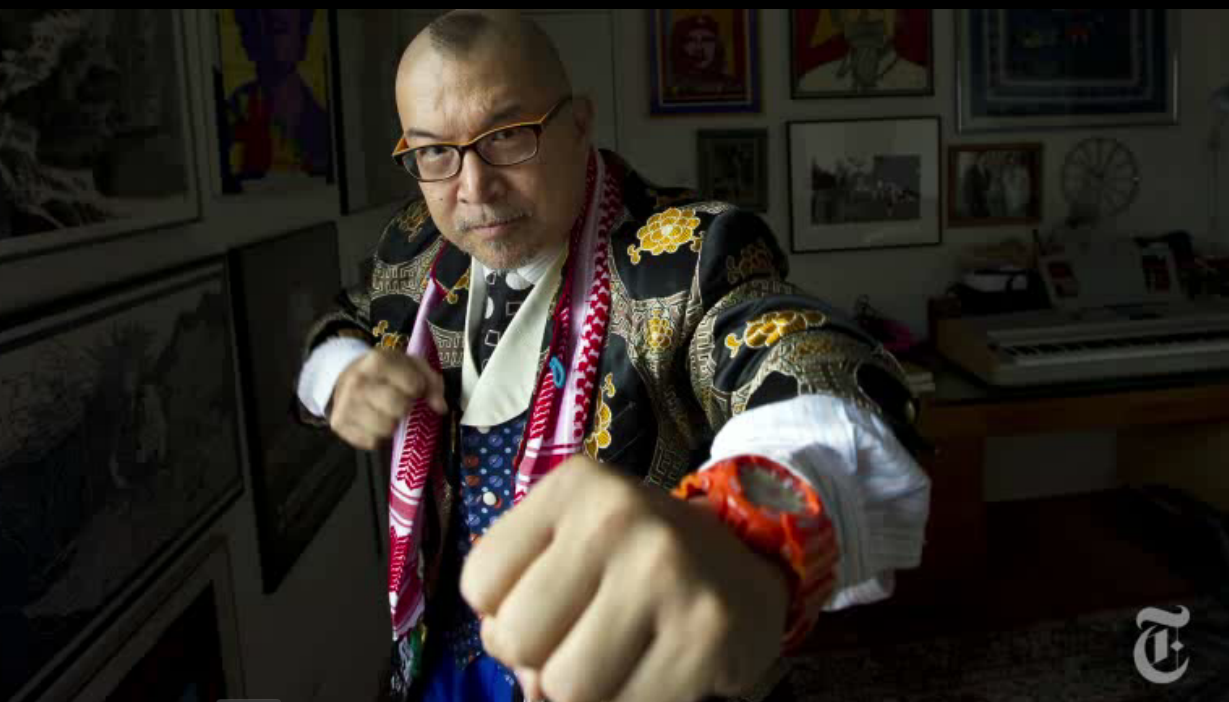
kufiyaspotting: Fred Ho (RIP)

The New York Times published an obituary for the respected, left-wing US jazz artist Fred Ho on April 12, the day he died, by Ben Ratliff. Ratliff did a fine job of recounting Ho's artistic achievements and ambitions as well as his complicated radical politics (he described himself as a “revolutionary matriarchal socialist and aspiring Luddite”).

Fred Ho, 2013. Photo: Fred Bright, for the New York Times

But Ratliff did not mention an aspect of Ho's politics that was apparent from the way he was dressed in the two photos that appeared on the page (one of them from the video on Ho, which is a must watch), which of course struck me. Ho was shown in both wearing a red (red salute!) kufiya scarf. I do not know whether Ho was ever active in, or ever made any statements in support of, Palestinian solidarity activism (he did however make a statement in criticism of John Zorn's "Zionism"). But it seems pretty clear that Ho did have a sentiment of solidarity; it's hardly likely that he wore the scarf simply because it was stylish.

 Screen save from vid (photo, Fred Bright)

"My hope is that my music would inspire revolution." (quote from the video)


Tuesday, January 07, 2014

Slim Gaillard, Arabian Boogie and Yabra Harisseh

I just went to see American Hustle, which I truly enjoyed, and of course before I went I had been forewarned that I was going to hear a version of "White Rabbit" in Arabic, by Lebanese singer Mayssa Karaa and that Robert DeNiro, playing the mobster Victor Tellegio, would speak Arabic. (The backstory of how that song came to be recorded is here. Dawn Elder, who used to work with Miles Copeland III on the label Mondo Melodia, that did so much to bring Arab popular music to the US in the early aughts, played a key role. I discuss this in my article "The 'Arab Wave' in World Music after 9/11.")


For some reason this reminded me of a 2010 post on Qifa Nabki about jazz singer and guitarist/pianist Slim Gaillard's 1945 song “Yep-Roc Heresay.” The post informs us that the song, mostly in Arabic, is mostly a recitation of items from an Arab (or maybe Armenian?) restaurant: "yabra (i.e. stuffed graped leaves), harisseh (a semolina dessert), kibbeh bi-siniyyeh (a dish of meat and bulgur), lahm mishweh (grilled meat)" and also burghul (bulgur) and mahsheh (stuffed vegetable) and banadura (tomato) and so on. The title stands for Yabra Harisseh of course.

According to wikipedia, this is the back story: "the actual origin of these phrases comes from his time living in Detroit. He was out of money by the time he made it to Detroit and was turned down a job at Ford. An Armenian woman named Rose Malhalab took Slim in, where he lived in the basement of her and her husband's beauty shop on Woodward Avenue. She cooked much Arabic food for him, explaining Slim's entire song."


I had not heard "Yep-Roc Heresay" until recently but I have been intrigued for several years now by another Gaillard tune, "Arabian Boogie," whose lyrics go, "Sayidi, kifa kifa saha?...shu baddak? inta majnoun" (Mr., how are you? What do you want? You're crazy.)

It is claimed that he spoke 8 languages, but...really?? Where did he learn them? And where did he learn Arabic in particular -- not that these two songs show any sort of fluency but they do indicate at least some knowledge. He served in the army from 1941-45 -- was he in North Africa? Or maybe it's from Rose Malhalab? It's well known of course that Gaillard liked to fool with language and that he invented a language he called Vout and used its hip, bebop style language in a lot of his songs. (From "Flat Foot Floogie:" "Flaginzy at flagat, flaginzy ooh flagoo-jigee.")

Lots more info about Slim Gaillard here.

I'll never forget Gaillard's wonderful performance of "Selling Out" in Julien Temple's interesting but flawed 1986 film, Absolute Beginners.

Thursday, September 26, 2013

drone life 3: Lynn Hill on "Capacity" (Vijay Iyer and Mike Ladd's Holding It Down: The Veterans' Dreams Project)

I learned of this thanks to a tweet of Teju Cole.

As you no doubt know, the great jazz pianist Vijay Iyer just received a prestigious MacArthur Award.

You will find him even more deserving when you learn, as I just have, of his recent release, with Mike Ladd, of Holding It Down: The Veterans' Dreams Project. I've only listened to a few tracks (it came out on September 24) but what I've heard is great. The publicity from Pi Recordings describes the album as follows: "a thought-provoking, sometimes frightening, and ultimately exhilarating combination of music, poetry and song, created from the actual dreams of young veterans of the Iraq and Afghanistan wars." And check out the vid below that introduces the project.


But because I sometimes blog here (not very profoundly) about drones, I was particularly interested in the track "Capacity" (which you can listen to here), featuring the poetry and recollections of Lynn Hill, who worked as a drone operator, firing missiles remotely into Iraq from her base in Las Vegas. "Soft kill," she calls it. It's very powerful stuff.


Here's a section of her poem:

I have a capacity for war. I have a capacity for hate. I have a capacity for insanity. For anger. For lies. 525,600 minutes times 2, before I break into an explosion of thoughts, of insurgents and soft kills, and career moves. Capacity for destruction. Capacity for loss. Capacity for death, violence, nothingness. 24 months of pain and disgust. Actions of my hands accuse me. Guilty, charge. Unclear clear details and shaky intell, but still I pull the trigger. There’s a limit to madness. Gague clocks out at two years, but they serve up poison like entrees at Blueberry Hill. Crazy with a side of numb. It took 63,720,000 seconds to go from me to somebody else. 

And check out the NEA interview with Lynn Hill, where she reflects more on her poetry and her work as a Predator Drone operator.

I have a capacity for war. I have a capacity for hate. I have a capacity for insanity. For anger. For lies. 525,600 minutes times 2, before I break into an explosion of thoughts, of insurgents and soft kills, and career moves. Capacity for destruction. Capacity for loss. Capacity for death, violence, nothingness. 24 months of pain and disgust. Actions of my hands accuse me. Guilty, charge. Unclear clear details and shaky intell, but still I pull the trigger. There’s a limit to madness. Gague clocks out at two years, but they serve up poison like entrees at Blueberry Hill. Crazy with a side of numb. It took 63,720,000 seconds to go from me to somebody else. To change. - See more at: http://arts.gov/audio/lynn-hill#file_audio_default_group_audio_transcript
PS: Vijay Iyer's 2003 collaboration with Mike Ladd, In What Language?, is also terrific.

Saturday, October 27, 2012

Majid Bekkas

Majid Bekkas was in Fayetteville (Arkansas) last week, as part of the Caravanserai program. He performed in a number of venues, together with his Gnawa ensemble and the multi-talented Brahim Frigbane ('ud, percussion) -- at Fayetteville and Bentonville High Schools, for several classes at the University of Arkansas, and at the Walton Arts Center. I was out of town for the WAC performance, alas, but I did see him perform at Fayetteville High, and I also got to spend a couple hours hanging out with him and Brahim at Arsaga's cafe on Dickson.

I had seen Bekkas perform with a Moroccan jazz ensemble (a kind of Gnawa-jazz fusion) at the Salé festival in Morocco in summer 1999, and since then I've acquired a number of his recordings. But seeing him perform again here as well as speaking with him made me appreciate even more how serious and multi-talented a musician he is. At the high school, besides performing his Gnawa repertoire (singing and playing guimbri), he also played the kalimba (the African thumb piano), and played it incredibly well. (And I think his vocals might have been in Zulu. Not sure.) No doubt he learned to play on one of his tours of sub-Saharan Africa. Here's a taste, from his performance in Grand Rapids, Minnesota.


He is also a very accomplished 'ud player, as demonstrated below, as he performs the song "Louhid," from his latest album (highly recommended), Makenba.


Another of my faves from Makenba is this song, "Bambrouia," which features Majid on guimbri. On the album the song has a very African feel. Here it sounds somewhat different, as he performs with a sax player and a drummer.


Majid has recorded three albums (Out of the Desert, Kalimba, and Chalaba) with the very talented and respected German jazz pianist and saxophone player Joachim Kühn, with Ramon Lopez on drums. So far I've only heard Out of the Desert, which is very, very fine and one of the best gnawa "fusion" recordings ever done. I asked Majid how he started working with Kühn. He said that Kühn saw him in concert in Europe, came up after the show, introduced himself, and suggested that they try working together.

Here's the trio playing live, performing the song "Sandiye" (recorded by Majid on his African Gnaoua Blues album).


Finally, here's a photo of Majid and his group performing at Fayetteville High School on October 17. He's in the center, on guimbri, and Brahim Fribgane, on 'ud, is at the left.


Here are his qarqaba players and dancers.


Majid at Arsaga's cafe, Fayetteville, October 16.


Monday, February 01, 2010

The Fez Series: Sun Ra & his Arkestra in Chicago, 1960, & the Tom Wilson connection


This is my reproduction of the inner tray card of the Sun Ra CD, "Music from Tomorrow's World" (Atavistic, 2002). L-r: Marshall Allen, Jon L. Hardy, John Gilmore, Sun Ra, Ronnie Boykins, George Hudson. (Credit: the original photo was transferred and restored by John McCortney, AirWave Studio, Chicago.)

Allen, Gilmore, Boykins and Hudson are all wearing fezzes (tarabish).

See my earlier post, where I quote Robert Campbell et al who write: "The [1957] photo that accompanied the Defender announcement showed Sunny wearing a fez, as he and the rest of the band had done for a little while the previous year. It is said that they quit after some of Elijah Muhammad's bodyguards showed up one night and told them, 'No more fezzes.' Apparently such headgear was reserved to the Nation of Islam."

I'm not sure how the chronology works out here, as the photo above shows the Arkestra still wearing fezzes in 1960. When did the NOI issue their threats?

And I wish the photo was a bit clearer--would like to work out what is on those patches sewn on the fezzes.

Do you think it's possible that über-cool Bob Dylan producer Tom Wilson was inspired to wear a fez by Sun Ra? (He wore one in one of the alternate cuts for "Subterranean Homesick Blues"--read more here.)

Wilson put out Sun Ra's first album, "Jazz by Sun Ra," on his Transition label in 1957. (He also put out records by John Coltrane, Cecil Taylor and Donald Byrd on Transition, whose catalogue was eventually purchased by Delmark.)

Then, of course, Wilson went on to produce several monster pieces of music. He added the electric guitars to Simon and Garfunkel's "The Sounds of Silence." His production credits include Bob Dylan's Don't Look Back, the Mothers of Invention's Freak Out!, The Velvet Underground's White Light/White Heat, and Nico's Chelsea Girl.

Why, for gods' sake, has no one written a biography of this amazing producer, arguably as important as Phil Spector and the like?

Wilson also produced Sun Ra's 1961 album, The Futuristic Sounds of Sun Ra.

And Wilson also produced one of the most unusual recordings (among a legion of them) that Sun Ra was ever involved in: Batman & Robin, by The Sensational Guitars of Dan & Dale (Tifton Records, 1966). The personnel on the album, in fact, was the Blues Project (whose 1967 album Projections was also produced by Wilson) and Sun Ra, John Gilmore, Marshall Allen and Pat Patrick of the Sun Ra Arkestra. Ra's Hammond B-3 organ playing is excellent! But it is definitely weird to hear the Ra men play together with the Blues Project, on songs that are mostly rock and blues.


Until I pieced all this together, I could not for the life of me figure out how Ra and the Blues Project appeared on the same album. Now I get it--it's the Tom Wilson connection.

And of course this all connects back to that fez scene in Mad Men. Season one, episode 8. When Don goes slumming with the beatniks.

Thursday, July 10, 2008

R.I.P. Salah Ragab

Allah yarhamu. I just got word (via the Sun Ra list), of the death of Salah Ragab. Here's what Ragab's collaborator Hartmut Geerken wrote:

Salah Ragab, drummer and founder - together with Hartmut Geerken and Edu Vizvari - of the first Egyptian jazz-bigband, died beginning of July in Cairo, aged 72.

Since his introduction to Jazz by Malik Osman Karim Yaqoub alias Mac X Spears in the early 1960, Salah Ragab performed with many important American and European jazz musicians. His collaboration with Sun Ra in the 1980 marked a significant time in his artistic life. As composer and bigband leader he introduced Arabic harmonies and rhythms to jazz.

Discography:
(The Sun Ra Arkestra meets Salah Ragab in Egypt, Leo Records GY.
Salah Ragab and the Cairo Jazz Band present Egyptian Jazz, Art Yard LP 006. (For a good review, go here. Hopefully this album will soon be out on CD as well.)


Sun Rise in Egypt. Sun Ra & Salah Ragab, the Historic Nights & Concerts of the Arkestra in Cairo Egypt 1984, Vol. I - III, Sphinx Records ECD 25735)

I only own The Sun Ra Arkestra meets Salah Ragab in Egypt, which is a great album, and the tracks featuring Salah Ragab and the Cairo Jazz Band really swing. Salah Ragab was one of the few non-USers to perform with the Sun Ra Arkestra. If memory serves, I believe that the only other was Talvin Singh.

Check out this video (composed of stills) of Salah Ragab and Sun Ra, set to the tune, "Egypt Strut":


And this one, with black-and-white footage of Sun Ra and his Arkestra, fully costumed, frolicking at the site of the Great Pyramids, Giza, Egypt:


Addendum, July 11: Here's a good bio of Salah Ragab by Joslyn Layne, on allmusic.com.