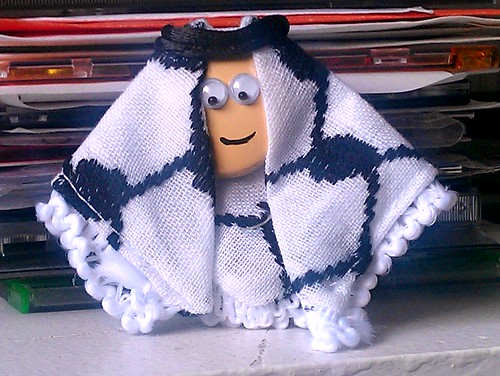
Check out this, er, surprising vid, featuring respected British reggae artist Maxi Priest.
The kufiya he is wearing is the record label Shemspeed. It describes its products thus: Israeli Keffiyeh, with its intricate Star of David pattern in the left piece, and words AM ISRAEL CHAI (Jewish People Live) in Hebrew weaved into its fabric in a variety of colors. Check them out here. Colors include blue-and-white, purple, "Army (IDF)" and "Rasta Tiedye."
But there is more to this product than simple appropriation -- though I think it is certainly susceptible to such a claim.
Shemspeed also offers the Peace Keffiyeh, which it describes thus:
Peace is something everyone wants, every language in the world has a version of this world in their vocabulary. One of the long standing feuds have been between Jewish & Muslim people, which is the inspiration behind the peace, shalom, salaam Keffiyeh. Though peace talks have been taking place for years now and the divide has grown even wider with harsh actions & rhetoric on both sides, yet it seems there is a consensus that both sides want peace, the problem is that each side wants it on their terms. We are launching a grass rout campaign to try to focus on the similarities on these Semitic people rather than on our differences. At the end of the day the roots are quite similar in nature since both faiths originate with Abraham and with a shared culture (before the Jews settled around the world) history and now the land. The only sustainable option is coming in terms with a peaceful resolution to this long standing divide. Here is our contribution to this effect.
The peace "kef" comes in both black-and-white and red-and-white.
I do, honestly, appreciate the sentiment. And the fact that the patterns of the "peace kef" include both Stars of David and the traditional kufiya pattern, and that peace is written on the "kef" in both Hebrew and Arabic. This all comes from the orientation of DJ/producer Erez Safar, who is the founder of Shemspeed, also the founder of the Sephardic Music Festival, and is of Yemeni background. This "Israeli keffiyeh" then should not be read simply as an attempt at Zionist colonial appropriation but as an effort on the part of an Israeli Jew of "Oriental" background, i.e., a Mizrahi, to stress the cultural commonalities between Arabs and Jews.
Before passing even cursory judgment on Safar's and Shemspeed's projects, I'd need to become more familiar with the Sephardi Music Festival and with the artists on Shemspeed's label. I am somewhat familiar with Pharaohs Daughter, who I like, though not wildly, and the Hasid reggae artist Matisyahu, whose music I sometimes like but whose politics, when it comes to Israel, I'm suspicious of.
I'm can't imagine that Erez Safar and Shemspeed will be warmly welcomed by many Palestinians or Palestine activists when they call try to reclaim the kufiya as Israeli, or when they infuse it with Star of David patterns. Or when they marked "IDF" kufiyas. Nor are they on very convincing political ground when they act as if both "sides" are equivalent in their "harshness" of their actions and rhetoric. One "side" is an occupying and colonizing force, with enormous military and economic assets. The other is an occupied people resisting. There is no equivalence.
And yet...I welcome Shemspeed's efforts to push the Sephardi, Eastern, Mizrahi side of Jewishness, to challenge Ashkenazi identity. Even at times, to "Arabize" it. Check out, for instance, the Moroccan-Israeli singer Smadar's "Ghali Ya Bouy." Very hot. And she is from Sderot...
Oh, and if you are interested, Shemspeed has other "kef" products (I really don't like this hip abbreviation, sorry), like the Kabbalah Kef and the Kef Shawl and various Kef Skinny Ties.
At least one of the fifty some vets of Afghanistan and Iraq who tossed away their medals on Sunday, May 20, as part of the anti-NATO demonstrations in Chicago, wore a kufiya. Not one of those military-issue khaki ones, but a red one.
The photo above is a screen save from the following report on the event. Please note the vet who tosses his medal, starting at 0:37. That is Jacob George, from my hometown of Fayetteville, Arkansas, who has been riding around the country on his bicycle for two years, organizing against the war and playing banjo. Read about his project, called A Ride Till the End, here.
Forty one years prior to this event, on April 23, 1971, as part of an anti-war action organized by Vietnam Veterans Against the War, over 800 Nam vets tossed their medals, ribbons, discharge papers, and the like, at the US Capitol. The event was widely covered, and part of a major, ongoing mobilization against the Vietnam War. Alas, the anti-war actions in the US these days are, by contrast to those events, are a whimper.
an interdisciplinary project dedicated to exploring non-western & poetic notions of sound in interaction with alternative interfaces...a suite of seven free audio tools for Ableton (Max for Live), including include four distinct synthesizers hardwired to North African & Arabic maqam scales with quartertone tuning built-in, a device called Devotion which lowers your computer’s volume 5 times a day during call to prayer (presets include Agnostic, Fervent, Devout), and a drone machine...as tools, Sufi Plug Ins are what you do with them.
2. On May 16, rupture did a live radio show from Cairo, with guest host Humphrey Davies, one of the preeminent translators of texts from Arabic to English (such as Elias Khoury's Gate of the Sun). The show opens with a divine track from Layla Murad, "Itmakhtari witmayli ya khayl (Strut and prance, Horses!)," from the 1949 film Ghazal al-Banat (which Davies translates as "Candy Floss").
Wayne Marshall (of the blog wayneandwax) tweeted about the show and the opening number: "when the cowbell comes in at 0:07 seconds here, it's so 'take me to the mardi gras' i jump out of my skin." Listen and jump out of your skin too. And be sure to stay tuned for the entire show.
Ghazal al-Banat, btw, is a fantastic, uproarious comedy. Someone has put the entire film up on youtube. (Sorry, no subtitles.) Check out this segment, which features an amazing number from Mohammed Abd-el Wahhab (starting at about 4:30), complete with a huge orchestra and chorus, an army of balalaikas, a division of clarinets, Abdel Wahhab on vocals and banjo...Wow. Ahhh, ya Masr.
On the occasion of Facebook's IPO, today, May 18, 2012, I want to share something I came across just last night, from an excellent article on the legacy of Karl Marx. ("Marx at 193," John Lanchester, London Review of Books, April 5, 2012). I particularly like statement this because (1) it's a great, teachable illustration of Marx's theory of surplus value and (2) it uses the theory to expose how labor is "hidden" in and by Facebook.
This idea of labour being hidden in things, and the value of things arising from the labour congealed inside them, is an unexpectedly powerful explanatory tool in the digital world. Take Facebook. Part of its success comes from the fact that people feel that they and their children are safe spending time there, that it is a place you go to interact with other people but is not fundamentally risky or sleazy in the way new technologies are often perceived to be – that VHS, for instance, was when it was launched on the market. But the perception that Facebook is, maybe the best word would be ‘hygienic’, is sustained by tens of thousands of hours of badly paid labour on the part of the people in the developing world who work for companies hired to scan for offensive images and who are, according to the one Moroccan man who went on the record to complain about it, paid a dollar an hour for doing so. That’s a perfect example of surplus value: huge amounts of poorly paid menial work creating the hygienic image of a company which, when it launches on the stock market later this year, hopes to be worth $100 billion.
Be sure to read the entire article.
As for the poorly paid Moroccans working for FB, it appears that The Gawker blew the whistle. And The Daily Telegraph did some reporting on this in March.
Since the uprising began, every village has come up with its own dabke, a traditional dance in which the dancers, their hands locked together, move in a circle and stamp their feet to the beat of a drum. Every funeral is turned into a protest procession. Among the most common funeral chants is a song written by Ibrahim Qashoush, a singer from Hama, called ‘Yallah irhal ya Bashar!’ (‘Get out, Bashar!’). When Qashoush was found last summer with his throat slit and vocal cords ripped out, the song became the movement’s soundtrack. It even made its way to Avenue Bourguiba in Tunis, where crowds sang it on the anniversary of their own revolution. It became such a phenomenon that the authorities pirated it. Schoolchildren were given it to sing, but with the lyrics altered: ‘Nahna rijalak ya Bashar!’ (‘We are your people, Bashar!’). Abbas said it was because they are afraid of the song: ‘They use it like a voodoo puppet. They think that if they appropriate the symbols of the revolution, they can tame its spell.’
Journalist writing Rachel Shabi is an Iraqi Jew, born in Israel to parents who migrated there from Iraq in the early fifties and then moved to England. In her book, We Look Like the Enemy: The Hidden Story of Israel's Jews from Arab Lands (New York, 2008), Shabi writes that her father lampoons the legend of Iraqi Jews weeping beside Babylon as they remembered Zion.
"They weren't crying, " he says. "They were singing and dancing and drinking arak!"
Can someone, someday, write and record a vision of that brilliant reggae song?
In an inspiring study being published next month in Diabetes Care, scientists at the Baker IDI Heart and Diabetes Institute in Melbourne, Australia, had 19 adults sit completely still for seven hours or, on a separate day, rise every 20 minutes and walk leisurely on a treadmill (handily situated next to their chairs) for two minutes. On another day, they had the volunteers jog gently during their two-minute breaks.
When the volunteers remained stationary for the full seven hours, their blood sugar spiked and insulin levels were out of whack. But when they broke up the hours with movement, even that short two-minute stroll, their blood sugar levels remained stable. Interestingly, the jogging didn’t improve blood sugar regulation any more than standing and walking did. What was important, the scientists concluded, was simply breaking up the long, interminable hours of sitting...
So every 20 minutes or so, I now rise. I don’t have a desk treadmill; my office is too small, and my budget too slim. But I prop my papers on a music stand and read standing up. I prowl my office while I talk on the phone...
I run for three or four miles most days, too, and grunt through 20 push-ups most mornings.
This is a gorgeous and moving set of photos of Gaza surfers from Andrew McConnell. There are 23 surfers there who own boards, and other surfers who borrow when possible. Supplies are impossible to get in, so international donors have helped supply boards and wetsuits. But the surfers have no wax, so they improvise. This photos shows them melting candles on their boards before they head out onto the beach.
photo: Andrew McConnell
You wonder whether the Gaza surfers know that surf music was invented by the Lebanese-American guitarist Richard Mansour, who recorded under the name of Dick Dale.
As Dale told George Baramki Azar, "My music comes from the rhythm of Arab songs," he says. "I applied the beat of the darbukkah (fluted drum) to my guitar. This is where a lot of great surf motifs originated."
Probably Dale's most famous song (due to Pulp Fiction) is "Misirlou," which is based on a Greek song (the title, meaning "Egyptian Muslim Girl," comes from the Arabic for Egypt, Misr) that was popular in the Arab-American community since at least the 1930's, and has been recorded in multiple versions. The song emerged from the rebetika tradition, forged in Smyrna, one of the Ottoman Empire's great cosmopolitan cities, which was emptied of its Greek population in the disastrous "population exchange" between Greece and Turkey that occurred after the First World War. Wikipedia has an excellent account of the song, its history, and its multiple versions. This excellent blog posting discusses the song and offers downloads of a number of versions, including one of Dick Dale.
Here's Dick doing the song in the 1963 film, "A Swinging Affair."
Dan Walsh, who runs the amazing Palestine Poster Project Archive, has very helpfully put together all the kufiya posters in the collection, available for viewing online here. As of this writing here are 803(!) images, but more to come for sure, in future.
I especially liked this one, but you may fancy others.
To see it full-sized, and with more details on the artist, etc., go here.
Back in 2007, Lauren Bush was spotted wearing a kufiya.
More recently, she has been promoting a designer (feed)bag, the proceeds of the sale of which will help feed starving children. Read about it here, from the blog Africa Is A Country.
The photos promoting the bag are priceless. Both feature Lauren, daughter of Neil, whose married name is Lauren Bush Lauren, who is both a fashion model and a designer. And humanitarian to boot.
Pakistani novelist Nadeem Aslam, who now lives in North England:
'After 9/11 happened...many writers in Britain and Aerica said that they felt their work was meaningless because it was so disconnected from the event. I felt that I had been writing about 9/11 all my life.'
From an article about Pakistani writers in the NYRB. Behind a paywall. Subscribe, already.
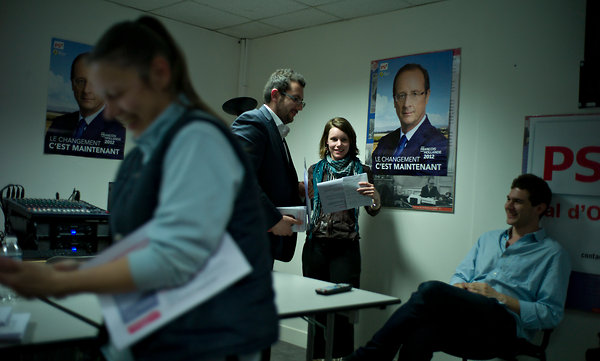
In the office of the French Socialist Party in Cergy, a Paris suburb (Corentin Fohlen for The New York Times)
This photo appears in today's New York Times (April 22, 2012), in an article entitled, "In France, Using Lessons From Obama Campaign."
It tells us that three young Frenchmen who studied at Harvard and MIT and are members of France's Socialist Party "witnessed the successful campaign of President Obama" and are now "back in France, using American models of canvassing to get left-leaning voters who would normally abstain to instead cast ballots. Their work, said Mr. Liegey, 31, is concentrated in the banlieues, poorer suburbs heavily populated with ethnic minorities, where alienation and abstention are high."
The photo is taken in Cergy, a banlieue ("suburb") of France, where there is a high concentration of immigrants and their offspring. According to wikipedia, Cergy-Pontoise, the town in which Cergy is located, has a far higher crime rate than the national average.
The French wikipedia article says that Cergy typically votes on the left side of the spectrum.
I have no idea whether the woman in the photo is wearing the kufiya to appeal to young banlieue potential voters of Maghrebi background, or if it is just a matter of stylishness. Or is it both?
Sayed Darwish (picture courtesy of the Friends of Sayyid Darwish Association; found here)
From a report in Egypt Independent on yesterday's massive demonstration at Tahrir.
A lonely island in a sea of Salafis, the National Coalition for Change stage boasts a handful of people, mostly in their early twenties. "We all remember Sayed Darwish and his beautiful lyrics," one youth bleats into the onstage microphone to a scattering of an audience (many of whom are wearing Abu Ismail badges and pins). "Here's one of his most beautiful songs, which we all know and love. It's called 'So It Goes.'" The youth begins to sing, but his voice is easily drowned out by the pro-Hazem stages on both sides. The small crowd disintegrates.
I am guessing that the song in question by Sayed Darwish is "Aho Da Lli Saar." On the run-up to the anniversary of the overthrow of Mubarak, the BBC produced a radio program by Reem Kelani, in which she explores the music of the revolution and in particular, the importance of Egyptian composer and singer Sayed Darwish in it. I posted about the program on the Merip blog, but I did not discuss what was said about "Aho Da Lli Saar." Given what happened yesterday, it is useful to go back to Kilani's program.
She opens by introducing Khaled Abu Naga, who co-produced and starred in the acclaimed 2010 film Microphone, about the underground art scene in Alexandria. Although the film was produced before the outbreak of the revolution, it in many ways seems to anticipate it, in its depiction of a vibrant artistic scene that is frustrated in its efforts to develop and put on its work (particularly the music) in public. Frustrated both by the bureaucratic agencies of the state, backed up by the security forces, and by the Islamist forces. (If you've seen the film, then what occurred yesterday feels like a cruel throwback.) The animators of the scene depicted in the film are the same educated, enthusiastic, creative youth segment of Egypt's urban population who did much of the demonstrating and fighting at Tahrir in late January and early February in 2011. And it is well-known that one of the positive effects of the revolution was both to release all kinds of creative and artistic energies, as well as bring into public view artistic movements and tendencies that had been repressed and marginalized under the Mubarak tenure. No wonder, then, that many, as Reem Kelani observes, regard Microphone as the film of the revolution.
Khaled Abu Naga tells Kelani that it was Said Darwish who the youth in Alexandria went back to, fo find lyrics that depicted the situation they were living in in early 2011, in the days of the revolution. And the song that really depicted how they all felt, he says, was "Aho Da Lli Saar," which Kelani translates as "This Is Where We're At." The song dates from the 1919 Revolution, which erupted in part due to the frustrations of Egyptians who felt that their active participation in the First World War (around a one and a half million Egyptians were conscripted into the Labor Corps) should have earned them independence from Britain.
Kelani provides a translation of some of the lyrics of the song (written, in fact, by Badi' Khayri; Darwish wrote the music):
Egypt, O mother of wonders Your people are great and your faults are not Watch out for those who love you For they are the champions of your cause
In the background, we hear the Darwish song, performed by the Alexandrian group, Massar Egbari ("Compulsory Detour"), who are also appear in the film Microphone.
I happened to see Karim Nagi perform at Georgetown last Wednesday evening, and one of the numbers he did was "Aho Da Lli Saar," which he translated as "This is what happened." Nagi is a fabulous dancer and a multi-talented percussionist and buzuq player. He is the animating force behind Turbo Tabla, whose two albums I highly recommend. He is also a great lecturer -- if you are looking for someone to provide an excellent introduction to Arabic music, be sure to hire Karim.
But I particularly loved Karim's performance of Sayed Darwish's "Salma Ya Salma" and "Aho Da Lli Saar." Before singing them he translated both songs into English -- and I regret not recording these. In his program notes, at least, Nagi provided a translation of a few more lines of "Aho Da Lli Saar":
This is what happened, you cannot blame us The wealth of our country is beyond our reach Let us not fight nor envy Unite our hands, and be strong for the cause
Here are some more versions of the song:
Ali Haggar's -- which predates Massar Egbari's, and on whom Massar Egbari's version seems modelled.
Fairuz does a version too. (I'm pretty sure this is from her Live at Beiteddine 2000 album, the title transliterated as "Ahoua dalli sar.")
An amazing performance of the song, from January 10, 2011 (two weeks before the start of the revolution), done at Al Sawy in Cairo by members of the cast of Microphone, "In solidarity with the victims of terror in Alexandria." In reference, clearly, to the terror bombing of a Coptic church in Alexandria on December 31, 2010, that killed 21 and wounded at least 96. Many blamed the bombing on the regime.
Fairuz's celebrated son Ziad Rahbani also has a version, very similar to his mother's. Apparently recorded in Damascus in 2008.
There are other versions as well, but it would seem that Ali Haggar, Fairuz and Ziad Rahbani in particular have played an important role in keeping the song alive in Arab popular memory.
Unfortunately, I cannot find a version of Darwish's version on youtube -- I assume there are downloads available, probably of dubious legality.
Here are the Arabic lyrics, with a transliteration and a translation into English, which I found here. I've changed a couple things. There are some discrepancies between what is below and the translations I've posted above, so if someone wants to help out and fix these, and provide some more commentary that would be terrific.
اهو دا اللي صار, و ادي اللي كان
aho dalli sar w dalli kan
this is what happened, this is what was!
مالكش حق
malaksh 7a2
you don't have the right
ملكش حق تلوم عليا
malaksh 7a2 tloom 3alayya
you don't have the right to blame me
تلوم عليا ازاي يا سيدنا
tloom 3alayya ezay ya sayedna
how can you blame me sir ?
و خير بلدنا مهوش في ادنا
w 5air beladna mahoosh fe edna
and the wealth of our country is not in our hand
قولي عن اشياء تفدنا
2olli 3an ashya2 tefedna
tell me about things that help us
بعدها بقى لوم عليا
ba3daha ba2a loom 3alayya
then you can blame me
مصر يا ام العجايب
masr ya 2om el 3agayeb
Egypt, the mother of wonders
شعبك اصيل و الخصل عايب
sha3bik aseel wel 5sl 3ayeb
your people are noble, your faults are not
خلي بالك مالحبايب
5alli balik mel 7abayeb
take care of your loved ones
دول انصار القضيه
dool ansar el 2adeya
those are the supporters of the matter
بدال ما يشمت فينا حاسد
bdal ma yeshmat feena 7asid
instead of the gloating of jealous people
ايدك في ايدي نقوم نجاهد
edak fe edi n2oom negahid
let's hold hands and fight
احنا نبقى الكل واحد
e7na neb2ael kol wa7id
we all become one
والايادي تكون قويه
wel 2ayadi tkoon aweya
and hands become strong
(Footnote 1: While working on this post I found this blogpost that accompanies Reem Kelani's BBC piece. It is an invaluable resource about the significance of Sayed Darwish and about the music that was performed on and played on and around Tahrir during the days of the revolution. Please have a look.)
(Footnote 2: on the treatment of Egyptians in the British army: the noted novelist E.M. Forster lived in Alexandria during the First World War. He took up with an Egyptian tram conductor named Muhammad al-Adl, who became the love of Forster's life. In an attempt to improve his position within the government bureaucracy, Forster was able to help Mohammad get a job with the British military on the Suez Canal, where he did low-level intelligence work. Al-Adl described himself as a "spy." Muhammad eventually came down with a fever, received miserable treatment in the badly run hospital and nearly died. Upon his recovery, he used to let Forster know that his British military employers treated him like "dirt," as they treated all Egyptians. Muhammad was arrested and sentenced to six months in hard labor, after an incident in which he and a friend encountered some Australian soldiers in Mansourah, who offered to sell them a revolver. Muhammad considered himself innocent, but he was humiliated, bullied, and badly fed in prison. Muhammad, whose health was impaired by both his time spent in a horribly run British military hospital and in prison, died of consumption in November 1922.
It seems that Forster's knowledge of the evils of colonialism and the bad treatment meted out to Egyptians during the war, mostly via Muhammad, motivated him to write a historical summary for a pamphlet, called The Government of Egypt, put out by the Labour Research Department in summer 1920. Forster did not go so far as to argue for Egyptian independence, but for Egypt to be put under a League of Nations-sponsored mandate. It appears as well that Forster's relations with Muhammad had a great deal to do with the critiques of colonialism that are expressed in his famous novel Passage to India. Forster used to put on Muhammad's ring every day, a ring that Muhammad had willed to him, and when he finished the last lines of Passage to India, Forster put down his pen and picked up a pencil that had belonged to Muhammad and wrote in his diary that he had finished the book.
All this, I learned from Michael Haag's Alexandria: City of Memory, Yale University Press, 2004.)
This is the cover of issue two of a new monthly gay publication out of Tunisia. Check out Gayday's online site. I guess that the kufiya here serves as a sign of cultural legitimacy.
Al-Haqed ("The Vengeful One"), charged on Friday March 30 with insulting the monarchy, for his song, Kilab al-Dawla (Dogs of the State). Read about it here. Read ANHRI's statement about his arrest and imprisonment and an earlier charge here. And watch the video, below. I hope someone produces a translation. In the meantime, here's a translation of his song, "Baraka Men Skate" (No More Silence).
A play, presumably about how kufiyas are mostly made in China, is being put on in Hebron on April 18 (and after, elsewhere in Palestine). Hebron (al-Khalil), of course, is the site of the last remaining kufiya factory in Palestine. I have no further information about the play, other than what is on the poster itself. It is presented (and presumably funded) by the A.M. Qattan Foundation, and the al-Malki al-Falamanki Theater. It's good to see some attention being paid to this critical issue. If you're gonna buy kufiyas, please buy Palestinian.
On Saturday, April 14, between 100 and 250 demonstrators (depending on which account you credit) took part in a bike protest against the harassment of Palestinian cyclists and drivers on Route 90, the main north-south highway in the Jordan Valley. A senior IDF officer launched an unprovoked attack on a peaceful international protester. Read about it here and be sure to watch the shocking video.
But maybe it wasn't really 'unprovoked'? Maybe the red kufiya drove the officer mad.
"two inventions, as far apart in technology as could be imagined, have transformed the relationship between the Mediterranean and the north of Europe in the second half of the twentieth century: the aeroplance and the bikini." David Abulafia, "A globalized Mediterranean: 1900-2000," in David Abulafia, ed., The Mediterranean in History (Los Angeles: The J. Paul Getty Museum, 2003), p. 312.
Micheline Bernardini models the first modern bikini, 1946
Torie Rose Deghett (check out her blog here) reviews a multimedia documentary from France24 on Egypt's revolutionary music. (I found the doc itself a bit hard to navigate, but well worth a look.)
Check out this very important and illuminating article about the role of drought in the Syrian unrest. Here are a few of the scary excerpts.
From 2006-2011, up to 60% of Syria’s land experienced, in the terms of one expert, “the worst long-term drought and most severe set of crop failures since agricultural civilizations began in the Fertile Crescent many millennia ago.”...
In 2009, the UN and IFRC reported that over 800,000 Syrians had lost their entire livelihood as a result of the droughts. By 2011, the aforementioned GAR report estimated that the number of Syrians who were left extremely “food insecure” by the droughts sat at about one million. The number of people driven into extreme poverty is even worse, with a UN report from last year estimating two to three million people affected.
This has led to a massive exodus of farmers, herders and agriculturally-dependent rural families from the countryside to the cities. Last January, it was reported that crop failures (particularly the Halaby pepper) just in the farming villages around the city of Aleppo, had led “200,000 rural villagers to leave for the cities.” In October 2010, the New York Times highlighted a UN estimate that 50,000 families migrated from rural areas just that year, “on top of the hundreds of thousands of people who fled in earlier years.” In context of Syrian cities coping with influxes of Iraqi refugees since the U.S. invasion in 2003, this has placed additional strains and tensions on an already stressed and disenfranchised population.
And be sure to check out the entire article. While the Mediterranean may be under severe threat in the long run, the outlook is not all that great for much of the US as well. In fact, it's disastrous.
It is often, in fact one should say, nearly always, claimed that the celebrated Greek Alexandrian poet Constantine Cavafy (1863-1933), lived his life in almost complete isolation from Egyptian Arabs. Hala Halim, in her unpublished dissertation, The Alexandria Archive: An Archaeology of Alexandrian Cosmopolitanism (UCLA, 2004), suggests that the reality is somewhat more complicated. She suggests that his work is in some ways Orientalist, but that his Orientalism "both could be qualified and undercut by a disaporic affiliation that goes beyond binaries and makes for a more cosmoplitan attunement to otherness and other textualities" (107-108).
One of the pieces of writing that she cites in evidence is this poem, written in response to the notorious Denshawai affair.
27 June 1906, 2 P.M.
When the Christians brought him to be hanged,
the innocent boy of seventeen,
his mother, who there beside the scaffold
had dragged herself and lay beaten on the ground
beneath the midday sun, the savage sun,
now would moan, and howl like a wolf, a beast,
and then the martyr, overcome, would keen
“Seventeen years only you lived with me, my child.”
And when they took him up the scaffold’s steps
and passed the rope around him and strangled him,
the innocent boy, seventeen years old,
and piteously it hung inside the void,
with the spasms of black agony–
The youthful body, beautifully wrought–
His mother, martyr, wallowed on the ground
and now she keened no more about his years:
“Seventeen days only,” she keened,
“seventeen days only I had joy of you, my child.”
You can read the full story of Denshawai here, which involved a dispute that broke out when British soldiers shot some pigeons owned by Denshawai villagers. Villagers were angered, attacked the soldiers, the British opened fire on villagers, wounding five, one of the villagers hit an officer with the stick. An officer who escaped died of heatstroke.
The British responded by rounding up 52 villagers, conducted a summary trial, and sentenced five to hanging and 27 others to various terms of hard labor and flogging. The hangings were carried out quickly, only two weeks after the "incident." The effect was to inflame nationalist sentiment in Egypt.
The family name of Cavafy is of Turkish origin; it comes from the word ayakkabici or "shoe seller."
Philip Mansel, the source for the above (Levant: Splendour and Catastrophe on the Mediterranean, Yale UP, 2010), also notes that it is highly unlikely that Cavafy's poems could have been published in any city other than Alexandria (with the exception of Paris). His erotic poems, Mansel observes, would have doubtless raised moral hackles and caused the author and publisher to be sentenced to jail. Cavafy's poems were published in Alexandrian literary magazines after 1919, and a book of a complete edition of his poems was published in Alexandrian two years after his death, in 1935 (144). Published in Greek, of course.
More evidence of the tolerant character of Alexandrian cosmopolitanism.
I want to give a shout out to this fabulous blog, Jewish Morocco, and its obsessive search for and commentary on music by Jewish Moroccans. And sometimes Algerians, like Blond Blond:
Rachid Taha first recorded "Menfi" on his 1998 album Diwân. He reprised it on his Rachid Taha Live album (2001), giving it a real kick-ass rock treatment (listen here), and by he also performs it with Khaled on Faudel on the famous 1-2-3 Soleils album (1999) (you can listen here).
I just came across a version of the original, which you can check out above. The song was written by Algerian Kabyle composer and singer Akli Yahiaten, who migrated to Paris in 1952, was a supporter of the FLN (the Algerian National Liberation Front), and composed "El Menfi (Banishment)" while in prison (for the second time), in 1959, for collecting funds for the FLN.
I located a transliteration of the Arabic lyrics here. And a translation of most of the lyrics here, where there are also some more versions of the song. I've tried to correct some mistakes in both the transliteration and translation, but there's a lot more to be done, and I'm sure I've made mistakes. So this is a work in progress -- and I hope someone will see this who knows Algerian dialect and will help out.
UPDATED, April 16, 2012. I came across this article, which has a better transcription, and translation (in French), of verse three, so I've made some more changes: Hadj Miliani, "Variations linguistiques et formulation thématiques dans la chanson algérienne au cours du XXe siècle: Un parcours," in Jocelyne Dakhlia, ed., Trames de langues: Usages et métissages linguistiques dans l'histoire du Maghreb, Paris: Maisonneuve & Larose, 2004, p. 433.
REFRAIN
Goulou lemmi ma tebkish Ya el menfi (Tell my mother not to cry/O banishment)
Weldak rebbi ma yikhelik Ya el menfi (God will look after your son/O banishment)
Aw ya dakhal fi wast bibaan Ya el menfi
Aw al-saba‘a fih el gadaan Ya el menfi (bis)
Aw galouli kashi al-doukhaan ya el menfi
Wana fi wasthum dehshaan ya el menfi
REFRAIN
Aw ki dawni le tribunal Ya el menfi (When they took me to court)
Aw djadarmiya kbaar wa sghaar Ya el menfi (Gendarmes large and small)
Aw tisensla tewzen qantar Ya el menfi (And the chain weighs a ton [one qintal, 100 kg.)
Aw derbouni b‘aam wa nhaar Ya el menfi (And they beat me for a year and a day)
REFRAIN
‘Ala dekhla haffuli al-ras Ya el menfi (When I entered they shaved my head)
Aw ‘atawni zura wa paillasse Ya el menfi (And gave me a blanket and a straw-filled mattress)
Wel prévôt ‘alaya ‘assaas Ya el menfi (The military police who surveils us)
‘Ala tamenya tesma‘a silence Ya el menfi (At eight you hear: silence)
REFRAIN
Ah ya gelbi wash dak taif Ya el menfi (My heart is revolted)
Aw el-soupa dayman kif-kif Ya el menfi (The share [of food] is always the same)
Aw el gamila ma‘amra bi el ma Ya el menfi (The bowl is filled with [mere] water)
Aw li gralou ionim [?] fiha Ya el menfi (And cockroaches swim in it)
And here is a link to some more vids from Akli Yahiaten.
Very illuminating post about US mercenary pilots who were recruited by the French to fly missions against Abdelkrim's Riffian rebellion in Morocco (1921-1926).
"In the end, US government concerns about violations of neutrality and hostile public opinion brought the chapter of the Escadrille Chérifienne to a close after only six weeks of combat operations."
US public opinion at the time, if you can believe it, was very much on the side of Abdelkrim and against the Spanish and French colonialists.
For instance, there is "The Riff Song," from the Broadway production, The Desert Song, which opened on Broadway in 1925 and was very successful.
"If you're the Red Shadow's foe
The Riffs will strike with a blow
That brings you woe."
"Palestinian tartare"..."Arabic ravioli"..."At Jaffa/Tel Aviv, the new restaurant by chef Haim Cohen, the godfather of Israeli cuisine, knafeh is one of the most popular dishes on the menu."
The acceptance and celebration of Palestinian food in current Israeli cuisine marks the peak of a long and gradual process, just as the identity of Israeli cuisine has started to reveal itself. When we think about what current Israeli cuisine is, a mix comes to mind: Jewish ethnic foods, excellent produce, young chefs with high culinary education and strong Arabic influences. Arguably, as the Israeli scene has become more established, it is able to credit its sources of inspiration. Another explanation for the rising popularity of this food is strictly political. This trend is limited to the city of Tel Aviv and its surroundings. “In Tel Aviv it’s considered ‘cool’ to be pro-Palestinian,” said Gil Hovav, a leading culinary journalist and television personality. “The culture encourages it.” In the past few years, Tel Aviv has shifted further left on the political map, positioning itself as the liberal refuge and natural habitat for Israel’s young creative community. Raising the banner of pluralism, the residents of Tel Aviv express their discontent with the government agenda not only with social activism, but also in their food culture.
Dalida, born in Shobra, Cairo, to Italian parents. Enrico Macias, an Algerian Jew, born Gaston Ghenassia, in Constantine, Algeria. Both huge stars in France. Part of the secret of their successes was that their music sounded a bit exotic, but for them to have used their background in the Arab world as more than frills would have been met with racist hostility. The Arabness therefore manifests itself in small doses. As in this case, in some sort of variety show, where Enrico greets Dalida in Arabic, with "Ahlan wa sahlan Dalida, salamaat salamaat" (welcome Dalida, greetings, greetings). She responds, "Ahlan wa sahlan ya Enrico, ezzayyak? Kuwayyis, ilhamdou lillah?" (Welcome Enrico, how are you? Well, thank God?"(The clip is not dated, but perhaps it's after Dalida recorded her string of hits in Arabic, starting with "Salma ya Salama," and so now it was somewhat more acceptable for stars like her to refer to their Arab roots -- in her case, cultural roots.)
They proceed to do a duet of Dalida's first hit, from 1956, "Bambino." Watch Dalida do the original here, back in the days when she wore her hair dark.
It's worth recalling that Jean Dujardin does a version of "Bambino," in Arabic, in his hilarious spy spoof, OSS 117: Cairo, Nest of Spies. You can check that one out here.
Enrico did not record in Arabic (other than some hints or a few words) until 1999, when he released his terrific Hommage à Cheikh Raymond, his tribute to his teacher and father-in-law, the grand master of malouf, Raymond Leyris.
And then there is this clip, of Dalida with another great French star, Claude François. They open by speaking of the fact that they both were born in Egypt, and that one of Claude François' parents was Italian. They then proceed to sing some duets in Italian.
Claude François (author of "Comme d'habitude," the original of "My Way") was born in Ismailiya, Egypt, in 1939. His father worked as a shipping traffic controller in the Suez Canal. The family left for France in the wake of the Tripartite Aggression (a.k.a. Suez War) of 1956.
Dalida recalled her first meeting with Claude François in 1963, when they became friends, thus: “Nous nous sentions tous les deux déracinés...Ensemble, nous parlions en égyptien” (We both felt uprooted...Together, we used to speak in Egyptian -- i.e., Egyptian Arabic). (Catherine Rihoit, Dalida, 1995, p. 344)
Ramy Essam, singer of the Egyptian revolution, who produced the unforgettable song "Irhal," has put out a song in solidarity with the Syrian revolutionaries. It may be his best song since "Irhal." Helpfully, the video comes with subtitles in English, and the Arabic is written below the vid. Check it out.
On the first anniversary (April 4) of the unsolved murder of Juliano Mer Khamis, the Palestinian-Israeli rap band DAM put out this very moving video. (Helpfully, with English subtitles.)
Juliano was the son of Palestinian-Israeli Saliba Khamis (who I met in 1985) and Jewish-Israeli Arna Mer-Khamis. His parents were Communists, and such "mixed" marriages were quite common in the Israeli Communist party in the 1950s. Julian was a movie and theater actor, and director of a well-respected documentary, Arna's Children (watch it here) about his mother's work with a children's theater in Jenin, a city in the West Bank. He is best known for founding Freedom Theatre, a community theatre that provided opportunities for children of Jenin Refugee Camp. Juliano was shot by a masked gunman in front of the theater, and the killer is still at large.
Check out Mark Levine's tribute to Juliano and his work here.
In anticipation of a future post on the film El Gusto, which is out now in France, this video of the Jewish Algerian master of Andalusian music, Cheikh Zouzou (given name Joseph Benganoun), born in Oran (Wahran), Algeria.
Apparently the group accompanying Zouzou is the "Orchestre de la Station d'Oran." On piano is Maurice El Medioni (also Jewish Algerian) and on guitar (in the long-sleeve shirt that looks grey in this B&W video), Blaoui Houari. Houari is mostly obscured and you can barely see the guitar, but he is there. And mostly we see Medioni's back. This would have been broadcast in the late fifties or early sixties, that is, prior to Algerian independence. The French authorities established television in Algeria in 1957, and they broadcast Arab music in part, in an attempt to co-opt the musicians. As a result, a lot of amazing music was produced on colonial Algerian t.v., much of which can be found on youtube.
Huh? really? If you must vote -- but I caution against it -- go here.
And no, I did not put this up because Shadia has a kufiya around her waist.
For those who do not know, Shadia Mansour is a Palestinian rapper. She is probably best known for her song, "The Kufiya is Arab," which I posted about here.
The photo is by Tyler Hicks of the New York Times, who accompanied Anthony Shadid (RIP) on his final visit to Syria. The photo gallery it is taken from is here. The very interesting article on their trip, to visit the armed opposition in Idlib province, is here.
And from the article, note that Anthony Shadid tried to protect himself from the horse dander by covering his face with a black-and-white kufiya. It didn't work.
Anthony’s health had been good during the week and he prepared himself for the trip down with antihistamines and a supply of inhalers. He had a black and white kaffiyeh covering his face to filter the air, the same one he had worn around his neck throughout the assignment. He told the young men he wouldn’t ride a horse and to walk ahead with them at a distance.
“Should we walk in front of the horses?” I asked Anthony.
This photo of rapper Jay Electronica accompanied his recent release, via RCRD.LBL, of the free single, "Suckas."
Jay Electronica is probably not wearing the kufiya because it is fashionable. His rap style is in the general universe of the likes of Mos Def, Talib Kweli, J Dilla, and the like. The song "Suckas" blasts shallow and materialistic mainstream rap MC's:
These wack emcees got the game twisted
We don't give a fuck about your rings and your chains
Your four-dot six Range
Or Frankie B jeans
His lyrics are in the "conscious" vein:
The last dragon, carrying weight like Oprah
Redeemer of Abner Louima and Sankofa
And, it is clear from this line, that he is a member of the Nation of Gods and Earths (Five Percenters):
Eighty-five think they free but they really in chains
Talking that big willy looking silly and strange
The "eighty five" in Five Percenter beliefs are the deaf, dumb and blind who are misled and victimized by the elites, the bloodsuckers of the poor, the Ten Percent. (The Five Percenters have "knowledge of self," and struggle to bring consciousness to the 85%.)
These lines allude to Jay's status as a "God":
Jay Elect reign supreme over everything
Meet the heavenly man mics in my hand I rip 'em
I'm somewhat surprised to come across a Five Percenter who is originally from New Orleans, but since leaving NOLA, Electronica has led a somewhat nomadic lifestyle, living variously in Philly, Detroit, NYC and Baltimore. Probably he came across some Gods in those places. Somewhere along the way he hooked up, for a time, with Erykah Badu (who has her own connections to the Gods and Earths; her first son is named 7), and they have a child together, born in 2009.
Electronica is worth following. Here are the complete lyrics to "Suckas" (which get the Abner Louima reference wrong, however.)
Anne de Zogheb in ensemble by Pierre Balmain, Marie Claire, March 1963
Anne de Zogheb was a top international fashion model in the late 50's and early 60's, gracing covers of fashion mags in the US and France. She married pop singer and teen idol Paul Anka -- who is of Lebanese descent -- in 1963, and stopped modeling after her second child was born. Part of her upbringing took place in Alexandria. Her father, Count Charles de Zogheb (d. 2006), who became a Lebanese diplomat, was a member of Alexandria's illustrious Levantine de Zogheb clan. The de Zoghebs were Christian Syrian-Lebanese, who migrated to Alexandria during the era of French occupation (1798-1801), served consuls for various European powers (I believe that they were entered into the rank of the nobility by Austria-Hungary), and became fabulously wealthy (for a time) from the cotton trade. They were major figures in the social life of colonial-cosmopolitan Alexandria.
Hala Halim has written some very important work about the remarkable Bernard de Zogheb, the last of the family in Alexandria (the rest of them left in the 50s and 60s) and in particular, his fascinating operettas. I highly recommend a read. Perhaps I will post something on them in future.
I've not been able to determine the exact kinship relationship of Charles and Bernard, nor do I know how long Paul's now ex-wife Anne lived in Alexandria.
I hope in future to post something about other famous Alexandrians, like Eric Hobsbawm, Ungaretti, Marinetti and others.
Robin just informed me about this website, Hipster or Jesus? It solicits your offerings. Its logo is this:
I'm no expert on hipsters, although I've devoted a fair amount of time to reading about them. I thought hipsters mostly made fun of longhairs. But I must admit, the layers of hipster irony are often so thick that I am unable to grasp the target of hipster humor. Or maybe this is making fun of hipsters. Who the frack knows?
Of course these images of Jesus (imagined and real) of course trade on the "old" Caucasian images of Jesus that someone like me was raised on, and that were much critiqued in the civil rights era and by the Black Power movement and so on. But hipster is largely a white phenom, so...
As of today, there are 7 pages of images of hipster/Jesus, and only this one is wearing a kufiya. (It's his headgear. The image is a little clearer if you consult the original.)
"Demonstrators huddled in alleyways breathing through keffiyehs soaked in lemon juice."
This after "Border Police forces dispersed the rally [yesterday] by throwing stun grenades, shooting tear gas, and spraying “skunk” liquid." The protest was against the 18 year closing of Hebron's downtown Shuhada Street, which is open only to Israeli settlers. Read about it here.
Here are some protesters, presumably before they soaked their kufiyas with lemon juice.
I'm sure you've noticed this, the seemingly unstoppable tendency of anyone writing about World Music to compare artists who are relatively unknown in the West to Western artists, with the aim of helping Western readers make sense of said artists. The results are frequently ridiculous, but that doesn't stop anyone.
The Supine View From the ARChive's Chesterfield, the blog of the ARChive of Contemporary Music, has provided an invaluable list of whoppers. Here are the relevant ones that deal with Middle Eastern artists.
“She became known as Cheikha Remitti, the Piaf of rai.” - …about early rai vocalist Cheikha Remitti el Ghilzania. Rough Guide p. 127
“Amina: The Cleopatra of Paris-Tunisian disco” - Straight No Chaser, Winter 1989, p. 41
“She has been called the Bessie Smith of Egypt, and for stark passion she was all of that.” - …about Umm Kulthum. All Music Guide, John Storm Roberts, p. 855
“And Cheb (or ‘young’) Khaled, the charismatic architect of modern rai, is their Elvis, their Beatles, and their Sex Pistols rolled into one.” – “Cheb Khaled & the Politics of Pleasure”, Antaeus, “On Music”, No. 71 / 72, Autumn, 1993. p. 262. Brian Cullman.
“Hameed Sharay,…His band, El Misdawier, was the Beatles of Egypt.” - Fresh Beats From Cairo, David Lodge, Take Cover, Vol. 1, No. 1, p. 26 – 28, 1990.
“Ali Hassan Kuban – The Egyptian James Brown” - World Music Institute ad copy, VV 2/3/98 p. 85
“The two-stringed rabbabah assaults the senses with ear-fluttering twills as the djallabiyah-dressed, handlebar-moustachioed trio – “Hendrix of the East” : Metqal Qenawi Metqal, Shamandi Tewfiq Metqal and Yussef ‘ali Bakash – sing of nomadic exploits and tales seemingly straight from the pages of ‘A Thousand and One Nights’”. - …about the pricipal performers in Les Musiciens Du Nil (Musician of the Nile) in the Realworld press kit for Charcoal Gypsies.
“Rachid el Baba…- he likens himself to an Algerian Jean Michel Jarre – built a studio in Tlemcen and began recording many of Rai’s top stars.” - about top rai producer Rachid by Martin Johnson, Pulse! “Do the Rai Thing” Nov, 1989, p. 50
“…Cheb Khaled (Algeria’s Jerry Lee Lewis analogue).” - CD review of Rai Rebels by Richard Gher. Village Voice, n.d., 19??
“… the famous Tunisian singer, Saliha (and if you are not yet familiar with this “Umm Kulthum of Tunisia,” find a recording of her soon) …” - Middle East Studies Association Bulletin, July 1995 by Dwight Reynolds
“If Khaled is the Ali Rotten of Rai, his rival for number one spot, Cheb Mami, shows signs of a potential to be Cliff Richard.” - “Rai Smile,” Africa Beat, Winter 86/87, p. 24. by Phil Sweeney.
“A kind of Arab Jim Morrison, he irritates and unsettles the authorities, at the same time seducing the masses and the intellectuals.” - …about Cheb Khaled, Intuition Records press kit, 8/89
“An American Salute to ‘Egypt’s Verdi’” - Headline referencing Egyptian composer, Sayyed Darweesh, NYTimes, 2/16/2006, by Ben Sisario.
“Kazem al Sahir is The Iraqi Elvis . Here he is singing ‘We Want Peace’ with Lenny Kravitz” - http://growabrain.typepad.com/growabrain/music_from_the_middle_east/, 7/24/2004
“For devotees of North African music, Hakim needs no introductions, but he received several anyway, with fanfare befitting a star nicknamed the Lion of Egypt, at Central Park SummerStage on Saturday. He was called the “king of shaabi music,” referring to his rhythmic street pop.” - “Enter Egyptian Pop Star, Blowing Kisses and Swiveling Hips: Hakim in Central Park” by Sia Michel, NYTimes – July 10, 2006
I got this via today's New York Times. This was filmed yesterday in the Halfaya neighborhood of Hama. Apparently this is a regular, morning event. 100's gather to dance the debke, as someone chants and the crowd responds, to the backing of live percussion. Pretty stirring.
You will recall that Hama is famous for its revolutionary debke chants. It is the source of that famous chant, "Come On Bashar, Leave," sung by Ibrahim Qashoush, who shortly after a video of him chanting at a demonstration circulated widely, was found with his throat slit, on July 4. I posted about it here. The recently-departed Anthony Shadid, the intrepid journalist for the Times, got into Hama in July 2011 and reported on the song, the song's author, and conditions in Hama.
It's cheering to see that, despite the deadly assaults by the regime, Hama is still at it. I hope that someone can fill the shoes of Anthony Shadid. I don't know whether I'm more pessimistic about that or about the future of Syria.
(The expert on Syrian debke is Shayna Silverstein, graduate of the University of Chicago. I look forward with keen anticipation to her publications on the subject.)
Demonstrators atop post at Tahrir Square, marking 1st anniversary of the launch of
the Egyptian revolution, January 25, 2012 (Jeff J. Mitchell / Getty Images).
Yes, I know this is a bit late. I'm not paid to do this. Sometimes I fail to keep it up to date. This is for the record. (Photo is from an article in the LA Times, Jan. 26.)
Today (February 14) marks the first anniversary of the Bahraini uprising. Although crushed by Bahraini security forces, with the support of Saudi Arabia, and the quiet connivance of the US administration, Bahraini pro-democracy forces continue to protest and to organize and to fight for freedom.
Here's a video showing marchers in Manama, Bahrain, yesterday, heading to Pearl (Lu'lu') Square. Anticipating a confrontation with security forces, they put on their gas masks. And some, including Nabil Rajab, a prominent human rights activist, put a kufiya over the gas mask.
Nabil dons his gas mask
and then the kufiya
(If you watch the vid you'll notice that others do the same.)
The new face gear for the Arab revolts: kufiya over gas mask.
(I got this from the New York Times, from a piece by Robert Mackey on the Times blog, The Lede.)
In this mindblowing article about the US prison system, from n+1.
"In gentrifying sections of Brooklyn, for example, steep drops in crime, combined with the virtual depopulation of entire city blocks, has underwritten a real estate boom. In neighborhoods like Fort Greene and Clinton Hill, wealthy people with children have reaped the benefits of climbing land values from apartments they never would have bought had it not been for the removal of tens of thousands of locals from adjacent areas. Neighborhoods like Bedford-Stuyvesant show the population exchange in its purest form. As African American Brooklynites are exported upstate for involvement in petty drug crimes, twenty-somethings reared in prison towns migrate south and reoccupy the same areas vacated by prisoners. Often, of course, the new inhabitants proceed to consume and sell the very same drugs that got the previous tenants into trouble. Since they’re white, they do so with impunity."
This photo is from the first published interview with Yaron Cohen/Dana International, published in the newspaper Tel Aviv, on August 14, 1992. It appears on the amazing website devoted to Dana International, put together by Geir Skogseth. The interview was published in Hebrew, and is translated by Ziv Geri.
The photo is of Dana as a drag queen, from the period when Yaron started out, in early 1992, performing in clubs in Eilat and Tel Aviv, on revues organized by Ofer Nisim. She became famous during this period doing a send-up of the Whitney Houston song, "My Name Is Not Susan." Yaron pretended to be Whitney Houston, performing in Saudi Arabia, and singing verses (from Whitney's song) in English as well as verses made up by Dana, sung in Arabic. The song was called "Sa'ida Sultana" (in it Dana shouts, "My Name Is Not Sa'ida!"). This song was subsequently recorded and became Dana International's first hit. A couple years later, it was a sensation in Egypt, on a bootleg cassette.
Who knows what song(s) she performed while wearing kufiya.
A video of Dana (backed by Ofer Nisim) doing "Sa'ida Sultana" is now available on youtube.
And Geir Skogseth has made the lyrics to the song (complete with a translation of the lyrics) available here. The lyrics on the video vary a bit from the recording, which Geir has transcribed. In the vid, for instance, she sings, "Ana 'ismi Whitney Houston" (My name is Whitney Houston) rather than "Ana 'ismi Solli Sa'dun."
On the 1st anniversary of January 25, the day that the uprising against Mubarak was launched, I posted a piece on Sayyid Darwish and the Egyptian revolution(s), at the Merip blog. See it here.
Merip has a brand new blog, launched today. I intend to contribute posts on a regular basis--but I will not be abandoning hawgblawg by any means. My first was a meditation on how Robin Wright celebrates Arab/Islamic hip-hop in her book, Rock the Casbah: Rage and Rebellion Across the Islamic World. Read it here.
And please check out the blog regularly. As of today, there are also posts by Chris Toensing and Laleh Khalili. Content will continue to flow.
This was broadcast back on February 15, 2011, just 4 days after the toppling of Mubarak. Although so much has happened since then, this is still a very valuable document, since it is based on a deep historical knowledge of the literature and social movements that fed into the Egyptian revolt. Please listen.
Professor of Anthropology, University of Arkansas. Author of Memories of Revolt: The 1936-39 Rebellion and the Palestinian National Past. Co-editor of Palestine, Israel and the Politics of Popular Culture and of Displacement, Diaspora, and Geographies of Identity.