Showing posts with label uprising. Show all posts

Saturday, March 09, 2019

Songs of the Sudanese Uprising: Surrender the Keys to the Country -- Muhammad Wardi, Zoozita

On March 3, NPR's Eyder Peralta reported on the song that is the anthem of the protesters in the current struggle in Sudan, aimed at taking down the regime of Omar Bashir.


The song was recorded by Sudanese singer Zoozita, who is based in the UAE, in January. Here's the video.


The song was composed by the late great Sudanese Nubian singer and composer, Muhammad Wardi. According to Peralta, it was composed in 1997, to perform at the Hague. It just so happens that I saw Wardi perform it on June 14, 1997, at a banquet at the Cairo Hilton, for the Sudan Studies Association banquet. Wardi only performed two songs, the first one about Sudanese living in exile, the second, "Sallim Mufatih al-Balad." I'm not sure exactly why he was only allowed to perform two songs, but my friends suggested that it was due to political sensitivities.

I loved the song at the time but never was able to find it for sale in Cairo. I'm so thrilled to come across it again. Wardi, who passed away in 2012, never recorded it, apparently, but you can find live recordings on YouTube, such as this one.


Here are the lyrics in Arabic, and maybe someday someone will come up with a good translation.

عليك الزحف متقدم
وليك الشعب متحزم ومتلملم
يقول سلم
سلم ومابتسلم
رحمت متين عشان ترحم؟
سلم مفاتيح البلد
سلم عباياتنا وملافحنا
مصاحفنا ومسابحنا
جوامعنا وكنايسنا
سلم مفاتيح البلد

تراث أجدادنا سلمنا
عقول أولادنا سلمنا
بنادقنا البتضربنا
الموجهة لي صدورنا
وبرضو حقتنا
سلمنا
سلم مفاتيح البلد

سلمنا الزمان الضاع
ليل الغربة والأوجاع
أحزانا العشناها
مع الوطن العزيز الجاع
سلم مفاتيح البلد

حتهرب وين من الألم الكبير والجوع
من تعليمك المدفوع
ومن شعبا سقاك لبنو سقيتو من الهوان والجوع
يا ساقي سمك المنبوع
سلم مفاتيح البلد

حتهرب وين من الذكرى وعذاباتها
ومن لبن الأمومة ومن حساب الرب
حتهرب وين وانت ايدينك الإتنين ملوثة دم
فصيح الدم ينضم وبتكلم يقول سلم
سلم مفاتيح البلد

I had the chance to meet Wardi in Cairo the following summer, and hope to blog about that meeting in future.

The best report on the current uprising in Sudan was Khalid Madani's February 23 article in Jadaliyya, "Tasqut Bas (Fall, That is All)."

Sunday, December 15, 2013

Kufiyaspotting remembered: Tahrir in the New York Times

Today's (December 15) New York Times featured this photo (in both the print and the online versions) from Jehane Noujaim's very well-received documentary on the Egyptian uprising of January-February 2011, The Square ("Al Midan"), and its complicated. (From Manohla Dargis' article "The Festival World, and What's Beyond." Online, it's photo 14.)

Noujaim Films

Almost three years later, Egypt is a total mess. But those were glorious days on Tahrir, in early 2011, it is important to remember, and it ("the revolution" or whatever it is) is not necessarily over. And the kufiya was and continues to be an important sartorial symbol of those days. And of coming ones.

<Here are some earlier Tahrir kufiya posts.>

Meanwhile, here's a trailer for the film. And more kufiyas.


Saturday, October 13, 2012

Occuper Tahrir en chantant

Music from the Egyptian revolution. Eskenderella, Ramy Essam, rapper Mohammed el-Deeb. Shaikh Imam and Sayyid Darwish. Ahmad Fouad Negm. Great stuff, courtesy France 24. French subtitles.

Friday, August 17, 2012

Syria's drought and the uprising

From the Bulletin of the Atomic Sciences. Read the rest here.

The drought in Syria is one of the first modern events in which a climactic anomaly resulted in mass migration and contributed to state instability. This is a lesson and a warning for the greater catalyst that climate change will become in a region already under the strains of cultural polarity, political repression, and economic inequity.

Meanwhile, let's just frack away in the good old USA. 

"Over its lifetime an average well requires 3 to 5 million US gallons (11,000 to 19,000 m3) of water for the initial hydraulic fracturing operation and possible restimulation frac jobs." (wikipedia)

Tuesday, February 14, 2012

Egyptians mark revolution, Jan. 25: yes, kufiyas

Demonstrators atop post at Tahrir Square, marking 1st anniversary of the launch of 
the Egyptian revolution, January 25, 2012 (Jeff J. Mitchell / Getty Images).

Yes, I know this is a bit late. I'm not paid to do this. Sometimes I fail to keep it up to date. This is for the record. (Photo is from an article in the LA Times, Jan. 26.)

1st anniversary of Bahrain uprising: kufiya over gas mask

Today (February 14) marks the first anniversary of the Bahraini uprising. Although crushed by Bahraini security forces, with the support of Saudi Arabia, and the quiet connivance of the US administration, Bahraini pro-democracy forces continue to protest and to organize and to fight for freedom.

Here's a video showing marchers in Manama, Bahrain, yesterday, heading to Pearl (Lu'lu') Square. Anticipating a confrontation with security forces, they put on their gas masks. And some, including Nabil Rajab, a prominent human rights activist, put a kufiya over the gas mask.


Nabil dons his gas mask


and then the kufiya

(If you watch the vid you'll notice that others do the same.)

The new face gear for the Arab revolts: kufiya over gas mask.

(I got this from the New York Times, from a piece by Robert Mackey on the Times blog, The Lede.)

Monday, December 12, 2011

Fadwa Suleiman: Syrian revolutionary, in hipster kufiya

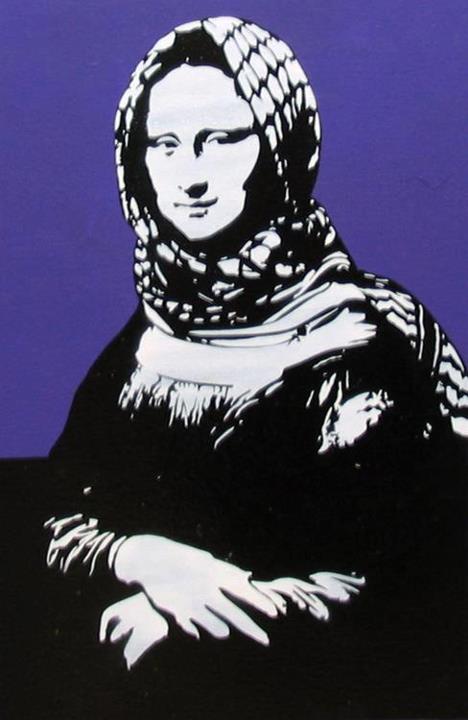
Check out this report from Al-Jazeera English on Syrian actress, star of TV, theater and cinema, Fedwa Suleiman, who has taken the side of the pro-democracy movement. She has been leading demonstrations in the city of Homs, the epicenter of the revolt. Of particular note is the fact that she is an Alawite, the heterodox Shi'ite sect, a minority in Syria, which forms the base of support for the Asad-led Ba'athi regime. Video clips of Suleiman, chanting on the microphone in Homs, typically show her wearing a purple kufiya. Purple kufiyas: no longer to be maligned as the insignia of the hipster or the empty-headed fauxhemian.


Here is a link to the full speech she delivered on November 11, together with an English translation. The Al-Jazeera report provides an excerpt. And here's a link to a BBC report on Suleiman's (or Sulayman) participation in the Homs demonstrations in early November. And a screen save, showing her with a black-and-white kufiya worn as a headscarf.


And here is a post from Razan Ghazzawi [see below], commenting approvingly of Fadwa Suleiman's speech of November 11, and noting how very dangerous it is for such a prominent Alawite to take a public anti-regime position.

Finally, here's another shot of Suleiman, leading chants in Homs, in the Khaldiya quarter, on December 9. Wearing a purple kufiya.


Screen grab from the above video:


Added December 14: I should note that Razan Ghazzawi, a Syrian-American, who blogged in support of Fadwa Suleiman last month and who I cite above, was arrested earlier this month and faces a 15-year prison sentence. Read about it here.

Monday, November 28, 2011

Egypt Revolution 2.0 Music

Madu and Wa'il 'Amr (of Taxi Band) sing ("'Aalu magnoun", "They all said he's crazy") for the latest round of Egypt's revolution. I love that these guys are smiling so sweetly, at a time (last week) when a full-scale war was raging, around Tahrir. I love the kufiya (predictable). And I love the lyrics to the song. One great line among many: "'aalou magnoun illi yahlim, masr tib'a ahsan, min ghayr ma yiruh 'a tahrir" (they all said, he's crazy who dreams that Egypt can be better without going to Tahrir).


The song is a take-off on this ad, featuring major stars, for the Egyptian mobile phone company Itisalat. It starts off with the actress Yosra (who I adore, but who turned out to be one of Egypt's stars who sided with the Mubarak regime.) Mohamed Mounir, who has supported the revolution consistently, is shown bumping fists with Yosra at the end.


Here's a spoof they did of the ad before the revolution.


And another version, done during the revolution. "Everyone thought we were crazy, but here we are, millions in Tahrir."


Thanks to Nermeen for all this info.

I think Robin is correct, that the Itisalat ad is borrowed from this song by Fred Astaire, called, "They All Laughed." "They all laughed when Christopher Columbus said the world was round." Frank Sinatra, Tony Bennett, Ella Fitzgerald: many have covered it. Wonderful to see it get to Egypt Revolution 2.0.

Sunday, November 27, 2011

and yes, even yet more Tahrir kufiyas

I got behind in my posting, due to Thanksgiving, and the misery of watching the University of Arkansas football team get "manhandled" by LSU. I'm now going to try to catch up.

Bernat Armangue/Associated Press

This is from the New York Times, Saturday, November 26. It shows a protester, injured in clashes with security forces, being carried away for medical care.


This photo, by Ali Garboussi, is from Al-Akhbar English. I love the way this gentleman has used the kufiya, and other scarves, to create a turban. This is from Tahrir, Friday, November 25.


This photo is also by Ali Garboussi, from Al-Akhbar English. Praying at Tahrir, Friday, November 25.


This photo, and the one below, are from an amazing photo album showing various ways that the fighters on Mohamed Mahmoud Street were protecting themselves. The photographer(s) is/are not credited.


From Maggie Osama's Photo Blog of Day 6 of the battle for Mohamed Mahmoud.

Mohammed Abu Zaid/Associated Press

This is a vendor on Tahrir, Thursday, November 24, selling gas masks to protesters. From the Brazilian newspaper, Folha.

Goran Tomasevic, Reuters

And from a photo album courtesy The Atlantic, showing a member of the security forces firing a shotgun at protesters, on either November 22 or 23. What's he doing in a kufiya?

AFP/Getty Images

Protester using kufiya to protect himself from teargas fumes. Tuesday, November 22.
From BBC Mundo.


Bahraini human rights activist Maryam Alkhawaja was on Tahrir Square in solidarity with the Egyptian democracy struggle on Saturday, November 26, and she tweeted this photo.

Saturday, November 26, 2011

more kufiyas on Tahrir


I found this amazing photo via twitter on Thursday. It was posted by Rehab El-Bakry (@Rehab_Elbakry). She writes: "Don't know who this guy is but he was at front lines. Who says heroes need a cap?"

The original source appears to be Albaraa -- but I can't figure out, at this moment, what that is.

Wednesday, November 23, 2011

and more kufiya's on Tahrir


It turns out the three American exchange students at AUC who were arrested at Tahrir on Tuesday were wearing kufiyas, and gas masks, when apprehended. They were accused of throwing molotovs at the security forces. Here's the report on them from Egyptian State Television. And a report from CBS.


And here's another good shot from yesterday, by Mohamed Hossam Eddin, via Al-Masry Al-Youm.

Sunday, June 26, 2011

Songs of the Syrian Revolt

It's thanks to Iman that I know about these two songs.

The first is by Syrian singer Samih Choukeir. I knew nothing of him before hearing this song. What I now know is based on this wikipedia entry, in Arabic. He is an established artist in Syria (or at least he was--who knows, after this song!), active since 1982, composing for the theater and t.v. serials as well as performing his own compositions. He studied art in the Ukraine (like so many other Syrians, who got advanced degrees from Eastern Bloc universities prior to the collapse of the Soviet Union) and is married to a Ukrainian woman. He does not belong to any political party in Syria but appears to be on the Syrian "left." (Here's his official bio in English.)

The song, "Ya Hayf (Oh Oppression)," is dedicated to the martyrs of Dera'a, March 15. Dera'a is where the Syrian revolt started. (It's also where T.E. Lawrence was tortured, if you remember the film Lawrence of Arabia.)


This one features someone leading a call-and-response song at a pro-democracy demonstration in the city of Hama, uploaded on June 23. It's entitled, "Bidkum Bashar (You want Bashar)." The singer chants various lines of government propaganda, and then chants Bidkum Bashara, and the crowd responds loudly, "La wallah" (No, by God!). It's quite wonderful.


(Again, I hope someone will translate these into English, and other languages, at some point.)

Wednesday, February 09, 2011

Music of the Egyptian Revolution

It's been pouring out, released in a fury of creativity set off by the astonishing events in Egypt over the last 16 days. Tahrir Square itself is one center. Check out this amazing video, of a singer and guitar (not shown), singing some of the key slogans of the uprising, with the crowd chanting and singing along. [Added February 12: I've learned his name: Ramey Essaam.] What is remarkable and rather surprising is that the song resembles "unplugged" grunge. This particular video helpfully translates the lyrics into English. But it makes a mistake in the beginning. Re: Mubarak, it should read: "We want to make Hosni Mubarak hear our voices!"


The original video (here) has gone viral. 545,932 views as of this writing.

Numerous accounts suggest that this is typical of what is going on at Tahrir Square on a daily basis. A group of people gathered around a singer (injured in the fights against the security forces or the pro-Mubarak thugs in earlier days) and an 'ud player, singing along with a tune that they have just learned from these two men, "Expel Hosni Mubarak." The men resemble roaming troubadors. These lyrics are translated as well.


And chants are song throughout the day and night. Here are some comic ones (which someone will hopefully at some future moment translate).


The last of the Tahrir songs is this one. Accompanying himself on guitar, the singer sings a comic song about a donkey refusing to step down for a younger one--an allegory about the old man Mubarak.


One more thing to add is that, according to Angry Arab, it is the songs of Abdel Halim Hafez that are played most often over the soundsystems on Tahrir. My friend Gamal Eid has also remarked that one hears the songs of Egypt's most beloved and important revolutionary singer, Sheikh Imam, on Tahrir.

Then there are the solidarity songs from "outside." One of the most impressive is Mohamed Mounir's "Azzay? (Why?)." Mounir, an Egyptian Nubian, has been a huge star, of music, cinema and theater, since the mid-1970s. Clearly this song was recorded prior to the outbreak of the uprising, but the video is full of scenes of the revolt, and the lyrics, ostensibly those of a love song, can also be read as a kind of allegory about Egypt and its conditions. The song is slamming, the video very moving. The video opens with the words: To every Egyptian citizen who participated in January 25...or who didn't participate. (There's a rough translation to the song in the comments.)


"Back Down Mubarak!" is a very lively, upbeat and oldschool sounding rap from Master Mimz, a Moroccan woman rapper, born in Casablanca, now based in England. The video features many shots of women who have participated in the protests.


There is also this rap, "#Jan25 Egypt," from Freeway, The Narcicyst, Omar Offendum, HBO Def Poet Amir Sulaiman, and Canadian R&B vocalist Ayah. Freeway's rap in particular is very compelling, at about 2:50.


In a quite different vein is this very beautiful chant from the Kuwaiti munshid, "Egypt Prayers." There is a rough translation into English in the comments.


There is "Long Live Egypt," by Scarabeuz and Omima. Scarabeuz's dad is Egyptian, his mother Dutch, and he was born in Berlin, where he is still based.

I at first thought the song was a little too sentimental and shlocky, but I came to like it more after listening to it all the way through. The images are quite moving, and the auto-tuned effects are endearing.


Finally, there's the free release, the Khalas Mixtape Vol. 1: Mish Ba'eed. With songs from rappers based in Tunisia, Algeria, Egypt and Libya. I particularly like the tracks from Tunisia's El Génèral and Algeria's Lutfi Double Kanon. Download it here.


Long live Egypt!

Kufiyas in the Egyptian revolution, cont'd.


This photo is from Jason Parkinson's riveting and disturbing video, Battle of the Interior Ministry, Jan. 29, 2011. View it here. Towards the beginning, we see a large crowd, marching through Tahrir Square. The man in the middle is holding up his kufiya, as if it were a flag or a symbol. There are other kufiyas in the footage too. And shots of men holding up spent cartridges, shot by the security forces, that say, Made in USA. And a deadly teargas canister, also from the USA.

Kufiya in action in Revolutionary Cairo

A protester carries an Egyptian flag and hangs it on the top of a traffic light post at
Tahrir Square in Cairo January 30, 2011. REUTERS/Asmaa Waguih

From a great collection of photos of the Egyptian revolution. (If you click on the photo to enlarge it, you'll notice the Che t-shirt.)

I've been asking friends who have lived in Cairo about the kufiya. In the early nineties, when I lived there, it was hardly to be seen. A friend of mine who was there at the same time says he only saw it among a small group of leftists, who put it on for revolutionary and Palestine-solidarity reasons. A friend who has been in Cairo the last couple years claims it is/was hipster garb. If the latter is (partially) true, then, these are very different hipsters from the US variety. These have been politicized and are important troops of the revolution.

See this, for instance. I think I see some kufiyas here. Even if not, this is the so-called "hipster" kufiya demographic. Now turned revolutionary. (Was that a Moz t-shirt I saw?)

Meet Egypt's Future Leaders

A run-down of the youthful leaders of the Egyptian Revolution, and much more, from Esam Al-Amin at Counterpunch.

Essential links on Egypt

Compiled by Seham, posted by Arabist. As of February 8.

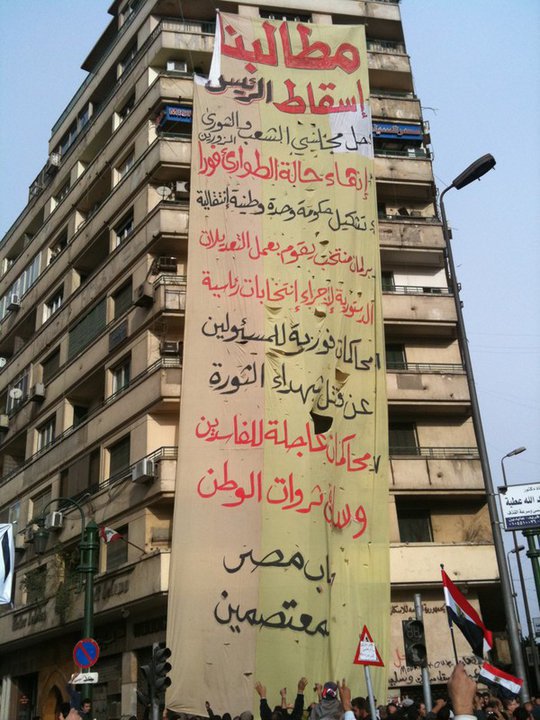
The Egyptian Democracy Movement's Clear and Non-negotiable Demands

Here they are, clear and consistent. Let's circulate them widely and support them tenaciously. They were posted on a huge banner on Tahrir Square a few days ago. The movement is sticking to them.

Mubarak should step down from power immediately.

Dissolving of the national assembly and the senate.

Establish a “national salvation group” that includes all public and political personalities, intellectuals, constitutional and legal experts, and representatives of youth groups who called for the demonstrations on the 25th and 28th of January. This group is to be commissioned to form a transitional coalition government that is mandated to govern the country during a transitional period. The group should also form a transitional presidential council until the next presidential elections.

Drafting a new constitution that guarantees the principles of freedom and social justice.

Prosecute those responsible for the killing of hundreds of martyrs in Tahrir Square.

The immediate release of detainees.


This is from an absolutely essential article by Anthony Alessandrini, "Non-Negotiable," in Jadaliyya.

Monday, February 07, 2011

More on Ahmed Basiony


The article below, entitled "Fallen faces of the uprising: Ahmed Basiony" was published in Al-Masry Al-Youm today, and written by Mia Jancowicz.

I learn two key things from this is: (1) how gifted and talented and promising an artist Ahmed Basiony was. You also get this from his live videos, mentioned in my earlier post. You can download an mp3 of one of his live performances, "Abou Alaa aal Dish," here. One hopes the album he was working on will be released soon. Alas, the website for his label, 100copies, remains down as of this writing. (2) how brutal was his murder, presumably at the hands of the security forces. He was beaten, shot five times and run over. God rest his soul, and let us pray that the criminals responsible for his murder will be run out of power and brought to trial.

Ahmed Basiony, a Cairo-born artist, experimental musician and teacher in his early thirties, was killed while participating in the first week of the January 25 uprising. Basiony is a husband and the father of two children, four-year-old Adam and several months year old Selma. He taught at the Art Education College at Helwan University, where he was pursuing his doctoral studies in the field of interactive arts and open source technology.

Early in his career as an artist, he received several prizes for his participation at the annual Youth Salon since 2001; he was the recipient of the Grand and Salon prizes in 2007 and 2008, respectively. Basiony exhibited his work, which spans multi-media, installation, performance and sound, in various spaces including the Gezira Art Center and the Townhouse gallery in Cairo, most recently participating in the shows Invisible Presence and Cairo Documenta. In his musical capacity, he was developing a strong personal language, experimenting with popular forms to produce a visceral, charged energy. He performed at festivals such as 100live, and with musician Abou Asala was working on an album with the label 100copies.

His influence across creative fields was felt not only through his practice but through his intellectual and teaching contribution. Supplementary to his formal teaching work he organized educational workshops for digital, live and sound art, enabling numerous young musicians to enter the field. “What he was doing with his music, performances, artwork and discussion had resonance with others and opened up thought for others,” says artist and musician Hassan Khan. His close friend and artist Shady Noshokaty says “he was a brave, funny man with an independent intellect and crazy energy; he put so much into everything he did, in his practice, as a person and in his teaching. This is a huge loss.”

Basiony’s last Facebook post said: “I have a lot of hope if we stay like this. Riot police beat me a lot. Nevertheless I will go down again tomorrow. If they want war, we want peace. I am just trying to regain some of my nation’s dignity.”

Ahmed Basiony died on January 28, the Friday of Anger. It is reported that the day prior to his death, he was severely beaten by Central Security Forces: he had been carrying a video camera. The day he died, he was separated from his friends at around 7PM. Several days later his body was found at the Um Al Masreyeen hospital in Giza. Hospital reports indicate he was shot five times, and run over by a vehicle. A Facebook “kolna Ahmed Basiony” has become a virtual memorial, where students, colleagues, friends, family and mentors share memories, anecdotes and prayers for him and his family.