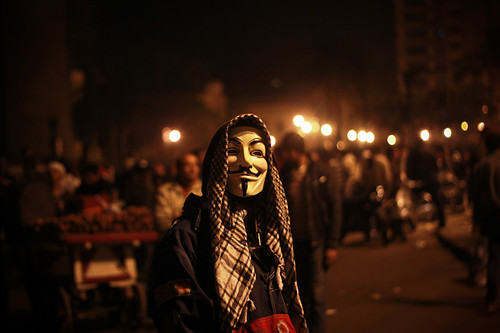
I got behind in my posting, due to Thanksgiving, and the misery of watching the University of Arkansas football team get "manhandled" by LSU. I'm now going to try to catch up.
Bernat Armangue/Associated Press
This is from the New York Times, Saturday, November 26. It shows a protester, injured in clashes with security forces, being carried away for medical care.
This photo, by Ali Garboussi, is from Al-Akhbar English. I love the way this gentleman has used the kufiya, and other scarves, to create a turban. This is from Tahrir, Friday, November 25.
This photo is also by Ali Garboussi, from Al-Akhbar English. Praying at Tahrir, Friday, November 25.
This photo, and the one below, are from an amazing photo album showing various ways that the fighters on Mohamed Mahmoud Street were protecting themselves. The photographer(s) is/are not credited.
From Maggie Osama's Photo Blog of Day 6 of the battle for Mohamed Mahmoud.
Mohammed Abu Zaid/Associated Press
This is a vendor on Tahrir, Thursday, November 24, selling gas masks to protesters. From the Brazilian newspaper, Folha.
Goran Tomasevic, Reuters
And from a photo album courtesy The Atlantic, showing a member of the security forces firing a shotgun at protesters, on either November 22 or 23. What's he doing in a kufiya?
AFP/Getty Images
Protester using kufiya to protect himself from teargas fumes. Tuesday, November 22.
From BBC Mundo.
Bahraini human rights activist Maryam Alkhawaja was on Tahrir Square in solidarity with the Egyptian democracy struggle on Saturday, November 26, and she tweeted this photo.
I found this amazing photo via twitter on Thursday. It was posted by Rehab El-Bakry (@Rehab_Elbakry). She writes: "Don't know who this guy is but he was at front lines. Who says heroes need a cap?"
The original source appears to be Albaraa -- but I can't figure out, at this moment, what that is.
I recommend these two items, from the very New York-based fine outfit ArteEast, doing its best to bring Middle Eastern culture to the metropole.
The Umm Kulthum brooch, for $130 cheap. Order it here.
Or the Art Papercups, which feature images of Um Kulthum (shown above), and, according to the website, Taheyya Kariokka. Essential for all your upcoming holiday festivities. Only $20. Order here.
Ashraf Khalil, in a fine commentary in Foreign Policy ("The Second Republic of Tahrir") writes: "unlike January, this isn't a festival; it's a fight. That old revolutionary spirit may be burning bright in Tahrir again, but nobody there would think of holding a concert right now."
I've heard or seen nothing that would contradict this. No youtube vids of anyone singing or anyone broadcasting songs. But let me know if I'm wrong.
On the other hand, the blog Revolutionary Arab Rap informs us that at least two Egyptian rappers saw what was coming.
To wit, Ramy Donjewan, in "Message to Tantawi" (I posted about him previously):
The blood of my brothers is so expensive, so precious, O Tantawi.
And we will NOT be threatened.
And what happened before can happen again
if our demands are not implemented.
And Ahmed Rock, in a video released on November 16, just 3 days before round two started, called "No to military rule" (Yasqut hukm al-'askar):
They seem to have forgotten who we are! They think that we're still scared!
We saw death in front of us and we stood there smiling!
We'll remind them, if they forget, that we're the generation of revolutionaries!
No matter how much the oppression against us increases, we'll break down all jail cells!
(Chapeau to Revolutionary Arab Rap. Keep the translations coming!)
It turns out the three American exchange students at AUC who were arrested at Tahrir on Tuesday were wearing kufiyas, and gas masks, when apprehended. They were accused of throwing molotovs at the security forces. Here's the report on them from Egyptian State Television. And a report from CBS.
And here's another good shot from yesterday, by Mohamed Hossam Eddin, via Al-Masry Al-Youm.
Latest count that I've seen, 33 dead Egyptian civilians at Tahrir Square since the start of the fighting, on Saturday November 19. The revolutionaries refuse to retreat. Kufiyas are there too.
This photo is from Sarah Carr, posted today on Facebook. Here's her blog.
Photo by Tara Todras-Whitehill (AP), grabbed from here. This is from the 20th of November. The scene was much the same today, lots of people had to rest from the seemingly inexhaustible supply of tear gas that Egypt's security forces possess and are using very freely.
Sheikh Imam (1918-1995) was a leftist Egyptian singer, whose songs galvanized the progressive movement in Egypt, especially in the late 60s and the 70s, and particularly during the reign of President Anwar Sadat. He formed a duo with the great colloquial poet Ahmad Fu'ad Nigm (also written Ahmad Fouad Negm), who composed his lyrics. Sheikh Imam's songs (and Nigm's lyrics) were great favorites among the crowds at Tahrir during the insurrectionary days of January and February of this year. One of the songs that Ramy Essam was well-known for singing was "The Donkey and the Foal," with lyrics by Nigm. (I blogged about it here.)
One of his famous songs is "The ballad of beans [ful] and meat" (sometimes translated as, on the subject of beans and meat). It is in response to Sadat's economic policies, which involved an "opening" to the West and an attack on government supports for the poor, which had been a mainstay of Gamal 'Abd al-Nasser's policies. Today we would call Sadat's policies neo-liberalism. Sadat's officials urged the poor and working working classes to tighten their belts. Apparently at one time this involved arguing that they didn't need to eat so much meat, and that the staple diet of the poor, ful (fava beans) was perfectly adequate. (It reminds one of the efforts by the Reagan administration to classify ketchup as a vegetable -- to economize on school lunches -- and recent efforts by the Republicans in Congress to similarly classify pizza as a vegetable.) Sheikh Imam and Nigm saw this for what it was, and pushed back.
This video, usefully, comes with an English translation. A couple weeks ago I attended a talk on Arabic colloquial poetry by Prof. Clive Holes of Oxford, and one of the three poems he discussed was this one, by Ahmad Fu'ad Nigm. So below the vid, I've included his translation. (I hope he doesn't mind.)
Some big-wig in the government
Declared the other day
(Some "Dr. Muhsin" backed him up
In what he had to say.)
That scientists have proved it true,
Broad beans will do you good -
"Eat beans," they say, "and yet more beans,
For your health's sake you should!
Egyptian beans, especially,
Are bursting with protein,
No beans can touch these beans of ours,
There's fat in them, and lean!
Eat beans and beans! You'll feel as if
You've scoffed a joint of meat!
Beans make you sound in wind and limb
They'll fatten you a treat!
They're kind of, sort of, "vege-meat"
(Kebabs are so passé!)
So eat your beans, dear citizens,
Get high on beans today!"
"And add to that," said Dr. M
The medical concerns -
It's proven meat's a poison that
Brings on dyspeptic turns.
And even worse, research has shown
Meat eating causes crime,
Creates light-fingered layabouts
Who don't clock-in on time!
So summing up, Id have to say:
Meat eaters, one and all,
You're heading for a sticky end
In Satan's fiery thrall!"
But wait a mo', dear Dr. M
You well-fed hypocrite,
Your statements made 'officially'
Are just official shit!
They say the world needs brains like yours --
Well, give us your best shot -
If some madman like me blurts out
"Eat meat and die!" - then what?
You lot can eat your beans and live,
That's fair, don't you agree?
Don't try to pull the wool my friend.
Shove off and let us be!
Today was the second day of fighting between the pro-democracy forces and the Egyptian security forces, supporting the hated SCAF. Here is a great summary of what has been happening, from Jack Shenker of The Guardian.
And here are a couple photos, courtesy a photo gallery published today in The Guardian.
Khaled Elfiqi/EPA
Here, demonstrators are fleeing from the attack of the security forces. They retreated, but later, they were back, occupying the scare. Notice all the kufiyas.
AhmedAli/AP
Here are the security forces, the CSF, on the attack. Notice the guy on the right side of the photo, who has accessorized his uniform with a kufiya. Did he grab it off of a protester, I wonder?
Long live the extraordinarily brave people of Egypt. Down with the SCAF.
Two friends kufiyaspotted for me today, and I found some of my own. Here's the round-up.
1. Amidst all the turmoil today on Tahrir Square, as the security forces attacked a few hundred camper-occupiers of the square, and in response, tens of thousands poured into the square to rescue it, to protest against the junta and its efforts to hijack the revolution and prevent the forward movement of democracy, and as battles erupted between the democracy forces and the thugs of the regime...
An enterprising salesman showed up in the evening to market his wares. It's autumn in Cairo, scarves are needed in the evenings, and especially, kufiyas, one of the insignias of the revolt, ever since January 25. (Here's the source.)
And there were plenty of photos from today of demonstrators in their kufiyas. Such as this one, courtesy The Guardian.
Khalil Hamra/AP
2. Then there is this, on p. 17, of the Sunday New York Times', The Winter 2011 Travel Issue of the Times Style Magazine. (A thousand thanks to Carolina for this.)
Interesting, no? Three designers (from Israel, Palestine, and the USSR), called threeAsfour, offering up designs from each of their respective traditions. Gabi Asfour (left, Palestinian) wears the Israeli design (based on the tiles of the floor of the Tel Aviv mayor's house), Adi Gil (center, Israeli) wears the Palestinian kufiya design, and Ange Donhauser (right, Russian, I guess) wears the Russian design. Although if you look closely you'll notice some kufiya patterns in the Israeli and that the Russian is wearing kufiya leggings. The line is called inSALLAm inSHALOm (pun on salaam and shalom and inshallah), and all the stuff is very, very, very expensive. (You can get a better view if you go to the link.)
Here is the website for threeAsfour, well worth checking out, and here is the very interesting video of their runway show, presenting the inSALLAm inSHALOm line at New York Fashion Week, September 2011. (They thank Sean Lennon at the end, so I suppose he had something to do with the soundtrack.)
This use of the kufiya in fashion has to be about the most interesting one that I've seen. It's telling that a Palestinian designer was involved. (And this, after I'd thought that the kufiya as high fashion phase had been over for at least a couple years. Is this the Tahrir effect?)
Notice that this uses the hand of Fatima, the khamsa (a symbol significant both for Muslims and Jews), and note the body suit and its kufiya pattern.
Note the blue evil eye symbols used cleverly here. And that under the sheer white dress the model is wearing, I guess, kufiya-patterned tights.
Kufiya patterned tights and hands of Fatima.
Red kufiya patterned dress over a kufiya patterned body suit on left. On right, more discrete black-and-white kufiya motif.
Here's a view from the back of that kufiya-patterned body suit.
Finally, the threeAsfour designers, after the show.
Finally, here's a piece from New York magazine on the emergence of threeAsfour from As Four (they lost the Tajik fourth awhile back). You learn that Angie once got into a fistfight with Cat Power (Chan Marshall). Nothing revealing about Gabi Asfour's Palestinian background, of course.
3. I've posted before about #Occupy kufiyas. Here's one from a demo I was at on November 17, to mark the 2 month anniversary of Occupy Wall Street, and in DC, to focus on the lack of funding for infrastructure, by marching from McPherson Square (site of Occupy DC) to Key Bridge, which links Georgetown to Roslyn, VA, and which needs fixing up. There were several kufiya wearers out that day (including me). This is my best photo of one.
4. Finally, Andie sent me this one. It's a new add for Sheets Energy Strips. On the left is NY Nicks B-ball star Amar'e Stoudemire, on the right (in yellow kufiya), Celia, a graphic designer. I haven't found the actual ad, just this. If someone can help me source this better, please let me know.
Glee is turning out to be the most kufiya-laden mainstream TV show ever. First, Mercedes wore a kufiya, in season one, as my readers will recall. And now, in the current season, Kurt (in the episode, "Mash-Off," first broadcast November 15, 2011).
He goes into the office of Coach Sylvester, to complain about the negative campaign ads she is running on TV against his dad, in a congressional campaign. Coach Sylvester gives him some advice about running his own campaign, for student body president. At one point, while dispensing with her wisdom, she even makes a reference to the scarf he is wearing, when she tells Kurt, "Have a seat, Yasir." (!)
It is some kinda weird kufiya gear that he is wearing, because it's not only the khaki scarf, but he seems to be wearing it over some kind of black-and-white kufiya shirt, as you can see from this photo, in this view from behind. (Fox doesn't have the episode up on the web, so I found the episode up elsewhere, with subtitles in Czech.)
Here's a piece from the BBC, on the last kufiya factory in Palestine, and how social media, to wit, a Facebook page called The Last Keffiyeh, has been set up to help garner orders from overseas. If you are on FB, please join. The publicity about the factory, plus the fact that efforts such as this have been established, seem to have given the Hirbawi factory in Hebron a new life. Go here to order yours. And wear it to your local occupy event.
Don't just read the article, but also watch the video, a good account by the BBC reporter who goes to the factory and also interviews Khalilis (Hebronites) to find out what they think. One thing I learned, besides the fact that orders from the US and Europe are helping to keep the factory going, is that the competition is not just from China, but also from Jordan and Syria.
A friend who was in Israel in summer '09 sent me this, and I'm finally getting around to posting it. Look closely: John Lennon, rendered with a kind of green kufiya on his head. At least that's what I "imagine."
He also sent me this one, also shot in Tel Aviv, which says, well, everything.
This photo is up on the New York Times homepage right now (9:15 a.m., EST, November 14). It illustrates an article about the problem of "noise," both from Occupy Wall Street drumming sessions, and World Trade Center construction, of NYC residents living near Zuccotti Park. Note the blue kufiya. Yeah.
You've probably seen this before, it has been reproduced multiple times. I can't even find the original source. If someone knows, I'd like to give credit, if possible.
You will pardon me my posts are sometimes not "timely." I am going back through old notes that I've stashed in various places, and finding things that I meant to post much earlier.
Here's what Terry Sawyer, in Popmatters.com, wrote about Pink's appearance at the 2010 Grammys: "While I admired her athleticism, Pink’s performance was a yawning Cirque du Flashdance...I know all the fashion attention of the Grammys will rightfully center around Lady Gaga’s sci-fi burlesque, but Pink deserves accolades for debuting the stripper-burka with its pleasure trail neckline rendering of traditional Islamic dress, even if it ends up earning her a Salman Rushdie-style fatwa. Performances like this represent the quiet neutering of awe."
Frankly, I'm not convinced that Pink's outfit truly evokes a burka, or female Islamic dress of any sort. (Sawyer needed to consult something like the Huffpost guide to "veiling," the subject of my previous post.) But it's interesting that he thinks it does. You decide.
From burqas to burqinis to hijabs to niqabs, and more. By Anne Patterson. How interesting is it that this was published on January 25, 2011, the day of the beginning of the Egyptian uprising?
Ben Davis reviewed the interesting N+1 volume, What Was the Hipster?, for the Huffington Post back in April. I purchased the book and read it and have meant to post something about it, but...life intervened, as they say. And I didn't bring the book along with me to DC (where I'm living for the year), so I can't do it now. It will have to wait. In the meantime, check out Davis' review, critical, but fair. And he defends hipsters.
I found this bit quite interesting, especially in light of more recent events, to wit, Occupy Wall Street:
I graduated from college in 2001 with a degree in Humanities and Cultural Studies. With no idea what the hell to do with that, I went to work in a bookstore. All my co-workers had degrees in English or Philosophy, and we all had scorn for the dumb best-seller tastes of our customers -- in exact proportion to our keen awareness of the uselessness of our own cultivated tastes, the worth of which apparently topped out at $12.50 an hour. What do you do in that situation except be ironic? The U.S. economy in the last decade threw many more college grads into this same type of purgatory -- still relatively privileged, but going nowhere. My best guess is that it is this group, with its wounded pride and self-consciousness at its own superfluousness, that forms the basis for the Quentin Tarantino-esque aesthetic vogue for useless cultural trivia. (Tarantino, in fact, is himself a former video store drone.)
In the same period, the slowing of upward mobility has also meant that young people are living in more varied and precarious living situations for longer periods of time before settling down (or rather, before attaining "the means to compete and exploit the benefits of the metropolis on traditional grounds of income and class dominance," as Greif [the book's editor] prefers).
Here's a conjecture, which I think demands some on-site research: a lot of the so-called hipsters, formerly masters of irony and helplessness, have gotten involved in the Occupy movement. Above, Davis provides, I think, the experiential and economic grounds for why significant numbers of young(er) people have been so inspired and motivated and mobilized by this movement. Meanwhile, check out Davis' piece on Occupy and the Situationists.
One final note about the book, What Was the Hipster? It is a collection of articles and observations and therefore is not united by a single view. There is not a consistent mocking tone. I found it useful and interesting and a good read. But, as I said above, I didn't find time, yet, to do a thoughtful analysis.
Kamel Daoud is a celebrated columnist for Le Quotidien d'Oran, a daily paper from Oran (Arabic, Wahran), Algeria. His column is called "Raina Raikoum," which translates literally as Our Opinion, Your Opinion, but it also of course resonates with the famous genre of music that originates in Oran, rai, as well as with the naem of the well-known rai group Raïna Raï, founded in Paris in 1980.
In April, Berfrois published English translations of several of his columns. I particularly liked his column about harragas, (from حراقة), the name for North Africans who migrate to Europe illegally, by boat. Harraga (in Algerian colloquial) means, literally, those who burn, and it refers to the symbolic act committed by many of these migrants, who burn their papers before they depart, so that it will be difficult for the receiving countries in Europe to repatriate them. It is a quite remarkable act, as it means, in a quite literal way, the destruction of one's "identity" before departure. It is also remarkable, given how essential one's papers are in everyday life in Algeria.
Here's the translation (by Suzanne Ruta), from Le Quotidien d’Oran, October, 2010:
Our harraga don’t leave the country because they are poor or jobless or can’t find a storefront to rent, even if that’s what they say. They leave because here, in this country, their lives are pointless, there’s no room to dream, and worst of all, there’s no fun, no laughter, no kissing, and no color. Men grow old before their time. It’s simple really. If you want an expert on emigration to understand the harraga, take him, empty his pockets, take away his cell phone, his address book, his salary, give him a pair of plastic sandals and two cents, an empty village and ask him does he get the point and by the end of two months he’ll say Yes. Because although rumor has it that Algeria is made up of cities, observation tells us it is made up primarily of villages and that in these villages – you have to see it to understand it – the boredom is unrelenting, unbelievable, unbearable, and inhuman. You have to be there to see the visceral nothingness, a boredom with no exit, an idleness that chills even the reproductive instinct… There’s nothing to look forward to but the post office at the end of the month and the mosque the rest of the time and the dull routine of burials and water trucks and brief, restless, unhappy marriages and the ailments of old age. Nothing youthful, nothing Technicolor, no joy, no enthusiasm. And this is the most simple, obvious and overlooked explanation for the harraga: the lack of leisure, not only in the childish sense of entertainment, but in the broadest, anthropological, anciently human meaning of the term.
In the villages, whose total square footage exceeds that of Algeria itself, no one has any fun… There are no swimming pools, no guitar music, no parties, and no winning soccer matches that are not controlled by hostile police. The mayors are glum and voracious, the mosques offer an inadequate response to the call of life, the roads are potholed, power outages are frequent, suicidal violence is latent. It’s only in the internet cafes that you sometimes see faces aglow with reflected light and get an inkling of another world that exists elsewhere. Otherwise there’s only sadness, ennui, the void. The same void that drove the younger generation to grow their beards and take up arms, today sends them to sea…ready to leave a country where even the president never smiles and is always angry about something.
I attended a conference last week at Georgetown University (Porous Nations? Migrants, Transnationals and Illegals in the Cinemas of Maghreb, Quebec and France) and heard a very interesting talk by Hakim Abder-razzak (University of Minnesota), entitled '"To Sea” or “Not To Sea”: North African Clandestine Crossings in the Mediterranean.' He stated that in contemporary Maghrebi cinema, the beach no longer functions as a space of leisure but instead, as a place that Maghrebis go to in order to look at and to imagine a different future, in another place, across the sea. He stated that, according to a recent study, 72% of Moroccans dream of expatriating. (So much for the happy kingdom.)
In addition, Abder-razzak discussed three films that deal with clandestine migration. Visa, a 30 minute Tunisian film, can be viewed (only!) on youtube. (Here's a link to part one; the other two parts can be easily found.) L'enfant endormi (2004, Morocco) deals with the women, and the fetuses, left behind.
Harragas (2009) is from the acclaimed Algerian director (Omar Gatlato, Bab El Oued City), Merzak Allouache. I have not yet watched it, but I am very keen to. As of this writing, you can view it here, online. With English subtitles, amazingly enough. Or you could purchase it through amazon.fr. From Abder-razzak's description, it sounded well worth a look. According to Abder-razzak, however, the film is somewhat inauthentic, in that, due to the funding sources, there is a lot more French dialogue than there would be in normal, everyday life.
Banning Eyre of NPR and Afropop worldwide was in Cairo this past summer, and did a nice piece for NPR (October 4) on music coming from Egypt's streets. Listen to it, or read it, here.
He calls attention to a couple of great dj's from Cairo's popular quarters. First, check out this guy, DJ Islam Chipsy. (In Egyptian colloquial, "chipsy" is slang for chips, i.e., potato chips.) This is amazing stuff, and as Chipsy tells Eyre, this is DJ'ing with a real Egyptian rhythm. One of the many remarkable things about this live clip is that this is recorded at some party or event in what is clearly one of Egypt's popular quarters. Next time I'm in Egypt, I want to go to that party.
This clip of Chipsy shows him playing at El Azhar Park. The recording is not as good as that of the first, but Chipsy really gets the crowd going. Notice the woman (who appears to be somewhat elderly) in higaab who is dancing! Here Chipsy's keyboard playing at times reminds me of the sound of a calliope. And I'm more impressed by the two drummers accompanying him (Khaled Mando and Islam To'to'), probably in part because you can see them better here than in the first video.
Here's another vid from the same concert. And there are lots more, that you can find if you search using the Arabic, اسلام شيبسى.
Eyre also mentions another artist, DJ Amr Haha, from Ain Shams, who I had heard previously. I think his stuff is really incredible, very loud, intense, autotuned, hypnotically repetitive sha'abi Egyptronica.
There is a lot of his stuff on youtube. Check out this track, identified simply as عمروحاحا 2010. Note how many hits it has. As of this viewing, 186,600. Some people are paying attention.
Here's another Ha Ha track, from August 2010, identified just as عمرو حاحا الجديد.
664,737 hits for this one. There are lots of Haha vids out there, just search for عمرو حاحا.
Here's a link to an article by Ola El-Saket, "The Shaabi music breakthrough," from Al-Masry Al-Youm (October 22), which discusses the emergence of this brand of Egyptian sha'abi music (she calls it "shaabi techno") in the early 2000s. These artists emerged, El-Seket says, as cheaper alternatives to hiring singers and dancing to perform at weddings in popular quarters. Eventually the artists started to hold street festivals as well, aimed primarily at young men in the popular quarters. There is a dispute between Amr Haha and Sallam City's DJ Figo (who I posted about last month, identifying him as DJ Vigo) over which of them invented the "shaabi techno" genre.
El-Saket also writes that "Shaabi music is very similar to rap and hip hop in terms of its inception, and the songs are not free from populist views on social issues. Haha for instance tackles how security forces intimidate people in one of his songs, titled “Your ID, Punk!”...
Figo also played his famous track about the revolution, which mixes Omar Suleiman’s famous 11 February speech with a techno beat."
(Hopefully I can find these tracks in future.)
Other names mentioned as part of this sha'abi techno trend are Alaa Fifty, Al-Sadat Rap, Wezza and Benzina. Hopefully I can find some youtube vids of these artists in future. In the meantime: you look!
A new blog has been started, which focuses on Arab rap and its relation to the "Arab Spring." While I have been critical of journalists who have over-stated the importance of Arab rap in the insurrectionary events of the last month, that does not all mean that I think rap is unimportant, uninteresting, and, in many cases, excellent. A very important and useful new blog has been started, which I recommend highly, called Revolutionary Arab Rap. It has two features: (1) an series of in-depth analyses of important artists and tracks. As of this date, one very good one has been published, on Tunisia's El Général, of "Rayes Lebled" fame. Here's the link. Keep checking back, there is more to come. (2) An archive of videos with transcriptions of the lyrics in Arabic and translations in Arabic. This is a very, very useful resource, and I really wish more people with good knowledge of the language were doing more translations of Arabic song lyrics.
This is a couple months late, but in a sense, it's never too late to pay tribute to DJ Mehdi, who died on September 13. DJ Mehdi, a French music producer, of French-Tunisian background, worked with, among others, Cassius, Asian Dub Foundation and Akhenaton. DJ/rupture did a terrific tribute to DJ Mehdi shortly after his death (on his blog mudd up!), focusing in particular on one of the best tracks he produced for French rap group 113, "Tonton du Bled" (from their album Les Princes de la Ville, 1999). As rupture says, "it was DJ Mehdi’s beat that brought everything together, that made the whole articulation danceable and audible to us outside of the Afro- Arab- Francophone rap world."
Yeah, it's a terrific beat.
Check it out. It's Rim'K (of Algerian background) who does all the rapping on this track.
I found the lyrics, and a translation into English, here. And I reproduce below, with a bit of editing.
Tonton du Bled
(refrain)
Je voulais rester à la cité, mon père m'a dit: "le le la"
Dans ce cas-là, je ramène tous mes amis? "le le la"
Alors dans une semaine je rentre à Vitry? "le le la"
J'irai finir mes jours là-bas? "oua oua oua"
504 break chargé, allez monter, les neveux
Juste un instant que je mette sur le toit la grosse malle bleue
Nombreux comme une équipe de foot, voitures à ras du sol
On est les derniers locataires qui décollent
Le plein de gazoil et de gazouz pour pas flancher
Billel, va pisser le temps que je fasse mon petit marché
Direction le port, deux jours pied sur le plancher
Jusqu'à Marseille avec la voiture un peu penchée
Plus de 24 heures de bateau, je sais c'est pas un cadeau
Mais qu'est-ce que je vais kiffer sur la place Guido
A Béjaïa City du haut de ma montagne
Avant de rentrer feudarr, je fais un petit tour par Oran
Vu qu'à Paris, j'ai devalisé tout Tati
Je vais rassasier tout le village, même les plus petits
Du tissu et des bijoux pour les jeunes mariés
Et des jouets en pagaille pour les nouveaux-nés
(refrain)
Je suis sur la plage à Boulemat avec mon zink et son derbouka
Dans la main un verre de Selecto imitation Coca
Une couche de Zit-Zitoun sur le corps et sur les bras
Avec mon pote sur un fond de Zahouania
On parle de tout et de rien, des Nike Air aux visas
De la traversée du desert au bon couscous de Yema
Et mon cousin me dit: "Karim t'kiifeut eul zeut la?"
Il était tellement bon que j'ai jeté mon cirage en ras
Avec deux, trois blédards on tape la discussion
Mahmoud ne peut pas s'empêcher de dire que je suis dans la chanson
L'un d'eux me dit: "Moi je t'ai pas vu à la tilivision"
Et l'autre me demande: "Sarra teurlof Mickael Jackson ?"
Ils parlent trop vite et en argot de blédard
Je sais ce qu'ils feraient pour une poignée de dinars, counard
Le soleil se couche et tout l'monde rentre chez soi
C'est l'heure du repas et de la teille, pour d'autres la chicha
J'ai passé un bon mois dans ce qu'on appelle le Tiers-Monde
Et si j'avais assez d'oseille, je ramènerais tout le monde
Mais je peux pas fermer les yeux sur ce qu'y se passe vraiment
Je dédie ce morceau aux disparus, aux enfants et aux mamans
Et je suis rentré à la cité en Rrbia
Content de revoir mes potos et ma chebba
Pendant deux semaines, j'ai mangé que de la chorba
J'irai finir mes jours là-bas inch'Allah
(refrain x2)
Uncle from the homeland
[Chorus]
I wanted to stay in the ghetto, but my father said me - No no no
In this case, let me take all my friends - No no no
So in a week, I'm going back to Vitry - No no no [Vitry-sur-Seine: a French "suburb"]
I'll go end my days there - Yeah yeah yeah
Heavy 504 estate car, come on nephews, get in [504: 4-door Peugeot]
Wait a minute while I put the big blue trunk on the rooftop
As large as a soccer team, the car is at ground level
We're the last tenants leaving
Filling up with diesel oil and lemonade, so as not to give out
Bilel, go piss while I do a little shoppin'
Direction: the harbor, two days seated
All the way to Marseille in a rickety car
24 hours in the boat, I know it's not easy
But I'm gonna have a freaking good time on Guido place
In Bejaia city, from the top of my mountain [Bejaia: port city in Kabylia, Algeria]
Before going back home, I take a little turn in Oran
Since I cleaned out the Tati shop in Pars
I'm gonna make the whole village happy, even the kids
Some clothes and jewelry for the newlyweds
Heaps of toys for the newborns
[Chorus]
I'm on Boulemat beach with my cousin and his derbouka
A glass of Selecto in my hand, imitation Coke
A drop of olive oil on my body, on my arms
With my friend, listening to Zahouania
We talk about nothing and everything, from Nike air trainers to Visa
From the desert's crossing to Yema's good couscous
Then my cousin says "Karim, do you deal drugs?"
It tasted so good that I gave him the shoe polish I had left [cirage (shoe polish) must mean something else here!]
With a bunch of homies we're discussing
Mahmoud can't stop himself from telling them that I'm into music
One of them tells me "I've never seen you on TV"
Another asks me "Is it true you know Michael Jackson ?"
They talk too fast and use some out-of-date slang
I know what they could do for a fistful of dinars, asshole
For a fistful of dinars, asshole, I'd "kiss" your sister
The sun sets and everybody goes home
It's dinner time, beer time and for others, bong time
I spent a good month in what they call the third-world
And if I had enough money, I'd leave taking everyone with me
But I can't close my eyes to what's really going on
I dedicate this track to the people we miss, children and mothers
Then I went back to my ghetto
Happy to see my friends and my girlfriend
For two weeks, all I ate was soup
I'll go end my life there, inshallah
Shirt.woot launches a new original t-shirt design every midnight(central). This shirt design came in third in the Hipster Animals derby.
Along with a posted commentary (October 10), which included these lines:
"Personally, I’m sick of all these button-down mainstreamers giving me static about my scarf. “It’s September,” they say. “It’s basically still summer,” they say. “You can’t possibly be cold,” they say...“What’s wrong in your brain that makes a cheesy, affected fashion accessory seem more important to you than your physical comfort?”
Affected? Pshuh! “Dude,” I always want to say (before deciding to just sneer at them with silent disdain instead), “35% of the surface area of my body is neck. A scarf is essential for maintaining my core body temperature, OK?”
That’s right. Scarf life, y’all. Recognize.
On days when I wear a keffiyeh, though, that’s totally affectation, I’ll give you that."
More tongue-in-cheek hipster bashing. But then there's this. Is this "affected," shirt woot?!
Even New York magazine's cover story (October 24), which the image above thematizes, is much more positive than shirt woot, which tries to be cool. Although it does so in a kind of abashed, rather apologetic, but hopefully post-irony tone: "The Kids Are Actually Sort of Alright." Dude, seriously, let this sixties-era geezer tell you: these kids are way better than alright. Viva #ows.
I really, really, like that the person on the cover wears two, mixed-together scarves: an American flag scarf (we are reclaiming our country!) and a kufiya (we are inspired by the Arab spring and maybe, just a bit, by Palestine).
I saw this film at Georgetown last week and I want to put in a very strong plug for it. It's not been released for the English-speaking market, so it's only available with French subtitles. It's a kind of road movie, with a very New Wave feel, telling the story of Zina and Kamal trying to find a guy who is going to supply Kamal with a fake passport, so he can migrate to Europe.
One of the the elements of the film that I was interested was in how rai music plays an important function, at key points in the film. The film rarely has a music soundtrack, it's quite bleak, sonically, just as is the urban and suburban environment, much of the time. Only once do we hear some rai music, while Zina and Kamal and Kamal's friend Merzak are caught overnight in a suburb of unfinished housing, and they take refuge with someone who works in a pizzeria kitchen. At one point, the worker puts some rai music on the cassette player, and they all engage in raucous dancing. It's a moment of very intense, and surprising, emotion in a film that is otherwise characterized for the most part by lassitude and waiting and frustrated searching. You can see a moment of the dancing, but without the music, at about 1:27 on the trailer below.
At another point, Kamal and Merzak (if I remember correctly) are talking and one of them recites a line or two of poetry. One says, that's Cheb Hasni. The other says, or maybe Rimbaud. Cheb Hasni is the much-beloved star of the rai sub-genre known as "love rai," who was assassinated in 1994 by the Armed Islamic Groups. (Probably. Although some say he was killed due to a dispute over money, by someone in the mafia-like syndicate of rai producers.)
At the end of the film, Kamal gets shot, as he and Zina drive away. We have no idea who did it or why and the violence comes out of the blue. Typical of life in Algeria, especially since the start of the civil war in 1992 and the unleashing of the shadowy forces of the pouvoir, the Algerian state, against the Islamist rebels. Kamal says to Zina (presumably he is badly wounded, although we can't see the wound), he hears Cheb Hasni. She calls him an idiot. The film ends.
There is much more to this film than the rai references, but given my interests, nay, obsession with rai, that's what I've discussed here. Again, I highly, highly recommend this film.
Someone passed this on to me awhile back, but I can't remember who.
It turns out that this photo was used as the cover for the Japanese version of Pat's single, "Temporary Heroes," from her 1984 album Tropico. Here's the song, for the curious. No connection at all between its lyrics and the scarf Pat is wearing. Not that one would expect any.
Clearly, here, she is saluting the Palestinian cause, right? The US 12" single looks quite different.
I posted another photo of Benatar in kufiya previously, here. Here is a better version of the one I published earlier.
Please see this piece from Al Jazeera English by Hishaam Aidi, Columbia University, on hip-hop in US diplomacy. One of the points Aidi makes, which is also one of my peeves of late, is that 'the role of music should not be exaggerated: Hip hop did not cause the Arab revolts any more than Twitter or Facebook did. the countries in the region with the most vibrant hip hop scenes, Morocco and Algeria, have not seen revolts. Western journalists' focus on hip hop - like their fixation on Facebook and Twitter - seems partly because, in their eyes, a taste for hip hop among young Muslims is a sign of moderation, modernity, even "an embrace of the US."'
Thank you, Hishaam!
Here is a typical report, by Karl Bostic of NBC News, entitled "How Rap Fueled the Revolution." (It's not dated, but was broadcast in early September 2011, I believe.)
It claims, "Rap music has become the soundtrack of the revolution, and the symbol of resistance." I'm pretty unconvinced by a lot of what Bostic asserts. He presents two rather unimpressive Libyan rappers, who rhyme in English, and claims that Libyan rebels were going into battle inspired by local rap. The so-called "rapper" from Hama, Syria, who did the popular song "Come On Bashar, Leave," was not really a hip-hop artist, contrary to what Bostic states, but rather chanted, in traditional style, to a debke beat. (See Anthony Shadid's report on this song, and how the person who performed it, Ibrahim Qashoush, had his throat cut shortly thereafter, here.) Bostic does at least show that the person he says is Syria's most popular rapper, Murder Eyez, supports the Bashar regime, and that rap's appeal in Yemen is limited. It is true that rappers like Egypt's Deeb were active during the uprising centered at Tahrir in January and February, but I believe that he was of lesser importance in these events than artists working in other musical genres. I believe the only place where hip hop truly played a significant role was in Tunisia, and in particular, the rapper El General and his song "Rais el-Bled."
Hishaam also raises all kinds of important questions about hip hop cultural diplomacy. For a more in-depth look at the issues of race, hip hop, Islam, and foreign policy, please see Hishaam's recent article in Middle East Report (Fall 2012), "The Grand (Hip-Hop) Chessboard: Race, Rap and Raison d'Etat."
I'm working pretty hard and fairly steadily on the rai chapter of the book I've been trying to finish for ages, Radio Interzone.
Part of what I'm doing in the book is dealing with many of the myths about rai that have been spread, for about 25 years, about the music and the artists. A little over a year ago, I responded to a piece by Banning Eyre on NPR, which asserted that rai music was "banned" from Algerian state radio. I explained that it wasn't so much a ban as the encouragement of more "refined" and classicist culture, which the very idiomatic rai was not. I also wrote:
"The standard story told about rai is that the music didn't make it onto state radio until 1985, but it appears that the restrictions against rai were not iron-clad. For instance, Cheb Mami became known nationally in 1982 due to the fact that he performed on a very popular television show, Alhan wa chabab ("Melodies and youth"), a program devoted to discovering new talent. He also performed in a national song competition, singing "El Marsam." When it was announced that Cheb Mami had come in second, the crowd booed, believing that he should have come in first (Daoudi and Miliani 1996: 102)."
I've been working up this argument for the chapter. I had learned that "El Marsam" or "Yad El Marsam" as it is more commonly known, was originally written and performed by Cheikh Muhammad, a well-known artist from Oran working in the bedoui genre. Since there is a lot of material being posted all the time on youtube, from the rai tradition, I thought I'd see if there was a youtube of this song, by Cheikh Muhammad. I didn't find one, but I did find this very interesting vid. It shows Cheb Mami, wearing a t-shirt, sitting next to Natacha Atlas, with whom he is conversing in French, and a roomful of people, including Aki Nawaz (sitting on a couch, wearing a red kufiya, of course), watching a television screen that shows a very young Cheb Mami performing "Yad El Marsam."
The TV footage is probably from 1982. According to Daouidi (2000: 20), it was when Mami performed this song on television that he became well-known in Algeria. Note that Cheb Mami is backed by an "Oriental" orchestra, whose members are all wearing suits. (And isn't his vocal just gorgeous?) No electric guitar or electronic keyboards, no trappings of the "pop-rai" that was becoming so popular in Algeria at the time. (Here is Cheb Mami in a more characteristic mode.) Mami manages to get onto television because he is performing rai music from one of its respectable branches, the bedoui genre. Although bedoui was rural in origin and was not as prestigious as urban, Andalusian music, it could be made to fit within the national patrimony as "folklore." It did not have the risqué reputation of another of rai music's important roots, the music performed by the cheikhat, whose subject matter was more bawdy and whose image was tainted because the cheikhat frequently performed for mixed-gender audiences. It's the fact that Cheb Mami performs a song from the bedoui tradition that permits him, prior to the shift in state policy in 1985, when the regime (or at least its liberal elements) decide to take rai under its wing, to make it onto state media. The song he performed on the radio show Alhan wa chabab (referred to above), was "Wahran, Wahran," a much-beloved number written and originally recorded in 1950 by Ahmed Wahby, celebrated practitioner of ouahrani music, an urban genre of music developed in the '30 and '40s in Oran, and much influenced by the neo-classical music of Egypt, as performed by the likes of Muhammad Abd al-Wahhab, Umm Kalthoum, and Farid al-Atrash. Here is Ahmed Wahby's version (I can't find a version by Cheb Mami):
Again, this entry of Cheb Mami onto the national media was via a performance of a song from one of the "respectable" roots of rai, the ouahrani genre. Wahby moreover, joined the Algerian National Liberation Front, going into exile in Tunisia in 1957, and was a highly respected national figure.
I posted this video on youtube a few days ago, and "tagged" Aki Nawaz (of Nation Records and Fun'Da'Mental fame), who is a "FB friend." He wrote that he didn't remember the occasion, but that back in the day (I assume the early to mid '90s) he and Fun'Da'Mental used to share the stage on occasion with the "chebs" of rai.
The very sad thing about this video, of course, is what has happened to Cheb Mami. Or rather, what he has done, and the inevitable consequences.
Cheb Khaled has also recorded his own versions of "Yad El Marsem" and "Wahran Wahran." And the ouahrani artist Blaoui Houari has also done a well-known version of "Yad El Marsam."
Thanks to John for this one. RCRDLBL_ says this about Jean Grae:
Jean Grae has been one of the most distinct and skilled voices in underground hip-hop for nearly 15 years. Her pitch-shifting, rhythmic, dip-diving flow and lyrics, heavy on allusive internal rhymes, was on display years before Nicki Minaj was picking up on it. On Grae's DJ Drama-hosted mixtape, Cookies Or Comas [get it here], you can hear this rollercoaster flow over and over again. The Boogie Blind-produced "Casebasket" is a sterling example [download here], with Grae's attitude-filled raps chipping into a chopped-up, funky drum loop, keeping it lean and mean.
What RCRDLBL_ doesn't tell you, and what I learned from this post about Jean Grae from Public Enemy Africa (also the source of the photo), is that Jean Grae is the daughter of famed South African jazz pianist Abdallah Ibrahim (Dollar Brand). She was born Tsidi Ibrahim in Capetown, South Africa, to Ibrahim and his wife Sathima Bea Benjamin, a jazz singer. The family went into exile in 1977, and moved to New York City. Holy Smokes, Batman!
She grew up in a household full of music, obviously. "At 13, she became the youngest dancer ever to earn a spot with the Alvin Ailey Repertory Ensemble, the second company of the famed modern dance company, the Alvin Ailey American Dance Theatre." She has appeared on recordings by, among others, Mos Def, Talib Kweli, Immortal Technique, and The Roots. And has seven albums out under her own name. Why she is not a star, not widely recognized, I do not know.
Professor of Anthropology, University of Arkansas. Author of Memories of Revolt: The 1936-39 Rebellion and the Palestinian National Past. Co-editor of Palestine, Israel and the Politics of Popular Culture and of Displacement, Diaspora, and Geographies of Identity.


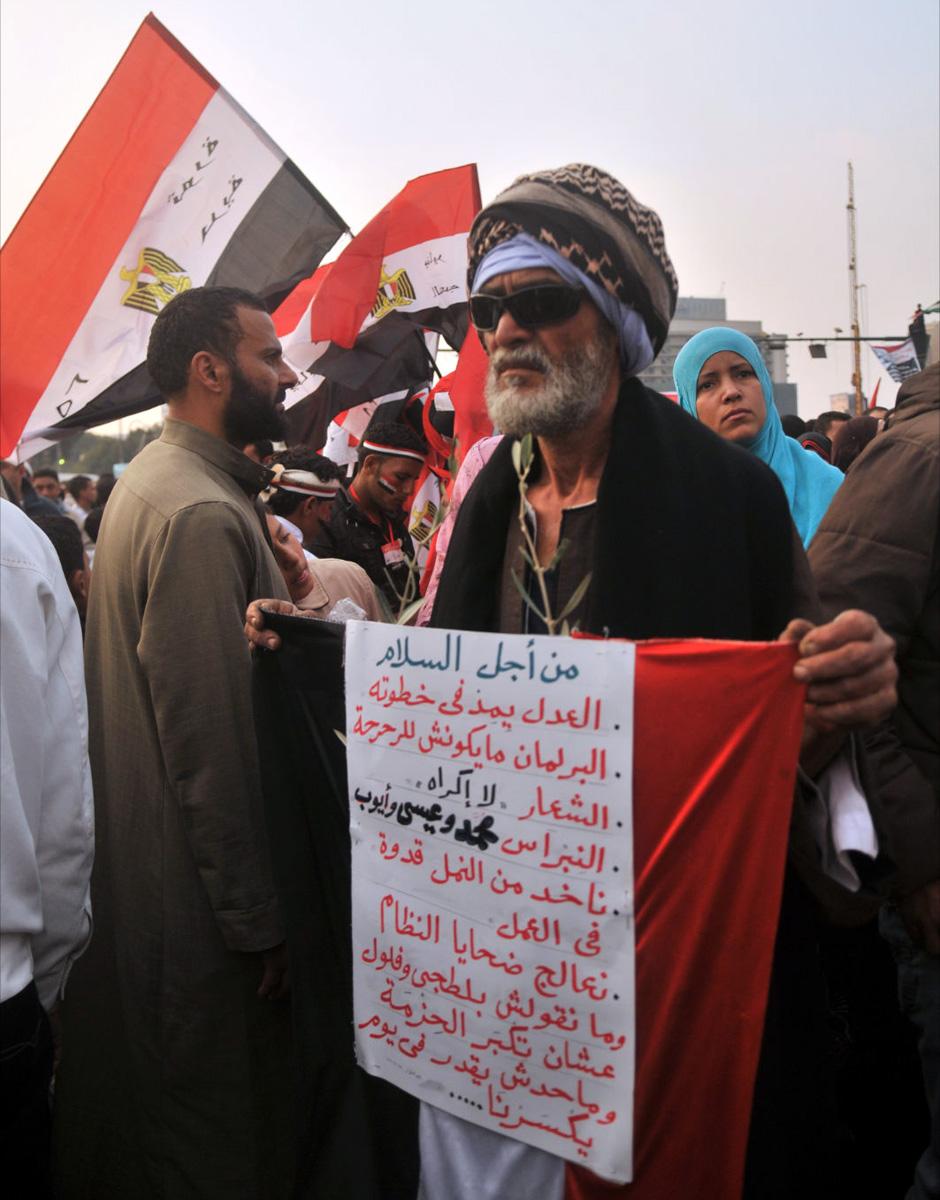


 AFP/Getty Images