Showing posts with label #jan25. Show all posts

Monday, January 27, 2014

Matariya Massacre January 25, 2014 + Mahragan + The Holy Family

Reading about the events of January 25, 2014, the three year anniversary of the launch of the Egyptian uprising that toppled Hosni Mubarak, I came across casualty figures. The first stats I saw were these (in Arabic, from Shorouk News, January 26), which give a total of 53. I noticed that a lot of the casualties seemed to be from al-Matariya, a popular quarter in the north of Cairo. I counted, and the total was 21. A more recent accounting from WikiThawra gives a total of 89 dead, 28 of them from al-Matariya.

I posted the early figure of 21 on Facebook, and my FB friend Alex posted as a comment this video of the events at al-Matariya, which is titled the "al-Matariya Massacre."


It shows a very large crowd of demonstrators, at Maidan al-Matariya, and lots of Ikhwan (Muslim Brotherhood) banners. (I've since learned that Matariya was one of two sites of MB demonstrations in Cairo on January 25, the other being Alf Maskan in Ain Shams. In Alf Maskan, according to WikiThawra, 32 died in confrontations with the security forces.) The young men who seem to be leading chants at the demo, shown early in the video, don't look like your typical Ikhwan members, but rather, like prototypical fans of mahragan (electro shaabi) music. Then you see confrontations between demonstrators and the security (who are not visible, you just hear shots being fired). And then, quite gruesome footage of casualties being carried from the lines of confrontation to (rudimentary) medical care. Quite gripping and shocking footage.

On twitter, I came across this photo of damage done to a wall of the shop by the firing of the security forces. You wonder what sort of ammunition they were using...


I've hunted around and been somewhat surprised that there has been very little coverage in English (or other European languages, as far as I can tell) of these events. One guesses because they happened in a popular quarter, which is far from the places that the Western media ever hangs out in, unlike Tahrir Square, which is very accessible. Al-Matariya is off the beaten path, like all of Cairo's popular quarters. One guesses as well that the absence of the usual subjects of Western coverage (young liberals/revolutionaries with Western education) is responsible for the lack of coverage. Finally, it was a Muslim Brotherhood organized demo, which is just not as sexy as a secular demo.

And yet al-Matariya is not, in fact, entirely unknown to the Western media. It's the 'hood of the celebrated mahragan (electro shaabi) posse, Eight Percent (Tamaniya fil-Miyya), composed of vocalists Wizza, Ortega and Oka. They're responsible for many great mahragan songs, including "Ana Aslan Gamid" (I'm Really Hard). This video, as of this writing, had been viewed by over 1,315,000 people.


These Matariya homies have received a great deal of publicity in both Egypt and abroad since 2011, including from yours truly, writing in Middle East Report, more recently for the Norient Musicfilm Festival 2014, and several times on this blog. They're among the mahragan stars featured in Hind Meddeb's fine documentary, Electro Chaabi, which screened at the Norient festival.

Al-Matariya is also an important pilgrimage site for Eastern Christians. The Holy Family is said to have stopped at al-Matariya village -- whose name is said to come from the latin Mater, for the Virgin Mary. (It was part of the area of the ancient city of Heliopolis, destroyed at the time of the Persian invasion in 525 BC.) Jesus is said to have used a staff that he took from Joseph, broken it into pieces, planted them, and then dug a well which made the pieces of wood take root and grow into a balsam tree. Mary (in the story about these events in the Qur'an -- not sure what verse) is said to have used the sweet-smelling water of the well (because of the balsam tree) to wash the clothes of Jesus, and so the well is known as the Tree of the Holy Virgin. A sycamore tree was planted on the site of the balsam in 1672, and a shoot of this tree still remains til today. 

Because Mary and Jesus are venerated in the Muslim tradition, and particularly in its popular versions (although Muslims do not believe in the virgin birth), both Muslims and Christians make pilgrimage til today to the shrine of Mary's tree. There are also a Jesuit Holy Family Church and a Coptic Virgin Mary Church at the site.

(A good source on the Holy Family in Egypt is Otto F.A. Meinardus' In the Steps of the Holy Family, 1963.)

The Holy Family visited Matariya because they were fleeing a massacre...

Saturday, March 05, 2011

More on Ramy Essam and Ahmad Fouad Negm

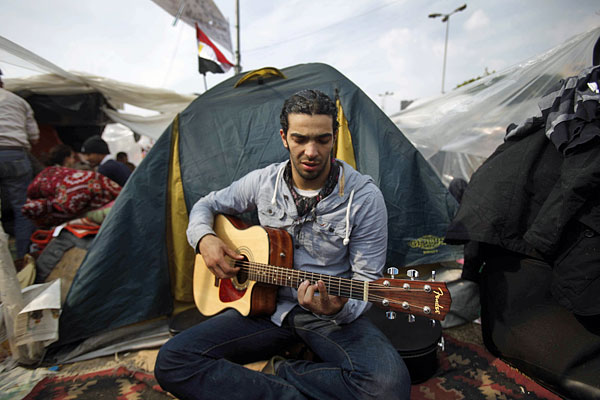
(Michael Robinson Chavez / Los Angeles Times)

On February 9, which now seems so long ago, I wrote a post called "Music of the Egyptian Revolution." Included in it was the now famous youtube vid of Ramy Essam singing "Irhal" (Leave, or, Go Away). I also included a vid of a song about a donkey refusing to step down for a younger one, but I was unable at the time to identify either the lyrics or the singer.

Since then many have written about the music of Egypt's revolution, and I'm able to identify the song and the lyrics. It's Ramy Essam (again), and the lyrics are by the celebrated revolutionary poet Ahmad Fouad Negm, the lyricist for Egypt's beloved revolutionary singer Shaykh Imam.

An article in The Los Angeles Times about Essam gives the story of his performance of the song on Tahrir:

One song that he relished, and that late at night the crowd would want to hear again and again, was an ode written by well-known poet Ahmed Fouad Negm: "The Donkey and the Foal," which everyone knew to be a commentary on Mubarak and his son Gamal.

Essam had written the music and played it for himself alone at home before the revolution. And now everyone shouted for the scathing lyrics of the aging poet, who had been jailed under Mubarak's predecessor. He felt honored when the poet stood with him and recited the words.

The foal said to the donkey, "Father, hand me the cart. Father, you have aged and now it is my turn."

The donkey coughed too strongly and the passengers panicked.

"It isn't about health, son," the donkey said. " Even the bridle is too big for you, son. Think and don't be greedy, or the passengers will rise up."

Since Hosny Mubarak's resignation, Ramy Essam has received a great deal of media attention, and has become something of a celebrity. Featured in the article in The Los Angeles Times, mentioned above, celebrated by Mark Levine in The Huffington Post (Levine produced a remix of "Irhal" as well--I respectfully prefer the original), an featured in an article in The Guardian by respected Middle East music commentator Andy Morgan, who calls Essam the Billy Bragg of Tahrir Square.

Before you imagine that Ramy Essam has gone all rock star, check out this video. It shows Essam performing his song "Irhal" on Tahrir Square to a big crowd. Later that night, the crowd at Tahrir is attacked by Mubarak's thugs. The pro-democracy forces keep them at bay. The video then shows Ramy Essam on the following morning. He stayed the night, and was wounded on the head by the rocks hurled by the counter-revolutionary goons. As far as I can tell, this occurred on the night of February 4-5, 2011. I don't know many "rock stars" who have the street fighting cred and the courage of Ramy Essam. I don't know if I know of anyone, in fact. Below is a screen grab of Ramy with his head bandage, and then, the full video.


This video shows Essam singing "The Donkey and the Foal" before a small group, on Tahrir, and also performing "Irhal," on another occasion, before a large crowd at the square.

This vid is a full version of "The Donkey and the Foal."

Here's Negm's poem in Arabic:

الجحش قال للحمار *** يابا اديني الحنطور

يابا انت سنك كبر*** و وجب عليا الدور

كح الحمار كحة *** فزعت لها الركاب

مش يابني بالصحة *** ده كل شئ بحساب

وسواقة الحنطور *** محتاجة حد حكيم

وانت عينيك فارغة *** همك علي البرسيم

قوللي تسوق ازاي *** والتبن مالي عينيك

ده حتي حبل اللجام *** واسع يا ابني عليك

اعقل وبطل طمع *** لاتسخن الركاب

ما تجيش يا واد جنبهم *** لاتبقي ليلة هباب

دول صنف ناس جبار *** قادر مالوهش امان

يبان عليهم وهن *** لكنهم فرسان

يابا دا نومهم تقل *** وبقاله يابا سنين

كل البشر صحصحوا *** ولسه دول نايمين

يا جحش بطل هبل *** وبلاش تعيش مغرور

ركابنا مش اغبيا *** ولا عضمهم مكسور

بكرة حيصحولك *** ويزلزلوا الحنطور

وتلاقي في قفاك *** تمانين خازوق محشور


And you can find out more about Ramy Essam, and download some of his music (although not the songs discussed above) from his Facebook page.

Friday, February 18, 2011

Wisconsin/Tahrir (+kufiya)

Lots of evidence that demonstrators in Wisconsin against Gov. Walker's draconian anti-labor bill is inspired, in part, by recent events in Egypt. Check out this photo of a kufiya-clad demonstrator, from a fabulous video of the last three days of protests, with a stirring soundtrack from Arcade Fire.

Wisconsin Budget Repair Bill Protest from Matt Wisniewski on Vimeo.


Check out this headline from an article on Boing Boing: "Midwestern Tahrir: Workers refuse to leave Wisconsin capital over Tea Party labor law."

Protesters also evoked Egypt's democracy struggle, on their first day at the Capitol--I'll add those links when/if I can find them.

Tuesday, February 15, 2011

Splits in the Egyptian Opposition: Kufiyas vs. Suits

In the meeting, the difference between the two populations was obvious, with the younger, fresher-faced protesters wearing Palestinian-inspired keffiyehs and looking bored while the older opposition figures in suits and ties bickered about committees.

From an article ("Egypt's opposition fights itself as about emerging splits within Egypt's opposition," by Shashank Bengali -- McClatchy Newspapers) about the post-revolution political maneuvering. Here's the background to the above:

"The two-hour gathering at the offices of the Democratic Front party in a middle-class section of western Cairo was one of several such meetings that have been held by various opposition groupings over the past three days. It was called to nominate committees to open negotiations with the military — which the military hasn't explicitly asked for — but instead it demonstrated Egypt's polyglot opposition scene at its most disjointed and chaotic."

Meanwhile, labor is on the move: "The army Monday accused labor protesters of "disturbing and disrupting" the country with their demands for better salaries and called on them to return to their jobs. In Cairo, a protest of about 200 workers outside the state-controlled Egyptian Federation of Trade Unions devolved into window smashing and shoving."

Monday, February 14, 2011

“Hold your head up high, for you are an Egyptian.”

Yasmine El Rashidi's article, "Freedom," in the New York Review of Books, really captures the euphoric atmosphere at Tahrir Square at the moment of the end of Mubarak. And it ends with this:

As I write this, a youth pop group is giving a concert in Tahrir Square, singing: “its the beginning, the beginning of your life, the beginning of stability, the beginning of security, the beginning of your life, say yes yes, say yes yes.” The crowd is waving flags and singing back.

I hope I can find out more about this unidentified group, and come back to this in future. This serves as a place holder. (Someone please message me!)

Sunday, February 13, 2011

Natacha Atlas, Egypt: Rise to Freedom Remix

The inimitable Natacha Atlas has released a remix of material her from most recent (and highly recommended) album Mounqaliba, in solidarity with the struggle of the people of Egypt. It's a wonderful remix, and the video footage, all from Tahrir, is quite stunning.


Please go to Natacha's webpage for an English translation of the lyrics.

Here's a sample:
Let us know there is a land
where words are the purveyors of truth,
heads are held high,
And human will is regarded above all.

I've posted about Natacha several times in the past. Here's my account of her performances in Chicago in 2006.

Saturday, February 12, 2011

Singing/chanting on Tahrir Square

This is a wonderful video, because it is yet another example of the great creativity and humor unleashed by the Egyptian Revolution, and because it demonstrates quite dramatically that the revolution was not simply a revolution of young, hip, middle class tweeters. Check out the chants (I've cribbed these from Haithem, who posted them on Facebook):

"e7na meen ou huwwa meen.. e7na el 3amel wil falla7.. ou huwwa 7arami linfita7.."
Who are we and who is he?... we are the laborer and peasant.. and he is the thief of the Infitah [Egypt's 'opening' --economic reforms, structural adjustment, etc.)

"e7na meen ou huwwa meen.. huwwa byelbes akher modah.. ou e7na bneskon 3ashara b2ouda.."
Who are we and who is he.. he wears the latest fashion.. and we live 10 in a room.

Wednesday, February 09, 2011

Kufiyas in the Egyptian revolution, cont'd.


This photo is from Jason Parkinson's riveting and disturbing video, Battle of the Interior Ministry, Jan. 29, 2011. View it here. Towards the beginning, we see a large crowd, marching through Tahrir Square. The man in the middle is holding up his kufiya, as if it were a flag or a symbol. There are other kufiyas in the footage too. And shots of men holding up spent cartridges, shot by the security forces, that say, Made in USA. And a deadly teargas canister, also from the USA.

Kufiya in action in Revolutionary Cairo

A protester carries an Egyptian flag and hangs it on the top of a traffic light post at
Tahrir Square in Cairo January 30, 2011. REUTERS/Asmaa Waguih

From a great collection of photos of the Egyptian revolution. (If you click on the photo to enlarge it, you'll notice the Che t-shirt.)

I've been asking friends who have lived in Cairo about the kufiya. In the early nineties, when I lived there, it was hardly to be seen. A friend of mine who was there at the same time says he only saw it among a small group of leftists, who put it on for revolutionary and Palestine-solidarity reasons. A friend who has been in Cairo the last couple years claims it is/was hipster garb. If the latter is (partially) true, then, these are very different hipsters from the US variety. These have been politicized and are important troops of the revolution.

See this, for instance. I think I see some kufiyas here. Even if not, this is the so-called "hipster" kufiya demographic. Now turned revolutionary. (Was that a Moz t-shirt I saw?)