Friday, November 07, 2008

Ghanian rapper Kwaw Kese: kufiya, big pimpin'

Check out this vid, in which Kwaw Kese (from Ghana) is kufiya-clad most of the time. The song does remind one of Jay-Z's "Big Pimpin'," doesn't it?


Found it courtesy of the very fine blog, The Elephants Child. I know nothing about Kwaw Kese, except that he's a "hip life" artist.

Kufiya-clad American Leftist, circa 1987


I found this in Fred Davis' book, Fashion, Culture and Identity (1992), in his chapter on Antifashion (p. 163). Jennifer Berman's cartoon, from In These Times, is entitled "The American Leftist (Progressivus Sandinistis Supportoris)." It features two male leftists in stereotypical late 1987 attire; I show (of course) only the one wearing what the cartoon calls a "Palestinian style scarf." (Unfortunately, it's not drawn very accurately. At the time it would have been a real black-and-white checked one.)

Among the other international characteristics of these two stereotypical leftists, according to the list at his left, is that they know: "some of the words to 'the Internationale'"; "at least 5 people who have been to Esteli [Nicaragua]"; "protest chants in Spanish" and "love Thai food."

More evidence that the kufiya was everyday eighties leftist attire, especially in the key movements of the era, the Central American solidarity movement and the nuclear disarmament movement. Contrary to what some accounts I've been reading say (including wikipedia--at least, as of today), its use in the US pre-dates the first Palestinian intifada, which broke out in December 1987.

Kufiyaspotting #43: Free Paris Hilton

I'm scheduled to give a paper at the Middle East Studies Association Annual Meetings in a couple weeks, entitled "Kufiyaspottings: Solidarity, Commerce, Banalization." I'm in the process of writing the thing, and so I've been reading over my old posts and also looking again at the work of the folks over at Kabobfest, who also do a lot of kufiyaspotting. And they turned me on to this:


It's hard to know what to say. Other than that Paris has managed, in my opinion, to outdo all other kufiya stylings in sheer trashiness. You simply can't beat it.


Except that Paris herself is not in fact the author of the "Free Paris" t-shirt. It is produced by Dissizit. (But alas, no longer up on their website.) I give them a tip of the tarbush, for they have managed to channel the true inner spirit of Paris.

Tuesday, October 28, 2008

Kufiya in Poland, front page of New York Times

Piotr Malecki for The New York Times

The front page of yesterday's (October 27) New York Times featured this photo of a kufiya-adorned woman in a Polish electronics store, as part of a story about the slowdown in Poland's once-hot economy. (Thanks, Joel.) Another example of how downright common the kufiya has become. And how even when you are suffering economically, you can still look stylish.

Sunday, October 19, 2008

Colin Powell: "[So] what if he [Obama] is Muslim?"

Colin Powell, on Meet the Press today, has the courage to say what someone of his stature should have said ages ago. He says, of course the answer to the claim that Obama is a Muslim, that he's a Christian. But he goes on to say:

The really right answer is, what if he is? Is there something wrong with being Muslim in America? The answer is no, that's not America. Is there anything wrong with some seven year old Muslim American kid thinking that he or she could be president? Yet I have heard senior members of my own party drop this suggestion, he might be a Muslim and he might be associated with terrorists. This is not the way we should be doing it in America. (My transcription.)

Then he goes on to talk about a soldier killed in Iraq, US Muslim, buried at Arlington National Cemetery, with star and crescent on his tombstone. Watch it here.

the fashion that refuses to die...

I can't escape it. In today's (Sunday) New York Times, in the Style section, there is the usual Bill Cunningham "On the Street" photos of street fashion, this one entitled "Color Guard." It features the colorful street style's of contemporary Paris. And damned if there isn't a guy wearing a kufiya in one of the shots.

Unfortunately, it's not posted online. You will need to consult your hard copy--until I can find an online version.

UPDATE, October 25. Here it is.

And, if you check out Cunningham's "On the Street" slide show that came out today, on the first blush of autumn fashion in NYC, you'll spot, yes, another kufiya. On a guy, toward the end of the slide show (28 seconds left). Here.

Kufiyas are, maybe, okay, but taking off Eid al-Fitr is "un-American"

Yarmulkes are banned at the workplace, too.

From the Wall Street Journal, October 18.

"Mass firings at meatpacking plants in Colorado and Nebraska last month highlight growing conflicts over how to accommodate religion in the workplace. The plants, owned by the U.S. unit of Brazil's JBS SA, collectively fired about 200 Muslim Somali workers who walked off the job over prayer disputes. The workers had asked management to adjust their evening break times so that they could pray at sunset. Managers at both plants initially agreed but then reversed their decisions after protests by non-Muslim workers...

A Tyson Foods Inc. chicken-processing plant in Tennessee this year agreed to let its work force claim holiday pay for Eid al-Fitr, which marks the end of the Muslim holy month of Ramadan, instead of Labor Day. Non-Muslims protested that the policy was un-American. Tyson managers reinstated Labor Day and switched a paid birthday to a personal day that could be used for religious observances...

In August, a federal judge in Nevada ruled that the Las Vegas police department must allow an orthodox Jewish officer to wear a beard, but not a yarmulke. The judge noted that the city permits employees to wear beards for medical reasons, but it prohibits all officers from wearing headgear...

Muslims in Greeley, Colo., last month protested the firing of more than 100 JBS workers after a walkout over Ramadan. (Sara Loven/The Greeley Daily Tribune, via AP)

The Somali workers said that they should be allowed to pray on their breaks and would be gone for only a few minutes. Supervisors responded that the only permitted unscheduled breaks were for use of the bathroom and that the plant couldn't have hundreds of workers leaving the lines at the same time.

"It takes less than five minutes," says Graen Isse, a Somali worker who was fired following a similar dispute at a JBS plant in Greeley, Colo. He says he and other workers offered to let JBS deduct pay for time spent praying."

Read the entire article here.

Update: I've just read an article about struggles over such issues at a JBS plant in Grand Island, Nebraska, from the Oct. 15 New York Times. It's a little more nuanced than the WSJ article. Interestingly enough, the objections to the JBS decision to give Somali workers time off to pray (and to cut the workday, and pay, of all workers by 15 minutes) came from Sudanese (mostly Christian) and Latino workers!

As an aside, Greeley, Colorado is where Sayid Qutb had his revelatory experiences with American civilization and mores, in the late 1940s. Props to John Calvert of Creighton University for doing the most to dig this info out. Read about it here.

Saturday, October 18, 2008

Kufiyaspotting #42: Afrika Bambaataa (or is it faux?)


I've been a fan of Afrika Bambaataa ever since I heard, back in the day, Afrika Bambaataa and the Soul Sonic Force do "Looking for the Perfect Beat" from 1982 (check out the terrific video here.) Bam, along with DJ Kool Herc and Grandmaster Flash, was one of the pioneers of hip-hop, and he and the Soul Sonic Force were largely responsible for the moment in the early eighties when rap was dominated by the "electrofunk" sound. (Then Run-DMC came along and hardcore took over.) I had the good fortune to see Bam and the Soul Force perform in Austin, at Liberty Lunch, in 1986 or 1987.

Bam & Co. were renowned for their creative, wild, Afrofuturist outfits--in the tradition of Parliament/Funkadelic and the Sun Ra Arkestra, but with a touch of the Village People for good measure. I don't remember ever seeing a video with Bam dressed in this Afrofuturist "sheikh" outfit (kufiya and 'aqal, the cord used to hold the kufiya in place.) This photo appears in the CD jacket to Part One of the Rhino Records box set, Street Jams: Electric Funk, a wonderful document of that era, with tracks from Flash, Grandmixer D.ST., Newcleus, The Wreckin Cru (featuring Dr. Dre!) and much more. (Alas, no Arabian Prince.)

"We are the future, You are the past!"

Wednesday, October 15, 2008

Kufiyaspotting #41: Harry Potter


I clipped this photo from The Arts section of the New York Times of Saturday, July 21, 2007 (p. 1). It took me over a year to (a) recover the clipping from the piles strewn around my office and (b) scan it. It's from an article about the long lines, in the US and England, that formed to buy the final Harry Potter volume, Harry Potter and the Deathly Hallows. This photo, of young fans celebrating the release of the novel in London, is another example of how completely everyday and mundane kufiya wearing had become by summer 2007, at least in London. (The photo does not appear on the on-line version of the article.

This is the larger spread (I couldn't quite scan the whole thing.)

Saturday, October 04, 2008

Otis Grand on CNN: Beirut Blues

Otis Grand is one of the world's great blues guitarists. We were together at the American University of Beirut in the late sixties and early seventies, and I used to play music with him from 1972-1975, part of that time in the Bliss Street Blues Band. I was never a very good singer, but Otis was an awesome guitarist. He moved to London in 1976, and in the early 1980s started playing music professionally there.

He appeared yesterday on the CNN show, "Inside the Middle East," talking about his life and the blues, from Beirut. There is great footage of him playing. And, there are some photos of the Bliss Street Blues Band, as well as some footage. I'm the guy with the dishwater blonde "Afro." Check it out.

Friday, October 03, 2008

"The Taqwacores" -- the movie


Very exciting news: Michael Muhammad Knight's novel, The Taqwacores, is being turned into a movie, with Mike serving as co-producer and co-writer. Read about it here. They are just starting up, so keep going back to read the blog as production proceeds.

Mabrouk, ya Michael!

Thursday, October 02, 2008

Report from The Guardian on the kufiya

This report appeared in The Guardian on September 22, and it's only now that I've had a chance to post it. It's one of the best and most accurate journalistic accounts that I've read. It's not the first to report on the last kufiya factory in Palestine, but at least it starts there. When I was in the West Bank in June, I planned to go to Hebron and purchase a kufiya from the Hirbawi factory, but alas, I never made it there. I saw a local, Hirbawi-manufactured kufiya in a shop in Bethlehem, and I should have bought it. The local ones really are of higher quality than the other 99%, which all seem to be produced in China. Interestingly, China is one of the few places where it's relatively easy for Palestinians from the West Bank to get visas, and so quite a few people go there, and many of these are involved in importing...kufiyas. So Palestinian merchants are complicit in the decline of the local kufiya manufacturing sector too.

A couple other interesting things to note about the article. I did not know that Islamists had taken up the red-and-white checkered kufiya, which formerly was worn as a distinctive sign by Palestinian leftists (Communists, PFLP, DFLP).

And I did not know that the practice of dyeing kufiyas various colors was at first something that kids were doing, and later adopted by the fashion moguls.

And I didn't know that Leona Lewis had been kufiyaspotted. But I didn't even know who Leona Lewis was until I read this article.

And here's why this is still relevant, and why The Guardian is reporting on it...A friend of mine just got back from London on Sunday, and she said everyone is wearing kufiyas there.

Chequered history

Everyone from Leona Lewis to Colin Farrell has taken to wearing the keffiyeh, as fashion goes wild for this symbol of resistance. But with sales soaring, why does the only factory in Palestine that makes these scarves look set to close? Rachel Shabi reports

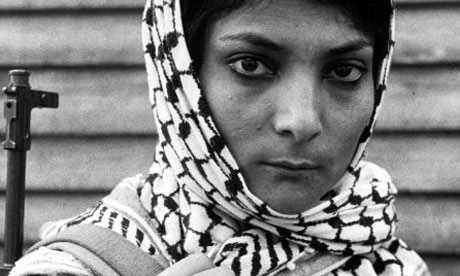
Leila Khaled wearing a keffiyah

Leila Khaled wearing a keffiyah. Photgraph: Eddie Adams/AP


'Next time you come, it will be better, God willing," says Yasser Herbawi, the 76-year-old owner of the first and only Palestinian keffiyeh factory. It's hard to see how. Last year, the distinctive black-and-white checked scarves became a surprise global trend, knotted around the necks of the most fashion-savvy. At the same time, the family-run company that produces this symbol of the Palestinian national struggle has been slowly grinding to a halt.

"It's the Chinese imports," explains Yasser, sitting amid piles of keffiyehs at the Herbawi factory storeroom, just outside Hebron in the West Bank. "In the 70s we could barely keep up with demand, but by the mid-90s cheap Chinese scarves started coming in, because of globalisation and Gatt." Yasser's sons Abdel Atheem, 50, and Judeh, 43, nod in agreement and curse the trade tariff-busting agreement. "We were forced to lower our prices and today we are working to a fraction of our capacity because we cannot compete." The factory used to produce more than 1,000 scarves a day, but now makes less than 100 - and struggles to sell those. A shutdown seems almost inevitable.

Needless to say, the Herbawi family isn't much enamoured with the cheap imports that first swamped and then stole their market. "They are not the same quality," says Yasser as he picks up a keffiyeh and spreads it across his knees, reverently feeling the light, dimpled cotton between his fingers. "Our product is better, much better. We take care of it and use only natural products, and it is beautiful." This textiles factory, which Yasser started 40 years ago, supplied the entire West Bank and Gaza - orders for scarves, robes and jackets, all fashioned from the same check, would also arrive from neighbouring Arab countries. Of course, the company creates much more than a specific cotton weave. "We are making the symbol of Palestine," says Yasser. "This scarf is the history and the heritage of our country."

The black-and-white square keffiyeh is Syrian in origin and is the head garment of choice for traditional, rural Arab males of a certain age. It was the 1930s Arab revolt against the British Mandate and Zionist organisations in Palestine that first established the scarf as a resistance symbol: it was worn in solidarity, and to make it difficult for the authorities to weed out orchestrators of the rural-led uprising. By the 60s, the scarf became emblematic of the nascent Palestinian national movement - it was the favoured headwear of the Palestinian leader Yasser Arafat and habitually worn by other symbols of the Palestinian resistance such as Leila Khaled. Then a red-and-white Jordanian version surfaced, taken up by Palestinian Marxists to differentiate themselves within the wider nationalist movement. More recently, its meaning changed again: "The Marxists in Palestine have all but disappeared and the ones who replaced them are the Islamists," explains Dr Samir Awad, political scientist at the West Bank's Bir Zeit university. "Now it's the Hamas guys who put on the red-and-white, just because they don't want to be associated with Fatah."

Around the Middle East, traditional, rural Arab men do still wear the keffiyeh, in the traditional way - as a headpiece, with the aqal ring holding it in place. But Awad says that these days, it is less widely used as a neckwear nationalist emblem by the younger generation of Palestinians. He provides one possible explanation: "The image of the keffiyeh as a symbol of resistance was tarnished by events in Afghanistan and Iraq, where it is used by terrorists, by anyone who wants to hide their face," he says. "It is very annoying, but there is no monopoly on the keffiyeh." The common appearance of the keffiyeh in suicide bomber videos has doubtless caused the two concepts to fuse in the minds of some observers.

For some years now, the keffiyeh has carried activist-chic credentials for anti-war protesters and supporters of the Palestinian cause across several continents. But it is more recently that the scarves have gained their full fashion stripes. "We noticed club kids were wearing them about a year and a half ago," says Melanie Rickey, fashion news director at Grazia magazine. "They were dyeing them fluorescent colours, and it was seen as a bit risque." Picking up on the trend, Balenciaga brought out a designer keffiyeh last summer. "What did they do, smother it with gold?" asks Abdel Atheem at the Herbawi factory when he hears of its £3,000 price tag. "If I tried to sell the scarves for £10, nobody would listen," says Yasser of the product, which gets a local market price of around £3. "And ours is the real thing."

The designer endorsement was a bit like the Midas touch - high street stores such as Topshop and American Apparel were soon churning out "black-and-white woven cotton" scarves for roughly the same sum that Yasser laments would cause his customers to turn a deaf ear. "After a while people just thought, 'These are nice scarves,'" says Rickey, "so that by this time last year, every teenage girl from London to Scotland had one." The keffiyeh as fashion item might now be on the wane, but Rickey thinks that the popular neckpiece started a paradigm-shifting trend - a retailer's dream scenario: it took the scarf out of a winter-wardrobe context and into the realm of all-year-round accessory. "The fastest selling accessory is the summer scarf," she explains. "Stores such as Oasis carry 30 to 40 different patterns - customers just can't get enough of them."

The high street has moved on from the black-and-white weave; Rickey says the current hot stock is glitter-thread-shot hippy scarves. Such faddishness is what makes it tough to interpret the craze for keffiyehs as ideological expression or act of Palestinian solidarity - in fact, fashion scarf-wearers often confess to being clueless over the politics of the chequered fabric. Still, that didn't stop the trend being read as inflammatory and insulting in some quarters. Earlier this year, Urban Outfitters pulled its line of "anti-war woven scarves", which had been a bestseller, after receiving complaints. "Due to the sensitive nature of this item, we will no longer offer it for sale," the company announced. "We apologise if we offended anyone, this was by no means our intention."

In May, Dunkin' Donuts pulled one of its online adverts because Rachael Ray, the celebrity chef that featured in it, was wearing a fashionably knotted keffiyeh. Slamming the scarves as "Jihadi chic" and "hate couture", popular American blogger and columnist, Michelle Malkin, one of the key campaigners against the black-and-white checks, wrote that, "Fashion statements may seem insignificant, but when they lead to the mainstreaming of violence - unintentionally or not - they matter."

Whatever the intention, the global surge in sales has had no impact on the fortunes of the ailing Herbawi factory. The textiles company does not export and, even at a local level, foreign competitors are holding sway. In the market stalls of Jerusalem's Old City, a Hebron factory-made keffiyeh is a rare sight among the scarves on sale to tourists. "For sure, I prefer the local product," says market vendor Saleh abu Ghazela, who stocks the Herbawis' new line of pastel multi-coloured checks alongside Chinese versions of the traditional colour combination. "But very few customers care about the quality or ask where the scarf comes from, and I have to cater to the market's demands."

All of which explains why most of the looms aren't even switched on at the Herbawis' factory. Fifteen machines used to operate daily for 18 hours, but now only one section of the vast factory is lit and just four clacking looms turn giant reels of thread into long flats of cloth. A factory technician moves between them, snipping rogue strands and making constant adjustments to the weave. "He has been our employee for 40 years," says Judeh Herbawi, of their last remaining staff member. "It is because of him that we stay open." Beyond this square of light, rows of grand machinery emblazoned with the label "Suzuki Loom" stand silent in the shadows, swathed in thick, yellow factory dust. Old swatches of keffiyeh fabric are still stretched out upon these once industrious machines - and underneath the powdery dust, the distinctive pattern so symbolic of the Palestinian national cause has all but faded away.

· This article was amended on Thursday September 25 2008. It was Urban Outfitters, rather than American Apparel as we originally said in the article above, that marketed the keffiyeh as an "anti-war woven scarf" but stopped selling it after protests. This has been corrected.

Tuesday, September 30, 2008

Jamaican dancehall kufiyas

I'm lucky to have a few readers who kufiyaspot for me. Thanks to Wayne (of the invaluable wayne&wax) who alerted me to this one--from Jamaica, with Wacky French Prince and Ding Dong introducing new dance moves, Nuh Linga and Ho mi look. You can't miss the kufiyas on a couple of the dancers. The kufiya presence can't simply be read as Jamaicans slavishly borrowing from US hipsters, although US rappers might be a source. But it's just as, and maybe even more, likely that thirdworldist solidarity with the Palestinians could be a motivation. Read wayne's post on this, and other dance move videos. He notes that this one bears a marked resemblance to voguing.

This makes me nostalgic for the good old days of the b-boys in South Bronx in the seventies. (Not that I was there, by any means.) And it calls to mind the heavy Caribbean influence on the foundational hip-hop scene. The three most important early hip-hop DJs all had a Caribbean foundation. DJ Kool Herc, who essentially invented sratching, immigrated to the US from Jamaica in 1967. (And Herc hung around with the Five Percenters.) Afrika Bambaata's parents were from the West Indies, and Grandmaster Flash's parents were from Barbados.

Monday, September 29, 2008

koffee-yehs! take that, dunkin' donuts!


I love it. I only recently heard about this campaign, which involves photos from all over the country of people drinking (their last cup of) dunkin' donuts coffee in a kufiya, in protest over the Rachael Ray debacle. (Thanks, Nadia.) Check the blog out for more photos like this one, which is from New Orleans. The big easy!

See, kufiyas still have their uses. Take that, hipsters.

And here's the campaign video:

Sunday, September 28, 2008

More kufiya hipster fashion, that Verena Von Pfetten loves to hate

My friend Theresa told me about this recent (Sept. 26) Huffington Post column by Verena Von Pfetten, entitled "7 Hipster Fashions We Love to Hate." It's fall, she says, and time to say goodbye to old trends and embrace the new ones. But--the hipsters need extra encouragement in this regard because, she says,

...no one group of people have ever so succumbed, so embraced, so clutched on to trends for dear life with cold, pale, smoke-yellowed fingers as that so-called creative counter-culture: The Hipster.

"From what I can tell," Von Pfetten continues,

the hipster depends, nay, thrives on irony, but the problem is that in doing so, they've a) diluted and deserted any formal definition that irony may or may not have once had and b) they've only served to create a fashion version of The Blob in which once they adopt a "trend" -- usually historical and always ironically, of course -- it feeds on itself, and it grows and grows until frat guys are wearing it and the cast of "The Hills" are designing it, and then someday Rachel Ray will star in a Dunkin Donuts commercial while wrapped in it. Or maybe it's the other way around.

Interesting, isn't it, that it's the hipster kufiya that's the iconic villain of this piece, the viral hipster fashion accessory? And that it's dead when frat boys and Rachael wear it--the archetypes of un-coolness?

And then there's Von Pfetten's point c):

...though they initially drench themselves in these sartorial affectations in a (soon-to-be proven misguided) attempt to show how very unconcerned they are with what exactly it is they wear and though it would seem that their entire image hinged upon the sheer disinterest they have in other people's opinions and the exquisitely cultivated and the desperately disdainful, "What, this? I picked it up off the floor and pulled this out of the garbage and stole this from my myopic maternal grandmother!," the very act itself is contradictory. In attempting to embrace something so patently unflattering so as to prove how patently unimportant such flattery is, they are -- in fact -- acknowledging their concern, and therefore, their endorsement.

And then:

To put it simply: these trends, these [seven] accoutrements, these god-awful outfits are fugly. And yet, they are everywhere. And somehow they just never seem to go away.

And then there's the slideshow, with a slide of Rachael Ray in kufiya, and the comment: If Rachel [Rachael] Ray is wearing something in a Dunkin' Donuts commercial, it's most definitely no longer cool. It's done. It's dead. Get over it. And a slide of Kirsten Dunst in brown-and-black "global chic scarf," with the comment: And while I'm a personal fan of Kirsten Dunst, this wasn't cool then, and it sure as heck isn't now.

Will Von Pfetten help kill this trend off? Will it revert back to the politicos?

I don't know. Fayetteville, Arkansas is certainly no bellwether of fashion. But now that the weather has cooled off, you do see the odd kufiya around. I have at least three students who wear them, who are both rather fashionable, and pro-Palestinian.

The saga continues...

Thursday, September 25, 2008

back on the kufiyaspotting tip: "Hipster: The Dead End of Western Civilization"

Yes, clearly I've not been blogging much lately. I have to attribute it to what seem like the very high demands of teaching this semester. But I've been collecting kufiya info, and it's time to start reporting. So here is the first of several posts which I hope to spit out over the next couple days.

One of my undergraduate students turned me on to this article yesterday,"Hipster: The Dead End of Western Civilization," by Douglas Haddow, from the latest issue (79) of Adbusters.

Here's the last paragraph of the article, which sums up the thesis and conveys the mood of the piece:

We are a lost generation, desperately clinging to anything that feels real, but too afraid to become it ourselves. We are a defeated generation, resigned to the hypocrisy of those before us, who once sang songs of rebellion and now sell them back to us. We are the last generation, a culmination of all previous things, destroyed by the vapidity that surrounds us. The hipster represents the end of Western civilization – a culture so detached and disconnected that it has stopped giving birth to anything new.

The article contains a couple of kufiya (keffiyeh) references--kufiyas, according to Haddow, are one of the key distinguishing signifiers of today's hipsters, as well as being symptomatic of the emptiness and meaninglessness that typifies the hipster subculture.

Here's how Haddow describes hipsters:

Take a stroll down the street in any major North American or European city and you’ll be sure to see a speckle of fashion-conscious twentysomethings hanging about and sporting a number of predictable stylistic trademarks: skinny jeans, cotton spandex leggings, fixed-gear bikes, vintage flannel, fake eyeglasses and a keffiyeh – initially sported by Jewish students and Western protesters to express solidarity with Palestinians, the keffiyeh has become a completely meaningless hipster clichĂ© fashion accessory.

The kufiya: the quintessential sign of the vacant character of contemporary youth culture!

The kufiya comes up again, at the end of Haddow's article, in his description of a bunch of urban hipsters making their way home at dawn, after the after-parties:

The half-built condos tower above us like foreboding monoliths of our yuppie futures. I take a look at one of the girls wearing a bright pink keffiyah and carrying a Polaroid camera and think, “If only we carried rocks instead of cameras, we’d look like revolutionaries.” But instead we ignore the weapons that lie at our feet – oblivious to our own impending demise.

Hmmm...you'd look like revolutionaries whay exactly? Because of the kufiya and the rocks? Like this kind of revolutionary? (A young Palestinian confronting the army of occupation.) Who would hipsters be throwing rocks at? Who would be driving the tank? Or would you just be throwing rocks at your "yuppie futures"? Maybe it would be better to forget imagining that one could look like a revolutionary, and join demonstrations against the $700 billion dollar bail-out or send money to the US Campaign to End the Israeli Occupation.

I'm not sure that the kufiya hipster signifies the end of Western civ either. Hipsters or bohos or whatever you want to call them were wearing kufiyas for style reasons back in the early to mid-eighties. And hip youth culture as now being about "consuming cool rather that creating it" (Haddow)--this isn't particularly new either. It's all well and good to critique hipsters wearing uniforms, not knowing the provenance or politics of their kufiya gear, and fooling themselves about the subversiveness of their style and attitude. But it's not the end of the world.

(Excellent hipster kufiya photos are to be viewed at Hipster Intifada.)

Sunday, September 21, 2008

Peaches and Tone-Loc: "Wild Thing"

Peaches has remixed Tone Loc's "Wild Thing," and performs on the new version. I just heard about it. It's the twentieth anniversary of the release of the original. Makes me feel old.

Nonetheless, it's made me smile, and I've been listening over and over. See whether it does the same for you:


And then there's the video for Peaches' song, "Get It." Hilarious!


Keep up with Peaches at her website, peachesrocks.com.

Sunday, September 07, 2008

Andalousies Atlantiques Festival in Essaouira, Morocco, Oct. 30-Nov. 1: Tribute to Judaeo-Arab singers Sami El Maghribi and Lili Boniche

I just received this announcement. I encourage anyone who reads this blog to both circulate this information and to try their best to go. I attended last year's festival, and it was splendid, both as a musical event, and as a tribute to the critical importance of Jews to modern Arab musical culture. Among last year's featured performers were the great Moroccan Jewish singer Haim Louk and the Algerian-Jewish pianist and vocalist Maurice El Medioni. Medioni will be there again this year, with the El Gusto Orchestra, a chaabi ensemble led by Abdel Hadi Halo. And other huge stars, the Judaeo-Arab singers Luc Perez and Luc Cherki, and Jil Jilala! I've posted a few photos from last year's event, which can be accessed here.

Haim Louk with Thami Harrak and his ensemble (photo: T. Swedenburg)

Dear All,


We would like to invite you to this year's Andalousies Atlantiques Festival, celebrating the prodigious musical heritage of al-Andalus. This year's event will take place in Essaouira from October 30 to November 1, 2008 and will pay tribute to two giants of Judeo-Arabic music who passed away earlier this year - the Moroccan Sami El Maghribi and the Algerian Lili Boniche.
Among the groups performing are El Gusto, a 50-person ensemble that reunites veteran chaabi musicians who performed together in the casbah of Algiers in the 1950s - including Maurice El Medioni, Ahmed Bernaoui, Rene Perez, and Luc Cherki under the leadership of Abdelhadi Halo; Maxime Karouchi, a young Moroccan-born vocalist who performs Andalusian nuba, and Sami El Maghribi's melhoun and chaabi repertoire; Mohamed Briouel and the Orchestre Andalous de Fes - Briouel directs the Music Conservatory of Fez, and won the Prix du Maroc for his book
Moroccan Andalusian Music: Nouba Gharibat Al Husayn; and the group Jil Jilala, who fuse the rhythms of Issawa and Gnawa with melhoun, and whose songs of protest of the 1970s and 1980s have become classics.

During the morning, panels will bring together researchers, journalists and musicians to discuss the music legacy of al-Andalus. Films, documentaries and exhibits will be shown during the afternoon - concerts begin at 6:00pm.

Here is a link to a newsreport on last year's Andalousies Atlantiques festival:
http://www.youtube.com/watch?v=8KvqSyWXHOs


Please join us!

For any questions about the festival, please contact Professor Ted Swedenburg at the University of Arkensas: tsweden@uark.edu (http://swedenburg.blogspot.com/)

Comité des Festivals d'Essaouira

Thursday, September 04, 2008

Jeff Halper on the Gaza Boat Trip


I just received this in the mail from the Israeli Committee Against House Demolitions. Their Director, Jeff Halper, participated in the recent, successful effort of the Free Gaza Movement to break the Israeli siege of Gaza, sending two boats in with supplies and a team of dedicated volunteers. Jeff was trained as an anthropologist, and participated in a panel at the American Anthropological Association meetings last fall, for which I served as a discussant. Please read Halper's very important observations on the trip, and on Israel and its relations with Gaza.

I've also been receiving communications from Fun'Da'Mental's Aki Nawaz, who also participated in the mission, and I'll be posting those soon.

End of an Odyssey
Jeff Halper
September 1

Now, a few days after my release from jail in the wake of my trip to Gaza, I'm posting a few notes to sum things up.

First, the mission of the Free Gaza Movement to break the Israeli siege proved a success beyond all expectations. Our reaching Gaza and leaving has created a free and regular channel between Gaza and the outside world. It has done so because it has forced the Israeli government to make a clear policy declaration: that it is not occupying Gaza and therefore will not prevent the free movement of Palestinians in and out (at least by sea). (Israel's security concerns can easily be accommodated by instituting a technical system of checks similar to those of other ports.) Any attempt on the part of Israel to backtrack on this - by preventing ships in the future from entering or leaving Gaza with goods and passengers, including Palestinians - may be immediately interpreted as an assertion of control, and therefore of Occupation, opening Israel to accountability for war crimes before international law, something Israel tries to avoid at all costs. Gone is the obfuscation that has allowed Israel to maintain its control of the Occupied Territories without assuming any responsibility: from now on, Israel is either an Occupying Power accountable for its actions and policies, or Palestinians have every right to enjoy their human right of travelling freely in and out of their country. Israel can no longer have it both ways. Not only did our two little boats force the Israel military and government to give way, then, they also changed fundamentally the status of Israel's control of Gaza.

When we finally arrived in Gaza after a day and a half sail, the welcome we received from 40,000 joyous Gazans was overwhelming and moving. People sought me out in particular, eager it seemed to speak Hebrew with an Israeli after years of closure. The message I received by people of all factions during my three days there was the same: How do we ("we" in the sense of all of us living in their country, not just Palestinians or Israelis) get out of this mess? Where are WE going? The discourse was not even political: what is the solution; one-state, two-state, etc etc. It was just common sense and straightforward, based on the assumption that we will all continue living in the same country and this stupid conflict, with its walls and siege and violence, is bad for everybody. Don't Israelis see that? people would ask me.

(The answer, unfortunately, is "no." To be honest, we Israeli Jews are the problem. The Palestinian years ago accepted our existence in the country as a people and are willing to accept ANY solution -- two states, one state, no state, whatever. It is us who want exclusivity over the "Land of Israel" who cannot conceive of a single country, who cannot accept the national presence of Palestinians (we talk about "Arabs" in our country), and who have eliminated by our settlements even the possibility of the two-state solution in which we take 80% of the land. So it's sad, truly sad, that our "enemies" want peace and co-existence (and tell me that in HEBREW) and we don't. Yeah, we Israeli Jews want "peace," but in the meantime what we have -- almost no attacks, a feeling of security, a "disappeared" Palestinian people, a booming economy, tourism and ever-improving international status -- seems just fine. If "peace" means giving up settlements, land and control, why do it? What's wrong with the status quo? If it's not broken, don't fix it.)

When in Gaza I also managed to see old friends, especially Eyad
al-Sarraj of the Gaza Community Mental Health Program and Raji Sourani, Director of the Palestinian Center for Human Rights, whom I visited in his office. I also received honorary Palestinian citizenship, including a passport, which was very meaningful to me as an Israeli Jew.

When I was in Gaza everyone in Israel -- including the media who interviewed me - warned me to be careful, to watch out for my life. Aren't you scared? they asked. Well, the only time I felt genuine and palpable fear during the entire journey was when I got back to Israel. I went from Gaza through the Erez checkpoint because I wanted to make the point that the siege is not only by sea. On the Israeli side I was immediately arrested, charged with violating a military order prohibiting Israelis from being in Gaza and jailed at the Shikma prison in Ashkelon. In my cell that night, someone recognized from the news. All night I was physically threatened by right-wing Israelis -- and I was sure I wouldn't make it till the morning. Ironically, there were three Palestinians in my cell who kind of protected me, so the danger was from Israelis, not Palestinians, in Gaza as well as in Israel. (One Palestinian from Hebron was in jail for being illegally in Israel; I was in jail for being illegally in Palestine.) As it stands, I'm out on bail. The state will probably press charges in the next few weeks, and I could be jailed for two or so months. I now am a Palestinian in every sense of the word: On Monday I received my Palestinian citizenship, on Tuesday I was already in an Israeli jail.

Though the operation was a complete success, the siege will only be genuinely broken if we keep up the movement in and out of Gaza. The boats are scheduled to return in 2-4 weeks and I am now working on getting a boat-load of Israelis.

My only frustration with what was undoubtedly a successful operation was with the fact that Israelis just don't get it - and don't want to get it. The implications of our being the strong party and the fact that the Palestinians are the ones truly seeking peace are too threatening to their hegemony and self-perceived innocence.
What I encountered in perhaps a dozen interviews - and what I read about myself and our trip written by "journalists" who never even attempted to speak to me or the others - was a collective image of Gaza, the Palestinians and our interminable conflict which could only be described as fantasy. Rather than enquire about my experiences, motives or views, my interviewers, especially on the mainstream radio, spent their time forcing upon me their slogans and uniformed prejudices, as if giving me a space to explain myself deal a death blow to their tightly-held conceptions.

Ben Dror Yemini of the popular Ma'ariv newspaper called us a "satanic cult." Another suggested that a prominent contributor to the Free Gaza Movement was a Palestinian-American who had been questioned by the FBI, as if that had to do with anything (the innuendo being we were supported, perhaps even manipulated or worse, by "terrorists"). Others were more explicit: Wasn't it true that we were giving Hamas a PR victory? Why was I siding with Palestinian fishermen-gun smugglers against my own country which sought only to protect its citizens? Some simply yelled at me, like an interviewer on Arutz 99. And when all else failed, my interlocutors could always fall back on good old cynicism: Peace is impossible. Jews and Arabs are different species. You can't trust "them." Or bald assertions: They just want to destroy us. Then there's the paternalism: Well, I guess it's good to have a few idealists like you around...

Nowhere in the many interviews was there a genuine curiosity about what I was doing or what life was like in Gaza. No one interested in a different perspective, especially if it challenged their cherished slogans. No one going beyond the old, tired slogans. Plenty of reference, though, to terrorism, Qassam missiles and Palestinian snubbing our valiant efforts to make peace; none whatsoever to occupation, house demolitions, siege, land expropriation or settlement expansion, not to mention the killing, imprisoning and impoverishment of their civilian population. As if we had nothing to do with the conflict, as if we were just living our normal, innocent lives and bad people decided to throw Qassam rockets. Above all, no sense of our responsibility, or any willingness to accept responsibility for the ongoing violence and conflict. Instead just a thoughtless, automatic appeal to an image of Gaza and "Arabs" (we don't generally use the term "Palestinians") that is diametrically opposed to what I've seen and experienced, a slavish repeating of mindless (and wrong) slogans which serve only to eliminate any possibility of truly grasping the situation. In short, a fantasy Gaza as perceived from within a bubble carefully constructed so as to deflect any uncomfortable reality.

The greatest insight this trip has given me is understanding why Israelis don't "get it:" a media comprised by people who should know better but who possess little critical ability and feel more comfortable inside a box created by self-serving politicians than in trying to do something far more creative: understanding what in the hell is going on here.

Still, I formulated clearly my messages to my fellow Israelis, and that constitutes the main content of my interviews and talks:

(1) Despite what our political leaders say, there is a political solution to the conflict and there are partners for peace. If anything, we of the peace movement must not allow the powers-that-be to mystify the conflict, to present it as a "clash of civilizations." The Israeli-Palestinian conflict is political and as such it has a political solution;

(2) The Palestinians are not our enemies. In fact, I urge my fellow Israeli Jews to disassociate from the dead-end politics of our failed political leaders by declaring, in concert with Israeli and Palestinian peace-makers: We refuse to be enemies. And

(3) As the infinitely stronger party in the conflict and the only Occupying Power, we Israelis must accept responsibility for our failed and oppressive policies. Only we can end the conflict.

Let me end by expressing my appreciation to the organizers of this initiative - Paul Larudee and Greta Berlin from the US, Hilary Smith and Bella from the UK, Vaggelis Pissias, a Greek member of the team who provided crucial material and political input, and Jamal al-Khoudri, an independent member of the PLC from Gaza and head of the Popular Committee Against the Siege and others - plus the wonderful group of participants on the boats and the great communication team that stayed ashore. Special appreciation goes to ICAHD's own Angela Godfrey-Goldstein who played a crucial role in Cyprus and Jerusalem in getting the word out. Not to forget our hosts in Gaza (whose names are on the Free Gaza website) and the tens of thousands of Gazans who welcomed us and shared their lives with us. May our peoples finally find the peace and justice they deserve in our common land.


Jeff Halper is the Director of the Israeli Committee Against House Demolitions (ICAHD). He can be reached at: jeff@icahd.org.