Continuing in my hysterically-obsessive effort to fully document and understand the kufiya craze, I came across these two articles from the British magazine New Statesman (analogous to The Nation in the US), from 2007 and 2005. The 2007 piece, by Allegra Stratton, discusses how Urban Outfitters, seemingly in response to the controversy over the firm's kufiya marketing in the US, opted to sell it as the "shemagh" in Britain. Ben White, writing back in 2005, worried that the keffiyeh was on its way to becoming an empty symbol of radical politics, just like Che and Martin Luther King. "Rather than its [the keffiyeh's] increased popularity signifying a politicisation of fashion," White concludes, "it simply means more people will be wearing something they know little about and which represents something they do nothing for." Good question: how keffiyeh wearers care at all or even know anything about the suffering of Palestinians in Gaza? The letter in response to white claims that British bikers, and some Goths, have been wearing the keffiyeh/shemagh for decades.
"Bedouin couture," Allegra Stratton (New Statesman, July 19, 2007).
You've just attended Glastonbury in the worst June since records began and could have done with your grandmother's shawl. A pashmina might have helped - but you're not Kate Middleton or Sienna Miller. Besides, you've got some rubber wristbands left over from last year and know that we live in political times. You opt for the shemagh.
The shemagh is the headcloth worn by Arab peasants for centuries, which now features in the autumn collection of the haute couture fashion house Balenciaga. That really is rags to riches. Something Yasser Arafat spent an hour intricately folding around his head each morning so that its tail formed the shape of Palestine, has spent most of 2007 as a fashion accessory.
Readers of Grazia magazine will have seen David Beckham in, variously, an orange and a green shemagh. Sienna and Kate were there at its beginning; one has even been seen round the neck of Jade Goody.
The main purveyor of the reinvented shemagh is the high-street chain Urban Outfitters. Black-and-white in Palestine as a symbol of nationalism, plain white in the Gulf, red and white in the Jordanian army. At Urban Outfitters, you can buy your shemagh in any colour as long as it's nu-rave fluorescent. In pink and purple, with added hearts against the classic checks, it has become the £18 Heart Woven Desert Scarf. "It won't provide you with much camouflage in the desert," says the catalogue, "but it sure is pretty."
Pretty? The Jewish and Palestinian lobbies united in fighting what they saw as trivialisation and the product was pulled from American shelves in January due to what the company acknowledged was its "sensitive nature". An inkling of this may have been why the store chose to name its scarves by the obscure name of the shemagh - something British soldiers called them when posted in North Africa during the Second World War - rather than what Arabs call them, keffiyehs.
In London's Urban Outfitters, the shemagh remains a bestseller. At the Covent Garden branch, a place so glibly political the male mannequin in the forecourt wears a T-shirt slogan, "Drop Acid Not Bombs", I ask one assistant why they're still selling shemaghs. "What, because of the whole Afghan thing?" she asks, making rabbit ear shapes with her fingers. Another assistant wore her shemagh on holiday to America. "Like Iranians, or whatever, would come up to me and say, 'I'm really proud of you for supporting us.'" Close, but not quite.
Centuries ago, shemaghs were a means for Arabs to protect themselves from the wind, sun and storms of the Middle East. Only latterly have they morphed into symbols of Arab nationalism. If the weather continues like this, the bedouin look could spread still further and return to its practical use in northern Europe.
"Fashion claims another symbol: Observations on radical icons," Ben White (New Statesman,
February 14, 2005)
I have seen it several times in Cambridge, and my friends report seeing it in London: the black and white chequered headdress, or keffiyeh. All of a sudden, the instantly recognisable symbol of Palestinian resistance is being adopted by the fashionistas.
As a supporter of the Palestinians ever since I went up to Cambridge in 2002 - I am now president of the university's Palestine Society - I wonder how I should respond. Do I quietly celebrate this adoption of the emblem of Palestinian nationalism, or do I bitterly resent these Johnny-come-latelies and the ignorantly casual way they swing the black and white scarf over their shoulders? As it is safe to assume that those sporting keffiyehs are not new card-carrying members of Fatah, is this phenomenon a "good thing"?
You might say that this anxiety is typical of the miserable left, moaning about the gradual acceptance by the trendsetters and taste-makers of a cherished symbol of resistance. To combine cliches, we never miss an opportunity to snatch defeat from the jaws of victory. But it is not as simple, or uplifting, as that.
In the past few decades, radical icons have been appropriated by market forces and rendered politically impotent. The archetypal commoditisation is Che Guevara or, more accurately, a picture of him. Once confined to posters in student digs, Che's mugshot has since appeared on, well, mugs, along with T-shirts, beer mats and other merchandise. He is now high-street fashion attire, at best worn in a spirit of ironic acknowledgement of his radical politics.
It's not just symbols that undergo a revision; entire moral and intellectual legacies can be transformed. Martin Luther King has become a contemporary saint in the US, complete with a holiday named after him. He has become a marketable meaninglessness, providing suitable quotations for all occasions, and reinforcing self-comforting American ideas of democracy. Meanwhile, his attacks on US foreign policy and the military-industrial complex are forgotten.
The keffiyeh could be heading in the same direction. Rather than its increased popularity signifying a politicisation of fashion, it simply means more people will be wearing something they know little about and which represents something they do nothing for.
Letters - Worn to be wild (New Statesman, February 21, 2005)
Ben White (Observations, 14 February) should know that the black-and-white keffiyeh has been worn by bikers, and the occasional Goth, for decades. It is noted for its warmth and dustproof properties at speed. The bikers buy it from that London purveyor of high fashion, Silvermans, the military clothing supplier, where it is known as a shemagh. [Silverman's still has them, for 6.99 pounds--just search for Shemagh. T.S.]
William Black
Scarborough, North Yorkshire
Saturday, January 19, 2008


Friday, January 18, 2008
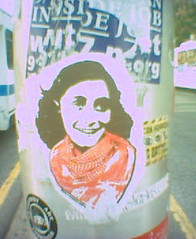
Anne Frank with Keffiyeh in NYC Street Art
Ever on the lookout for kufiyas (aka keffiyeh, kaffiyeh, shemagh), I found an interesting flickr pool called "Hipster Intifada." It has several interesting kufiya shots, including this one of Anne Fank. Plus check out the "History of the object in question" in the discussion section, from AnomalousNYC.
For more flickr photos, just click on kufiya, keffiyeh, or kaffiyeh on flickr. (Most common spelling on flickr: keffiyeh.)
For more flickr photos, just click on kufiya, keffiyeh, or kaffiyeh on flickr. (Most common spelling on flickr: keffiyeh.)
Friday, January 11, 2008
More kufiyaspottings (#30-32): Israeli Version with Star of David, Bush/Olmert/Peres, Hip Elbow Patch
Three more recent kufiya (كوفية) items.
(1) From a very informative blog, Culture et politique arabes, authored by Yves Gonzalez-Quijano, who teaches Arabic literature at l'université Lyon2. (Warning, francophobes, it's all in French.) He does a very nice job of providing an overview of the history of the kufiya and its recent inroads into the world of fashion. Two observations of particular interest. First, that, in response to the explosion of kufiyas in Western fashion, an Israeli designer has come up with a blue-and-white kufiya, in the colors of the Israeli flag, with the design of the Star of David. (You might have to look at the photo for a minute, like I did, to see the six-pointed star.) I've not been able to determine which designer is doing this.

Gonzalez-Quijano concludes by observing that despite its current fashionability, and much like the image of Che Guevara, "the Palestinian keffieh hasn't totally lost its evocative power," as evidenced by this photo of Hugo Chavez.

If you weren't convinced, how about this poster, plastered around Israel by extreme right-wing activists in anticipation of Bush's visit?

Six activists were arrested on the charge of vandalism, for putting up the posters, as reported by Ynet. The belong to the extreme right Jewish National Front, founded in 2004, which calls for Palestinians (both in Israel and in the West Bank and Gaza Strip) to be "encouraged" to emigrate. They oppose the withdrawal of Israeli civilians and military from any Palestinian territory, and therefore consider Israeli PM Ehud Olmert and Israeli President Shimon Peres (depicted here along with W) to be traitors.

Note that the kufiyas on their heads are arranged in the very distinctive style of late Palestinian president and PLO leader Yasir Arafat, as if to associate them with the ultimate "terrorist." (Note: Bush's niece Lauren has actually been kufiyaspotted.) Thanks to John L. Knight for alerting me to this item.
Finally, kabobfest has spotted another kufiya fashion line, this one from a New York outfit called Kiser. Read about it here. A "Kefia Shawl Collar Sweatshirt." Only $86. Very hip.

(1) From a very informative blog, Culture et politique arabes, authored by Yves Gonzalez-Quijano, who teaches Arabic literature at l'université Lyon2. (Warning, francophobes, it's all in French.) He does a very nice job of providing an overview of the history of the kufiya and its recent inroads into the world of fashion. Two observations of particular interest. First, that, in response to the explosion of kufiyas in Western fashion, an Israeli designer has come up with a blue-and-white kufiya, in the colors of the Israeli flag, with the design of the Star of David. (You might have to look at the photo for a minute, like I did, to see the six-pointed star.) I've not been able to determine which designer is doing this.

Gonzalez-Quijano concludes by observing that despite its current fashionability, and much like the image of Che Guevara, "the Palestinian keffieh hasn't totally lost its evocative power," as evidenced by this photo of Hugo Chavez.

If you weren't convinced, how about this poster, plastered around Israel by extreme right-wing activists in anticipation of Bush's visit?

Six activists were arrested on the charge of vandalism, for putting up the posters, as reported by Ynet. The belong to the extreme right Jewish National Front, founded in 2004, which calls for Palestinians (both in Israel and in the West Bank and Gaza Strip) to be "encouraged" to emigrate. They oppose the withdrawal of Israeli civilians and military from any Palestinian territory, and therefore consider Israeli PM Ehud Olmert and Israeli President Shimon Peres (depicted here along with W) to be traitors.

Note that the kufiyas on their heads are arranged in the very distinctive style of late Palestinian president and PLO leader Yasir Arafat, as if to associate them with the ultimate "terrorist." (Note: Bush's niece Lauren has actually been kufiyaspotted.) Thanks to John L. Knight for alerting me to this item.
Finally, kabobfest has spotted another kufiya fashion line, this one from a New York outfit called Kiser. Read about it here. A "Kefia Shawl Collar Sweatshirt." Only $86. Very hip.

Egyptian rock: "Mama Ayez Atgawez" from Wast al-Balad
Don't really know anything about this band. Wast al-Balad means "downtown." I can't make out all the lyrics, but here are some of them (thanks to Robin for help):
Mama ayiz atgawwiz, bass ma fish filus (Mama, I want to get married, but I don't have any money)...
Mama ayiz atgawwiz, ma indish filus ashtari sha'ah (Mama, I want to get married, but I don't have any money to buy an apartment)...
Mama ayiz atgawwiz, ma indish filus ashtari arabiyah (Mama, I want to get married, [but] I don't have money to buy a car).
Habibi sakin fi z-Zamalek, w-ana sakin fi-l-Abbasiyah! (My sweetheart lives in Zamalek, and I live in Abbasiyah.)
The song deals with typical problems facing young people in Cairo, who want to get married and to gain the status of adulthood, but who have difficulty putting together enough funds to do so. Middle class parents will not allow their daughters to marry a young man, if he can't provide an apartment, fully furnished, a car, etc. And what's worse, for the young man singing the song, he and his sweetheart reside in two different, and quite distant, neighborhoods of Cairo.
Great fun!
Monday, January 07, 2008
Prophet Motive: Kahlil Gibran

I highly recommend this amusing and informative account of Kahlil Gibran by Joan Acocella, writing in the New Yorker, on the occasion of a new volume of Gibran's work. The title tells it all: "Prophet Motive." I had not realized that Gibran is said to be the third best-selling poet of all time (after Shakespeare and La-Tzu), based almost entirely on sales of The Prophet. (At least as of 1997, Jalal al-Din Rumi was the best selling poet in the US.)
I could never understand, even as someone who is in some senses a product of "the sixties," why The Prophet was so incredibly popular. Acocella helped me understand. Among other things, it possesses the mysterious allure of "Oriental wisdom" but without being tied to any particular religion, and so prefiguring New Age spirituality. And: its "advice is not bad"; it is “inspirational literature”; it has a "pleasing ambiguity"; it's comforting; and it's short, 96 pages, with, as Acocella writes, "margins you could drive a truck through." Acocella has the good grace not to add that there's no accounting for bad taste--but I think that's a factor.
It's another example of what I'd call "popular Orientalism," rather stupid and banal, but nonetheless pretty harmless. (Although it wasn't really harmless for Gibran, who made lots of money but seems to have felt himself to be a fraud, and so drank himself to death. His adherents seem to prefer the more romantic, but mistaken, idea that tuberculosis did him in.)
What I still don't understand is why Gibran, a Maronite Christian from what is now Lebanon, who emigrated to the US as a child in 1895, spelled his first name Kahlil. The first letter of his name, خ in Arabic, is properly, and normally, transliterated 'kh.'
This bugs me almost as much as the book does...
Prime-time situation comedy in Israel on Palestinians ("Israeli Arabs")
I learned about this show from an informative article in the New York Times. The title of the show, written by Sayed Kashua, a Palestinian citizen of Israel, is "Avoda Aravit," which means Arab work or Arab labor. According to the article, the title is Hebrew slang for second-rate work. The title also riffs off of the slogan, "Avoda 'Ivrit," or Hebrew labor, which was fundamental for the Zionist colonizing movement in Palestine. The Zionist ideology proposed that the Jew of the diaspora would be remade by doing hard physical labor on the land, and by not hiring others (namely Arabs) to do that work. The fact that the iconic "worker," especially when it comes to the most difficult physical labor (in factories, in agriculture, in construction) is done in Israel today by Arabs represents, therefore, a kind of subversion of the Zionist dream.
Two things I love about the video clip (courtesy of Al-Jazeera English): first, the daughter who subverts her parents plan to get through the checkpoint by speaking Arabic: "Sabah al-khayr ya bulees!" (good morning, policeman); and second, the Palestinian-Israeli woman who refers to Edward Said's book Orientalism when she spurns her Jewish-Israeli date. "Since I'm an Arab, I must adore maqluba [a traditional Palestinian dish, made with cauliflower]. That's exactly what Edward Said wrote about in 'Orientalism.'" Interesting because the expectation is that both Jewish and Arab viewers in Israel would be expected to know, or at least know of, Said's book.
Wednesday, January 02, 2008
Gayhane: Gay disco in Berlin for Turks and Arabs
Nicholas Kulish reports, in an NYT article entitled "Gay Muslims Pack a Dance Floor of Their Own," on a monthly event known as "Gayhane" at a Berlin disco. But why give the article the title, "Gay Muslims"? No doubt many of those who participate consider themselves Turks or or Kurds Arabs or Turkish-Germans or Berliners?
The monthly club is organized by the transgendered Fatma Souad (pictured), who started throwing the events in 1997. What's the music? Amr Diab and Cheb Mami are popular. One of the dj's, Ipek Ipekcioglu, "spins everything from Turkish and Arabic music, to Greek, Balkan and Indian, a style she calls Eklektik BerlinIstan."
 The article leaves the unfortunate impression, however, that the young men and women who participate in Gayhane ("hane" means home in Turkish) would be "killed" if their families knew, but it also shows that homophobia isn't just a phenomenon peculiar to Middle Eastern communities in Germany. "[H]omophobia is also higher among Russian immigrants and in other, less urban parts of Germany," according to social psychologist Bernd Simon.
Gayhane of course is not a "new" phenomenon. Please check out this article from 2004, from AFP, whose title is "Gay Turks [as opposed to "Muslims"] Tearing Down Walls in Berlin," and which usefully discusses racism within the German gay community.
The monthly club is organized by the transgendered Fatma Souad (pictured), who started throwing the events in 1997. What's the music? Amr Diab and Cheb Mami are popular. One of the dj's, Ipek Ipekcioglu, "spins everything from Turkish and Arabic music, to Greek, Balkan and Indian, a style she calls Eklektik BerlinIstan."
 The article leaves the unfortunate impression, however, that the young men and women who participate in Gayhane ("hane" means home in Turkish) would be "killed" if their families knew, but it also shows that homophobia isn't just a phenomenon peculiar to Middle Eastern communities in Germany. "[H]omophobia is also higher among Russian immigrants and in other, less urban parts of Germany," according to social psychologist Bernd Simon.
Gayhane of course is not a "new" phenomenon. Please check out this article from 2004, from AFP, whose title is "Gay Turks [as opposed to "Muslims"] Tearing Down Walls in Berlin," and which usefully discusses racism within the German gay community.
Monday, December 31, 2007
Kufiyaspotting #29: Karen Hess

Thanks to Bob, who spotted this item on Karen Hess for me in this week's Sunday New York Times Magazine. (I had looked through the magazine but missed the photo.) This issue of the magazine is composed of obits for important people (at least, according to the Times) who passed away in 2007. I had never heard of Karen Hess, who according to Betty Fussell, author of the piece, was a well-known food activist, contrarian, and food historian. She considered Julia Child a "dithering idiot." And she wore a bonnet and a kufiya. You gotta love her.
Happy New Year!
"Arabian Nights": Marc Jacobs
 I saw this rather astonishing item yesterday in the Sunday Styles section of the New York Times. The piece, by Bill Cunningham (who also shot the photos), is entitled "Unveiled" and it reads as follows: "The 'Arabian Nights' event given by the designer Marc Jacobs at the Rainbow Room on Dec. 12 was the office party of the year. Many costumes reflected the fantasy drawings of the fashion artist Antonio Lopez in the 1985 book 'Antonio’s Tales From the Thousand and One Nights.' Top left, an image from the book’s cover." Unfortunately, the photos--the best part of the piece--are not reproduced in their full size on the NYT site. But if you click on the photo you can get a fuller view. You can also google "Marc Jacobs" and "Arabian Nights" and find more shots of the event on various blogs. I've reproduced a few here, many of which show more skin than the Times is able to show.


 These are the entertainers, presumably professional bellydancers.
I've not found out much relevant about fashion illustrator Antonio Lopez (d. 1987), the presumed source for many of the costumes, but I have been able to locate another painting from the book. But I would suggest that the "source" of the Marc Jacobs party fantasy goes back much further than Lopez's 1985. Orientalism was all the rage in the West during the first three decades of the twentieth century, and it was very common for socialites in New York and London to hold parties where the guests dressed up much as Marc Jacobs' guests did in 2007. Such events were quite popular, and considered "liberatory" for women, because adopting Eastern dress meant throwing off the constraining corset.
 (Some argue that the original "source" for this fashion movement was the appearance of Arab "bellydancers" at the Chicago Worlds Fair in 1893, and particularly the dancer known as "Little Egypt.") The brilliant and visionary filmmaker Jack Smith queerly evokes these traditions in his films Flaming Creatures and Normal Love (which you can view here); freak folksinger Devendra Bernhardt and Hairy Fairy also recall the early twentieth century Orientalist soirées in a NYT fashion spread.
This Orientalism can be found all over the place, and it is quite well documented. One of the best articles I've read about it is by Peter Wollen ("Fashion/Orientalism/The Body," in New Formations 1, 1987), where he discusses the role of Matisse, the Russian Ballet and its costume designer Leon Bakst, and fashion designer Paul Poiret in promoting these trends, in both the domain of "high art" and in popular culture.
 A photo of Nijinsky from the Ballet Russe, in a costume designed by Bakst.
 This is a photo of Peggy Guggenheim in a Poiret outfit, taken by Man Ray.
And then there is modern dance, whose development is closely related to the image of the Eastern bellydancer. Among the names to mention in this regard are Maude Allen (shown below in her famous Salomé role)
 Collette, Isadora Duncan and Ruth St. Denis (shown below).
And then of course there is cinema, from the Babylon sequences of D.W. Griffith's Intolerance (1916) to the films starring Theda Bera
 ,Rudolph Valentino as the Sheik, and so on.
And then there's even art deco, as evidenced in this bit of sculpture.

Back in the early twentieth century, when this sort of Orientalism was all the rage, it was connected to a certain notion of female, involving more freedom for the body from constricting clothing (the corset), and a more libertine orientation to bodily display, rooted in an imagined model of an Orient that was more sensual than the West. Today, clearly, it doesn't mean the same thing to dress up in "Oriental" costume as it did 100 years ago. I've not yet worked out what's going on with the Marc Jacobs party. More later, inshallah.
Saturday, December 29, 2007
Srebrenica Massacre

One of the many fine songs on Fun'Da'Mental's powerful 2006 release, All Is War: The Benefits of G-had, is "Srebrenica Massacre," featuring vocals in Bosnian (a variety of Serbo-Croatian, according to some) by Alma Ferovic. Since April I've given several talks about Fun'Da'Mental, which have included analyses of several songs from All Is War, but I've not had much to say about "Srebrenica Massacre." I failed to focus on it mainly because I'm much more familiar with the cultures and histories of England, the Middle East, and South Asia, which are more germane to the songs I did talk about. What I did say about the song was that it was a "dirge...lamenting the 1995 massacre of over 8000 Bosnian Muslims by Bosnian Serb forces, the largest mass murder to occur in Europe since World War II, ruled an act of genocide by the International Criminal Tribunal for the former Yugoslavia."
I've just read Marc Perelman's review in The Nation of Florence Hartmann's Paix et châtiment: Les guerres secrètes de la politique et de la justice internationales (Peace and Punishment: The Secret Wars of Politics and International Justice), which prompted me to go back to the song.
But first, let's rehearse some of the astonishing revelations of Hartmann, who served on the staff of the International Criminal Tribunal for the former Yugoslavia (ICTY), set up by the UN, as summarized by Perelman. (But be sure to read the entire review.)
Hartmann argues that France, Britain and the United States have obstructed the court in order to avert the public disclosure, during the course of a trial, of their failure to prevent the violent implosion of Yugoslavia and, more egregious, despite ominous warning signs, the July 1995 Serbian-led massacre of an estimated 8,000 Bosnian Muslim men and boys in the town of Srebrenica. Hartmann's claim is not new, but her evidence is. As such, the book raises serious questions about whether Western leaders--including members of the Clinton Administration, who justified US intervention in the Bosnian war on humanitarian grounds (a justification invoked, in turn, by politicians and journalists of various political stripes who backed the invasion of Iraq)--failed in their legal duty to prevent crimes against humanity...
[Slobodan] Milosevic, one of the ICTY's prime targets, was also "the key to the peace, the one who would sign the Dayton accords in November 1995, putting an end to three and a half years of war and ethnic cleansing in Bosnia-Herzegovina," Hartmann writes. As a result, the evidence of his role in coordinating the war crimes in Bosnia, primarily the infamous massacre in Srebrenica, had to be kept from the public, Hartmann says...
In the spring of that year, negotiations between Milosevic and Western officials over the shape of Bosnia were reaching a turning point. While there was general agreement to divide the country into two autonomous entities, the outlines of the map were still in dispute. The main point of contention was three Muslim enclaves--Srebrenica, Zepa and Gorazde--nestled in the midst of Bosnian Serb territory. In 1993 they had been designated by the UN as "safe areas" to protect them from Mladic's army. But in July 1995 Mladic and Karadzic decided to force the issue by launching a major offensive against the enclaves, starting with Srebrenica. The story of how the city was overrun and several thousand inhabitants were executed as UN peacekeepers watched helplessly has been recounted many times, most grippingly by David Rohde, an American reporter who first uncovered evidence of the massacre and whose Endgame: The Betrayal and Fall of Srebrenica (1997) describes the event through the eyes of seven witnesses. Rohde concluded that the litany of mistakes that led to the massacre was a "passive conspiracy" rather than a cynical backroom deal.
While acknowledging their failure to prevent Srebrenica--which was documented in French and Dutch parliamentary reports published in November 2001 and April 2002, respectively--UN, NATO and Western officials have always claimed they never imagined that the Bosnian Serb takeover of the city would result in the worst massacre on European soil since World War II. And they have consistently rejected the accusation that they purposely allowed the Bosnian Serb takeover of Srebrenica and, a few days later, Zepa in order to negotiate the release of dozens of UN troops being held hostage by Bosnian Serbs or to facilitate the peace agreement that was reached four months later in Dayton. Western officials have stressed that major powers actually prevented Mladic from taking over Gorazde.
In recent years, that official version of history has come under scrutiny. In Srebrenica: Un génocide annoncé (Srebrenica: A Genocide Foretold), a book published in France on the tenth anniversary of the massacre, French writer Sylvie Matton offers some fresh acknowledgments by senior European political and military officials--mostly French--that the tragic fate of the enclave was no mystery. The most vivid acknowledgment is provided by Alain Juppé, who was prime minister of France at the time of the Srebrenica massacre. "It was widely known that the Serbs wanted to take the enclaves and annihilate the men," Juppé told Matton, who then asked Juppé what he meant by "annihilate." "Let's say we knew they would take no prisoners," he answered.
In a November 2005 interview on Bosnian television, Holbrooke, who at the time of Srebrenica was assistant secretary of state for European and Canadian affairs and who later spearheaded the US mediation that led to the 1995 Dayton Accords, declared that his "initial instructions" were to "sacrifice Srebrenica, Gorazde and Zepa." His remarks went unnoticed for a year until Muhamed Sacirbey, who was the Bosnian foreign minister at the time, noticed them while watching a tape of the program. It was indeed a stunning reversal. Holbrooke had always said that the initial US policy during the summer of 1995 was to push the Bosnian Muslims to abandon only Gorazde--a policy he claims he successfully rejected, the proof being that the Bosnian Muslims never fled Gorazde while it was under siege. But in November 2005 he seemed to admit that the United States, in fact, envisioned sacrificing the three enclaves--which would have made it an accessory to the goals of the Bosnian Serbs.
Holbrooke told me he had misspoken in the television interview, and that the orders he received--and rejected--involved only Gorazde, thus returning to the original script. Sacirbey thinks a veteran diplomat like Holbrooke would be too savvy to make such a mistake, especially during a formal television interview taped on the occasion of the tenth anniversary of the fall of Srebrenica. "
To summarize, Hartmann provides compelling evidence that the US, the UN, and NATO powers (a) enabled the occupation of (and hence massacres at) Srebrenica, Gorazde and Zepa for the sake of a political agreement (Dayton) and (b) have been covering up ever since--and so two of the leading perpetrators of genocide, Radovan Karadzic and Ratko Mladic, are still at large.
The title of Fun'Da'Mental's album, All Is War, I argue in the papers I've given, "refer...to the heavy policing, surveillance and crackdowns on Muslim communities in Europe, but to the post 9/11 global environment, where it's war everywhere--the war on terror, the invasion of Afghanistan, Israeli offensives against Palestinians, the occupation of Iraq, Russia's continuing repression of Chechnya, and so on. The album's political sensibility is shared by many Muslims, in communities in the West and in the Middle East, as well as many in the Third World more generally. And it runs directly against widespread feelings in the West, orchestrated by agencies of public meaning, that it is Europeans and North Americans who are especially threatened by assault from a global network of Islamic terrorists, and that the threat based not just abroad but also within, inside Western minority communities." Bosnia and Srebrenica are a very important part of this picture, an important element in the sensibility of so many Muslims that, at worst, the West has declared war on Muslims, and at best, the West is indifferent to the fate of Muslims. Why else, they might ask, would the worst massacre in Europe have been a massacre of Muslims? The revelations of Hartmann can only add fuel to such sentiments. And remember, in case it's not obvious, when we're talking about Srebrenica, we are talking about the criminal responsibility of the Clinton administration, not Bush and the neo-cons. (I hate those "I Miss Bill" bumper stickers I see around Fayetteville.)
The tone of "Srebrenica Massacre," unlike many of the other numbers on All Is War, is mournful as opposed to angry and militant.
Here's Fun'Da'Mental's commentary on the song, from the band's website.
Was it Christianity that strangled the life out of defenseless Muslims or was it nationalism that committed another holocaust? In front of the eyes of their so called defenders they were herded and massacred wholesale, the barracks of the Dutch UN peacekeepers displayed their contempt of the Muslims with graffiti on the walls for all to see. On the doorstep of the Europe it committed yet another crime; foolishly we waited for rescue whilst barbaric genocide took place. We hold our heads in shame and so should the Muslim Governments across the world as they displayed their incompetence and impotence to take the correct steps to stop massacre of Muslims across Yugoslavia. Milosevic died a dog’s death but the wounds of deliberate genocide echo and rebound. Murderers remain at large whilst the West busies itself attempting to remove the last vestiges of Islam from the noble and pious Bosnian people...[Note: I've not seen evidence to support this last claim.]
The music and the concept of the song come from Aki Nawaz, lyrics and vocals are by Alma Ferovic, a Bosnian singer/actress born in Sarajevo, and trained at the Academy of Music University of Sarajevo in Bosnia and the Royal Academy of Music in London. She translates the lyrics as follows:
The smell of sorrow the dawn is bringing
Morning is rising, no one is here
I hear weeping, innocent souls
Crying in the darkness becomes a song
Aman, zeman (Oh, the time)
Aman, zeman (Oh, the time)
Near the graves, images of memories
And on them torture, faces of despair
Silver dream the time is bringing
Pain and sorrow, can not be forgotten
Aman, zeman (time)
Aman, zeman (time)
Of Aman Srebrenice
And she comments on the use of the words "aman" and "zeman": "The word Aman the way I used it in the song would have a meaning close to oh God, oh why, Zeman means time and I thought of the two as a combination for repetitive middle lines that any traditional song would have in Bosnia. So it is something that can symbolise heavy heart and sad, sad deep emotion."
"Zaman" means time in Arabic and Turkish, so this Bosnian word no doubt comes from the Turkish. "Aman" similarly means "God!" or "Lord help us!" in Turkish. (Bosnia was part of the Ottoman Empire from 1463 to 1878.)

Ferovic has also recorded another version of the song, called simply "Srebrenica," which has a much more subdued and simple instrumental backing. Check out the very effective video here, which shows Ferovic at the Srebrenica Memorial, walking in the fields, and behind barbed wire.
Friday, December 28, 2007
Kufiyaspotting #28: Khaled

I've been meaning to write about Khaled's kufiya for a long time, and finally found a photo. In winter 2002, shortly after the events of 9/11, music promoter Miles Copeland organized a very successful tour for three Arab artists who recorded for his (now-defunct) label, Mondo Melodia. The tour featured rai star Khaled, Egyptian sha'bi vocalist Hakim, and Palestinian-American 'ud and violin master Simon Shaheen. The tour served as a kind of coming-out party for Arabs in the US, who made up a significant and enthusiastic component of the audience in many locales. In a sense, the concerts represented a public validation for Arab popular culture, in the wake of several months of intimidation hanging over Arabs and Muslims in the wake of 9/11.
At the New York concert, an audience member threw a black-and-white kufiya onstage, and Khaled put it on and wore it for the remainder of the concert. A significant gesture, especially in light of the fact that Khaled is frequently depicted as "apolitical."
I write about this event, the tour, and the reception of Arab music in the US post-9/11 in an article published in Middle East Report (Fall 2002), called "The Post-September 11 Arab Wave in World Music," and at greater length in an article published in Anthropologica called "The 'Arab Wave' in World Music after 9/11." (Unfortunately, neither is available online.)
Alas, the demise of Mondo Melodia has meant that less Arab pop music is being released in the US...
Thursday, December 27, 2007
Marseille's Rap
Interesting article about the rap scene in Marseille. My own interest in Marseille was inspired by French rap group IAM, who I wrote about in an essay published in Tony Mitchell's edited volume, Global Noise: Rap and Hip-Hop Outside the USA (Wesleyan UP, 2002). Great resources on Marseille include issue #13 of Mediterraneans/Méditerranéennes (Spring 2002) and the policiers novels of Jean-Claude Izzo, his "Marseille trilogy," recently translated into English, and mentioned below.
As the article makes clear, there really is a difference between the sort of rap music that one hears in the rest of France, which is all "hardcore," and that of Marseille. The one thing that bothers me about this article is less what it says about rap in Marseille than what it implies about rap elsewhere in France. If marseillais rap "helps keep the peace" in Marseille, does that mean that rap is "responsible" for violence occurring in banlieues and cités elsewhere in France? The claim by French parliamentarians that the 2005 riots/uprising were caused by rappers was absurd. (They didn't "file suit," as Kimmelman states, but petitioned the Justice Minister.)
The article is informative, nonetheless. It's worth signing up for free online access to the New York Times in order to get access to the original article, where you can listen to several songs by the artists referred to. If you click on the Keny Arkana link below, you can also find some free downloads that are well worth listening to.
New York Times, December 19, 2007
In Marseille, Rap Helps Keep the Peace
By Michael Kimmelman
MARSEILLE, France — The other day, a dozen or so teenage rappers in baggy jeans and hoodies gathered outside a community arts center called Le Mille-Pattes in Noailles, a poor immigrant neighborhood here, hard by the Old Port.
One of this city’s most successful hip-hop artists, M’Roumbaba Saïd, who calls himself Soprano, lately wrote a track called “Melancholic Anonymous”: “I can’t help it, expressing my feelings, my melancholy in my lyrics,” he rapped. “I can laugh at my sadness. It helps.”
When the slums outside Paris and Toulouse exploded last month, repeating the violence that erupted two years ago, here in Marseille, France’s second-largest city, all remained calm. Back in July, in one of this city’s impoverished northern neighborhoods, a 14-year-old boy named Nelson Lobry-Gazelle was killed by a police car. Four hundred people demonstrated peacefully, so the incident barely made headlines. As it happens, it was also a police car’s killing two teenagers in Villiers-le-Bel, a destitute suburb about 10 miles north of Paris, that sparked the trouble that broke out across France in November. A bus-burning here in October 2006 was considered an isolated incident and failed to ignite a local chain reaction.
The Marseillais have plenty of explanations for this disparity, aside from the obvious one that the poor areas here aren’t segregated on the city outskirts, as they are in Paris — but it is hip-hop, as much a source of local pride as the town’s soccer team, that turns out to be a lens through which to examine why this city didn’t burn.
Melancholy is the word often used to describe the local rap style: melancholy as a reflective state of mind. In contrast to the city’s sun-and-sea context, melancholy actually suits lots of its culture. A Marseille novelist, Jean-Claude Izzo, who died just a few years ago, became famous in France for writing grim, pessimistic detective stories. Robert Guédiguian, also from Marseille, is a filmmaker whose reputation is based on dark movies.
Rappers in Marseille, some of the most original and distinctive ones anyway, compose sad odes to their local neighborhoods and hymns to the whole melting-pot city. The sound of Paris hip-hop, slicker and more aggressive, adopts much from American gangsta rap, as Marseille hip-hop does too, but Marseille boasts a groovier style. It mixes in blues, flamenco, Jamaican ragga.
The number that a decade or more ago helped fixed IAM, the Marseille group, on the French charts, borrows from George Benson to lay down a mellow beat. "Belsunce Breakdown," about one of the city’s downtown neighborhoods, by Bouga, a rapper from there, begins with a hypnotic piano riff, jazzily syncopated — a little Steve Reich crossed with 50 Cent.
Here the basic interconnectedness of all modern music expresses a local truth about the city’s cultural identity. An ancient, gritty seaport, Marseille flaunts its history as an immigrant magnet. Its population of 820,000 includes 200,000 Muslims, 80,000 North African Jews, 80,000 Armenians. One of the largest immigrant groups is made up of Muslims from the Comoro Islands, near Madagascar. Three of the four musicians in PSY4 de la Rime, Soprano’s band, are Comorians who grew up in the northern part of Marseille where Mr. Lobry-Gazelle died. The fourth member of the band, DJ Sya Styles (of Moroccan background, born Rachid Aït Baar), like many of the teenagers at Le Mille-Pattes, comes from Noailles.
Marseille lyrics can be full of rage but they’re not violent, the way those of certain Parisian bands are. Two years ago 152 conservatives in the French Parliament brought suit against seven rap groups, but notably none from Marseille, for fostering hatred and racism against whites and for what one politician called “anti-French ” sentiments.
PSY4, by contrast, wrote a rap not long ago called “Justicier”: “I know all the cops are not that bad, but why do you always ask me for my ID? To your violence I prefer responding with my lyrics. Can’t we have a proper dialogue?”
The other evening PSY4 occupied a recording studio in Grottes Loubières, just northeast of the city. During a break the members talked about the way rappers help one another here, and about how success comes not from landing studio contracts but from earning respect, ground up.
“Rap’s not a business here, the way it is in Paris,” DJ Sya Styles said. “It’s not like Paris, where the suburbs are just concrete. Here you first have to prove yourself in the neighborhoods.”
Stéphane Gallard put it another way: “Paris is more hard-core.” He is the quiet, suave young man in charge of music programming for the nonprofit Radio Grenouille, the city’s most popular hip-hop station. “The fact that hip-hop artists sell their music on their own blocks contributes to their identifying with Marseille, and this explains why there’s no car burning,” he said. “Different communities in Marseille are still quite separate, there’s racism here, but it’s a city in which you have the freedom to move among communities if you choose.”
It’s also true that this city has a contrarian streak going back at least 2,000 years, to when it backed Pompey over Caesar. You might say Marseillais rappers reflect the tradition of “pays,” or local communities, to which their inhabitants maintain more powerful loyalties than to France. At the same time, it’s a place proud of its old Corsican and French-Italian mob heritage (a popular downtown clothing store was named for a famous mob boss), and the prevalence of drug dealers and North African gangs does partly explain why there’s relative calm in destitute areas: Calm is maintained for the sake of their businesses.
Unemployment nears 40 percent in those same parts of town among those 18 to 25; it’s 13 percent citywide, much more than the national average of 8 percent. So clearly job opportunities alone, or their lack, don’t account for the absence of urban violence recently.
It helps that an old, Mediterranean-style civic patronage system doles out favors to earn loyalty and keep the peace. And, as everybody says, unlike Paris, where immigrant poor occupy huge concrete blocks cut off from the city center, Marseille has its neighborhoods, like Noailles, that are smack in the middle of town, while the hard-pressed quarters to the north are linked to the center by cheap public transport and remain inside city limits. So residents feel that they belong to Marseille, because they do, and in turn they feel that Marseille belongs to them.
Out of these communities, where musicians have their own version of a patronage system, the hip-hop scene has emerged — besides PSY4 de la Rime, IAM and Bouga, others, like Keny Arkana, FAF Larage, Fonky Family, DJ Rebel and Prodige Namor, have made it big here.
“Marseille rap never integrated violence the way Paris did,” Philippe Fragione told me. He’s Akhenaton, the leader of IAM. He, like other older musicians here, supports younger Marseille rappers. It was his studio in Grottes Loubières that PSY4 was using. Marseille rap is “more socially conscious,” Mr. Fragione added. “That’s because there is a real sense of community.”
I stopped in the waterfront office of Paul Colombani, the deputy director of the redevelopment program Euroméditerranée. With more than $5 billion in public and private investments, it plans, by 2012, to turn some 2.5 miles of downtown into office towers, mixed-income apartments, museums and esplanades. Zaha Hadid, Jean Nouvel and other archistars have signed on. Outside the porthole office window, the Danielle Casanova, an enormous white ferry, waited to carry passengers to Algeria. Passengers coming back often bring knockoff goods that merchants hawk on sidewalks. “Les jeunes errants,” as migrant street children, some as young as 12, are called, hide in boats, then head for Noailles when they land. A few have become aspiring rappers through community cultural centers like Le Mille-Patte.
Mr. Colombani noticed my gaze. “That will be moved out of this area,” he said about the ferry. He meant to L’Estaque, far to the north, “easier for customs,” he explained. Luxury cruise ships will dock here instead.
Marseille can surely use the money, but hardly at the cost of undoing the social chemistry that has kept the peace and fostered, among other things, the city’s musical life. At Le Mille-Patte those dozen or so young rappers outside were a typical Marseille mix: first-, second- or third-generation immigrants from Algeria, Morocco, the Comoro Islands, Eastern Europe, Argentina.
Habib was a skinny 18-year-old with a doleful face and a band called Urban Revolution. “We all get along because we share music,” he explained. Le Mille-Patte had first encouraged him to rap as a young boy: “I didn’t know what to do with my days, so this place was very important.”
Bacariane, a slightly older rapper wearing a New York Yankees cap, its brim pressed down over his eyes, piped in: “This is a rough neighborhood, but there’s not violence here without meaning, like in Paris. I lived there for a while,” he said, meaning in the isolated suburbs outside the capital. He paused to consider the difference. “Here there is a culture of respect,” he said. “We’re all Marseillais.”
As the article makes clear, there really is a difference between the sort of rap music that one hears in the rest of France, which is all "hardcore," and that of Marseille. The one thing that bothers me about this article is less what it says about rap in Marseille than what it implies about rap elsewhere in France. If marseillais rap "helps keep the peace" in Marseille, does that mean that rap is "responsible" for violence occurring in banlieues and cités elsewhere in France? The claim by French parliamentarians that the 2005 riots/uprising were caused by rappers was absurd. (They didn't "file suit," as Kimmelman states, but petitioned the Justice Minister.)
The article is informative, nonetheless. It's worth signing up for free online access to the New York Times in order to get access to the original article, where you can listen to several songs by the artists referred to. If you click on the Keny Arkana link below, you can also find some free downloads that are well worth listening to.
New York Times, December 19, 2007
In Marseille, Rap Helps Keep the Peace
By Michael Kimmelman
MARSEILLE, France — The other day, a dozen or so teenage rappers in baggy jeans and hoodies gathered outside a community arts center called Le Mille-Pattes in Noailles, a poor immigrant neighborhood here, hard by the Old Port.
One of this city’s most successful hip-hop artists, M’Roumbaba Saïd, who calls himself Soprano, lately wrote a track called “Melancholic Anonymous”: “I can’t help it, expressing my feelings, my melancholy in my lyrics,” he rapped. “I can laugh at my sadness. It helps.”
When the slums outside Paris and Toulouse exploded last month, repeating the violence that erupted two years ago, here in Marseille, France’s second-largest city, all remained calm. Back in July, in one of this city’s impoverished northern neighborhoods, a 14-year-old boy named Nelson Lobry-Gazelle was killed by a police car. Four hundred people demonstrated peacefully, so the incident barely made headlines. As it happens, it was also a police car’s killing two teenagers in Villiers-le-Bel, a destitute suburb about 10 miles north of Paris, that sparked the trouble that broke out across France in November. A bus-burning here in October 2006 was considered an isolated incident and failed to ignite a local chain reaction.
The Marseillais have plenty of explanations for this disparity, aside from the obvious one that the poor areas here aren’t segregated on the city outskirts, as they are in Paris — but it is hip-hop, as much a source of local pride as the town’s soccer team, that turns out to be a lens through which to examine why this city didn’t burn.
Melancholy is the word often used to describe the local rap style: melancholy as a reflective state of mind. In contrast to the city’s sun-and-sea context, melancholy actually suits lots of its culture. A Marseille novelist, Jean-Claude Izzo, who died just a few years ago, became famous in France for writing grim, pessimistic detective stories. Robert Guédiguian, also from Marseille, is a filmmaker whose reputation is based on dark movies.
Rappers in Marseille, some of the most original and distinctive ones anyway, compose sad odes to their local neighborhoods and hymns to the whole melting-pot city. The sound of Paris hip-hop, slicker and more aggressive, adopts much from American gangsta rap, as Marseille hip-hop does too, but Marseille boasts a groovier style. It mixes in blues, flamenco, Jamaican ragga.
The number that a decade or more ago helped fixed IAM, the Marseille group, on the French charts, borrows from George Benson to lay down a mellow beat. "Belsunce Breakdown," about one of the city’s downtown neighborhoods, by Bouga, a rapper from there, begins with a hypnotic piano riff, jazzily syncopated — a little Steve Reich crossed with 50 Cent.
Here the basic interconnectedness of all modern music expresses a local truth about the city’s cultural identity. An ancient, gritty seaport, Marseille flaunts its history as an immigrant magnet. Its population of 820,000 includes 200,000 Muslims, 80,000 North African Jews, 80,000 Armenians. One of the largest immigrant groups is made up of Muslims from the Comoro Islands, near Madagascar. Three of the four musicians in PSY4 de la Rime, Soprano’s band, are Comorians who grew up in the northern part of Marseille where Mr. Lobry-Gazelle died. The fourth member of the band, DJ Sya Styles (of Moroccan background, born Rachid Aït Baar), like many of the teenagers at Le Mille-Pattes, comes from Noailles.
Marseille lyrics can be full of rage but they’re not violent, the way those of certain Parisian bands are. Two years ago 152 conservatives in the French Parliament brought suit against seven rap groups, but notably none from Marseille, for fostering hatred and racism against whites and for what one politician called “anti-French ” sentiments.
PSY4, by contrast, wrote a rap not long ago called “Justicier”: “I know all the cops are not that bad, but why do you always ask me for my ID? To your violence I prefer responding with my lyrics. Can’t we have a proper dialogue?”
The other evening PSY4 occupied a recording studio in Grottes Loubières, just northeast of the city. During a break the members talked about the way rappers help one another here, and about how success comes not from landing studio contracts but from earning respect, ground up.
“Rap’s not a business here, the way it is in Paris,” DJ Sya Styles said. “It’s not like Paris, where the suburbs are just concrete. Here you first have to prove yourself in the neighborhoods.”
Stéphane Gallard put it another way: “Paris is more hard-core.” He is the quiet, suave young man in charge of music programming for the nonprofit Radio Grenouille, the city’s most popular hip-hop station. “The fact that hip-hop artists sell their music on their own blocks contributes to their identifying with Marseille, and this explains why there’s no car burning,” he said. “Different communities in Marseille are still quite separate, there’s racism here, but it’s a city in which you have the freedom to move among communities if you choose.”
It’s also true that this city has a contrarian streak going back at least 2,000 years, to when it backed Pompey over Caesar. You might say Marseillais rappers reflect the tradition of “pays,” or local communities, to which their inhabitants maintain more powerful loyalties than to France. At the same time, it’s a place proud of its old Corsican and French-Italian mob heritage (a popular downtown clothing store was named for a famous mob boss), and the prevalence of drug dealers and North African gangs does partly explain why there’s relative calm in destitute areas: Calm is maintained for the sake of their businesses.
Unemployment nears 40 percent in those same parts of town among those 18 to 25; it’s 13 percent citywide, much more than the national average of 8 percent. So clearly job opportunities alone, or their lack, don’t account for the absence of urban violence recently.
It helps that an old, Mediterranean-style civic patronage system doles out favors to earn loyalty and keep the peace. And, as everybody says, unlike Paris, where immigrant poor occupy huge concrete blocks cut off from the city center, Marseille has its neighborhoods, like Noailles, that are smack in the middle of town, while the hard-pressed quarters to the north are linked to the center by cheap public transport and remain inside city limits. So residents feel that they belong to Marseille, because they do, and in turn they feel that Marseille belongs to them.
Out of these communities, where musicians have their own version of a patronage system, the hip-hop scene has emerged — besides PSY4 de la Rime, IAM and Bouga, others, like Keny Arkana, FAF Larage, Fonky Family, DJ Rebel and Prodige Namor, have made it big here.
“Marseille rap never integrated violence the way Paris did,” Philippe Fragione told me. He’s Akhenaton, the leader of IAM. He, like other older musicians here, supports younger Marseille rappers. It was his studio in Grottes Loubières that PSY4 was using. Marseille rap is “more socially conscious,” Mr. Fragione added. “That’s because there is a real sense of community.”
I stopped in the waterfront office of Paul Colombani, the deputy director of the redevelopment program Euroméditerranée. With more than $5 billion in public and private investments, it plans, by 2012, to turn some 2.5 miles of downtown into office towers, mixed-income apartments, museums and esplanades. Zaha Hadid, Jean Nouvel and other archistars have signed on. Outside the porthole office window, the Danielle Casanova, an enormous white ferry, waited to carry passengers to Algeria. Passengers coming back often bring knockoff goods that merchants hawk on sidewalks. “Les jeunes errants,” as migrant street children, some as young as 12, are called, hide in boats, then head for Noailles when they land. A few have become aspiring rappers through community cultural centers like Le Mille-Patte.
Mr. Colombani noticed my gaze. “That will be moved out of this area,” he said about the ferry. He meant to L’Estaque, far to the north, “easier for customs,” he explained. Luxury cruise ships will dock here instead.
Marseille can surely use the money, but hardly at the cost of undoing the social chemistry that has kept the peace and fostered, among other things, the city’s musical life. At Le Mille-Patte those dozen or so young rappers outside were a typical Marseille mix: first-, second- or third-generation immigrants from Algeria, Morocco, the Comoro Islands, Eastern Europe, Argentina.
Habib was a skinny 18-year-old with a doleful face and a band called Urban Revolution. “We all get along because we share music,” he explained. Le Mille-Patte had first encouraged him to rap as a young boy: “I didn’t know what to do with my days, so this place was very important.”
Bacariane, a slightly older rapper wearing a New York Yankees cap, its brim pressed down over his eyes, piped in: “This is a rough neighborhood, but there’s not violence here without meaning, like in Paris. I lived there for a while,” he said, meaning in the isolated suburbs outside the capital. He paused to consider the difference. “Here there is a culture of respect,” he said. “We’re all Marseillais.”
Tough Jews
A random thought. I'm trying to do some catching up on reading. Today it was J. Hoberman's (the best film critic) review of Alan Wald's Trinity of Passion: The Literary Left and the Antifascist Crusade, in The Nation, October 8 (available online only with a subscription). Here's the bit that interested me:

"Another narrative concerns the autobiographical Spanish Civil War fictions of Abraham Lincoln Brigade veterans Alvah Bessie, Milton Wolff and William Herrick; for Wald, these novels constitute "a hitherto neglected segment in Jewish American cultural history." Grim, grizzled and jaunty, Bessie strikes an appropriately battle-hardened pose on Trinity's cover. Wald sees Tough Jews, like those who populate Bessie's Men in Battle, Herrick's Hermanos! and Wolff's Another Hill, as an alternative to the traditional Jewish Menschlichkeit that figures in the work of novelist Albert Maltz and playwright Irwin Shaw, two Popular Front middlebrows who would gain Hollywood contracts and be named as Communists in the course of the November 1947 hearings held by the House Un-American Activities Committee."
Menschlichkeit: the qualities that make one a mensch, a good guy. Properties that emerge from the Yiddish culture of the ghetto.
Is the "Tough Jew" advocated by Alvah Bessie and other Jewish vets of the Spanish Civil War related to the "tough Jew" masculinist image fostered by the Zionist movement in Palestine, as an alternative to the meek and mild and impotent Jew of the shtetl? Did the CP-USA play a role in the emergence of the image of the fighting Jew, so important for the Zionist movement? (Think: Paul Newman as Ari Ben Canaan in Exodus.)

As I said, random thoughts. According to Wald, these novels of Bessie et al have been neglected, so, who knows? (And I didn't mean for this to be another kufiyaspotting--this is the best Exodus photo of Paul N. I could find. He's really tough here, dressing up as the enemy.)

"Another narrative concerns the autobiographical Spanish Civil War fictions of Abraham Lincoln Brigade veterans Alvah Bessie, Milton Wolff and William Herrick; for Wald, these novels constitute "a hitherto neglected segment in Jewish American cultural history." Grim, grizzled and jaunty, Bessie strikes an appropriately battle-hardened pose on Trinity's cover. Wald sees Tough Jews, like those who populate Bessie's Men in Battle, Herrick's Hermanos! and Wolff's Another Hill, as an alternative to the traditional Jewish Menschlichkeit that figures in the work of novelist Albert Maltz and playwright Irwin Shaw, two Popular Front middlebrows who would gain Hollywood contracts and be named as Communists in the course of the November 1947 hearings held by the House Un-American Activities Committee."
Menschlichkeit: the qualities that make one a mensch, a good guy. Properties that emerge from the Yiddish culture of the ghetto.
Is the "Tough Jew" advocated by Alvah Bessie and other Jewish vets of the Spanish Civil War related to the "tough Jew" masculinist image fostered by the Zionist movement in Palestine, as an alternative to the meek and mild and impotent Jew of the shtetl? Did the CP-USA play a role in the emergence of the image of the fighting Jew, so important for the Zionist movement? (Think: Paul Newman as Ari Ben Canaan in Exodus.)

As I said, random thoughts. According to Wald, these novels of Bessie et al have been neglected, so, who knows? (And I didn't mean for this to be another kufiyaspotting--this is the best Exodus photo of Paul N. I could find. He's really tough here, dressing up as the enemy.)
Wednesday, December 26, 2007
Palestinian-Israeli Rap: Short documentary in French
Palestinian hip-hop has received and continues to receive a great deal of publicity. It will get an even bigger jolt now that Jackie Salloum's documentary Sling Shot Hip Hop has been selected for screening at the 2008 Sundance Film Festival, which opens January 17. This video reportage in French from Daily Motion, however, is not redundant. Even if you don't know French, check it out. Most of the interviews are conducted in English, so you can catch bits of them. Unlike many reports, it attempts to situate Palestinian hip-hop in relationship to the history of Palestine, and in particular, its focus is on Palestinian citizens of Israel. (Unfortunately, the video title uses Israeli state language: "Rap Israelo Arabe.") It starts with a discussion of the apartheid wall ("separation barrier"), shows some footage of a female Palestinian rapper named Rasha, who is great, and of course discusses the most well-known Palestinian rap outfit, Dam. (And it manages to translate the name correctly: in Arabic it means, "lasting" or "persisting" or "eternité" as they translate it in French, "blood" in Hebrew.)
The video introduces some rappers I was not familiar with--Saz, Nazareth Underground, and an Israeli Jewish rapper named Sagol, shown rapping in Amsterdam at an event called Rap for Justice, along with Dam. Sagol observes that Arab/Palestinian and Jewish citizens have a great deal in common, but that Palestinian-Israelis tend to view Jewish-Israelis as soldiers and Jews tend to view Palestinians as terrorists. Adi of Nazareth Underground observes that Israeli Jews regard Arab citizens as Palestinians, whereas the Arabs (outside Israel) regard Palestinian citizens of Israel as "Jews" (i.e., traitors, Israelis, etc.)
Well worth watching.
Tuesday, December 25, 2007
Gary Younge on anti-Arab fascism in Europe

Yep, folks, this is what I'm reading on Christmas morning...Gary Younge's very powerful column in the latest issue of The Nation. Here are a few choice excerpts, but be sure to read the entire piece. As Younge notes, it's not just the hard right in Europe that is making hay out of as well as inciting anti-Arab, anti-Muslim, anti-"Islamofascist" sentiment, but such sentiment is increasingly mainstream, as the comments by Martin Amis (never buy another one of his books!) and Angela Merkel indicate.
But the primary threat to democracy in Europe is not "Islamofascism"--that clunking, thuggish phrase that keeps lashing out in the hope that it will one day strike a meaning--but plain old fascism. The kind whereby mostly white Europeans take to the streets to terrorize minorities in the name of racial, cultural or religious superiority.
For fascism--and the xenophobic, racist and nationalistic elements that are its most vile manifestations--has returned as a mainstream ideology in Europe. Its advocates not only run in elections but win them. They control local councils and sit in parliaments. In Austria, Belgium, Denmark, France and Italy, hard-right nationalist and anti-immigrant parties regularly receive more than 10 percent of the vote. In Norway it is 22 percent; in Switzerland, 29 percent. In Italy and Austria they have been in government; in Switzerland, where the anti-immigrant Swiss People's Party is the largest party, they still are.
Recently German Chancellor Angela Merkel told a Christian Democrat party congress that "we must take care that mosque cupolas are not built demonstratively higher than church steeples."
In September 2006, British novelist Martin Amis told the Times of London: "There's a definite urge--don't you have it?--to say, 'the Muslim community will have to suffer until it gets its house in order.' What sort of suffering? Not letting them travel. Deportation--further down the road. Curtailing of freedoms. Strip-searching people who look like they're from the Middle East or from Pakistan.... Discriminatory stuff, until it hurts the whole community and they start getting tough with their children."
[Can you believe this guy??!!]
Far from being the principal purveyors of racial animus in Europe, Muslims are its principal targets. Between 2000 and 2005 officially reported racist violence rose 71 percent in Denmark, 34 percent in France and 21 percent in Ireland. With few governments collecting data on racial crime victims, it has been left to NGOs to record the sharp rise in attacks on Muslims, those believed to be Muslims and Muslim targets.
None of this means anti-Semitism and jihadism don't exist among Muslim communities in Europe. But it does provide a context for both. Muslims are a relatively tiny percentage of European citizens--there is a higher proportion of Asians in Utah than Muslims in Italy--and are overwhelmingly concentrated among the poor. More than 40 percent of Bangladeshi men in Britain under the age of 25 are unemployed. All of this excuses nothing but explains a great deal. According to a Pew Research Center survey, the principal concerns of Muslims in France, Germany and Spain are unemployment and Islamic extremism. Integrating into a society that won't employ you, educate you or house you adequately is no easy feat. Participating in a political culture that scapegoats you is also tough. Attacked as Muslims at home and abroad, they defend themselves as Muslims.
The most potent anti-Semites and bigots in Europe do not live in run-down housing projects but grace the corridors of power. They are not Muslim; they are Christian.
(The photo is from the New York Times.)
Monday, December 24, 2007
Everlast's "Letters Home from the Garden of Stone"

I learned about this song and video from the invaluable KABOBfest, who kufiyaspotted Everlast. (It would appear that I'm involved in some sort of kufiyaspotting contest with my kabob comrades!) But this cannot count as a kufiyaspotting for me, since I've already 'spotted' Everlast, who logged in at #13. Thanks to the KABOBers for turning me on to a great anti-war song, one of the best I've heard. Everlast sings from the position of a soldier fighting in Iraq, raising questions about the rightfulness of what he's doing. The song and video manage to raise sympathy both for US soldiers who are dying as well as for the Iraqi civilians. The video in particular makes clear that Iraqi civilian casualties are much higher; it shows a billboard that says, "684,000 Iraqi civilians killed since 2003," as well as images of wounded Iraqi civilians and one horrific image of a dead, burned corpse--the kind of picture our US media does its best to keep out of public view.
And I quite like this chorus:
Cuz I don’t know these men who kill me
And I don’t know these men I kill
Maybe I’ll wind up on the same side
Can’t see none of us doin’ God’s will
 But here's the thing about the video that is wild. For about half the vid, Everlast is shown, wearing a kufiya, playing guitar or walking around in a cemetery. There are a couple closeups of statues of Jesus and a number of closeups of the Virgin Mary. Then, for a few moments, we see Everlast assuming the position of prayer. And if you recognize these things, it's clear that he's performing Muslim prayer. Nothing in the lyrics give this away, but it is well known in rap circles that Everlast converted to Islam in 1996. According to Everlast, it was in part due to the influence of rapper Divine Styler, when he was making his transition from the Five Percenters to Orthodox ("Sunni") Islam.
 And there's nothing inherently un-Islamic about doing Muslim prayers in a cemetery, nearby statues of Jesus and Mary. For Muslims, Jesus is revered as a prophet (but is not regarded as the son of God). Muslims also honor Mary ("Maryam") and believe in the virgin birth (but not Jesus' divinity).
Everlast has come a long way since House of Pain and "Jump Around."
Sunday, December 23, 2007
More Tween Kufiyas (Kufiyaspotting #27)
 Finland is apparently not the only place where tweens are donning kufiyas. Check out this video, filmed by Vashtie with an all-volunteer crew, for the Kanye West/Lupe Fiasco/Pharrell song, "Us Placers." The kid who "performs" the Kanye West bits wears a red kufiya.
I can't say that I'm all that wild about the song--it's certainly not the most interesting outing from any of these artists. But what's notable about it is the kufiya placement--the sure marker of a cool kid.

Brazilian Burqinis

The burqini has even arrived in Brazil, as I just discovered, thanks to a comment on an old post on the subject. Check out the online catalog for the Brazilian company, Acquagym.
Wednesday, December 19, 2007
Santa's Ghetto: Murals and Grafitti against the Wall
I found this article (which appeared in the Arkansas Democrat-Gazettte on December 16) about the latest activity of Banksy and other artists around the Separation Barrier/Apartheid Wall to be quite interesting. The new project involves both the usual graffiti/art by foreign artists on the wall, as well as a "temporary gallery set up in a shuttered storefront on Manger Square, across from the Church of the Nativity where tradition says Christ was born." Items in the gallery are on sale, and proceeds go to benefit youth and children's programs in the West Bank. And, "One bidder in Santa’s Ghetto already has offered $ 125,000 for one of Banksy’s trademark rats with a slingshot that’s painted on a bent metal grate."

Here's the interesting bit:
"Banksy’s initiative has sparked an interesting debate about artwork on the wall.
While some see the art as a form of political protest, others see it as a misguided attempt to transform the wall into something beautiful.

'I don’t think they should do work on the wall,' said celebrated Palestinian artist Suleiman Mansour. 'In some way, artists become attached to their work and won’t want the wall to come down.' Still, Mansour has contributed to the Santa’s Ghetto gallery — a new version of his famous painting showing an elderly farmer carrying the Old City of Jerusalem on his back. The original was purchased in 1973 by Libyan leader Moammar Gadhafi and was destroyed when U. S. jet fighters bombed Tripoli in 1986 in retaliation for the bombing of a German disco that killed an American soldier."
I recently participated in a panel at the American Anthropological Association, serving as a discussant, and one of the papers, by Amahl Bishara, dealt precisely with this issue. She argued that whereas artists and delegations visiting Palestine to express their opposition to the wall have gained a lot of publicity for the graffiti/art they've put on it, Palestinians tend to have a very different relation to the wall, which is not often heard. In general, they'd rather that the wall NOT be decorated, or artistically "defigured," but torn down. (I'm simplifying a rather more nuanced argument, but that was one of Bishara's important points.) Finally, this position has now received some publicity. (And in my local newspaper.)
Here's an article about Banksy's latest intervention from the BBC, and one from The Guardian. Photos of Banksy's earlier Wall grafitti here.

Here's the interesting bit:
"Banksy’s initiative has sparked an interesting debate about artwork on the wall.
While some see the art as a form of political protest, others see it as a misguided attempt to transform the wall into something beautiful.

'I don’t think they should do work on the wall,' said celebrated Palestinian artist Suleiman Mansour. 'In some way, artists become attached to their work and won’t want the wall to come down.' Still, Mansour has contributed to the Santa’s Ghetto gallery — a new version of his famous painting showing an elderly farmer carrying the Old City of Jerusalem on his back. The original was purchased in 1973 by Libyan leader Moammar Gadhafi and was destroyed when U. S. jet fighters bombed Tripoli in 1986 in retaliation for the bombing of a German disco that killed an American soldier."
I recently participated in a panel at the American Anthropological Association, serving as a discussant, and one of the papers, by Amahl Bishara, dealt precisely with this issue. She argued that whereas artists and delegations visiting Palestine to express their opposition to the wall have gained a lot of publicity for the graffiti/art they've put on it, Palestinians tend to have a very different relation to the wall, which is not often heard. In general, they'd rather that the wall NOT be decorated, or artistically "defigured," but torn down. (I'm simplifying a rather more nuanced argument, but that was one of Bishara's important points.) Finally, this position has now received some publicity. (And in my local newspaper.)
Here's an article about Banksy's latest intervention from the BBC, and one from The Guardian. Photos of Banksy's earlier Wall grafitti here.
Candidate for the Palestine Benefit Album: Ian Brown, "Illegal Attacks"
Back in June I wrote a couple posts about an imaginary Palestine Benefit Album. (I need to write something on Propagandhi, as suggested in one comment, and hopefully I will soon.) Meanwhile, I recently came across a very cool blog, surplus thought, who turned me on to a new release by Ian Brown (Stone Roses) called "Illegal Attacks," and featuring Sinead O’Connor. The song is really an anti-Iraq war song, but it also includes references to Palestine/Israel.
Here are the Palestine references:
Does not a day go by
Without the Israeli Air Force
Fail to drop it’s bombs from the sky?
How many mothers to cry?
How many sons have to die?
How many missions left to fly over Palestine?
Coz as a matter of facts
It’s a fact, it’s an act
These are illegal attacks
So bring the soldiers back
These are illegal attacks
It’s contracts for contacts
I’m singing concrete facts
So bring the soldiers back!!!!
And, further along in the song:
These are commercial crusades
Coz all the oil men get paid
These are commando crusades
Commando tactical rape
And from the streets of New York and Baghdad to Tehran and Tel Aviv
Bring forth the prophets of the Lord
From dirty bastards filling pockets
With the profits of greed

I've not yet listened to the song enough times to decide whether it deserves to be in the imaginary Palestine Benefit Album. But at least it gets an honorary mention. I really like the Sinead O'Connor contributions, especially when she sings: "What mean ya that you beat my people/And grind the faces of the poor."
Go here for the complete lyrics. And the video is pretty decent, and of high quality, since it is posted by Polydor.
Saturday, December 15, 2007
Download These Rai Tunes!

I'm a huge fan of the music blog Magic of Juju, which has posted massive amounts of great music, downloadable for free (it's all from out-of-print LPs and 45's). But this is a real gem. The title of the album is "Bedouin Tribal Songs from Oran," which in a sense is an accurate designation. But in reality, it's an entire album of what more recently became known as rai music, recorded by Cheikh Mohamed Relizani, an important "proto-rai" singer, and one of the predecessors of the more famous Cheikha Rimitti. If you know Rimitti's recordings, this will immediately sound familiar, the distinctive gasba (reed flute) and guellal (goblet drum) backing Relizani's characteristic vocals. The name "Relizani" indicates that Cheikh Mohamed was from Relizane, a town established by the French colonizers of Algeria, located to the east of Oran. Cheikha Rimitti grew up in Relizane as well, and she recorded her first traclss in 1952 under the name Cheikha Remettez Reliziana. It's very exciting to have access to another early rai recording that I was completely unaware of. (The album came out in 1955 on the Westminster label, but it's not clear when it was originally recorded.)
It is correct that one of the sources of rai was the rural music that originated with the Bedouin and peasants of the Oran region. The liner notes for this recording, penned by Mouncef Saheb-Ettaba (author of an Arabic textbook), are a bit wacky, and claim that the Bedouin preserved the music of Andalusia. I believe this is totally incorrect. Andalusian music was an elite urban tradition in Algeria (and elsewhere in North Africa), and the rural tradition something quite different.
Go here to see a short clip of another rai master, Cheikh Hamada, backed by gasba and guellals.
As for Cheikh Mohamed Relizani, you must download.
My Photo of Mercer Island on Schmap Seattle
For those who care, scroll down, and on the right, below my flickr photos, you will find the 4th edition of Schmap Seattle. This photo is published in the guide to Mercer Island. Check it out.

Thursday, December 13, 2007
Finnish Tween Kufiya Fashion (Kufiyaspotting #26)

Cute, aren't they? But maybe this is so-o-o-o last year?
Courtesy Hel Looks, a site devoted to Finnish street fashion. (Thanks, Jeff!):
11 January 2007, Kamppi Shopping Center
Reko (11) and Jere (12)
Reko: "I bought this scarf last year. I like it because it's stylish. My jeans are Acne but Levi's and Lee are ok, too. I don't like bright colours. Next I would like to buy a white or grey WESC hoodie."
Jere: "I'm wearing jeans by Lee. The shoes gotta be Vans or Lacoste – other brands are ugly. I would never wear rubber boots. We listen to r'n'b and rap. Uniq and Elastinen are the best."
Monday, December 10, 2007
Sun Ra Fez alert!

This clipping is from the Chicago Defender, July 6, 1957, p. 30, and is to be found in the online version of From Sonny Blount to Sun Ra: The Chicago Years, by Robert L. Campbell, Christopher Trent, and Robert Pruter (Revised August 21, 2007). Regarding the photo, Campbell et al write: "The photo that accompanied the Defender announcement showed Sunny wearing a fez, as he and the rest of the band had done for a little while the previous year. It is said that they quit after some of Elijah Muhammad's bodyguards showed up one night and told them, 'No more fezzes.' Apparently such headgear was reserved to the Nation of Islam."

As far as I'm aware, the fez wasn't worn by the general membership of the Nation of Islam, but only by Elijah Muhammad and some of his inner circle.
Fez Alert: Tom Wilson in "65 Revisited"

I was alerted to this fez by Manohla Dargis' review of D. A. Pennebaker’s film 65 Revisited, based on footage shot for his famous Bob Dylan documentary, Don't Look Back. 65 Revisited includes an alternate version of the famous scene from Don't Look Back where Dylan flips through flash cards from the song "Subterranean Homesick Blues," while standing in an alley. Allen Ginsberg appears on the left side of the screen.

Here's what Dargis has to say about the alternate version:
The setup resembles the alley version — Mr. Dylan drops cards while standing (if visibly shuddering) on the right of the frame — though in this version his Columbia Records producer, Tom Wilson, makes a stylish stand-in for Allen Ginsberg. Wearing shades, an overcoat and an insouciant fez, Mr. Wilson looks as cool as it gets, cooler than even that poetic alley cat.
I believe the other guy is Bob Neuwirth.

What I find very interesting about Dargis' observation is that the "insouciant" fez worn by Wilson seems to be key to how cool he looks. How is it that the fez got to be so cool in the US in the fifties and sixties?

This is the question that I'm trying to work out. Tom Wilson, by the way, was extraordinarily cool, and deserves to be regarded as a producer on the order of Phil Spector. Among his production credits are Dylan's Don't Look Back, the Mothers of Invention's Freak Out!, and The Velvet Underground's White Light/White Heat.

Check out the Wilson-fez version from 65 Revisited here.
My first fez alert, prompted by "Mad Men," is here.
Subscribe to:
Posts (Atom)