Tuesday, February 26, 2019

Kufiyas and the Beur movement in France

I have read in a couple sources and also seen photos of kufiyas in the Beur movement in France of the eighties. The term Beur (verlan, a form of French slang that involves the reversal of syllables, for 'arabe') refers to young French Arabs of North African origin, the sons and daughters, or grandsons and granddaughters, of immigrants to France. Their movement was launched in 1983, with the March for Equality and Against Racism, which began in Marseille on October 15, 1983, and involved only 17 persons. It gradually picked up steam, and after 50 days, when it reached Paris on December 3, 1983, its numbers had grown, and tens of thousands rallied in Paris at its conclusion. Its effect was to put the issue of the Beurs and their struggles for recognition and against racism into public awareness. Below is one of the photos I've found (can't recall the source), and I think it is the activist Toumi Djaïdja (see below) who is wearing the kufiya.


Franceinfo INA did a short report on the 35th anniversary of the 1983 march in 2018, and it you can also see kufiyas on a number of the marchers, as in the screen shot below.


Also of interest is that it was not just Beurs wearing kufiyas, but also some of their non-Arab French supporters. There is a short clip of Father Christian Delorme wearing one as well.


Father Delorme is a progressive, activist priest, who served in Minguette, a banlieue of Lyon, home to a significant population of immigrants and their descendants. It was in the wake of a series of violent confrontations between young residents of Minguette and the police, in which a prominent activist named Toumi Djaïdja was badly injured, that the march originated. Delorme was one of the initiators and participants.

And here is the video clip from Franceinfo INA (1983 : La marche des beurs arrivait à Paris) sourced here. Another item of note is that Enrico Macias was one of the celebrities who joined the march when it arrived in Paris, and he is interviewed in this clip.


Sunday, February 24, 2019

Woody Guthrie ("Woody ben Khayyám") in Oran, Algiers

Yesterday I read Maurice El Medioni's book, A Memoir: From Oran to Marseilles (1938-1992 (a terrific resource) and learned this fascinating detail from Ben Mandelson's preface, that Woody Guthrie, who served in the Merchant Marine during World War II, landed in Oran, Algeria in 1943 or 1944. (El Medioni was 15 years old in '43, and Mandelson's fantasy is that the young man might have run into Woody at some point, as he was doing a lot of business with the US military personnel who were in his city. And also learning a lot about US popular music.)


Here's what I was able to find out, with an online search, about Woody's experiences in Algeria, from Will Kaufman's book, Mapping Woody Guthrie, just out from the University of Oklahoma Press.


Amazing, eh, Woody, as one of the "Seamen Three" (the other two: Cisco Houston and Jim Longhi), organizing a public workshop on the relation of Omar Khayyam to the working class movement. Woody known as "Woody ben Khayyam." Woody's song, recorded in the 40s, "The Rubaiyat (excerpt)." And his friend Ahmed Bashir, an American jazz scat singer. I've requested Kaufman's book and Longhi's memoir, Woody, Cisco and Me, from interlibrary loan, and I hope to report back when I learn more. Apparently the trio grew beards on the way to Oran, so they could mingle more readily with the local population in off-limit places and so avoid the MPs.


Here's a link to "The Rubaiyat (excerpts)" and the song lyrics (from this source), © Copyright 1951, 1956, and 1963 (renewed) and 2008 by Woody Guthrie Publications, Inc.

Don't give your money, not one penny spend
To learn the secret of your life, my friend
One little hair divides the false and true
And on that little hair, it starts and ends

One hair, I guess, divides the false and true (the false and true)
Find this one hair no matter what you do (what you do)
This hair will lead you to the drinking room
And to the wives of your great landlord too

I rolled in pain down on that sawdust floor (the drinkin' floor)
I prayed to heaven to open its golden door
I groaned and yelled: How long must I here roll? (roll here)
You must roll here till you are you no more (you no more)

I wasted lots of hours in the hot pursuit
Of this and that argument and dispute
Better to kiss the lip with laughin' grapes
Than eating sad or proud or bitter fruit

I'm glad I went off on my big carouse
And took my second wife into my house
Divorced old dried-up reason out of my bed
Took this daughter of the vine to spouse

What is and is not proof I rule in line (I rule in line)
And up and down by logic I define
I guess you thought I was a deep wise man
I never went deep in anything but wine

My drinkin' door eased open late last late (last night late)
I saw a lady with an angel shape (pretty girl)
She handed me a glass of wisdom juice
I drank it down and found the juice was grape

This grapy juice can prove a billion things
Can make our racial haters dance in rings
Can make our seventy-two fightin' priests and princes
Sing sinful songs, and tease my kings and queens (queens and kings both)

If God roiled my good wine, then would he dare (he wouldn't dare)
To make my viney grape a trap an' a snare
I drink my wine and I bless your sweet red mouth
If wine's a curse, well then, who set it there?

Friday, February 22, 2019

The best endorsement for Bernie Sanders...ever?

Khaled Beydoun, the author of American Islamophobia: Understanding the Roots and Rise of Fear, is my new colleague at the University of Arkansas (he teaches in the law school). I hope I get to meet his mom someday!


Gnawa Spirit: The Youngbloods and Orchestre Nationale de Barbès

I just discovered, while looking for used vinyl, that a photo of a Gnawi is featured on the cover of The Youngbloods' 1971 live album, Ride the Wind (other notable songs on it besides the title track are "The Dolphin" and "Get Together," the group's only hit).


The same photo also features on the Orchestre Nationale de Barbès' 1998 concert album. A big difference between the two albums, of course, is that the ONB actually use the Gnawa instrument depicted, the ginbri, in their work.


 I've not been able to find any live footage of the ONB using a ginbri, but here's a clip of them doing one of their many great songs, "Salam."


Monday, February 18, 2019

Noura, "Amirouche" (+ a Scopitone)

Isn't the jacket for this 45 rpm amazing?


The song "Amirouche" (listen here), a tribute to Amirouche Aït Hamouda, a hero of the Algerian war of independence. A lieutenant in the Army of National Liberation (ALN) and head of the Third Wilaya, he was killed in battle with the French colonial forces on March 28, 1959.  Read more about him here. The record was released on the Algerian label La Voix Du Globe -- I'm not sure in what year.


Noura (1942-2014) was one of Algeria's great female artists, who recorded over 500 sides, in Arabic, Berber (Kabyle/Taqbaylit) and French and in a variety of genres, in both France and Algeria, between the fifties and the eighties. Read more here.

And please check out this Scopitone from Noura, "Ammi Belkacem."


Sunday, February 17, 2019

Chris Silver on Mahieddine Bachetarzi, Dalila Taliana, and Cheikha Aicha La Hebrea

Chris Silver is blogging for Gallica, the digital library of the Bibliothèque nationale de France. Here he takes up recordings from the thirties by Mahieddine Bachetarzi, Dalila Taliana, and Cheikha Aicha La Hebrea. Remarkable music, great commentary.

On Cheikha Aicha La Hebrea: Cheikha Aicha La Hebrea has left barely an archival trace but a number of her recordings survive on Gallica. What is remarkable about this record is that it reminds that international labels like Pathé were keen to record popular music as much as the Andalusian high art repertoire. In fact, what we have here is one of the many covers of the Algerian Jewish artist Lili Labassi’s wildly popular “Mamak", recorded for Columbia Records in 1930 and which then spread like wildfire across North Africa. Indeed, one French composer at the time noted that every shoeshine boy from Algeria to Morocco was known to sing the tune. Among other things this recording provides us with a sonic glimpse into the North African popular music charts of the 1930s.

one of the best kufiyaspottings ever


This kufiya bib is available from the Palestine Online Store for $13. 
It's also for use with small children, but I really like it on the dog.

Sunday, February 10, 2019

kufiyaspotting: tactical desert scarf

Now, there's a kufiya for ya (found today, somewhat randomly -- Feb. 10, 2019). Another example of what I've called "tough guy kufiyas." Should I expand the notion to be "tough guy/gal kufiyas," or is this woman depicted here as a kind of trophy for the tough guy?


Tuesday, November 20, 2018

Claudia Cardinale, born in Tunisia, in Goha (1958), starring Omar Sharif

Claudia Cardinale, born in La Goulette, Tunisia, had her first film role at the age of 20 in Guha (1958), starring Omar Sharif. The film was made in Tunisia, directed by Jacques Baratier. Claudia had a minor role as Amina. Cardinale was raised speaking Arabic, French and Sicilian, and she only learned Italian later, when she started appearing in Italian films. When I first learned about this film, I had hoped that it would show Claudia speaking Arabic, but alas, the film is in French.


Claudia Cardinale (middle) in Goha

Like many people of my age, I had seen Cardinale in several films (among them, The Pink Panther, Once Upon a Time in the West, and Fitzcarraldo), but never knew she was born in Tunisia. Until I saw Tunisian director Férid Boughedir's 1996 film, Summer in La Goulette, where Cardinale makes an appearance, as herself. The best treatment I know of the various European populations of Tunisia is Julia Clancy-Smith's magisterial Mediterraneans: North Africa and Europe in an Age of Migration, C. 1800-1900 (2010). Highly recommended.

Monday, November 12, 2018

Franco-Arab music: Bob Azzam, Bruno Mory (Dalida's Brother), "Ya Mustapha," "Fattouma"


I first heard Bob Azzam's "Ya Mustapha" when I moved to Beirut in 1964, it was one of the very few songs in Arabic that any American kid would have been familiar with. It was a hit all over the Mediterranean, and I've posted about it previously. If you're not familiar with it, here it is:


I've since discovered a bit more about the song. First, it shows up in the Egyptian film "El Hob Kedda" (1961) which stars, among others, Salah Zo El Faqqar, Sabah and Abdelmonem Ibrahim. I'm not sure who is shown performing the song here, but it's the Bob Azzam's version. 


There is also another version, overshadowed by Bob Azzam's version, recorded by Dalida's younger brother Bruno Gigliotti, known in Egypt as Bruno Mory, and better known in France as "Orlando." Bruno had a brief career as an actor and a recording artist but then went on to become Dalida's artistic director and producer. It sounds much more "Egyptian" and less campy then Bob Azzam's version. 


It was released on record by the Egyptian label Sawt al-Qahira, and who knows, maybe it came out before Bob Azzam's version. Note that the lyrics are credited to Sa'id al-Masri, and the music to Muhammad Fawzi. According to an article from Rotana on "Franco-Arab" music, Bruno's version did precede Bob Azzam's.


Bruno's "Ya Mustapha" can also be found on a cassette, issued in 1978, called Al-Aghani al-Raqisa (Franco-Arab), or Dance Songs (Franco-Arab). I'd love to get my hands on this cassette.


The second song from Bruno on the cassette, "Fattouma," can be heard on YouTube (below). It's very very cool, more "Franco Arab" than his version of Mustapha.


"Fattouma" was released, according to discogs.com, in 1960, from the Egyptian label Misrphone. This song too was by Muhammad Fawzy and Sa'id al-Masri.


Finally, please check out the amazing scene of Bruno Mory, doing "Fattouma" while dancing the cha-cha-cha with the divine Egyptian actress Hind Rustom, from an online article from Rotana. Sorry, the article is in Arabic, it's the second video embedded here. Really, you must watch it. 

 
Bruno Mory and Hind Rustom in Fattouma, 1961

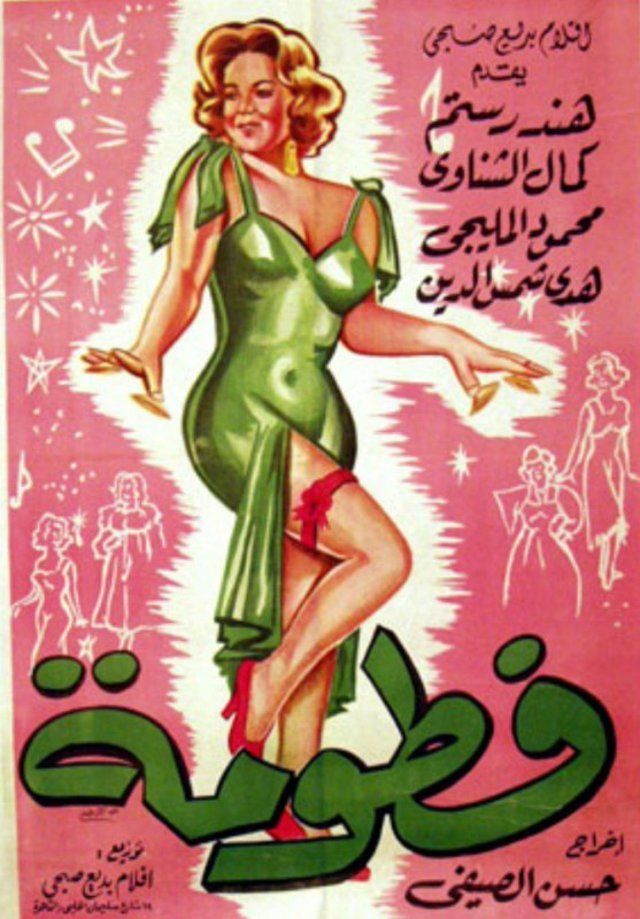
The scene is from the film of the same name, Fattouma, released in 1961. Here's a poster for the film. I've not seen it and don't know much about it.


And here is another poster for Fattouma, and note that it announces the participation of "Orlando" (on the right of the photo) in the film. (I cannot make out what it says above Orlando, sorry.)


That Franco-Arab cassette also has some songs from Karim Shukry, including "Take Me Back to Cairo," released on Sono Cairo, with lyrics in England. Not as interesting as Bob Azzam and Bruno's material, I don't think, but have a listen, you decide.

Sunday, November 11, 2018

Hamza El Din, live in New York, 1989


Nubian Egyptian composer, oud player, tar player, and vocalist Hamza El Din live in concert at the Borough of Manhattan Community College Triplex Theater (now known as the BMCC Tribeca Performing Arts Center) on April 15, 1989, broadcast on WNYC's show "Folkwave."
         

Thursday, November 08, 2018

Some Cheikha Rimitti 45 RPM Record Jackets

This is one of Rimitti's earliest recordings, if not the earliest (and I have the good luck to own this one). One of the tracks, "Erraï Arraï, was, according to Andy Morgan, her first recording, in 1952, for the French Pathé label. But on a 78 rpm, so I'm not sure when this 45 rpm version was pressed. (It was made in France.) Note she was known at this time as Elrelizania (al-Relizania), due to the fact that she grew up in the town of Rélizane (Ghalīzān in Arabic) in Western Algeria. Side A: "Erraï Arraï" (in Arabic al-ray ya al-ray, or "rai o rai."), may be one of the earliest songs in the tradition with "rai" in the title. (Sorry, I'm not able to translate the lyrics.) The genre in which Rimitti performed at the time, however, was not known as rai but as "al-klām al-hazl" or “light, amusing, trifling, playful speech.” 

The reverse side of the jacket describes the tracks as "Chant Oranais avec flûte." The photo on the jacket suggests "folklore." Side B, "Kheira Sali Anbi" (Khayra Salli ‘Ala al-Nabi) -- I'm not sure how to translate the title. Salli ‘Ala al-Nabi means "prayers on the prophet," but what "khayra" (good, choice) means in this phrase, I do not know. 

But note, however, that this is, at some level, a "religious" song, challenging the notion that became prevalent in the late eighties that rai was quintessentially secular. (The work of Marie Virolle is an excellent guide to the place of religion in rai lyrics of artists like Rimitti.) Both these tracks can be found on the CD, Aux Sources du Rai: Les Cheikhat.


The cover of this 45 also indicates "folklore," and this is how Algerian labels had to market the music post-independence, in the puritanical Boumedienne era, which lasted until 1978. This Rimitti record was put out by Triomphe Musique, based in France. This is not Rimitti's photo on the cover. I've seen no Rimitti release with her own photo on it prior to the late eighties, when she became a star on the rai scene, particularly in France, where she had resided since 1978.


This is a release from the Algerian label El Feth, under the rubric "Chants Folkloriques Oranais." I find curious the decision to use a picture of Djoser's Step Pyramid at Sakkara in Egypt on the cover, rather than a scene of Algeria. Side B, "Touche Mami," is a well-known Rimitti song, and it seems sexually suggestive: "touche mami touche, à droite, à gauche." Which is why the label "folklore" was necessary as a kind of cover for music that was considered vulgar by official state culture.


This one is from the French label, La Voix De La Jeunesse, and although the disc itself contains the rubric, "Folklore Oranais," by the time this comes out it seems that the folklore marketed is much more sexualized than that sold under the name Rimitti (or Remitti) in previous years. 


This one is from Voix Nouvelle, a French label that specialized in North African music. When rai cassettes began to be released, it was pretty common for European women to be the face on the cover of releases from female rai singers, the chabas. I've found no links to any recordings of these two songs or any mention of them except for on discogs.com.


I don't know anything about Atlas Records. This seems to be a re-release of "Errai Arrai," from the 1950s. I've not found a version of "Hak Tachroub Hak" anywhere.


This one is really eye-opening, eh? This is apparently from 1980, since it is called "Nouveauté Folk 80." When rai was being marketed as something sexy and outré. I don't find these two tracks anywhere either.

Sunday, November 04, 2018

Wild 45 rpm record jackets: Cheikh El Afrit


I have no idea why this recording of Cheikh El Afrit appears in a record jacket featuring what looks to be a women's underwear ad.

Cheikh El Afrit was a well respected Tunisian Jewish singer (born Issim Israël Rossio) who lived from 1897 to 1939. Listen to his song "Ya nas hmelt" here. Nothing salacious about it. About his name, Chris Silver writes: "his adoption of the name Cheikh El Afrite (roughly translating as Master of the Devil) paid homage to his wit and was perhaps also a play on the word ‘ivrit, which happens to mean Hebrew in Hebrew." 

I've no idea about the label ZEY that put this disc out. It is, as Gomer Pyle would say, a poser.

A little more on Mahieddine Bentir

I looked a bit more at the short Algerian TV documentary on Mahieddine Bentir that I linked to in my previous post. (I realize that it's a problem that I can't make too much of Algerian dialect. But I can't control my obsessions.) 

Two things: First, there is a reference to a film that Bentir starred in, called Fous de musique or غرام الموسيقي

screenshot from the documentary

It's from the early sixties, filmed prior to independence, a musical, no doubt with some of the rock'n'roll that Bentir became famous for in the late fifties and early sixties. 

Second, please check out Bentir doing rock'n'roll, in 1959, on Algerian television, in the documentary, starting at 4:00. It's very lively, Bentir's dancing -- he does a couple of flips at around 5:00 -- strong backing by a couple sax players, trumpeter, piano and drums. Quite amazing.


Finally, I found, courtesy the blog of the great Algerian music scholar Hadj Miliani, an article about Bentir, from the magazine Femmes Nouvelles, published in Algeria (April 10, 1961). 


There is a lot of information about Bentir's life (born in 1934, in the commune of Ménnerville, grew up in Algiers, worked for the PTT (Postes, télégraphes et téléphones). When he played guitar and sang for some of his friends at the PTT and one of them helped get him in touch with the RTF (Radiodiffusion Télévision Française) and he appeared on the show "Rendez-vous à 13 heures" of Françoise Espel and Jacque Bados. He performed with a band called Orchestre Chenouf, composed of musicians with full-time jobs (station master, anesthesiologist, cabinet maker), who must be the ones who appear in the documentary (and in the clip on my previous blog). 

According to the article, Bentir composed in a variety of genres: "Negro" spirituals, waltzes, jazz, chansons réalistes. And it claims he was the first to launch rock'n'roll in "Oriental" music. His records sold in Alexandria, Rabat, and throughout Algeria. 

As of the date of the article, he had recorded four songs: "Youp! Ya Aoud" (rock), "Sinbad et Amira Cha-Cha" ("cha cha cha oriental"), "Ya mama chérie" (cha cha cha bolero) and "Anaya Bouhali" (style not specified. 


He was also translating some French popular songs into Arabic (I don't know whether these were ever recorded other than "Ana bouhali") and was preparing songs for a singer named Samira -- cha cha cha, waltz, and jazz. 

A more recent account of Bentir, from January 2018 (Reporters: Quotidien national d'information -- Algiers) reports on an hommage to Bentir, and states that Bentir's rock'n'roll song "Scooter" dates from 1955 (there is no mention of the song in the 1961 article) and that the songs Bentir performed on television (see the documentary were "Cha Cha Cha Chechia" and "Anaya Bouhali," a remake of Darío Moreno's 1959 recording, "Le marchand de bonheur" -- this is the clip on my previous blog post. (Moreno was a Turkish singer who made his career in France in the fifties and sixties.)

This article also claims that Bentir made some banners attacking colonialism and because he was sought after by the security forces, he took refuge in Tunisia with the liberation army. Perhaps, although it seems somewhat unlikely, given that the article cited above was published in April 1961. It states that the musical Bentir was to appear in (certainly Fous de musique) was to be filmed in May and June, and we can see from the movie poster reproduced in the Bentir documentary, that the film was in fact released. Algeria gained its independence in March 1962, so the timing does not seem right. But even if Bentir did not flee to Tunisia for anti-colonial activity, he nonetheless continued to enjoy a musical career in Algeria after indpendence.

Wednesday, October 31, 2018

Dalida in Algiers, 1965, on the same bill as Mahieddine Bentir

Oh, to have seen this show in November, 1965 in Algiers, just three years after Algeria gained its independence! On the 11th anniversary of the launching of the Algerian revolution, organized by Algeria's national tourism office (ONAT). The divine Dalida, born in Shobra, Cairo, and a star throughout the Mediterranean.


One guesses of course that Dalida played her greatest hits, including those that hit the charts in France in 1965: 

"Viva la papa" (#10)


"La danse de Zorba" (#8)


"Bonsoir mon amour" (#5)


And my favorite from that year, "Amore scusami" (#13)


I find it quite amazing that Dalida was welcomed to Algeria in 1965, given that according to wikipedia, and other sources, Dalida had performed for the French colonial troops in Algiers in summer 1958. It's rather amazing how forgiving the Algerians were, given that hundreds of thousands of Algerians (the figure is not agreed upon, but perhaps Horne's number, 700,000, is a plausible number) were killed in the war of liberation (1954-62). Here's a photo of Dalida with one of the colonial soldiers, snapped by a fan.


In thinking about Dalida in Algeria, I came across an article by Barbara Lebrun, "Daughter of the Mediterranean, docile European: Dalida in the 1950s" (Journal of European Popular Culture 4(1), 2013). It argues that the Egyptian-born singer's Mediterranean identity was carefully crafted, as her career was launched in France in 1956, to occlude her origins: "Because Dalida’s early success in France coincided with the Algerian War, the singer’s oriental provenance was strictly ignored, and her ‘Mediterranean’ identity instead remapped onto the northern shores of the Mediterranean Sea." (Note: I've only read the abstract, and am waiting to receive the full article.) 

Apparently by 1965 her handlers thought it was okay for her to be seen as associated with Algeria. But note that she did not record in Arabic until 1977, with "Salma ya salama."

What really excited me about this concert was the fact that she was on the bill with Mohieddine Bentir. I've blogged about him previously, but let me both recap and add some more details. Born in 1930, Bentir recorded a terrific rock'n'roll song, "Scooter," apparently in 1955.  

In 1959, there was "Ana Bouhali," a cha-cha cha, done Cuban style, very, very hot. Check this out, from Algerian television, broadcast during the colonial era. (Added November 4: It's a remake, in Arabic, of a song recorded that same year by Dario Moreno, "Le marchand de bonheur," the Turkish singer who made his career in France during the fifties and sixties.


Later, he was doing twists, most famously, "Optimiste Twist," from 1964. I mention some other tracks on my earlier blog.

If you check these three tracks, you could get an idea about what a terrific performer Bentir was, and, wow, I just can't imagine (again) how cool it would have been to see him opening for Dalida in Algeria. 

If your Algerian Arabic is good (and mine is minimal), check out this report on Bentir from Algerian television, broadcast in 1994. I wish I could track down more.


Addendum (11/3/18): Kareem tweeted this at me: Bentir talks about his show with Dalida in the video (at 15:00). When they went to dinner she asked him to ask if there were fava beans. A real Egyptian I guess :-).

Monday, October 29, 2018

Cecilie's Petula Top: kufiyaspotting

I've posted about the Danish designer Cecilie and her kufiya fashion designs previously (back in 2014). Most of her designs (but not all) are kufiya patterned, and she has been doing this consistently for several years, since 2011. She seems to be pretty successful at it, and I have to say I am quite amazed, and somewhat mystified, by the longevity of her project. Maybe someone in Copenhagen can explain it to me in future. I know that kufiyas are quite commonly worn in various ways in Scandinavia, and that a kufiya is called a Palestinasjal in Sweden. But on her website Cecilie never mentions Palestine in reference to the origin of the pattern that is the basis of most of her clothing offerings.

In any case, I just became aware of what I considered a notable new offering from Cecilie, from her Autumn/Winter offerings: the "Petula Top," with bare shoulders and wide collar. My guess is that the Petula referred to is Petula Clark, but after a brief survey of photos of Petula from her heyday, I do not see bare shoulders and wide collar tops as iconically Petula. It's a mystery to me. In any case, you'll find below a model in the kufiya patterned Petula Top. For more shots of the top, priced at $165, go here. For more on Cecilie, go here

Kufiya nails

Kufiya patterned Palestine nails -- take this design to your nail salon lady and you can have them too.

Saturday, October 27, 2018

Record covers: Boussouar El Maghnaoui


Record covers of previously obscure recordings are much more readily available these days, due to various sources: discogs.com, ebay auctions, and FaceBook groups. This was vinyl single from pop-rai singer Boussouar El Maghnaoui was recently auctioned on ebay. Unfortunately I was not able to secure it -- such recordings, from Algeria in the seventies, when pop-rai was being invented, have become eminently collectible.

Boussouar El Maghnaoui was a second-tier figure in the pop-rai scene that developed in western Algeria from the mid to late 1970s, less well remembered than figures like Messaoud Bellemou, Belkacem Bouteldja, or Boutaïba Sghir. On his recordings he was usually backed by Groupe El Azhar, from Oran. Other lesser (but nonetheless important) lights backed up on pop-rai recordings during this period include Gana El Maghnaoui, Hocine Chabatti (AKA Cheb Hocine), Boutaïba Sghir's brother Afif Bashir and Mohamed Mazouzi. El Maghnaoui hailed from Oujda in eastern Morocco, symptomatic of the substantial cultural contact across the border between the east of Morocco and the west of Algeria. (During the colonial period many Moroccans migrated to work in western Algeria during grape harvest season.)

I don't have access to these two songs from El Maghnaoui, but there are several that you can find on YouTube, including this one.


It is very much in the mode of the pop-rai produced in the same period by Bellemou and his group, based in Aïn Témouchent, and my guess would be that Bellemou set the standard which others then imitated. According to maghrebunion, who posted the video, it features Ghana El Maghnaoui on trumpet (playing Bellemou style) and "Kassem" from Oran on saxophone. 

Check these out as well, courtesy the blog Phocéephone.

Friday, October 26, 2018

Kufiyaspotting: Madonna with Child


A friend posted this one on FaceBook. It looks like it could be a reproduction of an icon. Modern vintage, no doubt, with Jesus wearing a shirt in kufiya pattern, and Mary wearing a shawl with traditional Palestinian embroidery. The artist appears to be al-‘Abd al-Hati Samir Khuri.