Showing posts with label Madonna. Show all posts
Friday, October 26, 2018
Kufiyaspotting: Madonna with Child
A friend posted this one on FaceBook. It looks like it could be a reproduction of an icon. Modern vintage, no doubt, with Jesus wearing a shirt in kufiya pattern, and Mary wearing a shawl with traditional Palestinian embroidery. The artist appears to be al-‘Abd al-Hati Samir Khuri.
Wednesday, May 28, 2014
Another Palestinasjal (Swedish for Palestinian Kufiya) in the Sunday New York Times
Actresses Mira Barkhammar, Mira Grosin and Liv LeMoyne (in kufiya).
Credit: Magnolia Pictures
It's the same film as before, Lukas Moodysson's We Are the Best!, about three Swedish girls who start a punk band in the early 80s. I spotted this, along with Marc Spitz's review, in the print edition of the New York Times on Sunday, May 28, 2014. It sounds like a great film.
And I will tell you once again: in Sweden they simply call the kufiya a Palestinasjal or Palestinian scarf. The film is based on a graphic novel by the filmmaker's wife Coco Moodysson's, which recounts her experiences as a young punk in the early 80s. Kufiyas were there, as they were in the US.
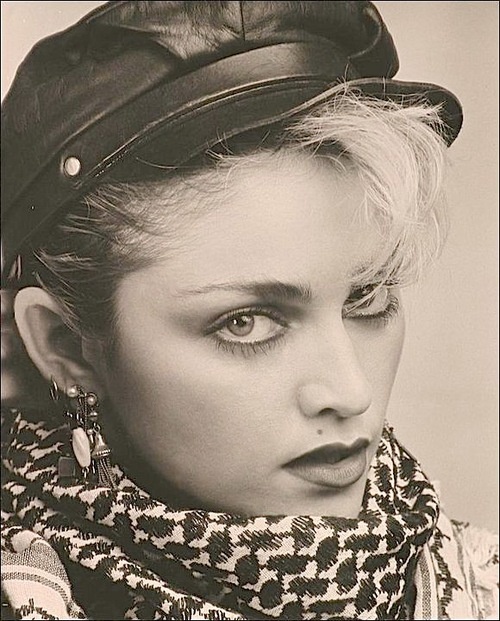
Madonna, NYC, early 80s.
Saturday, May 11, 2013
Madonna in kufiya
Sunday, March 17, 2013
kufiyaspotting
kufiya on the cover of Charlie Ahearn's "Wild Style The Sampler"
Note added April 19:
From the same era, here's one of Afrika Bambaataa in kufiya.
And Madonna, using it as a scarf. Madonna, for the record, was part of the general scene. Both she and Bam played at the Roxy in New York City around the same era.
You also wonder whether this guy on the cover of Ahearn's book wasn't channeling the Attica prison uprising of September 1971.
Note added April 19:
From the same era, here's one of Afrika Bambaataa in kufiya.
And Madonna, using it as a scarf. Madonna, for the record, was part of the general scene. Both she and Bam played at the Roxy in New York City around the same era.
You also wonder whether this guy on the cover of Ahearn's book wasn't channeling the Attica prison uprising of September 1971.
Saturday, August 18, 2012
Pussy Riot vs. Al Haqed
I'm really glad that there has been such an outpouring of support for the three members of Pussy Riot who were convicted yesterday of charges of hooliganism motivated by religious hatred, and sentenced to two years imprisonment each. Everyone is all over this, Amnesty International, the major news media, and US pop musicians are falling all over themselves to express their solidarity. Most notably, of course, Madonna. The fabulous J.D. Samson (Le Tigre, MEN, Peaches and the Herms) was on Democracy Now! yesterday to make the pitch for Pussy Riot, stressing that they are a feminist band.
But why has Moroccan rapper Al Haqed ('sullen/rancorous/enraged one'; born name, Mouad Belghouat) not garnered 1/100th of the attention that Pussy Riot has received? Al Haqed was sentenced in May to a one-year prison sentence for insulting the Morrocan police. Meanwhile, as Mark Levine has noted, the likes of Lenny Kravitz, Pitbull, Khaled, Mariah Carey, Scorpions, LMFAO, and Evanescence all played the Mayazine Festival in Rabat, Morocco in May. Not one said a word in support of Al Haqed. Joan Baez (!) and Bjork played the Sacred Music Festival in Fez in June. Didn't mention his name.
In July Al Haqed launched a 48-hour hunger strike to protest his conditions of detention. I didn't hear any messages of solidarity from our progressive musicians.
This is not to say Al Haqed's case has not received any coverage. Human Rights Watch has raised his case. Human Rights Watch has covered it, Torie Rose DeGhett has covered the story for The Guardian, The Huffington Post, and so on. And of course most importantly, Mark Levine. But where are the Madonnas in support of Al Haqed?
Here are a few possible reasons that the likes of Madonna haven't shown up to express solidarity with Al Haqed and outrage at the Moroccan monarch.
1. Morocco's King Muhammad VI is a strategic ally of the West.
2. Muhammad VI has successfully presented himself to the West as a "moderate." We love "moderates." They don't criticize us. They don't criticize Israel.
3. The Moroccan regime has successfully sold itself as a "moderate" government in contrast to those radical Islamist trends.
4. The Moroccan state has very effectively used its massive Festival industry and its tourism industry to sell its moderate image. The Mayazine and the Sacred Music festivals (plus the Gnawa Festival at Essaouira) are key elements in the selling of this image. Levine calls it "art-washing." Aomar Boum recently published an excellent piece on the regime's use of festivals in Middle East Report. Waleed Hazboun in his book Beaches, Ruins, Resorts: The Politics of Tourism in the Arab World shows how Tunisia was able to use tourism in the same way (see my review here.)
5. As Gene Lyons remarked on Facebook, people really seem to get a charge out just saying "Pussy Riot."
6. There is no charge to saying "Al Haqed."
7. Putin isn't our strategic ally.
8. Putin isn't going along with our Syria policy or our Iran policy.
9. Pussy Riot is a feminist band. Al Haqed is an Arab Muslim guy. And he is angry.
10. We can't understand what Al Haqed is saying. Of course, we can't understand Pussy Riot's Russian either, but it's been widely translated. And people like JD Samson can read their lyrics on Democracy Now! (Of course, if anyone tried a little bit, they could have found a translation of one of Al Haqed's songs at Revolutionary Arab Rap.)
11. The "Arab Spring" is so over. So 2011.
12. "Arab rap" is so over. Been there. Done that.
13. We love monarchs.
14. The pot is so good in Morocco.
15. Morocco is so cool, man. Didn't Paul Bowles and Brion Gysin and William Burrough say so? Don't harsh on my mellow.
End of rant. You add your own reasons. I leave you with the offending video from Al Haqed. "Klab al-dawla." The dogs of the state. Why doesn't Madonna like this vid?
But why has Moroccan rapper Al Haqed ('sullen/rancorous/enraged one'; born name, Mouad Belghouat) not garnered 1/100th of the attention that Pussy Riot has received? Al Haqed was sentenced in May to a one-year prison sentence for insulting the Morrocan police. Meanwhile, as Mark Levine has noted, the likes of Lenny Kravitz, Pitbull, Khaled, Mariah Carey, Scorpions, LMFAO, and Evanescence all played the Mayazine Festival in Rabat, Morocco in May. Not one said a word in support of Al Haqed. Joan Baez (!) and Bjork played the Sacred Music Festival in Fez in June. Didn't mention his name.
In July Al Haqed launched a 48-hour hunger strike to protest his conditions of detention. I didn't hear any messages of solidarity from our progressive musicians.
This is not to say Al Haqed's case has not received any coverage. Human Rights Watch has raised his case. Human Rights Watch has covered it, Torie Rose DeGhett has covered the story for The Guardian, The Huffington Post, and so on. And of course most importantly, Mark Levine. But where are the Madonnas in support of Al Haqed?
Here are a few possible reasons that the likes of Madonna haven't shown up to express solidarity with Al Haqed and outrage at the Moroccan monarch.
1. Morocco's King Muhammad VI is a strategic ally of the West.
2. Muhammad VI has successfully presented himself to the West as a "moderate." We love "moderates." They don't criticize us. They don't criticize Israel.
3. The Moroccan regime has successfully sold itself as a "moderate" government in contrast to those radical Islamist trends.
4. The Moroccan state has very effectively used its massive Festival industry and its tourism industry to sell its moderate image. The Mayazine and the Sacred Music festivals (plus the Gnawa Festival at Essaouira) are key elements in the selling of this image. Levine calls it "art-washing." Aomar Boum recently published an excellent piece on the regime's use of festivals in Middle East Report. Waleed Hazboun in his book Beaches, Ruins, Resorts: The Politics of Tourism in the Arab World shows how Tunisia was able to use tourism in the same way (see my review here.)
5. As Gene Lyons remarked on Facebook, people really seem to get a charge out just saying "Pussy Riot."
6. There is no charge to saying "Al Haqed."
7. Putin isn't our strategic ally.
8. Putin isn't going along with our Syria policy or our Iran policy.
9. Pussy Riot is a feminist band. Al Haqed is an Arab Muslim guy. And he is angry.
10. We can't understand what Al Haqed is saying. Of course, we can't understand Pussy Riot's Russian either, but it's been widely translated. And people like JD Samson can read their lyrics on Democracy Now! (Of course, if anyone tried a little bit, they could have found a translation of one of Al Haqed's songs at Revolutionary Arab Rap.)
11. The "Arab Spring" is so over. So 2011.
12. "Arab rap" is so over. Been there. Done that.
13. We love monarchs.
14. The pot is so good in Morocco.
15. Morocco is so cool, man. Didn't Paul Bowles and Brion Gysin and William Burrough say so? Don't harsh on my mellow.
End of rant. You add your own reasons. I leave you with the offending video from Al Haqed. "Klab al-dawla." The dogs of the state. Why doesn't Madonna like this vid?
Monday, June 07, 2010
Kufiyas: new & old (Mavi Marmara, Spike Lee, Madonna)
New kufiyas
Like all Palestinosymps, I've been following the Gaza flotilla outrage obsessively. It has been impressively covered--although not, of course, by the mainstream media in the US. (Did Maddow or Olbermann give it any meaningful coverage?)
My comments are just a side note, motivated by my kufiya obsession. I watched a bit of the live feed from the Turkish vessel, the Mavi Marmara, right before the Israeli attack. One of the things that I noticed was that everyone seemed to be wearing kufiyas of some sort--as scarfs, as headgear, and so on. I did not realize at the time that the passengers on the boat were mostly Turks, mostly affiliated with the IHH.
But it was not just the Turks, it was everyone, it seemed. Here's a photo captured from the live feed, an interview with a British-Asian woman with a red kufiya wrapped around her neck (I did not catch her name).

And here's a photo of one of the Turkish passengers who was wounded in the Israeli assault, from a report from Al Jazeera English which conducted interviews in Istanbul with several of the wounded. (The US media, of course, saw fit to do no such interviews.) Several of the interviewees were adorned with kufiya-patterned scarves and Palestinian flags.

Here's a photo of Irish activist, spokesperson for the Free Gaza Movement, which sponsored the flotilla, together with the IHH. (I have lost her name: someone help!) [added, June 8: it's Caiomhe Butterly]

Here's a photo of the ship the Rachel Corrie, with its crew of Irish and Malaysian humanitarians, before it was launched on its mission.

And the kufiya was so scary for the Israelis that it showed up in one of the propaganda photos put out by the Israeli Ministry of Foreign Affairs to illustrate to what extent the passengers on the Mavi Marmara were armed and ready to "lynch" the Israeli military personnel who landed on the vessel.

So you get the (perhaps all-too-obvious) point. Ubiquity of kufiyas in the Gaza flotilla.
Here's a somewhat silly kufiya item, in my opinion. (No doubt my take on this is influenced by Angry Arab, who is constantly making fun of the seemingly never-ending efforts in Lebanon to get into the Guinness Book of World Records, by making the biggest tabbouleh or the biggest kunafeh or the biggest hummos or whatever.) The world's biggest kufiya, certified as such by the Guinness Book, was put together in an effort to publicize the 62nd anniversary of the Nakba and to call attention to the plight of Palestinian refugees in Lebanon, whose conditions are abysmal. The kufiya was sewn by children and youth groups from Lebanon's 12 Palestinian refugee camps. I'm all in favor of calling attention to the Nakba and in particular the dire situation of Palestinian refugees in Lebanon. They and their conditions have been criminally ignored, particularly since the so-called "peace process" was launched in the early 90s. But using the Guinness Book as a means of publicity? Symptomatic of the Lebanese disease diagnosed by Angry Arab.

Old kufiyas
I've beem trying to put the current "kufiya craze" in historical context, arguing that there is a history, going back to the early 70s, of the kufiya being used for both political and stylistic purposes in the US. And, I would argue, the line between the two is not fixed and rigid, but rather, fluid, and hard, at times, to delineate. Here are two examples.
From the Village Voice in 1992 (November 10), a photo of Spike Lee, who has just released his Malcolm X movie. (The photo accompanies an article by Hilton Als on Spike and his new film.) How to read the kufiya here? It was all over New York City, worn by hipsters, by lefty politicos, by African-Americans. What sort of message is Spike broadcasting here, in his kufiya and his X baseball cap. Style and politics are intimately linked here, mutually interdependent.


And here is Madonna. Thanks to Nihal for this. I guess this photo is from around 1981-1984, when the kufiya was showing up in the downtown NYC scene, in hip circles.

The kufiya probably circulated with the same white kids who were the first to get into hip-hop, as documented by Jeff Chang in his invaluable Can't Stop Won't Stop. Madonna was part of the crowd at the Roxy, the downtown club that was the first to feature hip-hop, imported from the Bronx. One of the most important hip-hop pioneers in that group was Afrika Bambaata. Here's a photo of him, in faux kufiya.
Clearly more research is needed on the dates of the Madonna and the Bam photos. And, inshallah, a better copy of the Madonna photo.
Like all Palestinosymps, I've been following the Gaza flotilla outrage obsessively. It has been impressively covered--although not, of course, by the mainstream media in the US. (Did Maddow or Olbermann give it any meaningful coverage?)
My comments are just a side note, motivated by my kufiya obsession. I watched a bit of the live feed from the Turkish vessel, the Mavi Marmara, right before the Israeli attack. One of the things that I noticed was that everyone seemed to be wearing kufiyas of some sort--as scarfs, as headgear, and so on. I did not realize at the time that the passengers on the boat were mostly Turks, mostly affiliated with the IHH.
But it was not just the Turks, it was everyone, it seemed. Here's a photo captured from the live feed, an interview with a British-Asian woman with a red kufiya wrapped around her neck (I did not catch her name).

And here's a photo of one of the Turkish passengers who was wounded in the Israeli assault, from a report from Al Jazeera English which conducted interviews in Istanbul with several of the wounded. (The US media, of course, saw fit to do no such interviews.) Several of the interviewees were adorned with kufiya-patterned scarves and Palestinian flags.

Here's a photo of Irish activist, spokesperson for the Free Gaza Movement, which sponsored the flotilla, together with the IHH. (I have lost her name: someone help!) [added, June 8: it's Caiomhe Butterly]

Here's a photo of the ship the Rachel Corrie, with its crew of Irish and Malaysian humanitarians, before it was launched on its mission.

And the kufiya was so scary for the Israelis that it showed up in one of the propaganda photos put out by the Israeli Ministry of Foreign Affairs to illustrate to what extent the passengers on the Mavi Marmara were armed and ready to "lynch" the Israeli military personnel who landed on the vessel.

So you get the (perhaps all-too-obvious) point. Ubiquity of kufiyas in the Gaza flotilla.
Here's a somewhat silly kufiya item, in my opinion. (No doubt my take on this is influenced by Angry Arab, who is constantly making fun of the seemingly never-ending efforts in Lebanon to get into the Guinness Book of World Records, by making the biggest tabbouleh or the biggest kunafeh or the biggest hummos or whatever.) The world's biggest kufiya, certified as such by the Guinness Book, was put together in an effort to publicize the 62nd anniversary of the Nakba and to call attention to the plight of Palestinian refugees in Lebanon, whose conditions are abysmal. The kufiya was sewn by children and youth groups from Lebanon's 12 Palestinian refugee camps. I'm all in favor of calling attention to the Nakba and in particular the dire situation of Palestinian refugees in Lebanon. They and their conditions have been criminally ignored, particularly since the so-called "peace process" was launched in the early 90s. But using the Guinness Book as a means of publicity? Symptomatic of the Lebanese disease diagnosed by Angry Arab.

Old kufiyas
I've beem trying to put the current "kufiya craze" in historical context, arguing that there is a history, going back to the early 70s, of the kufiya being used for both political and stylistic purposes in the US. And, I would argue, the line between the two is not fixed and rigid, but rather, fluid, and hard, at times, to delineate. Here are two examples.
From the Village Voice in 1992 (November 10), a photo of Spike Lee, who has just released his Malcolm X movie. (The photo accompanies an article by Hilton Als on Spike and his new film.) How to read the kufiya here? It was all over New York City, worn by hipsters, by lefty politicos, by African-Americans. What sort of message is Spike broadcasting here, in his kufiya and his X baseball cap. Style and politics are intimately linked here, mutually interdependent.


And here is Madonna. Thanks to Nihal for this. I guess this photo is from around 1981-1984, when the kufiya was showing up in the downtown NYC scene, in hip circles.

The kufiya probably circulated with the same white kids who were the first to get into hip-hop, as documented by Jeff Chang in his invaluable Can't Stop Won't Stop. Madonna was part of the crowd at the Roxy, the downtown club that was the first to feature hip-hop, imported from the Bronx. One of the most important hip-hop pioneers in that group was Afrika Bambaata. Here's a photo of him, in faux kufiya.
Clearly more research is needed on the dates of the Madonna and the Bam photos. And, inshallah, a better copy of the Madonna photo.
Subscribe to:
Posts (Atom)