Check out this AFP report. (I love it: the "Golden Whip" award!)
CAIRO - Egyptian bloggers, long at the forefront of exposing rights abuses, are planning an online festival of torture videos to run alongside the 31st Cairo Film Festival, local media reported today.
The parallel festival is the idea of a blogger named Walid, the Egyptian Mail reported, and will feature "controversial acts of torture allegedly committed by the security authorities". [I've been unable to track down the original article.]
Prizes, including a "Golden Whip", will be awarded to the best entrants.
Egypt's blogosphere has exposed numerous incidents of police torture, including that of minibus driver Imad al-Kabir who was shown being sodomised with a stick in widely distributed video footage shot on a police mobile phone.
Two policemen were jailed for three years earlier this month for that crime in a rare case of security forces members being sentenced for abusing detainees.
Rights groups say the use of torture is widespread in Egyptian jails and police stations, while the interior ministry says that those who carry out torture are always punished.
The Cairo Film Festival runs from November 27 to December 7.
UPDATE: One of those who first released torture videos denies any such "fringe" festival will take place. Khusara!
Sunday, November 25, 2007


War Is Peace, Sanctions Are Diplomacy
A new Middle East Report Online (MERO): great analysis of US policy toward Iran, by Carah Ong, analyst at the Center for Arms Control and Proliferation.
Sanctions are punitive measures, not serious diplomacy, and the Bush administration has never undertaken a sustained diplomatic initiative aimed either at inducing Iran to cease enriching uranium or at soothing broader US-Iranian tensions. Meanwhile, the Bush administration’s persistent refusal to take military options “off the table,” combined with its intensified rhetoric against Iran, has made sanctions palatable to allies, as well as to some of the most dovish members of Congress and the American public -- but without addressing the political disputes that keep the US and Iran on a collision course.
Monday, November 19, 2007
W's new lap dog/poodle?

Sarkozy!
Cartoon courtesy of the inimitable Steve Bell of The Guardian. Please check out the article by Jonathan Steele which accompanies the cartoon, and which opens with this zinger: "Six months in office, and Nicolas Sarkozy has not ceased being an embarrassment on the world stage." It's interesting to see how Sarkozy is viewed from abroad, whereas in the US, both Democratic and Republican politicians are falling all over themselves to praise Sarkozy. When Sarkozy addressed a joint session of Congress on November 7, his speech in French was interrupted by applause over two dozen times and received six standing ovations. We just love foreign leaders who fawn all over us! That nasty Chirac (Sarkozy's predecessor)--wasn't with us on Iraq! So our current stance on Iran must be correct if Sarkozy is going along with it.
Here's a reminder of what urban youth of the cités thought of Sarkozy when he was Minister of the Interior.
Saturday, November 17, 2007
The Politics of Youth: new issue of Middle East Report
(Confession: I'm an editor, and I have an article in the new issue. Please note that you can access my article along with Marc Lynch's for free. But buy the issue anyway!)
Middle East Report 245
Winter 2007
THE POLITICS OF YOUTH

In many countries of the Middle East, as in other developing regions, young people between the ages of 15 and 24 make up a fifth or more of the population. These youth face serious socio-economic problems, including unemployment, under-employment and delayed marriage, but not the least of their burdens are the expectations and anxieties of their elders. In recent decades, indeed, youth have come to be seen as a problem in and of themselves. "The Politics of Youth," the winter 2007 issue of Middle East Report, measures the image against reality.
Anthropologist Ted Swedenburg sketches the "imagined youths" that preoccupy policy planners and pundits in the Middle East and the West. Youth are perceived both as people who need to be protected -- from radical political Islam or from "vulgar" popular culture -- and people from whom the social order may need to be protected. A corollary, among Western observers, is to see youth as the inevitable emancipators of closed political systems.
Real Middle Eastern youth confound elite hopes and fears in ways both conventionally political and mundane. In Egypt, finds political scientist Marc Lynch, young Muslim Brothers are challenging their older leaders' platforms and habits of mind with the open discussion fostered by their blogs. In Beirut, as Lara Deeb and Mona Harb demonstrate, the purchasing power of pious Shi'i youth is generating an "Islamic" culture of fun to parallel the hard-partying "Paris of the Middle East" downtown. In Israel, argues sociologist Tamir Sorek, young fans of Likud-supporting Beitar Jerusalem and the Arab team from Sakhnin both use the soccer stadium to demand full integration as citizens, rendering the Beitar-Sakhnin matches more than the Israeli-Palestinian conflict in miniature.
In a special report, James McDougall checks in on the recovery of Algeria from its long and brutal civil war. Many of the war's deep causes remain in place: The options in formal politics are limited to opportunism or principled, but impotent opposition, while the newly liberalized economy is working best for those who were already prosperous.
Also featured: Norma Claire Moruzzi reviews Shahram Khosravi's Young and Defiant in Iran; Khaled El-Rouayheb reviews Joseph Massad's Desiring Arabs; Rosemary Sayigh reviews Laleh Khalili's Heroes and Martyrs of Palestine; and more.
Subscribe to Middle East Report or order individual copies online at www.merip.org.
For further information, contact Chris Toensing at ctoensing@merip.org.
Middle East Report is published by the Middle East Research and Information Project (MERIP), a progressive, independent organization based in Washington, DC. Since 1971 MERIP has provided critical analysis of the Middle East, focusing on political economy, popular struggles and the implications of US and international policy for the region.
Middle East Report Online is a free service of the Middle East Research and Information Project (MERIP).
Middle East Report 245
Winter 2007
THE POLITICS OF YOUTH

In many countries of the Middle East, as in other developing regions, young people between the ages of 15 and 24 make up a fifth or more of the population. These youth face serious socio-economic problems, including unemployment, under-employment and delayed marriage, but not the least of their burdens are the expectations and anxieties of their elders. In recent decades, indeed, youth have come to be seen as a problem in and of themselves. "The Politics of Youth," the winter 2007 issue of Middle East Report, measures the image against reality.
Anthropologist Ted Swedenburg sketches the "imagined youths" that preoccupy policy planners and pundits in the Middle East and the West. Youth are perceived both as people who need to be protected -- from radical political Islam or from "vulgar" popular culture -- and people from whom the social order may need to be protected. A corollary, among Western observers, is to see youth as the inevitable emancipators of closed political systems.
Real Middle Eastern youth confound elite hopes and fears in ways both conventionally political and mundane. In Egypt, finds political scientist Marc Lynch, young Muslim Brothers are challenging their older leaders' platforms and habits of mind with the open discussion fostered by their blogs. In Beirut, as Lara Deeb and Mona Harb demonstrate, the purchasing power of pious Shi'i youth is generating an "Islamic" culture of fun to parallel the hard-partying "Paris of the Middle East" downtown. In Israel, argues sociologist Tamir Sorek, young fans of Likud-supporting Beitar Jerusalem and the Arab team from Sakhnin both use the soccer stadium to demand full integration as citizens, rendering the Beitar-Sakhnin matches more than the Israeli-Palestinian conflict in miniature.
In a special report, James McDougall checks in on the recovery of Algeria from its long and brutal civil war. Many of the war's deep causes remain in place: The options in formal politics are limited to opportunism or principled, but impotent opposition, while the newly liberalized economy is working best for those who were already prosperous.
Also featured: Norma Claire Moruzzi reviews Shahram Khosravi's Young and Defiant in Iran; Khaled El-Rouayheb reviews Joseph Massad's Desiring Arabs; Rosemary Sayigh reviews Laleh Khalili's Heroes and Martyrs of Palestine; and more.
Subscribe to Middle East Report or order individual copies online at www.merip.org.
For further information, contact Chris Toensing at ctoensing@merip.org.
Middle East Report is published by the Middle East Research and Information Project (MERIP), a progressive, independent organization based in Washington, DC. Since 1971 MERIP has provided critical analysis of the Middle East, focusing on political economy, popular struggles and the implications of US and international policy for the region.
Middle East Report Online is a free service of the Middle East Research and Information Project (MERIP).
Thursday, November 15, 2007
Wish I Could Go to This Event!

Poetry of Peace: A Night of Hip Hop & Culture Jam for Peace
* DAM the Palestinian Hip Hop Stars from Israel + Omar Offendum & Ragtop
* Read Taleed El-Sabawi's article on Palestinian Hip Hop
* Shaun Toub "Crash" & "The Kite Runner"
* Shiva Rose "David & Layla"
* Raya Meddine "Bosta"
* Mark LeVine author of Heavy Metal Islam: Rock, Religion and the Struggle for the Soul of Islam
* Saree Makdisi author of Palestine Inside Out: An Everyday Occupation
* Jodie Evans cofounder of CODEPINK: Women for Peace
* Apoetnomadali featuring Morvarid performing Sar Zamin
* Basic Poetry Base One Basic & Apoetnomadali featuring Weapon X performing 1.9.7.9.
* Jerusalem Women: Partners for Peace
* with Deejay Al Fareed
Artists, writers and activists for Middle East peace, a benefit for Levantine Cultural Center, celebrating six years of progressive arts programming.
Bovard Auditorium, USC, 3551 Trousdale Parkway, Los Angeles 90089. 7-8 pm meet/greet, booths; 8-10:30 pm show; 10:30-midnight after-party.

And, it has just been announced that Palestinian standup comedian Maysoon Zayid is to join the lineup.
Read the press release for the event here. (But note that my friend Mark Levine is wrong about Palestinian-Israeli rap group Dam. Their name means "lasting" or "persisting" in Arabic, "blood" in Hebrew. See Joseph Massad's article, "Liberating Songs: Palestine Put to Music" in the book I co-edited with Rebecca Stein, Palestine, Israel and the Politics of Popular Culture.)
------------
One of the cool things about the Levantine Cultural Center is that one of its founders is Jordan Elgrably, a Moroccan Jewish American. (Thanks, Mohja!)
The Dalai Lama: NOT Pro-Democracy

Although I'm in no way a supporter of China's rule over Tibet, I'm really sick of Western liberals fawning over the Dalai Lama and Tibetan Buddhism. So I was pleased to see Slavoj Zizek's recent op-ed in The New York Times (October 11--okay, so I'm way behind on my reading), which contained this observation:
What bothers Chinese authorities are sects like Falun Gong that insist on independence from state control. In the same vein, the problem with Tibetan Buddhism resides in an obvious fact that many Western enthusiasts conveniently forget: the traditional political structure of Tibet is theocracy, with the Dalai Lama at the center. He unites religious and secular power — so when we are talking about the reincarnation of the Dalai Lama, we are taking about choosing a head of state. It is strange to hear self-described democracy advocates who denounce Chinese persecution of followers of the Dalai Lama — a non-democratically elected leader if there ever was one.
Tuesday, November 13, 2007
Progress on the racial front? Income gap between black and white families grows
My mostly-white students tend to think that since the passage of civil rights legislation, racial problems in the US are "so over." My students are probably not out of synch with the rest of white America. Here's some troubling counter-evidence, from the Economic Mobility Project, funded by the Pew Charitable Trust. A few choice excerpts from the AP report:
(my italics)
Incomes have increased among both black and white families in the past three decades - mainly because more women are in the work force. But the increase was greater among whites, according to the study being released Tuesday.
One reason for the growing disparity: Incomes among black men have actually declined in the past three decades, when adjusted for inflation. They were offset only by gains among black women.
Incomes among white men, meanwhile, were relatively stagnant, while those of white women increased more than fivefold...
In 2004, a typical black family had an income that was only 58 percent of a typical white family's. In 1974, median black incomes were 63 percent those of whites.
"Too many Americans, whites and even some blacks, think that the playing field has indeed leveled," said Marc Morial, president and CEO of the National Urban League.
It has not, he added.
(my italics)
Monday, November 12, 2007
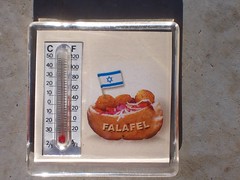
Why the FBI can't use falafel sales to catch Iranian agents
now Lauren Bush and Lupe Fiasco
kufiyaspotted by KABOBfest (they spell it keffiyeh spotting).
Yes, comrades, that is W's niece, daughter of Neil, who works as a fashion model. She reportedly once dated a Palestinian-American named Tammer Qaddumi (Yale) and now goes out with Ralph Lauren's son David.
And she majored in anthropology at Princeton. Maybe that explains her desire for exotic garb?
AS for skateboarding rapper Lupe Fiasco, he is Muslim, after all. Also kufiya-spotted by KABOBfest.
(Yes, kabobfest is now clearly outdoing me on the keffiyeh spotting. In my defense, they're a collective. And it's not a contest. My hatta is off to them!)
Yes, comrades, that is W's niece, daughter of Neil, who works as a fashion model. She reportedly once dated a Palestinian-American named Tammer Qaddumi (Yale) and now goes out with Ralph Lauren's son David.
And she majored in anthropology at Princeton. Maybe that explains her desire for exotic garb?
AS for skateboarding rapper Lupe Fiasco, he is Muslim, after all. Also kufiya-spotted by KABOBfest.
(Yes, kabobfest is now clearly outdoing me on the keffiyeh spotting. In my defense, they're a collective. And it's not a contest. My hatta is off to them!)
Friday, November 09, 2007
kufiyaspotting (yet another)

Watch what you eat...
 From Democracy Now!
Thursday, Nov. 8.
FBI Monitored Sales At Middle Eastern Grocery StoresRead the Congressional Quarterly report here. Particularly telling is this statement:
Congressional Quarterly is reporting that the FBI sifted through customer data collected by San Francisco-area grocery stores in 2005 and 2006, hoping that sales records of Middle Eastern food would lead to Iranian secret agents. The idea was that a spike in, say, falafel sales [!!!!], combined with other data, would lead to Iranian agents in the region. The program was the brainchild of top FBI counterterrorism officials Phil Mudd and Willie Hulon. The datamining operation was eventually stopped after FBI officials determined it was possibly illegal to place someone on a terrorist list because of what they ate.
As ridiculous as it sounds, the groceries counting scheme is a measure of how desperate the FBI is to disrupt domestic terrorism plots.And worse yet, a measure of how completely uninformed the FBI is, since falafel is a mainstay of the diet in Palestine, Syria, Jordan, Lebanon, and Israel--but NOT Iran. Falafel sales are much more likely to be indicative of the presence of Israelis than Iranians...
Wednesday, November 07, 2007
Henri Alleg on Waterboarding

French journalist Henri Alleg, arrested and tortured by French paratroopers in Algeria in 1957, describes his experience to Amy Goodman on Democracy Now!
(May the names Schumer and Feinstein live forever in infamy!)
Monday, October 29, 2007
Arabspotting: Coachella Valley High School Arabs
Coachella Valley is probably best known today for its music festival, "Coachella," but arguably it is more important economically for its dates, which originally started in the late nineteenth century with shoots from Morocco, Egypt, Iraq and Algeria. Almost 95% of US-produced dates come from Coachella, and all the date varieties have Arabic names: Deglet Nour, Medjool, Halawy, Khadrawy, Zahidi and Thoory. Hence the name of the Coachella Valley High School mascot: the Arab.
The history below has some mistakes: the headscarf is not a hijab but, as readers of this blog know, a kufiya (keffiyeh) or shemagh or hatta or ghutra. And Saudi Arabia was never a colony of France! (Of Aramco, maybe.) And who knows why the Saudis think they had any thing to do with this Arab mascot, since the original date shoots were not from the Arabian peninsula.
Here's the history, from the CVHS Alumni Association website.
The Evolution of Our Mascot
The Arab mascot dates back to when Coachella Valley High School first began to compete in athletics in the 1920s. The school adopted the name Arabs in part to recognize the importance of the date industry in this end of the valley, but also because it fit in perfectly with the neighboring towns of Mecca, Oasis, Arabia, and Thermal.
The original Arab was drawn carrying a lance and riding a horse. On his head he wore a turban.
His image remained that way until sometime in the 1950s when the turban was replaced by a fez and the lance was replaced by a scimitar.

There were two versions of the mascot - a young one holding a scimitar and an old one with a growling face and a gold tooth.
Another change in the mascot came in the 1980s. A group of Arabs from Saudi Arabia who were in the area touring the desert's date industry recommended that the mascot's headdress be changed from a fez to a hijab or head scarf. Their reasoning was that Saudi Arabia was no longer under French rule; therefore, Saudi Arabians no longer wore the fez as their headdress.


The school voted to honor the request and the mascot began to be drawn as he still appears today.
The history below has some mistakes: the headscarf is not a hijab but, as readers of this blog know, a kufiya (keffiyeh) or shemagh or hatta or ghutra. And Saudi Arabia was never a colony of France! (Of Aramco, maybe.) And who knows why the Saudis think they had any thing to do with this Arab mascot, since the original date shoots were not from the Arabian peninsula.
Here's the history, from the CVHS Alumni Association website.
The Evolution of Our Mascot
The Arab mascot dates back to when Coachella Valley High School first began to compete in athletics in the 1920s. The school adopted the name Arabs in part to recognize the importance of the date industry in this end of the valley, but also because it fit in perfectly with the neighboring towns of Mecca, Oasis, Arabia, and Thermal.
The original Arab was drawn carrying a lance and riding a horse. On his head he wore a turban.

His image remained that way until sometime in the 1950s when the turban was replaced by a fez and the lance was replaced by a scimitar.


There were two versions of the mascot - a young one holding a scimitar and an old one with a growling face and a gold tooth.
Another change in the mascot came in the 1980s. A group of Arabs from Saudi Arabia who were in the area touring the desert's date industry recommended that the mascot's headdress be changed from a fez to a hijab or head scarf. Their reasoning was that Saudi Arabia was no longer under French rule; therefore, Saudi Arabians no longer wore the fez as their headdress.


The school voted to honor the request and the mascot began to be drawn as he still appears today.
Saturday, October 27, 2007
California Über Alles
In San Diego County: “There were Mercedeses and Jaguars pulling out, people evacuating, and the migrants were still working,” said Enrique Morones, who takes food and blankets to the immigrants’ camps. “It’s outrageous.”
The American Civil Liberties Union said it had received reports that people had been denied help at shelters because they lacked proper identification. Officials have been checking identification to prevent people not affected by the fires from taking advantage of the free food, clothes and other services...
“San Diego likes its illegal migrants as invisible as possible,” Mr. Cornelius [Political Science professor at UC-San Diego] said. “So whenever something happens that calls attention to their presence, it is fodder for the local anti-immigration forces.”
from today's New York Times.
Some of the illegal workers who sought help from the authorities were arrested and deported. Opponents of illegal immigration, including civilian border watch groups, seized on news that immigrants had been detained at the Qualcomm Stadium evacuation center as evidence of trouble that illegal immigrants cause.
The Border Patrol also arrested scores of illegal immigrants made visible by the fires. Agent Fisher of the Border Patrol said 100 had been arrested since the fires started Sunday...
The American Civil Liberties Union said it had received reports that people had been denied help at shelters because they lacked proper identification. Officials have been checking identification to prevent people not affected by the fires from taking advantage of the free food, clothes and other services...
“San Diego likes its illegal migrants as invisible as possible,” Mr. Cornelius [Political Science professor at UC-San Diego] said. “So whenever something happens that calls attention to their presence, it is fodder for the local anti-immigration forces.”
from today's New York Times.
Monday, October 22, 2007
More downloads: Kuban and Mano Negra
This time, Nubian singer Ali Hassan Kuban with Mano Negra (Manu Chao's old band), here, at Kanz al-Tuhaf.
Sunday, October 21, 2007
Soundtrack for the Next Misadventure 2: Hich Kas

Go here for some mp3s by a great Iranian rapper named Hich Kas ("Nobody"). This youtube video features the song "Ekhtelaf" and some photos of the artist. And of course, Hich Kas has a myspace page, which you should keep returning to, for new songs.
Saturday, October 20, 2007
Soundtrack for the Next Misadventure

I love the title of this post, I wish I had invented it.
I intend in future (between finishing off a couple articles and getting ready to head off for Morocco) to post other sources for music from what may be the next target of US intervention. Meanwhile, Magic of Juju is a great source for all kinds of music, including Sabah and Fairuz.
Wednesday, October 17, 2007
Kufiyaspotting #25: Ayatollah Khameini, Hajjarian hit man

I've been reading Roxanne Varzi's very interesting ethnography, Warring Souls: Youth, Media, and Martyrdom in Post-Revolutionary Iran, and came across this interesting bit:
When the meaning of sacred symbols shifts [such as the chador, conventionally worn by women who support the Islamic revolution, but now sometimes worn by young women out on dates with their boyfriends], power structures are renegotiated, as well as trust in one's own vision. An example is the Arab qafiyeh (scarf) [I have no idea why Varzi adopts such an idiosyncratic spelling]: a symbol of Palestinian resistance. The qafiyeh was first donned by Islamic revolutionaries to show support for Palestine and resistance to Westernization. Later, it became a symbol of the volunteer soldiers fighting for Islam in the Iran-Iraq war.
The qafiyeh is still worn by Ayatollah Khameini [Iran's current Supreme Leader and ex-president]. Just before the Iranian New Year in spring 2000, a hit man [Saeed Asgar] in the assassination attempt on the reformist Said Hajjarian was described as wearing a beard and a qafiyeh. Suddenly the symbol sacred to Islamic revolutionaries became descriptive of a suspect against reform. Hatamikia, a well-known film director, wrote an editorial reminding the nation that the qafiyeh is not the symbol of an assassin or murderer; and he added that it was disrespectful to emphasize this characteristic in the description of Hajjarian's would-be assassin.

Go here for a Middle East Report Online interview with Hajjarian. For another example of the shifting meaning of "sacred symbols" in Iran, go here to read about how the Islamic republic has banned the wearing of red kufiyas as badges of Arab identity in Khuzistan/'Arabistan.
The photos are of Ayatollah Khameini, one from the early eighties, the other contemporary.
Monday, October 15, 2007
Kufiyaspotting #24: The Cool Kids

A kufiya from the rap world: The Cool Kids. (Thanks for the tip, Dave.) I was only just introduced to this rap duo, who are aptly named. Hip, old-schoolish. Check out their myspace page, and for some free downloads, go here.
Tuesday, October 02, 2007
Kufiyaspotting #24: Sting Plays at the Pyramids for Palestinian Children
 This photo by Abdel-Hamid Eid accompanies the article "Desert Bloom," about Sting's visit to Cairo in Al-Ahram Weekly, 26 April - 2 May 2001. It appeared shortly before Sting's concert at the Pyramids, along with rai star Cheb Mami, Egyptian sha'abi star Hakim, and Lebanon's Elissa.
Here's the most interesting bit, the Palestine connection. I quote:
The sponsors of this high profile event also pledged to donate 10 per cent of ticket revenues to the children of Palestine through Medical Aid for Palestinians (MAP), a British charity organisation.
Sting goes on to say:
"My opinion is that the future lies around the negotiating table in the peace process. I'm not with bulldozers and tanks. And the sooner we get there the better," he urged. He believes that some of his songs "sing very directly about the situation in Palestine in a metaphorical way. It was very moving. I don't take it for granted"...
The singer brushed aside concern that he might be criticised for performing at a concert where revenues will be channeled to Palestinians.
"A charity for children can't be criticised," the singer said matter-of-factly. "I am here because I want to be here. I have great joy in singing"...
Sting says his message is "intrinsic in my songs and my music", but he told Al-Ahram Weekly that he had "no idea" whether he will compose or write songs for the Palestinian cause any time soon...
Egypt's Hakim said that he was delighted to take part in a cultural exchange mixing Egyptian folklore, Algerian Rai, Western music and Lebanese pop. Lebanon's Elissa said that her performance at the concert "is the least I can do for the Palestinian cause."
After being badgered by politically-loaded questions, Sting reminded his inquisitors that his was not the art of politics. "I am a singer. When I have an opinion, I can express it, but my job is to entertain. I don't want to be a politician"...
Cairo brings back "very fond" memories of his days as lead singer with The Police, when the band performed at the American University in Cairo in 1980.
As for Sting's outfit, which he wore at the interview, the white disdasha and kufiya (scarf): He was given the outfit in Jordan where he performed two days earlier, Sting told reporters.
Subscribe to:
Posts (Atom)

