Showing posts sorted by relevance for query hirbawi. Sort by date Show all posts

Friday, March 28, 2008

The Last Kufiya Factory in Palestine

The article reproduced below, by Benjamin Barthe, appeared in Le Monde on February 20 (p. 7), with the title,"Mort annoncée du keffieh 'made in Palestine,'"and--translated into English--on March 14 in the Manchester Guardian Weekly (p. 31). And also check out this article from the Daily Telegraph (January 21), that also covers the threat to Hirbawi's factory. It has a useful photo gallery featuring kufiya wearers in Palestine and in the West (Colin Farrell, Beckham, and Sting).

As the kufiya has taken off in popularity in the West, the beneficiaries have not been Palestinian producers. Palestinian kufiya manufacturers have been getting wiped out of the market, due to a combination of factors: its growing international popularity, since at least the '80s, has inspired other producers, most notably Chinese manufacturers, to join the fray; the lack of protective tariffs for Palestinian producers--the Palestinian Authority has no "authority" to impose import duties, or really to impose much of anything; and the myriad Israeli checkpoints in the West Bank, which have ground economic activity to a virtual standstill.

I have a very nice kufiya, made in Hebron, which I bought in the West Bank in 1984, and is of much finer quality than any I've seen since, in the West or in the Middle East. Hopefully it's not too late for me to find another good one when I'm there this June.

Arafat's Scarf Loses Its Cool

Yasser Hirbawi, 78, takes us slowly round the factory, that he has directed for 45 years in Hebron, on the West Bank. In the early 1960s he imported 15 machines from Japan but only four are still running.

His firm is the last manufacturer in the Occupied Territories still weaving the traditional black and white keffiyeh worn by Palestinians. "Competition from Chinese textile products killed my business," he says with a sigh.

In its heyday the Hirbawi family factory produced almost 150,000 units a year. The boom owed a great deal to the Palestine Liberation Organisation's fedayeen and above all to their leader, Yasser Arafat, whose headgear was synonymous with the liberation movement. "All the people throwing stones during the first intifada felt obliged to wear a keffiyeh," says Hirbawi.

In the 1990s the Holy Land's popularity as a holiday destination boosted sales. But 10 years later, with China's economic growth, increasing deregulation of trade and the start of the second intifada, sales plummeted. Locally produced scarves were more expensive than imports, added to which Israeli checkpoints delayed deliveries.


Photo of Hirbawi (from the Daily Telegraph)


"The whole textile trade collapsed in just a couple of years, says Tareq Souss, the head of the Palestinian garment industry. "Our government, which has no control over the borders, was quite unable to cope with the massive influx of Chinese products."

Two other factories are closing. The Hirbawi business is just ticking over, producing 15,000 units a year with a handful of staff. "Even the scarves marked 'Jerusalem Is Ours' that Fateh handed out earlier this year were from China," Hirbawi's son, Izzat, grumbles.

Hirbawi is still hopeful, convinced that higher import duties could rescue his business. But his son's look of resignation suggests that Palestine's last keffiyeh factory is unlikely to outlive its founder.

Wednesday, February 04, 2009

Documentary on the last kufiya factory in Palestine

By French journalist Benoit Faiveley, courtesy Monocle. Watch it here.

Among other things we learn, from owner Yusif Harbawi and one of his workers, that black and white is for Fateh, red for the PFLP, multicolored ones for tourists, and green for Hamas--but they don't get many orders for the latter. (It seems that in Gaza, however, red ones are favored by Hamas supporters.)

A young man named Muhammad, from Ramallah, is also interviewed. He says that in the Occupied Territories, before 1992, at a time when the Palestinian flag was banned, the kufiya functioned as the symbol of Palestinian nationalism. According to Hirbawi (or his assistant), during the first Palestinian intifada (1987-92), the factory had lots of work, and produced on the order of 1000 kufiyas a day. Today it produces around 70-80. Previously 15 machines in the factory operated; today only 4 operate, 2 hours a day.

The problem is imports, mostly from China. It has affected textile production in Hebron in general, which has declined drastically since the West Bank and Gaza opened up to trade in the wake of the "peace process" launched in 1992. Hirbawi argues forcibly that such imports should stop, and that Palestinians should be buying textiles and kufiyas that are produced in Palestine.

It's unlikely that the quisling Abbas regime will make any move to bolster Palestinian industry, however. It's not likely that he even has any power to do so.

Hirbawi and his factory have received a lot of attention from the media in the last couple of years. See my previous posts on Hebron kufiyas here.

Wednesday, April 15, 2009

BUY PALESTINIAN KUFIYAS!!


This is terribly exciting. A group called The Kufiyeh Project has been set up to promote the kufiya as a Palestinian symbol and, more important to my mind, to promote the sale of Palestinian kufiyas (now made only at the Hirbawi factory, Hebron).

This is how the project describes itself. Please check out the group's website, order kufiyas ($12, a dozen for $120), sell kufiyas, involve yourselves in the project.

The Kufiyeh Project was conceived by concerned activists from New Orleans Palestine Solidarity and the Austin Coalition for Palestine, in coordination with Palestine Online Store. The project is not-for-profit, and its objectives are:

1. To proactively promote the kufiyeh as a symbol of Palestinian identity, resistance, struggle for justice, and solidarity with it.

2. To support Palestinian industry and make sure that kufiyehs continue to be produced in Palestine.

Our strategies and tactics will include asking progressive celebrities to wear it and to speak up for justice in Palestine. We also intend to promote the Palestinian-made kufiyeh as much as possible using all forms of publicity. And, last but not least, we will support the Hirbawi factory to the best of our ability and also encourage better quality production.

The Kufiyeh Project is currently being coordinated by Mai Bader and Haithem El-Zabri, and an advisory board is being formed. Income generated from sales and contributions will be rechanneled into the project (under supervision of the board) to pursue the above-mentioned objectives.

Contact the group at info@thekufiyehproject.org
.

(I'd really like to get hold of the kufiya shopping bag--where can I find one of those?!)

Thursday, October 02, 2008

Report from The Guardian on the kufiya

This report appeared in The Guardian on September 22, and it's only now that I've had a chance to post it. It's one of the best and most accurate journalistic accounts that I've read. It's not the first to report on the last kufiya factory in Palestine, but at least it starts there. When I was in the West Bank in June, I planned to go to Hebron and purchase a kufiya from the Hirbawi factory, but alas, I never made it there. I saw a local, Hirbawi-manufactured kufiya in a shop in Bethlehem, and I should have bought it. The local ones really are of higher quality than the other 99%, which all seem to be produced in China. Interestingly, China is one of the few places where it's relatively easy for Palestinians from the West Bank to get visas, and so quite a few people go there, and many of these are involved in importing...kufiyas. So Palestinian merchants are complicit in the decline of the local kufiya manufacturing sector too.

A couple other interesting things to note about the article. I did not know that Islamists had taken up the red-and-white checkered kufiya, which formerly was worn as a distinctive sign by Palestinian leftists (Communists, PFLP, DFLP).

And I did not know that the practice of dyeing kufiyas various colors was at first something that kids were doing, and later adopted by the fashion moguls.

And I didn't know that Leona Lewis had been kufiyaspotted. But I didn't even know who Leona Lewis was until I read this article.

And here's why this is still relevant, and why The Guardian is reporting on it...A friend of mine just got back from London on Sunday, and she said everyone is wearing kufiyas there.

Chequered history

Everyone from Leona Lewis to Colin Farrell has taken to wearing the keffiyeh, as fashion goes wild for this symbol of resistance. But with sales soaring, why does the only factory in Palestine that makes these scarves look set to close? Rachel Shabi reports

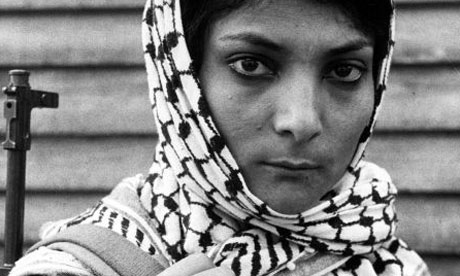
Leila Khaled wearing a keffiyah

Leila Khaled wearing a keffiyah. Photgraph: Eddie Adams/AP


'Next time you come, it will be better, God willing," says Yasser Herbawi, the 76-year-old owner of the first and only Palestinian keffiyeh factory. It's hard to see how. Last year, the distinctive black-and-white checked scarves became a surprise global trend, knotted around the necks of the most fashion-savvy. At the same time, the family-run company that produces this symbol of the Palestinian national struggle has been slowly grinding to a halt.

"It's the Chinese imports," explains Yasser, sitting amid piles of keffiyehs at the Herbawi factory storeroom, just outside Hebron in the West Bank. "In the 70s we could barely keep up with demand, but by the mid-90s cheap Chinese scarves started coming in, because of globalisation and Gatt." Yasser's sons Abdel Atheem, 50, and Judeh, 43, nod in agreement and curse the trade tariff-busting agreement. "We were forced to lower our prices and today we are working to a fraction of our capacity because we cannot compete." The factory used to produce more than 1,000 scarves a day, but now makes less than 100 - and struggles to sell those. A shutdown seems almost inevitable.

Needless to say, the Herbawi family isn't much enamoured with the cheap imports that first swamped and then stole their market. "They are not the same quality," says Yasser as he picks up a keffiyeh and spreads it across his knees, reverently feeling the light, dimpled cotton between his fingers. "Our product is better, much better. We take care of it and use only natural products, and it is beautiful." This textiles factory, which Yasser started 40 years ago, supplied the entire West Bank and Gaza - orders for scarves, robes and jackets, all fashioned from the same check, would also arrive from neighbouring Arab countries. Of course, the company creates much more than a specific cotton weave. "We are making the symbol of Palestine," says Yasser. "This scarf is the history and the heritage of our country."

The black-and-white square keffiyeh is Syrian in origin and is the head garment of choice for traditional, rural Arab males of a certain age. It was the 1930s Arab revolt against the British Mandate and Zionist organisations in Palestine that first established the scarf as a resistance symbol: it was worn in solidarity, and to make it difficult for the authorities to weed out orchestrators of the rural-led uprising. By the 60s, the scarf became emblematic of the nascent Palestinian national movement - it was the favoured headwear of the Palestinian leader Yasser Arafat and habitually worn by other symbols of the Palestinian resistance such as Leila Khaled. Then a red-and-white Jordanian version surfaced, taken up by Palestinian Marxists to differentiate themselves within the wider nationalist movement. More recently, its meaning changed again: "The Marxists in Palestine have all but disappeared and the ones who replaced them are the Islamists," explains Dr Samir Awad, political scientist at the West Bank's Bir Zeit university. "Now it's the Hamas guys who put on the red-and-white, just because they don't want to be associated with Fatah."

Around the Middle East, traditional, rural Arab men do still wear the keffiyeh, in the traditional way - as a headpiece, with the aqal ring holding it in place. But Awad says that these days, it is less widely used as a neckwear nationalist emblem by the younger generation of Palestinians. He provides one possible explanation: "The image of the keffiyeh as a symbol of resistance was tarnished by events in Afghanistan and Iraq, where it is used by terrorists, by anyone who wants to hide their face," he says. "It is very annoying, but there is no monopoly on the keffiyeh." The common appearance of the keffiyeh in suicide bomber videos has doubtless caused the two concepts to fuse in the minds of some observers.

For some years now, the keffiyeh has carried activist-chic credentials for anti-war protesters and supporters of the Palestinian cause across several continents. But it is more recently that the scarves have gained their full fashion stripes. "We noticed club kids were wearing them about a year and a half ago," says Melanie Rickey, fashion news director at Grazia magazine. "They were dyeing them fluorescent colours, and it was seen as a bit risque." Picking up on the trend, Balenciaga brought out a designer keffiyeh last summer. "What did they do, smother it with gold?" asks Abdel Atheem at the Herbawi factory when he hears of its £3,000 price tag. "If I tried to sell the scarves for £10, nobody would listen," says Yasser of the product, which gets a local market price of around £3. "And ours is the real thing."

The designer endorsement was a bit like the Midas touch - high street stores such as Topshop and American Apparel were soon churning out "black-and-white woven cotton" scarves for roughly the same sum that Yasser laments would cause his customers to turn a deaf ear. "After a while people just thought, 'These are nice scarves,'" says Rickey, "so that by this time last year, every teenage girl from London to Scotland had one." The keffiyeh as fashion item might now be on the wane, but Rickey thinks that the popular neckpiece started a paradigm-shifting trend - a retailer's dream scenario: it took the scarf out of a winter-wardrobe context and into the realm of all-year-round accessory. "The fastest selling accessory is the summer scarf," she explains. "Stores such as Oasis carry 30 to 40 different patterns - customers just can't get enough of them."

The high street has moved on from the black-and-white weave; Rickey says the current hot stock is glitter-thread-shot hippy scarves. Such faddishness is what makes it tough to interpret the craze for keffiyehs as ideological expression or act of Palestinian solidarity - in fact, fashion scarf-wearers often confess to being clueless over the politics of the chequered fabric. Still, that didn't stop the trend being read as inflammatory and insulting in some quarters. Earlier this year, Urban Outfitters pulled its line of "anti-war woven scarves", which had been a bestseller, after receiving complaints. "Due to the sensitive nature of this item, we will no longer offer it for sale," the company announced. "We apologise if we offended anyone, this was by no means our intention."

In May, Dunkin' Donuts pulled one of its online adverts because Rachael Ray, the celebrity chef that featured in it, was wearing a fashionably knotted keffiyeh. Slamming the scarves as "Jihadi chic" and "hate couture", popular American blogger and columnist, Michelle Malkin, one of the key campaigners against the black-and-white checks, wrote that, "Fashion statements may seem insignificant, but when they lead to the mainstreaming of violence - unintentionally or not - they matter."

Whatever the intention, the global surge in sales has had no impact on the fortunes of the ailing Herbawi factory. The textiles company does not export and, even at a local level, foreign competitors are holding sway. In the market stalls of Jerusalem's Old City, a Hebron factory-made keffiyeh is a rare sight among the scarves on sale to tourists. "For sure, I prefer the local product," says market vendor Saleh abu Ghazela, who stocks the Herbawis' new line of pastel multi-coloured checks alongside Chinese versions of the traditional colour combination. "But very few customers care about the quality or ask where the scarf comes from, and I have to cater to the market's demands."

All of which explains why most of the looms aren't even switched on at the Herbawis' factory. Fifteen machines used to operate daily for 18 hours, but now only one section of the vast factory is lit and just four clacking looms turn giant reels of thread into long flats of cloth. A factory technician moves between them, snipping rogue strands and making constant adjustments to the weave. "He has been our employee for 40 years," says Judeh Herbawi, of their last remaining staff member. "It is because of him that we stay open." Beyond this square of light, rows of grand machinery emblazoned with the label "Suzuki Loom" stand silent in the shadows, swathed in thick, yellow factory dust. Old swatches of keffiyeh fabric are still stretched out upon these once industrious machines - and underneath the powdery dust, the distinctive pattern so symbolic of the Palestinian national cause has all but faded away.

· This article was amended on Thursday September 25 2008. It was Urban Outfitters, rather than American Apparel as we originally said in the article above, that marketed the keffiyeh as an "anti-war woven scarf" but stopped selling it after protests. This has been corrected.

Wednesday, November 16, 2011

More help for the last kufiya factory in Palestine

Here's a piece from the BBC, on the last kufiya factory in Palestine, and how social media, to wit, a Facebook page called The Last Keffiyeh, has been set up to help garner orders from overseas. If you are on FB, please join. The publicity about the factory, plus the fact that efforts such as this have been established, seem to have given the Hirbawi factory in Hebron a new life. Go here to order yours. And wear it to your local occupy event.


Don't just read the article, but also watch the video, a good account by the BBC reporter who goes to the factory and also interviews Khalilis (Hebronites) to find out what they think. One thing I learned, besides the fact that orders from the US and Europe are helping to keep the factory going, is that the competition is not just from China, but also from Jordan and Syria.

Monday, August 31, 2009

Kufiya roundup: Fateh, DJ Rodrigo, Haifa, M-1, The Hurt Locker, Leila Khaled, DC, NYC, ties, and high fashion

PNA President Mahmoud Abbas, in the middle (Haytham Othman/MaanImages)

Here is the dead, the dessicated, the sucked-of-all life kufiya, as deployed by the dreadful mass assembled at the Fateh general conference, convened in Bethlehem earlier this month. Yasir Arafat was no angel, but at least he was the leader of a liberation movement. As a whole, the movement's leadership was corrupt, but at least it had the noble goal of national liberation. This new, post-Arafat crowd, headed by the atrocious Mahmoud Abbas, are simply Israel's and the US's guards in proxy of the concentration camp, the ghetto that is the Palestine National (sic) Authority. They have turned the kufiya into a kind of symbolic fetish, that all wear draped around their shoulders. As Sousan Hamad reported in Electronic Intifada, "As Abbas waited for his turn to read from what seemed like an inevitable 60-page speech, a man walked around the aisles handing out cheaply-made, Fatah-branded kuffiyehs (the traditional checkered scarf) to delegates and journalists. He insisted everybody wear it for the cameras." Abbas' own kufiya scarf was a bit fancier, with the Palestinian flag sewn into the ends.

Of course Fateh was too cheap to make any effort to support national kufiya production, seeing as how the organization is now all about neo-liberalization and capitalist globalization as the path to liberation. Meanwhile, University of Arkansas International Studies graduate Chris Wylie, and former student of mine, made a trip to Hebron where he bought his own, authentic, national production Palestinian kufiya, from the Hirbawi factory, the last remaining kufiya producer of kufiyas in Palestine. Bravo, Chris. Hmmm, if a young man from Arkansas could get to Hebron to buy a kufiya, why couldn't Abbas & Co. find their way there?

Despite Fateh's efforts to claim ownership of this symbol of resistance, there are lots of signs that its control is resisted. Check out the photos from this PANET article (in Arabic) about a hip-hop benefit for Gaza, held in Haifa, Israel in March--kufiyas are everywhere! Among the artists who performed: Awlad al-Hara (Nazareth), DAM (Lyd), Shadia Mansour (UK), The Patriarchs (US), Bihrang Mar'i (Sweden), and Lucky (UK).

Colombian DJ Rodrigo is also down with the kufiya. Go here to check out his latest release, through Indigenous Radio (IR), and go here to get a podcast of DJ Rodrigo, live mixing for IR. (Thanks to Dave Watts for alerting me to this.)


If you've not had enough of kufiyas, you could also purchase a limited edition Leila Khaled print, by Jesus Barraza, to benefit the Indigenous Youth Delegation to Palestine, now in progress.

According Muhaafiz Khan, writing in the blog As-Sabiqun, the act of converting to Islam has now become hip among African-American youths in the roughest neighborhoods of Washington, DC. And along with taking the shehadeh, apparently, comes wearing the kufiya. Khan writes:

The trend [of conversion] is still very much alive today, and it seems to have spread all across DC. As strange as it may sound to the suburbanite believer, it has now become en vogue in inner-city DC to be a Muslim; it is "cool" to sport a colorful kufi or Palestinian-style keffiyeh. Young brothers in thobes are becoming an increasingly common sight. Scented oils are in high demand. It is not uncommon to hear the greeting of "As-salamu 'alaikum" while walking down the street (that is, if you are obviously a Muslim).

Khan goes on to say that Islam is not just a "look" and external practice, and he expresses the hope that "with their constant expoure to the message (Jumu'ah khutbahs are hardly missed), some of it is bound to sink in and take root."

And you think kufiyas are no longer cool in New York City? Check out this guy, recently photographed on the New York subway by my friend Dave, a fellow kufiyaspotter, on the #1 train, Uptown, 125th and Broadway stop. The gentleman had fake vampire fangs in his mouth too. Dave calls it Harlem Punk Kufi.

And back in Palestine, here's a hot of a very stylish kufiya tie. I love it! Thanks to Rochelle, who alerted me to it, and to Howaida Arraf (an activist in ISM), who gave me permission to reproduce it here. The tie wearer is her brother, Wadeh.

Now a postscript on The Hurt Locker, which I finally got to see. Earlier I posted a photo of the character played by Ralph Fiennes. As my friend Carolina pointed out to me before I saw the film, he is wearing full-blown kufiya, as is the rest of his crew in the film. The Explosive Ordinance Disposal squad, protagonists of the film, comes upon them in the desert. When they first spot them, they think Fiennes & co. are insurgents, since they are in kufiyas. The disposal squad describe what they are wearing as 'haji' wear. Fiennes and his crew are not regular military, they're hunting most-wanted Iraqis, and have two guys who appear in the set of playing cards the US military developed to identify them. Meanwhile--as Carolina also pointed out--the bomb squad member played by Brian Geraghty also wears a kufiya, but it's quite subtle--a khaki scarf that seems to blend into his uniform. And, given that the scarf is khaki colored and not black-and-white or red-and-white, it's also "hipster."

M-1 of Dead Prez was recently in Gaza, as part of the Viva Palestina delegation. He writes about the experience here. Kufiyas were, as you might expect, worn by many in the delegation. M-1 describes what happened as the group approached the border:

On a comfortable chartered bus I daydreamed and listened to one the head organizers, Nancy, deejay to our anxiety and excitement. One of my favorite songs is the one that demanded us to “wave our kufiyas in the air!” which many of us wore. Even though they have become a passing fashion statement, we wore the red and white ones, and I felt extremely proud when the brothers got together to wave our red, black and green Liberation flag in the immigration office as they chanted loud enough for the people to hear us on the other side in Gaza.

I wish I knew what song that was! Note that red-and-white kufiyas have now become associated with Hamas, in the Palestine context. Here's a photo of M-1 from the post; I don't know who the guy is with him.

Do you remember when the kufiya was in all the fashion shows? In case you forgot: here are some 2008 photos of models dressed in "Fashion Week Style," from the fashion blog Jak & Jil. (Thanks, Rochelle!)

Sessilee Lopez, Peter Pilotto fashion show

Maryna Linchuk, Louis Vuitton fashion show

Hanne Gaby Odiele, Chloé fashion show

Is that enough kufiyas for now?

Thursday, June 25, 2009

Mother Jones blames hipsters for decline of Palestine kufiya industry. Plus, Colin Farrell & Isabel Marant

The Mother Jones blog published an article about kufiyas this week, by Sonja Sharp, and entitled "Your Intifada: Now Made in China!" For the most part, Sharp goes over material that hawgblawg has covered obsessively over the last year or so. (My first post on the demise of Palestinian-manufactured kufiyas is here.) But here is the key argument:

...why is the the last keffiyeh factory in Palestine about to go out of business?

That's because the one you're wearing (and, increasingly, the ones Palestinians are wearing) are now made in China.

Here's how it happened: Back in '87, during the first intifada, intifadniks couldn't get enough of Palestinian-made $25 scarves. Looser export restrictions meant that Israelis could rep them too, and slowly but surely the scarf and its emblematic pattern began appearing in the West. By the time the second intifada happened in 2000, hardcore activists and the super cool already had them. Then the keffiyeh trend reached its tipping point, and hipsters' insatiable lust for the scarf lured Chinese manufactures into the gig. Fast forward a decade, and Chinese keffiyehs are the norm.


Ironically, global support for Palestinian-statehood-as-fashion-accessory has put yet another nail in the coffin of the Occupied Territories' beleaguered economy. What's next?

So, hipsters are to blame for the decline of Palestinian industry? Ah, they are so easy to blame, aren't they?

But as more responsible reporting suggests, it probably makes more sense to blame the "peace process," which caused the West Bank to open up to "free trade" but created no viable national authority that could impose imports. But maybe criticizing the "peace process" would be too radical a step for Sharp.

One thing that Sharp could have done is to promote the purchase of Palestinian kufiyas by providing a link to the The Kufiyeh Project. (Note to The Kufiyeh Project: get the Hirbawi factory to make green kufiyas, so that we can show our solidarity with both Palestine and Iran. If you need a green kufiya, try the Arab American National Museum.)

And a footnote to earlier kufiyaspotting posts. Here's another photo I found of Colin Farrell (man, he has been photographed a lot in kufiya!--see here and here.)


And here's a photo of a kufiya from designer Isabel Marant, from her Fall/Winter 2008 Runway Show (courtesy Mick Margo, writing in the Fashion Journal):

Saturday, August 30, 2008

Another report on the last Palestinian kufiya producer--plus hair gel

An AFP report on the Palestinian kufiya, with an overview of its recent uses in the West, the controversies, and the story of the last remaining Palestinian producer, Yasser al-Hirbawi, who faces severe competition face from Chinese producers. I like the fact that French reporters find it worthwhile to actually go to Hebron and talk to real live Palestinians. The report covers much the same ground as one that appeared in Le Monde this February.

But I do like this statement:

Even here [Hebron] most Palestinians, including the politically active, have cast off the traditional keffiyeh in favour of a more modern look.

"The young guys prefer to wear hair gel," Abu Rumilah, another merchant says.


It's been probably three or more decades, in fact, since anyone other than older men, especially those in traditional or rural garb, routinely wore kufiyas on their heads in the West Bank. But it has been very common for those wearing "modern" clothing to wear kufiyas as scarves, in much the same way as hipsters and politicos do in the West.

Abu Rumilah's statement has more to do with the fact that some in the older generation are quite critical of the younger generation for their modern and trendy hairstyles. It's true that many young men in the West Bank are quite concerned with keeping their hair looking smart, and with global clothing styles. This doesn't keep them from covering their necks with kufiyas in cooler weather, however.

(I found this via The Angry Arab.)