Showing posts sorted by relevance for query turban. Sort by date Show all posts

Thursday, December 31, 2009

More on the turban puzzle: Rudy Ray Moore (and even more)

Still trying to make sense of the circulation of the turban (and fez/tarbush) in African-American popular culture. I just ran across an article that Blake gave me years ago, and that I had never bothered, until today, to read: "'I Ain't Lyin'!: The Unexpurgated Truth about Rudy Ray Moore," by Jerry Zolten, from the May-June 2001 issue of Living Blues. It's a thorough and informed piece, and is especially good about explaining the late Rudy Ray Moore's notorious x-rated humor.

Here's the interesting bit, at least as far as the turbans go. Rudy Ray Moore was born and raised in Ft. Smith, Arkansas (with a bit of time in Paris, AR). Then he moved to Cleveland, in, as far as I can tell the mid-40s or so, where:

Rudy Ray Moore met Billy Nightengale, a dancer who taught him stage moves. Nightengale wore a turban and soon the two of them took to wearing turbans all over town. "We'd put on our turbans and people would follow us around like we were foreign dignitaries." A few years later, the turban became a trademark for Chuck Willis, a singer who built up his fame on a string of hits for Atlantic records, including "C.C. Rider," his R&B version of Ma Rainey's blues classic. Willis got the idea to wear a turban from Rudy Ray who wore his when he emceed R&B stage shows. "He wanted to know where I got it from," says Rudy Ray, "and I carried him by the lady's house that made the turban for me and she made Chuck one...He wore the turban until he died."

Chuck Willis is one of the most celebrated of the R&B turban wearers, and was known as the "Sheik of the Blues." I can't authenticate Moore's claim. Willis was from Atlanta, but perhaps he met up with Moore in Cleveland. Willis had his first hit in 1952; Moore was in the army from 1950-53. When did Willis start wearing the turban? Dunno.

What I do get from this account is that wearing the turban made Moore and his pal Nightengale look and feel like "foreign dignitaries." The effect then was not only that they looked "exotic," but that they also looked distinguished.

In Cleveland, Moore also, teamed up with a woman and the two of them dressed exotically and performed torrid dances to the beat of African drums. [Moore] started singing a little, billing himself as the Harlem Hillbilly...

In time Rudy Ray's first great stage persona would emerge. He became Prince DuMarr, the 'turbanated' dancer in Neil Stepp's traveling revue. He liked the ring to the name "Dumarr" and the association with the Hollywood glamour queen Hedy Lamarr."

Moore joined Stepps revue, he says, when he was 17, and this was 1946.
Here's a photo of Moore as Prince DuMarr, taken in the late '40s. It's the cover of his Norton Records release, Hully Gully Fever. The article includes a photo of Moore as DuMarr, with the revue, but I've found no copy on the web. I believe it is found in the jacket for the Hully Gully Fever CD. It shows Moore, bare chested and in turban, with female dancers.

Moore barnstormed as Prince DuMarr until 1950, when he was drafted. In the mid-1950s, Moore moved for a time to Seattle, and took up the "Prince DuMarr" role again in a review headlined by sax player Big Jay McNeely. Presumably, again in turban. Perhaps it was in the Seattle period that Chuck Willis saw him in turban. This photo too is of Moore as "Prince DuMarr"--a poor reproduction from the LP cover of Hully Gully Fever.

And here are a few more turban images. It appears that Norton Records is really into the turban aesthetic. Here's the cover of Turban Renewal, a tribute album to Sam the Sham and the Pharaohs record. (Sam is another famous turban wearer.)

And the cover for another Norton release, Hannibalism!, from R&B singer The Mighty Hannibal.

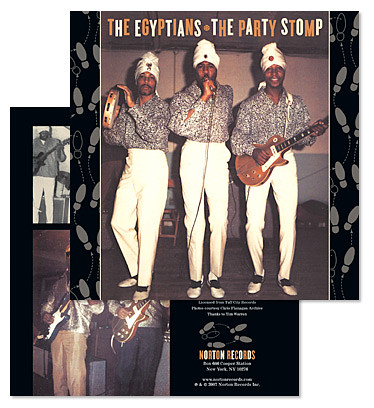
This is the cover of Norton's 2009 catalog. Unfortunately I can't find a better reproduction. Note that it features turbaned artists like Rudy Moore, Sam the Sham, Hannibal, Screamin' Jay Hawkins and The Egyptians, and that it advertises "Turban Contemporary Music."

Still more. Two LP covers from be-turbaned Hammond B3 ace Lonnie Smith: Afrodesia (1975) and Funk Reaction (1977).


Finally, another from King Khan, who is truly keeping "turban contemporary" alive.

The new album of King Khan and the Shrines, Invisible Girl, is terrific. And turbanated.

Ok, one more. This is the last, and from a different turban context and aesthetic. Kate Moss, May 2009.

Monday, February 12, 2007

Hijab couture goes mainstream?


Check out this fashion item from the current London Fashion Week. The caption on Yahoo! News says, "A model wears an outfit by Fashion East designer Louise Golden during her catwalk show at London Fashion Week in London, Monday Feb. 12, 2007. The designers are showing their Autumn/ Winter 2007/8 collections. (AP Photo/Alastair Grant)" (Thanks to Chris for bringing this to my attention.)


(Note that Muslim women have been wearing fashionable headgear for some time now--see for instance the items at HijabShop.com.)

Fox News carried a related article on February 6 by Catherine Donaldson entitled "Bye Bye, Hair! Hello, Turban Chic," which I initially discounted but now am inclined to take more seriously. Donaldson reports that designers like Prada, Marc Jacobs and Ralph Lauren, and chain stores like H&M are now offering turbans (Donaldson also calls them "full-on headscarves") for women, some as expensive as $700, and that they have been sported by Katie Holmes, Jennifer Lopez, Eva Mendes and Prince (at Superbowl half-time).


The "turban" hearkens back to '40s, '50s, and '60s fashion, when it was worn by the likes of Joan Crawford and Ava Gardner. Donaldson also notes that, "Some [observers] speculate that turbans are popping up on women because of India's increasing influence on Western pop culture and a growing post-Sept. 11 interest in Pakistan, Afghanistan and the Middle East." Sounds like more Orientalist confusion to me, a mash-up of the turban worn by Sikh men and the headscarves of pious Muslim women in Islamic cultures.

And here's a couple more strands noted by Donaldson: "the style has been adopted by hippie chicks on the one hand and women embracing their African roots on the other (think India.Arie and Erykah Badu)."

Fascinating that such style is showing up on London and Paris fashion catwalks (photo at left is a Prada turban at the Paris spring fashion show) when British politicians like Jack Straw, prominent Labor Party politician and Leader of the House of Commons are campaigning against veils worn by British Asian Muslim women. In early October 2006, Straw published a controversial article stating that he asked Muslim women constituents who visited his office for consultations to raise their veil, if they wore a niqab (a full veil with a slit for the eyes) so that he could see their eyes. The veil (i.e. niqab), he wrote, is a "visible statement of separation and difference." Both both PM Tony Blair and his presumed successor, Gordon Brown, chimed in to support Straw. Blair too has stated that the veil is a "mark of separation" and that it has made some "outside the community uncomfortable," while Gordon Brown said it would be "better for Britain" if fewer women wore veils. Brown also asserted that immigrants "should speak the language of English."

I don't read J-Lo, Katie Holmes', and Prada's embrace of the turban as indicating any kind of dissent from Labour politicians Straw, Blair and Brown. Erykah Badu, who comes out of a Nation of Gods and Earths background, is another matter, however. And then there is Cat Power's very intriguing use of hijabs in her video for "Living Proof."

Saturday, March 29, 2008

Turban Alert! The Fabulous Ottomans


A glance at the photo might lead you to think that this group dates from the '50s. But no, The Fabulous Ottomans are a working band, based in Barcelona, Spain, who play the "finest turban headed rhythm & blues."

You can download their very fine track, "Shake Shout Soul," on their myspace page. And also here, at Soulful Torino Records, which is where I found it.

For some reason, turbans were very popular among rhythm 'n' blues artists of the '50s and '60s, among them Screamin' Jay Hawkins, Chuck Willis, and Professor Longhair. Here's a photo gallery. Kim Wilson of The Fabulous Thunderbirds (is this where the Ottomans got their 'Fabulous' moniker?) used to wear a turban, back in the day (I first saw him perform in one in 1978). Meanwhile, here's one of my all-time fave turban wearers, Sam the Sham (Domingo Samudio) of Sam the Sham and the Pharaohs, of "Wooly Bully" fame. (And I guess, considering what The Pharaohs are wearing, it's a kufiyaspotting too.)

Monday, March 17, 2014

turbanophobia


I've reported on occasion about the bohemian hipness of turbans in the US. Notable why? Because it seems to fly in the face of endemic Islamophobia.

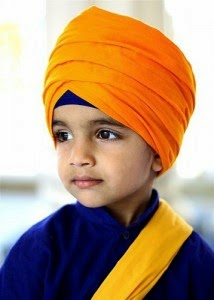
So maybe we on the progressive front should be doing more to promote turban wearing, in solidarity with Sikh children, who, it turns out, are the massive target of bullying in US schools. (Wearing a turban would be much more radical than sporting a kufiya scarf, eh?)

As reported by Jezebel:

"A recent survey by the Sikh Coalition has found that half of Sikh children and two-thirds of Sikh children who wear their hair in turbans report being bullied at school" (emphasis added).

Where is the anti-bullying lobby on this issue?!

The report goes on to argue that this is a wider phenomenon, due largely to the post 9/11 terror hyper-hysteria:

"The period since 9/11 has been particularly difficult for Sikh Americans and their children. While Sikh children experience bullying in the classrooms, their Sikh American parents endure astoundingly high rates of hate crimes, employment discrimination, and scrutiny at the nation's airports. Brown skin and turbans have popularly become associated with terror. Crude popular culture stereotypes of terrorists and damaging media images outside the class room have made their way into the classroom to the detriment of young Sikhs."

And, whenever instances of mass shootings are discussed in the context of the need for control, why in the hell is Oak Creek, Wisconsin almost never mentioned? It was here, on August 5, 2012, that a white supremacist killed six Sikhs and wounded four others, at a Sikh Temple.

Oak Creek, Oak Creek, Oak Creek. We remember Columbine, Aurora, Newton...Why not Oak Creek?

Oh, I guess the Sikh Coalition report begins to suggest why. Many of us do not believe turban wearers are "innocent" or even "American."


Saturday, June 25, 2011

The Turban Makes a Glorious Comeback (last fall!)

Kirsten Luce for The New York Times

I clipped this article from the New York Times last fall, but it got misplaced in some pile or other, and I've just recovered it. I think it's still of interest.

It focuses on the claim of June Ambrose (pictured above) who, it says, wore a turban every day during New York Fashion Week. And it traces the current trend to a Prada show in 2006, which wasn't picked up, but then began to catch on by 2009. Kate Moss wore one at the Met gala in May 2009. And it started showing up on the street, on young women.

The new fashion connected them to "sophistication linked with Hollywood glamour of the 1920s and ’30s, when women like Garbo, Gloria Swanson and Joan Crawford wore them. “From way back, turbans signified a woman who was very educated and worldly,” said Caroline Rennolds Milbank, the fashion historian."

The article goes on to say that, 'Because turbans have historically been associated with Arab dress, it is tempting to connect them with the conflict in the Middle East. “They make a strong political statement, like wearing harem pants,” Ms. [June] Ambrose said. “We take an element of other cultures and internalize it”'

For his part, the curator of the Costume Institute at the Met, Harold Koda, 'isn’t convinced that they have anything to do with politics: “It’s not a part of a Kumbaya fashion movement. I think it’s more of Poiret’s view of Orientalism than women watching the news and referencing what’s going on in Afghanistan. It’s an exoticism, a sense of the other that is visually compelling.”'

Fashion historian Caroline Rennolds Milbank meanwhile 'noted that in the past, Western culture looked at the Middle East for its exotic form of dress, which was seen as sexually liberating. “If you look back at the portrayal of women in films like ‘1,001 Nights,’ ‘Lawrence of Arabia’ or even the television show ‘I Dream of Jeannie,’ the West depicted those women very sexually with sheer fabrics and an exposed midriff,” she said. “Going back to the turban is a return to the allure and sexiness of a foreign culture.”'

My opinion is not that it's a question of either/or. Probably the trend has something to do with Middle East politics--in some displaced fashion. And no doubt it's also rooted in the history of popular Orientalism in the US. Check out the slideshow that goes along with the article for more turbans. I particularly liked the photo of Nina Simone wearing one.

(credit: Associated Press)

I've posted a few times on turbans, as well as related Orientalist fashions. Re Maria Montez and Lana Turner, here. Rudy Ray Moore and more here. Beyoncé here. Kim Wilson. Chuck Willis. The Fabulous Ottomans and Sam the Sham. Prince and Prada. Ongoing obsession.

Tuesday, April 01, 2008

Turban'd Kim Wilson, Fabulous Thunderbirds


I finally found a photo of Kim Wilson in a turban. Kim Wilson, the great lead singer and harmonica player of The Fabulous Thunderbirds. The other guy is lead guitarist, Jimmy Vaughan, brother of the late Stevie Ray Vaughn. Jimmy plays in a more restrained style than brother Stevie, but is fully his equal. I used to see these guys play in clubs all the time in the late 70s in Austin, and they kicked ass. Best album from that era is their eponymous The Fabulous Thunderbirds (19779), and this one, What's the Word, is a close second.

Kim used to wear the turban in concert quite often, and he looked slick.

Wednesday, October 09, 2013

more R'n'B turbans

Thanks to Nabeel for informing me about this gallery of African-American entertainers turbans, posted by Freddie Patterson for India Music Week.

If you've followed this blog, you will know that I don't just post about kufiyas, and sometimes do post on turbans on occasion. And I've posted some of the same photos as found in the gallery, and about most of the same artists. You can see my turban postings here -- there are quite a few.

But there were some revelations nonetheless. I just love this photo of R'n'B giant Louis Jordan.


And Aretha Franklin in a turban:


I had posted a photo of singer The Mighty Hannibal in a turban previously, but I found this vid, of him singing "Jerkin' the Dog," on a TV show, I guess, to be quite fun.


Sunday, November 16, 2008

kufiya note #7078 (plus turban and hijab chic)

I'm still slogging away, when I can, on the MESA paper, and am finding ever more material.

Here's another photo of Chris Brown, which I found courtesy of the blog Flypaper, dated February 26, 2008. Here is an earlier post of mine of Chris B. You learn from these photos that he owns more than one.
Flypaper posted the Brown photo again, along with a shot of BeyoncĂ© in a turban (original is from here), and some hijab fashion, under the title "Middle Eastern chic" (April 29, 2008). Symptomatically, not "Arab" chic. As Sunaina Maira notes in her article on Belly Dancing and Arab-Face, “Despite the recent proliferation of belly dance classes and clothing, hookah bars, and Arab music in urban U.S. popular culture, the word 'Arab' is hardly ever used in connection with these products and practices, and they are more commonly glossed as 'Middle Eastern.'” (Check out wayneandwax's post on Arab-Face here and download Maira's article here.)

Arab seemingly is too dangerous an identification to market, or blog. Nonetheless, I appreciate Flypaper's move to link the kufiya trend to other clothing trends. (I posted previously about turban style and hijab chic here. J-Lo and Prince beat Beyoncé to the punch.)

Here is a shot of Cameron Diaz, kufiya draped, appearing at Pangea Day in May, courtesy Popsugar. Pangea Day is a "global event bringing the world together through film, which on May 10, 2008, linked live events in Cairo, Kigali, London, Los Angeles, Mumbai, and Rio de Janeiro. It was initiated by Jehane Noujaim, director of Control Room (the documentary about Al-Jazeera). Check out the excerpts from the films that were shown--this is not just some flaky, ignorant Hollywood stuff that Cameron is participating. (And what about the fact that she wears a kufiya to an international event organized by an Egyptian?)

And back to Flypaper: the next post following the one on "Middle Eastern chic" is one about the "new Pashmina," as reported on by the London Times (April 26), which writes, " Except there’s a new way to wear scarves that’s almost universally foolproof – not knotted in a neat choker that ends up slipping round your neck, but folded into a big triangle at the front and tied, Middle-Eastern style. This is a cunningly brilliant route to prints and colours you wouldn’t otherwise be seen dead in, but know will cut a dash." Note, again: not folded Palestinian style or Arab style but Middle Eastern style.
Flypaper, helpfully, provides a photo of this triangle-in-front style, which the Times does not do. (Pashmina is a very pricey type of cashmere shawl, from the Kashmir, that became popular in the West of late. Maira writes that they showed up in clothing stores and street fairs in New York City in 1997-99, as part of the Indo-chic trend (p. 345, "Henna and Hip-Hop: The Politics of Cultural Production and the Work of Cultural Studies," Journal of Asian American Studies, October 2000).

More recently, RunwayDaily.com reported (August 18, 2008) on the first look at the "killer scarves" for fall 2008, and, whaddyaknow, the "triangle in front" (here labelled "triangle wrap") shows up again:

"Scarves were even seen wrapped tightly around the neck, in a fringed belted version and also in a triangular look that resembles the VERY CONTROVERSIAL keffiyeh (that I love to don)."
 
The controversy RunwayDaily.com refers to is, of course, the Rachael Ray/Dunkin' Donuts one. Note that the scarf and cap on the lower right (shoulder love) have a kufiya-looking pattern. And is the "head's covered" scarf more "hijab chic"?

That's not the end of it, for the post features more scarves, including the Peace Treaty line. Pictured is the Capsicum Peace Treaty scarf (shades of Urban Outfitters' "anti-war woven scarf").


And if you go to the website (shopbop.com) you can find "triangle wrap," kufiya-style scarves, including this one, the Netanya.


And there's more to the kufiya/pashmina connection, or merger. Bluefly is also marketing a red, cashmere kufiya (only $99, on sale), as part of its Kashmere line.
Finally (for now), you can buy the trompe l'oeil kufiya t-shirt now from fredflare.com.

As Fredflare says, "Unless you've been living under a rock somewhere, you've seen (or worn) this ubiquitous scarf. Now you can rock it all year long on a super comfy 100% cotton t-shirt by Newbreed Girl!" The kufiya is no longer just for fall/winter! (But see this earlier trompe l'oeil here.)

Apparently, kufiyas aren't going away any time soon. The "triangle" style of wearing them is getting, almost, branded. They are getting merged with Indo-chic pashminas. Viral...

Nor, I would maintain, does the fact that celebrities wear them necessarily mean that kufiyas are disconnected from progressive, or at least humanitarian, politics. Check out Pangea.

Sunday, March 30, 2008

Chuck Willis, Sheik of the Blues


Blues/Rhythm & Blues artist Chuck Willis, routinely wore a turban on stage when he performed (he reportedly owned 54 of them), and so was known as "Sheik of the Blues." (Some claim he was known as the Sheik of Shake and Sheik of the Stroll.) Best known for his 1957 hit, "C.C. Rider." He recorded for Atlantic Records starting in 1956. (Atlantic of course was co-founded by the Turk Ahmet ErtegĂĽn--who was secular and of course did not wear a turban.) Willis died of peritonitis, at the age of thirty, in 1958.

Monday, October 29, 2007

Arabspotting: Coachella Valley High School Arabs

Coachella Valley is probably best known today for its music festival, "Coachella," but arguably it is more important economically for its dates, which originally started in the late nineteenth century with shoots from Morocco, Egypt, Iraq and Algeria. Almost 95% of US-produced dates come from Coachella, and all the date varieties have Arabic names: Deglet Nour, Medjool, Halawy, Khadrawy, Zahidi and Thoory. Hence the name of the Coachella Valley High School mascot: the Arab.

The history below has some mistakes: the headscarf is not a hijab but, as readers of this blog know, a kufiya (keffiyeh) or shemagh or hatta or ghutra. And Saudi Arabia was never a colony of France! (Of Aramco, maybe.) And who knows why the Saudis think they had any thing to do with this Arab mascot, since the original date shoots were not from the Arabian peninsula.

Here's the history, from the CVHS Alumni Association website.

The Evolution of Our Mascot

The Arab mascot dates back to when Coachella Valley High School first began to compete in athletics in the 1920s. The school adopted the name Arabs in part to recognize the importance of the date industry in this end of the valley, but also because it fit in perfectly with the neighboring towns of Mecca, Oasis, Arabia, and Thermal.

The original Arab was drawn carrying a lance and riding a horse. On his head he wore a turban.


His image remained that way until sometime in the 1950s when the turban was replaced by a fez and the lance was replaced by a scimitar.


There were two versions of the mascot - a young one holding a scimitar and an old one with a growling face and a gold tooth.

Another change in the mascot came in the 1980s. A group of Arabs from Saudi Arabia who were in the area touring the desert's date industry recommended that the mascot's headdress be changed from a fez to a hijab or head scarf. Their reasoning was that Saudi Arabia was no longer under French rule; therefore, Saudi Arabians no longer wore the fez as their headdress.


The school voted to honor the request and the mascot began to be drawn as he still appears today.

Sunday, September 21, 2014

Turban alert: TM Mike Love (Beach Boys)

I came across these images of Mike Love from a post on the super super music blog Aquarium Drunkard. It presents and discusses a video of The Beach Boys singing with the Alexander Hamilton Double Rock Baptist Choir. The song, "That Same Song," is, well, vintage Beach Boys + gospel. It was released on their album 15 Big Ones in 1976.


One of the things that struck me was Mike Love in turban (the second photo shows him with Al Jardine.)


Mike had gone to Rishikesh, India, as part of a group of sixty, organized by The Beatles and including also Donovan and Paul Horn, in February. There they studied Transcendental Meditation with Maharishi Mahesh Yogi. I guess this is evidence that Mike was still fully in to TM in the mid-seventies.

While they were all there, The Beatles wrote and recorded a lot of music, that would show up on the White Album and Abbey Road.

And they recorded this, which never appeared on record: the very very BeachBoysesque "Spiritual Regeneration/Happy Birthday Mike Love," on the occasion of Mike's birthday.


I guess the most Beach Boys-sounding Beatles song ever recorded is "Back in the USSR," penned by Paul McCartney. Mike Love has stated that he encouraged McCartney to "talk about the girls all around Russia, the Ukraine and Georgia" to make the song sound more Beach Boys.

Wednesday, August 13, 2008

what else? a couple more kufiyaspottings (plus turbans)

People keep sending me this stuff. So here goes...

#1. The Akshay Kumar and Snoop Dogg video, "Singh Is Kinng." Kumar can be spotted sporting the kufiya, draped around his neck like a scarf, several times throughout the video. (Thanks, Rachel.)


Why in the world is a Bollywood movie star wearing a kufiya?--particularly when he is also wearing a turban, since he's playing the part of Lakhan Singh, a Sikh, which he plays in the film, Singh is Kinng. Is it because Singh is the king of the gangstas in Australia? Is it just international style? Or, since he's on screen with Snoop Dogg, is Kumar trying to look more hip-hop? Who knows?

"Singh Is Kinng" is a bhangra song, composed by the UK bhangra band RDB, but it's not terribly clever. Such hip-hop/bhangra collaborations seem to be getting more and more common, and there are lots of better ones. Jay-Z's collabo with Punjabi MC on "Beware" seems to have started the trend. Go here for more hip-hop/bhangra downloads.

#2. I found this video on the page of the band, Rainbow Arabia. It's one of their "influences," and it's a video that goes along with the performance of "Palmitos Park" by El Guincho. The kufiya shows up right away, as kind of table cloth, with colored feathers on it. The kufiya and the feathers show up several times, each time looking more psychedelic. It's a very "conceptual" video, by Will Bryant. Who knows why the kufiya is there. El Guincho is a Spanish musician whose music has been described as "space-age exotica."


As for Rainbow Arabia, it is a kind of exoticizing experimental band. Their press packet describes them as combining Middle Eastern flavors with American experimental dance music, according to a review of their first release by Pitchfork. (Thanks to Dave for turning me on to them.)

And catch this, the Pitchfork review actually says that the band has a "keffiyeh-fied aesthetic"!

I've not heard Basta, the EP in question. (It doesn't seem to be available for download on any sites I know.) But if you check out the band's webpage, you can listen to three of their songs. Only one of them, "Tiny Tiny Man," has a hint of "Middle Eastern" influence--the sound of the derbouka.

Not really sure how "keffiyeh-fied" their aesthetic is. It's definitely exotica. I'll let you know if/when I find out.

(Oh, and be sure to check out the 4th video of their "influences"--the completely amazing Syrian singer, Omar Souleyman.)

Tuesday, January 29, 2013

turban alert: The Turbans

Thanks to Jerry Zolten, the author of "'I Ain't Lyin'!: The Unexpurgated Truth about Rudy Ray Moore" (Living Blues, May-June 2001), who I quoted in an earlier post about turbans and Rudy Ray Moore. Zolten told me about the 'fifties doo-wop group from Philadelhia, The Turbans.


The Turbans had a national hit in 1955 with "When You Dance." You may have heard the song, as I had, but I didn't know, or remember, the name of the group associated with the tune.

Another great song from The Turbans, released in late 1955 in the hopes of following up the success of "When You Dance," is "Sister Sookey." Alas for The Turbans, it didn't chart. But it does have a great line: "and that girl she's gone to Egypt." That may be the only "Orientalist" theme in any of The Turbans songs. The group eventually split up, in around 1962.

Love those turbans.

Friday, June 11, 2010

Back on the tarbush/fez tip: Shafiq Husayn (plus Edward Said and a kufiya)

Thanks to Omar for turning me on to the video of Shafiq Husayn's "The U.N. Plan," from his album Shafiq En A-Freek-A.


I've mostly paid attention to the video and the general sound, so I'm turning to this account of the lyrics, courtesy The Quietus.

'The U.N. Plan' is about being stuck in a rut, "living in circles". A tight, delicious groove and surging drums accompany vocals about remembering to be a star. They duel with reflections in reverb, saying things like "her name was boo and she left me all alone to expand", as if a consciousness were struggling to put positive light on a situation.

As for the video, there are a number of intriguing elements. Shafiq appears in it in five guises: as a kind of Lonnie Liston Smith in red turban and camo fatigues; as a kind of Rasta-ish boho wearing a knit hat with Ethiopian colors; a somewhat similar look to the former, but with a red hat (you can see this guise in the frame of the embedded video above); in dark glasses and red beret; and finally, and most remarkably, as an old-school Afrocentric intellectual, complete with Malcolm-style glasses and a fez (tarbush).


The provenance of Shafiq's very intello look here is given in an earlier frame, with the titles for the video, when we see this title page, from a text by the Moorish Science Temple, founded by Noble Drew Ali. The fez was part of the outfit worn by adherents of Moorish Science. And in fact, in the photo above, not only does Shafiq recall Malcolm X, but also Noble Drew Ali (see the photo from this previous fez post.)


With these images Shafiq is conjuring with the racialist theories of Moorish Science, which proposes that African-Americans are of Moorish origin. But he also conjures up the image of post-Mecca Malcolm, who abandoned the racialist doctrines of Elijah Muhammad and advocated progressive alliances with peoples of all races. The gentleman sitting at the table with Shafiq-in-fez could be Arab or Hispanic or South Asian. The video also shows images of the Buddha and a text about Tibet.

And then the Shafiq-in-beret is shown with a woman wearing what may be an Islamic headscarf (worn pretty loosely). In one scene the two of them are shown in front of a mural that depicts a woman in red kufiya, who appears to be depicted with "African" features. (The woman also appears with Shafiq-in-red-hat.)


We see a shot of another page of a book toward the end of the video, another text that the Shafiq-in-fez is presumably reading.


Look closely, and you will see that it is the top of page 175 of Edward Said's Orientalism, from Chapter Two, "Orientalist Structures and Restructures." The passage is about Chateaubriand's visit to Egypt.

How cool is that, Edward Said in a music video? Of course, it would be a video from an artist who belongs to the afro-futurist ensemble Sa-Ra Creative Partners, a group that evokes the name, sensibilities, and mythologies of Sun Ra and his Arkestra. A group responsible for production on Erykah Badu's incredible New Amerykah: Part One.

There is no doubt more to say about how expansive and complex is Shafiq Husayn's "U.N. Plan," but I'll leave it there for now.

Friday, May 22, 2015

Kufiyaspotting and turban spotting: Gustav Klimt

photo: Imagno/Austrian Archives

Famed Viennese painter Gustav Klimt, at an artists' party hosted by Otto Primavesi at his house in Winkelsdorf (Moravia), 1916. Otto and his wife Eugenia were among the most important patrons of Klimt in his last years. Otto was owner and director of the Primavesi Bank, based in OlmĂĽtz (now Olomouc, Czech Republic). Klimt designed the Primavesis' country house at Winkelsdorf.

Orientalist parties like the one depicted above were a common feature of bourgeois life in the US and Europe in the first three decades of the twentieth century, as I've blogged about previously: here and here.