Showing posts sorted by date for query kate moss. Sort by relevance Show all posts

Saturday, June 25, 2011

The Turban Makes a Glorious Comeback (last fall!)

Kirsten Luce for The New York Times

I clipped this article from the New York Times last fall, but it got misplaced in some pile or other, and I've just recovered it. I think it's still of interest.

It focuses on the claim of June Ambrose (pictured above) who, it says, wore a turban every day during New York Fashion Week. And it traces the current trend to a Prada show in 2006, which wasn't picked up, but then began to catch on by 2009. Kate Moss wore one at the Met gala in May 2009. And it started showing up on the street, on young women.

The new fashion connected them to "sophistication linked with Hollywood glamour of the 1920s and ’30s, when women like Garbo, Gloria Swanson and Joan Crawford wore them. “From way back, turbans signified a woman who was very educated and worldly,” said Caroline Rennolds Milbank, the fashion historian."

The article goes on to say that, 'Because turbans have historically been associated with Arab dress, it is tempting to connect them with the conflict in the Middle East. “They make a strong political statement, like wearing harem pants,” Ms. [June] Ambrose said. “We take an element of other cultures and internalize it”'

For his part, the curator of the Costume Institute at the Met, Harold Koda, 'isn’t convinced that they have anything to do with politics: “It’s not a part of a Kumbaya fashion movement. I think it’s more of Poiret’s view of Orientalism than women watching the news and referencing what’s going on in Afghanistan. It’s an exoticism, a sense of the other that is visually compelling.”'

Fashion historian Caroline Rennolds Milbank meanwhile 'noted that in the past, Western culture looked at the Middle East for its exotic form of dress, which was seen as sexually liberating. “If you look back at the portrayal of women in films like ‘1,001 Nights,’ ‘Lawrence of Arabia’ or even the television show ‘I Dream of Jeannie,’ the West depicted those women very sexually with sheer fabrics and an exposed midriff,” she said. “Going back to the turban is a return to the allure and sexiness of a foreign culture.”'

My opinion is not that it's a question of either/or. Probably the trend has something to do with Middle East politics--in some displaced fashion. And no doubt it's also rooted in the history of popular Orientalism in the US. Check out the slideshow that goes along with the article for more turbans. I particularly liked the photo of Nina Simone wearing one.

(credit: Associated Press)

I've posted a few times on turbans, as well as related Orientalist fashions. Re Maria Montez and Lana Turner, here. Rudy Ray Moore and more here. Beyoncé here. Kim Wilson. Chuck Willis. The Fabulous Ottomans and Sam the Sham. Prince and Prada. Ongoing obsession.

Saturday, October 23, 2010

Bella Freud & Hoping Foundation & Hideous Kinky

I've been meaning to do a longer post on the Hoping Foundation's recent (July) charity event that raised 430,000 pounds sterling for Palestinian children. Among those who performed were: David Gilmour and Roger Waters of Pink Floyd, Nick Cave, Tom Jones, and Kate Moss (yes, she sang back-up and played tambourine). And maybe I will in future still do that post.

But then I came across this photo (source here) of Kate Moss and Hoping Foundation co-founder Bella Freud at the event.

I guess if I lived in the UK I might know that (a) Bella is the great-granddaughter of Sigmund; (b) she is a well-known fashion designer; (c) she has been an outspoken critic of Israel and (d) she is the elder sister of Esther Freud, author of the autobiographical novel Hideous Kinky (made into a fairly decent movie, starring Kate Winslet).

Having seen the movie (but not yet having read the book), here's what I like about what I learned about Bella Freud. Hippy mom who is way into Sufism drags her daughters off to Morocco in search of spirituality and exoticism. The elder daughter, who survives this difficult ordeal, which includes a nearly-fatal bout of streptococcus, returns to the UK and...grows up to become a successful fashion designer with a political conscience.

So let's not overdo it with making fun of the "Orientalism" of all those hippy treksters and seekers after spirituality who descended on Morocco in the sixties and seventies.

Monday, February 01, 2010

Massive Attack and the Palestine Connection (of course)


Massive Attack's latest (fifth) album, Heligoland, is out now. I am listening to it right now, because it is now available to listen to in its entirety, thanks to NPR. (This almost, but does not quite, make up for the execrable attack on All Things Considered last week on the late Howard Zinn. Almost.)

Go here for NPR's take on Heligoland. To listen:


I've only listened to a few tracks, so can't give an informed opinion, except to say that so far I like it. I've loved Massive Attack ever since the first one, Blue Lines, back in 1991.

Long after I had become an avid fan, I learned of another reason to admire Massive Attack: for their politics. I noted back in 2007 that the band had played benefits for the Hoping Foundation, which supports projects for children in Palestinian refugee camps.

I want to quote now from a longish article about Massive Attack that was published in New Statesman back in 2007 ("Two-man Army," by Alice O'Keeffe, Feb. 5), that tells us a bit more about the group's notions about Palestine, about the Iraq war, and about the potentiality for development of a Middle Eastern trend in the British music scene. NPR won't be talking about this aspect of Massive Attack. (In the photo above, which is "sampled" from Massive Attack's blog, Grant (Daddy G) Marshall is at left, Robert (3D) Del Naja at right.)

It quickly becomes evident that [Robert] Del Naja is unfashionably political, and not in the woolly way we have come to expect from our pop stars. "When you are travelling around the world on tour, you see all these places that you hear about on the news and you start to actually feel some connection with them," he says. "We've been to Israel, to Bethlehem twice, and to Lebanon, performing in Baalbek, which was heavily bombed in the last [Israeli] attacks. You see these places and you start to feel a connection, and to feel a bit more responsible for what happens there. I wanted to actually do something."

Thus it is that Massive Attack will be playing three benefit concerts this month in Birmingham and London for the HOPING (Hope and Optimism for Palestinians in the Next Generation) Foundation, a charity set up by Jemima Khan, Bella Freud and the academic Karma Nabulsi to support grass-roots organisations in the Palestinian refugee camps across the Middle East. Primal Scream played a similar concert in 2004 (it was Primal Scream's lead singer, Bobby Gillespie, who introduced Massive Attack to Nabulsi), but Del Naja insists this is not simply a case of "sleb" guilt. "It is easy to get cynical about this kind of thing. As much as an event like Live 8 was monumental, it left me cold. It does raise awareness, but then you ask, 'Were any of those ambitions really met? Which targets have been reached?' This charity is a small group of people, with specific aims. You can understand that; you know where you are."

For more on some of the Hoping Foundation benefits, which have involved the likes of Elton John, Jade Jagger, Kate Moss, Hugh Grant, Chrissie Hynde, Nick Cave...go here. I've said this before, but here goes again: our US celebrities are lame on the question of Palestine compared to the Brit stars. Or is it that we have no Karma Nabulsi to mobilize them?

Del Naja has occasionally been sneered at by less earnest music-industry types for his interest in political issues - an indication, perhaps, of how disengaged pop music has become. On the eve of the 2003 Iraq invasion, he and Damon Albarn tried to organise a group of similarly prominent musicians into an anti-war campaign, only to be greeted, he says, with a silence bordering on hostility. "We approached people who we knew, people who were our peers or who we respected. But no one was interested. The only ones who got behind it with us were [the British Asian rap group] Fundamental. The majority didn't even respond, and those who did asked us if we supported Saddam Hussein's regime.

"Everyone is happy to get behind a cause like Make Poverty History, or fair-trade and environment issues. But when it comes to politics, they are reluctant."

Comment: props, once again, to Damon Albarn--who, as far as I can tell, is not often credited for being so politicized. The heavy involvement he has had in promoting Arab music in England, through his Honest Jons label, is certainly connected to his politicization around Middle East issues. As for Fun'Da'Mental, well, if you read this blog, you know about Fun'Da'Mental.

I wonder if Asian and Middle Eastern cultures might begin to permeate popular music, in the same way as Massive Attack and their ilk absorbed African-Caribbean influences during the 1990s. "It's interesting - we have done some exciting work with Asian and Arab artists, but I think there is still an unbridgeable gap there in terms of what happens in clubs and bars," he says. "When I was a kid, the Asians got more passive abuse than any other race, just because people are ignorant - they don't understand the culture. And of course, integration is difficult in the current political climate."

Again, Del Naja is pretty clear-eyed on the problems of racism toward Asians and Middle Easterners in England. We can only hope that the work of artists like U-Cef and Natacha Atlas are helping to shift things, at least a bit.

(Wish I knew which Arab artists Massive has worked with.)

I seem to remember that Massive Attack had made some statement in the wake of Israel's assault on Gaza. If they did, I cannot put my hands on it. But check out the group's blog. Almost every one of the 'relevant links' is about Gaza. (And people think I'm obsessed!)

Thursday, December 31, 2009

More on the turban puzzle: Rudy Ray Moore (and even more)

Still trying to make sense of the circulation of the turban (and fez/tarbush) in African-American popular culture. I just ran across an article that Blake gave me years ago, and that I had never bothered, until today, to read: "'I Ain't Lyin'!: The Unexpurgated Truth about Rudy Ray Moore," by Jerry Zolten, from the May-June 2001 issue of Living Blues. It's a thorough and informed piece, and is especially good about explaining the late Rudy Ray Moore's notorious x-rated humor.

Here's the interesting bit, at least as far as the turbans go. Rudy Ray Moore was born and raised in Ft. Smith, Arkansas (with a bit of time in Paris, AR). Then he moved to Cleveland, in, as far as I can tell the mid-40s or so, where:

Rudy Ray Moore met Billy Nightengale, a dancer who taught him stage moves. Nightengale wore a turban and soon the two of them took to wearing turbans all over town. "We'd put on our turbans and people would follow us around like we were foreign dignitaries." A few years later, the turban became a trademark for Chuck Willis, a singer who built up his fame on a string of hits for Atlantic records, including "C.C. Rider," his R&B version of Ma Rainey's blues classic. Willis got the idea to wear a turban from Rudy Ray who wore his when he emceed R&B stage shows. "He wanted to know where I got it from," says Rudy Ray, "and I carried him by the lady's house that made the turban for me and she made Chuck one...He wore the turban until he died."

Chuck Willis is one of the most celebrated of the R&B turban wearers, and was known as the "Sheik of the Blues." I can't authenticate Moore's claim. Willis was from Atlanta, but perhaps he met up with Moore in Cleveland. Willis had his first hit in 1952; Moore was in the army from 1950-53. When did Willis start wearing the turban? Dunno.

What I do get from this account is that wearing the turban made Moore and his pal Nightengale look and feel like "foreign dignitaries." The effect then was not only that they looked "exotic," but that they also looked distinguished.

In Cleveland, Moore also, teamed up with a woman and the two of them dressed exotically and performed torrid dances to the beat of African drums. [Moore] started singing a little, billing himself as the Harlem Hillbilly...

In time Rudy Ray's first great stage persona would emerge. He became Prince DuMarr, the 'turbanated' dancer in Neil Stepp's traveling revue. He liked the ring to the name "Dumarr" and the association with the Hollywood glamour queen Hedy Lamarr."

Moore joined Stepps revue, he says, when he was 17, and this was 1946.
Here's a photo of Moore as Prince DuMarr, taken in the late '40s. It's the cover of his Norton Records release, Hully Gully Fever. The article includes a photo of Moore as DuMarr, with the revue, but I've found no copy on the web. I believe it is found in the jacket for the Hully Gully Fever CD. It shows Moore, bare chested and in turban, with female dancers.

Moore barnstormed as Prince DuMarr until 1950, when he was drafted. In the mid-1950s, Moore moved for a time to Seattle, and took up the "Prince DuMarr" role again in a review headlined by sax player Big Jay McNeely. Presumably, again in turban. Perhaps it was in the Seattle period that Chuck Willis saw him in turban. This photo too is of Moore as "Prince DuMarr"--a poor reproduction from the LP cover of Hully Gully Fever.

And here are a few more turban images. It appears that Norton Records is really into the turban aesthetic. Here's the cover of Turban Renewal, a tribute album to Sam the Sham and the Pharaohs record. (Sam is another famous turban wearer.)

And the cover for another Norton release, Hannibalism!, from R&B singer The Mighty Hannibal.

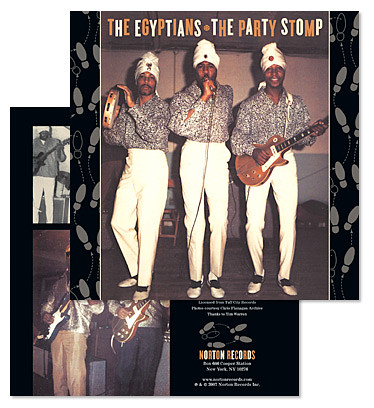
This is the cover of Norton's 2009 catalog. Unfortunately I can't find a better reproduction. Note that it features turbaned artists like Rudy Moore, Sam the Sham, Hannibal, Screamin' Jay Hawkins and The Egyptians, and that it advertises "Turban Contemporary Music."

Still more. Two LP covers from be-turbaned Hammond B3 ace Lonnie Smith: Afrodesia (1975) and Funk Reaction (1977).


Finally, another from King Khan, who is truly keeping "turban contemporary" alive.

The new album of King Khan and the Shrines, Invisible Girl, is terrific. And turbanated.

Ok, one more. This is the last, and from a different turban context and aesthetic. Kate Moss, May 2009.

Monday, May 11, 2009

From the streets of the NYC: Kufiyas at Kate Moss's Topshop


My comrade Dave just sent me these photos, which he took on his iPhone. They are from Kate Moss's new store, Topshop, located on Broome and Broadway. 20 bucks. The only description on the tag, says Dave, is the color.


It's worth recalling that back in 2007, Kate Moss was involved in some charity kissing to raise money for Palestinian children, in an event sponsored by the Hoping Foundation. At the time, Topshop's Kate Moss line also featured kufiyas, marketed as "Tablecloth Scarves."

Saturday, September 08, 2007

Pete Doherty, The Libertines, Love Music Hate Racism


Early on in my kufiyaspotting adventure, I posted about The Libertines and the kufiya that appears on the sleeve of their 2004 CD. More recently, I've posted about ex-Libertines, current Babyshambles leader Pete Doherty, infamous drug abuser and boyfriend of Kate Moss, who was spotted giving charity kisses for Palestinian children.

Now I find that Doherty has also played a leading role in the British anti-racist formation, Love Music Hate Racism, and in fact, has done more free work for the organization than any other artist. Love Music Hate Racism was set up in 2002 in response to "rising levels of racism and electoral successes for the Nazi British National Party (BNP)." LMHR is a successor to the celebrated Rock Against Racism movement of the late 1970s.

Among the many other acts involved with LMHR is British Muslim rap group Mecca2Medina as well as Asian Dub Foundation.

Sunday, August 05, 2007

Kufiyaspotting #18: Libertines Scarf Print T-Shirt


The trend that won't stop, that keeps mutating like a virus...This is a must have item: the "Libertines Scarf Print T-Shirt," so you don't have to buy an actual kufiya, you can wear a t-shirt with one printed on it, available from ASOS.com, for 16 pounds sterling.

Does the name have anything to do with the fact that Carl Barat appeared garbed in a kufiya on the cover of The Libertines' eponymous 2005 album? Or that ex-Libertine Pete Doherty's girlfriend, Kate Moss, has donated charity kissess to raise money for Palestinian children?

Meanwhile, I've recently learned that in Sweden they don't bother with the name, "kufiya," they just call it what it is: a Palestinian scarf (palestinsjal).

Tuesday, July 03, 2007

Beckham in Kufiya-Shemagh; Kate Moss for Palestine (Kufiyaspotting #16)

Thanks to Tom, I've now located a photo of Beckham in a kufiya. These things have now become quite the thing in the UK. (A forthcoming article in the New Internationalist provides more details.)

Urban Outfitters in the UK markets the black-and-white one as the "Shemagh Scarf" at 15 quid for women and 6.99 for men, and in pink and purple, as the "Heart Woven Desert Scarf."

According to the online catalogue, "The Shemagh scarf has been given the girly touch. Now in pretty colours and decorated with hearts, it won't provide you with much camouflage in the desert, but it sure is pretty." And 9.99 quid. (If you look close, you can see the hearts. But it's also got the distinctive kufiya checkered pattern too.)

Meanwhile, Topshop (known lately for its Kate Moss line) is marketing them as "Tablecloth Scarves," in purple (for 12 quid).


And just to show you how different the political atmosphere in the UK is when it comes to Palestine, tycoon Philip Green paid 60,000 pounds at an auction for the Palestinian charity Hoping Foundation for a kiss with Kate Moss--but then gave the chance to kiss to Jemima Khan. The event netted 200,000 pounds. Other donors included Hugh Grant and Imran Khan; attendants included Jerry Hall and her sorta stepdaughter Jade Jagger--whose own mom is pretty radical.


Kate (along with Elle McPherson and Jemima Khan) was also in attendance on June 21, when Elton John netted $200,000 for the Hoping Foundation, getting paid to sing Elvis' "Are You Lonesome Tonight?" Nick Cave, Shane McGowan, Mick Jones, Lulu, Chrissie Hynde (backed by Jeff Beck on guitar) and Bryan Adams also sang at the event, which raised $700,000 for Palestinian children.

Palestinian children really need this help. Where are the Jeff Becks and the Chrissie Hynde's of the US? (Or maybe it's that we don't have a Karma Nabulsi to organize events like this?)

I'm on the hunt for photos of Colin Farrell, Nicole Richie, and Cameron Diaz, who have also been spotted in the kufiya according to this article in the Palestine Chronicle.

Saturday, November 19, 2005

Kufiyaspotting #4: The Libertines, 2004


This photo is from the back cover of The Libertines' second, self-titled, album. The band member wearing the kufiya is guitarist-vocalist Carl Barat (if you click on the photo you can see a larger and clearer image). Next to Barat, in the hat, is Pete Doherty, The Libertines' legendary bad boy: confessed heroine and crack addict, in and out of rehab and court, boyfriend to Kate Moss. By the time this album appeared, Doherty was out of the band. The Libertines are a somewhat mainstream, Top 40 rock band, often compared to The Strokes, The Hives and the like. It's worthy of note, therefore, that Barat chose to wear a kufiya in this photo. But also important to remember that The Libertines are English. Meaning that: (a) solidarity with the Palestinians is much more acceptable there than in the US and (b) public opposition to the Iraq war has been much more sustained and vocal than here.

Tags: