Showing posts with label hijab. Show all posts
Showing posts with label hijab. Show all posts
Sunday, November 13, 2011
Huffington Post's Guide to Middle East Head Coverings (Women's)
From burqas to burqinis to hijabs to niqabs, and more. By Anne Patterson. How interesting is it that this was published on January 25, 2011, the day of the beginning of the Egyptian uprising?


Wednesday, November 02, 2011
Lupe Fiasco & Erykah Badu at Hip Hop Awards '11: #occupy, Palestinian flag, kufiya, burkah...
Rapper Lupe Fiasco performed his song, "Words I Never Said," at the Hip Hop Awards 2011 on October 10. The performance was provocative in all kinds of ways that we like here at hawgblawg.
First, Erykah Badu backed him up on vocals (singing), dressed like this:

Yes, full-on burqa. And green fingernail polish. And a hat that makes her look, kinda like an Orthodox Jew? In any case, the most remarkable thing is the burqa. This does not mean that Badu (who in the past has laced her lyrics with the doctrine of the Nations of Gods and Earths, and who in the past used to dress in the style of an Earth, a modestly dressed female Five Percenter) has become a devout Muslimah. Rather, one guesses, she is expressing solidarity with the devout burqa wearer. Or trying, by putting the burqa on, to make it appear less strange, alien and exotic. I doubt it's a matter of burqa chic.
And then there is the matter of the banner that Lupe Fiasco has attached to his mike stand, a combination kufiya and Palestinian flag, with the word, Palestine stitched into it.

Avid readers of this blawg will know that Lupe was seen waving a Palestinian flag in concert on September 16, when he expressed his support for Palestine's admission to the UN. They will also recall that Lupe is a Muslim who doesn't hide it and that he has been spotted in a kufiya several times in the past. The real avid readers might also recall these lines from the song he performed at the Hip Hop Awards, "Words I Never Said":
Gaza Strip was getting bombed, Obama didn’t say shit
That's why I ain't vote for him, next one either
I’m a part of the problem, my problem is I’m peaceful
And I believe in the people...
I really think the war on terror is a bunch of bullshit
Just a poor excuse for you to use up all your bullets...
Now you can say it aint our fault if we never heard it
But if we know better than we probably deserve it
Jihad is not a holy war, where's that in the worship?
Murdering is not Islam!
And you are not observant
And you are not a Muslim
Israel don’t take my side cause look how far you’ve pushed them
And then there is the matter of the shirt that Lupe was wearing:

What can I say? We really like this. Occupy everything.
Erykah took her hat and face covering off at the end of the song:

The purpose was not to "disrobe." (Unlike Erykah did famously here.) The purpose was to show her face so that Mos Def could introduce her -- otherwise, I guess, no one in the audience would have known who that "weird" person in burqa was. Here, she looks like someone in less "severe" Islamic dress, in hijab rather than burqa.
I only wish I really loved the song, "Words I Never Said." I think the rap/rock combo is hard to pull off, and for me, it isn't successful in this case. I do, however, admire the performance and the lyrics, a lot. Especially all the provocation and the expressions of solidarity. And I do like a lot of Lupe's material. But not this song, so much.
First, Erykah Badu backed him up on vocals (singing), dressed like this:

Yes, full-on burqa. And green fingernail polish. And a hat that makes her look, kinda like an Orthodox Jew? In any case, the most remarkable thing is the burqa. This does not mean that Badu (who in the past has laced her lyrics with the doctrine of the Nations of Gods and Earths, and who in the past used to dress in the style of an Earth, a modestly dressed female Five Percenter) has become a devout Muslimah. Rather, one guesses, she is expressing solidarity with the devout burqa wearer. Or trying, by putting the burqa on, to make it appear less strange, alien and exotic. I doubt it's a matter of burqa chic.
And then there is the matter of the banner that Lupe Fiasco has attached to his mike stand, a combination kufiya and Palestinian flag, with the word, Palestine stitched into it.

Avid readers of this blawg will know that Lupe was seen waving a Palestinian flag in concert on September 16, when he expressed his support for Palestine's admission to the UN. They will also recall that Lupe is a Muslim who doesn't hide it and that he has been spotted in a kufiya several times in the past. The real avid readers might also recall these lines from the song he performed at the Hip Hop Awards, "Words I Never Said":
Gaza Strip was getting bombed, Obama didn’t say shit
That's why I ain't vote for him, next one either
I’m a part of the problem, my problem is I’m peaceful
And I believe in the people...
I really think the war on terror is a bunch of bullshit
Just a poor excuse for you to use up all your bullets...
Now you can say it aint our fault if we never heard it
But if we know better than we probably deserve it
Jihad is not a holy war, where's that in the worship?
Murdering is not Islam!
And you are not observant
And you are not a Muslim
Israel don’t take my side cause look how far you’ve pushed them
And then there is the matter of the shirt that Lupe was wearing:

What can I say? We really like this. Occupy everything.
Erykah took her hat and face covering off at the end of the song:

The purpose was not to "disrobe." (Unlike Erykah did famously here.) The purpose was to show her face so that Mos Def could introduce her -- otherwise, I guess, no one in the audience would have known who that "weird" person in burqa was. Here, she looks like someone in less "severe" Islamic dress, in hijab rather than burqa.
I only wish I really loved the song, "Words I Never Said." I think the rap/rock combo is hard to pull off, and for me, it isn't successful in this case. I do, however, admire the performance and the lyrics, a lot. Especially all the provocation and the expressions of solidarity. And I do like a lot of Lupe's material. But not this song, so much.
Monday, September 26, 2011
hijabistas
Entrepreneurial Muslim women, making modest dress mainstream in Europe.
Her customers include non-Muslims too. "You don't have to be Muslim to prefer conservative dress," she said.
Her customers include non-Muslims too. "You don't have to be Muslim to prefer conservative dress," she said.
Saturday, June 25, 2011
Chic of Araby
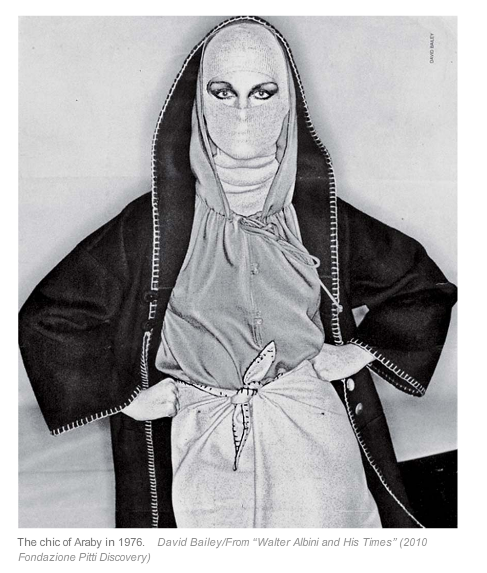
Italian designer Walter Albini created this in 1976 (photo from the New York Times, Oct. 12, 2010). Read more about him here. You'd think that, today, the more germane term would be hijab chic.
The phrase, Chic of Araby, isn't original. In fact, the Times used it for a men's fashion spread in Spring 2010. Below is a representative photo. Very Lawrence of Arabia retro. More here. (Maybe the Times got the name from the John Abercrombie 2009 track.)

Sunday, April 17, 2011
Some responses to France's 'burka ban'? Paris Fashion Week and Erykah Badu
As of April 11, it was illegal in France to appear in public with one's face covered. In anticipation of the soon-to-go-into-effect legislation, some Paris designers, including Jean-Charles de Castelbajac and Marithé François Girbaud, featured some fashion designs inspired by the burka at Paris fashion week in March. Read about it in this article from The Independent. (Elaine Sciolino notes in today's New York Times that, although there is much talk of the burka, in fact what the women in question are wearing in France is not the burka but the niqab.)
 AFP PHOTO/Pierre Verdy
 AFP PHOTO/Pierre Verdy
 AFP PHOTO/Pierre Verdy
This is of course not the first instance of "hijab fashion" to appear on Western runways. It's not something that I've been following terribly closely (kufiyas seem to consume most of my time and energies), but I have on occasion posted on it in the past. This occasion, however, seems, possibly, to be somewhat more oppositional.
Meanwhile, is Erykah Badu's poster for her Dubai appearance on April 9 in any way related to France's new legislation?
 And in a kind of footnote, in light of the above, what would you make of this?

I recently came across this via SPIN magazine. Hebrew letters (on face and on either breast), plus insignias on both shoulders which resemble the Arabic for allah. And a pyramid. The mystical symbolism is, well, beyond me. Gnostic Kabbala Afro-futurism.
(Erykah, despite requests from the BDS movement, performed in Israel in 2008. While there, she appeared in a t-shirt expressing opposition to the war in Iraq; her Israel concert poster featured a khamsa; she expressed support for Palestinian rappers; and defended Louis Farakhan.)
Erykah makes some of the best music in contemporary r&b/hip-hop/soul. I love her last two albums.
 AFP PHOTO/Pierre Verdy
 AFP PHOTO/Pierre Verdy
 AFP PHOTO/Pierre Verdy
This is of course not the first instance of "hijab fashion" to appear on Western runways. It's not something that I've been following terribly closely (kufiyas seem to consume most of my time and energies), but I have on occasion posted on it in the past. This occasion, however, seems, possibly, to be somewhat more oppositional.
Meanwhile, is Erykah Badu's poster for her Dubai appearance on April 9 in any way related to France's new legislation?
 And in a kind of footnote, in light of the above, what would you make of this?
I recently came across this via SPIN magazine. Hebrew letters (on face and on either breast), plus insignias on both shoulders which resemble the Arabic for allah. And a pyramid. The mystical symbolism is, well, beyond me. Gnostic Kabbala Afro-futurism.
(Erykah, despite requests from the BDS movement, performed in Israel in 2008. While there, she appeared in a t-shirt expressing opposition to the war in Iraq; her Israel concert poster featured a khamsa; she expressed support for Palestinian rappers; and defended Louis Farakhan.)
Erykah makes some of the best music in contemporary r&b/hip-hop/soul. I love her last two albums.
Tuesday, May 25, 2010
Sex and the City 2: Abu Dhabi Decadence
Check out this preview.
I think this is a must-see. The fact that four sexy women from Manhattan take a vacation to Abu Dhabi for decadence represents some kind of change, no?! Or does the film represent a return to 19th century Orientalist ideas about the Arab East as the height of decadence?
But...Abu Dhabi??? In fact, it's Dubai that is the "decadent" place in the UAE. Among other sources, please check out Waleed Hazbun's invaluable Beaches, Ruins, Resorts: The Politics of Tourism in the Arab World. I reviewed it a few months back, read it here.
Here's my summary of some of Hazbun's main conclusions regarding Dubai:
Dubai is the most spectacular post-9/11 winner, a city whose image is tied up with tourism like an upscale Las Vegas. It attracts a diverse clientele, with British visitors first on the list. In the past few years, Dubai has had immense publicity success with high-profile projects, such as indoor skiing facilities, the iconic Burj Hotel, and plans to open branches of the Louvre and the Guggenheim museums designed by top-drawer architects, all receiving overwhelmingly favorable coverage in the Western media. Commentators like Thomas Friedman have come to regard Dubai, with its reputation as a “cosmopolitan oasis,” as a model for Middle Eastern globalization, through economic liberalization, “dynamic free trade zones,” and “sound economic management” (p. 213). It is as if the specter of Islamic terrorism has helped transform the negative stereotype of the “rich Arab oilman” into a positive one. Yet Hazbun reveals that Dubai's fabled cosmopolitan spaces are anything but open. Instead, they are rigidly controlled, carefully segregating Dubai's workers (mostly migrants from South and Southeast Asia) from the contained spaces reserved for tourists. Moreover, the state has successfully purchased its citizens' acquiescence by extending almost free housing, due to its near total control over urban development and land rights.
Dubai has emerged as the most successful tourism model in the Middle East, a kind of enclave where tourists are insulated, where security for visitors--a priority since 9/11--is highly visible, and where the potential negative social and cultural impacts of tourism are mitigated. Since the book was published, the Dubai economy has collapsed, though the tourism model remains an eminently viable one, as recent reports of the revival of Beirut's nightlife niche tourism (now depicted as gay-friendly) suggest.
So, for "Abu Dhabi," I read "Dubai." It will be interesting to see to what extent the film conforms to the updated image of Dubai, that Dubai has been so successfully spinning, and to what extent it resorts to Orientalist tropes.
Perhaps it's some sort of clever mix? I mean, check out this wild "hijab" worn by Samantha!

Samantha seems to be simulating Middle Eastern "modesty" but in a super-chic (but at the same time wacky) way, while Carrie manages to cover her hair but not her ample bosom. (Sorry, the image just seemed to automatically call forth Victorian language.)
And possibly another reason to see the film is the fact that my Merip comrade, Moustafa Bayoumi, appears as an extra. Read his account for the New York Times here. As he remarks, "It could have been worse. I could have been a Middle Eastern extra on '24.'”
I think this is a must-see. The fact that four sexy women from Manhattan take a vacation to Abu Dhabi for decadence represents some kind of change, no?! Or does the film represent a return to 19th century Orientalist ideas about the Arab East as the height of decadence?
But...Abu Dhabi??? In fact, it's Dubai that is the "decadent" place in the UAE. Among other sources, please check out Waleed Hazbun's invaluable Beaches, Ruins, Resorts: The Politics of Tourism in the Arab World. I reviewed it a few months back, read it here.
Here's my summary of some of Hazbun's main conclusions regarding Dubai:
Dubai is the most spectacular post-9/11 winner, a city whose image is tied up with tourism like an upscale Las Vegas. It attracts a diverse clientele, with British visitors first on the list. In the past few years, Dubai has had immense publicity success with high-profile projects, such as indoor skiing facilities, the iconic Burj Hotel, and plans to open branches of the Louvre and the Guggenheim museums designed by top-drawer architects, all receiving overwhelmingly favorable coverage in the Western media. Commentators like Thomas Friedman have come to regard Dubai, with its reputation as a “cosmopolitan oasis,” as a model for Middle Eastern globalization, through economic liberalization, “dynamic free trade zones,” and “sound economic management” (p. 213). It is as if the specter of Islamic terrorism has helped transform the negative stereotype of the “rich Arab oilman” into a positive one. Yet Hazbun reveals that Dubai's fabled cosmopolitan spaces are anything but open. Instead, they are rigidly controlled, carefully segregating Dubai's workers (mostly migrants from South and Southeast Asia) from the contained spaces reserved for tourists. Moreover, the state has successfully purchased its citizens' acquiescence by extending almost free housing, due to its near total control over urban development and land rights.
Dubai has emerged as the most successful tourism model in the Middle East, a kind of enclave where tourists are insulated, where security for visitors--a priority since 9/11--is highly visible, and where the potential negative social and cultural impacts of tourism are mitigated. Since the book was published, the Dubai economy has collapsed, though the tourism model remains an eminently viable one, as recent reports of the revival of Beirut's nightlife niche tourism (now depicted as gay-friendly) suggest.
So, for "Abu Dhabi," I read "Dubai." It will be interesting to see to what extent the film conforms to the updated image of Dubai, that Dubai has been so successfully spinning, and to what extent it resorts to Orientalist tropes.
Perhaps it's some sort of clever mix? I mean, check out this wild "hijab" worn by Samantha!

Samantha seems to be simulating Middle Eastern "modesty" but in a super-chic (but at the same time wacky) way, while Carrie manages to cover her hair but not her ample bosom. (Sorry, the image just seemed to automatically call forth Victorian language.)
And possibly another reason to see the film is the fact that my Merip comrade, Moustafa Bayoumi, appears as an extra. Read his account for the New York Times here. As he remarks, "It could have been worse. I could have been a Middle Eastern extra on '24.'”
Wednesday, October 29, 2008

Friday, June 20, 2008
More kufiya (and hijab) fashion: Art Basel Parties
I can't 'grab' this photo from the terribly trendy art parties in Basel, so go here. This is found in the Fashion & Style section of the New York Times. Thanks, Kelley.
But also check these out. Are this and this further examples of hijab chic, or maybe even niqab chic?! You tell me.
But also check these out. Are this and this further examples of hijab chic, or maybe even niqab chic?! You tell me.

Monday, February 12, 2007
Hijab couture goes mainstream?

Check out this fashion item from the current London Fashion Week. The caption on Yahoo! News says, "A model wears an outfit by Fashion East designer Louise Golden during her catwalk show at London Fashion Week in London, Monday Feb. 12, 2007. The designers are showing their Autumn/ Winter 2007/8 collections. (AP Photo/Alastair Grant)" (Thanks to Chris for bringing this to my attention.)

(Note that Muslim women have been wearing fashionable headgear for some time now--see for instance the items at HijabShop.com.)
Fox News carried a related article on February 6 by Catherine Donaldson entitled "Bye Bye, Hair! Hello, Turban Chic," which I initially discounted but now am inclined to take more seriously. Donaldson reports that designers like Prada, Marc Jacobs and Ralph Lauren, and chain stores like H&M are now offering turbans (Donaldson also calls them "full-on headscarves") for women, some as expensive as $700, and that they have been sported by Katie Holmes, Jennifer Lopez, Eva Mendes and Prince (at Superbowl half-time).

The "turban" hearkens back to '40s, '50s, and '60s fashion, when it was worn by the likes of Joan Crawford and Ava Gardner. Donaldson also notes that, "Some [observers] speculate that turbans are popping up on women because of India's increasing influence on Western pop culture and a growing post-Sept. 11 interest in Pakistan, Afghanistan and the Middle East." Sounds like more Orientalist confusion to me, a mash-up of the turban worn by Sikh men and the headscarves of pious Muslim women in Islamic cultures.
And here's a couple more strands noted by Donaldson: "the style has been adopted by hippie chicks on the one hand and women embracing their African roots on the other (think India.Arie and Erykah Badu)."

Fascinating that such style is showing up on London and Paris fashion catwalks (photo at left is a Prada turban at the Paris spring fashion show) when British politicians like Jack Straw, prominent Labor Party politician and Leader of the House of Commons are campaigning against veils worn by British Asian Muslim women. In early October 2006, Straw published a controversial article stating that he asked Muslim women constituents who visited his office for consultations to raise their veil, if they wore a niqab (a full veil with a slit for the eyes) so that he could see their eyes. The veil (i.e. niqab), he wrote, is a "visible statement of separation and difference." Both both PM Tony Blair and his presumed successor, Gordon Brown, chimed in to support Straw. Blair too has stated that the veil is a "mark of separation" and that it has made some "outside the community uncomfortable," while Gordon Brown said it would be "better for Britain" if fewer women wore veils. Brown also asserted that immigrants "should speak the language of English."
I don't read J-Lo, Katie Holmes', and Prada's embrace of the turban as indicating any kind of dissent from Labour politicians Straw, Blair and Brown. Erykah Badu, who comes out of a Nation of Gods and Earths background, is another matter, however. And then there is Cat Power's very intriguing use of hijabs in her video for "Living Proof."
Friday, February 17, 2006
Hijabspotting: Cat Power
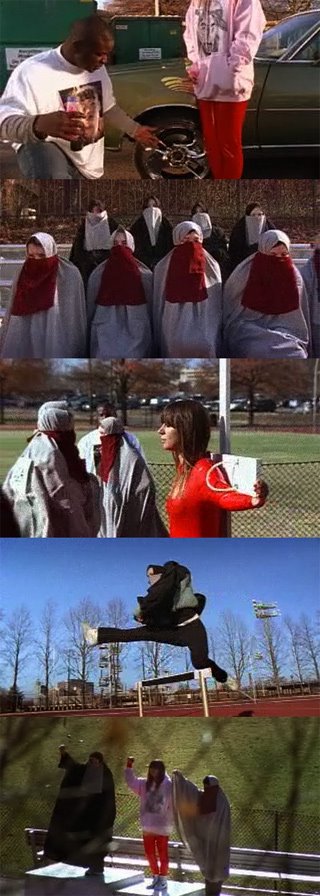
I frequently kufiyaspot on this blog, but rarely bother with the hijab, or alternately, veil, or alternately, Islamic dress. Hijabs are just too obvious, for the most part, whereas kufiyas, much more subtle. (Not of course if worn over the head, but as a scarf, yes.)
But here's a case where the symbolic usage of the hijab is pretty inscrutable, and more interesting to discuss. It's from a video for Cat Power's song "Living Proof," off her new, widely hailed album The Greatest, recorded in Memphis.
As Kelefa Sanneh notes, the Cat Power vid opens with what appears to be a tribute to a video by Mafia rappers Three 6 Mafia video that features group members drinking coffee syrup out of baby bottles. Chan Marshall (who records as Cat Power) is wearing a 2Pac hoody and drinking cough syrup out of a baby bottle together with a black man. (Cough syrup is the preferred intoxicant of the great rappers in Houston who produce a southern brand of hip-hop known as "screw.") But the more remarkable feature of the video is this. Chan Marshall takes off her hoody and puts a large white cross over her back, and, dressed in a red catsuit, races around a track with several women dressed in the kind of veils and Islamic dress typically worn in Iran. (The outfits look a bit sloppily conceived, not exactly what women wear in Iran.) Chan comes in second. She and the veiled first and third place medalists raise clenched fists, evoking the black power salutes of Tommie Smith and John Carlos at the 1968 Olympics in Mexico City.
I have no idea how to read this vid. Is the cross carried by Chan/Cat supposed to represent a burden, the analog of the religious burden of the Islamic dress worn by the other runners? Is Chan/Cat's red catsuit also supposed to represent a burden, the female burden of "looking good for men"? One of the veiled women is shown jumping over a hurdle in the course of the footrace. Does this suggest that Islamic dress is not a burden for women, since it doesn't hinder them from participating in athletic activity? Do the clenched fists a moment of female solidarity, transcending religious divisions? And why is Chan/Cat drinking cough syrup with her black companion/boyfriend?
I have no idea what the answers are, but I love the questions the video raises...
Cat Power, hijab
Monday, August 22, 2005
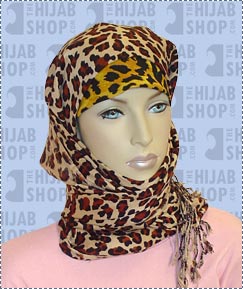

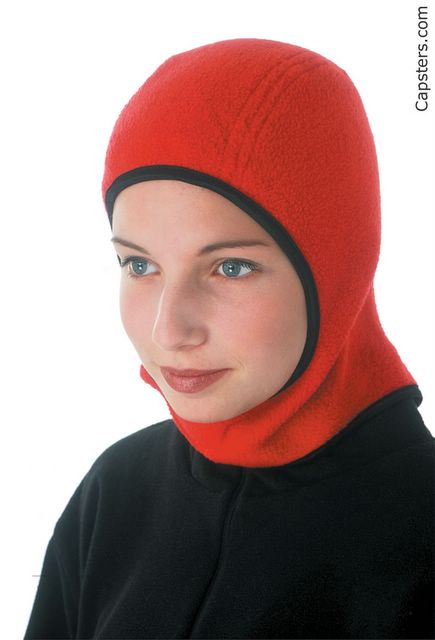

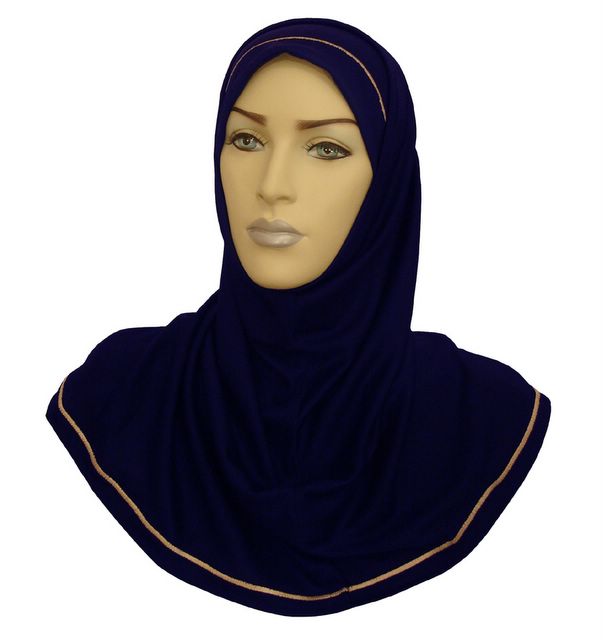
Hijab for IKEA's Muslim staff
TheHijabShop.com has designed and produced a hijab that fits in with the IKEA uniform, at the request of IKEA Edmonton (North London). The “branded” hijab was developed to accommodate the needs of IKEA’s Muslim employees.
TheHijabShop.com claims to be the world’s leading online retailer of Islamic headscarves. Its line includes “sporting,” “smart,” and “party wear” hijabs. (See http://www.thehijabshop.com/press/index.php).
TheHijabShop.com claims to be the world’s leading online retailer of Islamic headscarves. Its line includes “sporting,” “smart,” and “party wear” hijabs. (See http://www.thehijabshop.com/press/index.php).
Subscribe to:
Posts (Atom)


