Another report on All Is War (The Benefits of G-Had) from the BBC on June 28. This provides some clarification about why Aki says he could face prosecution for this forthcoming album (scheduled release date is now July 31). According to the BBC's legal affairs analyst Jon Silverman, "the album could result in a prosecution under glorification of terrorism laws, passed earlier this year, but may require the consent of the Attorney General."
In the article, Aki makes clear that "As far as terrorism and the killing of innocent people goes, I find it repulsive."
Even more interesting than this article is the video (see upper right hand corner of the BBC report) of Aki's appearance in the BBC studio. He defends his rights as an artist to make his comments and opinions known. The interviewers challenge him for rendering equivalent the actions of "the leader of the free world" (George Bush) and Usama Bin Laden, and the other person on the couch (Tory MP Michael Gove, author of Celsius 7/7) asserts that the album may be dangerous, that it may give succor to angry young Muslims and encourage them to resort to violence. Aki responds that the bombers of London on July 7, 2005 (7/7) were "inspired" by the policies of Tony Blair in Iraq.
Aki is cool, logical, coherent. And wearing a kufiya.
Tag: Fun-Da-Mental
Thursday, June 29, 2006


Wednesday, June 28, 2006
More on Fun^Da^Mental
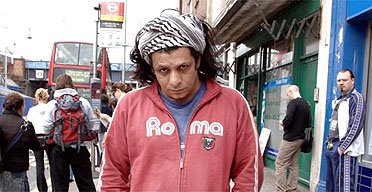
An article appeared in today's Guardian about the controversies surrounding Fun^Da^Mental's upcoming release. Nice quote from Aki: "I have a right to push the boundaries as much as anyone else has, whether it's Ken Loach or Harold Pinter or George Galloway or Neil Young or the Sex Pistols." (Photo is from The Guardian story.)
(A kufiyaspotting note: look what Aki is wearing!)
Tag: Fun-Da-Mental
New Fun^Da^Mental Release in Trouble?

The new release from Fun^Da^Mental, All Is War: The Benefits of G-had, from Nation Records, is due to drop on July 17. But according to an announcement from Nation on June 20, the album "has caused the directors of Nation Records to offer their resignations in the event the album is released through Nation Records. Martin Mills and Andrew Heath (Beggars Banquet Group [Nation's "parent" company]) both have expressed their concern and fear in the event they are linked to the many provocative and controversial elements of the album." According to Fun^Da^Mental's "leader," Aki Nawaz, "The album is challenging the notion of freedom of speech and creative dissent especially in current times and my background gives me the perfect platform to express the issues from a [personal] point of view and not from a mainstream imposed, misguided, patriotic perspective. I have the right equally and without condition as others to expose the hypocrisy and contradictions of democracy, [being] a Muslim does not mean I have to subservient, loyal or silent to the State or any of its illegal activities against any peoples, anywhere around the world."
Aki wrote to me awhile back saying he was worried he might be jailed for putting out this album. It's not clear exactly what is going to happen, the last post (June 21) on the Fun^Da^Mental website tells us that more news will appear real soon. I will keep looking. The site also offers a "manifesto" on All Is War, including what I take to be descriptions of all the songs. "Che Bin Pt 2 ant PT 1" is described as a "discussion on resistance and terrorism, word by word by Che Guevara and Osama Bin Laden. What makes the two men different? What makes one a symbol of resistance and the other a terrorist? What do they have, if anything, in common?"
So, All Is War promises--assuming it actually comes out--to be Fun^Da^Mental's most provocative release ever. Inshallah I'll get one in the mail when it's released, and I hope to write up a report soon thereafter.
Nation Records is responsible for releasing loads of great music, mostly in the vein of what has been termed the "Asian Underground" (although Aki describes what Fun^Da^Mental do as "global chaos"). Among the artists it has released (some of whom have since moved on to bigger labels): Natacha Atlas, Tranglobal Underground, Loop Guru, Asian Dub Foundation, TJ Rehmi...
The t-shirt pictured here is also courtesy of Fun^Da^Mental.
Tag: Fun-Da-Mental
Saturday, June 24, 2006
Review of Kamilya Jubran & Werner Hasler, "Wameedd," plus Le Trio Joubran and Wissam Murad

Here's my review for RootsWorld, which appears in RootsWorld Bulletin #356. RootsWorld is a great source of information on world music, of all sorts, and it is on a subscription drive ($20 a year for the bulletin). Well worth supporting. Eventually this review will go up on the RootsWorld website. RootsWorld, through CDRoots, is also a great source for world music, and often, the only source in the US for many recordings. For instance, I think it is the source for the Kamilya Jubran/Werner Hasler (pictured) and the Wissam Murad CDs that I review below; it's also the source for the music of Sabreen in the US. So there are multiple reasons to give RootsWorld your support. Go here for more sources on these musicians.
Kamilya Jubran and Werner Hasler, Wameedd (Artist released)
Le Trio Joubran, Randana (Fair Play)
Wissam Murad, Min Ba'd (Sabreen Productions)
Three recent recordings by Palestinian (plus one Swiss) musicians, each, in its own way, quite brilliant. Taken as a whole, they give a sense of the range of contemporary Palestinian music, from the rooted-in-tradition to the most avant-garde. Two of these recordings are from artists with what is probably the most important and creative contemporary Palestinian ensemble, Sabreen. Kamilya Jubran served as Sabreen's lead vocalist and qanun player for twenty years (1982-2002), while Wissam Murad remains one of Sabreen's core members. Sabreen's music has always been characterized by deep roots in the traditions of Arabic music, particularly that of the takht, the classical small ensemble known for its use of improvisation. Throughout its long recording career, Sabreen has been known for its creative ability to incorporate the rhythms and sounds of jazz, reggae, rembetika, blues, contemporary Arabic pop music, and even hip-hop, while at the same time to remain firmly grounded in the tradition. Although the members of Le Trio Joubran are not connected to Sabreen, their work too is at once innovative yet tradition-grounded.
I got a sense of Sabreen's classicist foundations in summer 1993 when I was invited to a party at Kamilya Jubran's house in Ramallah. One of Sabreen's members (it may have been Wissam Murad) was playing 'ud and singing for the 40 or so assembled guests. The rule of the night was that all the songs would have to date from before 1920. The 'udist played for two or three hours, and what I found remarkable was not just that he knew so many old songs, but that his audience, composed of university-educated and Westernized Palestinians, knew all the songs too, and sang along on each number. If I recall correctly, many of the songs were penned by the Egyptian composer and singer, Sayyid Darwish.
Of these three recordings, Kamilya Jubran and Werner Hasler's Wameedd is the most challenging, creative, and disturbing. Hasler, a Swiss composer and performer of electronic music, provides an eerie, subtle, and remarkably appropriate sound background for Jubran's voice and 'ud. Jubran's 'ud playing is mostly basic and spare, her repetitive lines and note-bending often bearing a family resemblance to that of Mississippi delta blues guitarists. The focus here is less on melody than on emotion, feeling, and the words. For Wameedd Jubran has set to music texts chosen mostly from contemporary Arab poets, like Paul Shaoul and Aïcha Amaout, as well as from the celebrated Gibran Khalil Gibran and Greek poet Dimetri Analis. Jubran's expressive vocals and the instrumental atmospherics make it easy to appreciate Wameedd without understanding the lyrics, but nonetheless a key element will certainly be missed. So here's a hair-raising sample, from the end of the song, "Nafad al-Ahwal 2": "I remembered the day I was killed, raped, cut to pieces lemon by lemon, cigarette by cigarette, was ripped and for the first time I cried for my death and for nature." (Listen to the extract here.)
These lyrics are by Lebanese poet Paul Shaoul, who frequently writes about his experiences during Lebanon's horrific civil war (1975-1990). No doubt these lines resonate somehow with the experiences of Kamilya Jubran, one of Israel's second-class Palestinian citizens, who was born in Akka (Acre), and who moved to the West Bank in the early 1980s to live under the Israeli military occupation, now in its 40th year. Jubran has lived in France, in voluntary exile, since 2002 but her music still resonates with the emotions, the trauma, and the cultural vitality, of her homeland.
Le Trio Joubran's Randana is the work of three brothers, also Palestinians with Israeli citizenship, born in Nazareth. Samir, 33, also eventually took up residence in the West Bank; more recently he too has gone into temporary exile in Europe. He has been performing and recording solo for the last several years, especially in Europe, to growing acclaim. In 2002 Samir released the album Tamaas, recorded with his younger brother Wissam, 22, an 'ud player and maker, a graduate of the Antonio Stradivari Institute in Italy. On Randana, Samir and Wissam are joined by their younger brother Adnan, 20. The inspiration for this recording, according to Samir, was the guitar trio of Al Dimeola, Paco de Lucia and John McLaughlin. Mercifully, Le Trio Joubran don't sound much like their inspiration; there's no speed picking or overblown energy. I don't hear much trio playing either, but rather solo or duo playing, and I'm unable to distinguish between the three 'udists. The instrumental compositions, by the trio, are rooted in the improvisational taqsim tradition, and are mostly contemplative, quietly rather than emotionally expressive. The 'ud playing, improvisation, and composition rank among the finest I've heard, although they don't quite achieve the level of master 'ud innovators like the Tunisian Anouar Brahem or the Iraqi Nassir Shamma. The only weak spot on the album is the group's live rendition of the Muhammad Abdul Wahhab composition, "Ahwak," made famous by the great Egyptian singer, Abdel Halim Hafiz and performed as a kind of sing-along. Samir's vocal is so inadequate to the task that I always want to stop the CD and listen to Abdel Halim's version again. (Listen to an extract from Randana here)
Wissam Murad's Min Ba'd is his tribute to the great Egyptian poet Bayram al-Tunisi (1893-1961), who attempted to revolutionize Arabic poetry by promoting colloquial ('ammiya) poetry addressed "to the people" and denouncing high/ classical (fusha) poetry as elitist. The album consists of four songs where Murad has composed music to accompany some of al-Tunisi's well-known verses; the other four numbers are instrumentals. Min Ba'd in many ways resembles the sounds of Sabreen's recent recordings, with its strong inventive ensemble playing in the improvisational and loose style of the takht, but with a modern sensibility, provided in particular by the bass playing of Oystein Bru Frantzen. I prefer the instrumentals on Min Ba'd to the songs. I am not overly fond of Murad's vocal style; it's a little too warbly for me. Nonetheless, this is a very fine recording, a kind of an Arabian trad-jazz style, in the best Sabreen tradition.
Although none of these albums is overtly political and none comments directly on the Palestinian condition, each emerges from the very difficult predicament that Palestinians find themselves in today. Each album represents a kind of heroic testimony to the continuing persistence and vitality of Palestinian culture, a kind of miracle of art and beauty, an oasis of hope, produced under the harsh conditions of war, resistance, and military occupation. - Ted Swedenburg
Listen to complete tracks:
Jubran and Hasler here
Wissam Murad here
CDs available from cdRoots
Wameedd
Randana
Min Ba'd
Tag: Palestine
Thursday, June 22, 2006
Roger Waters at the Wall

Roger Waters (ex-Pink Floyrd), on a visit to Israel and Palestine and who will perform at Neve Shalom today, visited the apartheid wall (separation barrier in Zionist doublespeak) at Bethlehem yesterday, the first stop on the tour. He tagged it with "tear down the wall." I wonder when some famous US popstar will ever get involved in this issue. Or will it just be more Sharon Stones, bussing with the likes of Shimon Peres? (Said Sharon: “I admire you, sir, so greatly, it’s beyond discussion or I would just sit here in a puddle of tears. That I can sit here beside you is my greatest achievement.”)
More on Roger Waters' engagement with the Wall here and here. On Hilary Clinton and the Wall, here and here. Banksy's Wall graffiti are here.
Tag: Palestine
Monday, June 19, 2006
Concert review of Haifa Wehbe & 50 Cent in Beirut

Here's a review of the Haifa Wehbe & 50 Cent concert in Beirut on 10 June, from the Daily Star (Beirut). (Photo is of Haifa at the concert.) For comments on the show and more photos go here. Sounds like Haifa was pretty disappointing, 50 Cent was pretty good, and that the venue sucked. It seems that the audience was full of very rich pre-teens, who demonstrated their "gangsta" proclivities by tossing around plastic bottles of water.
By Lysandra Ohrstrom and Tom McCarthy
Daily Star staff
Monday, June 12, 2006
Review
BEIRUT: If you've asked anyone about rapper-megastar 50 Cent's performance at the Beirut International Exhibition and Liesure Center (BIEL) Saturday night, most likely they've told you how great the show was. Granted, the sound was off. Like the heat coming from the crowd, most of the lyrics seemed to rise straight to the upper reaches of the barn-like venue and get lost.
And unlike the rapper's September 2004 appearance in Dubai, which featured a full-squad deployment of his backup group, the G-Unit, Saturday's production was carried by a skeleton crew of Young Buck and the sultry-voiced Olivia - no Tony Yayo, no Lloyd Banks.
On the other hand the audience was spared, without explanation, an appearance by Cuba Gooding Jr, whose presence had been promised on countless concert posters and touted by a months-long public relations blitz.
It would be going too far to say that Fiddy flopped, given the waves of cheers, the hothouse excitement of the pubescent crowd wielding camera-phones and the words of praise that fans had for their idol after the show.
But as things folded up around 2 a.m., there was no mistaking the sense that what the concert promoters were calling "The Biggest Ever Show in Lebanon" was not, in the end, all that.
The feeling of nagging disappointment began with an underwhelming turn on stage by national treasure Haifa Wehbe, whose unabashedly sexual romp won only half-hearted applause. Perhaps owing to the awful acoustics of the venue - a gigantic tent-thing glommed onto BIEL's main hall - she came across as something less than powerful in the lungs, as perky as she was otherwise.
"I love you so much," she cooed, bouncing pluckily across the stage in tight denim hot-pants and a top that read "No Photos" in sequins on its formidable front. The crowd didn't quite reciprocate - with the possible exceptions of a few drooling hormonal boys who stood ogling publicity stills of the starlet projected larger-than-life on screens flanking the stage.
"Haifa, she belongs to the hot chicks," said Waled, who gave his age as "12-and-a-half," following the famous coquette's dripping performance at the stroke of midnight of her runaway hit "Wawa."
That the audience was focused early on the projected images walling the auditorium, instead of the live act, was quaintly appropriate for what followed. It was the image of 50 Cent, his brand rather than the quality of his performance Saturday, that fueled the crowd. The audience's unflagging energy ultimately saved the concert.
Whatever else he is, 50 Cent is a big star. If Fiddy had a dime for every number-one hit he made, he'd have, well, more than half a buck. "In Da Club," "Candy Shop," "Just a Lil' Bit," "PIMP" - he performed them all for his Beirut base, cramming more than 20 songs into a set that ran just over an hour.
The star's 2003 album, "Get Rich or Die Tryin'," went multi-multi platinum, selling 6.3 million copies in the US alone, and the 2005 follow-up "The Massacre" sold 4.9 million. As the king of what seems to be the one American export the world still has an undiminished appetite for - hip-hop music - 50 Cent has a massive following, and the admirers (and their guardians) packing BIEL demonstrated that Lebanon is no exception.
Performing on a spare, portable stage with nothing but a wall of programmed spotlights as a backdrop, the rapper had the crowd in thrall from the opening number, "What Up Gangsta." From there on in, the teetotalling, bible-quoting, honey-loving thug mounted an all-out assault of hits.
The thousands of 10-to-20-year-old loyalists, who probably had to save a month's allowance for tickets to the show, some of which cost $300, seemed unfazed that apart from waving a flag, the headliner did not give even a token shout-out to Lebanon to prove that he knew where he was. (The closest he came were repeated observations that "It's hot in this mother******.")
Wherever he takes the stage, 50 Cent, ne Curtis Jackson, comes with an against-all-odds back-story that is ready-made for film (the flop of his recent Hollywood-adapted life story notwithstanding). Any fan could run down the list: impoverished upbringing in South Jamaica, Queens; mother murdered when he was eight; the drug-dealing career that landed him in jail in 1994; the nine bullets he took, with seeming indifference, in 2000; his artistic breakthrough under the guidance of Eminem and Dr. Dre; subsequent worldwide superstardom.
"Back before I took this trip," said the star in a segue to his hit "If I Can't," "when I was in LA, I was in the studio with Dr. Dre. And I said if I can't do it, baby it can't be done." Shotgun blasts; bass bumps; crowd goes nuts.
Part of the thrill of seeing Fiddy live was apparent Saturday night in the gap between his hard-earned gangster persona and his to-the-manner-born fans. Sure, security had to break up a couple fights in the crowd, one between two men who were slapping and kicking each other in not quite the old South Side style. But apart from the scuffles, and the constant stream of expletives coming from the stage, it was a pretty vanilla scene.
"He's the greatest rapper living now," said Beiruti Ahmad Yassine, 17, after the show, the caveat owing to the untimely demise of 1990s hip-hop trailblazers "Tupac and Biggy."
Tamer, 16, who has been a loyal fan "forever, like four years," said that despite the violent theme running through the artist's work, listening to 50 Cent is more about bringing people together than glorifying bloodshed. "Everyone at my school loves Fiddy," he said. "There is no religion in rap."
When asked about all the gunshots, Ray Harb, 10, who was escorted by his 18-year-old sister Carol, said, "If there were more little kids here, it could have been bad. But it's not a big deal."
Khalil Ghulmiyyah, 18, said afterward that the outing was a marked improvement from the rapper's 2004 Dubai show.
"50 Cent sucked in Dubai," Ghulmiyyah said. "His voice is bad without studio backup, and there were only like 4,000 people there. He's better here ... the energy of the concert overpowered his performance by like three trillion."
About halfway through the show the crowd began to display that energy by throwing plastic bottles, in what turned into an all-out water war between fans and star.
Less hardened performers might have been put off by having half-liters of Sohat continuously chucked at their heads. The smiling Fiddy didn't even flinch, and with something of a school boy's glee dug into his continually replenished onstage arsenal and returned fire.
Maybe he didn't know where he was; in any case, he parted with a fond farewell.
"Before we leave this b****, everybody holler 50 Cent!"
Tags: Lebanon, Beirut, 50 Cent, Haifa Wehbe
Saturday, June 10, 2006
Palestinian Music: Kamilya Jubran, Le Trio Joubran, Wissam Murad
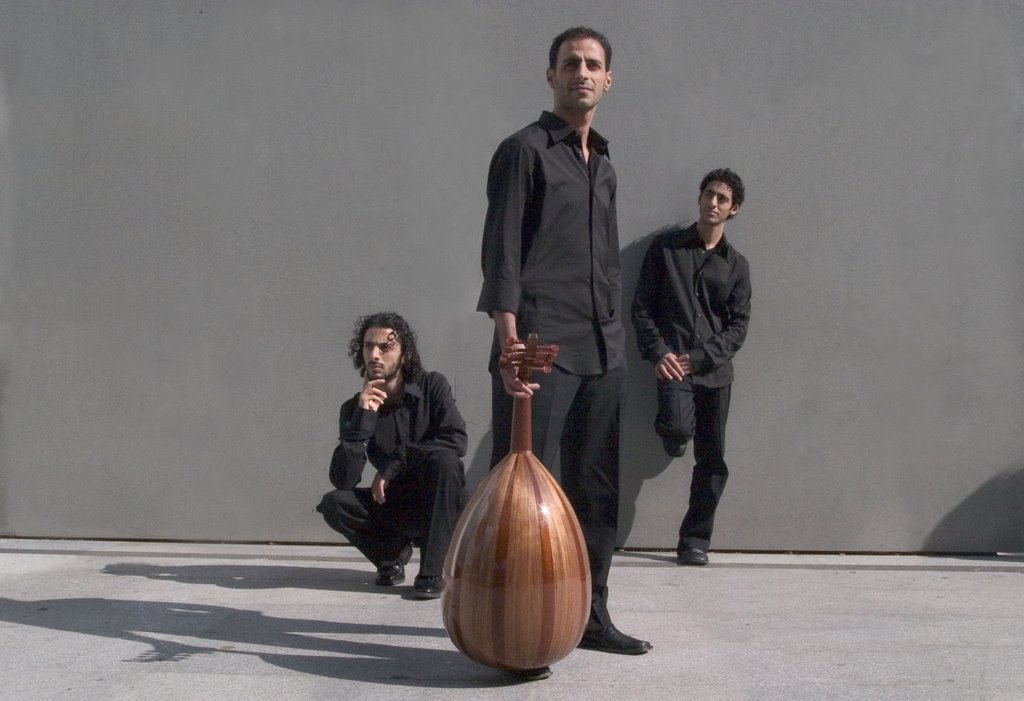
As I work on my review of Le Trio Joubran (pictured), Kamilya Jubran & Werner Hasler, and Wissam Murad for RootsWorld, I'm putting up some links.
Kamilya Jubran
Kamilya Jubran's homepage, with bio, description of her various projects including Wameedd, translations of the poems on Wameedd (essential!), downloads, press reports and a riveting video clip, etc.
An article on Kamilya from Le Monde, July 29, 2004
Le Trio Joubran
Eye for Talent -- this site has links to some reviews of Le Trio
An article from Mondomix. The site also features a link to a recording by Samir and Wissam Joubran.
More extracts of music and interviews with Samir Joubran, conducted by Daniel Brown.
Promotional material from Rock Paper Scissors, plus sample tracks from Randana. Go here for press coverage of Le Trio.
Sabreen
Sabreen's homepage, with some information on Wissam Murad here
General
An overview of contemporary Palestinian music by Yara Ghadban, from MESA Bulletin, summer 2001. She discusses Samir Joubran (oldest brother in Le Trio Joubran), Sabreen (Kamilya Jubran was formerly their lead vocalist), Amal Murkus, Adel Salameh, and more briefly, El Funoun and Rim Banna.
Tags: Palestine
My Music Reviews
Perhaps it's because I have nothing to blog. Or maybe that it's that I'm trying to force myself to write a review for the online publication, RootsWorld, which is an essential guide to "world music" (in quotes, because it such a problematic way to categorize music.) I wrote several reviews for Rootsworld as well as PopMatters a few years back. The purpose was (a) to try to get some practice writing about how music sounds, rather than just about the "sociology" of music, and (b) to get some free CDs. I gave up the venture about three years ago because I got too busy doing other things. But recently the RootsWorld editor convinced me to try my hand, and so I'm going to try to crank out, over the next day or so, a review of three CDs by Palestinian artists: Kamilya Joubran, Le Trio Joubran, and Wissam Murad. I'll post the link as soon as I get it up.
In the meantime, here is an archive of my old reviews:
For PopMatters:
Steve Earle + Stacey Earle, in concert, Dave's on Dickson, March 20, 2001
Antibalas Afro Beat Orchestra, Liberation Afro Beat Vol. 1
Hamid El Gnawi, Saha Koyo
Deepak Ram, Searching for Satyam
Ranarim, Till the Light of Day
Hakim, Yaho
Takfarinas, Yal
3 Mustaphas 3, Play Musty for Me
Taraf de Haïdouks
The Rough Guide to Bhangra
Henri Dikongué, Mot'a Bobe
dZihan & Kamien, Refreaked
Anouar Brahem Trio, Astrakan Café
Mabulu, Karimbo
Oumou Sangare, Ko Sira
Best of 2001
For RootsWorld:
Calicanto, Labirintomare
Yggdrasil, Herrelaus
Tinariwen, Radio Tisdas
Yat-Kha, Aldyn Dashka
Moh Alileche, Tragedy
The Henrys, Joyous Porous
Karen Tweed & Timo Alakotila, May Monday; Maria Kalaniemi and Sven Ahlbäck, Airbow
I've also written a couple reviews for MESA Bulletin, which are not online:
Ali Hassan Kuban featuring Salwa Abou Greisha and Shahin Allam. Real Nubian: Cairo Wedding Classics (Vol. 39 No. 1, June 2005)
"Rai's Travels" (Vol. 36 No. 2, Winter 2003)
In the meantime, here is an archive of my old reviews:
For PopMatters:
Steve Earle + Stacey Earle, in concert, Dave's on Dickson, March 20, 2001
Antibalas Afro Beat Orchestra, Liberation Afro Beat Vol. 1
Hamid El Gnawi, Saha Koyo
Deepak Ram, Searching for Satyam
Ranarim, Till the Light of Day
Hakim, Yaho
Takfarinas, Yal
3 Mustaphas 3, Play Musty for Me
Taraf de Haïdouks
The Rough Guide to Bhangra
Henri Dikongué, Mot'a Bobe
dZihan & Kamien, Refreaked
Anouar Brahem Trio, Astrakan Café
Mabulu, Karimbo
Oumou Sangare, Ko Sira
Best of 2001
For RootsWorld:
Calicanto, Labirintomare
Yggdrasil, Herrelaus
Tinariwen, Radio Tisdas
Yat-Kha, Aldyn Dashka
Moh Alileche, Tragedy
The Henrys, Joyous Porous
Karen Tweed & Timo Alakotila, May Monday; Maria Kalaniemi and Sven Ahlbäck, Airbow
I've also written a couple reviews for MESA Bulletin, which are not online:
Ali Hassan Kuban featuring Salwa Abou Greisha and Shahin Allam. Real Nubian: Cairo Wedding Classics (Vol. 39 No. 1, June 2005)
"Rai's Travels" (Vol. 36 No. 2, Winter 2003)
Wednesday, June 07, 2006
Gazans Miss the ATM...

As the occupation enters its 40th year, Palestinians still maintain a sense of humor, particularly in Gaza, where Israeli-mandated "belt-tightening" takes hold as the Hamas-led government is slowly strangled, deprived of funds. The following item from Reuters details the jokes now making the rounds (thanks, Laurie):
For unpaid Palestinians, laughter is free
Sat 3 Jun 2006 8:34 AM ET
By Nidal al-Mughrabi
GAZA, June 3 (Reuters) - Unpaid for the last three months, a Palestinian government employee telephoned a Gaza radio station to dedicate a song to an old friend he hadn't visited for a while -- his local ATM cash machine.
"I miss you," the man lamented over the airwaves, prompting loud laughter from the radio host.
Some 165,000 government employees have gone without pay since Western donors and Israel stopped sending money to the Palestinian Authority after Hamas, an Islamic group dedicated to the Jewish state's destruction, took power after a January poll.
Using local revenues and donations, the Finance Ministry plans to start paying the salaries of the 40,000 lowest-earning employees on Monday.
In the meantime, some Gazans are meeting hard times with a sharpened sense of humour.
A video clip making the rounds on Palestinian cellular telephones shows a ATM machine with a note reading "dead" on its screen. A man stands next to it, weeping and holding his credit card.
At a Gaza market, a fruit merchant told the tall tale of a Hamas government minister who wanted to buy a watermelon but was offered a peach instead.
"You call this a watermelon?" the minister asked.
"Yes, this is what it looks like after three months of your policies," the vendor replied.
And Palestinians have been chuckling at jokes like this:
A government employee walks into the street and throws his dentures into the gutter.
"How are you going to eat now?" asks a surprised passerby.
"No problem," the man replies. "There's nothing to eat, anyway."
Tags: Palestine, Gaza
Monday, June 05, 2006
39 Years of Occupation

Today, June 5, is the 39th anniversary of the June 1967 War, which resulted in Israel's occupation of the West Bank and Gaza Strip. Thirty-nine long and oppressive years of occupation. And in the US, the general public is scarcely aware that there is an occupation and in particular that it is a military occupation, and that we continue to subsidize and do everything possible to militarily and diplomatically and economically and morally to support this occupation, to the tune of about $3 billion a year. And no end in sight...
Sunday, June 04, 2006
Can't Believe They Said/Wrote That...

Three items that I came across in the news that I thought were particularly silly as well as telling:
1. Daniel Schorr's analysis yesterday on Weekend Edition Saturday. Liane Hansen's last set of questions was about East Timor. Schorr concluded his discussion of the mess today in East Timor by putting East Timor in the context of "disappointments" in other countries that gained their independence after the Second World War, such as Zimbabwe and Sudan. "Is this," Schorr concluded, "what we ended colonialism for?"
Interesting and instructive because Schorr includes the US in the "we" of colonialism. Symptomatic in that it hints at a notion that maybe life under colonialism was better.
2. Today's New York Times points you towards the Week in Review "World View Podcast." The subject: "Is democracy unraveling in Egypt?"Calvin Sims, the hosts, states in his background, "Last year, Egypt was held as a beacon of burgeoning democracy in the Middle East when President Hosni Mubarak announced he would allow competitive elections." Who in hell thought Egypt was a "beacon"?! Where was the "democracy" that started to unravel? The report is interesting, and the discussion of the protests being led by the judges, important, but the spin....
3. Again from the Times' Week in Review: a story by Jessica Yellin entitled "Single, Female and Desperate No More." It takes another look at the prevailing image of the desperate plight of over-40 single women, supposedly condemned to lives of spinsterhood and bitterness (as symbolized by the Glenn Close character in Fatal Attraction). What do we learn? Things are not so bad after all. 40-year old women can get married. Hooray! In 1996, a 40-year old woman had a better than 40% chance of getting married, and today, the odds are even better.
I had imagined the post-mortem would tell us that 40+ single women were not desperate, were managing to live happy and fulfilled lives as single people. Somehow I had forgotten that the goal of all women, in this heteronormative and couple-centric culture, is to find a man.
Friday, June 02, 2006
Against the Wal

Action today against Walmart, a march from the Fayetteville High School to the Bud Walton Arena, where the annual Walmart Shareholders' Convention opened today. The police corraled us even further away from the meeting than we were in the last two years, a few hundred yards away. This was a nationwide action, aimed at declaring Walmart a threat to public (health, labor, environmental) safety. Our action was small, maybe 30-35. All the local newspapers, all the businesses, are united in welcoming Walmart--the influx of thousands of shareholders is a big boon to local merchants, restaurant and hotel owners. Even liberals, in this liberal town, are reluctant to stand up, in public, to criticize Walmart. Hopefully, other actions elsewhere in the country were larger. More photos can be viewed on my flickr account.
Read reports of the 26 quarantine actions that took place throughout the country here.
Tags: Walmart, Labor
Thursday, June 01, 2006
Beyoncé in town for Walmart (a threat to public health)

Great news for Fayeteville residents, Beyoncé is in town for the Walmart Shareholders Meeting, held every year, here, at the Bud Walton Arena on the University of Arkansas campus. Last Christmas, Beyoncé appeared in Walmart Xmas ads on t.v., opening gifts with her family. But since I'm not a shareholder, I won't get to see her perform, keeping it real. Nor am I invited to the private party for Beyoncé this evening, to be held at one of our local watering holes.
But I will be at the rally tomorrow sponsored by the local Against the Wal Coalition, and co-sponsored by Jobs with Justice, the Ruckus Society and Little Rock ACORN. We will be dressing up in hazmat suits and armed with yellow caution tape, and will be putting the meeting under quarantine, as a threat to public health. I plan to take photos, which I'll post as soon as I am able.
(P.S. For what it's worth, you can view photos of Beyoncé performing for the Walmart pep rally here.)
Tags: Walmart, Beyoncé
Thursday, May 25, 2006
Ann Wright and GI's Against the Vietnam War
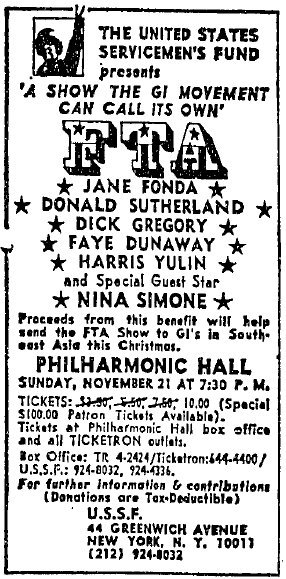
Ann Wright, Arkansas hero, retired Army Colonel, who resigned from the State Department to protest her opposition to the Iraq War, and who ran Cindy Sheehan's camp at Crawford, Texas last summer, has got into trouble again. This time, she was detained, and charged with sedition, at Fort McNair, for passing out flyers for the new film, Sir! No Sir! The Suppressed Story of the GI Movement to End the War In Vietnam.
This was reported by Democracy Now! yesterday. But the reason you should watch this segment is because it features a long clip from the film, Sir! No Sir!. The film, as is obvious from the title, is a documentary dealing with the very strong opposition that emerged, inside the US military, to the war in Vietnam. There is an interview with Jane Fonda, active in a troupe called FTA (Fuck/Free the Army), that used to travel around the country and perform for GIs (in one scene you can spot Donald Sutherland). The film tells an untold, suppressed, and essentially censored story of the GI antiwar movement, of the hundreds of underground papers put out at bases and on ships, of the some half million cases of desertion. It puts the lie to the myth that veterans who came home from the war were spat on by antiwar protesters (most famously, in the Rambo films). Fonda was not anti-military, her anti-war activity involved her working very closely with GI's. H. Bruce Franklin's essential book, Vietnam and Other American Fantasies (2001), devotes chapter 5 to the story of antiwar activity inside the military. Although I was involved in the antiwar movement when I was in the US (68-69, 71), I didn't know or remember this story, or at least, the extent of GI activity. (I teach this book in my Popular Culture class, and students love it.) I can't wait to see this film! See the official website for information on screenings, and for a preview.
Tag: Vietnam War, Sir! No Sir!
Cheikha Rimitti, R.I.P.
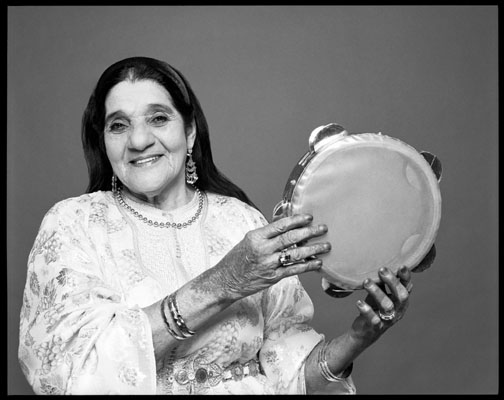
Two of my favorite Middle Eastern artists pass away within 8 days of each other! Cheikha Rimitti died of a heart attack in Paris at the age of 83 on May 15. She was a performer right to the end; she had just performed in Paris two days before she died. Rimitti was one of the great cheikhas of modern rai, releasing her first recording in 1952, but it was her 1954 release, "Charrak, Gattaa," that made her renowned, and infamous, throughout Algeria. The song was considered by some to be an attack on the preservation of female virginity. After independence, her music was banned by the NLF from the airwaves, because of its vulgarity.
Rimitti had a reputation for bawdiness, and her name reportedly came from her habit of demanding more drinks: "Remettez!"--"Give me another." Cheikha Give Me Another Drink. Her reputation for excess should not be exxagerated, as it is all too often in publicity about rai. After an accident in 1971, Rimitti gave up drinking and smoking, and went on hajj in 1976. I even have a cassette, purchased in Paris' Barbès district, which she recorded under the name Hajja Rimitti.
Rimitti recorded in the traditional cheikha style of Oran, singing typically to the backing of the gasba (read flute), guellal (a small metallic drum) and a rebaba (one stringed violin). After "pop rai" blew up, first in Algeria by the late seventies, and then on the world music market by the late eighties, Rimitti began recording with the type of electric backing typical of contemporary rai. A failed experiment, in my opinion, was Sidi Mansour (1994, with Robert Fripp and Flea). I find her electronic recording Nouar (2000) much more compelling. I've only listened to her just released N'ta Goudami a couple times, and I rather prefer Nouar. You can listen to all of N'ta Goudami and several cuts from Nouar and Sidi Mansour if you go to Cheikha Rimitti's official website and go to "Discotheques." I prefer Rimitti's traditional, unplugged recordings, but all of her recordings feature her deep, amazing, scorched voice.
If you want to see what Rimitti was like in performance, check out her performance at the Kennedy Center in July 2002 (you have to scroll down a ways, and then when you open the file, the Rimitti segment starts at about 51 minutes). Remember that she was 79 years old at this performance. The band vamps a bit too much, but the belly dancer who shows up for some of the songs is a real treat.
We'll miss you, Rimitti.
Tags: Algeria, rai, Cheikha Rimitti
Wednesday, May 24, 2006
Hamza El Din, R.I.P.
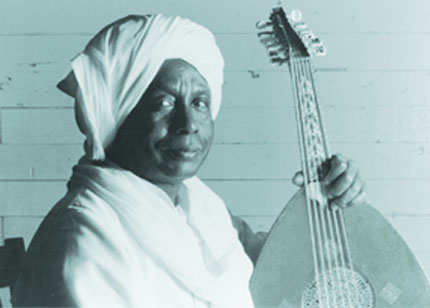
Hamza El Din passed away yesterday, May 23, of complications from brain surgery, at Alta Bates Hospital in Berkeley. I'll post more details if/when I get them.
Hamza was a giant of Nubian music, whose career spanned over four decades. I did a slide show/talk at University of Pennsylvania in December 2001, which was followed by comments and discussion by Hamza. Hamza started by saying, "I'm the one who wrecked Nubian music." He went on to explain that before him, traditional Nubian music consisted of singing to the accompaniment of the tar or frame drum, and sometimes the kisr or lute. Hamza was the first to set Nubian songs to the backing of the 'ud. Hamza moved to the US in the early '60s, and was a fixture on the US folk music scene, playing clubs in the Village. His first two albums were released on Vanguard, the leading folk label of the time. Hamza worked as an ethnomusicologist at the University of Texas and the University of Washington, and he played at Woodstock in 1969. He was friends of the Grateful Dead and used to play concerts with them, and played at the Pyramids in Cairo with the Dead in 1978. He later moved to Japan where he resided for a number of years, studying Japanese traditional music. I saw him perform in Cairo in 1994 (I think) with a group of traditional Japanese musicians. I also got to know him and hang out with him a couple of times, courtesy of my advisor, and Hamza's old friend, Bob Fernea.
Allah yarhamu!
Tags: Nubia, Hamza El Din
Haifa Wehbe, 50 Cent in concert in Beirut

What I reported as a rumor earlier now seems to be really happening. Both 50 Cent and G-Unit list a concert in Beirut on June 10th on their websites, and a friend of mine who just arrived in Beirut says yes, it's happening. If she goes, I'll try to get a report. Majnun!
Of course, Beirut has long hosted touring acts from the West, most notably at the Baalbek Festival. I saw Miles Davis & Co. perform at Baalbek in the summer of 1973. This was the Miles of the On the Corner era. It was funky and crazy and one of the most amazing concerts I've ever attended. (And the setting: the Roman ruins of the Temple of Bacchus.) I also saw Stockhausen perform in Lebanon, at the Jeita Caves. What's notable about this concert is that a major Lebanese artist is performing along with the touring US rap stars. Have the cultural power dynamics shifted, just a bit?
Tags: hip-hop, 50 Cent, Haifa Wehbe, Beirut, Lebanon
Monday, May 22, 2006
Robert Neralich, keynote speaker, Fayetteville High Commencement

Robert Neralich, keynote speaker, Fayetteville High Commencement
Originally uploaded by tsweden.
5-20-06. Note that Principal Willison is looking at his watch and Superintendent New looks unhappy. Perhaps it was when Neralich said to the students, "Do not attempt to respond to the critical council of obedient servants, good soldiers, corporate quantifiers and dress-for-success bureaucrats who will urge you to extinguish the candle of your creative potential."
Tags: Fayetteville, Arkansas
Evan's graduation, Fayetteville High
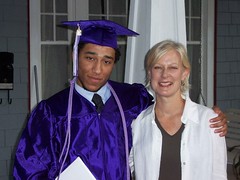
Evan's graduation
Originally uploaded by tsweden.
My son graduated on Saturday, and here he is, after commencement, with his mom. (The purple cord indicates he graduated with honors.) Besides the fact that I enjoyed the ceremony because I was proud of my son, the commencement keynote speaker was the best I've ever heard. Dr. Robert Neralich, humanities teacher at Fayetteville HIgh (and Evan's Asian Studies teacher), spoke in favor of controversy, and managed at the same time to create some controversy. At various points people booed, one person yelled, "get off the stage," and there was also a lot of cheering and clapping. Neralich started by taking aim at the U of A: "Many of you are aware that a professor at the UA [Kabin Thomas] was recently dismissed from his teaching post. I was appalled by his statement that one reason for his firing was that his administrative superiors [my Dean] did not approve of his unorthodox teaching methods and preferred faculty members who were not controversial. As a teacher, I am profoundly distressed that the term 'controversial' can be rendered so readily in a negative sense. When I think about controversial people, the names that occur to me constitute many of the world's greatest benefactors." Would that there were more Neralichs teaching students like my son.
Tag: Arkansas, Fayetteville
Tuesday, May 16, 2006
Joel Beinin sues Horowitz's publisher
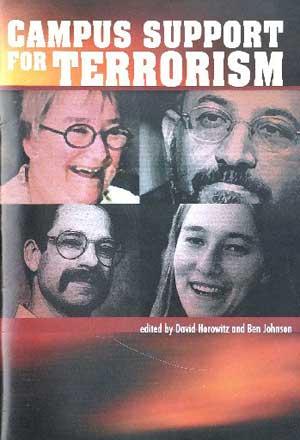
I caught this from The Angry Arab: Joel Beinin has sued the book publishers of David Horowitz's new book, Campus Support for Terrorism, for using his photo (he's on the lower left) on the cover. An article in the San Jose Mercury News quotes David Horowitz as stating that Beinin "supported terrorism," along with other typical Horowitz lies and distortions.
Some academics think it's a kind of honor to show up on Horowitz's various lists, but I disagree. It's McCarthyism, it's dangerous, and at the least, it's a horrible nuisance to be targeted by him.
Tags: David Horowitz, McCarthyism
Subscribe to:
Posts (Atom)


