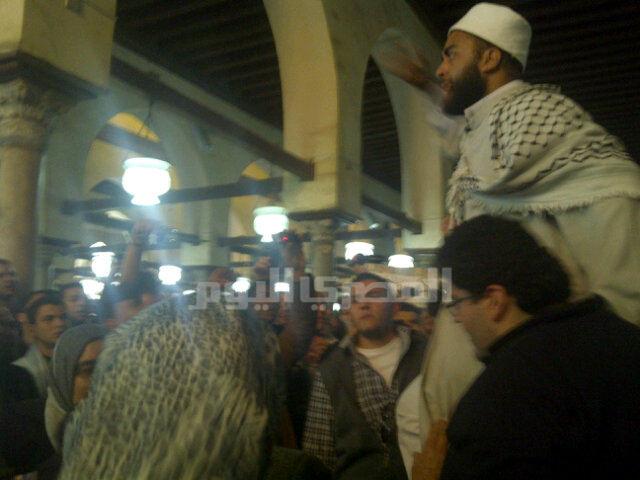
Demonstrators atop post at Tahrir Square, marking 1st anniversary of the launch of
the Egyptian revolution, January 25, 2012 (Jeff J. Mitchell / Getty Images).
Yes, I know this is a bit late. I'm not paid to do this. Sometimes I fail to keep it up to date. This is for the record. (Photo is from an article in the LA Times, Jan. 26.)
Today (February 14) marks the first anniversary of the Bahraini uprising. Although crushed by Bahraini security forces, with the support of Saudi Arabia, and the quiet connivance of the US administration, Bahraini pro-democracy forces continue to protest and to organize and to fight for freedom.
Here's a video showing marchers in Manama, Bahrain, yesterday, heading to Pearl (Lu'lu') Square. Anticipating a confrontation with security forces, they put on their gas masks. And some, including Nabil Rajab, a prominent human rights activist, put a kufiya over the gas mask.
Nabil dons his gas mask
and then the kufiya
(If you watch the vid you'll notice that others do the same.)
The new face gear for the Arab revolts: kufiya over gas mask.
(I got this from the New York Times, from a piece by Robert Mackey on the Times blog, The Lede.)
Merip has a brand new blog, launched today. I intend to contribute posts on a regular basis--but I will not be abandoning hawgblawg by any means. My first was a meditation on how Robin Wright celebrates Arab/Islamic hip-hop in her book, Rock the Casbah: Rage and Rebellion Across the Islamic World. Read it here.
And please check out the blog regularly. As of today, there are also posts by Chris Toensing and Laleh Khalili. Content will continue to flow.
This was broadcast back on February 15, 2011, just 4 days after the toppling of Mubarak. Although so much has happened since then, this is still a very valuable document, since it is based on a deep historical knowledge of the literature and social movements that fed into the Egyptian revolt. Please listen.
Here are some Egypt kufiyas, that date from the events around Tahrir and the Cabinet offices, around the weekend of December 16-18, when Egyptian military and security forces killed 17 protesters and wounded over 500. I have lost track of where I originally found all these photos, but I've given the photographers, or at least the agency, where available.
Ahmed Ali/AP
I believe this kid was one of the youngsters arrested. If I can find more info about him I will post it later. I worry about what happened to him.
Associated Press
This is one of the better-known photos of the events around the Cabinet sit-in, a photo of one of the several women who were badly brutalized by the military police, who appear to love to wield their long batons in a sadistic manner.
Asmaa Waguih/Reuters
I love this photo. One of the protesters, with his improvised head protector, takes a moment to read the Qur'an.
Dia/Associated Press
One of the many wounded revolutionaries, helped by a kufiya-clad comrade.
Ali al-Malky
These are protesters saving documents from the library of L'institut d'Egypte, which burned to the ground. The source is al-Masry al-Youm, where you can read about this calamitous event.
Rana Khazbak
This is a photo Sheikh Emad Eddin Effat, secretary general of Dar al-Iftaa, the body that issues Islamic fatwas (edicts), and one of the most famous martyrs of the protests, killed by a bullet to the chest on December 16. According to al-Masry al-Youm, Effat was considered one of Al-Azhar's moderate and progressive sheikhs. Effat's final fatwa forbade voting for parliamentary candidates affiliated with the Mubarak regime and former members of the dissolved National Democratic Party, who are known colloquially as the feloul. Effat based his ruling on the fact that regime remnants aspire to subvert Egypt’s post-revolutionary future through bribery and patronage.
Happy holidays. I've been collecting items to post, including lots of kufiyas from recent events in Egypt, but have fallen behind. I hope to finish up before the 1st of the year, before I have to make a new set of New Years' resolutions. Meanwhile, here's one, the photo that accompanies a very fine analysis of the Egyptian elections, by Yasmine El Rashidi, from the New York Review of Books. The title, "Egypt on the Edge," suggests a lot of danger ahead, but El Rashidi's tone is not, in fact, overly alarmist. But it is sobering. A few good suggestions as to why the Salafist Al-Nour party has done so well to date. One: a miscalculation by the Muslim Brotherhood, which has often shifted its position from supporting the revolution to wanting to clear out Tahrir Square for the sake of winning elections. El Rashidi suggests that this lost the Brothers some support in popular quarters. The Salafists, by contrast, were seen as straight shooters. Another miscalculation was by the "liberals," and particularly by telecom tycoon Naguib Sawiris and founder of the Free Egyptians Party, who tweeted a cartoon with a Minnie Mouse in face veil and a Micky Mouse in full beard, suggesting the dangers posed by an Islamist victory. This caused an uproar and a huge loss of customers and profit. And possibly a loss of votes for the FEP, the most important "liberal" party.
There's a lot more here, please read the entire piece.
I've been complaining of late that the role of hip-hop in the "Arab" Spring has been somewhat exaggerated. I plan, or I should say, hope, to do a post on this later, once I've thought it through more. But I really like this rap, from Ramy Donjewan, that was posted today on youtube.
It's called "Message to Tantawi," and it is just that, a message to Field Marshal Mohamed Hussein Tantawi, the Commander-in-Chief of the Egyptian Armed Forces, the Minister of Defense, and the chair of the Supreme Council of the Armed Forces or SCAF, which has ruled Egypt since the departure of Hosni Mubarak on February 11. The message to Tantawi is in his capacity as the head of SCAF. The democracy movement in Egypt has become increasingly frustrated with the SCAF, and in particular, of late, its failure to prosecute effectively those responsible for the 800+ deaths at the hands of the security forces during the revolution. Donjewan articulates this, and other demands, and frustrations of the revolutionary movement.
I like this song's flow, its lyrics, the calculated urgency of the Donjewan. Its slow, measured beats, convey a sense of dread, and the simple, repetitive guitar playing adds to the effects. I especially like the chorus, which can be translated as: What we did at first we'll do again Tantawi if our demands aren't implemented. (It's very poetic and effective in Arabic.)
(Once again, I urge someone who can do it quicker and more effectively than me to translate the lyrics of this song.)
Donjewan put out a song right before the start of the revolution, called "Against the Government," that was quite fantastic as well. Check it out here.
The title of this post: No SCAF Rap, is lifted from the 3Arabawy blog, where I first learned about this song.
(Footnote: the wikipedia entry on Tantawi says he's of Nubian origin, but the sources for this claim are gone. Is this true?)
UPDATE (later the same day): Robin translated a bit more: "Oh Tantawi, my brother's blood is very dear, and we are not making threats... where is the right of the poor, the one who died?"
Like all companies trying to make money in the new Egypt after Mubarak, Coke & Pepsi are trying to ride the revolution. (Thanks to Robin for calling them to my attention.)
Check out this ad from Coca-Cola, with the theme, "Make Tomorrow Better." We see the middle class youth of Egypt (the presumed revolutionary subjects) ushering in a new dawn. Note that the focus is entirely on Cairo's downtown, which has both been a site that the upwardly mobile in neo-liberal Egypt have been fleeing for the upscale satellite suburbs, and which is also the focus of plans for gentrification. Finally, and perhaps most significantly, note the penultimate shot, which shows Tahrir Square, with a crowd (meant, of course, to evoke a demonstration, right before the last shot of a young person drinking a bottle of Coke.
Then check out this Pepsi advert. Again, the middle class youth of Egypt are the subject. They are shown to be adding color (literally) and life to Cairo's downtown (which has, in fact, been renovated in recent years). They possess the trappings of advanced modernity (flat screen televisions, laptops) and also evoke the youth of the revolution. This young woman carries the iconic cellphone (the "twitter revolution") and, yes, yes, you guessed it, she wears the requisite iconic accessory of the revolution, the kufiya.
And towards the end of the video, youth begin to gather at a street intersection in what looks like it could be a demonstration, and from a balcony looking over the intersection, a young man gives an enthusiastic revolutionary salute, with a can of Pepsi in his hand.
The overall theme is "express yourself." Among the lyrics of the song are the lines, "you are the new, you are the unique," and "tomorrow is waiting for you." And here's the vid:
Don't be too surprised, or dismayed. Both Coke and Pepsi attempted to ride the waves of the sixties counterculture and oppositional movements in the US.
Here's a "psychedelic" ad from Pepsi, from 1969.
And one from Coke, featuring Lady Soul Aretha Franklin, from 1968, when she had only recently crossed over, as a sign of Black Pride.
Big capital will, of course, inevitably, try to profit from the revolutionary fever...
Update (one hour later): Just a bit after I posted the above, I came across an article from Al-Masry Al-Youm on the same subject (although less critical), entitled "Soft-drink giants ride wave of post-uprising optimism." “It’s about empowering youth to come up with ideas and do something about them,” said Karim Khouri, managing director at Impact BBDO, the agency that designed ads for Pepsi.
It's thanks to Iman that I know about these two songs.
The first is by Syrian singer Samih Choukeir. I knew nothing of him before hearing this song. What I now know is based on this wikipedia entry, in Arabic. He is an established artist in Syria (or at least he was--who knows, after this song!), active since 1982, composing for the theater and t.v. serials as well as performing his own compositions. He studied art in the Ukraine (like so many other Syrians, who got advanced degrees from Eastern Bloc universities prior to the collapse of the Soviet Union) and is married to a Ukrainian woman. He does not belong to any political party in Syria but appears to be on the Syrian "left." (Here's his official bio in English.)
The song, "Ya Hayf (Oh Oppression)," is dedicated to the martyrs of Dera'a, March 15. Dera'a is where the Syrian revolt started. (It's also where T.E. Lawrence was tortured, if you remember the film Lawrence of Arabia.)
This one features someone leading a call-and-response song at a pro-democracy demonstration in the city of Hama, uploaded on June 23. It's entitled, "Bidkum Bashar (You want Bashar)." The singer chants various lines of government propaganda, and then chants Bidkum Bashara, and the crowd responds loudly, "La wallah" (No, by God!). It's quite wonderful.
(Again, I hope someone will translate these into English, and other languages, at some point.)
It's been pouring out, released in a fury of creativity set off by the astonishing events in Egypt over the last 16 days. Tahrir Square itself is one center. Check out this amazing video, of a singer and guitar (not shown), singing some of the key slogans of the uprising, with the crowd chanting and singing along. [Added February 12: I've learned his name: Ramey Essaam.] What is remarkable and rather surprising is that the song resembles "unplugged" grunge. This particular video helpfully translates the lyrics into English. But it makes a mistake in the beginning. Re: Mubarak, it should read: "We want to make Hosni Mubarak hear our voices!"
The original video (here) has gone viral. 545,932 views as of this writing.
Numerous accounts suggest that this is typical of what is going on at Tahrir Square on a daily basis. A group of people gathered around a singer (injured in the fights against the security forces or the pro-Mubarak thugs in earlier days) and an 'ud player, singing along with a tune that they have just learned from these two men, "Expel Hosni Mubarak." The men resemble roaming troubadors. These lyrics are translated as well.
And chants are song throughout the day and night. Here are some comic ones (which someone will hopefully at some future moment translate).
The last of the Tahrir songs is this one. Accompanying himself on guitar, the singer sings a comic song about a donkey refusing to step down for a younger one--an allegory about the old man Mubarak.
One more thing to add is that, according to Angry Arab, it is the songs of Abdel Halim Hafez that are played most often over the soundsystems on Tahrir. My friend Gamal Eid has also remarked that one hears the songs of Egypt's most beloved and important revolutionary singer, Sheikh Imam, on Tahrir.
Then there are the solidarity songs from "outside." One of the most impressive is Mohamed Mounir's "Azzay? (Why?)." Mounir, an Egyptian Nubian, has been a huge star, of music, cinema and theater, since the mid-1970s. Clearly this song was recorded prior to the outbreak of the uprising, but the video is full of scenes of the revolt, and the lyrics, ostensibly those of a love song, can also be read as a kind of allegory about Egypt and its conditions. The song is slamming, the video very moving. The video opens with the words: To every Egyptian citizen who participated in January 25...or who didn't participate. (There's a rough translation to the song in the comments.)
"Back Down Mubarak!" is a very lively, upbeat and oldschool sounding rap from Master Mimz, a Moroccan woman rapper, born in Casablanca, now based in England. The video features many shots of women who have participated in the protests.
There is also this rap, "#Jan25 Egypt," from Freeway, The Narcicyst, Omar Offendum, HBO Def Poet Amir Sulaiman, and Canadian R&B vocalist Ayah. Freeway's rap in particular is very compelling, at about 2:50.
In a quite different vein is this very beautiful chant from the Kuwaiti munshid, "Egypt Prayers." There is a rough translation into English in the comments.
There is "Long Live Egypt," by Scarabeuz and Omima. Scarabeuz's dad is Egyptian, his mother Dutch, and he was born in Berlin, where he is still based.
I at first thought the song was a little too sentimental and shlocky, but I came to like it more after listening to it all the way through. The images are quite moving, and the auto-tuned effects are endearing.
Finally, there's the free release, the Khalas Mixtape Vol. 1: Mish Ba'eed. With songs from rappers based in Tunisia, Algeria, Egypt and Libya. I particularly like the tracks from Tunisia's El Génèral and Algeria's Lutfi Double Kanon. Download it here.
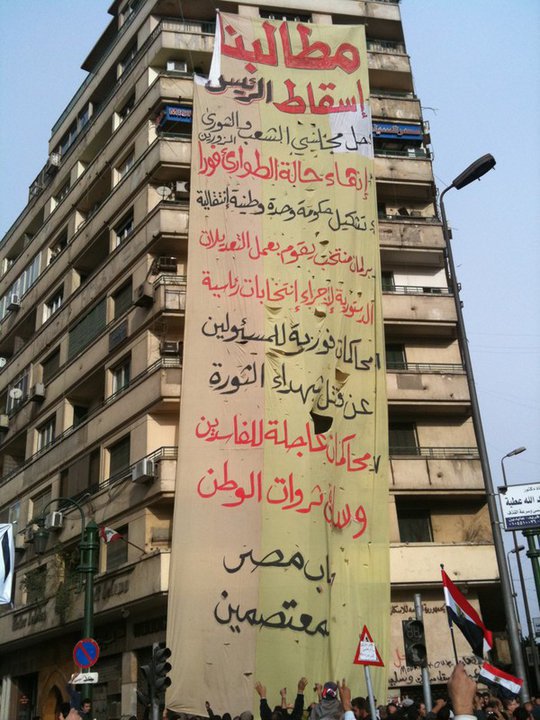
Here they are, clear and consistent. Let's circulate them widely and support them tenaciously. They were posted on a huge banner on Tahrir Square a few days ago. The movement is sticking to them.
Mubarak should step down from power immediately.
Dissolving of the national assembly and the senate.
Establish a “national salvation group” that includes all public and political personalities, intellectuals, constitutional and legal experts, and representatives of youth groups who called for the demonstrations on the 25th and 28th of January. This group is to be commissioned to form a transitional coalition government that is mandated to govern the country during a transitional period. The group should also form a transitional presidential council until the next presidential elections.
Drafting a new constitution that guarantees the principles of freedom and social justice.
Prosecute those responsible for the killing of hundreds of martyrs in Tahrir Square.
The article below, entitled "Fallen faces of the uprising: Ahmed Basiony" was published in Al-Masry Al-Youm today, and written by Mia Jancowicz.
I learn two key things from this is: (1) how gifted and talented and promising an artist Ahmed Basiony was. You also get this from his live videos, mentioned in my earlier post. You can download an mp3 of one of his live performances, "Abou Alaa aal Dish," here. One hopes the album he was working on will be released soon. Alas, the website for his label, 100copies, remains down as of this writing. (2) how brutal was his murder, presumably at the hands of the security forces. He was beaten, shot five times and run over. God rest his soul, and let us pray that the criminals responsible for his murder will be run out of power and brought to trial.
Ahmed Basiony, a Cairo-born artist, experimental musician and teacher in his early thirties, was killed while participating in the first week of the January 25 uprising. Basiony is a husband and the father of two children, four-year-old Adam and several months year old Selma. He taught at the Art Education College at Helwan University, where he was pursuing his doctoral studies in the field of interactive arts and open source technology.
Early in his career as an artist, he received several prizes for his participation at the annual Youth Salon since 2001; he was the recipient of the Grand and Salon prizes in 2007 and 2008, respectively. Basiony exhibited his work, which spans multi-media, installation, performance and sound, in various spaces including the Gezira Art Center and the Townhouse gallery in Cairo, most recently participating in the shows Invisible Presence and Cairo Documenta. In his musical capacity, he was developing a strong personal language, experimenting with popular forms to produce a visceral, charged energy. He performed at festivals such as 100live, and with musician Abou Asala was working on an album with the label 100copies.
His influence across creative fields was felt not only through his practice but through his intellectual and teaching contribution. Supplementary to his formal teaching work he organized educational workshops for digital, live and sound art, enabling numerous young musicians to enter the field. “What he was doing with his music, performances, artwork and discussion had resonance with others and opened up thought for others,” says artist and musician Hassan Khan. His close friend and artist Shady Noshokaty says “he was a brave, funny man with an independent intellect and crazy energy; he put so much into everything he did, in his practice, as a person and in his teaching. This is a huge loss.”
Basiony’s last Facebook post said: “I have a lot of hope if we stay like this. Riot police beat me a lot. Nevertheless I will go down again tomorrow. If they want war, we want peace. I am just trying to regain some of my nation’s dignity.”
Ahmed Basiony died on January 28, the Friday of Anger. It is reported that the day prior to his death, he was severely beaten by Central Security Forces: he had been carrying a video camera. The day he died, he was separated from his friends at around 7PM. Several days later his body was found at the Um Al Masreyeen hospital in Giza. Hospital reports indicate he was shot five times, and run over by a vehicle. A Facebook “kolna Ahmed Basiony” has become a virtual memorial, where students, colleagues, friends, family and mentors share memories, anecdotes and prayers for him and his family.
Great song, great images of the struggles in Egypt and Tunisia
Here are the lyrics:
I give up I live up I fill up Gotta keep my mind in motion Gotta keep motion in my mind Cut it out Leave it out take it out All the things that make confusion And diversions in these times Breathing out Hold it out hold it down buttoning down frustration out of neutral into drive ray of hope keep afloat take a note Need another survival strategy just to keep myself alive Too many ideas buzzin round inside my brain Live in the history of now And I'm feelin like there's Nothing left that I can really explain l Live in the history Live in the history Of now In a maze In a haze In a rage Can't tell the difference between My TV internet or me Who is that Who is this Who said that America's next top strictly dancing ghost celebrity And I'm always phasing between blinding lights and the deafening sound And I can't even make out the words Or make them match up with the mouths Too many ideas buzzing round inside my brain Live in the history of now And I'm feeling like there's nothing left that I can really explain Live in the history Live in the history Of now
Eye to Eye Gotta get back to the desert Gotta get right back to my soul Burning sky Where every drop of rain Is a blessing to behold Cos I can't be be a relay On an expanding circuit board My mind won't fit on a server somewhere I could never afford You can't download the sun You can't download the sea You can't download the sun You'll never download me Too many ideas buzzin round inside my brain Live in the history of now And I'm feelin like there's Nothing left that I can really explain l Live in the history Live in the history of Now
This is one of many incredible photos from a wonderful gallery published by The Guardian. Very significant.
Here's the caption: Protesters hold a Christian coptic cross and copies of the Qur'an as they take part in 'Sunday of the martyrs'. Photo: Amel Pain/EPA
Invaluable article from the estimable Adam Shatz, in London Review of Books. Read it here. Key extract:
The men and women congregating in Tahrir Square have the misfortune to live in a country that shares a border with Israel, and to be fighting a regime that for the last three decades has provided indispensable services to the US. They are well aware of this. They know that if the West allows the Egyptian movement to be crushed, it will be, in part, because of the conviction that ‘we are not them,’ and that we can’t allow them to have what we have. Despite the enormous odds, they continue to fight.
If you're on twitter and read Arabic, follow him. An old friend. He also puts out some tweets in English. He's a lawyer and a tireless democracy activist.
Elliott translates one of them: 'Scene from Tahrir: A small boy says, "I'm a poor street kid who doesn't know a lot of things, but I have my pride. My pants might be falling off me, but we just made a revolution. What have you done?"'
Here's what Gamal looked like almost 20 years ago.
Issandr El Amrani, writing in the London Review of Books.
There has been a lot of great analysis of this ongoing intifada, but this is one of the best.
Did you know that the recently cashiered minister of interior, Habib al-Adly, had received FBI training. Good job, G-men! This is the guy that unleashed the thugs and opened the prisons to inflict chaos on the democracy movement and the Egyptian people.
Here's the conclusion:
When Ben-Ali fled from Tunis, he created a vacuum at the top of the state that was imperfectly but quickly filled. The initial interim government did not please many, but a sense of civic duty appears for now to have stabilised the situation without a resort to authoritarianism. Mubarak, on the other hand, created a security vacuum in order to spread panic. In agreeing to step down, he tried to ensure that the regime would survive. Egypt is not Tunisia, at least not yet.
Professor of Anthropology, University of Arkansas. Author of Memories of Revolt: The 1936-39 Rebellion and the Palestinian National Past. Co-editor of Palestine, Israel and the Politics of Popular Culture and of Displacement, Diaspora, and Geographies of Identity.