Showing posts with label anti-war. Show all posts
Sunday, September 22, 2013
drone life 2: NYPD drones
In December 2012 the NYPD arrested the artist Essam Attia for posting 100 posters around the city suggesting that New York's finest were using drones to control crime. In particular, given the image, it intimates a targeting of the undocumented. (The image of the fleeing family is lifted from a warning sign developed by the California Department of Transportation to warn drivers, on I-5 north of San Diego, that illegal immigrants might be crossing.)
The posters also are riffing on a current iPod add seen around town:
Just a month after Attia was arrested, CBS News reported that the NYPD might be considering using drones in its crimefighting efforts.
A year earlier, anti-war activists in the city, led by a US army vet who had worked with drones during two tours in Iraq, were posting signs saying: “Attention, authorized drone strike zone.”
Stay tuned...
Thursday, May 24, 2012
Kufiya'd vet at NATO protest in Chicago
At least one of the fifty some vets of Afghanistan and Iraq who tossed away their medals on Sunday, May 20, as part of the anti-NATO demonstrations in Chicago, wore a kufiya. Not one of those military-issue khaki ones, but a red one.
The photo above is a screen save from the following report on the event. Please note the vet who tosses his medal, starting at 0:37. That is Jacob George, from my hometown of Fayetteville, Arkansas, who has been riding around the country on his bicycle for two years, organizing against the war and playing banjo. Read about his project, called A Ride Till the End, here.
Forty one years prior to this event, on April 23, 1971, as part of an anti-war action organized by Vietnam Veterans Against the War, over 800 Nam vets tossed their medals, ribbons, discharge papers, and the like, at the US Capitol. The event was widely covered, and part of a major, ongoing mobilization against the Vietnam War. Alas, the anti-war actions in the US these days are, by contrast to those events, are a whimper.
Here's a video of that dramatic event:
Tuesday, March 18, 2008
Colonialism in Iraq?
An interview with Army Maj. Gen. Mark Hertling, US commander in the north of Iraq, was broadcast today on NPR's Morning Edition, as part of NPR's coverage on the fifth anniversary of the US invasion of Iraq (Operation Desert Fox). Several of the things Hertling said struck me as reminiscent of classical colonialist discourse. Entirely unselfconscious, commonsensical, self-evident, and as as with all ruling ideology, it all just goes without saying. I consider Hertling's statements, the way he frames the discussion, symptomatic of what the Iraq adventure is all about.
You need to listen to the broadcast--note that NPR's written summary of the interview leaves these statements out. (Just click on "Listen Now" up at the top.)
Here's what struck me:
"We brought our seven governors together in the north...to Tikrit and we helped the ministers...come up here and we had an all day event with them where some key concerns were aired...we're beginning to see some results... [emphasis added]"
[Comment: Who's really in charge here? Whose governors are these, are they "our" governors or are they the northern Iraqis' governors? And of course, the ministers needed the US military to arrange for them to meet with the governors and get things going.]
"in the Arab mindset...it's a different culture of--you've got to change the way you think about things. Under Saddam, the central was government was viewed as successful if you saved their budget."
[Comment: The "Arab mindset"--another US military officer who's read Raphael Patai's The Arab Mind, the classic Orientalist anthropological text. And yet, by Hertling's own accounting, as he says in the next sentence, it's not really an "Arab" mindset but a mindset particular to the Saddam regime.]
"there are very few banks over here..."
[Comment: few banks in Iraq, it must be a primitive place!]
"We're really sort of the bridge between the central government and the provinces in trying to get the right things happening."
[That's us, just the facilitators, the guys trying to bring "good government" to Iraq.]
Let's stop this colonialist nonsense. The fifth anniversary of the war is tomorrow, and throughout the country there are demonstrations and vigils, coordinated by Moveon.org and a number of other organizations. (Find your local vigil here.)

In Fayetteville, the vigil will be held tomorrow (the 19th) at Federal Building on College Ave, corner of Mountain St. and College Ave from 4 to 6 PM.
You need to listen to the broadcast--note that NPR's written summary of the interview leaves these statements out. (Just click on "Listen Now" up at the top.)
Here's what struck me:
"We brought our seven governors together in the north...to Tikrit and we helped the ministers...come up here and we had an all day event with them where some key concerns were aired...we're beginning to see some results... [emphasis added]"
[Comment: Who's really in charge here? Whose governors are these, are they "our" governors or are they the northern Iraqis' governors? And of course, the ministers needed the US military to arrange for them to meet with the governors and get things going.]
"in the Arab mindset...it's a different culture of--you've got to change the way you think about things. Under Saddam, the central was government was viewed as successful if you saved their budget."
[Comment: The "Arab mindset"--another US military officer who's read Raphael Patai's The Arab Mind, the classic Orientalist anthropological text. And yet, by Hertling's own accounting, as he says in the next sentence, it's not really an "Arab" mindset but a mindset particular to the Saddam regime.]
"there are very few banks over here..."
[Comment: few banks in Iraq, it must be a primitive place!]
"We're really sort of the bridge between the central government and the provinces in trying to get the right things happening."
[That's us, just the facilitators, the guys trying to bring "good government" to Iraq.]
Let's stop this colonialist nonsense. The fifth anniversary of the war is tomorrow, and throughout the country there are demonstrations and vigils, coordinated by Moveon.org and a number of other organizations. (Find your local vigil here.)

In Fayetteville, the vigil will be held tomorrow (the 19th) at Federal Building on College Ave, corner of Mountain St. and College Ave from 4 to 6 PM.
Monday, August 06, 2007
Antiwar/Occupation Songs: Lee Hazlewood

As part of the ongoing and occasional series on songs critical of the Iraq war/occupation, there is Lee Hazlewood. I meant to post something earlier, and now that he has passed away, I'm finally prodded to do so.
His last album, Cake or Death, is quite wonderful, quirky and singular, like everything Hazlewood ever did (or at least, what I've heard). His version of "These Boots Are Made for Walking" is worth the price of the album alone.
And there are at least a couple notes of dissent here, first of all, on "Baghdad Knights":
And the soldiers they stay
Shoot to kill and then pray
They soon leave the outskirts of hell.
And they write their letters to loved ones
Write sometimes we fight
Sometimes we run
Just like playing football
…with a gun.
Ahhh ahhh ahhh ahhh ahhhhhh
Those Baghdad Knights!
Ahhh ahhh ahhh ahhh ahhhhhh
Those Baghdad Knights!
And then there is "Anthem":
I never never never ran.
I never fought or hurt nobody,
nobody I was bigger than.
I always did what my mama told me.
Do so good and pay that band.
I always did what my mama told me
but I never did vote Republican.
I never did vote Republican.
RIP, Lee.
Thursday, November 09, 2006
Anti-War March in Fayetteville

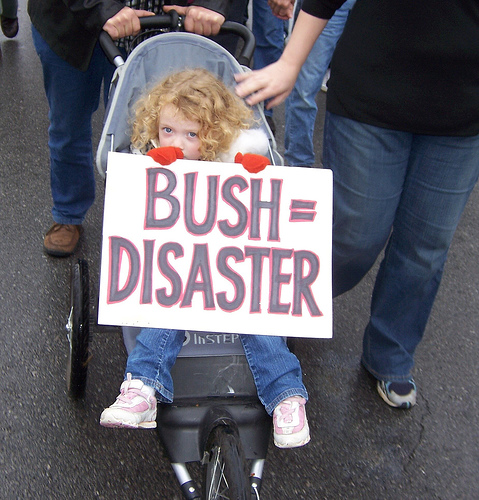
Sunday November 5, on a rainy and gloomy day, Omni Center for Peace, Justice and Equality organized a demo with the theme: Stop the War! March for Change. I guess about 250 people participated, but I'm not sure--there was little media coverage. In any case, it was spirited, the speakers and performers were good. (I spoke as well, and not so sure about my own performance. I argued that the peace movement needed to take on the issue of US support for Israel, stressing that the ongoing disasters in Lebanon and Gaza should be addressed in addition to that of Iraq.) More photos on my flickr account.
Subscribe to:
Posts (Atom)