Monday, October 13, 2014

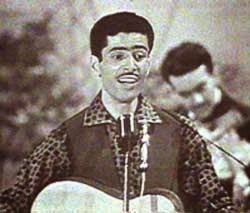
Naim Karakand

I highly, highly recommend this article by Ian Nagoski on the Syrian-American violin player Naim Karakand, recently published by Reorient.

It's a pretty incredible story. He emigrated to New York from Aleppo in 1909, and recorded his first side for Columbia in 1912. In 1916, he recorded "Tatos Bishro," which was made famous nearly 20 years later by renowned Egyptian violin player Sami El-Chawa, who also hailed originally from Aleppo.

Among his other recordings is this amazing tune from 1919: "Gazabieh (Pt. 2)," a dance from Gaza. [But see below: added Oct. 14] This one really blows me away. You can find it, and some other tunes by Karakand, on a terrific recording that Ian Nagoski produced for Tompkins Square Records, What Strange Place: The Music of the Ottoman-American Diaspora, 1916-1929.


In the 1930s Karakand went off to Brazil to join his brother. Then in the 1950s, he was back in New York City, where he played with the Kalimat Orchestra, which accompanied the well-known Lebanese-American fifties musician of belly dance, Mohammed El-Bakkar. Nagoski thinks it is Karakand on violin in all those El-Bakkar recordings. And if that is true, then Karakand appears on the soundtrack to Jack Smith's film Normal Love.

Finally, Karakand plays violin on Ahmed Abdul-Malik's 1958 "East-West jazz fusion" release, Jazz Sahara. Abdul-Malik played bass with, among others, Art Blakey, Thelonius Monk, and Randy Weston. But he also played oud on his solo, East-West fusion, jazz albums. Check out the track "El Haris," from Jazz Sahara. It is not a particularly ground-breaking "fusion," but the violin playing is really to die for.

Nagoski makes the following observation about the importance of the Arab music scene in New York City for fifties jazz: "Unwritten in the history of jazz, it had become fashionable during the 50s among some musicians to attend the many ‘Oriental’ nightclubs, particularly up and down 8th Avenue between 40th and 50th Street, where modal music in various time signatures could be heard. It was no coincidence, then, that in the late 50s and early 60s a string of jazz LPs were released that were both modal and featured 4/4 time signatures. As well, the movement of many African-Americans towards Islam further worked in favour of the incorporation of musical elements from the Middle East in jazz. The influence of Middle Eastern musicians on those of New York is, in retrospect very clear, although it has never truly been delineated." Hopefully someone will follow up on this.

P.S. October 14: I posted the song "Gazabieh (Pt. 2)" on Facebook and it elicited some discussion. Based on comments from my friends Reem and Rochelle (to whom: thanks), it appears that the song is probably not from Gaza. The song opens with the spoken lines, "Come on, ladies, here is a dance tune from Syria." word Gazabieh جاذبية  in Arabic means attractiveness, fascination, or charm. And Gazabieh is probably where whoever wrote the notes on the Youtube post got the "Gaza" idea.

Sunday, October 12, 2014

More Wadad


Awhile back I posted about the Jewish-Lebanese singer Wadad, most famous for her unforgettable song "Tindam."

Now the invaluable music blog Naksh al-Sanadeeq has posted two more songs by Wadad, "Wedding Song - اتمخطري يا عروسة" and "Gypsy Fortune Teller's Song - بصارة براجة", both songs composed by Sayyid Darwish. They are both wonderful versions, and it's great to have access to additional Sayyid Darwish covers, as well as two more tracks from Wadad.

Here's a version of "Gypsy Fortune Teller's Song - بصارة براجة" by Horeya Hassan, and Sayyid Darwish's own version here. And here are the Arabic lyrics, by Yunis al-Qadi. Plus Munira Mahdia's version.

Here's Sayyid Darwish doing "Wedding Song - اتمخطري يا عروسة". Ismail Yasin and Feyrouz do a version of the song as well, but I can't find an online version.


Saturday, October 11, 2014

Jewish North African musicians and the 1989 Toledo conference

1. A very nice tribute to Jewish North African musicians by the Israeli writer Ophir Toubul was published on October 9, 2014 by +972. Toubul discusses, among other artists, Reinette L'Oranaise, Maurice El Medioni, Al Gusto Orchestra, Salim Halali and Haim Botbol (please check out the clip of Haim singing in Essaouira, Morocco in 2013).

Touboul provides a sound cloud link to a singer I had never heard of: "Braham Swiri, who put out records in his youth yet lived the rest of his life in anonymity and sold his recordings outside the entrance to Jerusalem’s Mahane Yehuda Market."


The track is terrific, and I'm keen to hear more. 

Touboul mentions as well the Israeli Mizrahi pop star Kobi Peretz, and links to his recent cover of Sami Elmaghribi classic song “Omri Ma Nansak Ya Mama.” Very nice, modernized, sounds more Egyptian in style than Moroccan to my ears, and the video is bathed in nostalgia.

I was most moved by the vid Toubul posted of Israeli Moroccan singer Neta Elkayam, performing at  Tel Aviv’s Barby Club just last week. 


It's a track made famous by the Algerian Jewish singer Line Monty called "Ana Loulia." I love Neta Elkayam, but what I found particularly compelling about this concert vid is that she is backed on keyboards by legendary Algerian Jewish musician Maurice El Medioni, who moved from Marseille to Israel over the last year or so, after suffering a stroke. I was recently told by a friend who talks to Maurice regularly that his health is not so good, and that one side of his face is, at least partially paralyzed, so it was great to see him performing. (I mention Maurice in my previous post, on Blaoui El Houari. I met Maurice in Essaouira, Morocco in November 2007, when he performed at the Festival des Andalousies Atlantiques, as you can see here.) Saha, ya Maurice!

Here is Line Monty's version of "Ana Loulia." According to Chris Silver (Jewish Morocco), Messaoud El Medioni, better known as Saoud l'Oranais, recorded the song as early as 1932. Saoud was the uncle of Maurice El Medioni, and the teacher of Reinette L'Oranaise. He moved from Oran to Marseille before the Second World War, and met his end at Sobibor concentration camp (Poland) in March 1943.

Finally here's a bit more of the fabulous Neta Elkayam, doing Haim Botbol's "Alash Klam el Aar," live in Krakow. Oh, man.

2. Ella Shohat published an important piece in Jadaliyya (September 30) on the historic meeting, twenty five years ago, of Palestinians (including PLO officials) and "Jews of the Orient," in 1989. It provides an important compliment to the Touboul piece, dealing with the wider political and historical context. Please read it; I find it impossible to summarize. But I liked this bit:

"One beautiful evening that left a mark on us, embodying what is usually dismissed as “nostalgia” and “sentimental clichés,” was when the Jewish-Moroccan-French singer and composer Sapho graciously delighted us with her singing. I would reflect back on that moment a few years later when Sapho performed Umm Kulthum's legendary song “al-Atlal,” and when she released her album “Jardin Andalou” that fused rock, Arabic, and Andalusian elements. While a long-time supporter of Palestinian rights, Sapho, after that visit to Toledo, began to engage the music of the Judeo-Arab world in which she was raised. To stand up for justice in Palestine was all the more momentous when drawing on the complex memories of Sephardi/Arab-Jews."

I am familiar with Sapho's music, but had not known she was known as a supporter of Palestinian rights. Here's her version of "al-Atlal."

Monday, October 06, 2014

Blaoui Houari, "Isma'a"


Blaoui Houari was born 1926 in the M'dina Jadida district of Oran. He became familiar with bedoui music by listening to records at his father's café; he learned piano and mandoline from his brother Kouider. During World War II he worked as a timekeeper at the Oran docks for the US forces, and meanwhile commenced his musical career backing up a Jewish friend named Sébouan, who sang in the style of Tino Rossi, on guitar. Houari subsequently teamed up with Jewish-Algerian pianist Maurice El Medioni, who had developed a distinctive Oriental boogie-woogie style of playing, with a bit of rumba thrown in, after meeting US servicemen (and particularly Puerto Rican ones) who brought their jazz records with them when US forces occupied Oran in November 1942. Medioni and Houari, the latter on accordion or guitar, started out performing French and American hits, and eventually began to develop a repertoire in Arabic. The genre of music developed by Houari (and also Ahmed Wahby and Ahmed Sabr) is known as ouahrani. Houari and Medioni developed a following in Oran, playing at the famous Café Salva.

Medioni and Blaoui performed as the Orchestre d'Oran. Here's a  youtube video showing their group backing up the well-known Jewish-Algerian singer and violin master of Andalusian music, Cheikh Zouzou, on the song "Djesmi fani." Medioni is on piano, Houari on guitar. This is probably a broadcast from colonial-era Algerian television, which commenced broadcasting in 1957. It shows how versatile these artists were, and also how fluid the categories could be between ouahrani and Andalusian, and other genres as well.


Houari recorded his first sides for Pathé in 1953. 

One of his most famous numbers from this period was "Isma'a" (Listen). Here are two fabulous youtube vids of Blaoui Houari performing the song, on Algerian television. Perhaps from 1957. They show that Blaoui Houari was a very engaging performer, and they also demonstrate how modern, how contemporary sounding, was ouahrani.

In this clip the pianist is most definitely not Maurice El Medioni. You can see the pianist, from the back, at around 1:22.


In this one the pianist is not visible. It could be Medioni, who knows?


Medioni left Oran for France after independence, where he enjoyed a long and illustrious career. He recently fell ill and moved to Israel.

El Haqed in Aljazeera

The Moroccan rapper, El Haqed, recently released from prison for the third time, published an opinion piece today (October 6) in Al Jazeera (English) -- it's translated from French and English by Mark Levine.

He writes:

In 2007, a new kind of rap began to spread, with roots in groups like H-Kayne who rapped about social but not quite political issues. It was authentic rap, not imitating anyone. These dangerous ideas led the system to try to shut us down, put us in a big prison so to speak, a prison for ideas and freedoms to try to hem in our dangerous ideas...
 
And so we called our rap ar-rab muhabsi - "prison rap" - rap that expresses reality and sings about freedom, breaking down the borders and chains. We need to understand the power of prison rap in the context of most rappers being little more than marionettes, wholesale puppets of power. You can count the number of truly political rappers on one hand. And yet, the small number makes our music that much more powerful. The intellectual and cultural prison only made our music more powerful. The state still doesn't get that.

I learned at a workshop this past weekend that, in fact, you can in fact count the number of Moroccan political rappers on one hand. In fact, there are three--El Haqed, Hoba Hoba Spirit, and Muslim--who truly support the Moroccan revolutionary movement. The rest, while they deal sometimes with social issues, scrupulously avoid politics.

Thank gods for El Haqed!

P.S. October 7. Hisham Aidi adds (via twitter) that perhaps there is one more 'revolutionary' Moroccan rapper: Sí Simo of Fez City Clan -- but he raps more about poverty than politics.

P.S. October 11. Please check out this article in Jadaliyaa (Oct. 7) by Jessica Rohan, on the Mawazine Festival. She provides a discussion of rappers, including El Haqed and Muslim, and their positioning in relation to pro-regime rap stars like Bigg and Cheikh Sar. And she provides a link to a song by Sí Simo called "Kilimini," a song about social inequality in Morocco. Rohan tells us that kilimini  man is a "recently-coined slang term for wealthy Moroccans." It literally means “he eats from me,” "suggesting the elite gained their wealth through corruption" and also connotating shallowness.

http://youtu.be/bEV0s0tWZ6E

Friday, September 26, 2014

John Legend in kufiya

I am so not a fan of John Legend, primarily because he is a prominent supporter of "education reform," which is destroying public education. And serving up huge profits for venture capitalism.

And even if he has spoken up, just a bit, on behalf of the Palestinians, and even though he has appeared in concert in a kufiya (I don't know when exactly where the photo was taken)...


I'm still not a fan.

Added October 29: thanks to Susanna O for supplying this. One of her friends took it at a JL concert.

Sunday, September 21, 2014

Cheikha Rahma Labassia (Rai)

I don't know why Cheikha Rahma Labassia doesn't get more attention. Check out this absolutely slamming song of hers, "Maniche Mana," courtesy ShellacHead. Recorded, it seems, in the 1960s.


And then there is the fact that it was Cheikha Rahma who did the original version of "Sa'ida Ba'ida," also recorded by Cheb Mami, Cheb Khaled and Cheikha Rimitti. It is so brilliant, no wonder these artists wanted to cover it. 


Here is live footage from Cheikha Rahma, apparently from 2012:


Here's another great track from her, "Haya Neghdou":


And this: "Ya Chira." 


Here she is doing "Dane Dane Dan."

Her name means she is from Sidi Bel Abbès. Sidi Bel Abbès is considered to be one of the places where rai originated (it wasn't just Oran), and it has been the home of Algeria's national rai festival since 2008.

I really wish I knew more about this fabulous singer.

Turban alert: TM Mike Love (Beach Boys)

I came across these images of Mike Love from a post on the super super music blog Aquarium Drunkard. It presents and discusses a video of The Beach Boys singing with the Alexander Hamilton Double Rock Baptist Choir. The song, "That Same Song," is, well, vintage Beach Boys + gospel. It was released on their album 15 Big Ones in 1976.


One of the things that struck me was Mike Love in turban (the second photo shows him with Al Jardine.)


Mike had gone to Rishikesh, India, as part of a group of sixty, organized by The Beatles and including also Donovan and Paul Horn, in February. There they studied Transcendental Meditation with Maharishi Mahesh Yogi. I guess this is evidence that Mike was still fully in to TM in the mid-seventies.

While they were all there, The Beatles wrote and recorded a lot of music, that would show up on the White Album and Abbey Road.

And they recorded this, which never appeared on record: the very very BeachBoysesque "Spiritual Regeneration/Happy Birthday Mike Love," on the occasion of Mike's birthday.


I guess the most Beach Boys-sounding Beatles song ever recorded is "Back in the USSR," penned by Paul McCartney. Mike Love has stated that he encouraged McCartney to "talk about the girls all around Russia, the Ukraine and Georgia" to make the song sound more Beach Boys.

Saturday, September 20, 2014

Jewish Algerian Mixtape

Jewish Morocco's Chris Silver is in Algeria. He prepared this terrific guest mixtape for Afropop Worldwide. Please listen: you will immediately be sucked in by the amazing vocalizing of Salim Halali on the first track, "Layali Maghrabi." Beautiful.

Here's the link to the posting on Afropop Worldwide.

And Silver's longer discussion, plus the track listing, at Jewish Morocco.

Or, just go right to the music (which you can also download for free):


Monday, September 15, 2014

Revolutionary rap from Egypt: Katiba (Batallion) 101

A friend passed this on to me awhile back and I want to recommend it to you. It's from Egyptian rap group Katiba ("Batallion") 101. The title is "Shaytan wa Malak" (Demon and Angel). It proposes that the battle in Egypt is between the good or angelic forces, the forces of the revolution, and the demonic force of the authorities. According to the notes on youtube, the song was recorded two years ago (summer 2012), and is only now released.

I hope someone with better translation skills could translate the Arabic. The lyrics are there, on the youtube notes, so have at it. Katiba 101 also rap in English, and make a pretty good go of it. And it is really a slamming track. Have a listen. And I will try to learn more.


Essential resources on Palestine from B'Tselem

The Israeli human rights outfit B'Tselem has just won the 2014 Stockholm Human Rights Award.

In my opinion, part of the reason it deserves the reward is for its massive and careful documentation effort. Check out, for instance, this amazing interactive map of the West Bank, delineating Areas A, B and C, checkpoints, settlements, barriers, tunnel entrances, and so on.

And then there is this pie chart of Area C, which I found at B'Tselem's report on Israel's latest West Bank land grab, of 380 hectares. Absolutely essential for making sense of what is happening in Area C. Israel's occupation of the West Bank and its ongoing colonization is all about creating facts on the ground. B'Tselem is scrupulously documenting them, item by item.


Check out all B'Tselem's resources here.

Sunday, September 14, 2014

Massive Attack: Gaza/Palestinians/Syria

I know, I'm not up to date at all. Catching up on items that I saved and didn't post about because I spent 7 weeks or so following the awful events in Gaza and not doing much else.

The great band Massive Attack however did do something.

First, when they headlined at the Longitude Festival late July, they sent messages to their audience about Gaza. 


For more, read this article in The Independent.

Second, also in late July (28), two members of Massive Attack, Robert Del Naja and Grant Marshall, toured the Al Naqab Center at Burj al-Barajneh refugee camp in Lebanon. The center offers remedial classes, a meeting place for active youth and other social activities, primarily  for Palestinians recently arrived from Syria. On the 29th, they staged a concert to benefit the Al Naqab Center, organized by the Hoping Foundation. The money also went to fund building a new public library in a camp in the north of Lebanon and to supporting the ambulance service in Gaza. Read more here, also from The Independent.

Massive Attack at Burj al-Barajneh, wearing kufiya scarves. 
Robert Del Naja is in front, Grant Marshall in back

Here's a short AFP report on the concert in Lebanon, and here is some amateur footage.

Finally, here's a post I did back in 2010 on Massive Attack and Palestine.

Saturday, September 13, 2014

Nation of Islam Hip-Hop Again?

Zaheer Ali wonders whether a hip-hop/Nation of Islam connection might be on the horizon again, in The Root. He is inspired to speculate in this regard by Jay Electronica's performance at the recent Brooklyn Hip-Hop Festival, where he appeared with a phalanx of NOI Fruit of Islam guards as he arrived. And performed in his own Fruit of Islam garb. (Jay is in the center in the photo below.)


Frankly, I wonder whether NOI rap will really become a trend, but it's an interesting thought, and I urge you to read about it here.

I blogged about Jay Electronica back in 2012, when I spotted him in kufiya. I concluded at the time, based on his lyrics, that he was a member of the Nation of Gods and Earths (Five Percenters). I may have been right, that at the time, he was. He now seems to have more clearly aligned to the NOI.

Gnawa NYC

Yep, there is now a Gnawa zawiya in the South Bronx.


The photo is courtesy Samir LanGus via Facebook. LanGus is the guy in green clanging the kerakeb in the photo above. He is part of the South Bronx-based Gnawa troupe Innove, who, amazingly, were selected in May by the MTA to be part of their Music Under New York program, meaning they would get perform in “prime subway station spots.”

 Innove Gnawa Band

And here is a vid of them playing "Merhaba" (a song that welcomes the mluk, the "spirits" that the Gnawa cult propitiates), on September 7, at the 34th St Herald Square station (on the BMT Broadway Line and the IND Sixth Avenue Line of the New York City Subway), the third busiest station in the system.

For more on how Gnawa music can now be seen commonly in New York City, please read the fantastic article in the New Yorker (September 2) by my friend and colleague Hisham Aidi, entitled "Claude McKay and the Gnawa Scene." And yes, McKay first saw the Gnawa in 1928, in Casablanca.

And Innove isn't the only Gnawa group in the city. As Aidi informs us, there is also Gnawa Boussou and Nass Gnawa.

Nass Gnawa (which includes the great Brahim Fribgane) live:


And Gnawa Boussou (also featuring Brahim Fribgane):


I went to several Gnawa lilas when I was in Morocco in summer 1999. I hope I get to go to one in NYC, sometime soon! 

Friday, September 12, 2014

A plug for some "experimental Arab music": Radio Tashweesh #11 and Annihaya Records


I really like the latest (well, four months old) mix on Soundcloud from Algeria's Radio Tashweesh. Very nice, very experimental stuff from the Arab world, from the likes of Land of Kush (one of Sam Shalabi's many projects), Mahmoud El-Kholy, who 'wrecks' Umm Kalthoum's famous 1969 song "Asbaha ‘andi al-an banduqiya" (Now I've got a rifle), Zeid Hamdan with Miryam Saleh, Kamilya Jubran, and more. Plus, the photo that accompanies the mix (reproduced above) is just perfect to describe my mood at the moment. (Sorry, you really have to know Arabic to get it.)

And I also just noticed that Radio Tashweesh has produced a more recent mix in tribute to Ahmed Basiony, the multi-talented artist who was a martyr of the 2011 Egyptian uprising.


And then there is Annihaya Records on Soundcloud. Out of Lebanon, they are 'a conceptual music label that specializes in the displacement, deconstruction and 'recycling' of popular or folkloric musical cultures.' I recommend checking out all that they have, but I particularly liked the tracks "Najwa (Malayeen 2013)" by Malayeen:


and Raed Yassin's "Naima":

.

Listening again while writing this, my mood is improved. But I still think the photo at the top is an accurate assessment of what's going on in much of the Arab world today. At least there is some good music being produced.

Added September 20, 2014: according to the comment posted by Redha, the photograph is by Nadia Elissa, from Alexandria. I've not been able to find any internet link to her.

Sunday, September 07, 2014

Palestinian music: sources

Re: Palestinian music: I just wanted to give a plug to two fairly new books and one quite new posting.

First, Palestinian Music and Song: Expression and Resistance Since 1900, Moslih Kanaaneh, Stig-Magnus Thorsén, Heather Bursheh, and David A. McDonald, eds, 2013. It's in the Indiana University book series that I co-edit, Public Cultures of the Middle East and North Africa. Shayna Silverstein just published a very smart review of it in Journal of Folklore Research, which you can read here.

Then there is David McDonald's, My Voice Is My Weapon: Music, Nationalism, and the Poetics of Palestinian Resistance (Duke, 2013). I'm one of the folks who blurbed it, and I said the following: "David A. McDonald has written a singular, ambitious, and much-needed book that explores a very important dimension of the Palestinian-Israeli question. He provides an invaluable historical overview of Palestinian resistance music since the 1930s and an ethnography of music and musicians during the Second Intifada and its aftermath." I used the book in class last semester, and I highly recommend it for teaching.

Finally, if you are going to teach about Palestinian music, and use these books, then you should grab the following:


The album came out in 1989, from Virgin Records, but I've never seen it before, and I'm pretty sure it would be hard to track down a copy. But thanks to the estimable music tumblr naksh al sanadeeq, you can download it here.

When I taught McDonald's book I was able to find a lot of the music he discusses on Youtube. But it helps to know Arabic in order to track it down. Perhaps I'll do a follow-up.

In sum: we are now much more blessed with excellent materials, recorded and academic, on Palestinian music.

Wednesday, September 03, 2014

and in South Africa kufiya news...

At the World Debating Championships in Thailand in early August, the South African team put on kufiya scarves, as well as badges in the form of Palestinian flags, at the opening ceremony, in protest of Israeli human rights violations against the people of Gaza. And they took a photo, posted on Facebook on August 6. 


As a result, a petition was circulated calling for the team captain, Joshua Broomberg (on far right in the photo), who is also deputy head boy of the King David Victory Park High School, a Jewish day school, to be removed as deputy head boy. The petition picked up 2,000 signatures; a petition opposing his removal garnered 4,000, according to the Times of Israel.

Yoni Bass, writing for 972, explains that the uproar over the incident is symptomatic of a strong and perhaps growing conservative trend in South Africa's Jewish community. Read more here.

Sunday, August 31, 2014

Swedenburg family Middle East photos

Sultan Hassan mosque, Cairo, December 1961 (Photo: Romain Swedenburg)

My family made its first trip to the Middle East in December 1961-January 1962. We visited Egypt, Syria, Lebanon, Jordan (East and West Banks), and Israel. In January 1964 we moved to Beirut, Lebanon. My parents lived there until fall 1972; I stayed on until January 1976.

The last time we were at my parents, my brother and I went through some of the many slides that my father took over the years, selected a number and had them scanned professionally. My dad was an amateur, but he was a quite accomplished photographer. I've started to post the photos on flickr, and assembled them in an album called Swedenburg Family, Middle East. You can access them here. I will continue to add 3-5 per week, so if you find them of interest, you can check back to find more in future. I have received very positive feedback when I've also posted the photos on Facebook, and I may do something further with the photos in future. At the least, hopefully, publish a photo essay. The photos are varied, all from the nineteen sixties: you'll find shots of Tahrir Square, Abu Simbel in the process of being raised, Jericho refugee camp, Aqaba, Sinai, Damascus, the Cedars...Please have a look. Feedback appreciated.

Wednesday, August 27, 2014

Youssef Rakha on Adaweyah


 This is just the best thing I've ever read on the great Egyptian shaabi singer Adaweyah. You must read it. There's no way to summarize, but here's a sample.

As the lager moistens your gut, the shade winding you down, Adaweyah’s lyric tenor – full-bodied, clarion, gravelly at the high ends – transports you back to Cairo, a city very like the jerkwater megalopolis you just came from but infinitely more euphonic for the ultra-urban tarab of the voice. Tarab: the participatory aesthetic register of modal singing, translated as ‘enchantment’ though it really can’t be translated. Adaweyah’s is one of the rawest examples of it you’ve heard in any genre.

The song he is referring to is "El Marassi," which you can listen to here.


If you are interested in listening to more Adaweyah, you can download a huge collection of his cassettes here, courtesy ARAB TUNES الإيقاعات العربية

I highly recommend the first offering, Qala2 -  قلق

Tuesday, August 26, 2014

More on 'Traitors': #women #punk #Morocco

Back in March I posted about the film Traitors, which deals with Moroccan women punkers. (And which I have not yet seen. I've since came across a couple more interesting sources.

1. An article about the film's star, Chaimae Ben Acha, in Brownbook.

Chaimae plays Malika, leader of an all-girl punk band in Tangier (she's in white in the photo below).


Ben Acha’s preparation for the role required her to cut her hair like Joan Jett, enrol in singing lessons and wear combat boots while off-set so as to acquire a rebellious strut. She admits that prior to the filming of ‘Traitors’, she had ‘nothing to do’ with rock music. ‘To sing rock ’n’ roll, you have to be hard-edged. It’s not feminine,’ she says.

2. And, another preview. Music sounds great. Can't wait to see it.