Check out his video report here, and his article in the New York Times, yesterday, here.
The vid, with performance by Ibrahim Qashush (whose throat was cut soon thereafter) is here, with subtitles.
Note that the subtitles do not capture this: at about 2:30 the chanter says "ru7 sale7 7aref il S" which means go fix your pronunciation of the letter S, referring to Bashar's lisp! (Thanks to Yusef for this.)
Saturday, July 23, 2011


Saturday, July 16, 2011
No SCAF Rap: Message to Tantawi, by Ramy Donjewan
I've been complaining of late that the role of hip-hop in the "Arab" Spring has been somewhat exaggerated. I plan, or I should say, hope, to do a post on this later, once I've thought it through more. But I really like this rap, from Ramy Donjewan, that was posted today on youtube.
It's called "Message to Tantawi," and it is just that, a message to Field Marshal Mohamed Hussein Tantawi, the Commander-in-Chief of the Egyptian Armed Forces, the Minister of Defense, and the chair of the Supreme Council of the Armed Forces or SCAF, which has ruled Egypt since the departure of Hosni Mubarak on February 11. The message to Tantawi is in his capacity as the head of SCAF. The democracy movement in Egypt has become increasingly frustrated with the SCAF, and in particular, of late, its failure to prosecute effectively those responsible for the 800+ deaths at the hands of the security forces during the revolution. Donjewan articulates this, and other demands, and frustrations of the revolutionary movement.
I like this song's flow, its lyrics, the calculated urgency of the Donjewan. Its slow, measured beats, convey a sense of dread, and the simple, repetitive guitar playing adds to the effects. I especially like the chorus, which can be translated as: What we did at first we'll do again Tantawi if our demands aren't implemented. (It's very poetic and effective in Arabic.)
(Once again, I urge someone who can do it quicker and more effectively than me to translate the lyrics of this song.)
You can download the song for free here.
Donjewan put out a song right before the start of the revolution, called "Against the Government," that was quite fantastic as well. Check it out here.
The title of this post: No SCAF Rap, is lifted from the 3Arabawy blog, where I first learned about this song.
(Footnote: the wikipedia entry on Tantawi says he's of Nubian origin, but the sources for this claim are gone. Is this true?)
UPDATE (later the same day): Robin translated a bit more: "Oh Tantawi, my brother's blood is very dear, and we are not making threats... where is the right of the poor, the one who died?"
It's called "Message to Tantawi," and it is just that, a message to Field Marshal Mohamed Hussein Tantawi, the Commander-in-Chief of the Egyptian Armed Forces, the Minister of Defense, and the chair of the Supreme Council of the Armed Forces or SCAF, which has ruled Egypt since the departure of Hosni Mubarak on February 11. The message to Tantawi is in his capacity as the head of SCAF. The democracy movement in Egypt has become increasingly frustrated with the SCAF, and in particular, of late, its failure to prosecute effectively those responsible for the 800+ deaths at the hands of the security forces during the revolution. Donjewan articulates this, and other demands, and frustrations of the revolutionary movement.
I like this song's flow, its lyrics, the calculated urgency of the Donjewan. Its slow, measured beats, convey a sense of dread, and the simple, repetitive guitar playing adds to the effects. I especially like the chorus, which can be translated as: What we did at first we'll do again Tantawi if our demands aren't implemented. (It's very poetic and effective in Arabic.)
(Once again, I urge someone who can do it quicker and more effectively than me to translate the lyrics of this song.)
You can download the song for free here.
Donjewan put out a song right before the start of the revolution, called "Against the Government," that was quite fantastic as well. Check it out here.
The title of this post: No SCAF Rap, is lifted from the 3Arabawy blog, where I first learned about this song.
(Footnote: the wikipedia entry on Tantawi says he's of Nubian origin, but the sources for this claim are gone. Is this true?)
UPDATE (later the same day): Robin translated a bit more: "Oh Tantawi, my brother's blood is very dear, and we are not making threats... where is the right of the poor, the one who died?"
Ultras in kufiya (Cairo, Tahrir)
One of the great stories from the Egyptian revolution is how the "ultras" (fanatical football/soccer fans) of Cairo's two main clubs, Ahli and Zamalek, played a key role in defending, and in fact saving, the Revolution, on the night of February 2nd. When I was in Cairo, a good friend (and a reliable source) told me about how, on that night, when the thugs (baltagiyya) of the regime attacked, the word was sent out from ultras on the square, and 2000 more ultras showed up to organize those on Tahrir, many of them middle class youths not so accustomed to street fighting, as well as to fight for the revolution themselves. As my friend explained, the "ultras" detest the police, who have been as tough on them as on any Egyptians causing "trouble," or not. They've experienced the beatings, the torture, the abuse that so many young Egyptians have routinely faced at the hands of Egyptian security. And, what is more, the ultras have lots experience fighting the police and the security. The other key force that came to the rescue of the revolution on the night of February 2 were the Muslim Brothers. Their leadership was also called from the square when the regime thugs launched their attacks, and so the Brothers sent out about 2000 of their own "self-defence squads," i.e., their toughs, their enforcers. A coalition of ultras and Ikwhan therefore saved the revolution that night, along with the less-experienced but willing-to-fight thousands of pro-democracy demonstrators who were already there. (A great source on the intersection of politics and Middle East soccer is James Dorsey's invaluable blog, The Turbulent World of Middle East Soccer. He has posted several times about the role of the ultras in the Egyptian revolution.)
This Friday, July 15, the Brotherhood boycotted the protests at Tahrir. But the ultras were there, as this photo, and account, from 3Arabawy, shows. And I quote:

Ahmed Bahar and Tarek “Masaken” of Zamalek’s Ultras White Knights in Tahrir Square on Friday night.
I had an interesting chat with Tarek, a young UWK member who’s also a staunch pro-Palestine supporter. He told me he’s been attending demos in solidarity with Palestine since he was a prep school student. Both Bahar and Tarek in addition to thousands of other UWK members took part in the January uprising, and their role, as well of that of the Ultras Ahlawy, were sometimes central in confrontations with the Central Security Forces troops on the Friday of Anger, and against the thugs during the “Battle of the Camel” on 2 February.
It's great to learn that some of the ultras are not just struggling for democracy in Egypt, but are also supporters of the struggle of the Palestinians. And please note the Che t-shirt.
This Friday, July 15, the Brotherhood boycotted the protests at Tahrir. But the ultras were there, as this photo, and account, from 3Arabawy, shows. And I quote:

Ahmed Bahar and Tarek “Masaken” of Zamalek’s Ultras White Knights in Tahrir Square on Friday night.
I had an interesting chat with Tarek, a young UWK member who’s also a staunch pro-Palestine supporter. He told me he’s been attending demos in solidarity with Palestine since he was a prep school student. Both Bahar and Tarek in addition to thousands of other UWK members took part in the January uprising, and their role, as well of that of the Ultras Ahlawy, were sometimes central in confrontations with the Central Security Forces troops on the Friday of Anger, and against the thugs during the “Battle of the Camel” on 2 February.
It's great to learn that some of the ultras are not just struggling for democracy in Egypt, but are also supporters of the struggle of the Palestinians. And please note the Che t-shirt.
kufiyas: Cairo airport and Riyadh shopping mall

This is from Cairo airport, July 2011 (thanks, NT). You might think this represents an Arab woman in "traditional" fashion, but women don't usually wear kufiyas as headscarves. Swarovski is an Austrian company that produces lead crystal and other related luxury products, so this mannequin doesn't seem to have anything to do with the kiosk behind it.
Then there are these, from Mamlaka Shopping Mall, in Jedda, Saudi Arabia, January 2010 (thanks, EC). Very deluxe kufiyas, that have nothing to do with Palestine solidarity or any progressive politics whatsoever, and everything to do with elite Saudi identity. (The red kufiya, with white dishdash, is traditional Saudi dress.) Kenzo, Lamborghini, Borsalino, Versace: very swank. Please get me a Versace next time you're in Jedda, won't you?


Monday, July 11, 2011
kufiyaspotting: "Nick and Norah's Infinite Playlist" (2008)

Nick (Michael Cera) and Norah (Kat Dennings) are on the track of a band called Where's Fluffy. They get to a NYC club, where everyone is waiting for the late-night appearance of Where's Fluffy. This band (Are You Randy) comes on instead. Everyone is disappointed, boos, and leaves. Except for one loser, who takes his shirt off and dances around like a loon. The fact that the deejay of the band (played by Sammy Marc Rubin) was wearing a cool kufiya didn't dissuade anyone from leaving.
Wednesday, July 06, 2011
Monday, June 27, 2011
Coke & Pepsi and the Egyptian Revolution (+, yes, kufiyaspotting)
Like all companies trying to make money in the new Egypt after Mubarak, Coke & Pepsi are trying to ride the revolution. (Thanks to Robin for calling them to my attention.)
Check out this ad from Coca-Cola, with the theme, "Make Tomorrow Better." We see the middle class youth of Egypt (the presumed revolutionary subjects) ushering in a new dawn. Note that the focus is entirely on Cairo's downtown, which has both been a site that the upwardly mobile in neo-liberal Egypt have been fleeing for the upscale satellite suburbs, and which is also the focus of plans for gentrification. Finally, and perhaps most significantly, note the penultimate shot, which shows Tahrir Square, with a crowd (meant, of course, to evoke a demonstration, right before the last shot of a young person drinking a bottle of Coke.
Then check out this Pepsi advert. Again, the middle class youth of Egypt are the subject. They are shown to be adding color (literally) and life to Cairo's downtown (which has, in fact, been renovated in recent years). They possess the trappings of advanced modernity (flat screen televisions, laptops) and also evoke the youth of the revolution. This young woman carries the iconic cellphone (the "twitter revolution") and, yes, yes, you guessed it, she wears the requisite iconic accessory of the revolution, the kufiya.

And towards the end of the video, youth begin to gather at a street intersection in what looks like it could be a demonstration, and from a balcony looking over the intersection, a young man gives an enthusiastic revolutionary salute, with a can of Pepsi in his hand.

The overall theme is "express yourself." Among the lyrics of the song are the lines, "you are the new, you are the unique," and "tomorrow is waiting for you." And here's the vid:
Don't be too surprised, or dismayed. Both Coke and Pepsi attempted to ride the waves of the sixties counterculture and oppositional movements in the US.
Here's a "psychedelic" ad from Pepsi, from 1969.

And one from Coke, featuring Lady Soul Aretha Franklin, from 1968, when she had only recently crossed over, as a sign of Black Pride.

Big capital will, of course, inevitably, try to profit from the revolutionary fever...
Update (one hour later): Just a bit after I posted the above, I came across an article from Al-Masry Al-Youm on the same subject (although less critical), entitled "Soft-drink giants ride wave of post-uprising optimism." “It’s about empowering youth to come up with ideas and do something about them,” said Karim Khouri, managing director at Impact BBDO, the agency that designed ads for Pepsi.
Check out this ad from Coca-Cola, with the theme, "Make Tomorrow Better." We see the middle class youth of Egypt (the presumed revolutionary subjects) ushering in a new dawn. Note that the focus is entirely on Cairo's downtown, which has both been a site that the upwardly mobile in neo-liberal Egypt have been fleeing for the upscale satellite suburbs, and which is also the focus of plans for gentrification. Finally, and perhaps most significantly, note the penultimate shot, which shows Tahrir Square, with a crowd (meant, of course, to evoke a demonstration, right before the last shot of a young person drinking a bottle of Coke.
Then check out this Pepsi advert. Again, the middle class youth of Egypt are the subject. They are shown to be adding color (literally) and life to Cairo's downtown (which has, in fact, been renovated in recent years). They possess the trappings of advanced modernity (flat screen televisions, laptops) and also evoke the youth of the revolution. This young woman carries the iconic cellphone (the "twitter revolution") and, yes, yes, you guessed it, she wears the requisite iconic accessory of the revolution, the kufiya.

And towards the end of the video, youth begin to gather at a street intersection in what looks like it could be a demonstration, and from a balcony looking over the intersection, a young man gives an enthusiastic revolutionary salute, with a can of Pepsi in his hand.

The overall theme is "express yourself." Among the lyrics of the song are the lines, "you are the new, you are the unique," and "tomorrow is waiting for you." And here's the vid:
Don't be too surprised, or dismayed. Both Coke and Pepsi attempted to ride the waves of the sixties counterculture and oppositional movements in the US.
Here's a "psychedelic" ad from Pepsi, from 1969.

And one from Coke, featuring Lady Soul Aretha Franklin, from 1968, when she had only recently crossed over, as a sign of Black Pride.

Big capital will, of course, inevitably, try to profit from the revolutionary fever...
Update (one hour later): Just a bit after I posted the above, I came across an article from Al-Masry Al-Youm on the same subject (although less critical), entitled "Soft-drink giants ride wave of post-uprising optimism." “It’s about empowering youth to come up with ideas and do something about them,” said Karim Khouri, managing director at Impact BBDO, the agency that designed ads for Pepsi.
Sunday, June 26, 2011
Songs of the Syrian Revolt
It's thanks to Iman that I know about these two songs.
The first is by Syrian singer Samih Choukeir. I knew nothing of him before hearing this song. What I now know is based on this wikipedia entry, in Arabic. He is an established artist in Syria (or at least he was--who knows, after this song!), active since 1982, composing for the theater and t.v. serials as well as performing his own compositions. He studied art in the Ukraine (like so many other Syrians, who got advanced degrees from Eastern Bloc universities prior to the collapse of the Soviet Union) and is married to a Ukrainian woman. He does not belong to any political party in Syria but appears to be on the Syrian "left." (Here's his official bio in English.)
The song, "Ya Hayf (Oh Oppression)," is dedicated to the martyrs of Dera'a, March 15. Dera'a is where the Syrian revolt started. (It's also where T.E. Lawrence was tortured, if you remember the film Lawrence of Arabia.)
This one features someone leading a call-and-response song at a pro-democracy demonstration in the city of Hama, uploaded on June 23. It's entitled, "Bidkum Bashar (You want Bashar)." The singer chants various lines of government propaganda, and then chants Bidkum Bashara, and the crowd responds loudly, "La wallah" (No, by God!). It's quite wonderful.
(Again, I hope someone will translate these into English, and other languages, at some point.)
The first is by Syrian singer Samih Choukeir. I knew nothing of him before hearing this song. What I now know is based on this wikipedia entry, in Arabic. He is an established artist in Syria (or at least he was--who knows, after this song!), active since 1982, composing for the theater and t.v. serials as well as performing his own compositions. He studied art in the Ukraine (like so many other Syrians, who got advanced degrees from Eastern Bloc universities prior to the collapse of the Soviet Union) and is married to a Ukrainian woman. He does not belong to any political party in Syria but appears to be on the Syrian "left." (Here's his official bio in English.)
The song, "Ya Hayf (Oh Oppression)," is dedicated to the martyrs of Dera'a, March 15. Dera'a is where the Syrian revolt started. (It's also where T.E. Lawrence was tortured, if you remember the film Lawrence of Arabia.)
This one features someone leading a call-and-response song at a pro-democracy demonstration in the city of Hama, uploaded on June 23. It's entitled, "Bidkum Bashar (You want Bashar)." The singer chants various lines of government propaganda, and then chants Bidkum Bashara, and the crowd responds loudly, "La wallah" (No, by God!). It's quite wonderful.
(Again, I hope someone will translate these into English, and other languages, at some point.)
Saturday, June 25, 2011
The Turban Makes a Glorious Comeback (last fall!)
 Kirsten Luce for The New York Times
I clipped this article from the New York Times last fall, but it got misplaced in some pile or other, and I've just recovered it. I think it's still of interest.
It focuses on the claim of June Ambrose (pictured above) who, it says, wore a turban every day during New York Fashion Week. And it traces the current trend to a Prada show in 2006, which wasn't picked up, but then began to catch on by 2009. Kate Moss wore one at the Met gala in May 2009. And it started showing up on the street, on young women.
The new fashion connected them to "sophistication linked with Hollywood glamour of the 1920s and ’30s, when women like Garbo, Gloria Swanson and Joan Crawford wore them. “From way back, turbans signified a woman who was very educated and worldly,” said Caroline Rennolds Milbank, the fashion historian."
The article goes on to say that, 'Because turbans have historically been associated with Arab dress, it is tempting to connect them with the conflict in the Middle East. “They make a strong political statement, like wearing harem pants,” Ms. [June] Ambrose said. “We take an element of other cultures and internalize it”'
For his part, the curator of the Costume Institute at the Met, Harold Koda, 'isn’t convinced that they have anything to do with politics: “It’s not a part of a Kumbaya fashion movement. I think it’s more of Poiret’s view of Orientalism than women watching the news and referencing what’s going on in Afghanistan. It’s an exoticism, a sense of the other that is visually compelling.”'
Fashion historian Caroline Rennolds Milbank meanwhile 'noted that in the past, Western culture looked at the Middle East for its exotic form of dress, which was seen as sexually liberating. “If you look back at the portrayal of women in films like ‘1,001 Nights,’ ‘Lawrence of Arabia’ or even the television show ‘I Dream of Jeannie,’ the West depicted those women very sexually with sheer fabrics and an exposed midriff,” she said. “Going back to the turban is a return to the allure and sexiness of a foreign culture.”'
My opinion is not that it's a question of either/or. Probably the trend has something to do with Middle East politics--in some displaced fashion. And no doubt it's also rooted in the history of popular Orientalism in the US. Check out the slideshow that goes along with the article for more turbans. I particularly liked the photo of Nina Simone wearing one.
 (credit: Associated Press)
I've posted a few times on turbans, as well as related Orientalist fashions. Re Maria Montez and Lana Turner, here. Rudy Ray Moore and more here. Beyoncé here. Kim Wilson. Chuck Willis. The Fabulous Ottomans and Sam the Sham. Prince and Prada. Ongoing obsession.
Gaza (dancehall version)
 (Niketa Thomas, New York Times, June 19, 2011)
There's no evidence that Vybz Kartel gives two whits about Palestine's Gaza. Gaza is the name of Vybz's dancehall posse, as well as the name of the section of the Waterford housing scheme in Portmore, Jamaica, where Vybz Kartel grew up. He is also known as Gaza Emperor. Gully is the name of the actual gully which bisected Cassava Piece in St Andrew, where Vybz's rival Mavado grew up, and it's the name of his posse. Gaza/Gully feuding is constant in Jamaica. Read more here. (Thanks to Wayne Marshall for the reference. Don't blame Wayne for the fanciful account of the 'real' Gaza.)
(There is also a 'Tel Aviv' area in central Kingston.)
Vybz has released two albums called Pon Di Gaza. Please check out his Mavado dis song, "Pon Di Gaza":
Chic of Araby
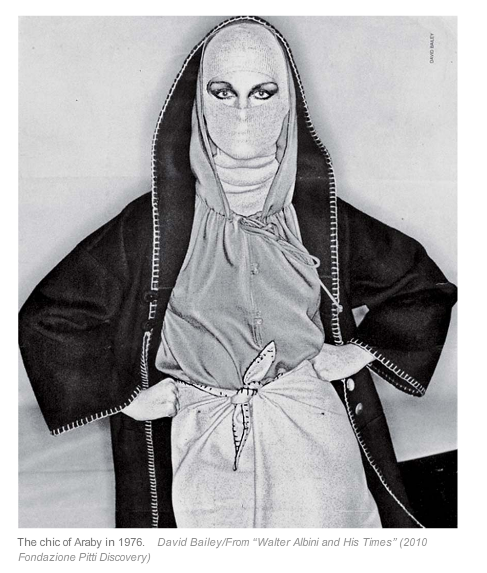
Italian designer Walter Albini created this in 1976 (photo from the New York Times, Oct. 12, 2010). Read more about him here. You'd think that, today, the more germane term would be hijab chic.
The phrase, Chic of Araby, isn't original. In fact, the Times used it for a men's fashion spread in Spring 2010. Below is a representative photo. Very Lawrence of Arabia retro. More here. (Maybe the Times got the name from the John Abercrombie 2009 track.)

Friday, June 17, 2011
Kurdish Kufiyas/Puşis

(Photo by Jodi Hilton for The New York Times. Caption: "Kurdish youth commemorated the 1977 May Day massacre last month during a march to Taksim Square in Istanbul")
This photo appeared in a recent article in the New York Times about the Kurdish struggle in Turkey for cultural autonomy, and particularly in the field of music.
I found the article quite enlightening, but I was, of course, particularly struck by the photo, which features Kurds wearing very stylish kufiyas. These are known in Kurdish as puşis. The puşi is traditional wear for men in Kurdistan, and is often taken as an insignia of Kurdish identity. In my investigation of kufiyas, I've not yet devoted much time to the Kurdish angle.
An article in the Turkish newspaper Hurriyet states that kufiyas/puşis have also become trendy in Istanbul, and that the origin of the trend is via the West. One vendor claims that it was due to the fact that Angelina Jolie was spotted wearing one. (I've not seen a photo of this. But I will look.) The kufiyas, in multiple colors, are made in Syria, the article claims.
But apparently, based on the evidence in this photo, it's not simply about trendiness. These Kurds are trendy, yes, but they are also political activists.
To be continued.
Wednesday, June 15, 2011
not your 'typical' electronics musicians

photo: Abdel-Rahman Hussein
Meet Yara Mekawie and Ola Saad, performing "abstract minimalist electronica" at the 100 Live Electronic Music Festival in Cairo last Thursday (as reported by Abdel-Rahman Hussein in Al-Masry Al-Youm).
Surprised by their "Islamic dress"? Yes, contemporary Egypt continues to surprise.
The 100 Live Electronic Music Festival is put on by 100 Copies Music, the Cairo label devoted to experimental music, and the label associated with the music of Ahmed Basiouny, who I have posted about several times, a martyr of the revolution.
I've not been able to learn much more about these two artists, who perform as RGB, other than what is written in Al-Masry Al-Youm. What I find of note is this:
1. RGB's music is very conceptual. Their performance was not, they say "about making music." “It’s about the sound and trying to convey colors through it,” Saad told Al-Masry Al-Youm. Mekawie concurred, adding, “When you hear what we do, the intent is for you to see light.”
2. They cite Ahmed Basiouny as their inspiration.
3. According to Hussein, "their work evokes Brian Eno and Robert Fripp’s “sonic landscapes” pioneered in the 1970s, but is more minimalist, less textured."
4. Most interesting, perhaps, is that the duo claim that the fact that they are women, and the only women in the festival, is "irrelevant." "The important thing is what we do."
The fact that they wear "Islamic dress": not even mentioned. At all.
Tuesday, June 14, 2011
Sennheiser headphones kufiya

Thanks to both @southsouth (who blogs here) and @wayneandwax (he blogs here) for informing me about the kufiya in the packaging for Sennheiser headphones. (Sennheiser is a German company.) I've used @southsouth's photo, which is to be found here. Wayneandwax's is here.
Hip, eh? Powerful bass goes perfectly with a kufiya, no?
Friday, June 03, 2011
Oh so hip Wal-Mart

Another Wal-Mart Shareholders' Meeting has descended upon my hometown, Fayetteville. And more pop stars have joined the Wal-Mart Hall of Shame, lending their voices to shill for one of the world's premier anti-labor corporations. This year brought us: Will Smith, Black Eyed Peas, Alicia Keyes, Darius Rucker, and Bob Seger. Previous years have brought such luminaries as J-Lo, Beyoncé, Kool and the Gang, Journey, Shakira, Taylor Swift...the list goes on and on.
Okay, let's forget about workers' rights, for the sake of argument. The Walmart Visitors' Center in Bentonville, on the site of Sam Walton's original Five and Dime store in that city, sits right across the street from a statue to Confederate soldier James Berry, erected on the town square in 1908 by the Daughters of the Confederacy. You can see how close that monument to the heroes of the War of Treasonous Secession is to the monument to corporate America from the photo above, which I shot on a visit to Bentonville a couple weeks ago.
Seriously, Will & Fergie & Alicia, couldn't you at least ask why Wal-Mart, with all its corporate power, doesn't insist that the statue to those who fought for their Confederate home and fatherland be taken down? Do you really need the money that badly?
And seriously, why does no one ever seem to complain about the fact that our beloved pop stars cavort so shamelessly for corporate power?
And then there's the issue of Crystal Bridges, the museum of American art that will open in Bentonville this November. It was initiated with funds from Alice Walton (daughter of Sam, founder of Wal-Mart, and the 8th richest American -- 3 of her siblings are alson in the top 10), and just received another huge endowment from the Walton Family Foundation. It will be a fabulous museum, and the architecture and the site promise, according to all reports, to be amazing. (Expect a report in the New Yorker soon.) And at the same time it will serve the function of art-washing: to clean up the Wal-Mart image through the Walton family's "disinterested" support of culture and the arts.
Wednesday, June 01, 2011
Lady Gaga gets the Bollywood treatment
Read about it (and watch the vid) in/on the Wall Street Journal here.
India is an appealing target for entertainers, as it has 700 million people under the age of 30.
And watch the Salim and Sulaiman Desi remix of "Judas" here:
Saturday, May 21, 2011
Kufiya and some Islamic refs in Digable Planets' "Where I'm From"

"Where I'm From" is off of Digable Planet's first album, Reachin' (A New Refutation of Time and Space), released in 1993. The best known single from the album is "Rebirth of Slick (Cool Like Dat)," a Grammy winner for best rap performance by a duo or group, and a crossover hit. Due to the album's jazzy feel and its apparently pop and light feel, the group was hailed by white hipsters and, as a consequence, got a reputation for being the opposite of hard and "street." A look at the video for "Where I'm From," which is all "street" scenes, and an investigation of the lyrics reveal that this impression was quite mistaken, and that there was a great deal of continuity between Reachin' (A New Refutation of Time and Space) and their second, much more overtly political album, Blowout Comb.
What I want to point out here are a few "Islamic" references. The kufiya worn by one of the Digable's posse in the video is one. As is the shot of some members of the Nation of Islam (NOI), including a woman in distinctive NOI dress (on left) and the man in bowtie, who looks like a member of NOI's paramilitary organization, Fruit of Islam. (Ladybug, a.k.a. Ladybug Mecca, is at the right.)

One line from Butterfly, whose influences seem not to drawn from any Islamic sources, goes "We be reading Marx where I'm from."
Meanwhile, one of Doodlebug's lines goes, "That's most asked by 85, where I'm from." This is a reference to the beliefs of the Nation of Gods and Earths (Five Percenters), that the world is divided into the 5%, those with knowledge of self, the poor righteous teachers, the "gods," the 10%, the bloodsuckers of the poor, who teach lies for the sake of personal gain, and the 85%, the masses, the people who are ignorant of the truth -- but to whom the 5% attempt to bring true knowledge.
Doodlebug (Craig Irving) hung out with Five Percenters while a student at Howard University. I don't know whether he considers himself to be a full-fledged "God," but he now goes by the name Cee Knowledge -- a very Five Percenter sounding name -- and tours with a group called Cee Knowledge & the Cosmic Funk Orchestra. The Digables' second album, Blowout Comb, is full of Five Percenter wisdom and references.
As for Butterfly (Ishmael Butler), his terrific, experimental-rap musical project Shabazz Palaces references the name of the ancient tribe that, according to NOI doctrine, settled in Mecca and then was led by a scientist, named Shabazz, into Africa. It was also the surname adopted by Malcolm X.
Shabazz Palaces' first performance in Seattle (where Butler is from) earlier this month certainly played up the Afro-Islamic imagery. Check out how Butler/Butterfly, who goes by the moniker Palaceer Lazaro, was decked out.

This was the poster for the show.

And check out the cover of Shabazz Palaces' 2009 album, Of Light.

My last example of Shabazz Palaces' crypto-Islamic references is from the group's 2009 video, "Bellhaven Meridian," directed by Kahlil Joseph, shot in Watts, which is a kind of tribute to Charles Burnett's film Killer of Sheep.
In this video the Arabic word
ينقذنا
appears at 0:36. It means "he saves us." I have no idea how it fits into the theme of the video.
Shabazz Palaces has recently been signed by Sub Pop, the first rap group the Seattle label has ever signed, and has an album called Black Up, due out in June.
One last thing. Cee Knowledge recorded a version of "Space Is the Place" with the Sun Ra Arkestra. Check it out. (Five Percent knowledge is afro-futuristic too.)
Thursday, May 19, 2011
Cleo Cola: Popular Orientalism

I found this item at the Walmart Visitors Center (the Walmart museum) in Bentonville. It's part of a display of soft drinks that used to be sold in Bentonville over the last several decades. Cleo Cola, the "Queen of sparkling drinks," bottled in St. Louis, was introduced in 1935 by the Whistle Company.

Note the resemblance of the outfit worn by Cleo to the popular Orientalism developed by the likes of Maude Allen and other Salomé dancers. I posted about this briefly here.
Friday, May 13, 2011
Popular Orientalism: Tuli Kupferberg in "Voulez-Vous Coucher Avec God?"

Here's another example of "popular" Orientalism, put to avant-garde and subversive purposes. It's not quite as subversive and avant-garde as Jack Smith's work, but it is still of interest.
I learned of this 1972 film, directed by Michael Hersh and Jack Christie, from a Facebook post by the Moorish Orthodox Church of America. It's called Voulez-Vous Coucher Avec God?, and all I really know about it is from this opening segment, featuring Tuli Kupferberg (of The Fugs) as God. God who speaks English with a strong Eastern European Jewish accent. God who smokes hash from the houka.

God who lives in Hashish Seventh Heaven, surrounded by a harem of barebreasted hippy bellydancers. Who loves Al Jolsen's "Swanee." Who sings The Trashmen's surf-punk avant-le-lettre "Surfing Bird."
Kupferberg is hilarious in this clip. I'm ambivalent about the claymation stereotypical-black figure in tarbush who introduces the film (see above). The barebreasted 'houris' of the harem are typical of the sixties counter-cultural sexual revolution, which seemed in large part to be about hippy women taking off their bras and tops so that hippy men could ogle them. But I've only seen this clip, so there may be more too all this. A DVD should be out later this year. The film has played in New York recently in tributes to Kupferberg, who passed away in July 2010. J. Hoberman wrote an interesting if short review of the film in The Village Voice, calling it "strenuously druggy, anarchic, and blasphemous," and writing that Kupferberg's God is "an unkempt, hairy schmoozer, consorting with his female subjects in a vaguely Baghdadian crash pad".
I continue to be interested in how significant a role Orientalist images of the Arab world and the Middle East played in avant-garde, counter-cultural, and hippy pop cultural manifestations of "the sixties." Besides several posts in hawblawg on Jack Smith, I've also written posts on the film Performance (here and here) and a few asides. More to come. I don't want to claim that such deployments of "Orientalism" are necessarily progressive, but I am against a certain kind of dogmatic and all-too-common deployment of Said's critique of Orientalism, that describes any Western consumption of "The Orient" as "flexible positional superiority," and therefore, exploitative.
P.S. If you don't know The Fugs, please check out their brilliantly hilarious zen nihilist song, "Nothing." "Social anthropology, uckalcucka, nothing."
Subscribe to:
Posts (Atom)


